Development of Life Cycle Inventory Worksheets for
Sustainable Wardrobe Management;
An inspection by university students for
the ESD lessons in high school Home Economics
Yoko SHINOHARA
Owning excessive clothing wastes resources and energy, and increases environmental burdens. To solve this problem, sustainable wardrobe management is required. Therefore, I developed the worksheets as Life Cycle Inventory (LCI) for solving this consumer problem from a home economics perspective. The LCI worksheets might be utilized by the ESD lesson in high school. In order to confirm it, this paper shows the results that the university students tested the LCI worksheets. Because it was expected that it was difficult for the high school students, I inspected the technique of LCI by the university students who had already learned school home economics. I clarified the problem for high school students. The mean of number of the garments which they owned was 111 (24.4kg). It included 17 (5.0 kg) garments that they did not wear for a long time. The results of the LCI were divided into two groups. The first group had consciousness of owing excessive clothing, and the other group did not have such consciousness. The group with consciousness had been reflected in their decision-making. Additionally, the LCI worksheets have helped university students improve their wardrobe management. In conclusion, I think that the LCI worksheets were effective for discovering their wardrobe problems.
Key words: Life Cycle Inventory, Sustainable Wardrobe Management, Home Economics, ESD <Research Article>
International Journal of Curriculum Development and Practice Vol.21, No.1, pp.15-26 (2019) DOI: 10.18993/jcrdaen.21.1_15
1.Introduction
1. 1.Having superfluous clothing
We should move toward building a sustainable society. A life cycle assessment (LCA) of clothing and textile products has been widely implemented, thereby leading to the rebuilding of effective systems, while there are no LCA for consumers. Japanese people tend to own excessive clothing. The following shows the reasons and problems.
[Reasons for owning excessive clothing]
・Easy to buy or obtain ・Low price ・Oversupply ・Buying on impulse ・Diversity of self-expression, etc.
[Problems with owning excessive clothing]
・Consumption of resources and energy ・Increased environmental burdens ・Shortage of storage space ・Increased outlay on clothing
1. 2.LCA (Life cycle assessment)
In the textiles industry, LCA about clothes and textiles is carried out toward sustainable social construction flourishingly, and the development of the better technique and product is advancing. On the other hand, the dwellers who are an end user continue a life style of mass consumption and the mass disposal. I thought that LCI (Life cycle inventory) was effective to evaluate one’s clothes life objectively. I thought LCI to have possibilities to be one method to improve the consciousness of students who were a dweller to solve the problem. From the viewpoint of clothing science, I tried development of the LCI worksheet.
1. 3.Purpose
In general, “the clothes investigation (Fig. 1-①)” may be carried out in the learning of the clothing life in home economics. There is not an educational content which students analyze one’s clothing life into quantitatively. In this study, I developed the LCI worksheets (Fig. 1-②) for ESD lesson in the home economics. Thereby, students utilize the LCI worksheets to analyze the result that they checked. Students also think about a sustainable life style by analyzing their own clothing lives (Fig. 1-③④).
Fig. 1.LCI worksheets of ESD lesson in Home Economics
①Clothing investigation ②LCI worksheets ③Improvement ④Sustainable clothing life ・A kind of clothing ・Scientific grounds ・Action ・Sustainable life style ・Amount of clothing ・Analysis clothing life ・Method of improvement
The LCI worksheets give scientific grounds for students to improve their clothing lives. Furthermore, students think how to improve their life. Students understand the present conditions of one’s clothes life by carrying out this worksheet. They will notice that they cannot ignore influence on environment. And they discover a problem of one’s clothing life and work on improvement. This is related to A-D of “Competencies to Cultivate” (Japanese National Commission for UNESCO) in ESD; A. Sustainable development-related values (respect for the environment), B. Systematic thinking (understanding the context of problem and phenomena, taking a multifaceted, holistic perspective), C. Alternative thinking (critical skills), D. Data and information analysis.
2.Method 2. 1.Outline
I assumed utilizing the LCI worksheets for ESD lessons of the home economics in high school. First, I developed a worksheet for Foreground Data (FD) on the LCI. Second, to check the effectiveness of the LCI, 21 university students tested it with their clothing. Third, I investigated the relationship between the results of LCI and their decision-making using the Analytic Hierarchy Process (AHP). This study reports the results that the university students tested the LCI worksheets and tested the AHP. Because it was expected that it was difficult for the high school students, I inspected the
2. 2.Basic Concept for Development of the LCI worksheets
Up to now, our lives have been dominated by mass production, mass consumption, and mass disposal. However, the resources that have fueled this social system are limited. The process of production, consumption, and disposal places a burden on the environment. The concept of sustainability requires that we recognize the environmental burden caused by consumption of resources and value our own decision-making with a view to realizing regenerative and low-carbon consumption and symbiosis with the global environment1-5).
Fig. 2.Development of the Inventory Analysis Sheet
In developing the LCI worksheets, I decided to focus on clothing behaviors that take place under the responsibility of the consumer. The LCI worksheets adopts the LCA framework (ISO 14040)6) and applies this to the clothing behavior of consumers (acquisition,
wear, management, and disposal of clothing) (Fig. 1). It was developed from the basic concept of “quantitatively evaluating the resources used and the environmental burden imposed by our wardrobes, clarifying problems in our own clothing life based on this analysis and evaluation, and applying a scientific and objective basis to decision making for improving our clothing lives.”
2. 3.Implementation (1) The LCI worksheets
User like a student input foreground data (FD) for use in the inventory analysis (Fig. 2-I). The system boundary of the LCA included acquisition (ownership), management (washing), and disposal/reuse. Users calculate the energy consumption and resource energy used in manufacturing and disposing/recycling7) (1) the entire contents of their
wardrobe and (2) those clothing items that they have not worn for a long time (Fig. 2-II). Next, users calculate the energy consumed, amount of water and detergent used, and
environmental burden (BOD)8) of washing their entire wardrobe (Fig. 2-II). Finally, users
identify problems in their own clothing life and improvement measures based on the results of the previous step (Fig. 2-III). The LCI worksheets are in the page 3 and 4. (2) The implementation and results of the LCI
In this study, the conditions of effective FD were investigated. The results of two groups were compared: An experimental group comprising 21 university students is using a personal FD and a control group comprising 12 university students are using model FD.
Object: The university students who aim at the acquisition of license of a primary school teacher or a home economics teacher.
1) Experimental group (Group 1): The experimental group (Group 1) was implemented in November 2013 (10 university students) and November 2014 (11 university students): 3 hours. All trainee of class “CLOTHING SCIENSE”; the 1st – the 4th grade, 21 university students (19 females, 2 males), the age average of 20.
2) Control group (Group 2): On the other hand, the control group (Group 2) was implemented in May 2015 (12 university students): 45 minutes. All trainee of class “Content Studies in Home Economics for Elementary Education”; the 3th – the 4th grade, 12 university students (8 females, 4 males), the age average of 22.
(3) Measuring on changes of decision making
The AHP9) was used to confirm whether the improvement measures derived from
the LCA were reflected in specific decision-making situations. In the AHP, university students examined which of the following aspects they prioritized when selecting clothing: design, comfort, quality, resources/environmental considerations.
3.Results
3. 1.The number of garments; Analysis Items 1-6 (Group 1)
University students had owned an average of 111 (24.4 kg) garments per person. It also had included 17 (5.0 kg) garments they did not wear for a long time (Table 1). The result of LCI was able to divide into two groups, the first group had consciousness of owning excessive clothing, and the other group did not have such consciousness. Fig. 3 is the frequency of total garments and disused garments.
Table 1.The number and weight of garments participants owned
3. 2. Manufacture; Analysis Items 7-8 (Group 1)
Table 2-① shows the result that manufacturing of their clothing items have the energy consumed and environmental
Fig. 3.The number and weight of garments owned burdens. Energy consumed in manufacturing, resource energy, CO2, SOx, NOx, and solid waste were proportional to the amount of clothing owned.
(1) Most common disused garments: 1. T-shirts. 2. Jeans. Reason disused:
1. Changes in taste/
preference. 2. Incorrect size.
(2) Plan for dealing with disused garments in the
future: 1. Pass on. 2. Keep.
Table 2-①.The energy and enviromental impact of manufacturing clothes owned
*SE: Standard error, **CV: Coefficient of variation, E.C.: Energy consumed, R.E.: Resource energy, S.R.: Solid refuse
3. 3.Washing; Analysis Items 9 (Group 1)
Table 2-② shows the results of the energy consumed and environmental burden that were generated by one time washing of the entire clothing. The results clarify the amount of water consumed, the electricity consumed by the washing machine, the amount of detergent used, the amount of discharged organic compounds: as one time washing of total garments. The actual burden incurred might be even greater since consumers are likely to wash their clothing multiple times.
Table 2-②.The energy and enviromental impact from a single wash of clothes owned
3. 4.Recycling; Analysis Items 10 (Group 1)
Table 2-③ shows the results that recycling of disused clothing were accompanied with the energy consumed and environmental burden. It is clear even recycling disused clothing consumes energy and imposes a burden on the environment.
Table 2-③.The energy and enviromental impact from recycling disused clothes
E.C.: Energy consumed, R.E.: Resource energy, S.R.: Solid refuse
3. 5.Discussion; Analysis Items 11-13 (Group 1)
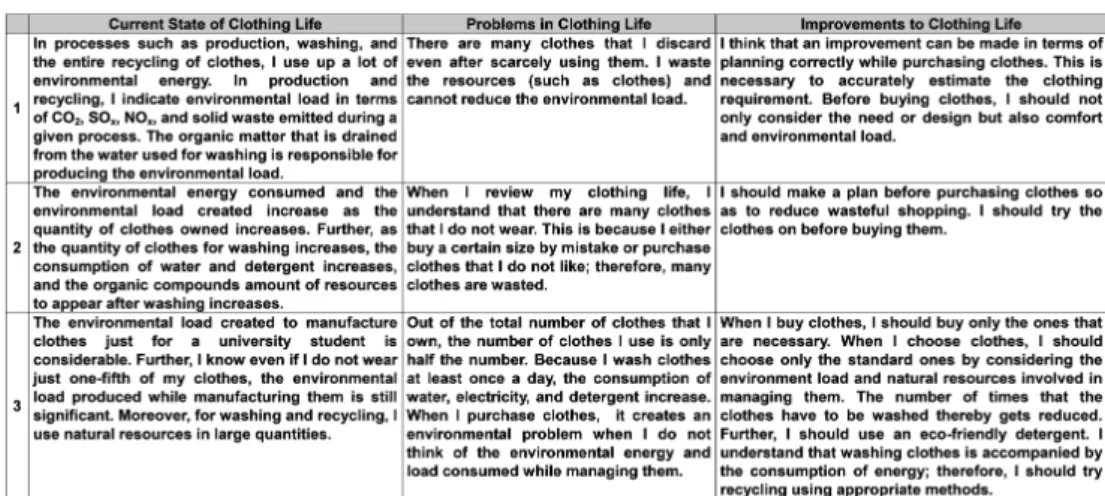
Table 3 shows as examples of their responses about the results of analysis items 1-10: (1) “the current state of your clothing life,” (2) “problems in your wardrobe management,” and (3) “improvements to your clothing life”.
(1) The current state of your clothing life (Analysis item 11)
Understanding how much clothing they owned enabled them to gain a quantitative grasp on the energy consumption and environmental burden of their clothing. They were able to comprehend the idea that their clothing lives consume energy and have a burden on the environment.
(2) Identifying problems in your wardrobe management (Analysis item 12)
In terms of problems in their clothing lives, they realized that they were not managing their wardrobes effectively and recognized that the excess ownership of clothing is a problem, which stems from decision making at the point of purchase. 9 university students had consciousness of owning excessive clothing, and 12 did not have such consciousness. One of the problems was to buy and consume with no plan. It is one of the problems that they buy and consume their clothing with no plan.
(3) Improvements of your clothing life (Analysis item 13)
Table 3 is the descriptions in their worksheets (worksheets No.1, 7 and 10). In order to improve on the problems they discovered, they identified improvement strategies as they recognized the need for a “clothing plan” and the need manage the clothing that they purchase or acquire. In addition, they recognized a need for this kind of inventory analysis in their clothing lives.
4.Discussion
4. 1.An inspection of the LCI worksheets
In LCI, it is important that individual terms and conditions are shown. I think that the following points need to be improved in the LCI worksheets: (1) Total Weight of Clothing (Analysis items: 1-6): An item for the composing fiber of each garment (Table 1), and the weight of each garment sizes and genders (Reference Material 1 in page 1). (2) Manufacturing (Analysis items: 7-8): Background data for each garment (Table 4). (3) Washing (Analysis item: 9): Background data of each the specifications of the washing machine and detergent and dry cleaning (Table 7). (4) Disposal (Analysis item: 10): Choice of recycle by consumers (Table 9).
Table 3.University students’ Responses (LCI worksheets: page.4)
4. 2.Change in a Decision Making: Result of AHP Test
I investigated their decision-making after carrying out LCI by AHP Testing. The degree of weight placed on (1) resources/environment, (2) quality, (3) comfort, and (4) design when selecting clothing items was examined. The results obtained before and after the LCI are shown in Fig. 4-a. Before the LCI, the weight of emphasis on design was high at 0.435 whereas and resources /environments was 0.084. After the LCI, resources/environments more than doubled to 0.178 whereas design and comfort decreased. The results of the LCI task were found to have been reflected in their subsequent decision making. In the LCI, they were divided into two groups, those who were aware of owning too many clothes (9 university students) and those who were unaware (12 university students). The results are shown in Fig. 4-b. The “awareness” group placed a higher weight in resources/environments. The “unawareness” group placed a higher weight like 0.417 or 0.299 in design both before and after the LCI. The “unawareness” group had showed a lower average value in resources/environments. However, resources/environments did increase to 0.220 from 0.148 after the LCI. These findings suggest that the results of their LCI were to some degree reflected in the decision making situation.
4. 3.Condition of Foreground Data in the LCI
A personal foreground data (FD) actually takes many time and needs the efforts to inventory. Is it useful of the LCI even if it uses model FD instead of personal FD? The results of group1 (the experimental group) were used as the model FD for group 2 (the control group). The results of having compared two groups are the following: (1), (2) and (3). (1) Description: Group 2
The experimental group’s understanding regarding their owned clothing enabled them to gain a quantitative grasp on the energy consumption and environmental burden of their clothing. In terms of their clothing lives, they realised that their wardrobe-management was ineffective, and they recognised that owning excessive clothing was a problem, which depended on their decision-making at purchasing (Table 3). On the other, the control group could not recognize their mismanagement (Table 4, worksheet No.1, 2 and 3). Therefore, the problems only included their purchasing failure. They did not result in the fundamental resolution.
Fig. 4-a. The weight of the evaluation criteria; AHP (Experimental group, n=21)
Fig. 4-b. Difference in the weight by having awareness or unaware of the excessive of clothes; AHP Post test (Experimental group, n=21)
(2) Results of AHP test: Group 2
The control group is different from the experimental group in an attribute as showed in 2.3(2), p.5. The control group worked on the worksheets using a result of the experimental group. A significant difference was recognized in design, quality, resource and environmental impact (Fig. 5, t-test, p<0.05). Although the weight on resource and environment impacts is high in the control group, the remedial measures indicated by the consideration results were insufficient to recognize suppression of occurrence (like a suppression
Fig. 5. The weihgt of the evaluation criteria; AHP (Control group, n=12)
of purchase), and it was expected that intrinsic improvement would be difficult. (3) Condition of FD: Group 2
The LCI should use a personal FD. The model FD was difficult to derive a remedy from causation. In order to improve to a sustainable clothing life, it is essential for the consumers to quantitatively analyze the actual condition of their clothing lives and to extract problems. The LCI was effective for improving their clothing lives, but it was revealed that it was an absolute requirement to use personal FD.
5.Examination of utilizing the LCI worksheets in ESD lessons
Potentially, the LCI has a wider applicability for informing consumers about their consumption patterns, enhancing their awareness of the environmental consideration and advancing efforts to promote a more sustainable society. The LCI was effective for improving their clothing lives, but it was revealed that it was an absolute requirement to use personal FD. However, the following two are required in order to utilize it in ESD lessons: (1) and (2).
(1) Simplification and reconfiguration of the LCI worksheets
First, it is necessary to secure the time period for investigating the number of the clothing which they own. The summer vacation may be sufficient as it. Next, it is required to simplify the calculation: Analysis items 1-10. It is better to reduce their effort and time for the calculation. Moreover, it is necessary to refer to the argument on 4-1. The university students of the experimental group thought, “LCI was difficult though it was good to have done LCI”. The reason was two of following; (1) taking much time for “the clothes investigation”, (2) complicated and many calculations. The university students worked on the worksheets in 180 minutes, but it is difficult for high school students to have a further lesson time. Therefore, I judged that the simplification of the worksheet is necessary.
(2) Development of educational contents for the LCI in ESD lessons
In the ESD lessons, it is required for students to grasp the current status of their clothing living. I prepare the educational contents for students to consider their sustainable living. After systematizing the whole learning of clothing living from the viewpoint of ESD, I construct the educational contents: 1. Clothing is resources, and the resources are limited on the earth. We should think about how to save energy consumed and resources and protection of our environment by our daily activities. 2. Clothing is
accompanied with the energy consumption and environmental impacts in all the processes of production, maintenance, and recycles. 3. It is important to consider environment and sustainability in our clothing life. We should think over owning too many garments in our lifestyle. 4. It is possible to decrease superfluous owning of clothing by individual consideration. 5. For the purpose, clothing should be purchased and maintained and consumed with a total plan.
In order that students may acquire these 1-5, students utilize the LCI worksheets as means to analyze. The next challenge develops an ESD lesson. This study would be continued.
Reference
1.Relevant ministries and agencies Liaison Conference, “Japan’s Action Plan for the UNDESD drafted”, 2006.
2.Ministry of the Environment, “Basic Act on Establishing a Sound Material-Cycle Society”, 2001.
3.Ministry of the Environment, “Act on the Promotion of Effective Utilization of Resources”, 2001.
4.Ministry of the Environment, “Waste Management and Public Cleansing Act”, 2010. 5.Ministry of Economy, Trade and Industry, “Report of 3R System for Textiles, 2011. 6.The Japan Institute of Energy, “Lecture Note: Life Cycle Assessment (LCA)”, p.1 and
29, 2006.
7.Ministry of Economy, Trade and Industry, “LCA Report of Textiles and Apparels”, p.15, 2003.
8.Ministry of the Environment, “Seikatu haisui dokuhon”, http://www.env.go.jp/water/ seikatsu/, (accessed October 25, 2017).
9.Thomas L. Saaty, European J. of Operational Research, 48, p.9-26, 1990. Note
1.Clothes is the things that you wear, such as shirts, jackets, dresses, and trousers. Clothing is more formal than clothes and is used especially to mean ‘a particular type of clothes. Garment (formal) is a piece of clothing. These are all quotations from “OXFORD Leaner’s THESAURUS, A dictionary of synonyms, p.111, 2012”.
Acknowledgement
This work was supported by JSPS KAKENHI Grant Number JP15K04438.