The Residential Groups of the Mbuti Pygmies
著者(英) Mituo Ichikawa
journal or
publication title
Senri Ethnological Studies
volume 1
page range 131‑188
year 1979‑02‑10
URL http://doi.org/10.15021/00003484
SENRI ETHNoLoGIcAL STuDIEs 1 1978 131
The Residential Groups of the Mbuti Pygmies
MITSUO ICHIKAWA
K),oto Uitiversity
The residential groups of the Mbuti Pygmies are described and analyzed, based on the data obtained during field research in the Ituri Forest, eastern Za'i're, from 1974 to 1975. The main points discussed here are the composition of
the band, and the mechanism of band integration. "
There are two contrastive views about the band composition of the Mbuti people who live in the forest. According to Putnam [1948], the Mbuti band ideally consists of family groups descended through the male line from a common ancestor. On the other hand, Tumbull [1965b], who studied in the same area (Epulu) as Putnam, stated that the band was plainly a nonlineal entity and exhibited the largest complexity.
The view presented here agrees with that of Putnam in that among the Mbuti of the Tetri area, which lies 100 km southeast of Epulu village, a patrilineally related male group forms the core of the band composition, and going beyond Putnam's work, the Mbuti band of this area, while having a fairly stable membership in appearance, repeats fission and fusion over a long interval of several decades. The essential feature of the Mbuti band seems.
to lie in this dynamic aspect, in which a patrilineally related group splits into segments and/or joins similar groups of a different band, to merge into a new band. The fission and fusion of the band cause reorganization of neighbor‑
jng groups and facilitate smooth intramaniage within neighboring groups, to which the Mbuti show a strong tendency.
The mechanism of integration of the Mbuti band is the second point discussed here. A strong tie between adult males is observed both in the socio‑political and religious aspects of Mbuti life. It is this male bond that integrates a group of ego‑centric families into a band as an integrated whole. This mechanism must be of the most elementary kind fbr integrating a small group, since it does not presuppose differentiation of status and centralization of authority.
1. ECOLOGICALBACKGROUND
The Ituri Forest is situated in the northeast of the Republic of Zaire, between O‑40N and 26‑310E. Since Ituri is located on the eastern. fringe of the Congo Basin tropical rain forest, at an altitude of 600‑1,OOO m, it offers a favorable environment fbr humans, compared to the other parts of the Congo Basin. The primary forest reaches an average height of 30‑40 m, but the undergrowth is sparse, which makes walking easy, and the luxuriant growth of the trees overhead blocks the intense rays of the sun. During the main rainy season, which lasts approximately from August
132 M. IcHIKAWA
Ishiro
・<ez({tze7.
fZkg.
Nia‑ni E ulu
b
N
o
Mamba
Bafwasende eg4}?iiil!llll[( eRIVer
‑
Beni ,
Butenbo Bunia
Nite ‑6Zv.
(bj>sl;.
loo
s:Tetri
200km Figure 1.
Lake IZ4bbutu 5lese 5Vko
(<ilil71ctil・aA??emlh
o b
tw
Ituri forest
.
"
Approximate location of the Tetri area including the Ituri fbrest.
L
until November, Ituri is hit by daily squalls, but at the peak of the dry season (from January to February), there may commonly be no rain for an entire month. The forest then becomes dry, trees shed leaves, and dry leaves crackle underfoot.
The vegetation of the Ituri Forest has been classified as [ITANi 1974; HARAKo 1976]:
1) primary forest
(i) C)2nometra forest (ii) Brachystegia forest (iii) Githertioclendion forest 2) swamp or marsh fbrest 3) secondary forest
Secondary forest surrounds the villages of the agriculturalists and the sites of former settlements or campsites for some 5‑6 km, and scattered swamp fbrest occurs ip marshy areas along the course of the larger rivers. Secondary forest and swamp forest together comprise somewhat less than 20 percent of the area of the Ituri Forest.
The remaining 80 percent (about 80,OOO km2) comprises the 3 types of climax or primary forests.
It has been estimated that about 60,OOO slash‑and‑burn agriculturalists and 40,OOO Mbuti hunters inhabit the Ituri Forest [TuRNBuLL 1972]. The range of daily activity of the farming people is generally confined to the secondary forest around the settlements, whereas the Mbuti hunters use the primary forest which lies
The Residential Groups of the Mbuti Pygmies 133 beyond. The Mbuti are said to go "everywhere," an indication of how much they use the forest. Of the 100,OOO km2 comprising the Ituri Forest, none is "impene‑・
trable forest" for the Mbuti, nor can any of it be considered "untouched."
The present study was carried out in the Tetri region, where there are nine bands or 592 Mbuti, who utilize an area of some 1,200 km2. The population density of the region is O.5 lkm2, which is equal to the average population density of the Mbuti in the entire Ituri Forest. This roughly equals the O.4‑O.5 lkm2 which Tanno calculated using estimations of the size of a band and its territory [TANNo 1976].
The annual cycle of Mbuti subsistence activities can be divided into three periods [IcHiKAwA 1977a]. The first coincides with the main rainy season (August to Novem‑
ber), at which time they stay in a camp (hereafter referred to as "base camp") close to the farming village and assist the villagers in agricultural activities, obtaining their fbod from the farmers. Little hunting is undertaken apart from occasional excur‑ ' sions, ofa few days duration, into the forest. Monkeys are also shot near the village.
The second period begins in December, with the start of the dry season, Which lasts from January to March. This is the best hunting season. At this time, the Mbuti move to hunting camps in the forest and engage in net hunting almost every day.
Since they subsist on the game caught in nets, or on the agricultural products for which it is exchanged, this period marks the Mbuti's most active season. The third period begins in the latter half of the hunting season and is called "the honey season."
It lasts fbr a month or two between April and July, during the minor rainy season, when the three main tree species of the climax fbrest come into bloom. While many bands continue to engage in net hunting at this time, subsistence activities for the most part consist of honey collecting; honey is the major source of fbod during this period. This is the time of the year when the Mbuti are least dependent on agri‑
cultural products as a source of food.
As the subsistence activities change with the passage of the seasons, so the social lives of the Mbuti also undergo change. Change can be seen in the construction of the camps fbr each season. In daily activities, such as singing and dancing, the influence of the change of seasons is clearly reflected. When they are in their base camp near the village, for example, the Mbuti amuse themselves nearly every night by playing bamboo flutes (luma) and by perfbrming the song and dance called kaduma.
But when the hunting season begins, they go into the forest leaving their luma and drums behind in the base camp. At their hunting camps the Mbuti chiefly sing about kaya (net hunting) or butuma (spear hunting). During the honey season, using wooden clappers (mbombo) they sing the honey song, boki.
The Mbuti hunt with spears, bows and arrows, and nets. Spear hunting is carried on by severai men or sometimes by lone hunters, fbr such big game as eleph‑
ant, buffalo, and the giant fbrest hog. Ten to twenty men and women participate and collaborate in net hunting, the chief catch of which is the several species of forest duikers. Bow and arrow hunting is not widespread among the Mbuti in the Tetri region, who are primarily net hunters. During the main rainy season, bows and
134 M. IcHIKAWA poisoned arrows are mostly used to shoot moonkeys inhabiting the secondary forest that surrounds the base camp.
The Ituri Pygmies are renowned big game hunters. But for them hunting is not simply a matter ofjust anyone going after game with spears. For an elephant hunt, there exist in each band at most two or three "specialists." From the viewpoint of subsistence, the high level of stability afforded by net hunting makes it of greater importance to the Mbuti than spear hunting [IcHiKAwA 1976].
It is difficult to estimate the population density of animals in the dense forest, but the fbllowing calculation was made from the several species of forest duikers that are the principal game taken by net hunting. Animals that have been encircled by nets are chased outwards and they run and become entangled in the nets (Figure 2).
They are never driven toward the nets from any great distance. Also, hunting grounds are chosen randomly. Consequently, an observer who witness many in‑
stances of net hunting can estimate the average number of animals captured in a single attempt, and from this calculate an approximate overall population density.
In January 1975 the following calculation was made based on a total of 170 attempts at net hunting in 3 different hunting camps. The total gross weight of game taken was 805 kg, or an average of 4.7 kg per attempt. A total of 10 nets was used, with a fu11 length of 550 m, which enclosed an area of O.03 km2.
Encircled animals, in particular the larger ones, often easily tear through or slip out from under the nets, or they escape through the opening between the wing‑end
A A
A
l
/
‑ z
1
N,(1., z
/
1
1 /
1
oolt tl l l l
1
/
'
oo lt ll
ll ll
lllt ltl
l lX
ltl N
ooIN(Nl,Nl 4X
N
NN
N l・
K
Nsi E:× /‑ /‑
NN
NN.kl‑ //
ry
40
Maies A (5 Femates
ll ll
Figure 2.
NN
4
Net hunting method.
Hunting net
The Residential Groups of the Mbuti Pygmies 135 nets (mulu). Only 30‑40 percent of the animals trapped in the net enclosure are finally captured. Considering this complication, an estimated 300‑500kglkm2 of game can be taken, or the equivalent of 70‑120 head of blue duikers (Cephalophus monticola), the most sought after species. Apart from the game hunted in nets, there are birds, monkeys, and larger mammals‑fbr example, elephants, buffaloes, okapis, giant forest hogs‑that are sometimes taken in the area.
The Mbuti hunt a wide variety of species; for example, just of mammals, there are 14 species of Artiodactyla, 9 Carnivora, 14 Primates, 6 Rodentia, 2 Insectivora, 2 Pholidota, and also 1 species each of Tubulidentata, Hyracoidea, and Proboscidea, making a total of 50 species that have been observed as the objects of their hunting [HARAKo 1976; TANNo 1976; IcHiKAwA 1976]. The fauna of the Ituri Forest is generally thought to be quite abundant. Statistical data were collected on the number of animals caught in nets during the period of January to February 1975, according to which a day's catch averages 5 or 6 animals, together totaling about 35 kg.
Thanks to the abundance of game in the fbrest, the Mbuti eajoy stable hunting, giving their subsistence a reasonably secure base.
Agricultural products make up most of the vegetable portion of the diet of the Mbuti, whereas wild plants are relatively unimportant. But, just the range of wild plants so far identified as included in the Mbuti's diet is quite extensive‑10 species of roots, 15 nuts, 17 berries, and 18 mushrooms‑suggesting that these wild plants were of greater importance in the past and that if necessary the Mbuti could survive on them.
2. THE MBUTI AND VILLAGERS
Agriculturalists' villages and Mbuti base camps in the area between Mambasa, the administrative ,center, and Laria, about 72 km distant, are shown in Figure 3.
Mbuti base camps are set up near the villages with which they maintain a close re‑
lationship. The close relationship between the agriculturalists and the Mbuti is demonstrated by the fact that Mbuti base camps exist only where there are agricul‑
tural settlements.
The Mbuti depend on agricultural products for more than half of their diet, but only rarely do they plow their own fields and grow crops. Even when Mbuti engage in agriculture, they leave the fields unguarded and go into the fbrest for the hunting season. As a consequence animals freely enter the fields and destroy the standing crops. When in base camps, the Mbuti go to neighboring fields and help with culti‑
vation, thus obtaining agricultural products for themselves. There is nothing they dislike more than a land without farmers ; a "hungry land" (kuma la nja).
It is thought that the original connection between the Mbuti and the farming people was based on food. When the Mbuti who inhabited the Ituri Forest in former times saw the cultivated fields of the Bira and Lese peoples‑‑‑‑groups came into the region later‑they likely thought that it was a place where food existed every‑
where and in abundance;a "forest of everlasting food," In exhcange for supplying
136 M. IcHIKAWA
Figure 3.
Mombasa(Okm) on
e
e
1 e e‑Ei!lil!EE!i!iE3
lturiRiver a
ki e e 1 e ‑ af
e t g
e :
(,i,ai:i9)l
oa
A Amapakpakpa (15km>
AO Tbkoleko (20km) a Mbela (23 km)
oA So me (28 km) o Maiyani Ao Bango (56km) Dar‑es‑‑salaam o Mahuaka D Tabia 8 Tetri (45 k'm)
o Mawambo
g Kalonge o Apekele o Sayu (52km) o Maulo(56 km) oO Kenia oo Butcha(61km) A
8 Konbokonbo ao
tu
a.o
i BaMbuti o BaBira o BaNandi A BaBudu & Others
Distribution of the Mbuti bands and villagers' settlements.
the Mbuti with agricultural products, these farmers probably expected 'manpower, or meat from animals hunted in the fbrest, Metal and the art ofmaking hunting nets, which. these farmers brought in, must have improved the eMciency of the Mbuti's hunting. The Mbuti's dislike of areas where there are no farming people does not mean that they themselves are "villagers‑like." They do not perform independent farm work or establish their own agricultural settlements because for centuries they have maintained a symbiotic relationship with the agriculturalists and have retained their hunting spirit.
This interdependent relationship between the Mbuti and the agriculturalists is also clearly seen in other aspects of social life, such as, in the influence of the villagers' social and ritual systems on the underdeveloped Mbuti, and in the knowledge which the villagers obtain from the Mbuti of the forest's flora and fauna. The import of this connection with neighboring agriculturalists over a period of several hundred
The Residential Groups of the Mbuti Pygmies 137 years・cannot be ignored when considering Mbuti social life.
It is not intended, in discussing the Mbuti group's social structure and marriage system, to suggest that these are proper to the Mbuti or of Mbuti origin. Here they are only extracted, described and analyzed as obviously important social phenomena functioning at the present time. For the synchronic study of social phenomena, the question of "origin"‑that is, whether an element was borrowed from another society or not‑is of secondary importance. Rather, the issue is how that element is inte‑
grated and how it functions within a particular social system.
The Mbuti of the Tetri region have traditionally had a close relationship with the Bira farmers of Bantu stock and they themselves speak Kibira (the language of the Bira). Each Mbuti band is connected to a specific Bira settlement and a'Mbuti band commonly takes the name of a Bira village, such as Bambutii) Mawambo (Mbuti of Mawambo village), or the name of the most influential village elder, such as Bambuti Akabisenge (Mbuti of Akabisenge). The Mbuti themselves choose the names of their own bands (usually taken from the name of the place where their base camp is located) but these names are used only among several Mbuti groups in the neigh‑
borhood,
While this intergroup relation exists between a band and a village, relationships between individual Biras and Mbutis are formed within the intergroup relationship.
Each Mbuti establishes an individual relationship with a specific villager called kpara or kparamo (my kpara), and, in the opinion of the Bira, this kind of individual re‑
lationship is handed down from generation to generation. The individual relation‑
ships between the Bira and the Mbuti in Mawambo village is shown in Figure 4.
(Refer to Figure 6 fbr the composition of the Mbuti of Mawambo band.)
But in reality, as Turnbull [1965b] has stated, when the Mbuti's position becomes disadvantageous or when acute discord arises, they dissolve the established relation‑
ship and move to the place of another kpara. Especially now that a trade economy has spread among the Mbuti and the neighboring society, there has recently been an increase in the number of the Mbuti bringing meat to the Nandi (Banande tribe in Murdock [1959]), who have a highly developed economic sense and offer stable trade.
From 1974 to 1975, the exchange rate of meat fbr agricultural products and other items were as follows: (The "unit" ofexchange is "one head" of blue duiker including the four limbs and the trunk, or one leg of a medium‑sized duiker2)‑former averaging 2.5‑3 kg; the latter about 2 kg.)
(1) When brought to a villager for exchange, one unit of meat is exchanged for 15 kg of cassava, or 2 kg of rice or refined cassava flour, or 30 makuta in cash (approximately 150 yen), but a length (about 1.5 m) of women's loin cloth (kikuenbe) equals four units of meat (that is four blue duikers or one medium‑
sized duiker) ;
1) Bambuti is with the prefix (Ba‑) to indicate plural.
2) Medium‑sized duikers are Cephaiophus nigrij}'ons, C. dorsalis, C. Ieucogaster, C. caUipMgus and C. sylvicultor.
138 M. IcHIKAWA
‑.b‑‑‑‑‑‑‑‑‑."e.a‑b,u‑m‑bg‑‑‑‑‑
t
es4
ll
5
2
6 7 8
5
9 10
{Villager :
Mbuti
Figure 4.
1
1A5,7 254 lll .‑"'h r"h 2,8 none i,ll
Ae‑dead
X × ‑ absent 5
l 10
6 l
4
7 l
.‑‑‑‑A‑‑‑N
12 l3
'
8I 14
9 l 6
10 l 3
ll
I
9
Relationships between the Mbuti and the villagers, an example of Mawambo village (see also Figure 6e).
(2) When exchanged in the hunting camp, the same weight of meat was 20 makuta (100 yen), or 1‑1.5 kg of rice or cassava flour, but a length of women's loin cloth equalled five units of meat. The greater the distance between the hunting camp and the village, the more disadvantageous becomes the exchange rate for the Mbuti.
3. SIZE AND COMPOSITION OF THE BANDS
1) SIZE' OF THE BANDS ' ' N
The band size of the Mbuti in the Tetri region, as shown in Table 1, fa11s within the range of from 10 to 25 families, or from 47 to 94 people. In other areas, the Lolwa net hunting band is composed of 12 families [HARAKo 1976]. Other research shows that the Njiakia hunting group was composed of 9 families; the Biasiku of 9;
and 12 families were active in the Laria hunting group. As is discussed in detail below, the size of a hunting group that is composed of a single band is generally slightly smaller than' the mother band, and it is thought that the size of the mother band also ranges from 10 to 25 families.
For archer bands, Harako [1976] reports a band of 15 families in. the Lolwa area.
In May 1975, the huts in the base camps of the Mbuti living near Lese village at Andiri, 25 km northeast of Nduye, were studied, It was found that the Ativu's camp had
The Residential Groups of the Mbuti Pygmies 139 13 huts, the Asani's 14, the Mustafa's 10, the Likenbe's 13, and the Ndelendele's 10.
All were set up in the fbrest, only 5‑10 minutes from the village of Andiri. From here, the Mbuti go forth, sometimes to engage in cooperative bow and arrow hunting, or sometimes to hunt individually with bows or spears.
If the number of huts is accepted as representing the number of families in the bow hunting band, then there is no great disparity between the size of the bow hunting band and that of the net hunting band in the Tetri area. Turnbull [1968] states that when the honey season begins, the Mbuti archers, previously in small groups, con‑
gregate and make a large camp. The present study of Andiri was done during the rest period in the honey collecting seasons, that is, between March‑April, when Ctvnometra blooms, and June, vvhen Brachystegia flowers. But it was found that those living together were roughly the same groups as those formed fbr collecting honey.
When Harako [1976] and Turnbull [1965b] compared the band sizes of archers and net hunters, they noted that the fOrmer was generally smaller. Since a small number of archers can hunt, a small band consisting of two or three families might subsist. But to lead a secure life, where hunting with bow and arrow is the principal method employed, a band of ten or so families, among which food distribution takes place, must be formed. Within that range, cooperative bow and arrow hunting (mota) can be performed effectively.
For the net hunters, a band size of from 10 to 25 families is closely connected with the hunting method employed. This corresponds roughly to the number of nets possessed by married men and some women. It is difficult for them to maintain their livelihood with fewer than six nets, and if there are too many, close cooperation, which is indispensable in net hunting, will suffer.
A band is the mother body for a hunting group as well as the base camp's re‑
sidence group, which is their autonomous societal unit. It is important for a band to have a generally stable integration. As is discussed below, in the long run both Tablel. Bandsize.
Band M. Married F. Unmarried
M. F. Total
Mahuaka
Tabia Tetri
Bujumbra
Mawambo
Kalonge Apekele‑1 Apekele‑2 Sayu
14 13 17 14 14 10 13 25 12
18 14 18 16 17 15 16 24 12
25
ca25
24 14 18 12 14
ca25
14
22
ca20
18 9 18 10 l2
ca20
10
79
ca72
77 53 67 47 55
ca94
48
Total Average
132 14. 7
150 16. 7'
ca171 19. 0
ca139 15. 4
ca592 65. 8
140 M. IcHIKAWA fission and fusion can be seen in their bands, but unlike the reports of Tanaka [1971]
and Lee [1969] on the Bushmen of the Kalahari, the phase of fission and fusion is not repeated many times within a short time.
From August 1974 to July 1975, a continuous investigation of nine bands was conducted, but during this period there was never a major change in the size of a band.
During the hunting and honey seasons, several small camps were set up and then modified, but this was not a real change in the band's composition. As Service [1971] has pointed out, as long as the individual members have a sense of belonging to a particular band it is unnecessary for a band to be always fbrmed into a fixed residential unit.
2) AGE AND SEX COMPOSITION OF THE POPULATION, FAMILY AND EFFECTIVE POPULA‑
TION RATIOS
The Mbuti are classified by infe,rred age as well as social role into four age groups, as fbllows:
(1) Infants andjuveniles (O‑about 12 years)
A nursing baby (mikilimakalungo), a young boy (apaloko), and a young girl (amasika) are called miki (child). This group depends on its parents for support, but when boys and girls reach the age of about 11 or 12, they begin to take part in net hunting, fi11ing an auxiliary role. There are many food restrictions, particularly on the parents of a nursing child who are told that if they break the restrictions, the child will become gravely ill [IcHiKAwA 1977b.]
(2) Youth (about 13‑17 years)
Within this age group, a boy is called kota and a girl sika. When the rites of passage have been completed‑fbr boys, ganja (circumcision), and fbr girls, elima‑‑‑
they are considered to have entered young adulthood. Although as yet they do not have their own huts or nets and they continue to live with their parents, youths per‑
form active role during net hunting. Prior to marriage, youths neither possess their own nets nor go spear hunting and they are not recognized as fu11 adults. For a year after having undergone rites of passage, youths are subject to many fbod restrictions,
which are later gradually lifted.
(3) Adults (about 18‑40 years)
Married and living independently in their own huts, they possess their own nets and are recognized as fu11 adults. They collect honey and those who are able take part in spear hunting. Almost all of the food restrictions have been eliminated.
Adult males take part in the molimo ceremony, in which only fu11‑grown males may partlclpate,
(4) Old age (about 40 years and over)
It is diMcult to clearly establish the time when a person enters old age, but as grandchildren are born and the bodies begin to weaken, people are called makpe or mangese (old people), and tend to stay in the camp. Although still participants in net hunting, they hand over their nets to the youths and increasingly remain behind in camp, making nets and repairing spears, Old people are no longer subject to the
The Residential Groups of the Mbuti Pygmies 141 Table2. Compositionofband.
Band OId Adult Young Infant Totai Family Effectives
size ratio*
Tetri
Mawambo
Kalonge
Apekele‑1
Apekele‑2
Sayu
Mahuaka
M.
F.
T.
M,
F.
T.
M.
F.
T.
M.
F, T.
M.
F.
T.
M,
F.
T.
M.
F.
T.
3 4 7 o 2 2 3 5 8 5 7 12 4 3 7 1 1 2 3 5 8
14 14 28 14 15 29 7 10 17 8 9 17 21 21 42 11 11 22 il 13'
24
7 7 14 2 4 6 6 4 10 7 6 13 7 6 13 2 2 4 8 3 11
17 11 28 16 14 30 6 6 12 7 6 13
ca18 ca14
32 12 8 20 17 19 36
41 36 77 32 35 67 22 25 47 27 28 55 50 op 94 26 22 48 39 co 79
4. 3
4. 8
4. 7
4. 2
3.8
4. 0
5. 6
54. 5
52. 5
57. 4
54. 4
58. 5
54. 2
".3
* Effectives Ratio=
[Lee 1969]
Adult+Young
Total population × 100
1
food restrictions of other age groups. Now they may eat embulu (flying squirrels), . amepulu (otter shrews), and other animals considered "meat for the old", which only old people are permitted to eat.
It is the adults and the youth (the "effective population") who perform the active roles in hunting and collecting, which maintain their subsistence, and children and old (the "dependent population") live a dependent existence. The age group composition of seven bands in the Tetri region is shown in Table 2. For each band, the average family and eflbctive population ratio are given. In the seven bands, the average family consists of 4.5 people, and among the Mbuti the greatest number of families appear to have fbur or five individuals. The malelfemale sex ratio is 303 : 289=1.05 : 1.00‑there being relatively more males than females.
r
142 M. IcHIKAWA
4. PRINCIPLES OF BAND RECRUITMENT 1) MARRIAGE
The results of a survey of the marriage patterns of the 132 married males in the Tetri region were: 11l monogamous, 18 polygamous‑16 had two wives and 2 had three or more wives, 2 widowers, and 1 divorced. Monogamy is the dominant pattern among the Mbuti of the Tetri region. Polygamy is approved as a rule, but it is only possible for those who can pay the necessary bride price for second or more wives, or for those who have sisters for the sister exchange marriage.
The Mbuti approve of levirate marriage (esikili), where a widow marries her dead husband's brother. When a man dies, his wife either returns to her natal band or marries one of her husband's brothers. If there is no one in her husband's band to look after her, she leaves her children in her husband's band and return to the natal band. Children remain in the husband's band because, as a rule, they are considered as belonging to the band of their father. In the 18 polygamous unions, five'men acquired second wives by levirate marriage. But there are exceptions to this rule.
When a wife is too old, she commonly remains in her husband's band, and is looked after by her adult children. And where the children are still young, the wife sometimes returns with them to her own band. As a rule children are regarded as belonging to the father's band; nevertheless, within Mbuti society it is not rare for them to be made members of their mother's band.
Mbuti consider a proper marriage to be one accompanied by some kind of com‑
pensation. Nowadays, cash compensation is not unusual, but what is often pre‑
ferred is for the person involved in the marriage to exchange sisters, in an exchange marriage (kusono). Before the development of a cash economy, it is said that among the Bira people also kusono was the general fbrm.
The Mbuti bride price (kasya) is 5 zaire (or about 2,500 yen)3). They obtain this money by selling meat, but for a people who quickly spend any money which falls into their hands, 5 zaire is a substantial sum. Only a very small minority of Mbuti pay the bride price in full, Generally they give the wife's relatives 1‑2 zaire when they marry, and they fritter away the rest. Bride price is generally paid even in levirate marriage, but only to the extent of O.5 zaire.
Sister exchange marriage (kusono) usually involves an exchange of the sisters of the parties concerned. When there is not suitable sister, a brother's daughter, a pa・rallel cousin or some more distant female relative living in the same band will be chosen as the exchange bride instead. The range within which a fiemale relative will become the object of an exchange marriage varies according to the strength of the kin group unity. Even the daughter of a fairly distant relative may become the object if the ties between members of the same band are strong.
There are also examples of taking brides by fbrce to one's own band, with neither sister exchange nor payment of the bride price (terya). In the Tetri region the 3) A Bira bride price is 3040 zaire.
The Residential Groups of the Mbuti Pygmies 143 couple involved in ter va rarely escape beyond the reach of the woman's parents.
71ei va occurs when the partjes do not first come to an agreement about the bride price or when the bride's father wishes for a kusono. In such a case relatives of the bride later go to the groom's band, and receive the bride price or at least a part of it. In this way the marriage is legitimized.
When Mbuti men reach the marriageable age of about 16 to 20, either individual‑
ly or in a group they visit neighboring bands. They visit neighboring areas where they can take advantage of their relatives',connections. Some go as far as to Mambasa, 50 km away, or even to Koki and Bahaha which are further from home.
When they find a suitable woman, the men immediately return home to begin discus‑
sions with their fathers. A formal marriage is arranged between the relatives of the man and the woman. The man chooses a marriage partner but realization of the marriage is the responsibility of the fathers and brothers of the two people involved.
When the marriage has been decided upon, the groom's father and brothers pay part of the bride price.
2) RESIDENCERULES
After marriage the couple establishes a virilocal residence. Most marriages in Tetri are virilocal. A survey of 132 rriarried couples showed that 122 were virilocal, 9 were uxorilocal, and one couple did not fit either pattern, being temporary visitors who returned to their band soon after the survey was completed.
However, where neither a bride price has been paid nor an exchange of sisters has taken place, the husband has to remain with his wife's band. Only when the wife's band has consented to allow the husband to pay the bride price, or a part of it, to his wife's parents, is he free to take his wife and children back to his own band.
Apart from this obligatory uxorilocal marriage, some men choose to live in their wives' homes. Even intentionally uxorilocal marriages, regardless of how clear the case is, a husband does not like to admit that he is living in his wife's band. Rather, the man takes the name ofhis own distant male relative living in the wife's band and usually says that he has come to live with the relative. The kinship terminology of the Mbuti in Kibira (the Bira language) has the peculiar characteristic of reduction rules, which apply kinship terminology over a wide range, so that often there is some man who will fa11 under the term epa (father) or noko (mother's brother) within that band (see appendix).
A special characteristic of Mbuti society with respect to these uxorilocal marriages, which are exceptions to the rule, is that such a residence pattern is the result of a personal decision to which the other members of the band do not raise an objection. Although the rule is virilocal marriages, uxorilocal marriages are possible.
Mbuti men prefer virilocal marriages because they wish to continue living with the close ties that they have with their own male relatives, rather than living among outsiders.
3) BIRTH AND MEMBERSHIP IN THE DESCENT GROUP AND THE BAND
In Tetri, the eight women past menopause had given birth to an average of eight
144 M. ICHIKAWA children. But, because of the small sample size, it cannot be concluded that this is the average for the Mbuti as a whole. Since the Mbuti, in common with the Bira and the neighboring agricultural people, avoid sexual intercourse for a year or two after a child is born, it is thought that the actual average number of births is approx‑
imately ten. Infant mortality is high immediately after birth, or when the infants are nursing. Of the 54 births recorded in the Mawambo band, 18 of the children died before weaning. For Mbuti children, the nursing period is critical, which is refiected in the strict observance of food restrictions by the parents [IcHiKAwA 1977b].
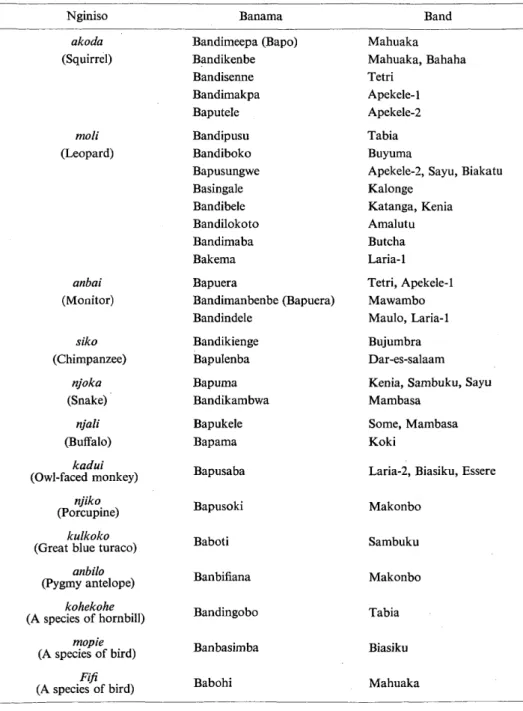
In Mbuti society, as among the Bira, a patrilineal descent group (banama) exists.
Full banama members can neither kill nor eat specific animals (nginiso), they take part in the ceremony (molimo) fbr the common spiritual animals, and as a group they possess a common sign (ekonbi). The molimo is a ceremony restrjcted to adult males, and it also means a spiritual animal (baketi) which is the object of the ceremony.
Ekonbi i's a sign used when they walk in the forest. It is worked on a leaf of the bulu plant (Marantaceae) and symbolizes an animal of their own nginiso. When a child is born, as a rule it fo11ows its biological father to become a member of the banama.
However, if when still nursing it is looked after by its mother's relatives, the child becomes a member of the maternal banama, and inherits the maternal nginiso.
The band to which a child belongs depends on the legitimacy of its parents' marriage. If the marriage is proper, with either a bride price paid, or an exchange of sisters, then the child belongs tO the father's band. A father who has chosen to live in his wife's band can at any time return to his own band, taking the children with him. Should the father did not pay the bride price, or ifhis relatives abandoned their rights and duties towards the child, the mother's brothers take it to be brought up as a member of the mother's band. Among the Mbuti, it is not rare fbr a child to succeed the nginiso of a member of its father's banama while being brought up as a member of its mother's band. Given the possibility of this discrepancy between the descent group and the band to which one belongs, the composition of the Mbuti band is complicated.
The children of a proper marriage belong to the paternal kin, and either the father or others of the paternal line have both rights and obligations toward the child. But the mother remains a member of the maternal kin group even after marriage.
Maternal kin, and particularly the mother's brothers (banoko) may take various claims through the mother. For example, when a mother gives birth to a child, her brothers may request compensation from the father for the bleeding at childbirth. If a chjld is iajured or dies, the mother's brothers will probably make a fuss. When a child dies, the mother's brothers hurry to the scene, and, having closely inquired into the details of the situation, will receive compensation for the loss suffered. This can be regarded as a part of the emphasis the brothers place on their rights over their sisters' children. The relationship between mother's brothers and their sisters' children is fu11 oflove, contrary to that with their sisters' husbands. That is, the mother's broth‑
ers show a negative attitude towards their sisters' husbands but a positive one toward
The Residential Groups of the Mbuti Pygmies 145 their sisters' children, both of which emphasize the interrelationship between the two kin groups.
For the Bira, this show of pretense is more strictly formalized, but for the Mbuti it is more ambiguous and opportunistic. When a Bira dies, some maternal uncles immediately come and receive two chickens, then several days later, on the day of the funeral (tanga), another five chickens (etisi) as the rules prescribe. The Mbuti have no such rules prescribing the number of chickens. During the period of this re‑
search, one old person in the Kalonge band died, as did a child in the Mawambo band.
When the old person died, a man calling himself the mother's brother of the deceased received one chicken, but when the child died, the mother's brothers received nothing.
4) ENDOGAMYANDEXOGAMY
Those Mbuti who can trace consanguinity, whether on the fathers' or mothers' side, are forbidden to marry. However, constraint for kinship on the mother's side being weaker, even when consanguinity exists, it is not uncommon fbr a couple to get married without being aware of the relationship. But on the father's side even distant relatives must avoid marriage if they can trace blood ties.
Because of the clarity of patrilineal consanguinity, intermarriage is avoided in principle among the members of the same banama. Yet it cannot be said that such marriages are strictly forbidden. When no other suitable marriage partner can be found, and therefore cbmpelled by necessity, a person marries someone from the same banama, provided that they are not linked by concrete consanguinial ties. In Tetri, there are three married couples from the same band and the same banama, but these are exceptions to the rule.
Several banamq exist among those belonging to a group with the same nginiso.
Intermarriage is possible even if the members are thought to have approximately the same ancestors, as long as they can not concretely traqe the same ancestry, because banama js djfferent. Among people of the same nginiso, a passive tie exists around the preservation of common nginiso rules only, but other than that cooperative ritual practjce and exogamous marriage are not fbund. Among the Epulu Mbuti, Turnbull [1965b] has called attention to the existence of 2 or 3 examples of patrilineal groups with the sarne name (what I call banama) within which there are different totems (what I call nginiso). A group with the same totem is considered a lineage ; a patriline‑
al group which contains lineage Turnbull calis a "clan"̀). In Tetri the situation is 4) Turnbull says that there is a high probability that the Mbuti's totem and lineage are something borrowed from the villagers with whom they are closely connected [TuRNBuLL 1965b]. Furthermore, according to Winter [1956], the Pygmy (Batwa) who live in the Ruwenzori Mountains in Uganda have the same totem as the villagers (Bwamba) with whom they are closely connected. But the Mbuti totem (nginiso), even if taken to be something previously borrowed, has subsequently become something handed down through their society's paternal lines so that there is no diMculty in seeing it as a symbol of their own descent group. In Tetri, there is no more than one Mbuti band which shares the same nginiso with the group of Bira people with which it maintains a close relationship,
146
Table 3. Alginiso group and banama.
M. IcHIKAWA
Nginiso Banama Band
akodo
(Squirrel)
moli (Leopard)
anbai (Monitor) siko (Chimpanzee) njoka (Snake) njali (Buffalo) kadui
(Owl‑faced monkey) njiko (Porcupine) kulkoko (Great blue turaco) anbilo (Pygmy antelope) kohekohe
(A species of hornbill)
mopie (A species of bird)
sw
(A species of bird)
Bandimeepa (Bapo) Bandikenbe Bandisenne Bandimakpa Baputele ' Bandipusu Bandiboko Bapusungwe Basingale Bandibele Bandilokoto Bandimaba Bakema Bapuera
Bandimanbenbe (Bapuera) Bandindele
Bandikienge Bapulenba Bapuma Bandikambwa Bapukele Bapama Bapusaba Bapusoki Baboti Banbifiana
Bandingobo Banbasimba Babohi
Mahuaka Mahuaka, Bahaha
Tetri Apekele‑1 Apekele‑2 Tabia
Buyuma
Apekele‑2, Sayu, Biakatu Kalonge
Katanga, Kenia Amalutu Butcha Laria‑1 Tetri, Apekele‑1
Mawambo
Maulo, Laria‑1 Buiumbra Dar‑es‑salaam Kenia, Sambuku, Sayu Mambasa
Some, Mambasa Koki
Laria・L2, Biasiku, Essere
Makonbo Sambuku Makonbo
Tabia Biasjku
Mahuaka
exactly reversed. It is having the same nginiso nginiso and the banama.
Figure 5 shows the
customary that several banama are contained within group (Table 3). This relationship is also seen between the Bira intermarriage connections for the nine bands in the Tetri
l
The・Residential Groups of the Mbuti Pygmies 147
NN xN
N NN
s N N 1 sx
Sayu
'
/
/ /
/ '
l!l 5
p
Apekele 2
‑l
‑‑‑ ‑‑. ‑si
‑
6 srS.slllN"
lll
, l t t l
xxx N
Mahuaka
xxx
xN
x /‑‑. .. ‑ /‑ ‑!‑
!‑‑
N
Apekele 1
s. !
"'‑ ‑
.. .. :
><: "" 'h NN.‑.h
l
1
,fXNIIIrl>.l::
.1 Xxx.
Xix.).(‑‑A×
tXlslltnX X/N
ls‑ h. .‑ l /Ss. '‑" "‑ .N Lh l l '‑' s. ... / 's
N
i!1>N・・,,,.
1 /
/1 /
1
Tabia
,Yl<i' )"A, YxJIN>lx l xl N ll /7)//l.‑.stiNttXsi f' ‑'‑7/‑,7L‑‑‑‑ti.
N
N
NN
x
xx
Tetri
!1l
' i ' i i i i i ll t/
ll ' ll 1
/l Je
Mawambo
/
1 11
// 1/
1/l/
1
1 /
i i
Kalonge /
o d i
/ 1/L }"xxX
t
pt .
‑‑‑‑‑‑ ;‑ ・ Sociogram of intermarriage
show intramarriage within the band).
5
II ll ll 11 tl ll Vl
Bujumbra
Figure 5.
N N
N x
x
l
4 2or3
l
xx NN
Nx N
(The numbers within the circles
region. Of the 125 women with virilocal marriages, 63 percent were born in the nine bands of Tetri treated here (20 had married within their own bands). Rather than saying, therefore, that a loose intermarriage tie is formed by people in the Tetri region, it seems that the Mbuti have a tendency to find a spouse among the groups in the region neighboring their own bands. Eighty‑six percent of the sample are comprised of those who have fbund their spouses in a band with a base camp within 10 km of the base camps of their own bands. The bands with an especially high frequency of intermarriages are the Kalonge and Mahuaka, but such a tendency is also seen
"
148 M. IcHIKAWA
between Kalonge and Mawambo, between Mahuaka and Tabia, between Apekele‑1 and Bojumbra, and between Tetri and Bojumbra. Of the five pairs of bands men‑
tioned above, it is noteworthy that they are either now located adjacent to one another or were previously adjacent. This high frequency of intermarriages between a particular pair of bands is probably derived from their preference for sister exchange marrlages.
5. GENEALOGICAL COMPOSITION OF THE BANDS
The general marriage rule among the Tetri Mbuti is virilocal marriage. Thus
Bandikenbe
‑L Bandimeepa(Bapo)
‑‑.‑‑‑‑L‑..‑‑‑‑
I
2 3
6 7
8 9 10 ll 12 13
4 5 l4
Figure 6a. Genealogy of the Mahuaka band.
Sandipusu :
l
1
2 54
Bandingobo
5 6
Figure 6b.
7 8 9 10 ll l2 l5
Genealogy of the Tabia band.
14
x.
l5
The Residential Groups of the Mbuti Pygmies 149 the pattern is patrilocal from the viewpoint of children born to such unions. If this patrilocality has persisted for generations, the band is a typical patrilocal band com‑
posed of patrilineally related males and their children, and women from other bands who have entered by marriage.
But, the actual composition of the bands usually deviates somewhat from this model, because the Mbuti accept uxorilocal marriage; or from the standpoint of the children, matrilocal residence. Even if there were only one example of uxorilocal marriage in a band, after a generation or two there would be many cases of members succeeding to the husband's, that is outsiders' banama (see Figure 6b, the example of Tabia).
Bapuera Bandisenne
4
1
56
o
78
2
II 3 10 ll
I4 l5 16
12 2
l7
15
9
Figure 6c. Genealogy of the Tetri band.
Bandikienge
Figure 6d. Genealogy of the Bojumbra band.