
This document is provided by JAXA.
JAXA Special Publication
宇宙航空研究開発機構特別資料
Proceedings of the 40th JAXA Workshop on
“Investigation and Control of Boundary-Layer Transition”
「境界層遷移の解明と制御」研究会講演論文集
(第 40 回)
Steering Committee of JAXA Workshop on
“Investigation and Control of Boundary-Layer Transition”
「境界層遷移の解明と制御」研究会
February 2008
Japan Aerospace Exploration Agency 宇宙航空研究開発機構
2008 年 2 月
This document is provided by JAXA.
本報告集は、2007年3月14日から16日まで、宮崎県日向市美々津軒において開催さ れた第40回「境界層遷移の解明と制御」研究会の講演要旨を収録したものである。 今 回の研究会は会の発足から20年の節目の年に当たることから会場を東京から地方に移し、
東北大学流体科学研究所の21世紀COEプログラム「流動ダイナミックス国際研究教育拠 点」と共同で開催し、公用語を英語とする国際会議(境界層の層流から乱流への遷移研究 に関する国際ワークショップ)の形式で行われた。 海外から著名な研究者5名をお招き して、それぞれの分野における最先端の研究成果についての解説をお願いすると共に、我 が国における遷移研究の現状を直接知って頂くこととした。 また、国内からも著名な 5 名を招待して、最新の研究成果や日本の流体力学研究の回顧などをお願いした。 さらに、
ポスター発表も取り入れ、自由な質問と討論の場を設けた。 講演並びにポスター発表に おける討論は有益かつ活発で、会議は全体として大きな成果を収めることができた。 招 待講演を含む全ての講演者、会議への参加者、会場を提供して下さった日向市教育委員会、
その他の関係者に対して、幹事一同心から感謝し、厚くお礼を申し上げる。
Preface
This issue forms the Proceedings of the 40th JAXA Workshop on “Investigation and Control of Boundary-Layer Transition”, which was held on the 14th to 16th of March, 2007, at Mimitsu-ken in Hyuga City, Miyazaki, as the International Workshop on Boundary-Layer Transition Study. The Workshop was cosponsored by Institute of Aerospace Technology/JAXA and the 21st Century COE Program, Institute of Fluid Science/Tohoku University. Ten distinguished scientists were invited from abroad and inland and gave keynote lectures on recent development of some fundamental researches and presentations associated with this field. The Conference was very active and presented a lot of things to be learned and so was undoubtedly a great success. All members of the Steering Committee express their thanks to all the speakers and participants for their contributions to this success. Thanks are also extended to the municipal Board of Education, for allowing us to use Mimitsu-ken, which is located at the reservation district for important cultural assets.
Chofu, December 2007
S. Takagi Y. Kohama Co-chairs of Workshop
This document is provided by JAXA.
International Workshop on Boundary-Layer Transition
Study
March 13-16, 2007 Mimitsu, Hyuga, Miyazaki, Japan
Hosted by
21st Century COE Program Flow Dynamics International Research Educational Base Institute of Aerospace Technology, Japan Aerospace Exploration Agency and
Supported by
Institute of Fluid Science, Tohoku University
Workshop Co-chair
Yasuaki Kohama (IFS, Tohoku Univ.) Shohei Takagi (IAT, JAXA)
Executive Committee Yasuaki Kohama (IFS, Tohoku Univ.)
Shohei Takagi (IAT, JAXA)
Shuya Yoshioka (Sunrise Beach Research Facility, IFS, Tohoku Univ.) Takashi Atobe (IAT, JAXA)
Secretary
Shuya Yoshioka (Sunrise Beach Research Facility, IFS, Tohoku Univ.)
This document is provided by JAXA.
The workshop was held at “Mimitsu-ken”, which is a Japanese typical house about 100 years old located at middle of Miyazaki Prefecture.
Participants.
This document is provided by JAXA.
March 13
March 14
17:00 Shuttle bus departs from Hotel Melissa Hyuga for Hyuga Sun Park.
Welcome Reception at Hyuga Sun Park
17:30 Japanese Drum Playing Performance by Tenchikokyou-shounentai.
18:30- 20:00
Cocktail
9:00-9:10 Welcome address by Yasuaki Kohama (Workshop co-chair, IFS, Tohoku Univ.)
9:10-11:30 Session: JAXA 20th anniversary of Investigation and Control of Boundary-Layer Transition Workshop
Chair: Shohei Takagi (Workshop co-chair, IAT, JAXA)
9:10-9:20 Opening address by Shohei Takagi (IAT, JAXA)
9:20-10:20 The detailed structure of randomization process in free shear layers
by Hiroshi Sato, Hironosuke Saito and Hiroshi Nakamura (Institute of Flow Research)
10:30- 11:30
Statistical Mechanics of Turbulence based on Cross- Independence Closure Hypothesis
by Tomomasa Tatsumi (Kyoto University)
11:30- 12:40
Lunch
12:40- 13:05
Session: Experiments in Sunrise beach research facility Chair: Takuma Kato (IFS, Tohoku Univ.)
12:40- 13:05
Aerotrain, challenge to zero emission high speed transportation system
by Yasuaki Kohama (IFS, Tohoku Univ.)
13:05- 13:30
Introduction of Towing wind tunnel facility in Sunrise beach research facility
by Shuya Yoshioka (Sunrise beach research facility, IFS, Tohoku Univ.)
13:30- 13:55
Testing the Effects of Surface Steps on Transition at the Towing Wind Tunnel
by Anne Bender and Aaron Drake (Northrop Grumman Corporation)
14:15- Session: COE invited lectures 1
March 15
17:25 Chair: Shuya Yoshioka (Sunrise beach research facility, IFS, Tohoku Univ.)
14:15- 15:15
Life after Finite Fossil Fuel
by Hans Tholstrup
15:15- 16:15
Recent developments in turbulent flow control
by Kwing-So Choi, Tim Jukes (University of Nottingham), Takehiko Segawa and Hiro Yoshida (AIST)
16:25- 17:25
An Experimental Study on the Structure of the Flow past a Cylinder-Plane Junction
by Qing-Ding Wei (Peking University)
9:00- 12:10
Session: COE invited lectures 2
Chair: Yasuaki Kohama (IFS, Tohoku Univ.) 9:00-
10:00
Large-Eddy Simulation of Transition in Wall-Bounded Flow
by Leonhard Kleiser (ETH Zurich)
10:00- 11:00
On the Concept of Hydraulically Smooth Wall
by J. M. Floryan (The University of Western Ontario)
11:10-
12:10
Early Times of Fluid Mechanics in Japan: Terada, Tani, Imai, and Aeronautical Research Institute
by Tsutomu Kambe (Science Council of Japan)
12:10- 13:20
Lunch
13:20- 14:50
Poster session
14:50- 15:30
Tea break
Ofunade dango (traditonal sweets) making performance by Hisae Sato.
15:30- 17:45
Session: General talks
Chair: Takashi Atobe (IAT, JAXA) 15:30-
15:55
An investigation on airfoil tonal noise generation
by Marthijn Tuinstra (National Aerospace laboratory NLR)
15:55- 16:20
Detailed flow field around a leading-edge slat at low Reynolds numbers
by Sanehiro MAKIYA, Ayumu INASAWA and Masahito ASAI (Tokyo Metropolitan University)
16:20- 16:45
Control of Vortex Paring in a Two Dimensional Parabolic Jet
This document is provided by JAXA.
March 16
List of Poster Presentations
No. 1
On the critical Reynolds number of the drag coefficient for a circular cylinder by Tatsuya Matsui (Gifu University)
No. 2
Wall normal jet produced by surface plasma actuator at elevated temperature
by Takehiko Segawa, Hirohide Furutani, Hiro Yoshida (AIST), Timothy Jukes and Kwing-So Choi (University of Nottingham)
No. 3
Strain field in compressible isotropic turbulence
by Hideaki Miura (National Institute for Fusion Science) No. 4
MORITA (Toyo Carrier Engineering Co., Ltd) 16:55-
17:20
Flow Control with Pitching Motion of UAV using MEMS Flow Sensors
by Hiroshi Tokutake, Shigeru Sunada, Jin Fujinaga and Yukio Ohtuka (Osaka Prefecture University)
17:20- 17:45
Measurements of Fluctuations of Mass Flux and Concentration in Supersonic Air/Helium Mixing by Hot- Wire Anemometry
by Akira KONDO, Shoji SAKAUE and Takakage ARAI (Osaka Prefecture University)
17:45- 17:50
Closing address by Shohei Takagi (Workshop co-chair, IAT, JAXA)
18:20- 20:20
Workshop dinner at Tokiwa
Workshop tour
9:30-10:15 Sunrise Beach Research Facility
10:15-13:00 Guided sightseeing tour around Umagase area
Numerical simulations of flow past a 2-D airfoil at a low Reynolds number
by Tomoaki IKEDA, Takuji KUROTAKI, Takahiro SUMI and Shohei TAKAGI (JAXA)
No. 5
The Velocity Distribution Around Aerofoil for Wing in Ground Effect
by Satoshi KIKUCHI, Yasuaki KOZATO, Shigeki IMAO and Hiroyuki MITSUI (Gifu University)
No. 6
Experiments at the Sunrise-Beach Research Facility of the Aerodynamic Characteristics on Ground Effects of Aerofoils with a Secondary Aerofoil
by Yuji Takahashi (Miyakonojo National College of Technology), Masanori Kikuchi, Kimitaka Hirano, Toshio Yuge, Taisi Moriya (University of Miyazaki) and Yasuaki Kohama (Tohoku University)
No. 7
An Experimental Study of the flow field on high speed railroads to investigate a ballast flying phenomena
by Joo-hyun RHO, Yo-cheon KU, Su-hwan YUN (Seoul National University), Jong-soo HA (Hyundai Motor Company) and Dong-ho LEE (Seoul National University)
No. 8
Friction Wear Properties between Partially Polished CVD Diamond and Structural Steel by Hiroyuki Miki, Naoki Yoshida, Toshihiko Abe, Takanori Takeno, Toshiyuki Takagi and Takeshi Sato (Tohoku University)
No. 9
Unsteady Aerodynamic Characteristics of Wings in Ground Effect
by Takahisa Matsuzaki, Shuya Yoshioka, Takuma Kato and Yasuaki Kohama (Tohoku University)
No. 10
LDV measurements of Unsteady Blade Suction-Surface Flow of an Axial-Flow Turbine Rotor
by Takayuki Matsunuma (AIST)
No. 11
Tonal noise from a symmetrical airfoil at low Reynolds number
by S. Rikitake (Gakushuin University), S. Takagi (JAXA) and T. Kamono (Gakushuin University)
This document is provided by JAXA.
Observation of the feedback loop associated with airfoil trailing-edge noise by Yasufumi Konishi and Shohei Takagi (JAXA)
No. 13
Observation of absolute instability behind symmetrical airfoils at low Reynolds numbers by T. Kamono (Gakushuin University), S. Takagi, N. Itoh (JAXA) and S. Rikitake (Gakushuin University)
No. 14
Momentum and energy transfer characteristics in nanoscale Couette flow and at solid-liquid boundaries
by Daichi Torii and Taku Ohara (Tohoku University)
No. 15
A Numerical Analysis of Aerofoil Flutter in Ground Effects
by Takayuki Kawahara, Masanori Kikuchi and Kimitaka Hirano (University of Miyazaki)
No. 16
Application of silica gels for environmental protection
by Kazunori Nobuhara, Yoshiyuki Fueda , Keiji Ashitaka and Masami Chimura (Fuji Silysia Chemical Ltd.)
No. 17
Vortices induced by small life
by Osamu Mochizuki (Toyo University)
The detailed structure of randomization process of free shear layers 1 Institute of Flow Research H. Sato, H. Saito, H. Nakamura
Statistical mechanics of turbulence based on cross-independence closure hypothesis 5 Kyoto University T. Tatsumi
Introduction of towing wind tunnel facility in Sunrise Beach Research Facility 9 Tohoku University S. Yoshioka, T. Kato, Y. Kohama
Recent developments in turbulent flow control 11
University of Nottingham K.-S. Choi, T.N. Jukes AIST T. Segawa, H. Yoshida
Large-eddy simulation of transition in wall-bounded flow 13
KTH P. Schlatter Philip Morris Research & Development S. Stolz
ETH Zurich L. Kleiser
On the Concept of Hydraulically Smooth Wall 17
The University of Western Ontario J. M. Floryan
Early times of fluid mechanics in Japan 21
Chern Institute of Mathematics T. Kambe
An investigation on airfoil tonal noise generation 25
NLR M. Tuinstra
JAXA T. Atobe, S. Takagi
Detailed flow field around a leading-edge slat at low Reynolds numbers 27 Tokyo Metropolitan University S. Makiya, A. Inasawa
M. Asai
Flow Control with Pitching Motion of UAV using MEMS Flow Sensors 31 Osaka Prefecture University H. Tokutake, S. Sunada
J. Fujinaga, Y. Ohtsuka
Measurements of mass flux and concentration 35
in supersonic air/helium mixing by hot-wire anemometry
Osaka Prefecture University A. Kondo, S. Sakaue, T. Arai CONTENTS
This document is provided by JAXA.
Numerical simulations of flow past a 2-D airfoil at a low Reynolds number 41 JAXA T. Ikeda, T. Kurotaki
T. Sumi, S. Takagi
The velocity distribution around aerofoil for wing in ground effect 45 Gifu University S. Kikuchi, Y. Kozato
S. Imao, H. Mitsui
Experiments at the Sunrise-Beach Research Facility of the aerodynamic characteristics 47 on ground effects of aerofoils with a secondary aerofoil
Miyakonojo National College of Technology Y. Takahashi
University of Miyazaki M. Kikuchi, K. Hirano, T. Yuge, T. Moriya Tohoku University Y. Kohama
Friction wear properties between partially polished CVD diamond and structural steel 51 Tohoku University H. Miki, N. Yoshida, T. Abe
T. Takeno, T. Takagi
Unsteady aerodynamic characteristics of wings in ground effect 53
Tohoku University T. Matsuzaki, S. Yoshioka T. Kato, Y, Kohama
LDV measurements of unsteady blade suction-surface flow of an axial-flow turbine rotor 57 AIST T. Matsunuma
Observation of the feedback loop associated with airfoil trailing-edge noise 61 JAXA Y. Konishi, S. Takagi
Momentum and energy transfer characteristics 65
in nanoscale Couette flow and at solid-liquid boundaries
Tohoku University D. Torii, T. Ohara
A numerical analysis of aerofoil flutter in ground effects 67
University of Miyazaki T.Kawahara, M. Kikuchi K. Hirano
This document is provided by JAXA.
JAXA Special Publication JAXA-SP-07-06E
This document is provided by JAXA.
4 JAXA Special Publication JAXA-SP-07-06E
This document is provided by JAXA.
6 JAXA Special Publication JAXA-SP-07-06E
This document is provided by JAXA.
JAXA Special Publication JAXA-SP-07-06E
This document is provided by JAXA.
Introduction of Towing Wind Tunnel Facility in Sunrise Beach Research Facility
S. Yoshioka*, T. Kato*, and Y. Kohama*
*Institute of Fluid Science, Tohoku University
ABSTRACT
In this paper a newly constructed Towing wind tunnel facility is introduced. This Towing wind tunnel system can create highly complex flow and zero free stream turbulence condition. The performance of this facility is first explained. The results of our first experiment on the boundary layer transition on a flat plate are then given. We concluded that this facility has good performance for complex flow testing under very low freestream turbulence condition.
Key Words: Towing wind tunnel, free stream turbulence, Boundary-Layer transition
1. Introduction
Fluid dynamics experiments have ever been done using wind tunnel. Highly complex flow such as flow between steady surface and moving obstacle is, however, hardly realize in this kind of conventional wind tunnel. It is also hardly realize the zero free stream turbulence condition. These two major fundamental problems make wind tunnel difficult to re-create actual flow condition.
To solve the first problem mentioned above, such as to re-create flow under a moving automobile on the ground and flow around an airplane taking off and touching down in the wind tunnel, we often use a moving belt system set up in the bottom wall of the wind tunnel. This moving belt, however, always generates wall vibration and electric noise which interfere the measurement especially in the region close to the wall. As to the second problem mentioned above, fan certainly generates free stream turbulence.
This is fundamentally impossible to avoid. The moving belt also generates turbulence which level is not negligible.
In this paper the development of towing wind tunnel, that may fundamentally solve above mentioned problems is reported. Some first results of experiments of boundary layer transition using this facility is then explained.
2. Towing Wind Tunnel
We have built 7 km long testing line in Sunrise beach research facility of Tohoku University in Hyuga city, Miyazaki, Japan in 2003. In the first 2 km out of total 7 km we constructed a testing track of the towing wind tunnel. A schematic of this facility is shown in Fig. 1. The first 910 m is accelerating region, the next 515 m is the measuring region and the final 475 m is the decelerating region. In this track an electrically driven vehicle runs, see Fig. 2. We named this facility
as HART which stands for Hyuga Aerodynamic Research facility by Towing. We call the vehicle as HART vehicle.
The measuring region is covered by FRP hood in which acoustic material was installed to avoid external noise. In this hood ventilators and lighting facilities are set up. This HART vehicle has 8 tires underneath its body to run, and 4 side tires to guide. 4 tires out of 8 tires underbody was electrically driven.
4 side tires are forced to touch guide walls by springs.
At the nose of this HART vehicle an arm supported by hydraulic pressure actuators is equipped. On the tip of this arm an testing model is set. The vibration of the this arm is minimized by the actively controlled hydraulically operated actuator. The acceleration and deceleration rates are 0.15G and -0.45G. The maximum speed of this HART vehicle is 50 m/s.
This HART vehicle is radio controlled from the control room beside the testing track
3. Experiments 3.1 Performance test
In Fig. 3 the ground speed and air speed measured by a pitot tube and two hotwires set up on the arm of the HART vehicle are shown. The experiment speed was set at 37.5 m/s as a ground speed. In the middle of the accelerating region the ground speed reached to 37.5 m/s. In the measuring region the air speed is decreasing. As a whole, the air speed is slightly slower as compared with the ground speed. This may be because the HART vehicle drives air around the vehicle itself. This trend is remarkably found in the measuring region. It is inferred that the vehicle pushes out the air inside of the measurement region to the exit direction. As a result, in the exit region of the hood the air speed is slower roughly 10% than the ground speed.
0 JAXA Special Publication JAXA-SP-07-06E
3.2Boundary-layer transition measurement
In the next stage we replaced the arm on the HART vehicle by a vertical flat plate, see Fig. 4, and tried to measure the boundary layer transition on this flat plate.
We put a single hot wire sensor 1 mm away from the surface of the flat plate. We measured velocity signals changing the streamwise location of this sensor keeping the vehicle ground speed constant, 45 m/s to see their Reynolds number dependence.
Fig. 5 shows the obtained velocity signals. Signals in Fig. 5 are representative signals measured in laminar (Re=1.6×10⁶), intermittent (Re=2.4×10⁶, 3.2×10⁶) and turbulent (Re=9.2×10⁶) boundary layers.
In the signals measured in the intermittent boundary layer (Re=2.4×10⁶, 3.2×10⁶), the passage of the turbulent spots are clearly observed as a positive spike.
The transitional Reynolds number Retr where the intermittency factor falls to 0.5 is determined as Retr ~ 4.0×10⁶. It can be therefore concluded that the free stream turbulence of HART facility is extremely low and boundary layer transition occurs at higher Reynolds number.
Fig .1 Schematic view of HART, towing wind tunnel facility
Fig .2 HART vehicle running in the measuring region
Fig .3 Comparison of ground and air speed of HART vehicle
Fig. 4 Vertically installed flat plate on HART vehicle
㪏 㪈 㪇 㪈 㪉 㪈 㪋 㪈 㪍 㪈 㪏 㪉 㪇 㪉 㪉
㪇 㪉 㪇 㪇 㪋 㪇㪇 㪍㪇 㪇
㫋㫀㫄㪼㩿㫄㫊㪀
㫍㪼㫃㫆㪺㫀㫋㫐㩿㫄㪆㫊㪀
㪩㪼 㪔㪐 㪅㪉㫏㪈 㪇㪵㪍 㪩㪼 㪔㪊 㪅㪉㫏㪈 㪇㪵㪍 㪩㪼 㪔㪉 㪅㪋㫏㪈 㪇㪵㪍 㪩㪼 㪔㪈 㪅㪍㫏㪈 㪇㪵㪍
Fig. 5 Measured velocity signals
This document is provided by JAXA.
Recent Developments in Turbulent Flow Contro l
K.-S. Choi, T.N. JukesUniversity of Nottingham, Nottingham, UK T. Segawa, and H. Yoshida
National Institute of Advanced Industrial Science and Technology, Tsukuba, Japan
ABSTRACT
Recent developments in turbulent flow control are discussed through a presentation of experimental results from wind tunnel tests which have been carried out at the University of Nottingham in collaboration with AIST. A particular emphasis is given to the use of surface plasma for controlling turbulent boundary layers for skin-friction reduction, delaying or reattaching flow separation and enhancing flow mixing.
Key Words: Turbulent flows, drag reduction, separation control, surface plasma
1. Introduction
Surface plasma is an emerging technique in active flow control, which has unique ability to create a body force close to the wall in atmospheric pressure air. The actuators based on surface plasma principle are simple, lightweight, require no moving parts, and are extremely fast acting.
2. Surface Plasma Actuators
Ȁ
Fig. 1 Symmetric surface plasma actuator.
The electrode layout of surface plasma actuators consists of a pair of electrodes - one patterned and one usually continuous - separated by a dielectric layer (Fig. 1), across which a pulsed or oscillatory voltage is applied. Typical excitation is at several kHz and several kV. Electrode sheets that have been used here are made from Mylar, with a typical thickness in the 125-250Pm range, double-sided with copper.1 One or both sides can be etched.
3. Turbulent Drag Reduction
Two sets of electrodes are etched onto the upper surface of the electrode sheet with a common ground electrode between opposing pairs. On energizing one electrode set, the offset of the ground electrode confines plasma formation to one side of the exposed electrode only. At a later point in time the other electrode set is energized, causing plasma to form on the opposite side of these electrodes. By switching the electrodes at an optimum frequency, it is possible
to produce spanwise flow oscillation in the near-wall region of the turbulent boundary layer.2,3 We have observed up to 45% of skin-friction drag reduction in the downstream of the actuators. Figure 2 shows the time averaged velocity profile with and without plasma forcing. The plasma causes a large streamwise velocity deficit in the lower region of the boundary layer, extending for 0.1 < y/į* < 2 (6 < y+
< 110). Within this region, the mean velocity has been reduced by as much as 40% at y/į* § 0.5 (y+§ 30).
Fig. 2 Mean streamwise velocity profile with (+) and without (ż) oscillatory surface plasma.
Figure 3 shows the turbulent intensity profile across the boundary layer. Velocity fluctuations have been reduced by as much as 30% for 0.1 < y/į* <
0.55 (6 < y+ < 30). However, the magnitude of the fluctuations has been increased by up to 30% for 0.55 < y/į* < 2.5 (30 < y+ < 140). This shift indicates that turbulence production has been reduced in the near-wall region, yet increased further out from the wall due to the change in local mean velocity gradient.
Lower Continuous Electrode Upper Patterned Electrode
Dielectric Plasma High Voltage
RF Power Supply
JAXA Special Publication JAXA-SP-07-06E
Fig. 3 Turbulent intensity profile with (+) and without (ż) oscillatory surface plasma.
4. Flow Separation Control
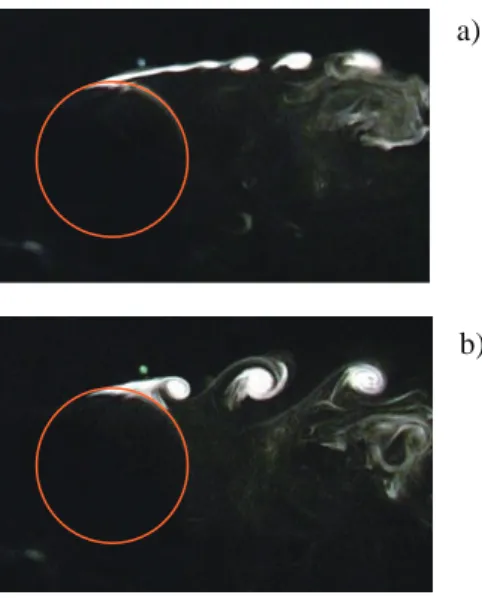
Ȁ For this experiment, a single plasma actuator was flush mounted within the circular cylinder. This consisted of two 17ȝm thick copper electrodes, separated by 250ȝm Mylar dielectric. The upper electrode was 1mm wide and offset relative to the lower. A high voltage (E = ±3.5kV) square-wave pulse train was delivered to the upper electrode. The circular cylinder was rotated about its axis so that the plasma forcing acted at several different azimuthal locations,ș, measured relative to the front stagnation point, where the freestream is from left to right.
Plasma was created in 1ms duration pulses at various multiples of the Karman vortex shedding frequency (fplasma/fK = 0.5, 1, 2, 4, 8, 14). Note that the frequency of separated shear layer roll-ups occurs at fSL/fK= 5.6 at this Reynolds number.4
a)
b)
Fig. 4 Flow visualisation images at Red = 3.3x10³. a) Without plasma; b) with plasma actuator at ș = 87°, pulsed at fplasma/fK= 4.
Figure 4 shows flow visualisation images of the flow around the cylinder with and without plasma forcing.
Without plasma (Fig. 4a), it is shown that the free shear layers rolled up into Karman vortices. Plasma forcing (Fig. 4b), clearly caused a significant change in the global flow structure around and in the wake of the cylinder, causing a downstream shift in the separation point. The effectiveness of the plasma in reattaching the flow was dependant on the actuator location. The most dramatic change was observed when the actuator was placed at 87° (i.e. very close to the natural separation point), where the flow was significantly reattached for all plasma forcing frequencies. In fact, the flow appeared to become reattached to the rearward stagnation point when fplasma/fK = 14.
5. Conclusions
Ȁ Ȁ Surface plasma actuators are versatile devices for active flow control, which can be integrated into aeronautical structures, such as the surface of aircraft wings or nacelle. Many flow control applications are possible with these devices from skin-friction reduction to separation flow control as has been demonstrated in this paper. We have also shown that the actuator configuration is easily adjustable, making unique applications possible. It is hoped that this paper could give an opportunity to aerospace engineers to take a look at surface plasma actuators and to find out what they are capable of.
This paper was based on the results of a research project funded by EPSRC and BAE SYSTEMS. TS was a research fellow of Japan Society for the Promotion of Science (JSPS).
References
1) T.N. Jukes, K.-S. Choi, G.A. Johnson and S.J.
Scott: Characterisation of surface plasma-induced wall flows through velocity and temperature measurement. AIAA J.,44 (2006) 764-771.
2) G.E. Karniadakis and K.-S. Choi: Mechanisms on transverse motions in turbulent wall flows. Ann.
Rev. Fluid Mech.,35(2003) 45-62.
3) T.N. Jukes, K.-S. Choi, G.A. Johnson and S.J.
Scott: Turbulent drag reduction by surface plasma through spanwise flow oscillation. AIAA paper 2006-3693 (2006).
4) A. Prasad and C.H.K. Williamson: The instability of the shear layer separating from a bluff body. J. Fluid Mech.,333 (1997) 375-402.
This document is provided by JAXA.
Large-Eddy Simulation of Transition in Wall-Bounded Flow
P. Schlatter*, S. Stolz**, and L. Kleiser
Institute of Fluid Dynamics, ETH Zurich, Switzerland,
* KTH Mechanics, Stockholm, Sweden,
** Philip Morris Research & Development, Neuchâtel, Switzerland
ABSTRACT
Laminar-turbulent transition is a crucial phenomenon appearing in a variety of industrial applications.
However the involved physical mechanisms as well as methods for reliable and accurate prediction of transition are still a matter of active research. In the present contribution, we give a brief overview on recent advances in the simulation and prediction of transitional and turbulent wall-bounded shear flows. The focus is on large-eddy simulations (LES), which differ from direct numerical simulations (DNS) by resolving only the large-scale, energy-carrying vortices of the fluid flow, whereas the fine-scale fluid oscillations, assumed to be more homogeneous, are treated by a subgrid-scale (SGS) model. The application of LES to flows of technical interest is promising and LES is getting more and more applied to practical problems. The main reason for this is that LES provides an increased accuracy compared to solutions of the (statistical) Reynolds-averaged Navier-Stokes equations (RANS), while requiring only a fraction of the computational cost of a corresponding fully-resolved DNS. Nevertheless, LES of practical transitional and turbulent flows still require massive computational resources and the use of large-scale computer facilities.
Key Words: Large-Eddy Simulation, Deconvolution Modelling, Wall Turbulence, Transition
1. Laminar-Turbulent Transition
Fluid flows are important in many technical applications of today's industrial world. The knowledge of the local fluid state, i.e. laminar or turbulent, is of major importance, since for instance drag and mixing significantly differ between the ordered laminar flow and the chaotic turbulent motion. Applications include e.g. flows along wings, intermittent flows around turbine blades and in combustion engines. The laminar-turbulent transition process and specifically its triggering mechanisms are not fully understood even nowadays. A summary of developments in transition research is given in the review article by Kachanov (4) and in the monograph by Schmid & Henningson (00).
A schematic overview of laminar-turbulent transition is given in Fig. (taken from the LES presented in Schlatter, 00) for the canonical case of plane incompressible channel flow excited by Tollmien- Schlichting (TS) waves (natural transition).
The fluid flows along the plate until at a certain downstream position the laminar flow becomes unstable giving rise to two-dimensional wave disturbances. These spanwise rollers rapidly
evolve into three- dimensional perturbations of triangular shape (Λ-vortices), which in turn tend to break down into localised turbulent spots through the formation of pronounced hairpin vortices. The spots grow and merge to form a fully turbulent flow.
2. Numerical Simulation: LES
The fully resolved numerical solution of the Navier-Stokes equations is extremely expensive even for moderate Reynolds numbers Re since the required CPU time roughly scales as Re. Practical high Reynolds-number calculations thus need to be performed using simplified turbulence models.
Commonly used methods include the Reynolds- averaged Navier-Stokes equations (RANS) in which the mean flow is computed with statistical turbulence models. A technique with a level of generality in between DNS and RANS is
the large-eddy
simulation (LES). In an LES, only eddies (turbulent vortices) above a certain size are resolved on the numerical grid, whereas the effect of the smaller scales is modelled by a subgrid-scale (SGS) model. The scale separation is motivated by the conjecture that smaller eddies are more homogeneous and isotropic than the large ones and depend less on the specific flow situation. For an Fig 1: Channel-flow transition
4 JAXA Special Publication JAXA-SP-07-06E
LES thus only a fraction of the computational cost compared to a fully resolved DNS (typically of order 0.-%) is required.
The success of an LES is essentially dependent on the quality of the underlying subgrid scale (SGS) model, but also on the applied numerical discretisation scheme (its order and accuracy).
However, the latter point has only recently been put into active consideration (Chow and Moin, 00).
The most common SGS model is the Smagorinsky (6) model, based on the eddy-viscosity assumption. A major generalisation of SGS modelling was achieved by Germano et al. () who proposed an algorithm which allows for dynamically adjusting coefficients of SGS models. A different class of SGS models has been introduced by Bardina et al. (0) based on the scale-similarity assumption. Considerable research effort has recently been devoted to the development of SGS models of velocity estimation or deconvolution type, see e.g.
the review by Domaradzki and Adams (00).
General reviews about different strategies for LES and SGS modelling are given in Lesieur and Métais (6), Meneveau and Katz (000) and Piomelli (00) as well as in the recent text books by Sagaut (00), Geurts (00) and Lesieur et al. (00).
3. LES of Laminar-Turbulent Transition
In transitional flows one is typically dealing with stability problems where small initial disturbances with energies many orders of magnitude smaller than the energy of the steady base flow are amplified and may finally evolve into turbulent fluctuations.
Moreover, the spatial and temporal evolution of various wave disturbances and their nonlinear interaction needs to be computed accurately over many disturbance cycles. An SGS model suitable for transition should be able to deal equally well with laminar, various stages of transitional and turbulent flow states. The model should leave the laminar base flow unaffected and only be effective when nonlinear interactions between the resolved and non-resolved scales become important. The initial laminar flow and the following growth of the instability waves is often sufficiently resolved even on a coarse LES grid.
While a number of applications of different SGS models to turbulent flows have been analysed, the application to transitional flows has become an active field of research only recently. An example of the difficulty of transitional flows is that the classical Smagorinsky model is too dissipative and usually, in addition to distorting laminar flows, relaminarises transitional flows. Several improvements have been
proposed, e.g., by Piomelli et al. (0), Voke and Yang () and Germano et al. () with the dynamic model. Several extended and more robust versions of the dynamic model have been proposed, e.g. the Lagrangian dynamic SGS model (Meneveau et al., 6) or the localisation model (Ghosal et al., ). A slightly different approach was followed by Ducros et al. (6) with the filtered structure function (FSF) model. A high-pass filter is used to decrease the influence of large scales in the calculation of the SGS terms. As a consequence, the model influence is reduced in regions where the mean-flow shear dominates over the turbulent shear, e.g. in the vicinity of walls or in laminar regions.
Related models include the filtered Smagorinsky model (Sagaut et al., 000) and also the dynamic mixed-scale model (Sagaut, 6). Another way to avoid model contributions in laminar flow was followed by Vreman (004) and subsequently Park et al. (006) by constructing the SGS stress tensor such that it vanishes in undisturbed flow. The variational multiscale (VMS) method by Hughes et al. (000), providing an explicit scale separation between the large and small scales based on disjunct spectral filters has, e.g., been used for simulating bypass transition along a flat plate (Calo, 004).
As to the work of our group, in Schlatter (00), results obtained using LES of transitional and turbulent incompressible channel flow are presented.
These simulations have been performed using spectral methods in which numerical errors (differentiation, aliasing) are small. Various classical and newly devised SGS closures have been implemented and evaluated, including the approximate deconvolution model (ADM, Stolz and Adams, ), the relaxation-term model (ADM-RT) (Stolz and Adams, 00 and Schlatter et al., 004), and the new class of high-pass filtered (HPF) eddy-viscosity models (Stolz et al. 00, Schlatter et al., 00a and Stolz et al., 00, 007). These models are discussed briefly in the following.
In Schlatter et al. (004), in addition to the original ADM algorithm, new variants have been examined. In particular an SGS model (ADM-RT model) with direct relaxation regularisation of the velocities based on a D high-pass filtering of the computational quantities is investigated. This model is related to the spectral vanishing viscosity (SVV) approach (Karamanos and Karniadakis, 000). The appropriate definition of the relaxation term causes the model contributions to vanish during the initial stage of transition and, approximately, in the viscous sublayer close to walls.
This document is provided by JAXA.
The application of the HPF eddy-viscosity models to transitional flows was presented in Stolz et al.
(00), see also Vreman (00). The HPF formulation is related to the VMS by computing the SGS terms on a highpass-filtered velocity field, thereby, with suitable filters, ignoring mean shear.
Detailed analysis of the energy budget including the SGS terms revealed that the contribution to the mean SGS dissipation is nearly zero for the HPF models, while it is a significant part of the SGS dissipation for other models (Schlatter et al., 00a). Moreover, unlike the classical eddy-viscosity models, the HPF models are able to predict backscatter. It has been shown that in channel flow that locations with intense backscatter are closely related to low-speed turbulent streaks in both LES and filtered DNS data.
Fig. 3: Comparison of the prediction of transitional structures using different SGS models: (a) fully-resolved DNS, (b) ADM-RT, (c) dynamic Smagorinsky model, (d) no-model LES (coarse-grid DNS). The box contains only xx grid points (from Schlatter et al., 00b).
The above references demonstrate that, e.g. for the model problem of temporal transition in channel flow, averaged integral flow quantities like the skin friction Reynolds number Reτ or the shape factor H12
can be predicted reasonably well by LES even on coarse meshes (see also Meyers and Sagaut, 007).
However, for a reliable LES in particular applied to transitional flows, it is equally important to faithfully represent the physically dominant transitional flow mechanisms and their D vortical structures such as the formation of Λ and hairpin vortices. A successful SGS model needs to predict those structures well even at low resolution, as demonstrated by Schlatter et al. (00b), Schlatter et al. (006) and Stolz et al.
(007). A comparison of various SGS models and their performance to predict transitional structures is shown in Fig. for temporal channel-flow transition.
When considering integral quantities only (e.g. skin
friction) major differences between the predictions could not be established (Schlatter et al., 004). The flow structures however have been found to be fairly different. In particular, the no-model LES and the standard dynamic Smagorinsky model fail to predict a distinct roll-up of the shear layers, and additionally spurious structures appear which lead to premature breakdown to turbulent flow. On the other hand, the high-order relaxation in the ADM-RT model closely follows the evolution of the exact (DNS) data.
In Schlatter et al. (006), different SGS models have been tested and compared in both the temporal and the spatial transition simulation approach. Fig.
shows a series of visualisations taken from a spatial LES using the ADM-RT model during classical K-type transition clearly showing the relevant series of break-ups of the distorted vortical structures eventually leading to a turbulent flow.
Fig. 2: Sequence (top to bottom) of vortical structures during spatial K-type transition using the ADM-RT model with only grid points in the wall-normal and spanwise direction (Schlatter et al., 006).
Compressible supersonic boundary-layer transition has recently been considered by Stolz et al.
(007). Compressible flows differ in various aspects from incompressible one: Not only is the type of equations changed to hyperbolic, giving the possibility of shock waves, but also the applied numerical methods are different. Whereas the above results used spectral methods, for the compressible case finite differences were employed. It is important to test modelling approaches also for compressible
(a) (b)
(c) (d)
6 JAXA Special Publication JAXA-SP-07-06E
transition and turbulence. The results in Stolz et al.
(007) show that using both ADM and the HPF model accurate approximate statistics (velocity profiles, skin friction etc.) are found. In addition ADM was found to be capable to predict instantaneous (flow structures) and at significantly reduced resolution.
At present, research in LES follows various directions. On the one hand, improved and new SGS models are developed; existing models are also applied to more complex flow cases with good results. In that respect, LES has matured to a research tool to predict e.g. complex transitional scenarios, see the recent application to bypass transition and control mechanisms (Schlatter et al. 007a,b). On the other hand, methods to actually quantify the errors of LES, e.g. induced by the lower resolution, but also by the discretisation scheme (Geurts, 006) are considered.
Solution-adaptive grid-refinement methods are currently being developed which could allow more reliable (and efficient) results for complex flow cases (Hoffman, 006).
4. Summary
The results obtained for transitional wall-bounded flows using various SGS models show that it is in fact possible to accurately simulate transition using LES on relatively coarse grids. However, the performance of the various models examined is considerably different with respect to an accurate prediction of e.g. the transition location and the characteristic transitional flow structures.
By examining instantaneous flow fields from LES of channel flow transition, additional distinct differences between the SGS models can be established. Some models which are based on high-pass filtering, e.g. ADM, ADM-RT and also the HPF eddy-viscosity models, are able to provide a realistic description of the flow structures up to the point of breakdown. In addition, the HPF eddy-viscosity models can be easily implemented in particular as an alternative to classical fixed-coefficient eddy-viscosity models, whilst performing significantly better than their non-highpass-filtered counterparts.
To conclude, LES using advanced SGS models are able to faithfully simulate flows which contain intermittent laminar, turbulent and transitional regions.
J. Bardina, J. H. Ferziger, W. C. Reynolds: AIAA Paper 7 (0).
V. M. Calo: Dissertation Stanford University (004).
J. A. Domaradzki, N. A. Adams: J. Turbulence, (00).
F. Ducros, P. Comte, M. Lesieur: J. Fluid Mech., 6 (6), pp. -6.
M. Germano, U. Piomelli, P. Moin, W. H. Cabot: Phys. Fluids A, :7 (), pp. 760-76.
B. J. Geurts: Elements of Direct and Large-Eddy Simulation, (00), Edwards.
B. J. Geurts: J. Turbulence, 7: (006), pp. -6.
S. Ghosal, T. S. Lund, P. Moin, K. Akselvoll: J. Fluid Mech., 6 (), pp. -.
J. Hoffman: J. Fluid Mech., 6 (006), pp. 77-.
T. J. R. Hughes, L. Mazzei, K. E. Jansen: Comput. Visual. Sci., (000), pp. 47-.
Y. S. Kachanov: Annu. Rev. Fluid Mech., 6 (4), pp. 4-4.
G.-S. Karamanos, G. E. Karniadakis: J. Comput. Phys., 6 (000), pp.
-0.
M. Lesieur, O. Métais: Annu. Rev. Fluid Mech., (6), pp. 4-.
M. Lesieur, O. Métais, P. Comte: Large-Eddy Simulations of Turbulence, (00), Cambridge University Press.
C. Meneveau, T. S. Lund, W. H. Cabot: J. Fluid Mech., (6), pp.
-.
C. Meneveau, J. Katz: Annu. Rev. Fluid Mech., (000), pp. -.
J. Meyers, P. Sagaut: Phys. Fluids, :040 (007), pp. -4.
N. Park, S. Lee, J. Lee, H. Choi: Phys. Fluids, :0 (006), pp.
-4.
U. Piomelli, T. A. Zang, C. G. Speziale, M. Y. Hussaini: Phys. Fluids A, : (0), pp. 7-6.
U. Piomelli: CFD00 Proceedings, Kitchener (00).
P. Sagaut: Rech. Aéro., (6), pp. -.
P. Sagaut, P. Comte, F. Ducros: Phys. Fluids, : (000), pp. -6.
P. Sagaut: Large Eddy Simulation for Incompressible Flows, (00), Springer.
P. Schlatter, S. Stolz, L. Kleiser: Int. J. Heat Fluid Flow, : (004), pp. 4-.
P. Schlatter: Dissertation ETH Zurich, No. 6000 (00).
P. Schlatter, S. Stolz, L. Kleiser: J. Turbulence, 6: (00a), pp. -.
P. Schlatter, S. Stolz, L. Kleiser: IUTAM Symposium on Laminar-Turbulent Transition (00b), Springer, pp. -.
P. Schlatter, S. Stolz, L. Kleiser: J. Turbulence, 7 (006), pp. -4.
P. Schlatter, H. C. de Lange, L. Brandt: Turbulence and Shear Flow Phenomena (007), to appear.
P. Schlatter, H. C. de Lange, L. Brandt: Advances in Turbulence XI (007), to appear.
P. Schmid, D. S. Henningson: Stability and Transition in Shear Flows, (00), Springer.
J. Smagorinsky: Mon. Weath. Rev., : (6), pp. -64.
S. Stolz, N. A. Adams: Phys. Fluids, :7 (), pp. 6-70.
S. Stolz, N. A. Adams: Phys. Fluids, : (00), pp. -4.
S. Stolz: J. Fluids Eng., 7 (00), pp. 666-67.
S. Stolz, P. Schlatter, L. Kleiser: Phys. Fluids, 7:060 (00), pp.
-4.
S. Stolz, P. Schlatter, L. Kleiser: AIAA J., 4: (007), pp. 0-07.
P. Voke, Z. Yang: Phys. Fluids, 7: (), pp. 6-64.
A. W. Vreman: Phys. Fluids, : (00), pp. L6-L64.
A. W. Vreman: Phys. Fluids, 6:0 (004), pp. 670-6
This document is provided by JAXA.
ν
ν





![Fig. 8 also shows sound pressure levels at Į=5.0[deg.] in Ref. 2. The reference cases were run at a different Mach number, 0.2; the plotted data were modified for M=0.1 by the factor M 2.5 , Mach number dependence of 2-D dipole sound](https://thumb-ap.123doks.com/thumbv2/123deta/6802866.2228819/61.892.474.805.325.832/pressure-levels-reference-different-number-plotted-modified-dependence.webp)
