Introduction
Proton transfer plays an important role in many chemi- cal and biological processes, and protolysis is an important elementary step for chemical reactions in aqueous solution.
Thus, protolysis has so far been studied on a wide variety of compounds.[1-4] We have kinetically studied on the protoly- sis of ligands involved nitrogen atom as a coordination atom, e.g. pyridine and 1,10-phenanthroline, paying our at- tention to the point that the protolysis of a ligand should play an important role in a complex formation.[5-9]
We found that the protolysis of pyridine (py), 2,2’-bi- pyridine (bpy), and 1,10-phenanthroline (phen) proceeded with relatively slow rate through the concurrent paths I and II expressed by Eqs. 1 and 2.[8, 9]
path I (1)
path II (2)
where L and HL+ represent the free base form of py or phen and the conjugate acid of them, respectively. A nitrogen acid and an oxygen acid may generally undergo protolysis with fast rates, and there is little instance of slow protolysis of a nitrogen acid such as pyH+ and phenH+. Thus, it is very interested in the mechanism of these slow protolysis, espe- cially in retarding factors operated on their protolysis.
A carbon acid is known to undergo quite slow protoly- sis. The reasons for the rate retardation in such slow pro- tolysis are considered to be (1) the small hydrogen-bonding
ability of carbon acid with solvent, (2) the electronic and structural reorganization on going from the acid to its con- jugate base, and (3) the accompanying reorientation of sol- vated solvent molecules.[1, 2, 4] The former two reasons are not likely to be the retarding factors in the protolysis of py and phen, because they have relatively strong hydrogen- bonding ability and are rigid molecule.
In our previous work,[9] the protolysis of py, phen, and several their derivatives was kinetically investigated in or- der to elucidate the operated retardation factors in their pro- tolysis. The effect of addition of 1,4-dioxane on their rates was also examined, as 1,4-dioxane is freely miscible with water and has extremely low dielectric constant. We sug- gested that the change in hydration sphere might participate significantly to retard the protolysis of py and phen. In this study, the temperature dependence of the protolysis of py and phen was examined in water and 0.05 mole fraction 1,4- dioxane-water mixture. Equilibrium and activated state were discussed thermodynamically.
Experimental
Materials and Sample Solution. Pyridine, 2,2’-bipyri- dine, and 1,10-phenanthroline monohydrate were purchased commercially available and were used without further puri- fication. 1,4-Dioxane was reagent grade for non-aqueous titration and was used without further purification. The wa- ter content of this solvent was measured by use of a Mit- subishi CA-02 moisturemeter and was less than 0.2 w/w %.
All other reagents were of guaranteed reagent grade and
Thermodynamic Investigations
for the Slow Protolysis of Pyridine and 1,10-Phenanthroline
Kazuhisa I
toh1), Isao A
ndo1)*, Kikujiro U
jImoto1), and Hirondo K
UrIhArA1) (Received December 1, 2014)Abstract
Equilibrium and kinetic measurements were carried out for the protolysis of pyridine, 2,2’-bipyridine, and 1,10-phenanthroline in water and for the protolysis of pyridine and 1,10-phenanthroline in 0.05 mole fraction 1,4-diox- ane-water mixture. The thermodynamic and activation parameters for the acid dissociation of their conjugate acids were evaluated from the temperature dependencies of the acid dissociation constants and the deprotonation rate-con- stants. Their protolysis was discussed thermodynamically. It was suggested that the change in hydration structure sig- nificantly affected upon the protolysis.
1) Department of Chemistry, Faculty of Science, Fukuoka University, 8-19-1, Nanakuma, Jonan-ku, Fukuoka 814-0180, Japan
were used without further purification.
Stock solutions of py, bpy, and phen were prepared by dissolving a weighed amount of them in water. Sample so- lutions for measurements were prepared by diluting those stock solutions to the desired concentration with water or the desired amount of 1,4-dioxane. The ionic strength of a sample solution was adjusted to 0.20 mol dm-3 with sodium chloride and the pH of it was adjusted the desired value as mentioned below. On the kinetic measurements, the pH of a sample was adjusted to the desired value with hydrochloric acid or sodium hydroxide. On the other hand, the buffers, acetate, phosphate, and ammonium buffer systems, were used at the concentration less than 0.02 mol dm-3 in the pH range of 4 to 10 on the pH adjustment of a sample solution for pKa measurements.
Measurements. Acid dissociation constants were mea- sured by a spectrophotometric pH titration at the wave- length of absorption maximum of pyH+, bpyH+, and phenH+.[8] The rate of protolysis were measured at the same
wavelength as those of the measurements of acid dissocia- tion constants by the pH-jump method without buffer solu- tion by use of an Union RA-401 stopped-flow spectropho- tometer. The detailed procedures of whole measurements in this study were mentioned in previous work.[8, 9] All mea- surements were carried out at the temperatures controlled within 0.1°C in the range of 15 to 35°C.
The hydrogen-ion concentration in 1,4-dioxane-water mixture was determined by Gran’s method.[10] The constant appearing in the Nernst equation, E0, was determined by means of Gran plots and the potential of a sample solution, E, was measured under an atmosphere of nitrogen gas satu- rated with solvent vapor by a TOA HM-6A pH meter equipped with a TOA HGS-2005 glass electrode in combi- nation with a TOA HS-305DS double junction silver-silver chloride electrode as a reference electrode. Then, the hy- drogen-ion concentration of a sample solution was calculat- ed by the Nernst equation,
E = E0 + 59.15 log[H+].
in aqueous solution in 1,4-dioxane-water mixture
t / ºC pKa n pKa n
pyH+ 15.0 5.48±0.01 1.00±0.01 5.12±0.01 0.96±0.01 20.0 5.39±0.01 0.96±0.02 5.04±0.01 0.93±0.01 25.0 5.34±0.01 0.95±0.01 4.97±0.01 0.95±0.01 30.0 5.29±0.01 0.98±0.01 4.93±0.01 0.95±0.01 35.0 5.20±0.01 0.96±0.03 4.81±0.01 1.00±0.02 bpy H+ 15.0 4.61±0.01 0.98±0.01
20.0 4.54±0.01 0.99±0.01 25.0 4.51±0.01 1.02±0.01 30.0 4.48±0.01 0.99±0.01 35.0 4.45±0.01 1.00±0.01
phen H+ 15.0 5.12±0.01 0.97±0.01 4.72±0.01 0.93±0.01 20.0 5.08±0.01 0.99±0.01 4.68±0.01 0.94±0.01 25.0 5.03±0.01 1.00±0.01 4.62±0.01 0.96±0.01 30.0 4.99±0.01 0.99±0.01 4.55±0.01 0.94±0.01 35.0 4.94±0.01 1.00±0.01 4.51±0.01 0.99±0.01 These values are shown together with the 0.95 confidence intervals.
Table 1 The pKa values and the number of the transferred proton for conjugate acid of py, bpy, and phen in aqueous solution and 0.05 mole fraction 1,4-dioxane-water mixture.
Results and Discussion
Equilibrium Studies. The pKa values of pyH+, bpyH+, and phenH+ were determined at 15 to 35°C in aqueous solu- tion and 0.05 mole fraction 1,4-dioxane-water mixture. The results are summarized in Table 1. In the temperature range of 15 to 35°C, the number of transferred proton was found to be about unity in both solvents. Therefore, the observed protolysis was one-proton dissociation reaction. The ob- tained Ka values at every temperature were larger in 1,4-di- oxane-water mixture than those in aqueous solution, i.e.
those acids easily dissociate in 1,4-dioxane-water mixture.
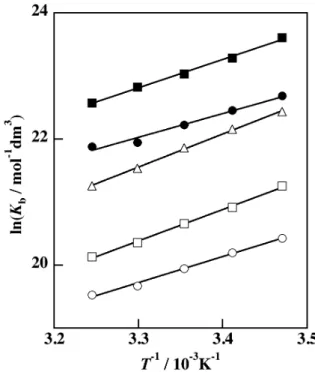
The Ka values or phenH+ are of good agreement with those of Ishiguro in both solvents.[11] They pointed out that the promotion of acid dissociation of it in mixture solvent was primarily due to the reduction in hydration of proton. All of the van’t Hoff plots in Fig. 1 gave a good linearity. This in- dicates that each compound in this study dissociates through an analogous mechanism in the temperature range of this study.
The relation of Eq. 3 holds between the equilibrium constants of path I and II, Ka and Kb.
(Ka / Kb) = KW (3)
where KW denotes the ionic product of water. The values of
Kb were calculated from the Ka values obtained in this study and KW values in literatures[12, 13] using the relation of Eq. 3.
Van’t Hoff plots for Kb are shown in Fig. 2 and the van’t Hoff plots in Fig. 2 also gave a good linearity. Table 2 sum- marizes the thermodynamic parameters for the acid dissoci- ation of pyH+, bpyH+, and phenH+ obtained van’t Hoff plots
Figure 1 Temperature dependences of the equilibrium con- stants of deprotonation via path I for pyH+ (○, ●), bpyH+ (△), and phenH+ (□, ■). The open and solid symbols represent the data in aqueous solution and in 0.05 mole fraction 1,4-dioxane-water mixture, respectively.
Figure 2 Temperature dependences of the equilibrium con- stants of deprotonation via path II for pyH+ (○, ●), bpyH+ (△), and phenH+ (□, ■). The open and solid symbols represent the data in aqueous solution and in 0.05 mole fraction 1,4-dioxane-water mixture, respectively.
Table 2 Thermodynamic parameters for deprotonation.
Gº / kJmol-1 Hº / kJmol-1 Sº / JK-1mol-1
in aqueous solution
path I pyH+ 30±7 23±5 -27±17
bpyH+ 26±7 13±5 -43±16
phenH+ 29±2 15±2 -45±5
path II pyH+ -50±7 -34±5 51±17
bpyH+ -54±5 -44±4 35±12
phenH+ -51±3 -42±2 33±7
in 0.05 mole fraction 1,4-dioxane-water mixture
path I pyH+ 28±10 25±7 -12±24
phenH+ 26±5 19±4 -26±12
path II pyH+ -55±12 -32±9 77±29
phenH+ -57±8 -38±6 63±19
These values are shown together with the 0.95 confidence intervals.
in Figs. 1 and 2. As can be seen in Table 2, the thermody- namic parameters for the acid dissociation of path I are re- markably different from those path II in both aqueous solu- tion and 1,4-dioxane-water mixture. However, they are essentially identical on the deprotonation of all compounds in this study, if taking the thermodynamic parameters for formation of water into account;[12, 13]ΔG° = -80 kJmol-1, ΔH° = -54 kJmol-1, and ΔS° =87 JK-1mol-1 in aqueous solu- tion, and ΔG° =-83 kJmol-1, ΔH° = -58 kJmol-1, and ΔS° = 85 JK-1mol-1 in 0.05 mole fraction 1,4-dioxane-water mixture.
Hereafter, we shall discuss about the thermodynamic pa- rameter for acid dissociation via path I.
The thermodynamic parameters for acid dissociation, ΔX° (X=G, H, or S), is composed of terms ascribed to the bond formation and breaking, ΔXd, and the accompanying the change in hydration, ΔXh.
ΔX° = ΔXd + ΔXh (4) The ΔXh term is represented by the thermodynamic parame- ter for the solution of the respective species into the sol- vents, ΔXs,
ΔXh = ΔXs (L) + ΔXs (H+) - ΔXs (HL+) (5) and the ΔXd term correspond to the thermodynamic parame- ter for the acid dissociation in gas phase. Accordingly, the value of ΔX° can be calculated if the value of ΔXd and ΔXs on each species participated in the protolysis are known.
For example, the values of ΔXs(L), ΔXs(HL+), ΔXs(H+) and ΔXd are reported about pyridine.[14, 15] The calculated ΔXh values from them were ΔHh =-918 kJmol-1 and ΔSh
=-140 JK-1mol-1, and the values of ΔXd are ΔHd =940 kJmol-1 and ΔSd =109 JK-1mol-1 for the acid dissociation of pyH+. Accordingly, the values of ΔH° and ΔS° for the acid disso- ciation of pyH+ were calculated to be 22 kJmol-1 and -31 JK-1mol-1, respectively. The ΔH° and ΔS° values obtained in this study are good agreement with the calculated ones. The positive value of ΔXd reflects the breaking of the N-H+ bond.
Taking the remarkably negative ΔXs(H+) value,[15] the nega- tive value of ΔXh indicates that the formation of hydration about the dissociated proton contributes to ΔXh in preference to the difference in hydration structure between HL+ and L.
The thermodynamic parameters can be similarly discussed for the protolysis of bpy and phen. As can be seen in Table 2, the positive values of ΔH° for each acid dissociation im- ply that the ΔHd contributes to ΔH° in preference to the ΔHh. However, the difference in ΔHh causes the difference in ΔH°
among the acid dissociation of pyH+, bpyH+, and phenH+ if the ΔHd corresponding to the breaking energy of the N-H+
bond does not differ among them. Furthermore, the nega- tive ΔS° is attributed to the contribution of the ΔSh term.
The difference in ΔH° and the negative ΔS° suggested that the change in hydration structure affected significantly upon the acid dissociation of pyH+, bpyH+, and phenH+.
In 0.05 mole fraction 1,4-dioxane-water mixture, the ΔG° for the acid dissociation of pyH+ and phenH+ are more negative than those in water. This fact implies that the acid dissociation of them is promoted in 1,4-dioxane-water mix- ture. Although the ΔH° in 1,4-dioxane-water mixture is more positive than that in water, the ΔG° is more negative than that in water. This indicates that the ΔS° term primarily contributes to ΔG° in 1,4-dioxane-water mixture. The more positive ΔS° is attributable to the fact that the ΔSh term is more positive than that in water, provided that the ΔSd term is similar between in water and in a small mol fraction 1,4-dioxane-water mixture. It is suggested that the main reason for the more negative ΔG° is the reduction in hydra- tion in mixture solvent.
Kinetic Studies. The rates of protolysis of py, bpy, and phen were measured at 15 to 35°C both in water and in 0.05 mole fraction 1,4-dioxane-water mixture. The apparent first-order rate constants of deprotonation, (kdp)0, were lin- early dependent on hydroxide-ion concentration for all compounds in both solvents. It was obvious that their de- protonation proceeded through the concurrent path I and II in Eqs 1 and 2 in the temperature range of 15 to 35°C, as previous work.[8] It was also clarified that in 1,4-dioxane- water mixture their deprotonation was accelerated by two to five times and showed the same behavior as in water.
Figures 3 and 4 show the temperature dependence of the deprotonation rate-constants through path I and II, kdp and kOH, which were obtained from the dependence of (kdp)0
on hydroxide-ion concentration. The rate constants of pro- tonation through the path I and II, kp and kH2O, were calcu- lated by Eq. 6. (Tables 3 and 4) In calculation of
Ka = (kdp/kp) = (kOHKW/kH2O[H2O]) (6) kp and kH2O, the literature values[12, 13] were used as the value of KW, and 1 [16] and 0.96 [17] were used as the activity of water in aqueous solution and 0.05 mole fraction 1,4-di- oxane-water mixture, respectively. The activation parame- ters for deprotonation were obtained from the Arrhenius plots in Figs. 3 and 4, and were summarized in Table 5.
The activation parameters for deprotonation can be similarly discussed to the thermodynamic parameters. With the progress of the deprotonation via path I, the N-H+ bond lengthens and the hydration extends around the N-H+ bond.
t / ºC kdp / s-1 kp / mol-1dm3s-1 kOH / mol-1dm3s-1 kH2O / mol-1dm3s-1
py 15.0 (1.6±0.4) 10-2 (4.8±1.2) 103 (1.0±0.7) 103 (1.4±1.0) 10-6 20.0 (3.1±0.7) 10-2 (7.6±1.7) 103 (1.5±0.9) 103 (2.5±1.5) 10-6 25.0 (4.9±1.0) 10-2 (1.1±0.2) 104 (3.4±1.3) 103 (7.5±2.9) 10-6 30.0 (6.2±2.4) 10-2 (1.2±0.5) 104 (8.6±3.8) 103 (2.5±1.1) 10-5 35.0 (9.0±3.4) 10-2 (1.4±0.5) 104 (1.5±0.7) 104 (5.0±2.3) 10-5 bpy 15.0 (7.2±1.5) 10-2 (3.0±0.6) 103 (1.4±0.3) 104 (2.6±0.6) 10-6 20.0 (1.8±0.3) 10-1 (6.3±0.9) 103 (2.0±0.5) 104 (4.7±1.3) 10-6 25.0 (3.2±0.5) 10-1 (1.0±0.2) 104 (4.5±1.3) 104 (1.5±0.4) 10-5 30.0 (4.1±0.7) 10-1 (1.2±0.2) 104 (6.3±2.0) 104 (2.8±0.9) 10-5 35.0 (7.8±2.0) 10-1 (2.2±0.3) 104 (9.3±3.7) 104 (5.5±2.2) 10-5 phen 15.0 (7.4±1.8) 10-2 (9.8±2.4) 103 (8.2±4.7) 103 (4.9±2.6) 10-6 20.0 (1.3±0.2) 10-1 (1.6±0.2) 104 (1.5±0.4) 104 (1.2±0.3) 10-5 25.0 (2.9±0.3) 10-1 (3.1±0.3) 104 (1.9±0.5) 104 (2.1±0.5) 10-5 30.0 (5.3±1.4) 10-1 (5.2±1.4) 104 (6.8±3.2) 104 (9.8±4.6) 10-5 35.0 (5.5±1.4) 10-1 (4.8±1.2) 104 (1.1±0.3) 105 (2.0±0.5) 10-4 These values are shown together with the 0.95 confidence intervals.
Table 3 The rate constants of the protolysis in aqueous solution.
Figure 3 Temperature dependences of the rate constants of deprotonation via path I for pyH+ (○, ●), bpyH+ (△), and phenH+ (□, ■). The open and solid symbols represent the data in aqueous solution and 0.05 mole fraction 1,4-diox- ane-water mixture, respectively.
Figure 4 Temperature dependences of the rate constants of deprotonation via path II for pyH+ (○, ●), bpyH+ (△), and phenH+ (□, ■). The open and solid symbols represent the data in aqueous solution and 0.05 mole fraction 1,4-diox- ane-water mixture, respectively.
On the other hand, the N-H+–OH- bond is formed at the same time as the lengthening of the N-H+ bond with the progress of the deprotonation via path II. Accordingly, the hydration structure also changes. Thus, the activation pa- rameters, ΔX‡ (X=H or S), are expressed for path I by the summation of the terms of ΔXd‡ and ΔXh‡ and for path II by the summation of the terms of ΔXd‡, ΔXf‡, and ΔXh‡. The subscripts d and h are the same meaning as mentioned above and ΔXf‡ denotes the change in thermodynamic pa-
rameter due to the formation of the N-H+–OH- bond at the activation state. Therefore, the ΔXd‡ is positive and ΔXf‡ is negative. On path I, the ΔXh‡ becomes negative because the enhancement of hydration is caused by the charge separa- tion due to the lengthening of the N-H+ bond. On the other hand, the ΔXh‡becomes positive on path II because the re- duction in hydration is caused by the charge neutralization ascribed to the formation of the N-H+–OH- bond.
As can be seen from Table 5, the ΔX‡ for the deproton- ation via path I in aqueous solution is positive except the ΔS‡ for the deprotonation of pyH+. The order of magnitude of ΔH‡ is pyH+ < bpyH+ ≅ phenH+ and the difference in ΔS‡ is much greater than that in ΔH‡. This fact implies that the difference in ΔS‡ term is seriously affected upon ΔG‡, al- though the ΔXd‡ term is preferred to the ΔXh‡. Thus, it is suggested that the activation state of deprotonation of pyH+ is close to the proton dissociated state and has larger incre- ment in hydration around the N-H+ bond than those of bpyH+ and phenH+. Comparison of ΔX‡ for the deproton- ation via path II to that via path I, ΔS‡ is remarkably positive more than that via path I, and the deprotonation via path II becomes more entropic. The positive ΔXd‡ and the negative ΔXf‡ may cancel out each other and summation of them be- comes to be nearly equal to zero. On the activation state, however, the hydration around the N-H+–OH- bond should be reduced because of the charge neutralization due to the formation of the N-H+–OH- bond. Consequently, ΔS‡ be- comes markedly positive owing to the contribution of the change in hydration to the ΔS‡ term.
t / ºC kdp / s-1 kp / mol-1dm3s-1 kOH / mol-1dm3s-1 kH2O / mol-1dm3s-1
py 15.0 (7.8±2.9) 10-2 (1.0±0.4) 104 (4.5±1.6) 103 (6.5±2.3) 10-7 20.0 (1.3±0.2) 10-1 (1.4±0.2) 104 (9.3±1.1) 103 (1.7±0.2) 10-6 25.0 (2.7±0.6) 10-1 (2.5±0.6) 104 (1.4±0.3) 104 (3.3±0.7) 10-6 30.0 (4.6±0.5) 10-1 (3.9±0.4) 104 (2.5±0.3) 104 (7.7±0.9) 10-6 35.0 (9.7±2.1) 10-1 (6.3±1.4) 104 (4.2±1.2) 104 (1.4±0.4) 10-5 phen 15.0 (3.0±1.1) 10-1 (1.6±0.6) 104 (4.3±1.4) 104 (2.5±0.8) 10-6 20.0 (5.9±0.8) 10-1 (2.8±0.4) 104 (5.2±1.1) 104 (4.2±0.9) 10-6 25.0 (9.6±1.4) 10-1 (4.0±0.6) 104 (9.2±2.5) 104 (9.6±2.6) 10-6 30.0 1.9±0.2 (6.7±0.7) 104 (6.9±3.8) 104 (8.8±4.9) 10-6 35.0 3.0±0.4 (9.7±1.3) 104 (1.5±0.7) 105 (2.5±1.2) 10-5 These values are shown together with the 0.95 confidence intervals.
Table 4 The rate constants of the protolysis in 0.05 mole fraction 1,4-dioxane-water mixture.
G / kJmol-1 H / kJmol-1 S / JK-1mol-1
in aqueous solution
path I pyH+ 81±29 60±21 -70± 69 bpyH+ 76±27 80±27 14± 5 phenH+ 77±48 78±34 4±114 path II pyH+ 52±36 102±26 165± 86 bpyH+ 47±20 70±19 79± 16 phenH+ 48±59 96±42 160±140 in 0.05 mole fraction 1,4-dioxane-water mixture
path I pyH+ 77±19 92±13 49± 45 phenH+ 73±13 84± 9 36± 32 path II pyH+ 49±14 78±10 97± 33 phenH+ 45±55 39±39 -21±132 These values are shown together with 0.95 confidence intervals.
Table 5 Activation parameters for deprotonation
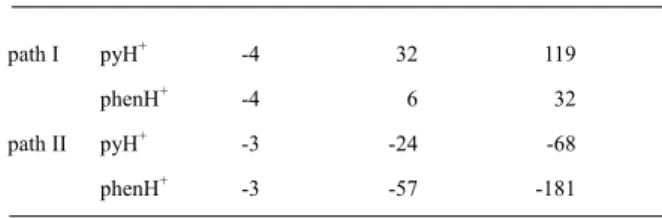
In order to compare the ΔX‡ in 0.05 mole fraction 1,4-dioxane-water mixture to that in aqueous solution, the difference in them, δΔX‡= ΔX‡(mix) - ΔX‡(aq), are summa- rized in Table 6. The values of δΔG‡ are -4 to -3 kJmol-1. This indicates that the deprotonation should be accelerated in 1,4-dioxane-water mixture. On the deprotonation via path I, the magnitude of activation parameters is ΔH‡(mix) >
ΔH‡(aq) and ΔS‡(mix) > ΔS‡(aq), and moreover the differ- ence in ΔS‡ is extensively large. If ΔXd‡(mix) is equal to ΔXd‡ (aq), the difference in ΔX‡ should be the difference in the ΔXh‡ term. It is suggested that the hydrophilic hydration around the N-H+ bond is not so formed on the activation state of deprotonation via path I in 1,4-dioxane-water mix- ture as in aqueous solution. It is, therefore, concluded that the extent of the newly formed hydration around the N-H+ bond affects significantly upon the deprotonation rate via path I. On the deprotonation via path II, the order of magni- tude of the activation parameters shows the reverse tenden- cy to that of path I, ΔH‡(mix) < ΔH‡(aq) and ΔS‡(mix) <
ΔS‡(aq). This tendency implies the strong the N-H+–OH- bond formation at the activation state which arises from the weakly hydrated hydroxide ion in 1,4-dioxane-water mix- ture. Accordingly, the ΔH‡ and ΔS‡ become more negative than those in aqueous solution. It is, therefore, concluded that the deprotonation via path II is accelerated by the con- tribution of the ΔH‡ term which is ascribed to the strong the N-H+–OH- bond formation.
In this study, we found that the acid dissociation of pyH+ and phenH+ was promoted and their deprotonation were accelerated in 1,4-dioxane-water mixture. It is sug- gested that the reduction in pKa is caused from the weakened hydrophilic hydration about the solutes in 1,4-dioxane-water mixture. It is also suggested that the deproto nation rate via path I is affected by the extent of the newly formed hydro-
philic hydration at the activated state, while the deproton- ation rate via path II is affected by the strength of the N-H+– OH- bond formed at the activation state which depends on the extent of hydration about hydroxide ion. In conclusion, the change in hydration accompanied by the protolysis sig- nificantly affected the protolysis of py, phen, and their de- rivatives.
References
1 Part I. K. Itoh, I. Ando, K. Ujimoto, and H. Kurihara, submitted to this journal.
2 M. Eigen, Angew. Chem., Int. Ed. Engl., 3, 1(1964).
3 F. Hibbert, “Comprehensive Chemical Kinetic,” ed by C. H. Bamford and C. H. F. Tipper, Elsevier, Amster- dam(1977), Vol. 8, Chap. 2.
4 F. Hibbert and, A. Awwal, J. Chem. Sco, Perkin Trans.
2. 1978, 939.
5 T. Okuyama, Y. Ikenouchi, and T. Fueno, J. Am. Chem.
Soc., 100, 6162(1978).
6 I. Ando, S. Nishijima, K. Ujimoto, and H Kurihara, Bull. Chem. Soc. Jpn., 55, 2881(1982).
7 I. Ando, K. Yoshizumi, K. Ito, K. Ujimoto, and H. Kuri- hara, Bull. Chem. Soc. Jpn., 55, 1368 (1983).
8 I. Ando, J. Saito, K. Ujimoto, and H. Kurihara, Fukuo- ka. Univ. Sci. Reports, 11, 47(1981).
9 I. Ando, K. Ujimoto, and H. Kurihara, Bull. Chem. Soc.
Jpn., 55, 713(1982).
10 K. Ito, I. Ando, K. Ujimoto, and H. Kurihara, submitted to this journal.
11 G. Gran, Analyst, 77, 661(1952).
12 S. Ishiguro, H. Wada, and H. Ohtaki, Bull. Chem. Soc.
Jpn., 58, 932(1985).
13 “Lange’s Handbook of Chemistry,” ed by J. Dean, McGraw-Hill(1979), p5-7.
14 H. S. Harmed and L. D. Fallon, J. Am. Chem. Soc., 61, 2374(1939).
15 D. H. Aue, H. M. Webb, and M. T. Bowers, J. Am.
Chem. Soc., 98, 318(1976).
16 H. Ohtaki, M. Tanaka, and S. Funahashi, “Yoeki-hanno No Kagaku,” Gakkai Shuppan Center, Tokyo(1977).
17 L. G. Hepler and E. M. Woolley, lley, olled by F.
Franks, Plenum Press, New York(1973), Vol., Chap. 3.
18 M. Kato, H. Konishi, and M. Hirata, J. Chem. Eng.
Data, 15, 501(1970).
G / kJmol-1 H / kJmol-1 S / JK-1mol-1
path I pyH+ -4 32 119
phenH+ -4 6 32
path II pyH+ -3 -24 -68
phenH+ -3 -57 -181
X = X(mix) X(aq)
Table 6 Difference in activation parameters