奈良教育大学学術リポジトリNEAR
Helminth Fauna of Bats in Japan VII
著者 SAWADA Isamu
journal or
publication title
奈良教育大学紀要. 自然科学
volume 19
number 2
page range 73‑80
year 1970‑11‑30
URL http://hdl.handle.net/10105/3028
Helminth Fauna of Bats in Japan \1
With 22 Text-figures
Isamu SAWADA
(Biological Laboratory, Nara University of Education, Nara, Japan) (Received March 9, 1970)
Three species of common Japanese cave-bats, Rinolophus ferrumequinum, R.
cornutus and Miniopterus schreibersi, collected in Okayama Prefecture were examined for the presence of cestodes. Eleven of these twenty-four bats harbored five species of hymenolepid cestodes, of which were new ones. It is the purpose of this paper to describe these new species of cestodes.
Insectivorolepis okamotoi n. sp.
Fourteen specimens of common bats, Rinolophus ferrumequinum, collected in a lime grotto, Kimendo, in the suberbs of Niimi City in Okayama Prefecture on November 2, 1969, were examined for the presence of parasites. Six of the fourteen specimens of the bats were infected with a number of medium-sized tapeworms, four of them with many of nematodes and three of them with many of trematodes. As the result of investigation, these tapeworms were found to represent undescried species belonging to Insectivorolepis of the family Hymeno-
lepididae. All measurements are given in millimeters unless otherwise stated.
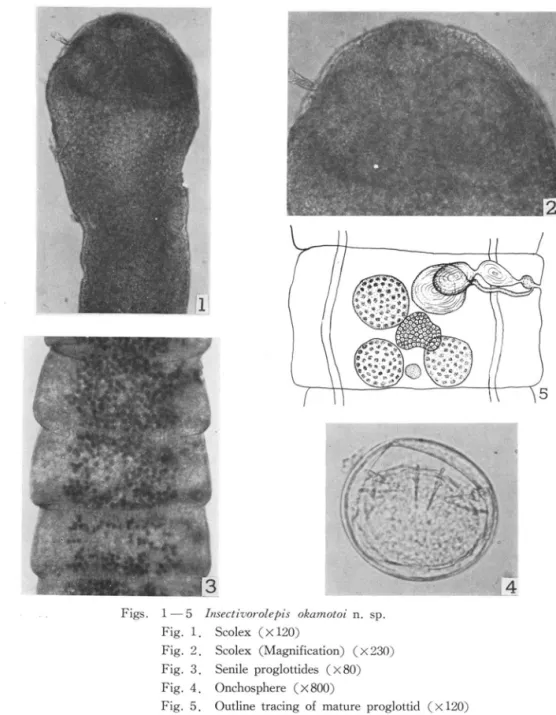
Specific diagnosis - Hymenolepididae. Strobila : Total length 15 to 25 ; maximum width 0.553 to 0.761 '> number of proglottides about 90. Proglottid margins not serrate. Scolex unarmed, 0.332 to 0.415 long and 0.290 to 0.318 wide, poorly differentiated from neck. Rostellum rudimentary, 0.081 to 0.088 by 0.053to0.067. Four suckers, unarmed, 0.101 to 0.112 by 0.112 to 0.119. Neck 0.180 wide and 0.553 to 0.692 long. Proglottides all wider than long. Genital pores unilateral, dextral, and situated in the anterior half of proglottid, at about junction of the 1st and 2nd fourths, in mature proglottid.
73
74 Isamu SAWADA
*n. å '^
inr. å «å
*
i,
'..',. å *å .-- >
- •E>.
•Eå å å >/'å
Figs. 1-5 Insectivorolepis okamotoi n. sp.
Fig. 1. Scolex (X120)
Fig. 2. Scolex (Magnification) (X230) Fig. 3. Senile proglottides (X80) Fig. 4. Onchosphere (x800)
Fig. 5. Outline tracing of mature proglottid (xl20)
Male genitalia : Cirrus pouch small and indistinct, 0.035 long and 0.018 wide. Testes three in number, one opral and two aporal, spherical, 0.56 to 0.070 in diameter.
Female genitalia : Ovary rather small, 0.07 long and 0.053 to 0.07 wide, centrally located, not at all bilobats. Vitelline gland compact, 0.042 by 0.035, postovarian and located between poral and posterior antiporal testis. Uterus appears
early in strobila as spherical body which gradually enlarges, not filling entire gravid proglottid. External and internal seminal vesicle both prominent." the former 0.032 to 0.046 by 0.035 to 0.046, the latter 0.035 to 0.07 by 0-025 to 0.032.
Ovoid seminal receptacle prominent, 0.049 long and 0.039 wide. Outermost egg membrane 0.042 by 0.046, innermost one 0-032 by 0.039- Onchosphere sperical,
0.028 by 0.035, embryonal hook, with distinct shaft and clows, 0.014 long.
Discussion : The present species closely resembles Insectivorolepis yoshidai Sawada, 1967 found from bats. However, it may be distinctly differentiated from /. yoshidai by the size of scolex, the form of ovary in the mature proglottid and the morphology of onchosphere.
Host 'å Rhinolophus ferrumequinum Habitat : Small intestine
Locality and Date : Niimi City, Okayama Prefecture : November 2, 1969 Type specimen : Biological Laboratory, Nara University of Education,
Nara, Japan
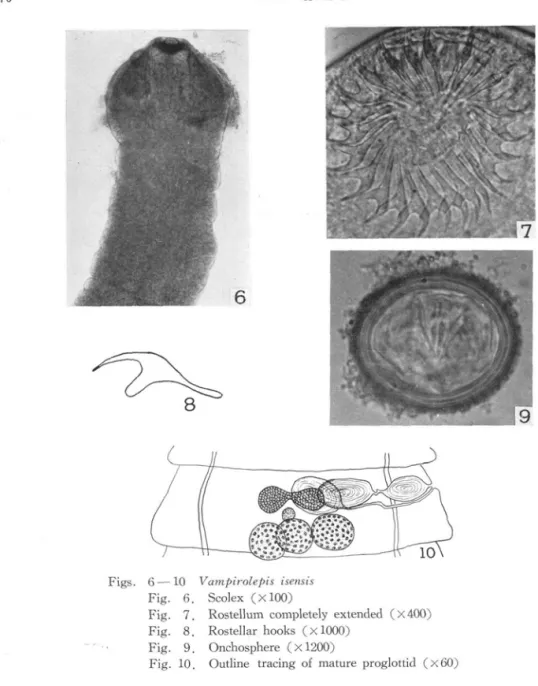
Vampirolepis isensis Sawada
On November 2, 1969 , one specimen of Rhinolophus ferrumequinum and one specimen of R. cornutus were collected in a autigua of a copper mine at Kawamo in the suberbs of Takahashi City, in Okayama Prefecture. Three specimens of very small tapeworm, Hymenolepis grisea, four specimens of rather large trematodes, twenty-five specimens of small trematodes, nine specimens of nematodes and a specimen of acanthocephala (? ) were found in the small intestine of the former and three specimens of large tapeworms in the small intestine of the latter.
On the basis of a study of three tapeworms which appeared morphologically identical, the author belives these tapeworms belong to Vampirolepis isensis Sawada, 1966-
Diagnosis - Hymenolepididae. Worm length 62 to 70 ; greatest width, attainted in gravid proglottides, 1.1 to 1.3. All strobila wider than long with a slight increase in length in gravid proglottides. Scolex 0.249 wide and 0.221 to 0.249 longj rostellum 0.07 to 0.074 in diameter; distal end armed with a single row of 24 hooks, each measuring 0.032 in length. Suckers oval, 0.097 by 0.111.
Genital pores unilateral, situated near anterior end of margin of proglottid.
Cirrus sac very small and indistinct. Testes 0.07 to 0.091 by 0.084 to 0.035, with one poral and two aporal in position; arranged in a transverse row.
76 Isamu SAWADA
wå 3*r å *>>>-å
å å 'å å :å -.å å å '?
1 r r . .. r * 1
Figs. 6-10 Vampirolepis isensis Fig. 6. Scolex (xlOO)
Fig. 7. Rostellum completely extended (X400) Fig. 8. Rostellar hooks (X1000)
Fig. 9. Onchosphere (X1200)
Fig. 10. Outline tracing of mature proglottid (X60)
External seminal vesicle 0.084 by 0.051 and internal seminal vesicle 0.105 by 0.056. Ovary bilobed, situated near center of proglottid. Vitelline gland directly posterior to ovary. Seminal receptacle prominent, 0.07 by 0.035. Eggs 0.035 by 0.042. Onchosphere 0.03 by 0.025 and embryonal hooklet 0.014 in length.
Rodentolepis macrotesticulatus n. sp.
Eleven specimens of the common bat, Rinolophus ferrumequinum, two speci- mens of the small common bat, R. cornutus and three specimens of the small commonbat, Miniopterus schreibersi, were collected in a lime grotto, Komoriana,
in the suberbs of Niimi City, Okayama Prefecture on November 3, 1969 and were examined for helminth parasites. Two of the eleven R. ferrumequinum harboured two to four medium-sized tapeworms and one of them five specimens of the large tapeworms. On the other hand, one of the two R. cornutus harbourd three specimens of the medium-sized tapeworms. But no presence of tapeworms could be recovered in M. schreibersi. The records of the two species parasitic in R.
ferrumequinum are new for the bat tapeworm. As to the tapeworm parasitic in R. cornutus, a whole strobila with scolex was not found, so identification of the tapeworms was impossible in the present study. No trematodes and nematodes were recovered from the above-mentioned bats.
..;'- å
.4** ifr~
å * fl.-
å
r; li
m-J
> V å a
?-/.I
å n
13
>4lW- å /%•E -å '-i
V* -St MB
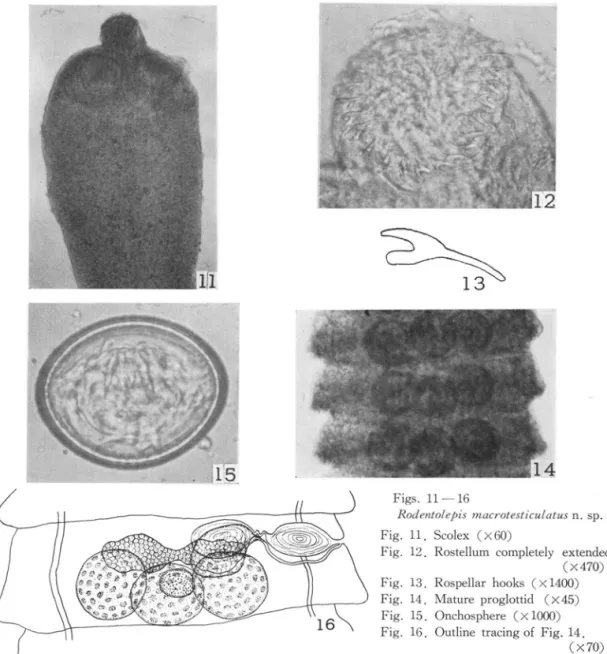
Figs. ll-16
Rodentolepis macrotesticulatus n. sp.
Fig. ll. Scolex (X60)
Fig. 12. Rostellum completely extended (X 470) Rospellar hooks (xl400) Mature proglottid (X45) Onchosphere (x lOOO) Outline tracing of Fig. 14.
(X70)
78 Isamu SawADA
Diagnosis - Hymenolepididae. Maximum length of strobila 81 to 97, maximum width 1.1 to 1.2. Scolex prominent, rectangular, 0.553 to 0.622 long and 0.304 to 0.360. Suckers rounded or oval and unarmed, 0.083 by 0.088 to 0.097.
Rostellum 0.084 in diameter, provided with a single row of 26 to 28, 0.021 long, handle being much larger than blade. Neck 0.194 to 0.207 wide and 0.122 long.
Proglottid margins serrate. Genital pores unilateral and situated in anterior half of margin of proglottides. Cirrus pouch small and indistinct ; cirrus unarmed.
External and internal seminal vesicle present ; the former 0.053 by 0.046, the latter 0.056 to 0.042. Three testes distinct, 0.084 to 0.105 by 0.105 to 0.126, arranged in a transverse row, one poral and two aporal in position. Ovary irregularly shaped, transversely elongate, being located at anterior field of proglottid. Vitelline gland, 0.018 by 0.021, just posterior to ovary, overlapping central testis. Seminal receptacle prominent, 0.063. Vagina opening posterior to male genital opening.
Uterus sac-like and lobed, filling entire proglottid. Egg ovoid, 0.042 by 0.032, outermost egg shell pretty thick, measuring 0. 004. Onchosphere spherical, 0.021 by 0.025. Embryonal hook 0.014 in length.
Discussion : The present form closely resembles Rodentolepis taruiensis Sawada, 1967 and R. microstoma (Dujardin, 1845) among of 26 species described up to the present, but it differs from the former in the number and the length of the rostellar hooks, and from the latter in the form of scolex, the size of suckers, the length of rostellar hooks and the size of egg.
Host : Rhinolophus ferrurnequinum Habitat : Small intestine
Locality and Date : Niimi City, Okayama Prefecture : November 3, 1969 Type specimens : Biological Laboratory, Nara University of Education,
Nara, Japan
Insectivorolepis niimiensis n. sp.
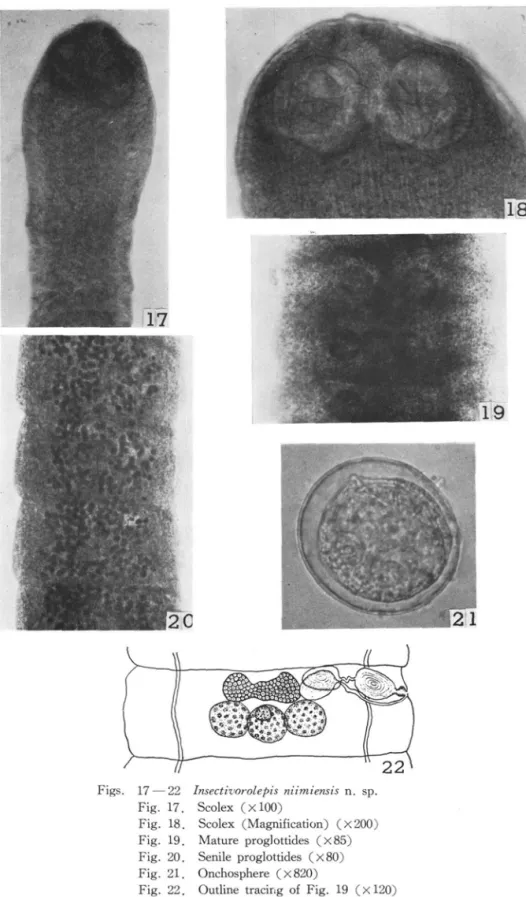
Diagnosis - Hymenolepididae. Strobila length 22 to 25 »' greatest width about 0.553 to 0.761. Margins of strobila not serrate. Proglottides about 100 in number, much wider than long through strobila. Scolex unarmed, 0.415 to 0.484 long and 0.235 to 0.332 wide. Rostellum rudimentary, 0.111 long. Suckers discoid, 0.097 to 0.124 by 0.083 to 0.111. Neck very slender, 0.166 to 0.221 wide.
Genital pores unilateral, situated in anterior half of margin of each proglottid, at about junction of the first and second thirds. Cirrus pouch very small, 0.025 long
•Eå '*!•E'* *
n
å 1
*yr :å å
WM
20
å *> "
å å
i...
lliS^
1 jr
19
I.
X s j-
å 21 1
*221 17 -22 Insectivorolepis niimiensis n. sp.
Fig. 17. Scolex (xlOO)
Fig. 18. Scolex (Magnification) (X200) Fig. 19. Mature proglottides (X85) Fig. 20. Senile proglottides (X80) Fig. 21. Onchosphere (x820)
Fig. 22. Outline tracing of Fig. 19 (X120)
80 Isamu SAWADA
and 0.014 wide. Cirrus aspinose. External seminal vesicle 0.028 to 0.032 by 0.053 to 0.060 and internal seminal vesicle 0.032 to 0.035 by 0.042 to 0.049.
Testes three in number, arranged in a transverse row. Testes sperical, 0.07 to 0.077 by 0.077 to 0.091 in mature proglottides. Ovary elongate, with long axis transverse. Vitelline gland posterior to ovary, overlapping central testis. Vagina postrior to cirrus pouch ! seminal receptacle pretty prominent, 0.056 to 0.06 in width and 0. 052 in length. Uterus sac-like, not overlapping longitudinal excretory ducts. Egg spherical, 0.042 to 0.049 in diameter; onchosphere 0.032 by 0.035 '
<
embryonal hooklet 0.014 in length.
Discussion : The species described here most closely resembles Insectivorolepis okamotoi n. sp. above-mentioned, but it differs from /. okamotoi in the situation of the suckers in the scolex, in the arrangement of testes and the morphology of ovary in the mature proglottid, and in the position of genital pores in each pro- glottid-in the /. okamotoi the genital pore is located at the anterior half, at about the junction of the first and second fourths of the proglottid margin, but in the present species it is located at the anterior half, at about the junction of the first and second thirds of the proglottid margin.
Host : Rhinolophus ferrumequinum Habitat : Small intestine
Locality and Date : Niimi City, Okayama Prefecture : November 3, 1969 Type specimens : Biological Laboratory, Nara University of Education, Nara, Japan.
Acknowledgment
Thanks are due to Mr. Okamoto, Niimi High School for generous assistance in collecting the bats in the cave.
References
(1) Dujardin, E. 1845 Histoire naturelle des helminthes on vers intestinaux. xvi 654
(2) Sawada, I. 1966 On a new tapeworm, V'ampirolepis isensis, found in bats with the table of the morphological features of tapeworms in Vampirolepis. J. J. Med. Sci and Biol. 19 (1) : 51-57
(3) Sawada, I. 1967 Helminthfauna of bats in Japan H. J. J. Parasit. 16(2) : 103-106 (4) Sawada, I. 1967 Helminth fauna of bats in Japan I. Annot. Zool. Japon.40(3) : 177-179