
• 検索結果がありません。

What drives and determines competitiveness and sustainability in small to medium-sized Australian wineries?

N/A
N/A
Protected

Academic year: 2021

シェア "What drives and determines competitiveness and sustainability in small to medium-sized Australian wineries?"

Copied!
16
0
0

読み込み中.... (全文を見る)

全文

(1)

What drives and determines competitiveness and sustainability in small to medium‑sized

Australian wineries?

著者 SAKURAI Yuka, 櫻井 結花

journal or

publication title

明治学院大学産業経済研究所研究所年報 = The Bulletin of Institute for Research in Business and Economics Meiji Gakuin University

number 29

page range 125‑139

year 2012‑12

URL http://hdl.handle.net/10723/1410

(2)

共同研究 8  後発国産業のグローバル化に関する研究─豪州ワイン産業のグローバル化を中心にして─
What drives and determines competitiveness and sustainability in small to medium-sized Australian wineries?

Yuka Sakurai

Introduction

Over  the  past  15  years  the  Australian  wine  industry  has  demonstrated  remarkable  growth in overseas markets. As a result Australia is now the 4

th

 largest wine exporter in  the world, exporting more than 700 million liters annually to over 100 countries. However,  this  remarkable  success  story  has  not  been  achieved  without  cost.  Due  to  the  fact  that  Australian wine predominantly represented entry level wines in overseas markets, it gained  an unfortunate reputation for being a cheap everyday commodity notwithstanding the benefits  of greater market share and a global presence in a short period of time (Aylward & Clements  2008;  Robinson,  2009;  Kesmodel  2009).  But  as  competition  from  wine  producers  in  other  countries increasingly intensified, a volume-oriented approach targeting a mass market was  no longer viable as an export strategy for Australia. Instead, a more value-oriented approach,  that is, creating low-volume but high-value brands through limited high-end distribution, has  been acknowledged as a new key strategy in the Australian wine industry while continuing  to  promote  high-volume  products  through  existing  distribution  channels  (Euromonitor  International  2005).  In  addition,  tapping  into  underdeveloped  wine  markets,  specifically  in  Asia with existing products at higher price points is recognised as another effective way to  achieve sustainable growth (AWBC 2007). This paper intends to argue that Small to Medium  Enterprises  (SMEs)  are  better  positioned  than  large  wine  conglomerates  in  creating  low- volume but high-value brands through limited high-end distribution: but only if they are able  to  successfully  leverage ʻdistinctive  capabilitiesʼ  to  create  a  competitive  advantage  in  the  marketplace. 

Currently, 2,532 companies that commercially sell wines in Australia are listed in The

Australian and New Zealand Wine Industry Directory 2012. The majority (over 90%) are 

small family-owned firms that crush 500 tonnes or less of grapes per year. Therefore, it is 

vital to address the unique characteristics and challenges of these SMEs in order to build 

a sustainable business model to ensure long-term growth of the Australian wine industry 

(3)

both domestically and internationally. Hence, the main purpose of this paper is to explore the  following question: What drives and determines competitiveness and sustainability in small to  medium-sized Australian wineries. I propose to undertake this research by utilising a resource- based view (RBV) of strategy management (see: Prahalad & Hamel, 1990, Barney 1991), in  particular, John Kayʼs (1993) ʻdistinctive capabilitiesʼ framework.  

RBV has been widely used in examining the performance of firms in various industries; 

however, little work has been done in examining the applicability of the framework to SMEs  in the wine industry. The wine industry by nature represents an agricultural industry with  the addition of manufacturing (winemaking), bottling, market development, and distribution. 

Because  of  its  complex  nature,  the  wine  industry  requires  a  very  long-term  vision  and  commitment.  Identifying  capabilities  embedded  in  these  enterprises  and  leveraging  their  capabilities through cultivating and nurturing long-term relationships with both internal and  external stakeholders will be required for a sustainable growth of the industry. 

This paper has been organised into four  main sections. The first section outlines a brief  review of RBV which views firmsʼ internal resources and capabilities as determinants of an  organisationʼs performance and sustainability. The second section provides a discussion of  the methodology used in this paper. The third section compares and contrasts how three  SMEs successfully leverage their ʻdistinctive capabilitiesʼ to create a sustainable competitive  advantage.  The  fourth  section  provides  discussion  of  findings  and  suggestions  for  future  research. This report is a part of the research project funded by the Faculty of Economics,  MeijiGakuin University. A brief review of the RBV of firmsʼ strategic management will be  provided next. 

The resource-based view of firms’ strategic management

The ʻresource-based viewʼ approach gained its popularity in the early 1990s (see: Prahalad 

& Hamel, 1990, Barney 1991). RBV sees a firm as a bundle of resources and emphasises that 

the way these resources are combined and applied within a firm can create a ʻsustainable 

competitive advantageʼ that is not easily duplicable or surpassed by its competitors. Resources 

are  categorised  as  tangible  and  intangible.  Tangible  resources  include  physical,  financial 

and human assets. Intangible resources include intellectual and/or technological resources 

and  reputation.  Technological  resources  include  the  organisationʼs  ability  to  innovate  and 

the  promptness  with  which  innovation  takes  place.  In  the  knowledge-based  economy,  a 

tacit knowledge that is shared and learnt by people in the organisation and is embedded 

in  organisational  culture  is  increasingly  viewed  as  an  important  resource  of  competitive 

(4)

advantage.  For  example,  the  reputation  and  goodwill  of  the  organisation  is  a  valuable  organisational resource as it takes time to build but can be easily damaged. In order for a firm  to have competencies in the marketplace, the firm needs to find a way to efficiently coordinate  and  organise  these  resources.  Prahalad  &  Hamel  (1991)  use  the  term ʻcore  competenciesʼ  to refer to the activities in which the firm can achieve a sustainable competitive advantage  whereas  Kay  (1993)  uses  the  term ʻdistinctive  capabilitiesʼ  as  the  sources  of  the  firmʼs  sustainable competitive advantage.

Kay  (1993)  views  an  organisation  as  a  collection  of  capabilities,  and  argues  that  the  success of an organisation is determined by those of their capabilities that are ʻdistinctiveʼ. 

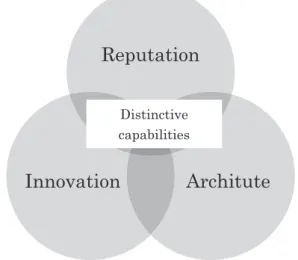
Moreover,  Kay  points  out  that  an  outstanding  organisation  derives  its  strength  from  a  distinctive structure of relationships with various stakeholders such as customers, employees  and suppliers. The stability and continuity in these relationships is essential for creating social  and commercial values. ʻDistinctive capabilitiesʼ are often embedded in an organisation and  therefore cannot be easily copied or imitated by its competitors.  Three important sources  of ʻdistinctive capabilitiesʼ through which a company can achieve a sustainable competitive  advantage include: architecture, reputation, and innovation. 

Architecture refers to a structure of relational contacts with its employees, customers,  suppliers and a group of collaborative firms which a firm may network with. Reputation can  be built over time through firmʼs reliable relationships such as excellent customer services and  consistency in quality of product offering. Innovation in management and technology allows  an organisation to be distinctive in the marketplace; however, in order to create a sustainable  competitive advantage, a firm needs to engage in constant innovation and development that is  supported by its organisational architecture. Thus, a distinctive collection of both internal and 

Reputation

Architute Innovation

Distinctive capabilities

Figure 1: Distinctive capabilities of strategy (adapted from Walters 2003)

(5)

external relationships that are developed and nurtured for a long period of time would help  firms to achieve a competitive advantage (see Figure1 below). 

As mentioned earlier, the wine industry largely represents an agricultural industry in  nature  and  thereby  requires  a  very  long-term  vision  and  commitment.  For  organisations  that belong to such an industry, the stability and continuity in relationships with internal and  external stakeholders is hypothesised to be essential for creating added values. Thus, Kayʼs  framework of ʻdistinctive capabilitiesʼ of strategy is employed in this study to explore drivers  and determiners of competitiveness and sustainability of small to medium-sized Australian  wine producers. In the following section, the methodology employed in this study will be  articulated and discussed.

Methodology

The interviews were undertaken as follows: 1) in Victoria interviews were conducted at,  four wineries in Bendigo and one winery in the King Valley region, between the 13th and 16th  of August 2011; and 2) in Queensland interviews were conducted at two wineries in the Granite  Belt Region, between the 29th of March and 3rd of April 2012. The cases were selected from  The Australian and New Zealand Wine Industry Directory 2011.  Due  to  the  significant  difficulty encountered in identifying appropriate and willing respondents and the widespread  location  of  selected  cases,  only  a  limited  number  of  wineries  were  able  to  be  identified  within  the  Australian  wine  industry.  Finding  willing  respondents  was  time  consuming  as  in many cases interviews were only agreed to if a positive referral was given from another  wine  producer.  As  a  result  of  this  process,  the  investigator  has  learnt  the  importance  of  spending a considerable amount of time building trust with each respondent in a closely-knit  wine community. One limitation of this research involves a small number of cases with an  exploratory focus; however, findings will provide some insight into the sources of a competitive  advantage pertaining to small and medium sized wineries that may have been overlooked.

In each case, semi-structured, in-depth interviews (recorded) were conducted with the  marketing and/or management decision makers to identify an understanding of the pertinent  research issues. Due to their in-depth nature, each of the interviews can be classified as a  single case study (Yin, 2003). The investigator travelled to conduct interviews with them.

Upon the completion of the interview, the investigator asked the interviewees to fill in a  questionnaire containing questions concerning 1) what they perceived as strengths of the firm,  2) what they perceived as key success factors and 3) the anticipated factors for future success. 

In this paper, three companies were selected that demonstrate unique characteristics in 

(6)

terms of how they leverage their ʻdistinctive capabilitiesʼ to achieve a sustainable competitive  advantage. All three companies are family-owned; however they are different in size and scale  of production. The information was supplemented by publically available resources including  industry reports and company websites. In the following section, three cases are presented  with findings concerning ʻdistinctive capabilitiesʼ that create a competitive advantage for each  firm. 

Findings

Case 1: Alpha

Alpha was established in 1889 in Victoria. It is one of the oldest, family-owned wineries in  Australia prospering over five generations. The firm sources grapes from its own vineyards  that are located within a 50km radius of the headquarters and also from recently acquired  vineyards in Tasmania. This enables the firm to offer a wide range of products in terms of  varieties and wine styles to both domestic and international markets. Wines are exported  to over 30 countries in which the largest markets are the UK and New Zealand. The firm  employs over 300 people and produces more than 1 million cases annually. 

1-1: Reputation-Brand sovereignty as a family heritage

The firm places great importance on its family heritage and traditions that are deep- rooted  in  its  organisational  culture  and  sees  them  as  a  source  of  the  firmʼs ʻdistinctive  capabilitiesʼ. This can be illustrated by the following statement from the marketing manager: 

“The important thing is there has been no change to the vision of the company, what we stand for, how we operate and culture [over the years] . The culture of the company is really the culture of the [founding] family and there is no difference between [our] brand and the family. The brand and the family really have the same values- very unpretentious, very innovative”.

The founder incorporated its family name into a company name, which has been passed on 

through generations along with their family values for over 100 years. This demonstrates that 

the founding family members take great pride in their business and their product offering. The 

strong identification of family heritage with its brand was reinforced in 2003 when the firm 

released a new flagship range of super-premium wines that were named after the winemakerʼs 

wife of an earlier generation. Thus, for Alpha, family heritage plays an essential role in creating 

and embracing a distinctive corporate and brand sovereignty which is continuously being 

expressed in organisational practices. This is one of their ʻdistinctive capabilitiesʼ which cannot 

(7)

be easily transferred or imitated by other firms.  

1-2: Leveraging reputation through internal relationships

While the family heritage is greatly valued, Alpha makes sure that non-family members  with expertise and knowledge in certain areas are brought into the company and gets them  involved in decision-making in order to be flexible and innovative. At the same time, the firm  is very clear in communicating its vision and goals to all employees. As stressed by the firmʼs  executive director, a loyal and engaged workforce is regarded as one of the most important  characteristics of the firmʼs competencies. Thus, tacit organisational knowledge that is shared  by a loyal and engaged workforce creates a distinctive value in Alpha. 

1-3: Leveraging reputation through cellar door experience

Cellar door experience is seen as an effective way for the promotion and sales of high- value brands through limited high-end distribution. In Victoria, 75.5% of all wineries have a  cellar door facility (The Australian New Zealand Wine Industry Directory 2012). The benefits  of having cellar door sales include: distribution at a low marginal cost, the development of  brand  equity,  and  a  chance  to  add  value  to  their  product  by  sharing  a ʻstoryʼ  with  their  customers about the uniqueness and qualities inherent in each wine. 

Alpha strongly believes that a firm can build customer loyalty and enhance its reputation  through cellar door sales as illustrated by the following quote: 

“The best way to sell your product is the principle of the cellar door, face to face, glass in the hand, get your potential customers to taste, understand and hear the story.

.what has to be done is to take the cellar door across the nation and then across the world ” (quoted in Dunstan, 1999, p.174).

At Alpha, customers are provided an opportunity to explore new wine varieties and styles 

including limited release of new varieties, experimental batches and optimum aged wines that 

are only available at the cellar door. The question that arises is: How can the winery tell the 

story to international customers who are unable or unlikely to visit its cellar door? One way 

to do this is by organising a number of tasting events which include participating in food and 

wine markets and then persuading repeated customers who come to the events or markets to 

tastetheir wines on a regular basis. Another way being suggested by the marketing manager 

is the effective use of a website that “tells everything about the family, the vineyards and the

latest vintages available” (in Dunstan, 1999, p.175). Wine club membership of Alpha is currently 

only available to Australian residents; however, it is another effective way to promote high-

value brands through a loyal customer base.

(8)

1-4: Leveraging reputation through industry leadership and networking

Alpha is highly respected in the wine community and was complimented by a number of  people encountered during the interview processes. They constantly provided complimentary  comments on the founding family about their personalities and contributions to the community. 

In fact, several people used the term ʻunpretentiousʼ in describing the family which is also  a core corporate value of Alpha. Clearly, Alpha has attained its reputation in the community  through  developing  dedicated  relationships  with  other  wineries  and  industry  leadership. 

Alpha is an active member of Australiaʼs First Families of Wine, that is, an alliance of 12  multi-generation family-owned wineries, with a long history, having committed to export and  environmental best-practice and producing iconic wines. The alliance members are active  promoters of raising the profile of Australian wine in the international arena; showcasing a  representative of Australiaʼs premium and super premium wines; and highlighting the quality  and diversity of Australian wine. Thus, the firm sees that networking with other firms in  the industry is a valuable way of raising the firmʼs reputation as well as the reputation of  Australian wines. Being a member of the alliance also enables the firm to exercise strong  market influence.

1-5: Innovation within a traditional organisation

Whereas Alpha is identified with its family heritage and history, it is also acknowledged  for having an innovative spirit. The firm has been at the forefront of experimenting with  different grape varieties and winemaking processes. A good example of this is the opening of  an experimental mini-winery in 1989  where winemakers could experiment with new grape  varieties and wine styles and conduct research on viticulture and winemaking practices. A  wide range of varieties available as a result of innovation provide Alpha a competitive edge in  export markets; because it allows Alpha to cater products for different tastes and preferences. 

Alpha is continuously inspired to be innovative in viticulture and winemaking and innovation  itself is cultivated within the organisation. Alpha has tradition, but it does not behave as a  traditional company which makes Alpha distinctive.  

Case2: Beta

Beta is the oldest family-owned winery in Queensland and was established in 1930. Of 

the 64 wine regions in Australia, Queensland has only two, one of which is the Granite Belt 

region where the winery is located. The winery was originally established by Italian migrants 

who came to settle in the region in the early 1900ʼs as the place was suitable for growing 

grapes and stone fruits which the Italians were renowned for. Given that around a half of 

(9)

the population in the region is of Italian descent, the winery and the surrounding region still  display distinct Italian characteristics, for example providing authentic Italian food, quality  wines and even hosting an opera event. Currently the third generation of the founding family  is actively involved in management of the winery where 11 people are employed. The winery  crushes around 350 tonnes of grapes and produces between 10,000 and 19,999 cases. Beta is  exporting to Taiwan. 

2-1: Reputation- Brand integrity blending regional flavor with family history

Beta  places  a  very  strong  emphasis  on  brand  identity  and  good  will,  and  traditional  products. Given that the winery is a small boutique winery it focuses on producing wines that  represent the flavor of the region blending this with the history of their four generations. The  vines are carefully grown and managed by the second generation of the founder who is very  enthusiastic about viticulture and winemaking. According to the client relations and marketing  manager, what they value the most is the productsʼ integrity which has a strong linkage with  the family and region as is illustrated by the statement below:

“We only use grapes from our vineyards, which makes us so special . [this] gives

you the product integrity. Thatʼs what we work on and people appreciate the fact that they can come here and know that our wines are all made here and our grapes are all grown here”.

The  client  relations  and  marketing  manager  points  out  that  as  a  small  family-owned  winery, Beta offers not only a good quality product, but it also offers added value to the  products as seen from the statement below:

“It is important for any small wineries to have stories to share. For big companies, it is all about prices and the bottom line. We cannot compete with that. For the price our customers pay for our products, they are getting our story, our services, and more from us. Wine is not a commodity. Our wine is more important to us than selling it for the cheapest price we can. It comes with a lot more than that”.

Thus, Betaʼs Italian heritage and the strong attachment to the region and community is a  ʻdistinctive capabilityʼ that is very difficult to copy. Whereas Beta is open to every opportunity  coming  along,  it  is  not  willing  to  compromise  the  quality  and/or  lower  the  prices  of  the  products for the sake of a new market entry. 

2-2: Leveraging internal relationships- a tight knit small family firm

The interviewee stressed that being a small family-owned firm itself is a competitive 

advantage in the wine industry. This is because the nature of the industry is, “just so family-

(10)

oriented, or it has a potential to be. If youʼve got children who want to carry on, it has so much scope as a business”. Again, it is the nature of the industry which requires a long-term  commitment and vision which will be relatively easy to manage as a family. 

2-3: Leveraging reputation through face-to-face interaction

According to the client relations and marketing manager, the sales generated through its  cellar door and wine club accounted for around 80% of the total sales. Betaʼs cellar door has a  very friendly and warm atmosphere which makes customers feel as if they were a part of the  BIG Beta family. Similar to Alpha, Beta places great emphasis on developing loyal and ongoing  customers through face-to-face interaction. Beta is actively taking the cellar door experience  within and around Queensland by offering tastings during Queensland events (such as home  shows) to customers who might then be encouraged to visit the cellar door and become loyal  customers.   

2-4: Leveraging reputation through external relationships

The winery believes that the firmʼs strength is derived from a good relationship with local  communities. In fact, the winery is very active in promoting the wine industry and the region  by organising events that attract a large number of tourists and encouraging them to return. It  is also actively involved with local and regional wine and tourism committees. By using these  external channels, the firm is creating market influence and acceptance and building good will  in the local community. Additionally, the firm changed its name in 1980s with a reference to  the region which demonstrated to the local community the firmʼs strong regional commitment.

Currently, the firm has only one importer in Taiwan with whom it has cultivated a good  and trusting relationship over the past 10 years. Whilst the winery is open to new market  opportunities, they are happy to wait until they find another customer (importer) who truly  appreciates and values what Beta offers. According to the client relations and marketing  manager, being a smaller, family-oriented winery itself is a ʻdistinctive capabilityʼ which can  be transferred into a competitive advantage given that it enables the firm to have greater  flexibility and promptness in responding to customersʼ needs and to provide better services  to them both internationally and domestically. Thus, a continuous relationship with external  stakeholders is a key to building a solid reputation for Beta.

2-5: Innovation through tapping into the tourism sector

The owner and winemaker of Beta is willing to experiment with new varieties that are 

suited to regional conditions. However, as previously stated they are proud of their traditions 

(11)

and authenticity in winemaking. Therefore, innovation in the Beta winery is not so much about  the winemaking process or investing in new technology but more about the firmʼs ability  to strategically identify itself as a part of the tourism cluster. The winery has been very  successful in this regard and has won the Queensland tourism awards five times out of the six  times they entered. The client relations and marketing manager stated that: 

We are not in it for the glory of being a winery but we are in it for the business of making money for our family and to make tourists happy, and to give them a good time as an attraction. [Being a winery] is not just about winning medals and being on certain lists”.

Beta in fact has a number of award winning wines yet, the above statement summarises  the fundamental value that is shared within the family and with their customers. Beta hosts  events to attract large numbers of people to the region including an opera in the vineyard  and charity dinners that help enhance the local profile. Moreover, Beta is very aware that  being represented on tourism committees for the region and developing and maintaining good  relationships with journalists will enhance their reputation. 

The firmʼs website, states that  “Beta is a winery for ALL tourists”. The winery (and the  surrounding region) attracts intra-state customers as a weekend getaway as well as capturing  interstate  and  independent  international  travelers  who  are  travelling  around  Australia  in  camper vans. The client relations and marketing manager at Beta did not hesitate to say: 

“Because we are so tourism-oriented, I guess that is what we focus on and how we promote and market our business is to tourists”. 

Thus,  Betaʼs  reputation  is  leveraged  through  continuous  relationships  with  the  local  community and the broader community beyond the region. 

Case 3: Delta

Delta is the largest winery in Queensland and is renowned for its successful business 

model since its establishment in 2000. It combines a winery, vineyard and an award winning 

restaurant. Delta also offers tours, wine tastings, cellar door wine sales, weddings and corporate 

functions. Delta employs around 60 full-time staff and 70 part-time staff. It is privately owned 

by a single family who are involved in a diversified range of businesses including property 

development and data processing as well as managing the winery. In terms of tonnes of grapes 

crushed annually, Deltaʼs capacity ranges between 1,000 and 2,499 which come from their own 

three vineyards. Delta demonstrates quite different characteristics from the first two cases and 

is successfully tapping into a niche premier market overseas including China and Japan. 

(12)

3-1: Reputation gained through winning medals

Given that Delta is a relatively young winery, it lacks the story that compliments and/

or reinforces the products it offers. Unlike Beta, Delta is keen on enhancing its domestic and  international reputation by winning medals. As the marketing manager explains:

“In terms of the wine itself, we use a very traditional wine making method, but mixed with new technology that produces the greatest consistency in quality and great products”. 

His  statement  was  substantiated  by  the  fact  that  the  winery  had  received  over  620  national and international medals by 2012. This, in part, assisted them with entering into a  premier market in Japan and establishing a partnership with a major Chinese distributor. Delta  uses multiple strategies in cultivating customer relations to enhance its reputation. A more  detailed explanation of these strategies is outlined below.

Delta  describes  their  core  competences  as  the  firmʼs  long-term  relationships  with  its  business partner and seeking and embracing new business ideas and business methods. It  places relatively less emphasis on traditional products given that the firm is relatively new to  the industry. 

3-2: Leveraging reputation through wine education

Delta believes that providing consumer education at the point of sales creates a distinctive  advantage. Delta employs Japanese and Chinese speaking nationals residing in Australia and  places them at duty free shops, as well as its own cellar door to interact with customers. 

Internationally, Delta is sending their winemakers to key influential outlets and restaurants  to conduct a series of wine education programmes through food and wine matching. This  programme  has  been  implemented  in  China,  where  the  wine  market  is  expanding  yet  undeveloped. By utilising these strategies, Delta can effectively leverage its reputation through  customer relations. Delta also uses its website as a tool to educate its customers and provide  detailed information about the winemaking process. 

3-3: Leveraging reputation through external relations

Similar to Beta, Delta recognises the importance of tapping into the tourism cluster. But it 

uses a quite different strategy from Beta with greater international focus. Delta has employed 

the following strategy to tap into the Japanese market: 1) Developing a good relationship 

with Duty Free Shops targeting Japanese tourists coming to Australia; 2) Setting up its own 

warehouses in Japan for home-delivery services; 3) Employing Japanese nationals residing in 

Australia to educate Japanese travelers about their wines at the point of sale (both at DFOs 

(13)

and  cellar  door);  3)  Cultivating  a  good  partnership  with  a  Japanese  importer/distributor  through the existing relationships with the local Japanese staff; 5) Moving the logistics and  home-delivery services to the Japanese partner: 6) Seeking and creating more direct market  opportunities, i.e. establishing a wine club with the partner by combining its own customer  database with that of the partnerʼs. 

As illustrated above, finding unique routes to market a product that are not cluttered  with competitors and then cultivating them through the firmʼs long-term relationships with  its business partner translate their resources into ʻdistinctive capabilitiesʼ. By building and  combining customer databases from Australian and from Japan, Delta can educate members  about: “what Delta can do, what Delta can offer, what is unique about Deltaʼs product offering and what put Delta in line with French wines etc” (the marketing manager). 

3-4: Innovation in eco-friendly wine production

Delta  uses  state  of  art  technology  to  produce  consistent  quality  of  product.  It  also  invests  in  the  latest  technologies  and  innovations  to  achieve  environmentally  sustainable  wine production including energy conservation, waste recycling and minimising water usage. 

For example, it is experimenting with low carbon bottling materials such as PET (recyclable  plastics) as an alternative to glass. One of Deltaʼs key successes, as noted on their website,  has been their ability to significantly reduce dependence on mains water. This is an important  achievement since water shortage is a major challenge in an arid country like Australia. Deltaʼs  leadership in addressing and overcoming these challenges definitely enhances its profile.

Discussion and conclusion

This  paper  has  sought  to  examine  and  analyse;  what  drives  and  determines  competitiveness and sustainability in small to medium-sized Australian wineries. To conduct  this  analysis  three  Australian  small  to  medium-sized  wineries  demonstrating ʻdistinctive  capabilitiesʼ  were  examined  using  the  Kayʼs  framework.  By  analysing the  three  different  wineries it has been possible to identify the unique firm-specific capabilities or ʻdistinctive  capabilitiesʼ embedded in each enterprise. The analysis has also shown how these ʻdistinctive  capabilitiesʼ  have  been  leveraged  by  each  of  the  three  wineries  to  create  a  competitive  advantage in the marketplace.

Though the vision and core values of each winery may vary; they each ensure that their 

unique set of ʻdistinctive capabilitiesʼ is leveraged through cultivating and nurturing long-

term  relationships  with  both  internal  and  external  stakeholders.  Alpha  has  achieved  this 

(14)

leveraging by accentuating its core value of ʻfamily heritageʼ with innovation in winemaking  and production. The core value and vision prospering over five generations that is deeply  embedded in the organisational culture is shared with every member of the organisation, its  customers, and the wine community. Alpha demonstrates strong leadership in raising the  profile of Australian wines by leveraging its ʻfamily heritageʼ. Beta has achieved it leveraging  by  combining  its  family  heritage  with  wine  tourism.  Betaʼs  active  involvement  in  wine  tourism enables it to create market influence and build good will in the local community. 

Delta has achieved this leveraging by combining marketing and technological innovation in  wine production. Although Delta is a relatively young firm, it is aware of the importance of  cultivating and nurturing internal and external long-term relationships. Delta has sought to  achieve this through customer relations, consumer education and an on-going partnership  with a Japanese distributor. Sharing the core values and establishing trust with international  partners is an important factor to achieve a sustainable competitive advantage. 

A sustainable competitive advantage is also achieved by establishing trust and sharing  core values with customers. In all three cases this paper has shown that cellar door and quasi  cellar door experience is a good way to develop a firmʼs reputation through close contacts  with their customers. This is where family-owned wineries have an advantage over wine  conglomerates because at the cellar door, winery employees can share their tacit knowledge  and add value to the product. Multi-generation family firms naturally possess a capability that  is unique; however as demonstrated by the three cases, it needs to be integrated into other  capabilities to make it become distinctive. 

Another way of improving the profile of smaller Australian wineries in the market place is  by establishing linkages with another industry sector, such as tourism. This is exemplified by  the two cases from Queensland. The Queensland government has also recognised the economic  benefit arising from wine tourism, and set up a state-of-the-art $8.5 million education and  training facility in the heart of the Queensland wine region. Queensland wineries such as Beta  and Delta exploit this opportunity by using wine-tourism as a platform for their market entry  strategies. 

Due to the rapidly changing nature of market conditions in the Australian wine industry, 

the  question  of  how  each  firm  utilises  its  capabilities  in  facilitating  market  entry  and 

sustainable growth is increasingly important. Tapping into underdeveloped wine markets, 

specifically in Asia is recognised as an effective way to achieve sustainable growth. To raise 

the profile of and expand wine exports from smaller Australian wineries to the Asian market, 

further study is required to help determine: a) How smaller wineries can bypass wholesalers 

and linkup directly with international partners who understand their core values and work 

(15)

collaboratively  to  achieve  sustainable  success  in  export:  b)  How  small  to  medium  sized  Australian wineries can convey their brand identity effectively to international customers  particularly those in East Asian countries like Japan, South Korea, China and Taiwan where  English is not commonly spoken: c) How small Australian wineries can market their wines to a  niche market of select customers who appreciate the value of boutique Australian wines. This  study would ideally be conducted in collaboration with family owned wineries from multiple  wine  regions  and  aim  to  develop  effective  strategies  to  improve  sustainable  competitive  advantage and map out possible future opportunities in Asia for the Australia wine industry.

Reference

Aylward, D. and Clements, M. (2008). Crafting a local-global nexus in the Australian wine industry.  Journal of Enterprising Communities, 2 (1), 73-87.

AWBC (2007). Wine Australia: Direction to 2025. An industry strategy for sustainable success May 2007. 

Barney, J. (1991). Firm resources and sustained competitive advantage. Journal of Management.

Dunstan, K. (1999).  Not a bad drop . Brown Brothers. 2

nd

 ed. Utber & Patullo Publishing.

Euromonitor International. (2012). Passport: Wine in Australia. January 2012, 1-24.

Kay, J. (1993). Foundations of Corporate Success. Oxford University Press.

Kesmodel, D. (2009). Corporate new: Australia unlocks U.S. push countryʼs winemakers seek to counteract  slump with pricier labels.  Wall Street Journal  (Eastern Edition). 3. P.B.6.

Prahalad, C.K. & G. Hamel. (1990). The core competence of the corporation. Harvard Business Review, Onpoint  article. Product 6528. www. hbr.org.

Robinson, J. (2009). How Australia went down under. Financial Times. April 4:4.

Sakurai, Y. (2011). Theorising internationalisaton of latecomer entrants in a location-specific industry: evidence  from the Australian wine industry. Keizai Kenkyu. MeijiGakuin University. 144.

Walters, D. (2003). Operations Strategy, Palgrave Macmillan. 

Winetitles. (2011). The Australian and New Zealand Wine Industry Directory 2011, 29

th

 Edition.

Winetitles. (2012).  The Australian and New Zealand Wine Industry Directory 2012 , 30

th

 Edition.

Yin, R. K. (2003). Case study research: Design and methods (3

rd

 ed.). Thousand Oaks. Sage Publications.

Acknowledgement

We  would  like  to  thank  a  number  of  people  who  share  insightful  knowledge  of  wine  business  and  passion  for  winemaking  through  interview  process  (names  are  not  to  be  identified).

Special  thanks  are  given  to  Dr.  Rumintha  Wickramasekera  for  his  contributions  to  coordinating and assisting the interviews. 

This research project is funded by the Faculty of Economics, MeijiGakuin University.

(16)

Appe nd ix A: C as e co de Ye ar es ta bl is he d F am ily O w ne d/ m an ag ed

N um be r of em pl oy ee s To nn es cr us he d W in e is m ad e on s it e E xp or t m ar ke ts P os it io n of In te rv ie w ee C el la r do or s al es W in e cl ub R es ta ur an t ca fe A lp ha 18 89 ☑ 32 0 (F E *) 10 ,0 00 -1 9, 99 9 ☑ N ew Z ea la nd U K A si a M ar ke ti ng di re ct or (E xe cu ti ve D ir ec to r fo r su rv ey )

☑ ☑ ☑ B et a 19 30 ☑ 8 (F *) 3 (P *) 25 0- 49 9 ☑ T ai w an (C an ad a in th e pa st )

C lie nt re la ti on s & m ar ke ti ng m an ag er

☑ ☑ ☑ D el ta 20 00 ☑ 60 ( f) 70 ( P ) 1, 00 0- 2, 49 9 ☑ C hi na , H K, T ai w an , Ja pa n Sw it ze rl an d

M ar ke ti ng m an ag er

☑ ☑ ☑ N ot e: * F E r ef er s to f ul lt im e- eq ui va le nt e m pl oy ee s, F r ef er s to f ul l- ti m e em pl oy ee s, P r ef er s to p ar t- ti m e em pl oy ee s.

Figure 1: Distinctive capabilities of strategy (adapted from Walters 2003)

参照

関連したドキュメント

Experiments were conducted in order to validate the developed silicone retractor with an embedded force-sensing function and determine the relationship between the

The findings obtained in this study can be summarized as follows: i) CD56(-)CD16(+) NK cells were increased around the small bile ducts and beneath the biliary epithelia of large

In immunostaining of cytokeratin using monoclonal antibodies, the gold particles were scattered in the cytoplasm of the hepatocytes and biliary epithelial cells

Rats hearts were perfused ex vivo for 120 minutes after 24 hours’ preservation in two groups (n=6 each): (1) conventional storage group, in which the hearts were stored at 4°C,

We derive a high-order topological asymptotic expansion for a Kohn-Vogelius type functional with respect to the presence of a small obstacle inside the fluid flow domain.. An

This survey studies what is known when the distribution is a probability density function of small variance, and examines in what sense the zeros must have large moduli.. In

We have presented in this article (i) existence and uniqueness of the viscous-inviscid coupled problem with interfacial data, when suitable con- ditions are imposed on the

[Mag3] , Painlev´ e-type differential equations for the recurrence coefficients of semi- classical orthogonal polynomials, J. Zaslavsky , Asymptotic expansions of ratios of