Exchange Rate Pass Through in Japanese
Automobile Trade―Empirical Analysis based on the Interviews with Japanese Automobile
Companies
著者 SASAKI Yuri
journal or
publication title
明治学院大学産業経済研究所研究所年報 = The Bulletin of Institute for Research in Business and Economics Meiji Gakuin University
volume 33
page range 91‑101
year 2016‑12‑25
URL http://hdl.handle.net/10723/2969
91 Exchange Rate Pass Through in Japanese Automobile Trade
共同研究 8 日本の自動車の輸出価格分析
Exchange Rate Pass Through in Japanese Automobile Trade
̶Empirical Analysis based on the Interviews with Japanese Automobile Companies
Yuri Sasaki
1 .Introduction
This paper examines exchange rate pass through in Japanese Automobile Trade. The feature of this paper is that we develop a model of export company and examine some hypotheses on exchange rate pass through based on the interviews with Japanese Automobile Companies which we reported in Ito et al. (2008).
The interviews with automobile companies were conducted by the members of RIETI (Research Institute of Economy, Trade and Industry) Asian Currency project. The report of the interviews shows that the key elements for determining pass through of exchange rates are, market share of a good, degree of differentiation, menu cost, trade partners, and production costs. When a companyʼs market share is small, the company canʼt reflect exchange rate change to export prices. If a car is well differentiated with other companiesʼ cars, a company can change its price easily. When menu cost is expensive, price canʼt be changed so often. Pass-through also depends on whether a company exports automobiles to its affiliated companies or armʼs length companies. When a company exports to its overseas affiliated companies, the company tends not to change prices when exchange rate changes because the company in home country doesnʼt want to put exchange rate risks to its overseas affiliations.
Also, degree of pass through depends on which currency production costs are denominated.
If the company imports many intermediate goods in foreign currency, its production costs are partly denominated in the foreign currency and exchange rate risks are partly offset.
Based on the key points from the interview, we set a model of exchange pass through. We overview the pass through models developed so far, and pick up some models and modify them to test the hypotheses based on the interviews.
研 究 所 年 報 92
2 .The interview with Japanese Automobile companies
2 . 1 .The background and the summary of the interviews
The interviews were conducted in 2007 and 2008 in one of the studies of the RIETI project.
The report of the interviews is included in the discussion paper, Ito et al. (2008). The paper, through interviews with 12 major Japanese firms, has revealed new “stylized facts” of the Japanese firmsʼ strategy of currency invoicing, foreign exchange risk managements, and price-setting in recent years. The main findings of the paper are summarized in five points.
First, the amendment of Foreign Exchange and Foreign Trade Control Law in 1998 had significant impact on the foreign exchange risk management of Japanese firms. Electronics and automobile companies pursue the most efficient settlements of trade transactions under the amended law, and currency invoicing is one of the most important strategic variables to optimize their foreign exchange risk managements.
Second, as intra-firm trade has been increasingly a major part of their external trade, Japanese electronics and automobile companies have a strong tendency to choose local currency invoicing in exports to advanced countries, while U.S. dollar invoicing has been increasing when exporting to East Asian countries. Such an invoicing strategy aims at stabilizing the local currency (or U.S. dollar) price of their exports in local markets, which conforms to the pricing-to-market (PTM) behavior discussed in the literature.
Third, the recent increase in U.S. dollar invoicing in East Asia can be attributed to (i) U.S.
dollarʼs dominant role of world financial and foreign exchange transactions, (ii) the importance of the U.S. markets as a final export destination, and (iii) the increasing intra-firm transactions as Japanese firms has established regional production networks. Fourth, the currency invoicing and price-setting strategies are affected by competitors in global markets where it is hard to pass-through exchange rate risks to importers due to the strong market competition. Since U.S. dollar invoicing is now dominant in the East Asian markets, not only Japanese parent companies but also local affiliates in East Asia will take exchange rate risks against the U.S.
dollar if the dollar fluctuates unstably. As the intra-regional trade keeps growing, it will become more important for East Asian countries including Japan to stabilize the exchange rate not vis-a-vis the U.S. dollar but between the regional currencies. This aspect will have important implications for new strategy of optimal exchange rate risk management and, hence, establishing regional currency arrangements such as a common currency basket in East Asia.
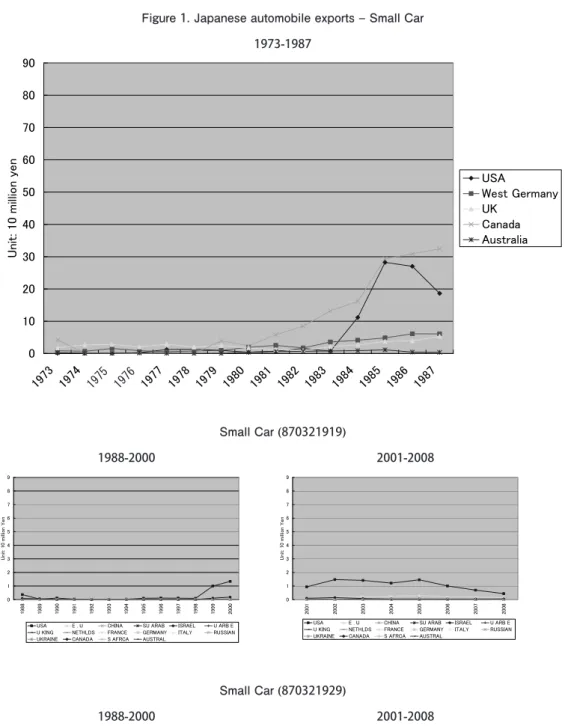
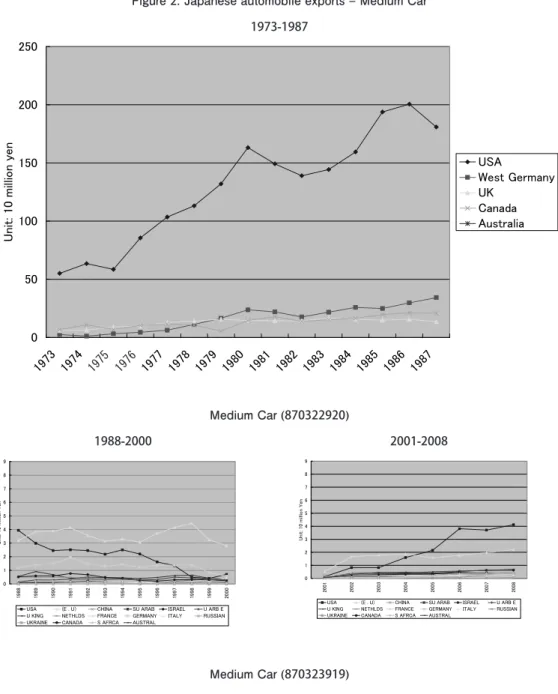
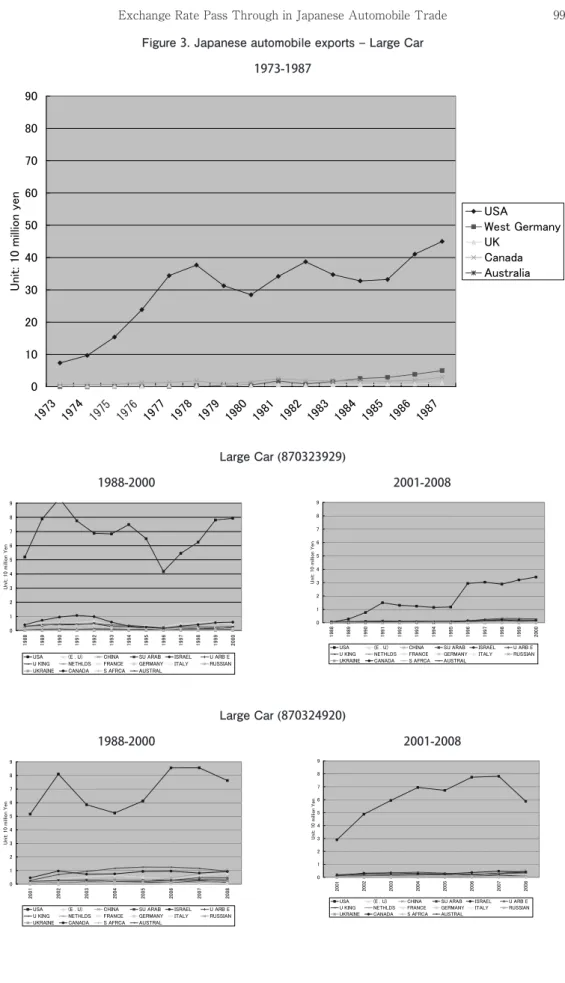
Figure 1〜3 show the amounts of Japanese automobile exports by the size of the cars and by destinated country.
93 Exchange Rate Pass Through in Japanese Automobile Trade
2 . 2 Pass-through
Among several points of the paper, this paper especially focuses on exchange rate pass through.
We found a couple of important points in the interviews about pass-through of exchange rates. We asked if they change car prices when exchange rates changes. What they answered first was, it depends on “market power.” If they have market power in the market, they alter prices of their products flexible when the exchange rate changes, while they canʼt change their prices by themselves if they donʼt have market power. This is one of the factors which pass-through papers have discussed so far. The term “market power” is usually defined as the power which can change the prices. The automobile companies said that they think the sources of the market power are market share of the company, quality of the products, and competitiveness of the company.
3 .Model
We start with the basic monopolistic competition model of pricing to market. Suppose a Japanese monopolistic firm in the i-th industry sells in US markets. Later, it will extend to the model of the company exporting into multiple countries. The profit function of the firm is assumed to be as follows.
3. Model
We start with the basic monopolistic competition model of pricing to market.
Suppose a Japanese monopolistic firm in the i-th industry sells in US markets. Later, it will extend to the model of the company exporting into multiple countries. The profit function of the firm is assumed to be as follows.
USExpit
WJP MJP
JAit US US
it t itYen Expit US itYen
Exportit GDP C d P P
P P s d
P , , ,
1
(Eq.4-1)
Where letter i denotes good i and letter t denotes time t. π denotes export company’s profit, PExpJA denotes export price in terms of yen, dUS denotes demand for the good i, P denotes the price of competing companies, Pw denotes wage price, Pm denotes price of intermediate goods and primitive goods, s denotes exchange rates in terms of Japanese Yen, and cJA denotes production costs.
USLocalit
WUS MUS
USit US US
it it it Local it US
LocalPit GDP C d P P
P d P
P$ $ , , ,
Where it PitYen P$ S1
US MUS
it W Local it US US US
US it
itYen Localit
US itYen
LocalPit GDP S C d S P S P
P SP d
P
S
, , ,
1
Localit it US
Export US
US d d
d
(Eq.3-1)
Where letter i denotes good i and letter t denotes time t. π denotes export companyʼs profit, 3. Model
We start with the basic monopolistic competition model of pricing to market.
Suppose a Japanese monopolistic firm in the i-th industry sells in US markets. Later, it will extend to the model of the company exporting into multiple countries. The profit function of the firm is assumed to be as follows.
JP MJP
it W Exp it US JA US US
it t Yen it Expit US itYen
Exportit GDP C d P P
P P s d
P , , ,
1
(Eq.4-1)
Where letter i denotes good i and letter t denotes time t. π denotes export company’s profit, PExpJA denotes export price in terms of yen, dUS denotes demand for the good i, P denotes the price of competing companies, Pw denotes wage price, Pm denotes price of intermediate goods and primitive goods, s denotes exchange rates in terms of Japanese Yen, and cJA denotes production costs.
US MUS
it W Local it US US US US
it it it Local it US
LocalPit GDP C d P P
P d P
P$ $ , , ,
Where it PitYen P$S1
US MUS
it W Local it US US US
US it
Yen it Localit US Yen it it
LocalP GDP S C d S P S P
P SP d
P
S
, , ,
1
Localit it US Export US
US d d
d
denotes export price in terms of yen,
3. Model
We start with the basic monopolistic competition model of pricing to market.
Suppose a Japanese monopolistic firm in the i-th industry sells in US markets. Later, it will extend to the model of the company exporting into multiple countries. The profit function of the firm is assumed to be as follows.
JP MJP
it W Exp it US JA US US
it t Yen it Expit US itYen
Exportit GDP C d P P
P P s d
P , , ,
1
(Eq.4-1)
Where letter i denotes good i and letter t denotes time t. π denotes export company’s profit, PExpJA denotes export price in terms of yen, dUS denotes demand for the good i, P denotes the price of competing companies, Pw denotes wage price, Pm denotes price of intermediate goods and primitive goods, s denotes exchange rates in terms of Japanese Yen, and cJA denotes production costs.
US MUS
it W Local it US US US US it it it Local it US
LocalPit GDP C d P P
P d P
P$ $ , , ,
Where it PitYen P$S1
US MUS
it W Local it US US US
US it
itYen Localit US itYen
LocalPit GDP S C d S P S P
P SP d
P
S
, , ,
1
Localit it US Export US
US d d
d
denotes demand for the good i,
3. Model
We start with the basic monopolistic competition model of pricing to market.
Suppose a Japanese monopolistic firm in the i-th industry sells in US markets. Later, it will extend to the model of the company exporting into multiple countries. The profit function of the firm is assumed to be as follows.
JP MJP
it W Exp it US JA US US
it t Yen it Expit US itYen
Exportit GDP C d P P
P P s d
P , , ,
1
(Eq.4-1)
Where letter i denotes good i and letter t denotes time t. π denotes export company’s profit, PExpJA denotes export price in terms of yen, dUS denotes demand for the good i, P denotes the price of competing companies, Pw denotes wage price, Pm denotes price of intermediate goods and primitive goods, s denotes exchange rates in terms of Japanese Yen, and cJA denotes production costs.
US MUS
it W Local it US US US US
it it it Local it US
LocalPit GDP C d P P
P d P
P$ $ , , ,
Where it PitYen P$S1
US MUS
it W Local it US US US
US it
itYen Localit US Yen it it
LocalP GDP S C d S P S P
P SP d
P
S
, , ,
1
Localit it US Export US
US d d
d
denotes the price of competing companies,
3. Model
We start with the basic monopolistic competition model of pricing to market.
Suppose a Japanese monopolistic firm in the i-th industry sells in US markets. Later, it will extend to the model of the company exporting into multiple countries. The profit function of the firm is assumed to be as follows.
JP MJP
it W Exp it US JA US US
it t Yen it Expit US itYen
Exportit GDP C d P P
P P s d
P , , ,
1
(Eq.4-1)
Where letter i denotes good i and letter t denotes time t. π denotes export company’s profit, PExpJA denotes export price in terms of yen, dUS denotes demand for the good i, P denotes the price of competing companies, Pw denotes wage price, Pm denotes price of intermediate goods and primitive goods, s denotes exchange rates in terms of Japanese Yen, and cJA denotes production costs.
US MUS
it W Local it US US US US it it it Local it US
LocalPit GDP C d P P
P d P
P$ $ , , ,
Where it PitYen P$ S1
US MUS
it W Local it US US US
US it
itYen Localit US itYen
LocalPit GDP S C d S P S P
P SP d
P
S
, , ,
1
Localit it US Export US
US d d
d
denotes wage price, 3. Model
We start with the basic monopolistic competition model of pricing to market.
Suppose a Japanese monopolistic firm in the i-th industry sells in US markets. Later, it will extend to the model of the company exporting into multiple countries. The profit function of the firm is assumed to be as follows.
JP MJP
it W Exp it US JA US US
it t Yen it Expit US itYen
Exportit GDP C d P P
P P s d
P , , ,
1
(Eq.4-1)
Where letter i denotes good i and letter t denotes time t. π denotes export company’s profit, PExpJA denotes export price in terms of yen, dUS denotes demand for the good i, P denotes the price of competing companies, Pw denotes wage price, Pm denotes price of intermediate goods and primitive goods, s denotes exchange rates in terms of Japanese Yen, and cJA denotes production costs.
US MUS
it W Local it US US US US it it it Local it US
LocalPit GDP C d P P
P d P
P$ $ , , ,
Where it PitYen P$S1
US MUS
it W Local it US US US
US it
itYen Localit US itYen
LocalPit GDP S C d S P S P
P SP d
P
S
, , ,
1
Localit it US Export US
US d d
d
denotes price of intermediate goods and primitive goods,
3. Model
We start with the basic monopolistic competition model of pricing to market.
Suppose a Japanese monopolistic firm in the i-th industry sells in US markets. Later, it will extend to the model of the company exporting into multiple countries. The profit function of the firm is assumed to be as follows.
JP MJP
it W Exp it US JA US US
it t Yen it Expit US itYen
Exportit GDP C d P P
P P s d
P , , ,
1
(Eq.4-1)
Where letter i denotes good i and letter t denotes time t. π denotes export company’s profit, PExpJA denotes export price in terms of yen, dUS denotes demand for the good i, P denotes the price of competing companies, Pw denotes wage price, Pm denotes price of intermediate goods and primitive goods, s denotes exchange rates in terms of Japanese Yen, and cJA denotes production costs.
US MUS
it W Local it US US US US
it it it Local it US
LocalPit GDP C d P P
P d P
P$ $ , , ,
Where it PitYen P$ S1
US MUS
it W Local it US US US
US it
itYen Localit US Yen it it
LocalP GDP S C d S P S P
P SP d
P
S
, , ,
1
Localit it US Export US
US d d
d
denotes exchange rates in terms of Japanese Yen, and 3. Model
We start with the basic monopolistic competition model of pricing to market.
Suppose a Japanese monopolistic firm in the i-th industry sells in US markets. Later, it will extend to the model of the company exporting into multiple countries. The profit function of the firm is assumed to be as follows.
USExpit
WJP MJP
JAit US US
it t itYen
Expit US Yen it it
Export GDP C d P P
P P s d
P , , ,
1
(Eq.4-1)
Where letter i denotes good i and letter t denotes time t. π denotes export company’s profit, PExpJA denotes export price in terms of yen, dUS denotes demand for the good i, P denotes the price of competing companies, Pw denotes wage price, Pm denotes price of intermediate goods and primitive goods, s denotes exchange rates in terms of Japanese Yen, and cJA denotes production costs.
US MUS
it W Local it US US US itUS
it it Local it US
LocalPit GDP C d P P
P d P
P$ $ , , ,
Where it PitYen P$ S1
US MUS
it W Local it US US US
US it
Yen it Localit US itYen
LocalPit GDP S C d S P S P
P SP d
P
S
, , ,
1
Localit it US Export US
US d d
d
denotes production costs.
3. Model
We start with the basic monopolistic competition model of pricing to market.
Suppose a Japanese monopolistic firm in the i-th industry sells in US markets. Later, it will extend to the model of the company exporting into multiple countries. The profit function of the firm is assumed to be as follows.
USExpit
WJP MJP
JAit US US
it t itYen Expit US itYen
Exportit GDP C d P P
P P s d
P , , ,
1
(Eq.4-1)
Where letter i denotes good i and letter t denotes time t. π denotes export company’s profit, PExpJA denotes export price in terms of yen, dUS denotes demand for the good i, P denotes the price of competing companies, Pw denotes wage price, Pm denotes price of intermediate goods and primitive goods, s denotes exchange rates in terms of Japanese Yen, and cJA denotes production costs.
USLocalit
WUS MUS
USit US US
it it it Local it US
LocalPit GDP C d P P
P d P
P$ $ , , ,
Where it PitYen P$ S1
US MUS
it W Local it US US US
itUS itYen Localit
US itYen
LocalPit GDP S C d S P S P
P SP d
P
S
, , ,
1
Localit it US
Export US
US d d
d
Where 3. Model
We start with the basic monopolistic competition model of pricing to market.
Suppose a Japanese monopolistic firm in the i-th industry sells in US markets. Later, it will extend to the model of the company exporting into multiple countries. The profit function of the firm is assumed to be as follows.
USExpit
WJP MJP
JAit US US
it t itYen Expit US itYen
Exportit GDP C d P P
P P s d
P , , ,
1
(Eq.4-1)
Where letter i denotes good i and letter t denotes time t. π denotes export company’s profit, PExpJA denotes export price in terms of yen, dUS denotes demand for the good i, P denotes the price of competing companies, Pw denotes wage price, Pm denotes price of intermediate goods and primitive goods, s denotes exchange rates in terms of Japanese Yen, and cJA denotes production costs.
USLocalit
WUS MUS
USit US US
it it it Local it US
LocalPit GDP C d P P
P d P
P$ $ , , ,
Where it PitYen P$ S1
US MUS
it W Local it US US US
itUS itYen Localit
US itYen
LocalPit GDP S C d S P S P
P SP d
P
S
, , ,
1
Localit it US
Export US
US d d
d