Big Bang Nucleosynthesis
Riou NAKAMURA1 、Masa-aki HASHIMOTO1、 Katsuhiko SATO2,3 and KenzoARAI4
1 Department of Physics, Kyushu University, Fukuoka 812-8581
2 Institute for the Physics and Mathematics of the Universe, The University of
Tokyo, Kashiwa, 277-8568
3 School of Science and Engineering, Meisei University, Tokyo 191-8506 4 Department of Physics, Kumamoto University, Kumamoto 860-8555
(Received September 30, 2010)
Big bang nucleosynthesis is reviewed with taking into account the observed abundance of light elements. We examine the standard big bang nucleosynthesis (SBBN) and confirm that helium abundance is not enough to fix the baryon to photon ratio tj. As for deuterium, observational constraint on r\ agrees well with the value determined from WMAP. It is, how ever, difficult to reconcile the observations of 7Li with the WMAP constraint. Furthermore, we investigate a simple two-zone model of inhomogeneous big bang nucleosynthesis (IBBN), where we review a series of our recent studies. In a high density region, heavy elements are produced up to the mass number 160. We present several interesting results that may become an important milestone for the origin of the elements in the universe.
§1. Introduction
Primordial nucleosynthesis is one of the best astrophysical sites to understand
the origin of the elements,1) because it produces the reasonable abundances2)'3) of light elements, 4He, D and 7Li. The simplest and most trustful theory is called the
standard big-bang nucleosynthesis (SBBN), where we assume the cosmological prin ciple that the universe is homogeneous and isotropic in the large scale. Unfortunately, current situation of SBBN cannot be compatible with the observed abundance of 7Li, though observational uncertainties have been pointed out such as the atmosphericmodel of metal-poor stars4) or some unknown physical processes.5)
On the other hand, heavy element nucleosynthesis beyond the mass number
A = 8 has been investigated in a framework of inhomogeneous BBN (IBBN) 6)~11) The baryon inhomogeneity is induced from baryogenesis10) or some phase transi tions11)'12) as the imiverse cools down during the expansion of the universe. It should
be noted that IBBN motivated by QCD phase transition becomes difficult, because the transition has been proved to be crossed over smoothly by the Lattice QCD sim
ulations,13) which means that the phase transition occurs between the quark-gluon
plasma and hadron phase under the finite temperature and zero chemical potential.
Although a large scale inhomogeneity of baryon distribution should be ruled out by
cosmic microwave background (CMB) observations,14)'15) there still be advocated for
small scale inhomogeneities within the present accuracy of observations. Therefore, it remains possible for IBBN to occur in some degree during the early era.
The Wilkinson Microwave Anisotropy Probe (WMAP) has derived critical pa rameters concerning the cosmology of which the baryon to photon ratio r/ is deter-
mined15) to be r?WMAP = (6.19 ± 0.15) x 10~10. While the uncertainty in the observed abundance of 4He is large, the value r/WMAP is surely consistent with that obtained
from the observation of D. Therefore, we are able to fix r/WMAP in considering the nucleosynthesis in the early universe. Once r\ is determined, BBN can be performed along the thermodynamical history with use of the nuclear reaction network (BBNcode).16) On the other hand, peculiar observations of abundances for heavy elements and/or 4He could be understood in the way of IBBN. For example, metallicity of C, N and Si in quasars could be explained from IBBN.17) Furthermore, from recent
observations of globular clusters, possibility of inhomogeneous distribution of He ispointed out,18) where proposed are some separate groups of different main sequences
in blue band of low mass stars due to high primordial helium abundances.19)Using recent progress in observations, it could be urgent to re-investigate IBBN
as opposed to Ref. 20). It has been found that21) synthesis of heavy elements for both
p- and r-processes is possible if 77 > 10~4 and that the high 77 regions are compatible with the observations of the light elements, 4He and D. However, the analysis is only limited to a parameter of a specific baryon number concentration. Therefore we need to constrain the possible regions in the universe by adopting a two-zone model comparing with available observations.§2. Thermal evolution of the universe
Based on the cosmological principle or the Robertson-Walker metric,, the stan dard model has been constructed with use of the Einstein equation. In practice, we can follow the evolution of temperature T and energy density p by solving the Friedmann equation
'"'-¥* (-»
where x is the cosmic scale factor and G is the gravitational constant. The total energy density p is written as
P = Ay + Pv + Pe± + Pb*
where the subscripts 7,1/, e± and b indicate photons, neutrinos, electrons/positrons and baryons, respectively.
The energy conservation law is given by
-(z3) = 0, (2.2)
where p is the pressure of the fluid. The equation of state is described as for photons and neutrinos,
for baryons.
Therefore, the baryon density varies as pb ex x"3 and the temperature as T oc x~l
except for the era of the significant contribution of e± to the energy density at
T ~ 5 x 10⁹ K. We include the effects of e± annihilation on the temperature.23)
10"
io"2 10"4
1 io"6
I*
10.-12
-
_
y/ im S
*•' ' f
— "* ^ //"
•" 1
/ |
1 / '
A-
; V -
/ / ^\
I
1 /
/1 / —
1 /I /
— nm
— p ---- D/H
—' 3He/H - -4He
Li/H
7Be/H
10" 1OU 101 10*
Time [sec]
10' 10*
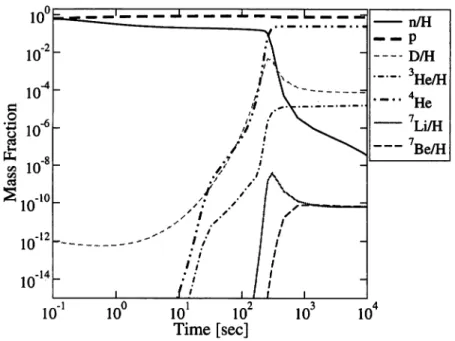
Fig. 1. Evolution of mass fractions in SBBN for t?wmap = 6.19 x 10"10
§3. Standard big bang nucleosynthesis
It has been advocated that SBBN is established to explain the origin of the
light elements. We calculate nucleosynthesis with use of the BBN code16) which contains 24 nuclei from neutron to 16O. We adopt the reaction rates of NACRE,24) the neutron life time tn = 885.7 sec,25) and take the number of species of massless
neutrinos to be JVi, = 3. Figure 1 shows the evolution of main components of light elements for /?WMAP = 6.19 x 10"10. Significant amounts of D, 3He, 4He, 7Li and 7Be are produced during the first 3 min. However, as has recently been pointed out, there remains a problem in SBBN that is clarified by considering the current observations.
The primordial abundance of 4He, by mass fraction, is3)
yp = 0.2477 ± 0.0029, (3.1)
which includes the systematic uncertainties in various observations. The number
ratio of deuterium is observed26) to be
D/H =(2.82 ±0.12) xlO"5.
The observed abundance of 7Li is27)
7Li/H = (2.19 ± 0.28) xHT10,
(3.2)
(3.3) which is inconsistent with the calculated abundance in SBBN. This problem is diffi
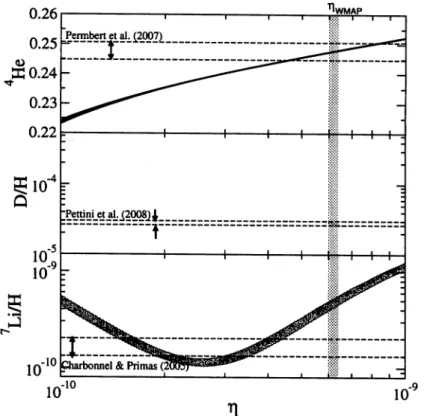
cult to solve at the present stage. In Fig. 2 we show the produced values of 4He, D/H
and 7Li/H as a function of 77. The line widths for individual elements correspond to
0.26
•Pettini et al._£2008J J
====z=.=== -zzzzzzzz
Fig. 2. Abundance of light elements produced in SBBN as a function of r). The vertical hatched region i?WMAP = (6.19 ±0.15) x 10"10 indicates the constraint from WMAP.15)
the errors attached to the nuclear reaction rates of NACRE. Although a new decay
rate of free neutrons rN = 878 ± 0.7 ± 0.3 sec yields28) Yp ~ 0.245, we adopt the
conservative rate considering the uncertainty of the half life.29)As against the excellent agreement for D and 4He, the discrepancy for 7Li is un allowable. To solve this problem, we could rely on some unknown physical processes, nuclear reaction rates coupled with other reaction paths, and/or non standard mod els. It is noted that the observations of 7Li involve uncertain atmospheric models concerning the low metallicity stars. The metallicity is measured usually from the abundance ratio relative to the solar value, e.g., [Fe/H]=log(Fe/H)Obs - log(Fe/H)0.
Although the origin has been advocated to be cosmic spallation, puzzles of severe underproduction of 6Li, 9Be and nB in SBBN would be attributed to non standard scenario.
3.1. Neutrino degeneracy
Effects of neutrino degeneracy associated with /3-decays have been investigated.30)
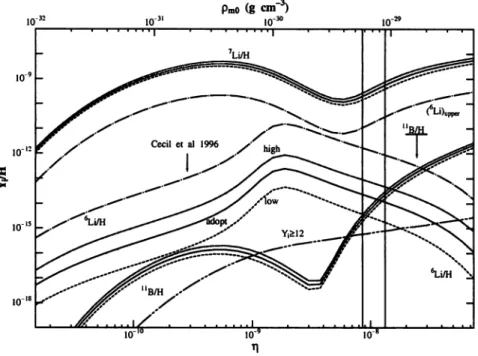
Our consideration is restricted to the inconsistency of the 7Li abundance in low metallicity stars. The degeneracy would change the ratio 6Li/7Li which dependson the rate of D(a,7)6Li reaction. Figure 3 shows the abundance of 6'7Li and nB
with including neutrino degeneracy31) & = /Xt/fcT, where m is the chemical poten
tial of neutrinos. The uncertain ranges due to the cross sections of NACRE24) are
illustrated by the bands. Also shown is the observational constraint by the vertical
lines.32)'33) Two upper limits deduced from low metallicity stars [Fe/H] ~ -3 are 6Li/7Li < 0.052 ± 0.0019 and B/H < (3 - 6) x 10~12. The produced abundances of 6Li and nB could be highly affected by neutrino degeneracy through 77, since they
shift significantly to higher densities due to rapid expansion. Precise determination of the cross sections of D(a,7)6Li and 7Li(a,7)nB should give an insight into not only primordial abundances of Li-Be-B but the dark baryon density.
10
Pmo (g cm"3)
10-30
■ ■^■■■■■,'fiT ■ ■ ■
Fig. 3. Abundances of 6'7Li and nB produced in a neutrino degenerate model with £e = 1.29 and
& = 20.
§4. Inhomogeneous big bang nucleosynthesis
A new astrophysical site of BBN is presented22) that contains very high 77. In
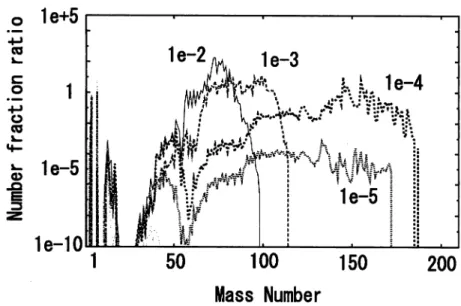
Fig. 4 we show the evolution of abundance for 77 = 10~~4, where neutrons are still left when heavy elements are synthesized. Stable nuclei with the mass number A = 90 are first synthesized with being followed by proton rich nuclei. On the other hand, other stable nuclei with A = 158 are synthesized through neutron rich nuclei. Figure 5 shows the similar results for 77 = 10~3, where almost all neutrons are consumed before heavy elements are produced appreciably. The number fractions relative tothe solar system abundances are shown in Fig. 6 .for 77 = 10~5 — 10~2. Note that the
mass number of the produced elements is the largest at 77 ~ 10"4. The problem to
be solved is the origin and evolution of the high density region. The size of the highdensity island is estimated22) to be 105 - 1017 cm at the BBN epoch. The upper
bound is obtained from the maximum angular resolution of CMB and the lower is1e-04
oCO
1e-08
COCO
1e-12
1e-15
J if
P
Eu158
vX Mo90
\ Zr!
6dl58
1 100 10000 1e+6
Time (sec)
Fig. 4. Evolution of mass fractions in a high density region22) with r\ = 10~4.
§ 1e-04
CO CO
100
Time (sec) Fig. 5. Same as Fig. 4 but for r\ = 10~3.
10000
from the analysis7^ of comoving diffusion length of neutrons and protons.
Some models of baryogenesis suggest that very high baryon density regions form in the early universe. Recent observations, however, suggest that heavy elements could already exist in high red-shift epochs and therefore the origin of these elements becomes a serious problem. Motivated by these facts, we investigate BBN in very high baryon density regions. BBN proceeds in proton rich environment, which is regarded as a rapid p-process. However, by taking heavy nuclei into account, we find that BBN proceeds through both p- and r-processes simultaneously. Furthermore, p-nuclei such as 92Mo, 94Mo, 96Ru and 98Ru, whose origin is not well known, are
1e+5
1e-10 200
50 100 150
Mass Number
Fig. 6. Number fractions relative to the solar system abundances.22)
also synthesized. The above issues should be refined and checked by investigating the possible model consistent with available observations.
4.1. Two-zone model of IBBN
Quite interesting features22) have been presented for the possibility of IBBN,
but relevant parameters concerning the high and low density regions have not yet been specified. Therefore, we explore the reasonable parameters using a simple two-
zone model.8) The early universe is assumed to contain high and low baryon density
regions. For simplicity we ignore the diffusion effects.
We assume that all the produced elements are mixed homogeneously at some epoch between the end of BBN and the recombination era. To construct a two-zone model, we need to define nove, Uhigh and n^ as the average-, high-, and low-number densities of baryons, fv as the volume fraction of the high baryon density region, and Xfve, X{ tg and Xl™ as the mass fractions of element i in the average-, high- and low-density regions, respectively. Then the basic relations between these variables are written as
nave = fvnhigh
nn \-ave + (1 - /,) nlowX
T
(4.2)If the baryon fluctuation is assumed to be isothermal,6)'11)'12) then Eqs. (4.1) and
(4.2) are divided by the number density of photons n7 to beWave = fvWhigh + (* ~ fvfolowi (4-3)
Vave^i = fv*i Vhigh + U " Jv)Xi Wlow \^A) Here t/'s are
Wave —
n7 Whigh = Tthigh
Vlaw = n7
1011
V io10 I
Q.
d)
10:
10e
,9 .;JV>V
. . .1
r .^.
■ "1 ■ • "1 • ■ *
Phigh :
P|(
.......
*■
DW
••s
:
• i
!
i !
:--*v ^
: \.
i 104
10"
10"1 10° 101 102 103 104
Time [sec]
Fig. 7. Temperature and baryon densities for /„ = 10~4 and R = 106.
where r\ave is set to be the observed value15) t?wmap = 6.1 x 10"10. Both r)high and
Vlow **e determined from fv and the density ratio R = nhigh/nlaw = ^^/r/^.We note that pb is the average baryon density obtained from Eq. (4.1), and temperature T is set to be homogeneous. This assumption is critically important to build our model; otherwise we must treat the zones to evolve separately, which involves fundamental problem as opposed to the cosmological principle.
Figure 7 shows the temperature (dashed line) and the baryon densities against time in the IBBN model with fv = 10"~4 and R = 106. Note that plaw is nearly equal to that in SBBN, while phigh becomes very large. This indicates that nucleosynthesis in individual regions yields quite different elements.
4.2. Constraints from light-element abundances
We show in Fig. 8 an example of light element synthesis in the high and low
density regions with fv = 10~6 and R = 106 that correspond to rjhigh = 3.05 x 10~"4 s^d Vlow = 3.05 x 10~10. In the right panel with 77/^ the evolution of the elements
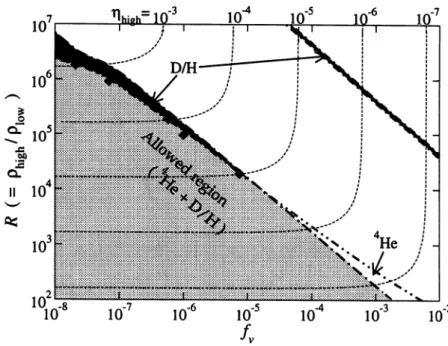
is almost the same as that of SBBN. In the left panel with rjhigh^ D and 4He are synthesized at higher temperatures. This is because the reaction p + n -> D + 7 starts at earlier epoch. In addition the amount of 4He is larger than that in the low density region, because neutrons still remain when nucleosynthesis starts. On the other hand, 7Li (or 7Be) is much less produced. It implies that heavier nuclei, such as 12C and 16O, are synthesized in the high density region. Using these calculated abundances in both regions, we obtain the average values of the light elements from Eq. (4.4). Then we can put constraints on fv and R by comparing the values of Yp and D/H with the observed abundances.The constraints are shown in Fig. 9 on the fv - R plane with the contours of rihigh- In our analysis, we obtain only the upper limit to the parameter R. Note that
the allowed region includes as very high density region as rjhigh = 10"3.
ltf
10-2
•S ,n"6
10
10"
,-12 _
—**■
~r
•
1 x
-
\ \
h
i i —
a• ■■■■■bb■■
n
p ... D
•-'4He
7_Be
v-i
s L.
•
• /
-1 1 L.-s
A--- -
4
/ \
\1. .:
10" 10 10 10
time [sec]
10410°
101 10' 10 time [sec]Fig. 8. Evolution of light elements in IBBN with /„ = 10~6 and R = 106. The left panel indicates the high density region rihigh = 3.05 x 10"4. The right panel is the low density region t)iow = 3.05 x 10~10.
Since rihigh takes a larger value, nuclei heavier than 7Li are synthesized more and more. Then we estimate the abundance of CNO elements in the allowed region.
Figure 10 shows the contours of the summation of Xfve over heavier nuclei (A > 7).
As far as our small BBN code is concerned, the total mass fraction of CNO nuclei amounts to X(A > 7) ~ 10"7.
4.3. Synthesis of heavy elements in high density region
We investigate synthesis of heavy elements in the high-density region considering the constraints shown in Fig. 9. The evolution of temperature and density is the same as in the previous subsection. The abundance change is calculated with a large nuclear reaction network, which contains 4463 nuclei from neutron, proton to Americium (Z = 95 and A = 292). The nuclear data such as reaction rates, nuclear masses and partition functions are the same as used in Ref. 34) except for the weak
interaction rates35) which is adequate for the high temperature stage T > 1010 K.
Note that the mass fractions of 4He and D obtained with the large network are consistent with those calculated with a small network in §4.2 within an accuracy of a few percents.
As seen in Fig. 10, heavy elements are produced at the level X(A > 7) > 10~~9
nearly along the upper limit of R in the allowed region. To examine the efficiency of the heavy element production, we select five models with parameters rihigh =
(1,5.5,10.2,53,106) x 10"5, which are indicated by the filled squares in Fig. 9.
Table I gives the abundance of light elements in the high and low density regions
for Case A with rihigh = 1-02 x 10~4 and Case B with rihigh = 1.06 x 10"3. The mass
fractions in the low density region (the second columns) are same as those obtained
Fig. 9. Constraints on the /„ - R plane from the observed abundance of light elements. The double dots-dashed line is derived from Yp and the dot-dashed line is from D/H. The shaded region is allowed from both Yp and D/H. The dotted lines indicate the contours of Tfhigh- The filled squares indicate the parameters for which synthesis of heavy elements is examined in §4.3.
in § 3, because the abundance flows beyond A = 7 are negligible. We should note that the averages of Yp and D/H coincide with the observed abundances (3.1) and (3.2).
In the high density region of Case A, the nucleosynthesis paths proceed along the stable line during a few seconds, and afterwards they are classified with the mass number. For nuclei with A < 100, proton captures become very active compared to neutron capture at T > 2 x 10⁹ K and the path shifts to the proton rich side, which begins from breaking out the hot CNO cycle. For nuclei of 100 < A < 120, the path goes across the stable nuclei from proton- to neutron-rich side, since temperature decreases and the number of seed nuclei of neutron capture increases significantly.
Neutron captures become much more efficient for heavier nuclei of A > 120. The neutron capture is not similar to the canonical r—process, since the nuclear reactions
proceed under the condition of the high-abundance of protons. For example, 159Tb, 159Gd and 159Eu are synthesized through neutron captures. After t = 103 sec, we can see /3-decays 159Eu -> 159Gd -> 159Tb, where the lifetimes of 159Eu and 159Gd
are 10.1 min and 18.479 h, respectively.
In Case B the reactions also first proceed along the stable line in the high density region. Subsequently, the reactions directly proceed to the proton-rich side through rapid proton captures. We can see /3-decays 108Sn -> 108In -> 108Cd, where the lifetimes of 108Sn and 108In are 10.3 min and 58.0 min, respectively. In addition, radioactive nuclei 56Ni and 57Co are produced just after the formation of 4He in
the extremely high density region with r)high > 10"3 like the beginning of supernova
X(A>7)=106 Iff7 Iff8 Iff9 Iff10
S\itorvt(iregion vv
Fig. 10. Contours of the total mass fractions of heavier nuclei (A > 7). The shaded allowed region is the same as in Fig. 9.
explosions.36^
Figure 11 shows the evolutions of the neutron abundances for relevant values of rjhigh. When rj^igh = 10~3, the neutron abundance decreases immediately at t ~ 10 sec because of the rapid production of 4He and 56Ni. Therefore, the neutron abundance is not enough for neutron capture to produce heavy nuclei of A > 90. On the contrary, neutrons still remain even at high temperatures for the lower value of
Vhigh- If ^high = 10~4> neutrons are left to induce the neutron captures. Note that,
as seen from Fig. 6, synthesis of heavy elements beyond A ~ 50 becomes inefficient for i) < 10"4.
The decrease in time scales change drastically the flow of BBN. When rjhigh = 5.3 x 10~4, nucleosynthesis proceeds along the stable line by way of the neutron induced reactions before the significant decrease in the neutron abundances at t ~ 10 sec. At that time, the nuclear reactions are stuck around Z = 60 with N = 82, since it takes long time to synthesize heavier nuclei because there are stable isotopes Nd (Z = 60) and Sm (Z = 62). As time goes, neutron captures start by these nuclei and r-elements can be synthesized. After the depletion of neutrons at t ~ 40 sec, nuclei around the neutron numbers N = 82 like 144Sm are produced through proton induced reactions. •
In Case A a lot of nuclei of A > 7 are synthesized whose amount is comparable
to that of 7Li. The yields include both s-element 138Ba and r-elements such as 142Ce
and 148Nd, since moderate amounts of neutrons remain as shown in Fig. 11.In Case B there are few r-elements, though both s-elements 82Kr and 89Y and
p-elements 74Se and 78Kr are synthesized. A significant amount of heavy elementsTable I. Mass fractions of light elements in IBBN. tfin and Tfin are the time and temperature at the final stage of our calculations.
Case A
/«> R
*/»n> Tfin elements
P D
3He
4He7Li
1.0 x 1.02 x
10~7, 1.7 10"4, 6.00 1.2 x 10s sec, 4.3 >
high 0.638 6.84 x 10"22
2.9 x 10"14
0.362
7.42 x IO-13
low 0.752 4.34 x 10"5
2.2 x 10"5 0.248
1.87 x KT9
xlO5 x 10-i°<107K
average
0.750 4.27 x 10"5
9.3 x 10"6 0.249 1.70 x 10~9 CaseB
fv, R
*fini Tfin elements
P D
3He 4He 7Li
2.1 x 1.06 x
1.0 x]
high 0.586
1.76 x 10"2i
2.9 x IO-140.413 1.63 x IO-13
10"8, 1.8:
10"3, 5.88 >
0& sec, 4.2 x low 0.753
4.48 x 10~5
2.2 x 10~50.247
1.79 x 10~9
< 10°
( 10-1°
107K
average
0.746 4.32 x 10~5
9.3 x 10~6 0.253 1.72 x 10~9
A < 90 is produced owing to the explosive nucleosynthesis under the high density circumstances (p ~ 106 g cm"3). The most abundant element is found to be 56Ni.
The produced amoimt is much larger than the upper limit of the mass fraction derived from the usual calculations with the BBN code, because our BBN code used in § 3 contains the elements up to 16O and the actual abundance flow proceeds to much heavier elements.
Figure 12 shows the averaged abundances Xfve compared with the solar system
abundances.:37) When 77/^ ~ 10~4, the produced abundance of 120 < A < 180 is
comparable to the solar values, while nuclei of 50 < A < 100 have been synthesized
well for r}high — 10"3. lirjhigh = 5-3 x 10~4, there are outstanding two peaks around
A = 56 (N = 28) and around A = 140. The abundance pattern is very different from that of the solar system, because IBBN occurs under the peculiar condition of abundant neutrons and protons.
Finally we show in Fig. 13 the evolution of abundances which are classified in the solar system abundances as pure nuclei of 5, r and p-elements. We remark the
coexistence of Xe isotopes produced simultaneously. These isotopic anomalies38)
observed in many samples of meteorites are regarded as a long-standing problem.
Our IBBN model, therefore, could present a clue to solve this problem.
10°
time [sec]
10"
Fig. 11. Evolution of the neutron abundances. The double dots line indicates SBBN with r/
6.1 x 10"10. The others indicate the high density regions in IBBN.
fv=5.7x10"!R=1.9x10⁶
fv=1.0x1 O":R=1 .7x10
fv=1.0x10'8R=1.7x10⁵
Anders & Grevesse +
10
100 150 200
Mass number
250
Fig. 12. Comparison of the averaged mass fractions for rjhigh = 10 4.
§5. Summary and discussions
We have compared the results of SBBN with the current observations of light el ements. Considering the uncertainties in the nuclear reaction rates and the observed errors, we can summarize as follows:
1
o10 10 10
10 10=
Mo92 (p) Mo96 (s) Mo100(r Xe126(p Xe128(s Xe136(r Sm144(p Sm148(s Sm154(r
Fig.
Time [sec]
13. Evolutions of the averaged mass fraction of pure nuclei for r\hi3h = 10~4.
(1) The consistency is confirmed as fax as 4He and D are concerned.
(2) Large uncertainties of He observations may indicate some unknown processes beyond SBBN. For example, a large value of Yp ~ 0.3 has been reported in low
metallicity stars in globular clusters.39)
(3) The significant discrepancy in 7Li remains to be solved.
(4) Underproduction of 6>7Li and/or UB might be ascribed to some uncertain nuclear reaction rates coupled to non-standard model loaded with neutrino degener
acy.
The consistency between IBBN and the observations of 4He and D/H abun dances has been investigated under the thermal evolution of the standard model with ?7WMAp. We have examined the two-zone model, where the universe has the high and low baryon density regions separately at the BBN epoch. We have calcu lated nucleosynthesis that covers 4463 nuclei in the high density region. Below we summarize our results and give some prospects.
(1) There are significant differences for the evolution of the light elements be tween the high and low density regions; In the high density region, nucleosynthesis begins at higher temperature. 4He is more abundant than that in the low density region. Using the observed abundances of 4He and D/H, we have constrained two parameters in IBBN: the volume fraction /„ and the density ratio R.
(2) Both p- and r-elements are synthesized simultaneously in the high density
region with rjhigh — 10~4. Total mass fractions of heavier elements than 7Li amount
to 10~7 for r)high = 10"4 and 10~5 for r)hi9h = 10~3. The average mass fractions in IBBN are comparable to the solar system abundances. There exist over-producedelements around A = 150 (for T}high = 10"4) and A = 80 (for i)high = 10"3). We
suspect the results to be in conflict with the chemical evolution in the universe. It is, however, possible to find permissible parameters to avoid the overproduction.
(3) Heavy elements beyond Fe surely affects the formation process of the first generation stars due to the change in the opacity. Therefore, it may be also necessary for IBBN to be constrained from the star formation scenarios.
(4) Although underestimation of observed abundance40) of 7Li cannot be ex
plained in terms of SBBN, our IBBN model may conduce to the answer. A reason able abundance of 7Li can be synthesized not only in the low density region but high density one with adjusting 77.
(5) Although we have ignored the diffusion effects so far, it is shown that they
affects IBBN significantly.8) Evolution and distribution of high density regions in the
sea of low density plasma should be explored considering a statistical analysis.
(6) Because IBBN could provide a clue to solve the long-standing problem of isotopic anomalies in meteorites, comparison between the produced amounts and the observed abundance leads to constrain to our IBBN model.
Acknowledgements
This work has been supported in part by a Grant-in-Aid for Scientific Research (19104006, 21540272) of the Ministry of Education, Culture, Sports, Science and Technology of Japan.
References
1) R. A. Alpher, H. Bethe and G. Gamow, Phys. Rev. 73 (1948), 803.
C. Hayashi, Prog. Theor. Phys. 5 (1950), 224.
R. V. Wagoner, W. A. Fowler and F. Hoyle, Astrophys. J. 148 (1967), 3.
G. Steigman, Ann. Rev. Nucl. Part. Sci. 57 (2007), 463.
F. Iocco et al., Phys. Rept. 472 (2009), 1.
2) V. Luridiana et al., Astrophys. J. 592 (2003), 846.
Y. I. Izotov, T. X. Thuan and G. Stasinska, Astrophys. J. 662 (2007), 15.
D. Kirkman et al., Astrophys. J. Suppl. 149 (2003), 1.
M. Pettini et al., Mon. Not. Roy. Astron. Soc. 391 (2008), 1499.
J. M. O'Meara et al., Astrophys. J. 649 (2006), L61.
3) M. Permbert et al., Astrophys. J., 666, (2007), 636.
4) S. G. Ryan et al., Astrophys. J. 530 (2000), L57.
P. Bonifacio, et al., Astron. Astrophys. , 462 (2007), 851.
5) A. Coc et al., Astrophys. J. 600 (2004), 544
R. H. Cyburt, B. D. Fields and K. A. Olive, JCAP 0811 (2008), 012.
6) N. Terasawa and K. Sato, Phys. Rev. D 39 (1989), 2893.
K. Jedamzik, and J. B. Rehm, Phys. Rev. D 64 (2001), 023510.
T. Rauscher et al., Astrophys. J. 429 (1994), 499.
7) J. H. Applegate, C. J. Hogan and R. J. Scherrer, Phys. Rev. D 35 (1987), 1151.
8) R. M. Malaney and W. A. Fowler, Astrophys. J. 333 (1988), 14.
J. H. Applegate, C. J. Hogan, R. J. Scherrer, Astrophys. J. 329 (1988), 572.
N. Terasawa and K. Sato, Astrophys. J. 362 (1990), L47.
D. Thomas et al., Astrophys. J. 430 (1994), 291.
9) K. Jedamzik, G. M. Fuller, G. J. Mathews and T. Kajino, Astrophys. J. 422 (1994), 423.
10) S. Matsuura, A. D. Dolgov, S. Nagataki and K. Sato, Prog. Theor. Phys. 112 (2004), 971.
11) C. Alcock, G. M. Fuller and G. J. Mathews, Astrophys. J. 320 (1987), 439.
12) G. M. Fuller, G. J. Mathews and C. R. Alcock, Phys. Rev. D 37 (1988), 1380.
H. Kurki-Suonio and R. A. Matzner, Phys.Rev. D 39 (1989), 1046; ibid. D 42 (1990),
1047.
13) Y. Aoki et al., Nature 443 (2006), 675.
14) C.L. Bennett, et al., Astrophys. J. Suppl. 148 (2003), 1.
D. N. Spergel et al., Astrophys. J. Suppl. 170 (2007), 377.
J. Dunkley et al., Astrophys. J. Suppl. 180 (2009), 306.
15) E. Komatsu et al., astro-ph. CO 1001.4538 (2010).
16) M. Hashimoto and K. Arai, Phys. Rep. Kumamoto Univ. 7 (1985), 47.
17) Y. Juarez et al., Astron. Astrophys. 494 (2009), L25.
18) T. Moriya and T. Shigeyama, Phys. Rev. D 81 (2010), 043004.
19) L. R. Bedin et al., Astrophys. J. 605 (2004), L125.
G. Piotto et al., Astrophys. J. 661 (2007), L53.
20) T. Rauscher, Phys. Rev. D 75 (2007), 068301.
21) S. Matsuura, S. I. Pujimoto, S. Nishimura, M. A. Hashimoto and K. Sato, Phys. Rev. D 72 (2005), 123505.
22) S. Matsuura, S. I. Fujimoto, M. A. Hashimoto and K. Sato, Phys. Rev. D 75 (2007),
068302.
23) R. Nakamura, M .Hashimoto, S. Gamow and K. Arai, Astron. Astrophys. 448 (2006), 23.
24) C. Angulo et al., Nucl. Phys. A 656 (1999), 3.
25) K. Hagiwara et al., Phys. Rev. D 66 (2002), 010001.
26) M. Pettini et al., Mon. Not. Roy. Astron. Soc. 391 (2008), 1499.
27) C. Charbonnel and F. Primas, Astron. Astrophys. 442 (2005), 961.
28) G. J. Mathews, T. Kajino and T. Shima, Phys. Rev. D, 71 (2005), 021302.
29) A. P. Serebrov et al., Phys. Lett. B 605, (2005), 72.
A. P. Serebrov et al., Phys. Rev. C 78, (2008), 035505.
30) K. Kohri, M. Kawasaki and K. Sato, Astrophys. J. 490 (1997) 72.
31) M. Hashimoto, M. Kamimura and K. Arai, Few-Body Systems Suppl. 12, (2000), 92.
32) S. Buries, D. Kirkman and D. Tytler, Astrophys. J. 519, 18, 1999.
33) K. Arai, M. Hashimoto and T. Wakita, Phys. Rept. Kumamoto Univ. 11 (2000), 37.
34) S. Fujimoto, M. Hashimoto, O. Koike, K. Arai and R. Matsuba, Astrophys. J. 585 (2003), 418.
O. Koike, M. Hashimoto, R. Kuromizu and S. Fujimoto, Astrophys. J. 603 (2004), 592.
S. Fujimoto, M. Hashimoto, K. Arai and R. Matsuba, Astrophys. J. 614 (2004) 847.
S. Nishimura, K. Kotake, M. Hashimoto, S. Yamada, N. Nishimura, S. Fujimoto and K. Sato, Astrophys. J. 642 (2006), 410
35) L. Kawano, FERMILAB-Pub-92/04-A
36) M. Hashimoto, Prog. Theor. Phys. 94 (1995), 663.
37) E. Anders and N. Grevesse, Geochim. Cosmochim. Acta 53 (1989), 197.
38) M. Rayet, M. Arnould, M. Hashimoto, N. Prantzos and K. Nomoto, Astron. Astrophys.
298 (1995), 517.
39) Y. Izotov and T. X. Thuan, Astrophys. J. 710 (2010), L67.
40) A. J. Korn et al., Nature 442 (2006), 657.