with Super-strong Magnetic Fields
Osamu Nishimura Kohsuke Sumiyoshi and Toshikazu Ebisuzaki
We numerically calculate the radiative transfer in neutron star atmospheres threaded by a . uniform superstrong magnetic field ('" 109Tesla), where not only cyclotron resonant scattering but also photon splitting occurs. Here, the multiangle radiative transfer equations are solved for cyclotron resonant scattering, which depends strongly on an angle of photon propagation with respect to the magnetic field line. The structure of the cyclotron lines are investigated in the self- emitting atmospheres with some super-strong magnetic fields around 4.41 x 10⁹Tesla including photon splitting effects. We find that the cyclotron lines are sufficiently influenced by photon splitting at the cyclotron energy of 5UkeV in which photon splitting become effective. It is also found that the cyclotron absorption lines become shallow due to photon splitting. Furthermore, the spectra could have a common shape even for plasmas with various temperatures in the direction perpendicular to the magnetic field.
We calculate the radiative transfer in self- Cyclotron lines have been detected in the spectra of accreting pulsars' and GRBs. It is also possible to detect these lines in the spectra of SGRs, which are phenomena sim- ilar to GRBs. A large number of numeri- cal calculations[6]"'[13] regarding the cyclotron lines of pulsars and GRBs have been per- formed using the Monte Carlo method or the Feautrier method, but the spectra for neu- tron star atmospheres with superstrong mag- netic field (~ 109T) taking into account cy- clotron resonant scattering have not yet been calculated.
same source.
I.INTRODUCTION
• Assistant Nagano National College of Technology
•• Assistant Computational Science Laboratory
••• Professor Computational Science Laboratory Received October 31, 1997
Key words: Radiative Transfer, Neutron Stars, Soft Gamma Repeaters
'Y -+ e+e-, which is about 1 MeV. The ra- diative transfer problems in such strong mag- netic fields were solved by Baring[3][4] SGRs are events that have episodes of short (~ 1 s), soft (~ 30 keV), intense (~ 100 Crab), gamma-ray bursts (GRBs)[51. The SGRs are distinct from classic GRBs, in that the typ- ical photon energy is 30 keV and the events repeat. The key character is that SGR spec- tra have similarities between bursts from the Recently, neutron star atmospheres with
extremely strong magnetic field of the order of the hundreds teragauss attract attention.
First, the 1979 March 5 burst (GRB 790305) occurred within supernova (SN) remnant N49 in the Large Magellanic Cloud suggests that Soft gamma repeaters (SGRs) could have a surface dipole field of the order ofB ~ 1010T[1]. Second, Paczynski[2j pointed out that the observed luminosities of SGRs may be sub-Eddington for sufficiently large mag- netic fields, using the magnetically reduced opacity. The required fields are given byB >
wmec(2L)1/2e L whereL ~ 2x1038ergs-1is the
o 0
zero-field Eddington limit. The luminosities of some SGRs (SGR 1806-20 or SGR 0525- 66) require B > 1010 ~ 1012T. Such strong fields permit the process of magnetic photon splitting 'Y -+ 'Y'Y to act effectively below the threshold of single photon pair production
On considering neutron star atmospheres with super-strong magnetic fields (~ 109T), we cannot neglect magnetic photon splitting effect, , - t " . This effect become impor- tant only in magnetic fields approaching the quantum critical value, BeT = 4.41 x 10⁹T.
The photon splitting is phenomenon pre- emitting atmospheres of neutron stars with superstrong magnetic field (~ 109T) includ- ing cyclotron resonance scattering and pho- ton splitting. Since these are strongly de- pendent on the angle of photon propagation with respect to the magnetic field line, we solve the radiative transfer problem using multiangles. Although the polarization and relativistic effects are ignored for simplicity, we need to solve the radiative transfer equa- tion taking into account the relativistic ef- fects for plasmas with temperatures of kT >
50keV. We also ignored Compton scattering of the continuum component, since photon splitting effects will be dominant there. In self-emitting atmospheres with super-strong magnetic fields ( ~ 109T), we discuss how influences photon splitting give in the con- tinuum of the spectra. We also investigate the angle-dependence on the spectrum, since photon splitting depends severly on the pho- ton propagation angle to the. magnetic field line direction. In paticular, we investigate the deformation of the cyclotron lines due to photon splitting. However, the polarization effects on cyclotron resonant scattering and photon splitting are considered to be signif- icant. We will calculate the energy spectra including the polarization effect in the future.
2.MAGNETIC PHOTON TING AND CYCLOTRON NANT SCATTERING
SPLIT- RESO-
dicted by quantum electrodynamics (QED), and is forbidden in field-free regions by the charge symmetry of the theory (the Furry theorem[14]). The first calculations of the rate of photon splitting were made by Skobov[15]
and Minguzzi[161. Since these, however, were incorrect, the first correct evaluations of the reaction rate were performed by Adler et alJ17) and Bialynicka-Birula and Bialynicki- Birula[18]. These calculations were performed in the limit of zero dispersion: wB/ Bcr ~ 1, because the reaction rate for the splitting is substantially complicated by dispersive ef- fects caused by the deviation of the refrac- tive index from unity in the strong field.
Adler[19) demonstrated that splitting could effectively operate below the pair produc- tion threshold of €sinO = 2 in neutron star magnetospheres. Mitrofanov et alJ20] and Baring[21] discussed the possible application of I - t I ' to GRB models. Baring[3] also investigated the spectral formation of ,-ray bursts from neutron stars by photon splitting effects. It was found that photon splitting produces observable effects in the continuum spectra of gamma-ray burst sources for the magnetic field B ~ 1.5 X lOST. Moreover, Baring[22] found that magnetic photon split- ting degrades two-photon annihilation lines in neutron star sources, assuming th~ field- free two-photon annihilation spectrum of a simple Gaussian. Baring[4] shows that details of the reprocessing of gamma-ray radiation into the SGR energy range, by applying pho- ton splitting to a quasi-monoenergetiC injec- tion with the energy 2mec2•
Since photon splitting effect is negligible for the photon of the cyclotron energy cor- responding to the magnetic field strength (
~ lOST), we have not ever considered pho-
ton splitting in the calculation of the cy- clotron lines in such a field. The photon split- ting, however, is not negligible for the pho- ton of the cyclotron energy corresponding to a super-strong magnetic field (~ 109T).
3.TRANSFER EQUATION
When performing the calculations, a static, plane-parallel, isothermal atmosphere was as- sumed. The magnetic field direction was taken to. be perpendicular to. the surface of the plane-parallel atmosphere. We also ig- nored the polarization effects. Using the Feautrier method,[23] the radiative transfer equation can be written as
282u(z,JL,x)
JL 8 (TZ,JL,X)2 =u(z,JL,x) - S(z,JL,x), (1)
where u(z, JL,x) is given by
( ) I(z, JL, E) +I(z, - JL, E)
U Z,JL,X = 2
(JL >0). (2) Here, I(z, JL,E) is the radiation intensity,
"'(JL, E) is the opacity , S(z, JL, E) is the source function, Here, z is the height of the slab, E is the radiation energy, andJL is the cosine of the angle () between the direction of the magnetic field and the line of sight to the viewer. The optical depth [T(Z,JL,X)], that is, the mean free path of a photon for scatter- ing and absorption is defined as dT(Z, JL, x) =
-"'(JL,x)pdz, Also, x is the deviation from the cyclotron energy in units of the Doppler width of the linex = ELJ~~:;m.e2' andEL is
the energy of the cyclotron lines,EL = n;: =
11.610S:esla keV.
We took into account of cyclotron resonant scattering and photon splitting as scattering effects. The free-free absorption in strong magnetic field was considered as absorption
term[24]. We used the redistribution func- tion and the cross section in cyclotron res- onant scattering derived at Wasserman and SalpeterJ25] The method for solving the cy- clotron resonant scattering is similar to that of Meszaros and Nagel[7]. As for the photon splitting rate, Papanyan and RituS[26] derived the total rate averaged over photon polariza- tions in the B « Be limit. This can be con- venientlyexpressed[3] as an optical depthT sp for a radiation emission region of size Rand further extended to consider B ~ Be regimes:
Inan extremely strong magnetic field(B ~
4.414 x 10⁹ Tesla), photons with energies of
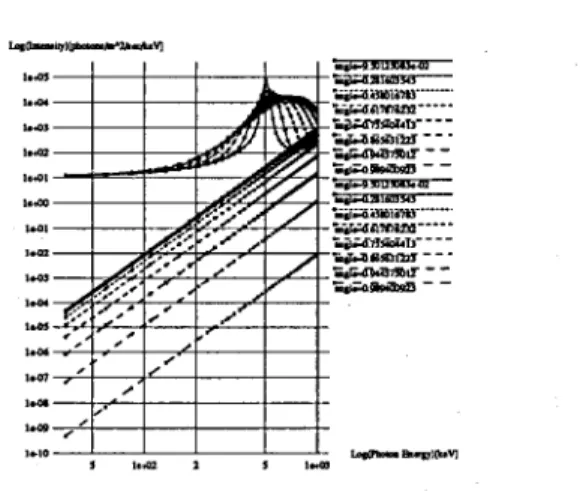
nw ~ 511keV split before escaping from the emission region, although this is strongly de- pendent on (). The produced photons~merge at an angle () to the field since the split- ting is a collinear process in the nondisper- sive limit. Figure 1 shows the optical depth of both the cyClotron scattering and photon splitting. Theyboth depend strongly on the angle () and the energy.
We see that photon splitting dominate cy- clotron scattering at energies greater than about 511 keY in the direction normal to the field line.
The source function is, therefore, given by
S(Z, JL, x) = ~JJdx' dJL'R(x,JLix', JLI)·
"'total
'U(Z,JL',X' )+~B(x)
"'total
"'sp 100d I ( ' ) ( ')
+-- X Tsp X,X U Z,JL,X
"'total z
Here, R(x,JLix', JL') and Tsp (€,w) represent the redistribution function of cyclotron reso- nant scattering[25] and photon splitting[4], re-
spectively. In the present calculations we em- ploy the boundary conditions of self-emitting atmosphere. The inner boundary condition is one of perfect reflection, and the outer one assumes no incoming radiation from outside.
Assuming no radiation from above at
Z=Zma:l:'then
8u(z,p,x) ( )
p8 ( ) =U Zma:l:'p,X T z,p,x
4. RESULTS AND DISCUSSION at Z =Zma:l:' (4) Ifradiation is incident from neither below nor above (self-emitting slab) at z=O, then
iDiiD'i.inBbl);&
_.*"._""..:::...<=--=:--"'i-h.,-...--+-+~~
1oI+2:J-1--+--I~"-+-+
(,100=1.0'10'3 kg ,kT= SOkeV,z=10'3m)
1.a&a-ilJl~~"V1
..".
Figure 1 The opacities of cyclotron resonant scattering and photon splitting are shown for eight angles at kT=50 keY ,p = 1.0X10³kg' m-3 and nwcyc = 5UkeV. The eight angles are given by p = cosO.
at Z =O. (5) 8u(z,p,x)
p =0
8T(Z,p,X)
We calculated the spectra using a set of 50 frequencies and 8 angles, with nwcyc 5UkeV. Only thermal emission in the slab itself was considered, Le., we used the bound- ary conditions (4) and (5). A density ofp =
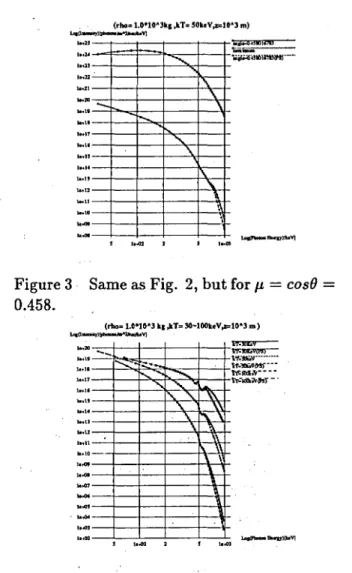
1.0 X 10³kg' m-3, and a height of Z = 103m was assumed. Figure 2 shows the spectra considering and non-considering the photon splitting for the direction perpendicular to B (p ~0.095) in a self-emitting atmosphere with a temperature of kT=50 keY.
The absorption lines around nw= 5UkeV
due to cyclotron resonance scattering appear in this direction. The cyclotron absorption lines, however, is very shallow, since the cross section of cyclotron resonance is porportional to i and polarization effects are ignored.
Photon splitting is effective in this direction, because the cross section is proportional to sin60. The high energy photon is degraded down and then the structure of the cyclotron line is deformed by photon splitting. Thus,
1'1.
"\
... --- "\
101+19 ...
101+11
"'\.
'"
'MU ~
\\
... \\
I .... S • ..... I.atO'k-81qy)/b\l)
Figure 2 Spectra with and without photon splitting are shown for p = cosO = 0.095 in a self-emitting atmosphere at a temper- ature of kT=50 keY. with the magnetic field coressponging tonwcyc = 5UkeV. The depth of the slab was chosen as z=103m. PS is pho- ton splitting.
we see that the cyclotron resonance isn't ef- fective under this condition; we might find no cyclotron line, which is consistent with the observed spectra.
Figure 3 shows the same spectra as Fig- ure2, but for the direction inclined to the magnetic field (p ~ 0.458). We see that split- ting effect is smaller than that of Fig.2. This is because the photon splitting effect is· de-
pendent on sin60. We see that photon split- ting doesn't have considerable influence upon the structure of the cyclotron line and the continuum in this angle. The spectrum has cutoff at around nw = 5UkeV due to photon splitting.
(rho:1.0·lOA3kl ,kT=SOkeV,&=10-3 m)
Lot~~Ia"VI.,.bY]
r.t2S .&\;:(jdiilOO
-1=:=:j:=~"""-+-~~:''''-''''-\''''-lHl-·--··
1...:n--+--+--+-"""""'-+--+-
1~"~-1--+---1--~1~;--+
~
"."--1--+---1--'l.~-+
" \.'
T
,....
I • ..,
111+1J-+--+--+--~'I.-+K
\,
(mo=1.0-10'3 k.,kT= 3O-IOOkeV,z=IO'3 m)
~~IQ'UV)
\\
...10--+--+--1---P,k---¥\lI-
\
Figure 3· Same as Fig. 2, but forJL = cosO=
0.458.
Furthermore, the spectra from five dif- ferent Prognoz 9 bursts in SGR 1806-20 were consistent with optically thin thermal bremsstrahlung with a single temperature, even though the total intensities of the bursts in that analysis varied by a factor of 4. We see that the spectra of plasmas at various temperatures have similar profiles. Figure 4 shows the spectra calculated for a plasma at three temperatures, with an angle ofJL ~
0.095, assuming a density of p = 1.0X 10³kg·
m-3,and a height ofz = 103m.
These spectra have a common shape in the higher energy region due to photon splitting effect. Photon splitting is independent on the temperature of the plasma. This can cause the similar spectra even in the plasma of distinct temperatures. The higher tem- perature is, the larger the high energy pho- ton decreases. This is because there are a large number of photons at higher tempera- ture which will split. This characteristic is in agreement with the common spectral shape observed by Prognoz 9.
In conclusion, we find that the photon splitting effects influences the spectrum in the self-emitting atmospheres with the super- stong magnetic field. The higher component of the spectra distorted by photon splitting have similar forms for distinct temperatures of plasma, since the nature of photon split- ting is to degrade the high energy photon.
We will solve the radiative transfer equation including polarization, relativistic effects and
,....--+----+--I---I-~~f.I
... -+--+--1---'+---\I-
I.'"
Figure 4 Spectra calculated with the pho- ton splitting effect in a plasma at three tem- peratures of atmospheres for an angle ofJL ~
0.095. Three temperatures assumed here are kT= 30, 50,100 keV, respectively. ,PS is pho- ton splitting.
Compton scattering of the continuum compo-
nent in the feature, in order to investigate the detailed structure of the cyclotron lines and continuum spectra.
REFERENCES
[1]Duncan, R. C. and Thompson, C. 1992, Ap. J, 392, L9.
[2]Paczynski, B. ,1992, Acta Astron., 42,145.
[3]Baring, M. G. 1991, A fj A, 249, 581.
[4]Baring, M. G. 1995, Ap. J, 440, L69.
[5]Fenimore, E. E. , Laros, J. G. and Ulmer, A. 1994, Ap. J,432, 742.
[6]Nagel, W. , 1981, Ap. J, 251, 278.
[7]Meszaros, P. and Nagel, W. 1985, Ap. J, 298, 147.
[8] Wang, J .C.L., Wasserman, 1.M. and Salpeter, E.E. 1988 Ap. J. Suppl., 68, 735.
[9] Wang, J.C.L., Wasserman, 1.M. and Salpeter, E.E. 1989 Ap. J, 338, 343.
[10]Lamb D Q, Wang J C L, Loredo T J, Wasserman I M, Salpeter E E, Feni- more E E 1989Proc. 14-th Texas Sym- posium on Relativistic Astrophysics, Ann., NY Acad. Sci. p406
[l1]Alexander, S. G., Meszaros, P. and Bus- sard, R. W. 1989, Ap. J, 342, 928.
[12] Alexander S G, Meszaros P 1991 ApJ,372, 565
[13]Nishimura0 and Ebisuzaki T 1992 PASJ, 44, 109
[14]Furry, W. H., 1937 Phys. Rev., 51, 125.
[15]Skobev,V.G.,1959, Sov.Phys. JETP ,8,919.
[16]Minguzzi,A., 1961, Nuovo Cimento ,19,847.
[17]Adler, S. L., Bahcall, J. N., Callan, C. G.,
&Rosenbluth, M. N. 1970, Phys. Rev.
Lett., 25, 1061.
[18]Bialynicka-Birula and Bialynicki-Birula 1970, Phys. Reb. D,2,2341.
[19]Adler, S. L. 1971, Ann. Phys., 67, 599.
[20] Mitrofanov,1.G. , Pozanenko,A.S., Dolidze,V.Sh., Barat, C., Hurley, K., Niel, M., & Vedrenne, G. 1986, Soviet Astron, 30,659.
[21]Baring, M. G. 1988, MNRAS, 235, 79.
[22]Baring, M. G. 1993, MNRAS, 262, 20.
[23] Mihalas, D. ·1978, Stellar Atmospheres (2nd ed. j San Francisco:Freeman).
[24]Nagel, W. 1980 Ap. J, 236, 904.
[25]Wasserman, 1. and Salpeter, E. 1980 Ap.
J, 241, 1107.
[26]Papanyan, V. 0., and Ritus, V. 1. 1972, Soviet Phys.-JETP, 34, 1195