Study on Potential-Dependent Dynamics of Small Oil Droplet at Au Electrode/Water Interface
水と混和しない液体の小滴が
水中の金単結晶電極上で示す電位応答に関する研究
February 2020
2020
年2
月Department of Advanced Technology and Science for Sustainable Development, Graduate School of Engineering, Nagasaki University
長崎大学大学院工学研究科グリーンシステム創成科学専攻
Tetsuro Morooka
諸岡 哲朗
i
Contents i
Abstract iv
Acknowledgments vii
Chapter 1
1. Introduction 1
1.1. Background 1
1.2. Objectives 4
1.3. Scope of the thesis 6
References 8
Chapter 2
2. Review on dynamics of materials driven by interfacial energy change 12
2.1. Spontaneous motion of liquid droplet 12
2.1.1. Spontaneous motion driven by a marangoni effect 12
2.1.2. Spontaneous motion driven by a formation-deformation of the surface aggregate
14 2.2. Contact angle change of liquid droplet on solid substrate 17 2.2.1. The contact angle change as a function of the electrode potential 18
2.2.2. The mechanism of contact angle saturation 20
2.2.3. Electrowetting on conductor (EWOC) 26
2.2.4. Contact angle change with surface reaction 27
2.3. Phase change of organic molecular adlayer on solid electrode 33 2.3.1. Phase change of sodium dodecyl sulfate adlayer on single crystal electrode 33 2.3.2. Phase change of n-alkane and alcohol adlayer on single crystal electrode 37
References 40
Chapter 3
3. Experimental methodology 46
3.1. Materials 46
3.2. Electrochemical measurements 47
3.3. Electrochemical fluorescence microscopic measurements 50
3.4. In situ contact angle measurements 50
3.5. In situ ATR-SEIRA spectroscopy 52
References 53
ii
electrode in aqueous solution: A voltammetric and electrochemical fluorescence
microscopic study
55
4.1. Introduction 56
4.2. Results and discussion 56
4.2.1. Voltammetric studies 56
4.2.2. Fluorescence microscopic studies 60
4.2.3. Block properties of HD for redox reaction 64
4.3. Conclusion 69
4.4. Supporting information 70
References 72
Chapter 5
5. Effect of bromide adsorption on electrowetting of Au electrode with hexadecane 75
5.1. Introduction 76
5.2. Results and discussion 77
5.2.1. Voltammograms with HD 1 L droplet 77
5.2.2. Contact angle as a function of surface charge density 80 5.2.3. Effect of Br
-adsorption upon the potential-controlled shape change of HD droplet 83 5.2.4. Droplet reshaping by potential sweep in the presence of Br
-85 5.2.5. Scaling of droplet reshaping in the presence of Br
-87
5.3. Conclusion 90
5.4. Supporting information 92
References 94
Chapter 6
6. Effect of oil droplet coexistence upon potential-dependent phase change of surfactant adlayer on gold electrode: interplay of hexadecane droplets and dodecyl sulfate adlayer 96
6.1. Introduction 97
6.2. Results and discussion 98
6.2.1. Voltammogram in SDS solution with or without HD on Au(1 1 1) 98
6.2.2. Contact angle change of HD in SDS solution 100
6.2.3. Coexistence of HD and DS
−on the Au electrode: SEIRAS study 102
6.2.3.1. Cyclic voltammetry of Au thin film electrode 102
6.2.3.2. SEIRAS of O-H stretching mode of interfacial water 104 6.2.3.3. C-H stretching mode of Alkyl Chains of DS
−and HD 108
6.2.3.4. S-O stretching mode of DS
−110
6.3. Conclusion 112
iii Chapter 7
7. Potential-dependent contact angle change of fluoro liquid droplet on Au electrode 118
7.1. Introduction 119
7.2 Materials 119
7.3. Results and discussion 119
7.3.1. Voltammogram with Novec 7100 on Au(1 1 1) 119
7.3.2. Effect of Br
adsorption upon shape change of Novec 7100 on Au(1 1 1) 122 7.3.3. Discussion of the effect of adhesion energy on electrowetting of HD on Au(1 1 1) 123
7.4. Conclusion 124
References 125
Chapter 8
8. Trial of fluorescence imaging of HD droplet 126
8.1. Introduction 127
8.2. Analysis procedure for fluorescence microscopic images 127
8.3. Materials 128
8.4. Results and discussion 129
8.4.1. I
FLchange of HD microdroplets in KClO
4solution on Au(1 1 1) electrode 129 8.4.2. Discussion on the state of HD droplets on the basis of microscopic fluorescence
data 131
8.4.3. I
FL-E curve obtained using surfactant dye 135
8.4.4. Electrochemical measurements for HD with SDS on Au(1 1 1) electrode 137 8.4.4.1. I
FL-E curve obtained using surfactant dye 137 8.4.4.2. I
FL-t curve for the shape change of microdroplets 138
8.4.5. Fluorescence Image Analysis 143
8.5. Conclusion 149
References 150
Chapter 9
9. Summary and future prospects 152
List of Figures 158
List of Publications 162
iv Dynamics of organic molecules at an electrode surface can be driven by an applied potential. The investigation of the interfacial chemistry of the electrode in molecular view is directly connected to the understanding of the electrical double layer structures governing the functions of electric devices such as supercapacitors. Deeper understanding of the behavior of organic molecules on the electrode surface provides us with new insight into physical chemistry of the interface. The dynamic processes of interest at electrified interfaces include an adsorption-desorption of molecules, a two-dimensional (2D) phase transition to form a condensed monolayer, and an ingress/egress of water molecules into/from the adlayer.
Electrified interfaces such as a potential-controlled electrode/water and oil/water interfaces are the typical regions where the interfacial energy change takes place as a function of an applied potential following electrocapillarity. When the interfacial energy of the electrified interface is changed, the value of contact angle () of a liquid droplet on the electrode surface will change as described by Young’s equation. Measurements of of the liquid droplet on the electrode interface enable us to monitor the dynamics of molecules at the interface.
In this study, I first focused on the dynamics of alkanes as insulating oils on a Au(1 1 1) electrode surface in aqueous solutions. The dynamics of alkanes at a mesoscopic level should be described by both morphological changes determined by the interfacial tension balance at the macroscopic three-phase contact line and the molecular-level direct interaction between alkane molecules and electrode surface atoms. Then, the potential-dependent dynamics of n-hexadecane (HD) in the presence of sodium dodecyl sulfate (SDS) on Au(1 1 1) electrode was investigated by the use of voltammetric, fluorescence microscopic, and surface-enhanced infrared reflection adsorption spectroscopic (SEIRAS) measurements.
The study for coexistence of HD and DS
-molecules on a metal surface will reveal the molecular-level interplays for interaction between oil and surfactant, whichever they tend to mix or to be phase-separated.
This thesis consists of nine chapters.
Introduction to this doctoral dissertation research is given in Chapter 1. Chapter 2 is a
review on the dynamics of materials driven by the interfacial energy change. This chapter
describes the spontaneous motion of oil droplets in water, the change of the liquid droplet
v electrode.
Chapter 3 describes experimental methods including electrochemical measurements, fluorescence microscopic measurement, and SEIRAS measurement.
In Chapter 4, I focused on the electrochemical measurements for Au(1 1 1) electrode with HD in electrolyte aqueous solution. HD prepared by the touching method did not block the redox reaction of Fe(CN)
63-/4-. Fluorescence measurements using Perylene as a fluorescence probe revealed that the HD (prepared by touching method) formed into many tiny microdroplets with their diameter smaller than 50 m. The fluorescence intensity (I
FL) changed as a function of the electrode potential. The change of fluorescence intensity as a function of the electrode potential revealed that the height of the microdroplets became greater beyond the double layer thickness region at more negative potentials.
Chapter 5 shows that specifically absorbed Br
at the Au(1 1 1) electrode/water interface induced the retraction of both HD microdroplets and 1.0 L droplet. The electrowetting of HD was largely affected by specific adsorption of Br
on the Au surface. The adsorption distinctly changed the potential dependence of the of HD droplets on a Au(1 1 1) electrode surface in line with electrocapillary relationship. Measurements of as a macroscopic observable was sensitive to the atomic level change of the electrode surface such as surface reconstruction and Br
adsorption.
In Chapter 6, I described the effects of DS
−adlayer on the shape change of HD microdroplets on Au(1 1 1) electrode surface. The DS
−adlayer lowered the interfacial tensions of HD/water and electrode/water interfaces, and a HD droplet spread wider. In addition, I investigated the coadsorption state of HD and DS
−adlayer in a molecular level using in situ SEIRAS measurements. ATR-SEIRAS revealed that the alkyl phase of the mixed adlayer was more liquid-like than the DS
−adlayer alone and more solid-like than the HD droplet alone.
In Chapter 7, the electrowetting of a hydrofluoroester solvent of a low adhesion energy,
Novec 7100
™, was examined as a liquid droplet on a Au(1 1 1) electrode. No hysteresis was
observed for Novec 7100
™in a cosE curve obtained by potential step measurements in
contrast to conventional organic solvent. The value of of Novec 7100
™droplet increased
over pzc in contrast of HD which does not change the shape over pzc. These results show
that the adhesion energy of a liquid droplet was found to play an important role on the
vi curve of Novec 7100 was shifted to the negative potential in line with the electrocapillary curve with specific adsorption. In addition, to evaluate the adhesion energy of HD droplet, the E curve obtained from
M–E curve was compared to the cos–E curve in positive potential step measurements. It was concluded that the difference between
S/Wand
S/Oover 6 mN/m needs to exceed the adhesion energy of HD droplet to Au(1 1 1) surface.
Chapter 8 focused on the analysis of the potential-dependent shape change and the 2D mapping of HD microdroplets with fluorescence probes using fluorescence microscopy. I used Di
10ASP-PS as a surfactant dye to analyze the microdroplet shape in detail. The change of I
FLover 60 s observed by the potential step measurements suggested that the process of the shape change of HD microdroplets on Au(1 1 1) electrode surface is sluggish compared with double layer charging. The number of the fluorescence spot with a diameter around 6-20 m drastically increased while potential sweeping to negative direction. The I
FLprofile of the bright spot reflected on the shape change of microdroplets and its height gradually lowering in potential sweeping to positive direction.
In Chapter 9, I summarized conclusions of the potential-dependent self-assemblies and dynamics of the organic molecular at the electrode/water interface observed in this thesis.
I also described a future directions to realize the droplet locomotion driven by
electrowetting.
vii
Throughout the course of this study, the patience, encouragement and mentorship provided by Professor T. Sagara is greatly deserving of recognition. Prof. Sagara has taught me many things including science and beyond to which I will be always grateful. Simply, many thanks for everything.
For immense help and extremely fruitful discussions during my studies and research, I would like to express sincere thanks to Associate Professor H. Murakami.
Sincere thanks also go to Assistant Professor H. Tahara for many helpful advice and valuable discussions in this project.
Thanks are extended to referees which consisted of Professor C. Kondou for the reading and thorough discussions in this thesis.
Special thanks to Mrs. N. Yuuki for many help and support, simplifying my efforts.
The excellent working environment established by the people of the Sagara lab group, I would like to thank them each for their friendship.
Supports from Japan Society for the Promotion of Science (2019) are gratefully acknowledged.
Finally, thank you to my mother and sister for their support in my life.
1
1. Introduction
1.1. Background
Interfacial energy, which is defined as the Gibbs free energy per area, is an essential parameter of wetting and dewetting phenomena. Plants are the most familiar examples of wetting and dewetting phenomena, such as a raindrop on a lotus flower, and most importantly, plants gain water from soil using capillary force. In engineering fields, coating and printing technology need understanding of interfacial energy.
Interfacial energy as a macroscopic quantity forces to increase or decrease the contacted area between two immiscible phases, namely interface. A contact angle () of a liquid droplet on solid/air interface is generally used to directly measure the interfacial energy (Fig. 1-1). The value of lets us know the chemical structures of both liquid and solid phase.
When the liquid droplet (aqueous or oil phase) put on the solid surface in any air, aqueous or oil media, the value of is determined by the Young’s equation (Eq. 1) to satisfy the mechanical balance of three interfacial energies at three phase contact line.
cos 𝜃 = 𝛾
SA− 𝛾
SL𝛾
LA(1)
where 𝛾
SAis an interfacial energy of solid/air interface, 𝛾
SLis an interfacial energy of solid/liquid interface, and 𝛾
LAis an interfacial energy of liquid/air interface. The interfacial energy depends on the chemical structure; inorganic crystals and metals have high energy surface because of the covalent bonding or the metallic bonding; On the other hand, liquid and polymeric materials have low energy surface because of the van der Waals bonding or the hydrogen bonding. In addition, the value of depends on surface structures such as roughness and even on an atomic level step.
Figure 1-1 . The schematic model the contact angle determined by the interfacial energy
balance at three phase contact line
2
The interfacial energy change can cause a spontaneous motion of liquid droplet in water or on solid substrate. Such a non-equilibrium state naturally goes a steady state. It is known that an electrified interface is the typical regions where the interfacial energy changes as a function of an applied potential following electrocapillarity. Electrified interface is a potential-controlled electrode/water interface or oil/water interfaces. Various organic molecules show the potential-dependent dynamics at the interface, such as oxidation and reduction processes, adsorption-desorption processes, and order-disorder phase transitions of adlayers. These potential-dependent dynamics at the electrified interface have attracted great interest of chemists for a long time.
Dynamics of organic molecules at the electrode surface can be driven by the applied potential. They form an ordered adlayers on an electrode surface, and also they cover it as liquids. These dynamics provide us with rich perspectives of electrochemistry and molecular organization chemistry in aqueous media. Amphiphiles such as surfactants bearing a long alkyl chain often form adlayers that exhibit potential dependent reversible phase changes on an electrode surface [1-5]. The phase changes include adsorption-desorption and orientation change of molecules, two-dimensional (2D) phase transition to form a condensed monolayer, and ingress/egress of water molecules into/from the adlayer. To mention just one example, sodium dodecyl sulfate (SDS) shows adsorption and undergoes multi-step potential-dependent phase transitions [6-17]. Dodecyl sulfate anions (DS
-) form a hemi-micellar adlayer, and the layer transforms into an interdigitated bilayer at more positive potentials. This behavior was confirmed at a molecular level using many in situ experimental methods such as electrochemical scanning tunneling microscopy (EC-STM) [10,14], atomic force microscopy (AFM) [10], neutron reflectivity [11], electroreflectance (ER) [12] and fluorescence microscopy [13]. DS
-formed self-assembled layers on single crystal electrode surfaces, such as Au(1 1 1) [10-14], graphite [15], Bi [16], and Ge surfaces [17].
Non-polarized molecular, such as alkane molecules, also take place adsorption and form
an ordered layer at an electrode/aqueous solution or electrode/liquid alkane interface. They
have been the targets of in situ EC-STM. Uosaki and Yamada showed the formation of the
2D crystal of normal alkanes (C16, 17) on Au(1 1 1) surface/neat alkane liquid interfaces as
STM images [18]. They observed a herringbone structure and a row structure (lamella)
crossing the herringbone. Several systematic studies of Au(1 1 1) surfaces in contact with
3
neat liquids or solutions of normal alkanes (C14-38) using (EC-)STM revealed the structures of flat-lying ordered adlayers of the alkanes [19-24]. The ordered structure originates in the interaction between the hydrocarbon chain and the Au(1 1 1) surface lattice. An alkanol monolayer (C10-30) also takes the titled lamellar structure and the herringbone-like structure [25]. He and colleagues showed that an order-disorder transition of n-hexadecane molecules in a monolayer at a Au(1 1 1) electrode surface is induced by the electrode potential [26].
Around the potential of zero charge (pzc), observed was a highly ordered flat-lying hexadecane monolayer, which disappeared at the negatively and positively charged electrode surfaces. Such a potential dependent change of the state of the adlayer results from competitive adsorption of alkane molecules to water molecules and electrolyte ions at the interface.
Competitive adsorption in molecular-scale at interface can affect in macroscopic-scale shape change as an emergence of interfacial tension change as schematically shown in Fig. 1-2. Precise control of the interfacial energy balance could apply to conduct chemical reactions in artificial cell size. Electrochemistry especially enables us to take a precise control the interfacial energy, through electrocapillary phenomena. Since Lippmann’s demonstration of electrocapillary phenomena in the 19th-century [27], an electrode potential-controlled change of the interfacial energy balance for a liquid droplet at an electrified interface has been extensively studied. In 1998, Welters and Fokkink achieved reversible and repeatable shape change of an aqueous electrolyte droplet on a thin dielectric material coated on an electrode in air [28]. This functional mechanism using a dielectric thin film is called “electrowetting on dielectric (EWOD)”. It found applications, for instance, to a focus-changeable optical lens in air [29], although its operation needs over 30 V of
Figure 1-2. Schematic model of electrowetting of a liquid droplet driven by a surface reaction.
4
applied voltage. Even on a bare metal electrode, reversible shape change of a liquid droplet has been achieved. Ivošević and Žutić demonstrated a large magnitude of shape change of n-hexadecane (HD) droplet of 75 L on a Hg electrode in an aqueous electrolyte solution driven by potential dependent interfacial tension change of the Hg/solution interface [30].
The shape changes of the droplet placed directly on a bare metal electrode is called
“electrowetting on conductor (EWOC)”. The EWOC-type shape change of an insulating dielectric oil droplet placed on an electrode surface in water is in principle controlled by the interfacial tension at the solid electrode/water interface,
SW, as far as two other interfacial tensions,
OWand
SO, are potential independent, where
OWis the interfacial tension at the oil/water interface and
SOat the electrode/oil interface. Until now, various mechanisms of EWOC have been unveiled [3138]. For example, a hexadecanethiol (HDT) droplet directly placed on a Au electrode in aqueous electrolyte solution changed its shape by potential dependent adsorption-desorption of HDT molecules themselves on Au electrode surface [31].
Addition of an organic electrolyte salt in a nitrobenzene droplet amplified the range of the shape change [32]. Motion of an aqueous electrolyte droplet in air on a HDT self-assembled monolayer (SAM) with embedded redox active sites in SAM on an electrode was induced by the redox reaction of the SAM underlying the droplet [33]. The structural change of interfacial electric double layer induced by specific adsorption of sulfate anions on a Pt single crystal electrode resulted in the motion of a hexane droplet [34]. The intercalation- deintercalation of electrolyte anions also drives the droplet shape change on a highly oriented pyrolytic graphite (HOPG) electrode [35,36] and that of protons on a hexagonal boron nitride monolayer on Rh(1 1 1) [37]. Electrodeposition of Sn to Au electrode could also be a driving force to change the interfacial tension of the electrode/water interface [38].
1.2. Objectives
I focused on the dynamics of alkanes as insulating oils on a Au(1 1 1) electrode surface in
aqueous solutions. The potential-dependent dynamics of HD and SDS on Au(1 1 1)
electrode was investigated by the use of voltammetric, fluorescence microscopic, and
surface-enhanced infrared reflection adsorption spectroscopic (SEIRAS) measurements in this
study. The investigation of the interfacial chemistry of the electrode in molecular view is
directly connected to the understanding of the electrical double layer structures governing the
5
functions of electric devices such as supercapacitors. Understanding of the behavior of organic molecules on the electrode surface provides us with new insight into physical chemistry of the interface.
Because a Au(1 1 1) surface has rather a low surface energy and high stability in a wide electrochemical window, it appears the substrate of choice in many studies to place an oil droplet or to adsorb alkane molecules on it. I may have two different ways to view the alkanes on the electrode surface; one is a molecular view and the other is a continuum liquid phase view. All the droplet studies fall in the volume range between 0.1 L to 0.5 mL or 3 mL, whereas molecular views are on literally a nanometer scale. Mesoscopic level studies of the potential-driven dynamic are thus indispensable especially to bridge the two separate scales and to develop the method of dynamic control. Control of the movement of a small liquid droplet at various spatiotemporal scales is a subject of paramount importance in interfacial chemistry, painting and coating technology, and microfluidic device technology [39].
The dynamics of alkanes at a mesoscopic level should be described by both
morphological changes controlled by changing the interfacial tension balance at the
macroscopic three-phase contact line and molecular-level direct interaction between alkane
molecules and electrode surface atoms. In macroscopic view, the shape of mobile droplet is
described by its . Balance of interfacial tensions at the peripheral three-phase contact line
of a droplet determines. In-depth understanding of mechanisms of the shape change and
movement of a droplet on a solid substrate provides us with the basis to realize locomotion of
the droplet at will. For this purpose, the use of voltage application to change the interfacial
tension has advantages over other techniques for rapid regulation, repeatability, and
controllability. In molecular-scale, the experiments at a mesoscopic level are required for
in-depth understanding of unclarified dynamic behavior and for elucidation of factors of the
potential dependent behaviors. Analysis of the dynamics of alkanes at a mesoscopic level is,
therefore, expected to gain new perspectives, for example, the state of disordered n-alkane
monolayers at negative potentials, characteristics of the liquid adlayer of a several monolayer
level amount, and relevance to the redox processes.
6
1.3. Scope of the Thesis
This thesis consists of nine chapters.
Introduction to this doctoral dissertation research is given in Chapter 1. Chapter 2 is a review on the dynamics of materials driven by interfacial energy change. This chapter describes the spontaneous motion of oil droplets in water, the change of the liquid droplet on the solid substrate, and the phase change of organic molecular adlayers on the solid electrode.
Chapter 3 describes experimental methods including electrochemical measurements, fluorescence microscopic measurement, and SEIRAS measurement.
The aim of Chapter 4 is to describe the dynamics of liquid HD at a single crystal Au(1 1 1) electrode/aqueous electrolyte solution interface at a mesoscopic level in response to ca. 1 V change of the electrode potential. The dynamics of HD adlayer at a mesoscopic level should be described by both morphological changes controlled by changing the interfacial tension balance at the macroscopic three-phase contact line and molecular-level direct interaction between alkane molecules and electrode surface atoms. The main approach to track the potential-driven movements of the HD liquid is the use of in situ electrochemical fluorescence microscopy for real time imaging of the electrode/solution interface under potential control.
Chapter 5 focus on the effect of a specific adsorption of bromide ion (Br
) to change
S/Wwith an aim at describing the mechanism of shape change of a HD liquid droplet in the presence of Br
in aqueous electrolyte solution on a single crystal Au(1 1 1) electrode in ca.
1.5 V range of the electrode potential. The specific adsorption directly changes the structure of the electric double layer, resulting in the emergence of a new type of potential-controlled shape change of an oil droplet. Microscopic structural changes of the electrode/solution interface caused by Br
adsorption may reflect in the macroscopically observable of HD droplets through the change of the interfacial tension balance as a function of the electrode potential and Br
concentration, c
KBr.
In Chapter 6, a focus is placed on the effect of HD droplet coexistence upon the potential dependent phase change of dodecyl sulfate anion (DS
-) adlayer on a gold electrode.
Especially, interplay between HD droplet and DS
-adlayer should be highlighted. Upon
adsorption of DS
-on the electrode surface, the electrode/water interfacial tension is
decreased by formation of a self-assembled adlayer of DS
-, which forms into hemi-micelles,
7
or interdigitated bilayer. These effects on both oil/water and solid/water interfacial tensions may play an important role for emergence of new potential-dependent changes of the adlayer structure of DS
-and of the shape of HD droplet. Synergetic effect may emerge because of coexistence of these well-investigated two molecules, which form individual ordered adlayers on the single crystal electrode surface.
In Chapter 7, the focus on this chapter is to study the effect of adhesion energy on the electrowetting. The electrowetting of a hydrofluoroester solvent of a low adhesion energy, Novec 7100
™, was examined as a liquid droplet on a Au(1 1 1) electrode. In addition, to evaluate the adhesion energy of HD droplet, the E curve obtained from
M–E curve was compared to the cos–E curve in positive potential step measurements.
Chapter 8 focused on the analysis of the potential-dependent shape change and the 2D mapping of HD microdroplets with fluorescence probes using fluorescence microscopy. I used Di
10ASP-PS as a surfactant dye to analyze the microdroplet shape in detail. In addition, I conducted image analysis to reveal the 2D distribution and the height change of HD microdroplets because it remains unclear the condition of HD microdroplets on Au(1 1 1) electrode deposited by Procedure A (touching method).
In Chapter 9, I summarized conclusions of the potential-dependent self-assemblies and
dynamics of the organic molecular at the electrode/water interface observed and analyzed in
this thesis. I also described a next step to realize the droplet locomotion driven by
electrowetting.
8
References
[1] T. Sagara, Dynamic behaviors of molecular assemblies and nano-substances at electrified interfaces, Chapter 13, in: K. Ariga, H. S. Nalwa (Eds.), Bottom-up Nanofabrication - Supramolecules, Self-Assemblies, and Organized Films, Vol. 3, American Scientific Publishers, Valencia, 2009, pp. 347-373.
[2] M. Chen, I. Burgess, J. Lipkowski, Potential controlled surface aggregation of surfactants at electrode surfaces – A molecular view, Surf. Sci. 2009, 603, 1878-1891.
[3] Th. Wandlowski, Phase transitions in two-dimensional adlayers at electrode surfaces – thermodynamics, kinetics, and structural aspects, in: E. Gileadi, M. Urbakh (Eds.), Encyclopedia of Electrochemistry, Vol. 1, Wiely-VCH, Weinheim, 2003, pp. 383-467.
[4] D. Bizzotto, V. Zamlynny, I. Burgess, C.A. Jeffey, H.-Q. Li, J. Rubinstein, A.R. Merill, J.
Lipkowski, Z. Galus, A. Nelson, B. Pettinger, Amphiphilic and ionic surfactants at electrified interface, Chap. 23, in: A. Wieckowski (Ed), Interfacial Electrochemistry:
Theory, Experiment, and Applications, M. Dekker N.Y., 1999, pp. 405-426.
[5] C. Buess-Herman, S. Baré, M. Poelman, M. Van Krieken, Ordered organic adlayers at electrode surfaces, Chap. 24, in: Wieckowski (Ed), Interfacial Electrochemistry: Theory, Experiment, and Applications, A. M. Dekker N.Y., 1999, pp. 427-447.
[6] Eda, K. Structure of Adsorbed Layers at the Interface of Mercury-Surfactant Solution. III.
Structure of Adsorbed Layers of Sodium Decyl, Dodecyl, and Tetradecyl Sulfate, Nippon Kagaku Zasshi 1959, 80, 349–352.
[7] Eda, K.; Takahashi, K. Structure of Adsorbed Layers at the Interface Mercury-Surfactant Solution. X. Study of the Competitive Adsorption of Two Surfactants by the Method of Differential Double Layer Capacity, Nippon Kagaku Zasshi 1964, 85, 828–832.
[8] Skoluda, P. The Voltammetric Study of the Au(100) Electrode in the Presence of Alkyl Sulfates, J. Electroanal. Chem. 1996, 406, 235–238.
[9] Wandlowski, T.; Hromadova, M.; de Levie, R. On the Kinetics of Adsorption of Dodecyl Sulfate at the Mercury-Water Interface, Langmuir 1997, 13, 2766–2772.
[10] Burgess, I.; Jeffrey, C. A.; Cai, X.; Szymanski, G.; Galus, Z.; Lipkowski, J. Direct Visualization of the Potential-Controlled Transformation of Hemimicellar Aggregates of Dodecyl Sulfate into a Condensed Monolayer at the Au(111) Electrode Surface, Langmuir 1999, 15, 2607–2616.
[11] Burgess, I.; Zamlynny, V.; Szymanski, G.; Majewski, J.; Smith, G.; Satija, S.; Ivkov, R.;
9
Lipkowski, J. Electrochemical and Neutron Reflectivity Characterization of Dodecyl Sulfate Adsorption and Aggregation at the Gold-Water Interface, Langmuir 2001, 17, 3355–3367.
[12] Sagara, T.; Izumi, K. Electroreflectance Study of Potential Dependent Phase Changes of Dodecyl Sulfate Adlayer on a Au(111) Electrode, Electrochim. Acta 2015, 162, 4–10.
[13] Chandar, P.; Somasundaran, P.; Turro, N. J. Fluorescence Probe Studies on the Structure of the Adsorbed Layer of Dodecyl Sulfate at the Alumina-Water Interface, J. Coll. Int.
Sci.1987, 117, 31–45.
[14] Petri, M.; Kolb, D. M. Nanostructuring of a Sodium Dodecyl Sulfate-Covered Au(111) Electrode, Phys. Chem. Chem. Phys. 2002, 4, 1211–1216.
[15] Paruchuri, V. K.; Nalaskowski, J.; Shah, D. O.; Miller, J. D. The Effect of Cosurfactants on Sodium Dodecyl Sulfate Micellar Structures at a Graphite Surface, Coll. Surf. A 2006, 272, 157–163.
[16] Nurk, G.; Kasuk, H.; Lust, K.; Jänes, A.; Lust, E. Adsorption Kinetics of Dodecyl Sulfate Anions on the Bismuth (011) Plane, J. Electroanal. Chem. 2003, 553, 1–19.
[17] Viana, R. B.; da Silva, A. B. F.; Pimentel, A. S. Adsorption of Sodium Dodecyl Sulfate on Ge Substrate: The Effect of a Low-Polarity Solvent, Int. J. Mol. Sci. 2012, 13, 7980–
7993.
[18] K. Uosaki, R. Yamada, Formation of two-dimensional crystals of alkanes on the Au(111) surface in neat liquid, J. Am. Chem. Soc. 1999, 121, 4090-4091.
[19] H.M. Zhang, Z.X. Xie, B.W. Mao, X.Xu, Self-assembly of normal alkanes on the Au (111) surfaces, Chem. Eur. J. 2004, 10, 1415-1422.
[20] A. Marchenko, J. Cousty, L. Pham Van, Magic length effects in the packing of n-alkanes adsorbed on Au(111), Langmuir 2002, 18, 1171-1175.
[21] O. Marchenko, J. Cousty, Molecule length-induced reentrant self-organization of alkanes in monolayers adsorbed on Au(111), Phys. Rev. Lett. 2000, 84, 5363-5366.
[22] R. Yamada, K. Uosaki, Two-dimensional crystals of alkanes formed on Au(111) surface in neat liquid. Structural investigation by scanning tunneling microscopy, J. Phys. Chem.
B 2000, 104, 6021-6027.
[23] Z.X. Xie, X. Xu, J. Tang, B.W. Mao, Reconstruction-dependent self-assembly of n- alkanes on Au(111) surfaces, J. Phys. Chem. B 2000, 104, 11719-11722.
[24] A. Marchenko, Z. Xie, J. Cousty, L. Pham Van, Structures of self-assembled monolayer
10
of alkanes adsorbed on Au(111) surfaces, Surface Interface Anal. 2000, 30, 167-169.
[25] H.-M. Zhang, J.-W. Yen, Z.-X. Xie, B.-W. Mao, X. Xu, Self-assembly of alkanols on Au(111) surfaces, Chem. Eur. J. 2006, 12, 4006-4013.
[26] Y. He, T. Ye, E. Borguet, The Role of hydrophobic chains in self-assembly at electrified interfaces: observation of potential-Induced transformations of two-dimensional crystals of hexadecane by in-situ scanning tunneling microscopy, J. Phys. Chem. B 2002, 106, 11264-11271.
[27] G. Lippmann, Relations entre les phénomènes électriques et capillaries, Ann. Chim. Phys., 5 (1875) 494-549 (Translation in English: in F. Mugele, J.-C. Baret, Elecctrowetting:
from basics to applications, J. Phys.: Condens. Matter 2005, 17, R705-R774.
[28] W. J. J. Welters, L. G. J. Fokkink, Fast electrically switchable capillary effects, Langmuir 1998, 14, 1535.
[29] Y.-P. Zhao, Y. Wang, Fundamentals and applications of electrowetting: A critical review, Rev. Adhesion Adhesives 2013, 1, 114.
[30] N. Ivošević, V. Žutić, Spreading and detachment of organic droplets at an electrified interface, Langmuir 1998, 14, 231.
[31] C. B. Gorman, H. A. Biebuyck, G. M. Whitesides, Control of the shape of liquid lenses on a modified gold surface using an applied electrical potential across a self-assembled monolayer, Langmuir 1995, 11, 2242.
[32] A. A. Kornyshev, A. R. Kucernak, M. Marinescu, C. W. Monroe, A. E. S. Sleightholme, M. Urbakh, Ultra-low-voltage electrowetting, J. Phys. Chem. C 2010, 114, 14885.
[33] B. C. Gallardo, V. K. Gupta, F. D. Eagerton, L. I. Jong, V. S. Craig, R. R. Shah, N. L.
Abbott, Electrochemical principles for active control of liquids on submillimeter scales, Science 1999, 283, 57.
[34] T. Nagai, S. Nakanishi, Y. Nakato, Water molecules adsorbed at electrode surface determine the macroscopic contact angles, ChemPhysChem 2007, 8, 1016.
[35] G. Zhang, M. Walker, P. R. Unwin, Low-voltage voltammetric electrowetting of graphite surfaces by ion intercalation/deintercalation, Langmuir 2016, 32, 7476.
[36] D. J. Lomax, P. Kant, A. T. Williams, H. V. Patten, Y. Zou, A. Juel, R. A. W. Dryfe, Ultra-low voltage electrowetting using graphite surfaces, Soft Matter 2016, 12, 8798.
[37] S. F. L. Mertens, A. Hemmi, S. Muff, O. Grönig, S. De Feyter, J. Osterwalder, T. Greber,
Switching stiction and adhesion of a liquid on a solid, Nature 2016, 534, 676.
11
[38] Y. Mukouyama, T. Shiono, Spontaneous motion of nitorobenzene droplet on Au electrode
during sn electrodeposition, J. Electrochem. Soc. 2016, 163, H36.
[39] O. D. Velev, B. G. Prevo, K. H. Bhatt, On-chip manipulation of free droplets, Nature
2003, 426, 515.
12
2. Review on Dynamics of Materials driven by Interfacial Energy Change
Manufacturing an artificial migration system inspired by a single-celled organism like an ameba would become a next breakthrough in chemistry. The system will need various knowledges from interfacial chemistry, supramolecular chemistry, biology and other science fields. The system will apply to “molecular robot” [1], especially intending to apply for a drug delivery system. The molecular robot will consist with oil phase or lipid layer to divide itself from an environment, an aqueous phase. The main candidate for a driving force of the molecular robot will be the interfacial energy change. Spontaneous motions driven by the interfacial energy change have been seen for a long time. The interfacial energy change in this kind of the spontaneous motion system is caused by solvation of the surfactants driven by a graduation of the surfactant concentration called Marangoni effect. Marangoni effect could make the spontaneous motion, but the motion depends on a diffusion process, which is slow and goes to an equilibrium state. As mentioned above in Chapter 1, the electrocapillary phenomena controlled by the electrode potential also can cause the dynamics of the droplet on the electrode as a faster, repeatable, and directional motion.
Non-equilibrium state at the interface could be a driving force of the artificial cell immigration which has a membrane divided itself from an environment. This chapter provides a brief description of the dynamics of materials driven by the interfacial energy change. It includes the spontaneous motion of oil droplets or liposomes in water, the contact angle change of liquid droplet on solid substrate, and the phase change of organic molecular adlayer on solid electrode.
2.1. Spontaneous Motion of Oil Droplets in Water 2.1.1. Spontaneous Motion Driven by a Marangoni Effect
It has been many reported that an oil droplet in water emerges a spontaneous motion
driven by a Marangoni effect which is interfacial tension change diffusion process of solutes
but slow process [2-13]. Sumino et al. proposed the system that an oil droplet on glass
substrate moves spontaneously driven by a Marangoni effect of the surfactant at the oil/water
interface [2-5]. It was reported that the diffusion of the surfactants on the prepared glass
substrate could stop the spontaneous motion [2]. Fig. 2-1 shows a schematic model of the
spontaneous motion driven by the adsorption-desorption process of surfactants. The
13
surfactants in aqueous phase aggregate on the glass surface. Iodide anion contained in the oil phase can form an ion pair with the surfactant in oil phase. This ion pair process makes the difference of the interfacial energy between the front and back of the droplet.
A slight difference of the polymer and the salt concentration between aqueous droplet and aqueous phase was proposed to be a driving force [6]. Using the same mechanism, vesicles encapsulation polymer was also transported [10]. It was reported that the oil droplet could show the pH-dependent motion in aqueous solution by the Marangoni effect of the deprotonated surfactant as shown in Fig. 2-2 [7, 9]. These designed surfactants which show an environmental response character (temperature, pH and light) are often used as a key-factor to realize a spontaneous motion.
Figure 2-1. Schematic diagram of oil-droplet motion and glass surface. Surfactant is
represented as a hydrophobic bar with a hydrophilic head. Taken from ref. 2
14
Figure 2-2. Schematic representation of a self-propelled droplet. The deprotonated surfactant decreases interfacial tension, inducing a circulating flow inside the droplet. The deprotonated surfactant transfers to the aqueous phase. Taken from ref. 7
2.1.2. Spontaneous Motion Driven by a Formation-Deformation of the Surface Aggregate
It is known that surfactants form a micrometer-scale structure by self-aggregation and can
possess elasticity on a millimeter-scale. The spontaneous motion driven by the generation of
surfactant aggregates could be a simple model of biological motility. Sumino et al. reported
that blebbing of an oil droplet interface, when both the oil droplet and an aqueous phase
contained an anionic and cationic surfactant mixed each other [14]. Palmitic acid (anionic
surfactant) was dissolved into tetradecane as an oil phase. The oil phase floated on an
aqueous phase as an oil droplet 100 L. In an aqueous phase, stearyltrimethylammonium
chloride (STAC, cationic surfactant) was dissolved. After an oil droplet was placed on the
aqueous phase/air interface, it shrunk continuously and then started to spread and recoil in
around ~ 1 s. The droplet subsequently underwent continuous interfacial blebbing for over 1
h as shown in Fig. 2-3. The blebbing behavior at the interface was observed in the
15
concentration range C
STAC> 0.1 mM and C
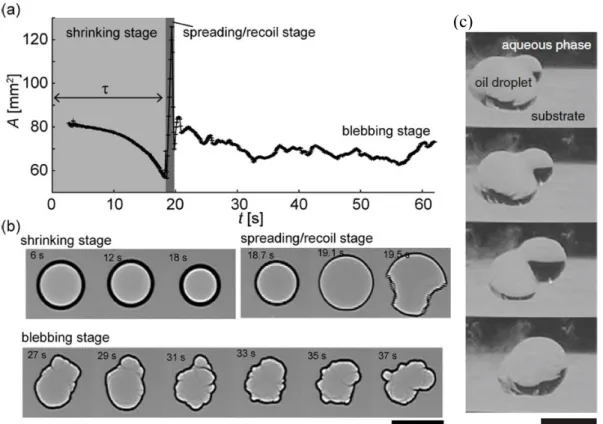
palmitic acid> 1 mM. When STAC and palmitic acid formed into cationic complex at the oil droplet/water interface, the decrease of the interfacial energy at air/water interface occurred and played an important role in the oil droplet deformation. On the other hand, the interfacial energy of air/water interface and of oil droplet/water interface was steady state at the blebbing stage. Palmitic acid molecules in oil droplet are absorbed into the STAC micelles in the aqueous phase. Due to a larger packing parameter of Palmitic acid (larger than 1) than that of STAC (smaller than 1/3), the STAC micelles elongate to form bilayers. Therefore, the micellar phase turns to the lamellar structure, and the lamellar structure forms semitransparent aggregates (Fig. 2-4, [17]).
Figure 2-3. (a) Apparent area, A, and (b) shadowgraph images of an oil droplet. τ represents the duration of the shrinking stage. In this plot, τ = 18.3 s. t = 0 is the time when the oil droplet was placed on the aqueous surface in a Petri dish. The concentration of the aqueous phase C
swas 1.0 mM. Scale bar corresponds to 10 mm. (c) Oil droplet (3 μl) with C
p= 20 mM sank and walked at the bottom of aqueous phase with C
s= 50 mM. Here the oil droplet was heavier than water, as it contained 12 vol.% of 1,1,2,2-tetrabromoethane. Scale:
1 mm. Snapshots were taken every 1 s. Taken from ref. 14 and 16
(c)
16
It was reported that a transition from a lamellar structure with d larger than 80 nm formed at the blebbing oil−water interface to a lamellar structure with smaller d (25 to 40 nm). Such transition of lamellar structures from the larger d to smaller d is induced by a penetration of surfactants from an aqueous phase into the aggregates. It was proposed a model in which elastic stress generated by the transition drives the blebbing motion at the interface.
Figure 2-4. (a,b) Microscope images of interfacial blebbing accompanied by semitransparent aggregate formation, obtained from a 0.5 μL oil droplet on an aqueous phase with Cs = 20 mmol/L: (a) bright field snapshots (see Movie 1 in ref. 17) and (b) polarized crossed Nicols microscope image. The scale bars correspond to 0.5 mm. In panel a, the aggregates were peeled away from the oil−water interface at the constricted part of the interface. An aggregate that had already detached from the oil−water interface was accumulated around the droplet seen in the lower right corner of all images, and shows birefringence as depicted in panel b.
(c) Schematics of molecular aspect of aggregate formation. Bars with white (red) circles
represent STAC (PA) molecules. Taken from ref. 17
17
2.2. Contact Angle Change of Liquid Droplet on Solid Substrate
The interfacial energy at the electrode/water interface depends on the electrode potential, called the electrocapillary. The electrocapillary curve, which shows the interfacial energy as a function of the electrode potential, has been measured to understand the structure of the electric double layer or the adsorption/desorption process of organic molecules. The interfacial energy of the electrode/water interface can be studied through measuring the contact angle () of the oil droplet on the electrode using the Young’s equation. This three phase system is useful to understand the macroscopic dynamics of molecule controlled by the electrode potential [19, 20].
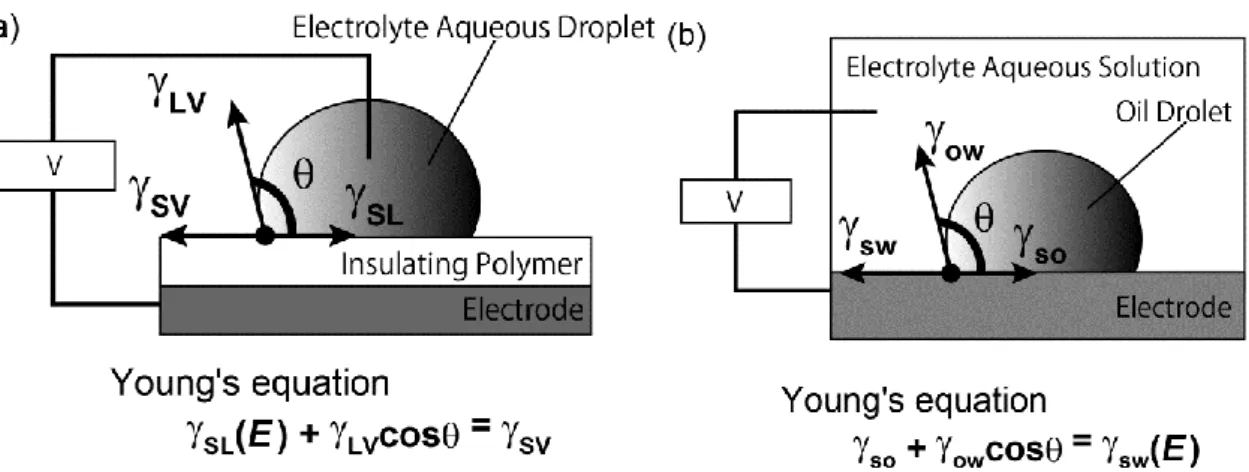
The value of is defined by the balance of three interfacial energies at the three-phases contact line as shown in Figure 2-5. The system in Figure 2-5(a) is called electrowetting on dielectric EWOD because an aqueous electrolyte droplet is put on the isolated polymer-coated electrode surface. On the other hand, Figure 2-5(b) shows electrowetting on conductor EWOC, where an oil droplet is put on the electrode/electrolyte aqueous solution interface.
The electrowetting system enables us to easily control the microdroplet, such as several
L or nL droplet. Therefore, the electrowetting system is a useful tool for manipulating biological cells or emulsion particles. For example, a floating emulsion particle at the air/oil interface is controlled by the ac voltage of the electrode at the oil bath bottom, and then this system can work as the microreactor [21]. In this section, the change regulated by the electrode potential was described.
Figure 2-5. Electrowetting system of (a)EWOD, (b)EWOC, and Young’s equation in each
state.
18
2.2.1. The contact angle change as a function of the electrode potential
Figure 2-6. Shape change of KNO
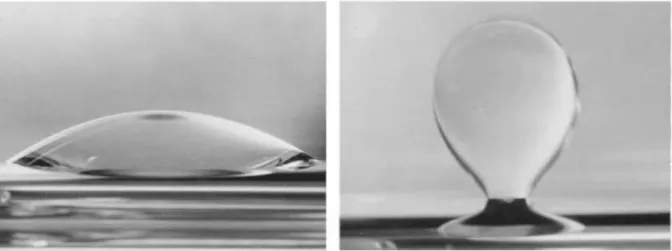
3aqueous solution droplet on teflon-coated ITO electrode at 0 V (left side) and at 200 V (right side). Taken from ref. 22
In 1998, Welter and Fokkink first demonstrated the repeatable change using EWOD system (Figure 2-6, [22]). Since then, the EWOD system is generally applied to the changeable focus lens and display elements. In the EWOD system, the electrolyte aqueous solution droplet is put on the insulated polymer coated electrode in air or oil phase. The interfacial energy at the droplet/polymer interface is defined as a function of the electrode potential in Eq. 1, called Lippmann equation.
𝛾
SL(E) = 𝛾
SL0− 1
2 CV
2(1)
where 𝛾
SL0is the interfacial energy at the droplet/polymer interface when applied no voltage, C is the integral capacity of the polymer coated electrode, and V is the applied voltage. We can know the interfacial energy change by a measurement of the of the droplet. Therefore, we obtain the connection between the value of and the applied voltage using Young-Lippmann equation (Eq. 2).
cos 𝜃 = cos 𝜃
0+ 𝜀
0𝜀
2δ𝛾
LVV
2(2)
where
0is the value of when no applied voltage, 𝜀
0and 𝜀 are respectively the dielectric
permittivity of the vacuum and the polymer, and is the thickness of the polymer. This
equation tells us that cos could be close to 1, namely = 0 when the applied voltage is fully
high. In addition, the interfacial energy change shows a parabolic function depending on the
applied voltage. If the insulated coated polymer becomes more hydrophobic (which means
19
that the value of
LVbecome greater), the value of cos
0is smaller. The value of cos
especially depends on the applied voltage. It is known that the isolated polymer has advantage to prevent a surface reaction or splitting a droplet and brings a smooth surface for electrowetting.
Welter and Fokkink measured the height of meniscus of the electrolyte aqueous solution between two electrodes to describe the interfacial energy change. The height of meniscus is defined by Eq. 3.
ℎ = 2𝛾
LV∆𝜌gd cos 𝜃 (3)
where ∆𝜌 is the difference of the density between the aqueous solution and air, g is the gravitational acceleration, and d is the distance between two electrodes. When the value of 𝛾
LVchange, the change of the height of meniscus is as follows,
∆ℎ = 𝜀
0𝜀
∆𝜌gdδ V
2(4)
and Eq. 4 shows the meniscus height changes as a parabolic function of the applied voltage as same as the change.
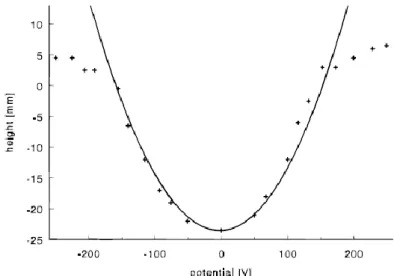
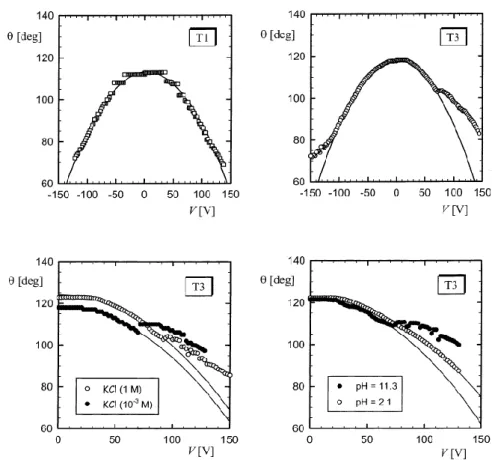
Fig. 2-7 shows the meniscus height change as a function of the applied voltage. The value of h changed between -150 V and +150 V and was in good agreement with the theoretical values in that potential range. In addition, the of the liquid droplet on the electrode changed from 60° to 110° and also depended on the thickness of the coated polymer.
After the demonstration of such a repeatable change, various systems are reported [23].
Figure 2-7. Height change as a function of the electrode potential shown as experimental data
(dots) and theoretical value (solid line). Taken from ref. 22
20
For example, the lipid bilayer was formed to reduce the value of 𝛾
LV, and the ionic droplet was used. As shown in Fig. 2-7, the value of went to out the theorical value over
|V| > 150 V, which called contact angle saturation and this saturation has been frequently reported [24]. To expanding the range of change, the mechanism of the contact angle saturation has been studied.
2.2.2. The Mechanism of Contact Angle Saturation
It was proposed that the effect of an electrostatic interaction at three phases contact line to study the mechanism of the contact angle saturation. The intermolecular force at three interfaces is not considered in Young’s equation. To consider the intermolecular force at three phases contact line at a macroscopic level, the line tension is put as a correction term in Young’s equation. The line tension is a one-dimension and defined as an interfacial energy at three phases contact line as follows,
R + 𝛾
LAcos 𝜃 = 𝛾
SA− 𝛾
SL(5) where R is a droplet’s diameter of the contacted area. When the value of R is fully big, the influence of the line tension is close to 0. There are many difficulties to reveal the effect of the line tension on Young’s equation, for example, preparing an ideal surface and precise measurement of the value of .
Digilov assumed that Young-Lippmann equation does not consider the equilibrium state when the electric charge exists and considered the electrostatic interaction at the contact line to correct the distribution of the electric charge [25], and proposed the corrected equation as follows,
𝛾
SV− 𝛾
SL= 𝛾
LVcos 𝜃 + (𝐸)
L
0(6)
where L
0is a length of the contact line without the applied potential, and (E) is defined as follows,
0− (E) =
SLVE
SLVL
0(7)
where
0is the line tension without the applied potential,
SLVis the electric charge density
at the contact line, and E
SLVis an electric field intensity at the contact line. Eq. 6 tells us
that the polarization at both the interface and the contact line when the voltage applied. It
21
means that the polarization at the interface and at the contact line reduce the interfacial energy and the line tension, and then the value of changes.
As shown in Fig. 2-8, when the value of decreased to around 20~30with applied several hundred volt, the characteristic phenomena are reported, that the thin liquid layer formed at the edge of the droplet ionized the atmosphere (Fig. 2-8-a, [26]), many tiny satellite droplets formed around the droplet (Fig. 2-8-b, [27]), and two contacted liquid droplets did not unite (Fig. 2-8-c, [28]). These were reported that it resulted in the electrostatic interaction at the three phases contacted line.
Fig. 2-8-a shows when an ethanol droplet on 50 m-thickness isolated polymer coated glass plate with 950 V applied was illuminated, the edge of the droplet emitted. An orange light was observed under C
2F
6atmosphere. Fig. 2-8-b shows when a pure water or glycerol liquid droplet on 80 m-thickness isolated polymer coated glass plate applied around 500 V, tiny droplets formed around the droplet. These droplets did not form when the droplet contained electrolytes. Fig. 2-8-c shows two droplets put on 12 m-thickness isolated polymer coated glass plate with 200 V did not unite even if these droplets contacted each other.
Figure 2-8. (a) Thin layer formed around the liquid droplet, (b) satellite droplets formed around the liquid droplet and (c) two liquid droplets contacted each other without uniting.
Taken from ref. 26, 27 and 28
22
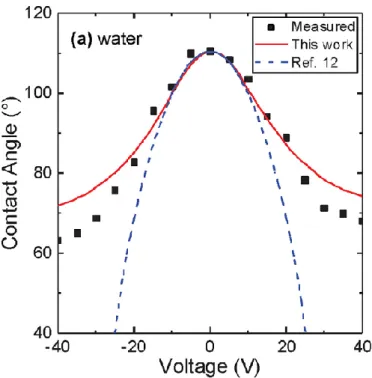
Recently, Jiang et al. proposed the potential-dependent interfacial energy change model with considered dipole-dipole moment interaction [29]. The isolated polymer changes its degree of polarization depending on the applied potential, therefore, its interfacial energy is assumed to also change. When used water and ethylene glycol droplets, the curve of the was good agreement with the theoretical value to correct the potential-dependent
SLin Young-Lippmann equation (Fig. 2-5). Fig. 2-9 shows the result using the water droplet.
When used ethylene glycol droplet, the contact angle saturation appeared at positive potential region more significantly than at negative potential region because ethylene glycol has monopole.
This result shows that the electrowetting effect appeared the more significantly, the less polarization and that the big dipole-dipole interaction disturbs the electrowetting. The dipole moment in water or ethylene glycol molecule shows highly ordered when applied high voltage, the dipole moment of the polymer surface is induced. The polarization is result in the change of the molecular order at the surface and the effect appears as a change of interfacial energy.
Figure 2-9. The contact angle change on the polymer as an electrode potential, experimental
data (■), Young-Lippmann equation (blue line) and corrective data considering with the
polarization of the polymer (red line). Taken from ref. 29
23
Ralstron et al. studied the mechanism of the contact angle saturation and the effect of the electric double layer on electrowetting with using various electrolytes and changing the polarity of the substrate [30]. In comparison with Fig. 2-10-(a) and (b), the difference between theoretical value and the measurement value became bigger when the substrate contained with more dipole moments. And then, the electrolyte concentration of the liquid droplet became higher, the electrode potential range in good-agreed with theorical value expanded (Fig. 2-10-c). In addition, the pH value of the electrolyte aqueous droplet became smaller, the electrode potential range in good-agreed with theoretical value expanded (Fig. 2-10-d).
These results show the electric double layer is important in electrowetting, and the disagreement with theoretical value is because a practical applied potential at the electrode/
electrolyte aqueous solution interface is smaller than the applied potential between the
Figure 2-10. The contact angle change on the substrate with (a) PDD<1%, (b) PDD = 65%,
dependence on (c) the electrolyte concentration, (d) the pH values. Taken from ref. 30
24
substrate and the droplet. It needs to correct when the polarity of the substrate is bigger or the applied potential is bigger because the electric charge density at the interface is not proportion to the applied potential. The potential dependent of the electric charge density is resulted in the adsorption of hydroxide ions at the interface.
Neumann et al. considered the effect of the electric field intensity on electrowetting using alcohol droplets [31]. An alcohol droplet was put on the Teflon-coated electrode and two electrodes were in 6 mm distance. As shown in Fig. 2-11-a, when the electrode potential without the droplet became bigger, the value of increased as a linear function of the applied potential, not a parabolic function from a Young-Lippmann equation. In addition, the slope of the fitting line as a function of chain length of alcohol molecules increased with the chain length (Fig. 2-11-b). The interfacial energy of alcohol/air interface would also increase, not only the interfacial energy of alcohol/electrode interface. On the other hand, an alkane droplet did not show these results like alcohol molecules, therefore, the reordering of the alcohol molecules with hydroxy occurred with applied potential.
In conclusion, the substrate which consist with isolated material and not polarized would prefer not to appear the contact angle saturation. The reordering of molecule at the droplet/electrode interface is more important to the electrowetting than the electrostatic interaction of the three phases contact line.
Figure 2-11. (a) The contact angle as a function of the applied voltage of each alkyl chain
length, (b) the plot of the chain length of alcohol and the slope of the plot of (a). Taken from
ref. 31
25
Recently, to achieve the electrowetting with lower applied voltage because it is easy to handle and the mechanical limitation, it is used the electrochemical surface reaction at the polymer surface as a useful mechanism to change the of droplet on the polymer-coated electrode. Yang et al. reported the electrowetting of an oil droplet using the reduction- oxidation process of a polymer doped a surfactant (Eq. 8), dodecylbenzene sulfonate anion (DBS) as a driving force of the interfacial energy change (Fig. 2-12, [32]). In oxidation state, the alkyl chains of DBS molecule order at interface and the interfacial energy is high. After reduction in NaNO
3aqueous solution, the sulfonate group of DBS occupied the polymer surface so the interfacial energy decreased. In addition, the isolated DBS molecules adsorbed at the oil droplet/water interface and decreased the interfacial energy of droplet/water interface. These two processes work for decreasing the value of of the oil droplet.
PPy
0(Na
+DBS
-)
oxidation
→
PPy
+(DBS
-) + Na
++ e
-(8)
reduction
←
Figure 2-12. The photographs of an oil droplet driven by reduction of polymer surface (a) and the model of the mechanism. Taken from ref. 32
(b)
(a)
26
2.2.3. Electrowetting on Conductor (EWOC)
The mercury (Hg) electrode is known as an ideal surface for electrowetting for the atomic-level smooth surface and a wide electrochemical window. Ivošević and Žutić studied the electrode potential at which the oil droplet (n-hexadecane, HD) floats from the Hg electrode surface (Fig. 2-13, [33]). Adhesive free energy G is given by equation 9. A is a contacted area with HD droplet and electrode surface.
−∆G = A(𝛾
SW− 𝛾
OW− 𝛾
SO) (9)
By defining 𝛾
SW− 𝛾
OW− 𝛾
SO= S , the HD droplet spontaneously floated from the interface when S < 0, and the HD droplet spread at the interface when S > 0. They calculated the critical potential E
cthat gives S = 0. Actually, the HD droplet floated from the electrode surface at 700 mV negative than E
c, because the HD monolayer formed at the edge of the droplet and decreased the interfacial energy of the electrode/water interface. As shown in Fig. 2-13, the shape of the oil droplet greatly changed in the range of the electrode potential 0.9 V. This shape change did not influence by the polarity or the viscosity of oil droplet.
Recently, Kornyshev et al. have reported a low-voltage electrowetting on Au electrode [34]. In this case, a nitrobenzene (NB) droplet containing tetrabutylammonium tetraphenyl- bolate (TBATPB) as an electrolyte on Au electrode in LiCl aqueous solution formed electric
Figure 2-13. The shape change of hexadecane droplet on Hg electrode/electrolyte solution
interface. Taken from ref. 33
27