南極海の酸性化が植物プランクトン(ハプト藻 類)におよぼす影響
服部 寛1・三島 翼1・遠藤 寿2・本川正三3・飯田高大4・栗原晴子5・橋田 元4・鈴木光次2・ 田口 哲3・小達恒夫4・佐々木 洋6
1:東海大学、2:北海道大学、3:創価大学、4:極地研究所、5:琉球大学、6:石巻専修大学
Impact estimation of Southern Ocean acidification on calcium carbonate phytoplankton (haptophytes)
Hiroshi Hattori1, Tsubasa Mishima1, Hisashi Endo2, Shouzo Motokawa3, Takahiro Iida4, Haruko Kurihara5, Gen Hashida4, Koji Suzuki2, Satoru Taguchi3,Tsuneo Odate4, Hiroshi Sasaki6
1: Tokai Univ., 2: Hokkaido Univ., 3: Soka Univ., 4: NIPR, 5: Ryukyu Univ., 6: Senshu Univ., Ishinomaki
Southern Ocean is one of high biological productive areas in the whole ocean because large amount of primary production is occurred in the seasonal sea-ice zone. Predicted acidification in the sea water would affect on the marine food web particularly on the calcium carbonate phytoplankton such as coccolithopholids. Biological samplings were carried out along 110oE and 140oE in the Indian Sector of the Southern Ocean to represent the coccolithopholids and prymnesiales biomass and to estimate the acidification effects on the phytoplankton communities during the T/V Umitaka-maru cruise in Austral summer of 2011/2012. This study is made as a part of the 53th Japanese Antarctic Research Expedition (JARE-53).
Ocean acidification experiment was carried out 4 times during cruise. Phytoplankton collected by a clean pump at 45oS (Stn C02) and 60oS (Stn C07) of 110oE and 50oS (Stn D13) and 64oS(Stn D07) of 140oE were replaced in around 750 µatm of pCO2 water to compare the non-acidified natural condition. Each experiment was done for three days.
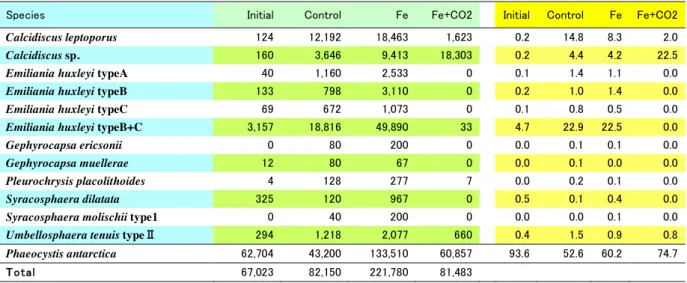
CHEMTAX analysis revealed that diatoms were major component of the phytoplankton in the study area where as Phaeocystis antarctica was most dominant at northernmost station (C02). Incubation at Stn C02, cell density of haptophytes (coccolithophorales and prymnesiales) was increase 123% under the non-enrichment condition. Cell densities became 331% when Fe was added, however it decreased to 122% under Fe enrich with high pCO2. Expected ocean acidification would affect on the production of haptopytes particularly most dominant P. antarctica and subdominant E. huxleyi .
Table 1. Changes in calcium carbonate phytoplankton density (cells L-1) and percent composition (%) at the beginning of natural water (Initial) and obtained national (Contro), Fe enriched (Fe), and Fe enriched with acifified (Fe+CO2) waters after the 3 days incubation at Stn C02 of .15 oS and 110 oE.
Species Initial Control Fe Fe+CO2 Initial Control Fe Fe+CO2
Calcidiscus leptoporus 124 12,192 18,463 1,623 0.2 14.8 8.3 2.0
Calcidiscus sp. 160 3,646 9,413 18,303 0.2 4.4 4.2 22.5
Emiliania huxleyi typeA 40 1,160 2,533 0 0.1 1.4 1.1 0.0
Emiliania huxleyi typeB 133 798 3,110 0 0.2 1.0 1.4 0.0
Emiliania huxleyi typeC 69 672 1,073 0 0.1 0.8 0.5 0.0
Emiliania huxleyi typeB+C 3,157 18,816 49,890 33 4.7 22.9 22.5 0.0
Gephyrocapsa ericsonii 0 80 200 0 0.0 0.1 0.1 0.0
Gephyrocapsa muellerae 12 80 67 0 0.0 0.1 0.0 0.0
Pleurochrysis placolithoides 4 128 277 7 0.0 0.2 0.1 0.0
Syracosphaera dilatata 325 120 967 0 0.5 0.1 0.4 0.0
Syracosphaera molischii type1 0 40 200 0 0.0 0.0 0.1 0.0
Umbellosphaera tenuis typeⅡ 294 1,218 2,077 660 0.4 1.5 0.9 0.8
Phaeocystis antarctica 62,704 43,200 133,510 60,857 93.6 52.6 60.2 74.7
Total 67,023 82,150 221,780 81,483