103
Article
1. INTRODUCTION
Physical gels with mechanically weak network structures are used in foods, cosmetics, and other personal care products, where they are supposed to be fractured during use. The reversible gels are particularly interesting. Soft materials such as these gels exhibit a transient network structure. Transient network systems can be found in two types of materials. The first type of material that forms a transient network system is the associating polymers group. The telechelic polymers (TPs), a typical example of a system with transient network
1-4), show unique rheological properties when in aqueous solution.
The most remarkable characteristic is that the mechanical spectrum, the frequency dependency of the dynamic modulus can be analyzed by a simple Maxwell model. In this case, the relaxation time is the lifetime of the crosslink of the transient network. Theoretical studies have revealed that the lifetime of the transient network of TP aqueous solutions is governed by the tension of the effective elastic chain and the affinity of the hydrophobic chain to the micelle-like crosslink point.
5,6)This theoretical exception has been confirmed by experimental studies on a TP aqueous solution.
7,8)The second
type of material having a transient network system is thread- like molecular assemblies formed by low-molecular-weight amphiphilic molecules. Certain classes of surfactants form thread-like micelles in water. Many studies on ionic surfactant/
salt/water ternary systems have been published.
9)The thread- like micelle solutions also show Maxwellian behavior in their rheological properties. It is somewhat surprising that these completely different types of molecular systems show similar rheological properties.
Thread-like molecular assembly is quite interesting from both academic and industrial viewpoints.
10)The mechanism of stress relaxation in this system is still under debate. Cates et al.
11)proposed a reptation model that assumes that the transient entanglement of the thread-like molecular assemblies is relaxed by reptation. Another idea is a phantom network theory that assumes that the thread-like molecular assemblies slip through at the transient entanglement.
12)Because the mechanism of the mechanical relaxation of temporally entangled thread-like molecular assemblies is not well understood, further studies on a wide range of such materials are required.
From the perspective of industrial application, the thread- like molecular assemblies are a promising candidate for novel drug delivery system on account of their relatively large hydrophobic space.
10)If we can engineer the system to have a stimuli response property, it could become a smart delivery
A Transient Network Structure in Sucrose Stearate/Water Systems
Saori T akahashi and Isamu k aneda
†Department of Food Science and Wellness, College of Agriculture, Food, and Environment Science, Rakuno Gakuen University
Bunkyodai Midrimachi, Ebetsu, Hokkaido 069-8501 Japan (Received : November 29, 2013)
The rheological properties of an industrial-grade sucrose stearate aqueous solution were studied. This solution at 1 to 8 wt % appeared translucent or turbid from 20 to 48 °C; however, it became transparent above 48 °C and its viscosity increased. Furthermore, the apparent viscosity of the sample solution increased with temperature, and showed peak value at 48 °C for all such samples. On the other hand, small angle laser-light scattering studies revealed that the molecular-assembly size of the surfactant abruptly decreased at the same temperature. The dynamic modulus of the sample at approximately 48 °C was successfully analyzed with a bimodal Maxwell model, which showed that sucrose stearate formed several types of molecular assemblies and the shape was dependent on temperature. In particular, the rheological properties at approximately 48 °C strongly suggest that the surfactant formed thread-like molecular assemblies.
Key Words: Sucrose fatty acid ester / Molecular assemblies / Transient network / Rheology / SALS
To whom correspondence should be addressed † Tel/Fax: +81-11-388-4701
E-mail address: [email protected]
104
system for a wide industrial field. The system is also an interesting prospect for the food industry as a texture modifier.
It is quite important to control the rheological properties of foods in order to make them feel more satisfying in the mouth and easy to swallow
13-15), and hence, a new type of rheological control agent is required.
We focused on sucrose stearate, which is a popular edible emulsifier. This nonionic surfactant forms several types of molecular assemblies depending on the temperature of the aqueous binary system.
16-18)The properties of fatty acid esters in industrial-grade sugar are quite complicated owing to impurities. Samples of sugar fatty acid esters, mainly a food ingredient, generally consist of mono, di, and tri esters.
16)The shape of the molecular assembly strongly depends on the shape parameter (SP) described Eq. (1).
l
ca SP v
0
= (1)
( ) ( )
ω ω ω
η ' = G " (2)
+ +
= +
2 22 2 2
2 2 2
1 ) 1
('
f f f s s
s
G
G
G ω τ
τ ω τ
ω τ
ω ω (3)
+ +
= +
2 2 2 21 ) 1
(
"
f f f s s
s
G
G
G ω τ
ωτ τ
ω
ω ωτ (4)
(1) where v, a
0, and l
cdenote the volume occupied by the hydrocarbon tail, the area on the surface of the aggregate that the head group occupied, and the tail’s “maximum effective length,” respectively. A surfactant having small SP (<1/3) tends to create spherical micelles. If the value is greater than 1/3, the micelle grows linearly and makes a thread- like micelle. Sucrose mono-stearate has a small SP value;
therefore, it is expected to make spherical micelles. However, as mentioned above, industrial-grade samples contain di- ester and tri-ester. In fact, the sample used in this study also contains impurities (see experimental section). A SAXS study reveals that industrial-grade sucrose stearate forms a multilayer system in water.
16)There are several reports on the phase behavior or rheological properties of the sucrose stearate/water binary system. Calahorro et al.
17)report that sucrose stearate solution showed a micelle solution phase above 43 °C; however, this micelle solution never showed rheological properties similar to those of worm-like micelles.
Sadtler et al.
18), in another study on a sucrose stearate/water binary system, report that a viscous phase above 45 °C is the L
a+ water phase; however, they did not perform dynamic modulus measurements (just showed the steady-state viscosity). Both these studies were conducted on samples from the same distributor (Mitsubishi Kagaku Foods, Tokyo).
Since we recently found that the surfactant formed thread-like molecular assemblies without any additives, the details of the rheological properties and some results of small-angle laser- light scattering (SALS) studies for the molecular assemblies are reported in this study.
2. MATERIALS AND METHODS
2.1 Materials
Sucrose stearate (Ryoto Sugar Ester S-1670) was obtained from Mitsubishi Kagaku Foods (Tokyo, Japan). Fig. 1 shows the chemical structure of the mono-ester. S-1670 consists of 77 % mono-ester, 20 % di-ester, and 3% tri-ester.
16)The sample was used without further purification. The sample solutions were prepared with distilled water. Since the surfactant does not dissolve in chilled water, the sample solution was heated at around 70 °C to completely dissolve the surfactant.
2.2 Phase Behavior
Samples were prepared for phase analysis by weighing the proper amount of sucrose stearate and water (from 1 to 8 wt % of surfactant). The sample solutions, which were sealed in test tubes, were immersed in a water bath to maintain their temperature. The temperature of the sample was controlled within an accuracy of ±0.5 °C. The phase behavior of the binary system was checked by observation with the naked eye.
2.3 Rheological Measurement
Rheological measurements were performed with a strain- controlled rheometer (ARES, TA instrument, USA) equipped with a water bath temperature control system having a Couette geometry with a cup diameter of 18 mm, a bob diameter of 16 mm, and a bob length of 16 mm. The temperature sweep of the dynamic modulus at constant frequency and strain was measured to check the consistency of the change behavior at various temperatures. The samples were first heated at 70 °C and then cooled (1 °C/10 min) during the measurement. The frequency dependence of the dynamic modulus was also investigated at various temperatures and concentrations.
Fig. 1. Chemical structure of sucrose mono-stearate.
105 2.4 Small-Angle Laser-Light Scattering
SALS measurement was performed with a homemade apparatus. A He–Ne laser source (5 mW, l = 635 nm) (LDU33;
Sigma Koki, Tokyo) was used as the light source. The sample solution was sealed up in a quartz cell (thickness: 1 mm) and its temperature was controlled with a homemade temperature control unit equipped a circulator. The digital images of the projection of the scattering light on a screen were taken with a digital camera (D-5100; Nikon, Tokyo), and then analyzed with free image analyzing software (Image J, and Calib CCD).
3. RESULTS
3.1 Phase Behavior
The appearance of the S-1670 aqueous solutions, whose concentrations ranged from 1 to 8 wt %, was observed with the naked eye at various temperatures ranging from 20 to 60 °C. The phase behavior is shown in Fig. 2. The most remarkable point is that all the samples changed in appearance from translucent (bluish) /turbid (white) to transparent at approximately 48 °C. It is expected that the samples contain discrete micelles or vesicles (translucent phase) or somewhat large-sized molecular assemblies (turbid phase); however, it is difficult to describe the details of these phases from the result because this observation was performed only by the naked eye. Since the transparent phase exhibited high viscosity (checked by the titling method), the viscosity change behavior of the samples was investigated. Dynamic measurement was performed at constant frequency ( w = 10 rads
−1) and strain (g = 0.1) at various temperatures to obtain the dynamic modulus, and then, the dynamic viscosity was calculated according to Eq. (2).
l
ca SP v
0
= (1)
( ) ( )
ω ω ω
η ' = G " (2)
+ +
= +
2 22 2 2
2 2 2
1 ) 1
('
f f f s s
s
G
G
G ω τ
τ ω τ
ω τ
ω ω (3)
+ +
= +
2 2 2 21 ) 1
(
"
f f f s
s s
G
G
G ω τ
ωτ τ
ω
ω ωτ (4)
(2)
The 3D plot (Fig. 3) shows the dynamic viscosity for various concentrations and temperatures. As can be seen, there is a peak at around 48 °C for all concentrations of samples.
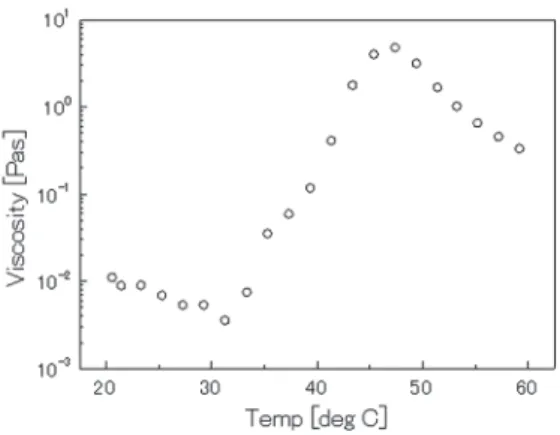
The temperature is in agreement with the phase transition temperature (translucent / turbid to transparent). The viscosity of the samples decreased with increasing temperature above the transition temperature. In general, amphiphilic molecules tend to form a molecular assembly in aqueous solution. The details of the viscosity change were checked on a 4 wt % S-1670 solution, as shown in Fig. 4. The viscosity of the sample started to increase at approximately 40 °C, at which point the appearance changed from turbid to opaque. The viscosity continued to increase with the temperature until approximately 48 °C. The peak value of the viscosity was approximately 10 Pa∙s, which is an incredibly high value for an aqueous solution of low-molecular-weight matter.
This temperature is also the critical temperature at which the appearance became transparent. Because the relative
Fig. 2. Phase diagram of S-1670/water binary system. Fig. 4. Temperature dependence of the dynamic viscosity measured at w = 10 rads
-1for the 4 wt % S-1670 aqueous solution.
Fig. 3. Apparent viscosity change behavior for the S-1670/water binary
system.
106
viscosity of a colloid dispersion depends on the concentration, shape, or size of the disperse phase, these behaviors indicate that the size or structure of the molecular assemblies began to change at approximately 40 °C, and that another change occurred at around 48 °C. As shown in Fig. 4, this viscosity change behavior agreed with the phase behavior (Fig. 2). We are particularly interested in the transparent viscous phase.
Such high viscosity must be due to well-formed molecular assembly; therefore, we assume that the transparent viscous phase would be a thread-like molecular assembly phase.
3.2 Rheological Properties
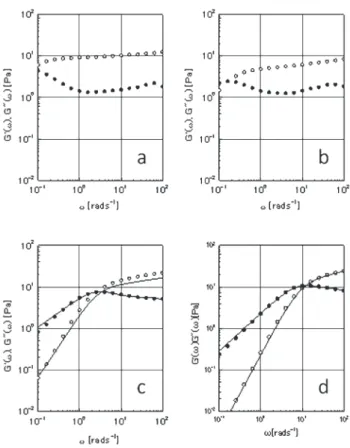
3.2.1 Temperature dependence of the dynamic modulus To investigate the structure of the molecular assemblies of the S-1670 solutions at various temperatures, the frequency dependence of the dynamic modulus was measured. As a typical result, the mechanical spectra of the 4 wt % S-1670 aqueous solutions at 40, 44, 48, and 50 °C are shown in Fig. 5 (a, 40 °C; b, 44 °C; c, 48 °C; d, 50 °C). In particular, the result at 44 °C, just below the critical temperature, is quite interesting. The mechanical spectrum (Fig. 5 b) shows bimodal relaxation behavior; namely there is a fast mode and a slow mode. When we focused on the slow mode, the relaxation time shortened with increasing temperature.
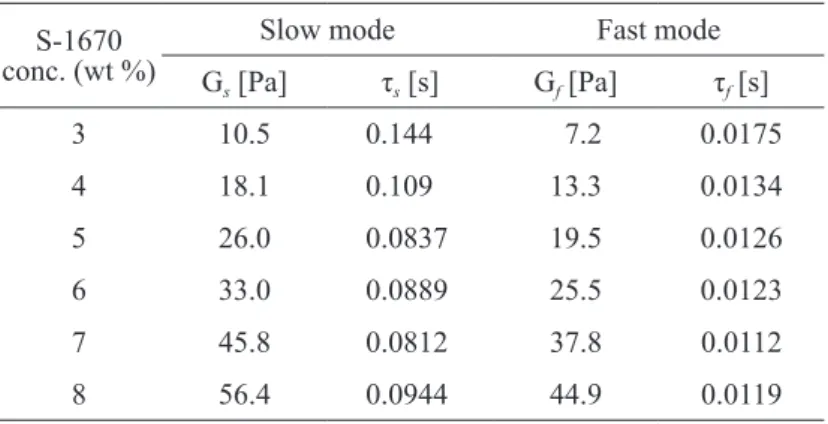
This result indicates that the microscopic structure of the molecular assembly in S-1670 solution changed depending on the temperature. Above the transition temperature, 48 °C, the mechanical spectrum is Maxwellian (Figs. 5 c and d). We analyzed the experimental data at 48 °C and 50 °C by using a bimodal Maxwell model [Eqs. (3), (4)]:
l
ca v SP
0
= (1)
( ) ( )
ω ω ω
η ' = G " (2)
+ +
= +
2 22 2 2
2 2 2
1 ) 1
('
f f f s
s s
G
G
G ω τ
τ ω τ
ω τ
ω ω (3)
+ +
= +
2 2 2 21 ) 1
(
"
f f f s
s s
G
G
G ω τ
ωτ τ
ω
ω ωτ (4)
(3)
l
ca SP v
0
= (1)
( ) ( )
ω ω ω
η ' = G " (2)
+ +
= +
2 22 2 2
2 2 2
1 ) 1
('
f f f s
s s
G
G
G ω τ
τ ω τ
ω τ
ω ω (3)
+ +
= +
2 2 2 21 ) 1
(
"
f f f s
s s