in 19th Century Europe
著者名(英) Jonas Ruegg
journal or
publication title
Bulletin of center for interdisciplinary studies of science and culture Kyoritsu Women's University & Junior College
volume 21
page range 153‑176
year 2015‑02
URL http://id.nii.ac.jp/1087/00003017/
The Challenges of Publishing Japanese Sources in 19th Century Europe
Jonas Rüegg
After the Swiss diplomat and politician Aimé Humbert returned from a political mission that had led him to Japan in 1863–64, he published a book that described Japan with a precision no French-speaking author had reached before him. Thanks to his status as a diplomat, Humbert was able to travel to places that had not been accessible to most foreigners yet. Documenting his observations made on numerous excursions in words and images – often he travelled together with the well known photographer Felice Beato – Humbert created a great stock of ethnographical sources upon which he would build his travel account Le Japon Illustré in 1870.
In spite of the fact that the opening of Japanese harbor cities made it possible to travel to and trade with Japan, and that Japanese Studies in Europe had developed quite significantly since the 1850s, it was rare for European Scholars of Japanese Philology at Humbert's time to have a chance to see the Land of the Rising Sun with their own eyes. As late as around 1870, importing a few books from Japan was still a complicated and expensive issue. Also, translating Japanese sources and printing Japanese texts in dictionaries or bilingual editions was accompanied with major intellectual and technical difficulties. Such challenges, however, did not deter a small group of intellectuals, who rather seemed to be attracted by the mysterious remoteness of East Asian cultures.
This paper
1aims to illustrate the challenges European Orientalists faced in their work when it came to gathering information or translating and publishing Japanese language texts and images.
On this purpose, I will introduce four protagonists, August Pfizmaier (1808–1887), Aimé Humbert (1819–1900), Léon Metchnikoff (1838–1888) and François Turrettini (1845–1908), whose works reflect the rapid development of Japanese Studies in the mid-nineteenth century.
Translation and visual sources
Access to Japanese documents in the 1860s was all but easy. Aimé Humbert witnessed some of the last months of the Tokugawa government and had access to a vast choice of visual sources on Japanese culture, which he collected with a vivid interest. Humbert had, however, no command of the Japanese language. Of many of the books he collected, he cut out the images and threw away
1) Jonas Rüegg is an MA candidate in Regional Studies - East Asia at Harvard University. Email: [email protected].
edu. I would like to thank my academic advisors Hans B. Thomsen and David L. Howell for their feedback and support
in writing and publishing the present paper.
the text. He used visual sources as illustrations for his Japon Illustré, in which, as the title says, images played a crucial role.
2)Looking at those illustrations, one notices that the majority depicts images of photographic exactness. In the mid-nineteenth century, European audiences were used to realistic styles in their illustrations, and Humbert’s work, which aimed to be a scientific contribution to ethnography, joined this trend. Most of the illustrations were based on the 3668 graphic art objects that he had collected during his stay in Japan. This collection contained works of Western as well as Japanese artists, including great names such as Felice Beato and Katsushika Hokusai. Characteristically Asian elements of these sources, such as axonometric perspective, fukinuki-yatai, or narration of different temporal frames within a subdivided space, were consistently filtered out. Also, the flow of narration in Humbert's illustrations generally leads the observer from the left to the right, as it is common in the European tradition. The contents were, so to speak, translated into a visual tradition familiar to the European eye. This required the construction of a central perspective, naturalistic depiction of individuals and objects, clearly defined situations of shadow and light, and a point of view that can be located within the image. (cf. Fig. 1)
The artists engaged in the illustration of Humbert's book were not what one typically calls japonistes in the art historical sense. Nevertheless, they seemingly aimed to experiment with a few relatively true reproductions of Japanese images. (cf. Fig. 2 and 3) These, however, may have had the function of delivering a flavor of the exotic in the midst of scientific depictions of the true Japan, thus of exoticism as opposed to science. I want to emphasize that the translation of Japanese images into European visual culture was necessary in order to enhance the authority of an image as a true depiction, whereas a representation in the original style stood in the shadow of the non- reliability of Asian artists, as the following statement in Humbert's Japon Illustré shows:
The artisan of Yedo [Edo] is a true artist. Apart from the conventional style, to which he still believes to have to submit in his reproductions of the human body, and if one may forgive him the inadequacy of his studies of what regards the rules of perspective, one won't have, for the rest, anything else than praise to award him.
3)Humbert therefore translated visual documents on Japan into European visual culture.
Indeed, images that did not even have a correctly constructed perspective were considered unreliable and had no authority when it came to depicting a true situation. Of course, there is no contradiction when Humbert praises the exotic beauty of Japanese art in a paternalistic way.
The traditional patterns and Japanese-style drawings that Humbert depicts in his book show the multifarious faces of Japanese artistic expressions that gave inspiration to European artists.
2) Many of the images in the Collection Humbert were cut, glued and contain notes in Humbert's handwriting. On many drawings, he wrote notes on how the image should be used as an illustration in his book, such as: "Chapelle élevée sur la tombe du Siogun / Sujet no. 88) Liv. III Kamakura / Chap. 14 la résidence du Siogun; / Texte page 83." MEN, Fonds Aimé Humbert, 12.41.0275-IX.B.1.
3) Humbert 1870: vol. II, p. 95.
In doing so, Humbert effectively sensed the tenor of his time and reacted to a growing demand for Asian motives. His publications in Le Tour du Monde appeared in 1866–69
4)and coincided with the 1867 Exposition Universelle in Paris, which exerted a great influence at an early stage of Japonisme . The first step towards Japonisme in the 1860s consisted in the increasing depiction of Japanese objects – folding screens, fans and Kimonos – rather than in the adaption of Japanese visual culture. Only in the following decades, European artists succeeded in disrupting European conventions of perspective, image-, and color-composition when referring to Japanese examples.
5)The representation of Japanese artworks was drastically different in the publications of the Swiss linguist François Turrettini. Starting in 1871, Turrettini ran a publishing house in Geneva, where he published works on Far-Eastern philology, often quoting original language documents and printing Chinese characters. Devoting himself to accuracy in his translations, Turrettini accordingly decided not to let the images go through the filter of an European artist's adaption.
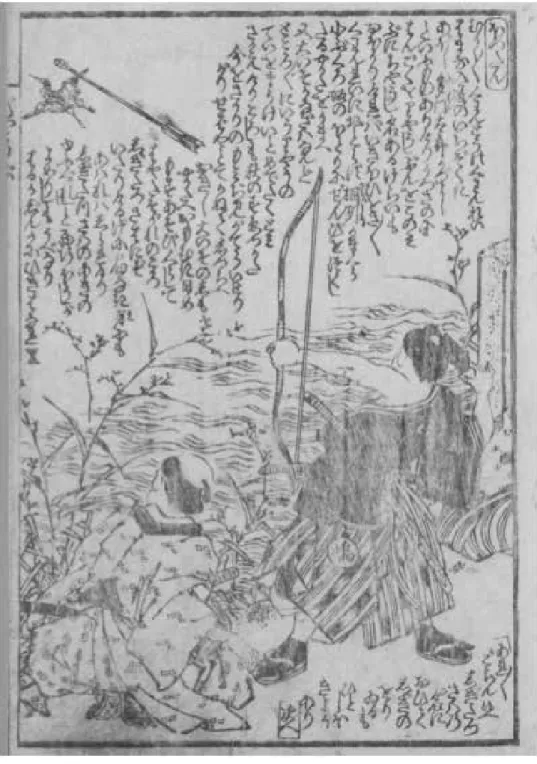
Instead, he reproduced the works very closely to their original in style. (cf. Fig. 4) The first fascicle of Turrettini's translation of Heike Monogatari, published in 1871,
6)merely a year after Humbert's Japon Illustrée, contains three images, and all of them are kept in the style of black and white Japanese woodblock prints, printed on a fine paper similar to the Japanese washi . The images might have been copied from the art collection of Aimé Humbert as well, which Turrettini had taken over in the same year.
7)Turrettini apparently aimed to depict a piece of Japanese art true to its original style. Even though copying the image required a European artist's work between the original object and the lithograph, the artists were obviously committed to displaying the image as Japanese-like as possible. In the images, we therefore find characteristically Japanese elements that could have surprised the European eye. Not only do the images contain an axonometric perspective, but one may also find clouds containing calligraphic text on the border of the image, several horizon lines indicating distance and depth, or a person depicted twice in order to narrate two scenes at once. In these scenes, the flow of the narration also drifts from the right to the left. All these elements had consciously been avoided in most of Humbert's illustrations.
Even Japanese characters were carefully copied in Turrettini's lithographs. Some characters apparently changed their number of strokes, and most of the furigana are hard to read. As opposed to Humbert’s publication (cf. Fig. 5), however, they can be identified as a correct Japanese text. In spite of their commitment to photographic exactness, Humbert's artists – not surprisingly – ignored the value of Japanese text within the image.
4) Humbert 1866-69.
5) The French painter James Tissot undertook exactly this step in this well-known oil painting Japonaise au Bain (1864). A woman with an open kimono stands on a Japanese-style veranda beneath cherry blossoms. The image is bursting with Japanese attributes, but its technical execution is true to the European conventions of its time (cf. Fig. 11).
6) Turrettini 1871.
7) Dallais 2005: 100.
The Russian exiled geographer Léon or Lev Il'ič Metchnikoff, who had cooperated closely with Turrettini during his years in Switzerland, used to draw most of his illustrations himself.
Thereby, he endeavored to imitate a Sino-Japanese style, as he announces in the preface of his major work, L'Empire Japonais (1881):
The usefulness of drawings in a descriptive work doesn't need to be explained; (...) our description could not be complete, if we wouldn't add a carefully selected series of illustrations by reproducing the major part of the different styles of the Japanese art, of which, in our opinion, the uncountable trinkets one sees nowadays in our stores of chinoiserie give just a very incomplete idea.
8)Given the fact that his work was mainly a historiographic account, Metchnikoff's drawings emphasize the depicted object rather than the style of drawing or calligraphy. In particular, historic moments and portraits of historic personalities receive much attention. The figures and even the calligraphy were drawn by pen and, in some cases, embellished with some gold color. In many cases, Metchnikoff made use of the shading technique using lines typical for copper-plate engravings in order to emphasize brighter parts of the image. The depiction of shadow in a portrait differs from the bokashi shading technique in Edo period landscape prints and is a - probably unconsciously applied - form of adaption. (cf. Fig. 6) I therefore argue that, for Metchnikoff, the illustrations served as historical sources much more than as an inspiration to European artists;
nevertheless he did not need to "translate" images into the European visual culture.
Humbert, as opposed to this, built the authority of his travel account upon the photographic exactness of its illustrations. Indeed, he emphasizes that his works "let the Orient speak itself", when he writes: "This collection represents, on its own, the essence of an album one might entitle:
the Japanese, depicted by themselves “.
9)In spite of the fact that most photographs in early Japanese photography were composed studio-works delivering a European audience,
10)they were largely perceived to have great reliability when depicting a true fact . This notion, however, weakened as the audience became more familiar with the medium and its ability to deceive the observer. Turrettini, in contrast, gained his reliability from the fact that he not only worked with original-language documents, but that he also provided the original wording of his sources and thereby assured transparency in his work.
The works I discuss in this paper introduced Japanese visual sources to European readers at an early point in time. Thereby, they provided sources of inspiration for the development of Japonisme, which then consisted of the depiction of Japanese motives within a European visual culture. Only later on did Asian narrative and technical patterns find their way into European artistic expression.
8) Metchnikoff 1881:VII.
9) Humbert 1870:vol. I, p. II.
10) Delank 2000: 261–262.
Importing knowledge
Gaining access to East Asian text documents was one of the major challenges for scholars like Turrettini who never had the chance to travel to Asia and build up their own collection of works. When it came to finding Japanese-language documents as objects of research, scholars faced a big problem. In spite of numerous collections of chinoiserie possessed by wealthy exponents of the European nobility, texts written in East-Asian languages were a rare sight in 19th century libraries. Scholars relied on direct or indirect contacts with East Asia in order to receive the necessary material for their work. During the period of limited exchange with Europe (1639-1858), this was difficult. But it was not impossible to find smuggled materials on the European market.
Many of the books, upon which the Austrian linguist and Japanologist August Pfizmaier built his work in the 1840s, were brought to Europe by the German physician Philipp Franz von Siebold and bought by the Austrian Court Library in 1835.
11)Siebold had been expelled form Japan in 1829 when it became known that some translators in Dejima had helped him in smuggling forbidden goods such as geographic maps abroad.
12)Those of Pfizmaier's books that can be tracked back to Siebold did not only include several examples of contemporary as well as classical and kokugaku - literature, but also Dutch-Japanese dictionaries compiled by Japanese rangakusha (
蘭学者, scholars of Dutch learning) and a Sino-Japanese vocabulary.
13)While the European state of knowledge on Japan was still modest, the Japanese research on Europe was, regardless of governmental suppression, advancing steadily. Pfizmaier, therefore, made use of the preliminary work done by Japanese scholars.
In the two decades and a half after Pfizmaier's outstanding translation of Six Folding Screens (1847), to which we will come back later on, European-made instruments for research on Japanese language sources developed quite significantly. In the field of linguistics, publications of the 1860s increasingly integrated Portuguese, Dutch and French or English approaches.
14)As one can learn from the preface to Komats et Sakitsi (1875), Turrettini was largely relying on recent works such as W. G. Aston's Grammar of the Japanese Written Language (1872), Léon de Rosny's Introduction au cours de japonais (1856) as well as Japansche Spraakleer (1868) by Johann Joseph Hoffmann.
The publication of J. C. Hepburn's Japanese and English Dictionary (1867) was also a great step for Japanese philology.
15)Nevertheless, Turrettini writes, the grammatical and lexical instruments were still unsatisfactory for philological research. None of the newer dictionaries could substitute, according to him, the Japanese-Portuguese Dictionary by the Jesuit Father João Rodriguez from
11) Pantzer 1987:41–5.
12) Torii 2000:406.
13) Pantzer 1987:41–5.
14) Kaiser 1995, esp. p. 21–8.
15) Turrettini refers to all these works in the prefaces of Heike Monogatari (1871) and Komats et Sakitsi (1875).
1604.
16)Thanks to its translation into French by Léon Pagès between 1862–68, it continued to be an essential instrument for Japanologists even 270 years after its publication.
17)Around 1870, it was apparently possible to translate contemporary texts without resorting to Japanese rangaku dictionaries, thanks to the boom in European publications mentioned above. For classical Japanese, however, Turrettini relied on imported Japanese-Japanese dictionaries. As we can gather from the sketch of a letter of 1867 to a certain Mr. Borel in Japan, Turrettini established a financial limit of 500 francs and gave some indications on a few works he desired, leaving the further choice to an "erudite Japanese" friend of Borel's. Among the ordered works, there was a popular novel entitled Six Folding Screens (1821) by Edo novelist Ryûtei Tanehiko along with the Heike Monogatari, but also Japanese maps, and, of special importance, dictionaries containing kanji-writings.
18)Due to difficulties of printing Japanese characters, most western vocabularies at the time contained only Romanized Japanese.
The challenge of printing Asian texts
In 1875, Turrettini published a work entitled Komats et Sakitsi ou la rencontre de deux nobles cœurs dans une pauvre existence. Nouvelles scènes de ce Monde périssable exposées sur six feuilles de paravent (Komats[u] and Sakitsi, the encounter of two noble hearts in a poor existence.
New scenes of this perishable world exposed on six folding screens), a translation of a novel by the best-selling Edo novelist Ryûtei Tanehiko (
柳 亭 種 彦, 1783-1842) published for the first time in 1821 under the title Ukiyo gata rokumai byôbu (
浮世形六枚屏風, Six Folding Screens in Appearance of the Floating World ).
19)The novel had gained fame among European Orientalists thanks to its translation into German by August Pfizmaier in 1847.
20)Comparing the choice of kanji in Turrettini's edition and the original prints of the Six Folding Screens, one can assume that Turrettini referred to the original 1821 version as well as to a newer edition from 1869, which he might have received upon his order two years earlier on.
Remarkably, the 1869 edition displayed the English title "Account of a Japanese Romance".
21)This might simply be a fashion of the early Meiji years, but it might as well be an indication that a new edition of this work was requested by foreign Japanologists, or that it was even the product of an export-oriented industry similar to Yokohama photography.
16) Turrettini 1875: 2.
17) Kaiser 1995: 23.
18) According to the draft of a letter to Mr. Borel in Japan (1867), in: Archives Turrettini, Tb.4. It is possible that Turrettini was referring to Japanese rangaku vocabularies, even though he believed the Japanese-Dutch vocabularies were Dutch books published in Japan.
19) Ryûtei Tanehiko 1821, in: National Diet Library.
20) Pfizmaier 1847.
21) Ryûtei Tanehiko 1869: 1, in: Waseda University Library.
Tanehiko was famous in Edo Japan as an author of popular literature of the gôkan (
合 巻) genre, in which the image (
挿 絵sashi-e ) played an important role. Many of his works were illustrated by eminent artists such as Utagawa Kunisada (
歌川国貞1786–1865) and, in the case of Six Folding Screens, Utagawa Toyokuni (
歌川豊国1769–1825). Tanehiko also maintained a close friendship with Katsushika Hokusai. In spite of his popularity and his high birth as a hatamoto, Tanehiko’s works were subject to a censure strike during the Tenpô reform of 1841–43 (
天保 の改革tenpô no kaikaku ).
22)Pfizmaier may not have known of these happenings, when Tanehiko’s texts found their way into his hands.
Pfizmaier's German translation entitled Sechs Wandschirme in Gestalten der vergänglichen Welt (Six folding screens in shapes of the perishable world) was an outstanding work, not only because it was the first complete Japanese novel published in a European language,
23)but also because it comprised a strikingly precise reproduction of the original novel in Japanese writing.
Apart from the text, all woodblock-prints were copied from the original document. Pfizmaier ordered lithographic reproductions of all 56 illustrated pages of the original novel, but he printed the main text by using movable types of kana and a few kanji . Including even some ligatures of several kana , the types imitate the impression of cursive writing quite well. Looking at single characters, however, one can recognize that they tend to be more angular than original Japanese calligraphy, and their shapes are not as fluid as in Japanese prints. There is a subtle interruption of the brush- line after every single letter, further betraying the fact that the text was not carved into a woodblock as it would have been common in Japan, but printed by means of movable types. The characters therefore became larger and much more static than the hand-written original text which makes it more easily readable (cf. Fig. 7 and 8). In order to avoid too much divergence between the original illustrations and the now-enlarged corresponding text, Pfizmaier inserted 24 additional pages filled exclusively with text throughout the reproduction.
The types used for the reproduction of six paravents were evidently produced according to the 1821 original document. The reproduction not only uses kanji in the same place as the original edition of 1821, but also hentaigana appear according to the original. The calligraphic style of the original document was imitated as well. Pfizmaier seems to have misread in a few cases,
24)but the overall impression is strikingly convincing.
The reason for this complicated combination of lithography and movable type was not only the improved readability of the Japanese writing, but presumably also the high price of lithographic reproduction of Asian texts. Pfizmaier's lithographers were certainly able to imitate calligraphic texts, as the first seven pages of the reproduction show. (cf. fig. 9) These pages contain many kanji
22) Satô 1995: 621–9.
23) Pantzer 1987: 47.
24) E.g.: 勢 instead of を, 々 instead of や, both Pfizmaier 1847:189.
and furigana . In the case of calligraphic texts, lithography was the most convenient technique of reproduction. Why then, did Pfizmaier print his text with movable types? The answer lies in the improved readability of the text. Scholars of East Asian book history explain the woodblock print's prevalence over the movable type for almost a millennium through the low wages of illiterate carvers who could graphically copy a text. A woodblock would further have the advantage of cheap reprints.
25)For Pfizmaier, the opposite was the case. The graphical enlargement of the characters for the sake of readability required philological expertise of the carver or typesetter, and had therefore to be separated from the reproduction of images. Presumably, Pfizmaier worked with a small set of types, which he could reuse from page to page. Considering the 24 pages without illustrations, this way of reproduction was doubtlessly cheaper than an exclusively lithographic reproduction
The production of movable types, however, was not yet suitable for large-scale texts in Chinese characters, due to the great number of characters required. Three years after Six Folding Screens, in 1851, Pfizmaier published the first and only fascicle of a Japanese dictionary that needed to be printed by lithography since it mainly contained kanji . The project was stopped after the publication of the first 160 pages due to the enormous cost of the printing process.
26)Printing Asian texts was a great challenge for Western scholars in the mid-nineteenth century, and only a few works could be realized in this way. Pfizmaier’s experience is representative of a more general challenge encountered by Western scholars intending to print Asian texts, and his success with six folding screens is the exception rather than the rule. Another notable example is W. H. Medhust's Japanese - English dictionary of 1830,
27)composed of 344 lithographic pages containing Japanese and Roman letters.
These circumstances enhanced the value of the Chinese printing equipment owned by Turrettini's Edition de l'Atsume Gusa in Geneva. Being able to print kanji in Japanese texts was helpful for the community of European scholars. Since most 19th century Japanologists were, like Turrettini, originally Sinologists, the lack of Chinese characters was a hurdle to them when dealing with Japanese texts. In particular, the numerous readings of Japanese and Sino-Japanese words were confusing for non-native speakers. In the preface to Komats et Sakitsi (1875), Turrettini writes:
The Japanologist, for whom the Chinese usually is of great help, finds himself in an embarrassing situation in front of texts deprived from their hieroglyphs. (...) It is as difficult as guessing the meaning of a Chinese word transliterated into the alphabet.
28)Accordingly, the addition of kanji to the text in Romanized Japanese in Turrettini's editions functioned as a reading assistance for Sinologists, who stepped over into the world of Japanese
25) Brokaw and Chow 2005:9.
26) Pantzer 1987:39. Even though the dictionary explained 1046 words, it did not even come beyond the first letter of the iroha alphabet.
27) Medhust 1995 [1830].
28) Turrettini 1875: I–III.
literature. As opposed to Pfizmaier, Turrettini, did not have any kana -types. (cf. Fig. 10) The kanji , printed below the Romanized words, correspond with the spelling in the newer Japanese edition of Six Folding Screens of 1869,
29)since the original version by Tanehiko hardly made use of Chinese characters. Turrettini did not consistently print all characters used in the original work, and he generally did not use any kanji where the original used kana . The illustrations, depictions of Komatsu and Sakichi, were copied from the 1821 original version by Utagawa Toyokuni, whereas a reproduction of two pages of the original text was taken from the more easily legible re-edition in kanjikana majiribun of 1869.
During his studies in Paris under the then leading Sinologist Stanislas Julien, Turrettini seems to have first experimented with the technical challenges of printing. In a letter of 1866, he writes to his former teacher Father Guriel in Rome:
I gained some information on the Chinese characters of Mr. Julien; they are 42.000 in number and they have been carved into wood in Peking; they look nice and are of middle size, I've seen the catalogue which consists in a Chinese book; we will now prepare molds that will allow us to found as many characters as we want.
30)This enormous number of characters was needed in order to print Julien's Chinese grammar
31)that appeared as Nouvelle Synxtaxe Chinoise . Its first volume was produced in 1869 in the Austrian K. K. Hof- und Staatsdruckerei,
32)and the second one in 1870 in the Imprimerie Orientale Victor Goupy in Paris.
33)Since the characters of Julien's Syntaxe Chinoise have the same shape and size as Turrettini's, it is probable that Julien lent his equipment to those publishers for his publication. Presumably, Julien allowed his student Turrettini to copy a set of his characters in order to run his own publishing enterprise in Geneva.
Intellectual networks in the age of globalization
In 1872, Julien published his Si-Siang-Ki with Turrettini in Geneva. For this purpose, Turrettini employed a Chinese printer named Tschin-Ta-Ni (
陳大年Chén Dànián ), who had an exciting biography of his own.
34)Born in China in 1842, he was forced to serve as a soldier during the Taiping rebellion. After the Second Opium war, he worked as a servant in a British household in Shanghai, where he learnt English. After quitting this job, he was lured by another job offer but then was trapped and sold to Cuba as a slave in 1864. His Spanish master, however, decided to release
29) Ryûtei Tanehiko 1869, in: Kokuritsu Kokkai Toshokan.
30) Draft of a letter to Mr. Falanga at the Chinese college in Naples (1867), in: Archives Turrettini, Tb.4.
31) According to the draft of a letter to Father Guriel in Rome (1867), in: Archives Turrettini, Tb.4.
32) Julien 1869.
33) Julien 1870.
34) The following information is based on a transcription of Tschin-Ta-Ni's Autobiography, in: Archives Turrettini, Tf.2.
him from plantation work and to take him along to France as a servant, where Tschin-Ta-Ni, under local law, became a free man. Through the intermediation of the Chinese embassy and an English professor, Tschin-Ta-Ni responded to Turrettini's job offer as a typesetter. Shortly after settling down in Geneva, he converted to Calvinism and was quickly accepted by influent local families. Thanks to Turrettini's support, Tschin-Ta-Ni became a citoyen of Geneva in 1876
35)and got married shortly after. In all the decades he spent in Geneva, Tschin-Ta-Ni never stopped worrying about what had become of his family and travelled to China again, initially in the company of a missionary from Basel. His native village, however, he reached alone. There, he found his relatives
(...) In a complete ignorance, be it in terms of education, or of religion. They have never heard of a missionary, none has ever penetrated my village, they would like to have one, and if God granted me enough money, I'd be delighted to go back with a missionary.
36)Tschin-Ta-Ni's autobiography ends with his return to his chosen home, Geneva, where he stayed until 1915. In the year of this presumable death, he undertook a last journey to China, from where he never returned.
37)Unfortunately, not many details are known about Tschin-Ta-Ni's collaboration with Turrettini. Turrettini's contact with Chinese nationals, however, was important not only for the printing process, but mainly for his studies of the Chinese language. As we know from an album of letters written between 1866 and 1870,
38)Turrettini was in contact with many Chinese nationals based in Europe. Some of them were affiliated with institutions of Oriental studies, such as a certain Mr. Sing and a certain Francesco Wang at the Chinese college in Naples,
39)or Xavier Seng in Toulon. Turrettini wrote to them to inquire about details of their mother tongue, or to order Chinese books. As of now, there is no proof, however, of any Japanese correspondents in Europe in the 1860s and 1870s.
40)His correspondent in Japan, Mr. Borel, seems to have been professionally engaged with providing Japanese documents to European scholars and collectors, earning a considerable margin of up to half of the final price. A parcel of 100 volumes delivered in 1868 came to cost 1,100 francs. Borel's margin of profit was, according to Turrettini's estimation, ca. 500 francs whereas the postage and insurance fees amounted to 135 francs.
41)35) Perrot 1996:87-99.
36) The above biography and quotation are bases on a transcription of Tschin-Ta-Ni's autobiography, in: Archives Turrettini, Tf.2., quotation from p. 5.
37) Perrot 1996: 111.
38) Archives Turrettini, Tb.4.
39) Turrettini has spent some time at the Chinese College in Naples in 1866, and he maintained a vivid correspondence with numerous individuals affiliated to the institution. (Archives Turrettini, Tb.4: Album of letter drafts between 1866–69.)
40) Even though some Japanese students from Satsuma and Chôshû were being sent to Europe since the 1860s and Switzerland was visited by Japanese official delegations in 1867 and 1873, it was apparently not easy yet to have contacts with Japanese individuals around 1870. Mottini 2009: 53–70.
41) Draft of a letter to his father, 1868, in: Archives Turrettini, Tb.4.
The 1867 World Exhibition in Paris coincided with Turrettini's stay at the Collège de France, and, of course, he benefited from this unique opportunity to get in touch with original far-eastern objects and individuals. The exhibition showed Asian art objects and everyday utensils to a vast public and it significantly enhanced European curiosity for Japan.
42)During the summer of 1867, Turrettini visited the exhibition several times, and he reported on it to his colleagues abroad. In the sketch of a letter dated 1867, he writes on the Chinese pavilion:
In the park of the exhibition, one finds a charming Chinese pavilion that serves as a restaurant and store, all around is a garden. Next to it, [there is] another, smaller pavilion, on the balcony of which one can see three young Chinese from Canton. (...) Unfortunately, among the actors I just wrote about there is only one Chinese, it's the famous Ling-Lok, who swallows and rejects eggs without breaking them. He even inserts himself the blade of a sharp sword on top of which he poses a cartridge on which he points a rifle and shoots. It's a pity that there are not more Chinese in this establishment, since there are just three or four (...).
43)This description of the exhibition shows that just the presence of Chinese individuals was exciting enough to the public at the time, so that any representation at the Chinese pavilion would be appropriate if carried out by a Chinese and as long as it delivered a certain demand for exoticism.
The Chinese exhibition had been organized by a Sinophile French businessman, and not by the Chinese government.
44)Representations of Far-Eastern cultures thus had to deal with expectations from the audience. If authors ignored this fact and represented direct translations without any adaption, they risked critique from the public. This had happened to Pfizmaier's translation of Six Folding Screens, since its literary style was not appreciated.
Europe's interest in East Asian cultures, and thereby its demand for exoticism, expanded in the years following the World Exhibition of 1867. The artistic trend called Japonisme , which spread its influence across many genres of art, was created in Paris and irradiated its influence across Europe. A central topic of Japonisme in art and in literature was its tendency to exoticize Japan as the extreme opposite of Europe. This sort of escapism rooted in the designation of European artists who were seeking new sources of inspiration.
45)Japonisme thereby fulfilled a clear-cut function of integrating Japanese motives and ways of visual narration into European art, opening up new ways of artistic expression.
42) Eckerle 2013: 6.
43) Draft of a letter to a Scholar at the Chinese college in Naples (1867), in: Archives Turrettini, Tb.4.
44) "(...) le gouvernement chinois n'a pas voulu exposer; c'est un sinologue distingué, Monsieur le marquis d'Her[vé Saint-Denis?] qui avec une autre personne s'est chargé de faire une exposition chinoise, à ses frais. Il a fait venir 2 cantonnaises, qui si je ne me trompe serviront du thé." (Draft of a letter to Mr. Falanga at the Chinese college in Naples (1867), in: Archives Turrettini, Tb.4.) In 1876, the Marquis d'Hervé Saint-Denis published the translation of a Chinese classic, Ma-Touan-Lin's Ethnographie des peuples etrangers, in Turrettini's edition (cf. Bibliography in the appendix).
45) Eckerle 2013: 3-4.
Turrettini published his first scholarly texts in 1871 in the midst of enthusiasm for Japanese exoticism. One expects him to have met a broad readership among the French-speaking cultural elite, just because of the rarity of such translations. In spite of the great fascination for Japanese objects and images, however, the general interest in Japanese literature grew just hesitantly, and the influence of literary works upon Japonisme was relatively weak. This was mainly due to the hurdle of translation,
46)but one might also argue that accurate and relatively sober translations such as Turrettini's do not allow exotization to the same extent as the artistic elaboration of images, and therefore had a more difficult standing on the market.
Globalizing Japanese philology
European scholars of East Asian philology in the mid-19th century faced a series of challenges in their activity to make textual and visual sources accessible in the West. Not only was it difficult to gain access to imported materials from Japan, but also the reproduction of Japanese texts or teaching materials imposed technical difficulties. Whereas before the treaties of 1858, European scholars had to search for Japanese materials within Europe, Turrettini, as early as 1867 could already rely upon a global network that enabled him to order books directly in Japan. Attempts to reproduce Japanese texts and images in Europe have been successful early on, nevertheless is was a significant step for publishing in East Asian studies as Stanislas Julien introduced movable Chinese types in 1867.
In Europe's research on East Asian cultures in the 19th century, visual and textual sources were both of central importance, and both underwent a process of translation. For images, translation meant the adaption to a Western visual culture of what regarded flow of narration, composition and technical realization. Since visual sources were generally more easily accessible, they exerted, especially since the 1870s, an impressive influence upon visual arts in Europe. When Japanese images were reproduced in scholarly publications, they often delivered a demand for exoticism as opposed to photograph-like, "true" depictions. This was the case in Aimé Humbert's Japon illustré . A few authors such as Turrettini and Metchnikoff however, treated Japanese images as ethnographic sources and published them together with original-language texts. Japanese literature, on the other hand, faced a more serious challenge of translation. Even though publications on the Japanese language had followed upon each other on a high speed in the 1860s, great part of the pioneering work was yet to be done. In contrast to the Chinese, there was no Japanese national in the intellectual network described here that would have facilitated the learning of Japanese.
As we have seen, cultural transfer in the mid-nineteenth century was a multilateral development. In fact, even to regard it as a number of bilateral processes would be an
46) Eckerle 2013: 13.
oversimplification. Not only did Japan import knowledge from the West throughout the Edo period, but also European scholars were able to build upon Japanese preliminary works. Turrettini's example, as well as those of Metchnikoff or Pfizmaier, show that knowledge about East Asia was the product of a multilateral exchange reflecting also the political and cultural landscapes of Europe. Research on East Asian cultures was made possible by an international network of travellers, philologists, diplomats and artists who were involved in the production and transmission of knowledge. This network involved Western and Asian players, and thereby integrated different traditions of knowledge.
47)Within Europe, it was mainly the intellectual and artistic scenes of Paris, London, and Rome that irradiated an interest towards East Asia in the late 19th century. This is not only but also due to the World Exhibitions in Paris. Geneva had traditionally built the basis for clusters of exiled intellectuals from France, Russia and other countries, a circumstance that favored the development of intellectual work also in the 19th century.
Among the Japanese philologists I described in this paper, we can distinguish between two sorts of scholarship. Humbert, on the one hand, had a limited access to Asian cultures due to language problems but a strong political agenda he latently pursued in his statements on the Japanese society. Empathic philologists like Turrettini and Metchnikoff, on the other hand, aimed to integrate hitherto unknown East Asian sources into the Western discourse, without being institutionally linked to political interests in East Asia. Their attempt to give a voice to the experiences of remote societies, and to integrate East Asian traditions of knowledge, they contributed significantly to the development of differentiated approaches of world history.
47) Especially in the case of empathic scholars such as Metchnikoff and Turrettini, to whom indigenous historiography
played a central role, contributed to a globalized tradition of Humanities. (cf. Osterhammel 2009:1163.)
Archival sources and bibliography 1.1 Archival sources
Archives Turrettini (Private Archives of the Turrettini Family, Rue de l'Hôtel de Ville No. 8, Geneva), Ta. – Th.2 Musée d'Ethnographie Neuchâtel (MEN), Fonds Aimé Humbert.
Ryûtei Tanehiko
柳 亭 種 彦. "Ukiyo gata roku mai byôbu
浮 世 形 六 枚 屏 風(First Edition with Illustrations by Utagawa Toyokuni)." Edo: 1821. In National Diet Library
国立国会図書館, Tokyo: Acc.-Nr.: 208-67, http://
dl.ndl.go.jp/info:ndljp/pid/2537601, [2014/05/17].
Ryûtei Tanehiko
柳 亭 種 彦. "Ukiyo gata roku mai byôbu
浮 世 形 六 枚 屏 風(Second Edition by Matsunoen Umehiko)." Tokyo: 1869. In Waseda University Library
早稲田大学図書館, Tokyo: Acc.-Nr.: Bunko 11 A0393 http://www.wul.waseda.ac.jp/kotenseki/html/bunko11/bunko11_a0393/index.html, [2014/05/17].
1.2 Bibliography
Brokaw, Cynthia, and Kai-wing Chow. Printing and Book Culture in Late Imperial China . Berkeley: University of California Press, 2005.
Dallais, Philippe. "Horunā, Anbēru, soshite sonogo. Jinruigakuteki shiten ni okeru Suisujin no nihon zō
ホルナー、アンベールそしてその後


![Fig. 4) Hotoke Gozen se rend chez Giwau, in Japanese: "Hotoke Gozen hosshin Giô no iori o toburau zu 佛御前発心祇王の庵を訪ふ図 [Hotoke Gozen wakes spiritually and visits Giô in his hut]", in: Turrettini 1871, p](https://thumb-ap.123doks.com/thumbv2/123deta/6495873.2155967/19.773.108.662.115.527/Fig4HotokeGozenserendchezGiwauinJapanese34HotokeGozenhosshinGiônoioriotoburau佛御前発心祇訪ふ図Hotoke.webp)
![Fig. 6) Minamotono Yori-Tomo, in Japanese: “Kamakura Udaishô Minamoto no Yoritomo-kô 鎌倉右 大将-源頼朝公 [The great general of Kamakura, prince Minamoto no Yoritomo]”, in: Metch-nikoff 1881, p](https://thumb-ap.123doks.com/thumbv2/123deta/6495873.2155967/20.773.104.668.108.915/Fig6MinamotonoYoriTomoinJapaneseKamakuraUdaishôMinamotonoYoritomokô鎌倉右大将源頼朝公ThegreatgeneralofKamakuraprinceMinamotonoYoritomoMetchnikoff.webp)