_ 204 _
Glycative Stress Research
Introduction
Proteins nitrogen radicals and reducing sugars are involved in the so-called Maillard reaction, whose mechanism was first described in 1953 by Hodge 1), to produce condensed products.
Advanced glycation end-products (AGEs) are the final products of complex chemical non enzymatic reactions leading to the formation of intra and inter-molecular cross-links between adjacent proteins, impairing their functionalities and modifying their physical properties 2, 3). Crosslinking of proteins is a pathophysiological mechanism that has been recognized as a causative factor in diabetic complications and age-related diseases 4) like nephropathy, retinopathy, vascular functionality impairments and skin loss of elasticity. In healthy individuals, loss of functionality of proteins increases slowly with age 5). In diabetic patients, AGE accumulation and protein crosslinking are accelerated due to high glucose concentration 6).
Therapeutic approaches include prevention of AGE- formation with better control of blood sugar in diabetic individuals and/or use of AGE-inhibitors and use of AGE-
Online edition : ISSN 2188-3610 Print edition : ISSN 2188-3602 Received : October 26, 2015 Accepted : November 21, 2015 Published online : December 31, 2015
Glycative Stress Research 2015; 2 (4): 204-207 (c) Society for Glycation Stress Research Contact Address: Daniel Jean, PhD
Institut des Substances Végétales
5 Rue Denis Papin, 63110 Beaumont, France
Phone/Fax: +8-90-39-10 38 E-mail: [email protected] Co-authors: Pouligon M, [email protected];
Dalle C, [email protected] Original article
Daniel Jean 1), Maryse Pouligon 1), Claude Dalle 2)
1) Institut des Substances Végétales, Beaumont, France
2) World Society Interdisciplinary Anti-aging Medicine, Paris, France
Abstract
Objective: Although numerous works were carried out to evaluate the ability of various molecules to break AGE, none of them, to our best knowledge, were done to evaluate the ability of these molecules to break protein crosslinks considered globally.
The objective of this work was to show clearly the albumin polymerization elicited by reaction with ribose and the ability of a polyphenolic acid extracted from rosemary (Rosmarinus officinalis), rosmarinic acid, to break preformed albumin polymers.
Methods: Albumin was glycated by incubation with ribose and the resulting albumin polymers were evaluated by the size exclusion Chromatography (SEC) and fluorimetry. After elimination of ribose by dialysis, the proteins were treated by rosmarinic acid, aminoguanidine, carnosine, and Alagebrium (ALT-711; Alteon) as a positive control. Reversion of glycation was measured by the ratio between polymerized and native albumin before and after treatment by the reversing molecules.
Results: Rosmarinic acid was shown to be an as good crosslinks-breaker as Alagebrium. At the opposite, aminoguanidine and carnosine, the glycation reaction inhibitors do not produce a significant reversion of albumin polymerization.
Discussion: Albumin polymerization elicited by glycation by ribose can be measured by SEC and fluorimetry of the resulting polymers. We have shown that rosmarinic acid is able to reverse this polymerization to a similar extent to Alagebrium.
Conclusion: Rosmarinic acid seems a promising molecule, known as safe and able in vitro to break protein AGE-related crosslinks approximately as efficiently as Alagebrium, considered until now as the reference molecule in this field. It could be a promising treatment of diabetics, skin aging, and of elderly impaired vessels-related diseases as nephropathy, neuropathy and retinopathy.
Evaluation in vitro of AGE-crosslinks breaking ability of rosmarinic acid
breakers, molecules able to break protein AGE-related crosslinks. Today, numerous molecules are known to be able to inhibit the glycation process in vivo and in vitro 7) at one step or the other, leading to a slow reduction of glycated proteins, mostly proteins with medium or fast turnover. Inhibition is far less efficient on slow turnover proteins like collagen in skin, joints or elastin in aorta wall. Discovering safe molecules able to break AGE-protein crosslinks would be a major progress toward the improvement of conditions related to aging and diabetes.
One of the major issues in finding such molecules is that glycation protein crosslinks are based on numerous molecules among them pentosidine, glucosepane and methylglyoxal- lysine dimer (MOLD), to cite a few 8). Thus, finding a universal AGE crosslink-breaker, able to cleave all the glycation crosslinks is unlikely. In 1996, a thiazolium derivative, Alagebrium or ALT-711 (Alteon Inc., Montvale, NJ, USA) was reported as a potent AGE-derived crosslinks breaker 9), without describing the type of crosslink being broken by the molecule.
Later in 2013, it was shown that it was able to break alpha-
KEY WORDS:
advanced glycation end products (AGEs), rosmarinic acid, crosslink, AGE-breaker.HO
OH O O
O
OH OH OH
_ 205 _
Glycative Stress Research dicarbonyl groups present in Amadori products before
formation of crosslinks 10).
Inter-molecular crosslinking of proteins leads to protein polymerization 11). The extent of polymerization after reaction of proteins with reducing sugar can be considered as a global marker of AGE-related crosslinking. In this work, we describe a method in vitro to evaluate the rate of AGE-crosslinking in albumin and we show that rosmarinic acid (Fig. 1) presents glycated proteins crosslinks breaking ability.
Materials and methods
Preparation of glycated crosslinked albumin
Reagents and materials used were as follows: bovine serum albumin (BSA), Fraction V ≥ 96 % (Sigma A9647, St. Louis, MO, USA ); D (-) ribose, min. 99.0 % (Sigma R7500) ; acetic acid, 99.8 % (Acros ref 222140010, Acros Organics, Geel, Belgium); ammonium hydroxide (A.C.S. Sigma-Aldrich 22,122-8); dialysis tubing, benzoylated, Avg. Flat width 32 mm (1.27 inches) (Sigma D7884); Sephadex G-50 (Sigma G-50-80).
Glycation of albumin
Solutions were prepared in following conditions; BSA, 24 % (w/w) in ammonium acetate buffer at pH 7.4 and ribose solution, 30 % (w/w) in ammonium acetate at pH 7.4. Then, 250 g of BSA solution were mixed with 50 g of ribose solution, sterilized by filtration on a 0.2 μm membrane and left for 6 days at 37°C. The glycated BSA solution is dialysed against water for 4 days at room temperature to eliminate ribose and stop the glycation reaction.
Size Exclusion Chromatography (SEC)
Dialysed BSA solution is purified by SEC on Sephadex G50 in ammonium acetate buffer pH 7.4. The orange-brown fraction is collected.
Determination of albumin crosslink rate
Reagents and equipment for high-performance liquid chromatography (HPLC) were as follows; Water Chromasolv Plus for HPLC (Sigma-Aldrich 34877); HPLC Waters Integrity
System with HP fluorescence detector (Hewlett Packard, Palo Alto, CA, USA); Low-Temperature Evaporative Light- Scattering Detectors (ELSD) (Sedex 55; SEDERE, Alfortville, France); HPLC column (TSK Gel Super SW3000; Tosoh Bioscience, Tokyo, Japan). Analysis conditions were; flow rate, 0.3 mL/min ; column temperature, 25 °C ; isocratic 24 min;
ammonium acetate buffer, pH = 6.0; acetic acid, 0.5 mL; water, qs 100 mL; ammonium hydroxide, qs pH= 6.0; detection wave length; fluorescence (excitation 335 nm; emission 385 nm);
injection, 10 μL of water diluted samples 1/2.5 (V/V).
Calculation of BSA crosslink rate and of crosslink breaking ability of molecules
Glycation of albumin by ribose elicits polymerization of albumin. The multiple polymers are then separated and evaluated globally from the total surface of the peaks corresponding to the different polymers. Relative concentration of BSA polymers is obtained by calculating their chromatogram areas ratio.
Att, Ate = Total area of proteins before and after treatment by potential crosslinks breaker.
Agt, AGe = Total area of protein polymers (crosslinked BSA) before and after treatment by potential crosslinks breaker.
Tg = crosslink ratio of glycated BSA before treatment by potential crosslinks breaker (Tg = Agt/Att,).
Eg = crosslink ratio of glycated BSA after treatment by potential crosslinks breaker (Eg = Age/Ate).
Percent crosslinks breaking ability of potential crosslinks breaker is given by the final formula:
Dg = ((Tg/Eg) x 100)).
AGE-breaking ability of molecules
Test samples used were; Alagebrium (Alteon); L-carnosine (Sigma-Aldrich ref C9625); aminoguanidine bicarbonate (Sigma-Aldrich ref 109266); rosmarinic acid (Sigma-Aldrich ref R4033).
Results
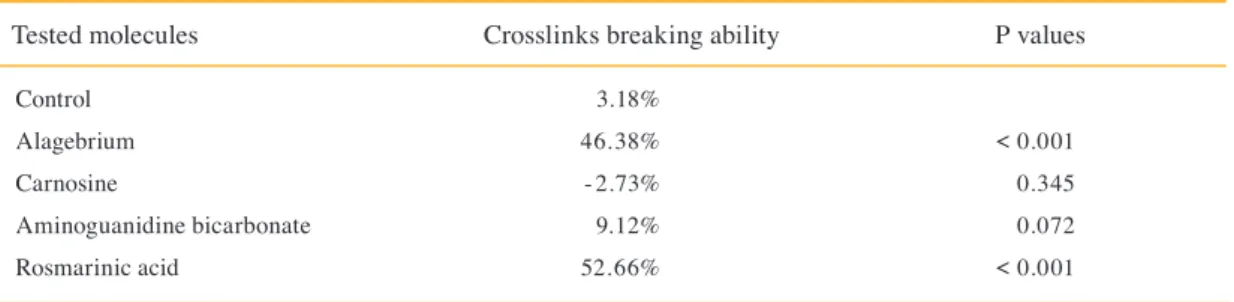
Crosslinking breaking ability of tested molecules are shown in Table 1 and diagram in Fig. 2.
Discussion
After reaction with ribose, albumin is polymerized as shown by SEC. Percentage (%) of the monomer is converted into polymers. This polymerization is stable in time and can be reverted by Alagebrium and rosmarinic acid, both recovering approximately 50% of the monomer involved in polymerization. Rosmarinic acid can be extracted and purified from rosemary (Rosmarinus officinalis).
This results shows that beyond the Alagebrium ability to break alpha-dicarbonyl AGE radicals, it is also able to break preformed AGE-related albumin crosslinks. Rosmarinic acid produces approximately the same results, showing that a natural molecule with a long and in depth documented safety is able to reverse at least in vitro protein crosslinks which are at the origin of mechanical structure-based glycated protein property and functionality impairment.
Fig 1. Structure of rosmarinic acid.
Molecular formula, C18H16O8; molecular weight, 360.3.
10
0 40 30
20 60 50
% Breaking
Control Alagebrium Carnosine Aminoguanidine
bicarbonate Rosmarinic acid Table 1. Crosslinks breaking ability.
Tested molecules Crosslinks breaking ability P values
Control Alagebrium Carnosine
Aminoguanidine bicarbonate Rosmarinic acid
3.18%
46.38%
-2.73%
9.12%
52.66%
< 0.001 0.345 0.072
< 0.001 P values, probability values compared with control, by Student t test, n = 3.
_ 206 _
AGE-Crosslinks Breaking Ability of Rosmarinic Acid
Conclusion
Rosmarinic acid is a natural product well known for its safety. We have shown that it is possible to reverse AGE-related crosslinks and that it could be a promising treatment of diabetics, skin aging, and of elderly impaired vessels-related diseases as nephropathy, neuropathy and retinopathy to name a few.
Fig 2. Crosslink breaking ability.
Bars indicate standard deviation. Number of measurement; n = 3.
Acknowledgements:
Part of this study was presented at the 13th Anti-Aging Medicine World Congress on March 28th 2015 in Monaco.
Conflicts of interest statement
Part of this work was supported by A2P Nacriderm Laboratories, Lyon, France.
_ 207 _
Glycative Stress Research
References
1) Hodge JE. Dehydrated foods: Chemistry of browning reactions in model systems. Journal of Agricultural and Food Chemistry. 1953; 1; 928-943.
2) Verzijl N, DeGroot J, Oldehinkel E, et al. Age-related accumulation of Maillard reaction products in human articular cartilage collagen. Biochem J. 2000; 350; 381-387 3) Guitton JD, Le Pape A, Sizaret PY, et al. Effects of in vitro glucosylation on type-I collagen fibrillogenesis. Biosci Rep.
1981; 1: 945-954.
4) Brownlee M. The pathological implications of protein glycation. Clin Invest Med. 1995; 18: 275-281.
5) Nowotny K, Jung T, Grune T, et al. Accumulation of modified proteins and aggregate formation in aging. Exp Gerontol. 2014; 57: 122-131.
6) Shah S, Baez EA, Felipe DL, et al Advanced glycation endproducts in children with diabetes. J Pediatr. 2013; 163:
1427-1431.
7) Monnier VM. Intervention against the Maillard reaction in vivo. Arch Biochem Biophys. 2003; 419: 1-15.
8) Sell DR, Monnier VM. Molecular basis of arterial stiffening:
Role of glycation-a mini-review. Gerontology. 2012; 58:
227-237.
9) Vasan S, Foiles P, Founds H. Therapeutic potential of breakers of advanced glycation end product-protein crosslinks. Arch Biochem Biophys. 2003; 419: 89-96.
10) Kim T, Spiegel DA. The unique reactivity of N-phenacyl- derived thiazolium salts toward α-dicarbonyl compounds.
Rejuvenation Res. 2013; 16: 43-50.
11) Perera HK, Handuwalage CS. Analysis of glycation induced protein cross-linking inhibitory effects of some antidiabetic plants and spices. BMC Complement Altern Med. 2015;
15:175.