Acta Med. Nagasaki 39:41-44
Antiphospholipid Antibodies in Patients with Myasthenia Gravis
Ikuo KINOSHITA1, Masakatsu MOTOMURA 1, Kunihiko NAGASATO1, Katsuhiro ICHINOSE1, Kiyosumi OHISHI1, Gou TAKEO1, Akira SATOH1, Tatsufumi NAKAMURA1, Toshiro YOSHIMURA1, Mitsuhiro TsuJIHATA 2, and Shigenobu NAGATAKI'
1 The First Department of Internal Medicine, Nagasaki University School of Medicine 2 The School of Allied Medical Sciences, Nagasaki University, Nagasaki 852, Japan
We measured antiphospholipid antibodies in sera from 94 patients with myasthenia gravis (MG). We found lgG aCL in 14/94 (14.9 % ), lgM aCL in 6/94 (6.4 %) and LA in 4/56 (7.1 %) patients with MG. As a whole 21 of 94 (22.3 % ) patients with MG had some aPL. There was no correlation between the presence of aPL and the severity of MG, the presence of hyperplasia of thymus, titer of the anti- acetylcholine receptor antibodies or anti-single stranded DNA antibodies. Though the percentage of malignant thymoma with aPL were higher than that of malignant thymoma without aPL, we thought that aPL were not the specific antibody in malignant thymoma. In MG, aPL did not play as the aCL syndrome and seemed to be non-specific antibodies.
Keywords: Antiphospholipid antibody, Anticardiolipin antibody, Myasthenia gravis, Lupus anticoagulant, Anti- single stranded DNA antibody
Introduction
Anticardiolipin antibodies (aCA) belong to antibodies directed against anionic phospholipids 1), and have been reported in many clinical systemic syndromes. Most of these syndromes are related to lupus erythematosus')2), but are not specific for this disease'). They include neurologic diseases which appear as ischemic thrombotic episodes affecting the arterial or venous system's 5) . Other non- stroke syndromes such as myelopathy 6) , Guillain-Barre syndrome') , migraine') , chorea') , seizures 10) and autoimmune neurological diseases'", have been also de- scribed in association with raised aCL levels.
In myasthenia gravis (MG), an autoimmune response to the acetylcholine receptor (AChR) in postsynaptic mem- brane, neuromuscular transmission is impaired 12)'3) Colaco et al. described that aCA were detected in sera of patients
Reprint request to : Ikuo Kinoshita, The First Department of Internal Medicine, Nagasaki University School of Medicine, 1-7-1 Sakamoto-machi, Nagasaki 852. Japan
FAX number: 418-649-5910
with multiple sclerosis, MG and Lambert-Eaton myasthenic syndrome"). But Rombos et al") reported that there was no significant difference of serum aCA level between MG and the controls. Therefore, relationship between aCA and MG is still not well defined.
In this report, measured antiphospholipid antibodies (aPL), aCA and lupus anticoagulant (LA) in sera of patients with MG and investigated the significance of these antibodies in MG.
Materials and methods
Ninety-four MG patients (31 men and 63 women) were studied. They were diagnosed according to the clinical findings, the electromyography (Harvay-Musland test), Tensilon test, the titer of anti-AChR antibodies" and deposition of immune complexes at the motor end- plates 16) All blood samples were kept at -70°C until exami- nation. Control sera from 140 healthy subjects were available.
Anticaradiolipin antibody assay
The levels of 1gG and 1gM to aCL were determined by the solid phase enzyme-linked immunosorbent assay with some modifications. In brief, cardiolipin (Sigma, USA) was diluted in ethanol and used to coat microtiter plates with 100 # 1 (5 g g/ml). The plates were dried and washed three times with PBST (0.01MPBS, 0.05 % Tween) buffer. The antigen-coated plates were blocked with normal rabbit serum in PBS. The plates were incubated with test sera diluted to 1:50 in the same buffer for 90 minutes (100 m ,u 1 /well), and washed in PBST followed by a 90 minutes incubation with 100 ,a 1 of peroxidase conjugated goat anti-human lgG or 1gM (DAKO, Japan). After 3 times of washing, color was developed using o-phenylenediamine
(WAKO Pure Chem Indust, Japan) and the reaction was stopped by the addition of 2.5 M H2SO9. The optical density
(0. D) was measured at 490 nm using an ELISA microtiter reader. The O.D values and positive values of lgG and 1gM
in healthy individuals were 0.105, 0.173 and 4.1 %, 2.7 % respectively. The ratio of the O.D of patients to the control was cut off index and the positive was defined as greater than 1.0. Comparisons were made with x2 analysis.
Lupus anticoagulant activity
The tissue thromboplastin inhibition was performed 17). The ratio of clotting times at 1:100 and 1:1000 dilutions of thromboplastin were determined. A ratio of 1.3 or greater was defined positive.
Autoantibody testing
Anti-AChR antibodies were assayed by an immunoprecipitation method using human junctional AChR as the antigen"'. Antinuclear antibodies were detected by indirect immunof luorescence method. lgG- class antibodies to single-stranded (ss) and double- stranded (ds) DNA were detected by ELISA kit (MBL, Japan). 2 U/ml or greater was defined positive.
Results
Antiphospholipid antibodies in MG
Raised aCL activity was detected in 19/94 (20.2 %) patients with MG (Fig. 1). Positive of only 1gG aCL was 12, only 1gM was 4 and both of them was 2. LA was
examined in 56 patients with MG. LA was detected in 4/56 (7.1 %). Two cases had aCL too. In this data, aPL was detected in 21/94 (22.3 %).
Features of 21 MG patients with antiphospholipid anti- bodies
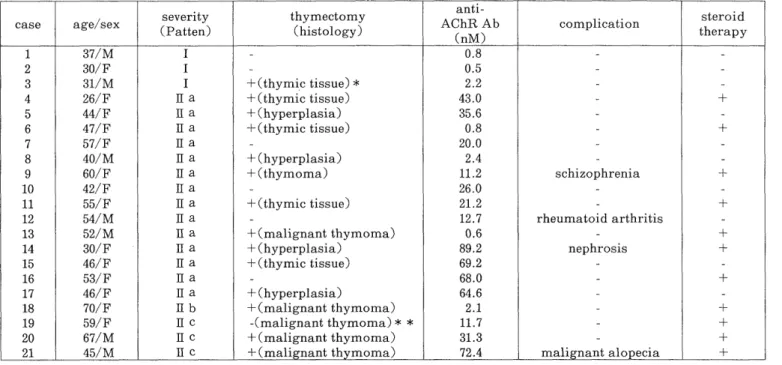
In 21 MG patients with aPL, the clinical features and laboratory data were shown (Table 1, 2, 3). Three patients were ocular type and the others were generalized type. In their complications, rheumatoid arthritis, schizophrenia, nephrosis and malignant alopecia were observed. In the histology of the thymus, 5 patients had hyperplasia and 6 had thymoma (5 were malignent). The number of hyper- plasia of thymus and thymoma were not significantly different in the two groups. But the number of malignant thymoma were higher in this group (5/21, 23.8 %) than in the patients without aPL (3/73, 4.1 %) (P<0.005). There were no patients who had the history of coagulopathy, thrombocytopenia and spontaneous abortion.
Titer of the anti-AChR antibodies were 13.8 ±28.7nM, and there were no significant differentce in comparison to another 73 MG patients. Two patients with LA had the prolongation of active partial thromboplastin time. Only one patient had a false-positive VDRL. Antinuclear antibodies were positive in 5/21 (23.8 %). Though anti- ssDNA antibodies were positive in 12/21 (57.1 %), there was no significant difference in two groups. Anti-ds DNA antibodies in all patients were negative.
Table 1. Clinical data for MG patients with aPL
severity thymectomy anti- steroid
case age/sex (P AChR Ab complication
atters) (histology) (nM) therapy
1 37/M I - 0.8 - -
2 30/F I - 0.5 - -
3 31/M I +(thymic tissue) * 2.2 - -
4 26/F II a +(thymic tissue) 43.0 - +
5 44/F II a +(hyperplasia) 35.6 - -
6 47/F II a +(thymic tissue) 0.8 - +
7 57/F It a - 20.0 - -
8 40/M II a +(hyperplasia) 2.4 - -
9 60/F II a +(thymoma) 11.2 schizophrenia +
10 42/F 11 a - 26.0 - -
11 55/F II a +(thymic tissue) 21.2 - +
12 54/M II a - 12.7 rheumatoid arthritis -
13 52/M II a +(malignant thymoma) 0.6 - +
14 30/F II a +(hyperplasia) 89.2 nephrosis +
15 46/F II a +(thymic tissue) 69.2 - -
16 53/F II a - 68.0 - +
17 46/F II a +(hyperplasia) 64.6 - -
18 70/F II b +(malignant thymoma) 2.1 - +
19 59/F II c -(malignant thymoma) * * 11.7 - +
20 67/M II c +(malignant thymoma) 31.3 - +
21 45/M II c +(mali nant th moma) 72.4 malignant alo ecia +
* residual thymic tissue
* * autopsy case
Table 2. Laboratory data for MG patients with aPL
anti-DNA Ab(U/ml)
case BFP ANA LA PT(%) APTT(sec',
ss ds
1 - - - 0.9 0.4
2 - - + 0.6 0.3 103 36.7
3 - - 0.7 0.3
4 - - + 1.8 0.7 103 36.6
5 - - - 10.6 0.9
6 - - - 0.5 0.3 106 25.0
7 - - - 25.3 1.8 81 34.4
8 - 40 X + 3.2 0.8
9 - - - 0.7 0.6 119 29.6
10 - - - 3.0 0.7 115 30.3
11 - - 1.8 1.0 79 33.8
12 - - 4.3 0.6
13 - - 0.9 0.2
14 - 160 X 10.2 0.2
15 - - 0.7 0.4
16 - - 5.1 1.3
17 - - 70.1 1.5
18 - 40X 14.0 1.7
19 - - 49.6 0.9
20 - - 2.2 0.9
21 - 80X 15.9 0.8
BFP: biological false positive for serological tests for syphilis ANA: anti-nuclear antibody
LA: lupus anticoagulant
ssDNA: single-stranded DNA dsDNA: double-stranded DNA PT: prothrombin time
APTT: active partial thromboplastin time
Table 3. Correlation of clinical features and aPL in MG patients
aPL(+) aPL(-) (n = 21) (n = 73) Type
ocular 3 18
generalized 18 55
Thymus
hyperplasia 5 10
thymoma 6 16
(malignant th moma) * (5) (3)
Anti-AChR Ab(nM) [mean-!-SD] 27.9±28.7 25.2±91.4
* significantly different (p<0.005)
Discussion
ACL are found in various clinical conditions including infections and connective tissue disease') 13> APL are associated with clinical complications such as thrombocytopenia, deep-vein thrombosis and spontaneous abortion in autoimmune disorders 19). These antibodies have been found in the patients with some neurological diseases, because they cross-react with the brain phospholipids cephalin and sphingomyelin 21) 21>.
In the present study, we detected aPL in sera of MG patients; lgG aCL in 14/94 (14.9 %), 1gM aCL in 6/94 (6.4
%) and LA in 4/56 (7.1 %). Therefore, 21 MG patients (22.3 %) had some aPL, and our data are not in agreement
with those of Colaco et al. according to which, 1gM aCL were more specific in MG than lgG aCL 11). There is rela- tively little cross-reactivity of the aCL with anti-DNA antibodies 22). This may be because the glyceride portion of the phospholipid is essential for antibody binding 23) l) . These findings raise the possibility that membrane bound phospholipids in association with autologous or exogenous membrane antigens might play a role for the development of autoimmunity ". But in our study, anti-ssDNA antibod- ies were positive in 12/21 (57.1 %) MG patients with aCL and in 26/73 (35.6 %) MG patients without aCL, and no significant difference in anti-ssDNA antibodies between these two groups. Though in the complication of thymoma these two groups had no significant difference, the percen- tage of the malignant thymoma was higher in aCL posi- tive group than in negative group. Thymic hyperplasia and thymoma are thought to play a crucial role in the pathogenesis of MG and the antiskeletal muscle antibodies is reported to be specific or closely associated with thymoma 25). In the malignant thymoma with aPL, the patients were small number and 4 of them had anti-ssDNA antibodies. Though aPL were secondly detected by the tissue damage, we thought that aPL were not specific antibodies in the malignant thymoma. In MG, aPL were thought not to play as the aPL syndrome and had no correlation with severity of the MG and anti-AChR antibodies. In conclusion, aPL were detected in about 20 %
of MG patients but we could not observe the relation between these antibodies and MG. These data suggest that
these antibodies had no activity of the aPL syndrome and were non-functional as polyclonal antibodies in MG.
Further studies are needed to confirm the relationship of these antibodies and pathogenesis of MG.
References
1 Harris EN, Gharavi AE, Hughes GRV. Antiphospholipid antibodies.
Clin Rheum Dis 11: 591-593, 1985.
2 Harris EN, Gharavi AE, Boey ML, Patel B, Mackworth C, Loizou S.
Anticardiolipin antibodies: Detection by radioimmunoassay and association with thrombosis in systemic lupus erythematosus. Lancet 2:
1211-1214, 1983.
3 Manoussakis MN, Gharavi AE, Drosos AA, Kitridou RC, Moutsopoulos HM. Anticardiolipin antibodies in unselected
autoimmune rheumatic disease patient. Clin Immunol Immunopathol
44: 297-307, 1987.
4 Briley DP, Coull RM, Goognight Jr SH. Neurological disease associ- ated with antiphospholipid antibodies. Ann Neurol 25: 221-227, 1989.
5 Levine SR, Deegan MJ, Futrell N, Welch KMA. Cerebrovascular and neurological disease associated with antiphospholipid antibodies: 48
cases. Neurology 40: 1181-1189, 1990.
6 Harris EN, Gharavi AE, Mackworth Young CG. Lupoid sclerosis: a possible pathogenetic role for antiphospholipid antibodies. Ann Rheum
Dis 49: 281-283, 1985.
7 Frampton G, Winer JB, Cameron JS, Hughes RAC. Severe Guillain- Barre syndrome: an association with IgA anti-cardiolipin antibody in
a series of 92 patients. J Neuroimmunol 19: 133-139, 1988.
8 Brandt KD, LessellS. Migrainous phenomenain systemic lupus erythematosus. Arthritis Rheum 21: 7-19, 1978.
9 Lubbe WF, Walker EB. Chorea gravidarum associated with circulating lupus anticoagulant: successful out of gregnancy with prednisone and
aspirin therapy. Br J Obstet Gynaecol 90: 487-490, 1983.
10 Hughes GRV, Harris EN, Gharavi AE. The anticardiolipin syndrome.
J Rheumatol 13: 486-489, 1986.
11 Colaco CB, Scadding GK, Lockhart S. Anti-cardiolipin antibodies in neurological disorders: cross-reaction with anti-single stranded DNA
activity. Clin Exp Immunol 68: 313-319, 1987.
12 Kinoshita I, Nakamura T, Satoh A, Matsuo H, Seto M, Tomita I, Tsujihata M, Nagataki S. Role of the macrophage in the pathogenesis
of experimental autoimmune myasthenia gravis. J Neurol Sci 87: 49-59, 1988.
13 Patrick J, Lindstrom JM. Autoimmune response to acetylcholine receptor. Science 180: 871-872, 1973.
14 Rombos A, Evangelopoulou-Katsiri E, Leventakou A, Voumvourakis
K, Triantafyllou N, Papageorgiou C. Serum lgG and 1gM anticardiolipin antibodies in neurological disease. Acta Neurol Scand
81: 243-245, 1990.
15 Lindstrom JM, Seybold ME, Lennon VA, Whittingham S, Duane DD.
Antibody to acetylcholine receptor in myasthenia gravis: prevalence,
clinical correlates, and diagnostic values. Neurology (Minneap) 26:
1054-1059, 1976.
16 Tsujihata M, Yoshimura T, Satoh A, Kinoshita I, Mathuo H, Mori M, Nagataki S. Diagnostic significance of IgG, C3 and C9 at the limb
muscle motor end-plate in minimal myasthenia gravis. Neurology
(Minneap) 39: 1359-1363, 1989.
17 Schleider MA, Nachman RL, Jaffe EA, ColemanM. A clinical study of the lupus anticoagulant. Blood 48: 499-504, 1976.
18 Vaarala 0, Palosuo T, Kleemola M, Aho K. Anticardiolipin response in acute infections. Clin Immunol Immunopathol 41: 8-11, 1986.
19 Hughes GRV. Thrombosis, abortion, cerebral disease and the lupus anticoagulant. Br Med J 287: 1088, 1983.
20 Chaleomchan W, Hemachdha T, Sakulramrung R, Deesomchok U.
Anticardiolipin antibodies in patients with rabies vaccination induced
neurological complications and other neurological diseases. J Neurol Sci
96: 143-151, 1990.
21 Levine SR, Welch KMA. The spectrum of neurologic disease associated with antiphospholipid antibodies. Arch Neurol 44: 876-883, 1987.
22 Harris EN, Gharavi AE, Tincani A, Chan JKH, Englert H, Mantell P, Allegro F, Ballestrieri G, Hughes GRV. Affinity purified anti-
cardiolipin and anti-DNA antibodies. J Clin Lab Immunol 17: 155-162,
1985.
23 Rauch J, Tanerbaum H, Stollar BD, Schwariz RS. Monoclonal
anticardiolipin antibodies bind to DNA. Eur J Immunol 14: 529-534, 1984.
24 Smeenk RJT, Lucasse WAM, Sweak TJG. Is anticardiolipin activity a cross-reaction of anti-DNA or separate activity ? Arthritis Rheum 30:
607-617, 1987.
25 Gilhus NE, Aarli JA, Janzen RWC, Otto HF, Fasske E, Matre R.
Skeletal muscle antibodies in patients with a thymic tumor but without
myasthenia gravis. J Neuroimmunol 8: 69-78, 1985.