渦鞭毛藻類の独特な核ゲノム
將口 栄一
沖縄科学技術大学院大学マリンゲノミックスユニット
〒
904-0495
沖縄県国頭郡恩納村字谷茶
1919-1
An unusual dinoflagellate nuclear genome
Eiichi SHOGUCHI
Marine Genomics Unit, Okinawa Institute of Science and Technology,
Okinawa 904-0495, Japan
SUMMARY
Dinoflagellates are ecologically important, unicellular eukaryotes in aquatic environments. They
have unusual, permanently condensed chromosomes and immense nuclear genome sizes. Recent
advances in dinoflagellate biology have revealed many novel genomic features.
The first draft genome of the dinoflagellate, Symbiodinium minutum, displays unique and derived
characteristics (http://marinegenomics.oist.jp/genomes/gallery). (1) The genome comprises approximately
42,000 protein-coding genes, including highly duplicated genes for regulator-of-chromosome-condensation
proteins. One-third of these have eukaryotic orthologs, whereas the others have similarities to those of
bacteria. (2) Symbiodinium genes are enriched in spliceosomal introns (average 18.6 introns/gene), in
which donor and accepter splice sites are unique. (3) All spliceosomal snRNA genes, spliced-leader
genes, and 5S rRNA genes are clustered in the genome. (4) The Symbiodinium genome displays
unidirectionally aligned genes throughout the genome, forming a cluster-like gene arrangement. Here I
briefly introduce recent advances in dinoflagellate genomics, paying special attention to the genome
structures of gene-rich regions.
Key words: Alveolates, Gene arrangement, Chromatin, Exon-intron structure, Trans-splicing, Gene
duplication, Comparative genomics, RCC1, Symbiodinium, Trypanosoma
Tel: +81-98-966-8653/Fax: +81-98-966-2890 E-mail: [email protected]
Received: 25 January 2014; Accepted: 31 March 2014.
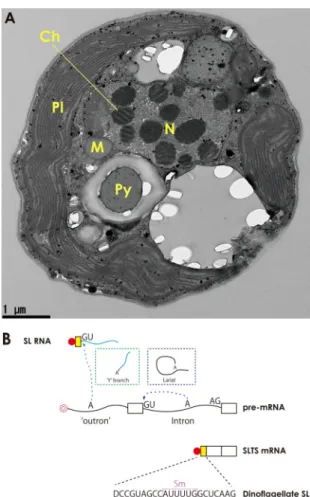
や微細構造のデータによって再検討が行われている (Moestrup and Daugbjerg, 2007; Bachvaroff et al., 2014) . 渦鞭毛藻類の種の約半数は光合成を行う.その共 通祖先が二次共生により獲得したと考えられるプラ スチドのゲノムは,プラスミド状のミニサークル DNA という特殊な構造へと進化している.さらにそ れらとは別に,進化の過程で三次共生イベントなど により獲得したと考えられるプラスチドを持つ種 や,クレプトクロロプラストを持つ種などがおり, 細胞内共生のメカニズムや核ゲノムとオルガネラゲ ノムの共進化を研究する上でも興味深いグループで ある(Onuma and Horiguchi, 2013; 山口ほか, 2008). 最近,渦鞭毛藻類のトランスクリプトーム解析や 一部のゲノム配列解析から興味深い特徴が徐々に明 らかになってきている(Lin, 2011; Wisecaver and Hackett, 2011; 將口, 2013).核ゲノムの分子生物学的研究に 限ると,mRNA のトランススプライシング(Zhang et al., 2007)(Fig. 1B)や同じ遺伝子がタンデムに繰り 返し並んで存在するという報告である(Liu and Has-tings, 2006).また転写調節に関して真核生物に共通 はじめに 渦鞭毛藻類は単細胞真核生物であり,常に凝縮し た液晶性(liquid crystallic)の染色体と巨大な核ゲノ ムを持つ(その多くがヒトゲノムの数倍のサイズで ある)(Fig. 1A).またコアヒストンを含むヌクレ オソーム構造が観察されてこなかった.かつては, その特殊な核の特徴から「中間核生物(Mesokaryotes)」 と呼ばれていたこともある(Dodge, 1965).現在で はこの説は否定され,分子系統学的研究などによ り,マラリア原虫などのアピコンプレックス類,ゾ ウリムシなどの繊毛虫類と共に,渦鞭毛藻類はアル ベオラータの主要グループの一つであることが明ら かになっており(Burki et al., 2007),その特殊な核は, 「渦鞭毛藻核(dinokaryon)」と呼ばれている. 渦鞭毛藻類にはおよそ 2,000 種が知られており(Adl et al., 2007),赤潮の原因となる種(Alexandrium)や サンゴに共生する褐虫藻(Symbiodinium)などが含 まれ,海洋環境を考える上で重要な生物である.渦 鞭毛藻類間の系統関係は未解決の部分も多く,分子
Fig. 1. The dinoflagellate nuclear genome. (A) Transmis-sion electron micrograph of the dinoflagellate, S. minutum. Twelve permanently condensed chromosomes (Ch) show regular, banded patterns. Proteins associated with DNA in chromatin are less abundant in dinoflagellates, as in bacte-ria, but the basic structures of chromatin have not been clarified. M: mitochondria, N: nucleus, Pl: plastid, Py: pyrenoid, Scale bar: 1 μm. (B) Spliced leader trans-splicing (SLTS) is common in dinoflagellates. SLTS has been shown to occur in a limited number of eukaryotes (dinoflagellates, euglenozoans, cnidarians, nematodes, flatworms, and tunicates). In cis- (intron) splicing, the splice donor and acceptor sites lie on the same strand. During splicing a lariat structure is formed (blue dotted line) and the intron is removed. For SLTS, a „Y‟ branched byproduct is formed (green dotted line), the donor site of SL RNA is spliced to acceptor sites of pre-mRNAs and the outron is removed. As a result, the SL (yellow-box) and the 5‟ exon of pre-mRNA from the different strands are joined. Introns are located „inside‟ the target gene, whereas outrons are located „outside‟ the gene. Many mature mRNAs have a common „SL‟ that is spliced into different genes. Red circles show cap structures (2,2,7-trimethylguanosine cap for SL RNAs, 7-methylguanosine cap for mRNA) (Stover et al., 2006). Dinoflagellate SL sequences are highly conserved and the binding site (purple box) for the Sm protein complex on dinoflagellate SLs is different from corresponding binding sites in the SL RNAs of other species. The SL RNAs of most other spe-cies contain a Sm binding site in the 3‟ half (aqua line).
な TATA box のプロモーター配列が見つからず,渦 鞭毛藻 Crypthecodinium cohnii から単離された TATA
box に結合するタンパク質(TBPs)に類似性の高い TBP-like タンパク質は,TATA box よりも TTTT box の配列に強く結合するという結果が報告されている (Guillebault et al., 2002). このように渦鞭毛藻類のゲノムは実にユニークで あり,例えば渦鞭毛藻の全ゲノム解読により,進化 の過程でヌクレオソーム構造を失うことによってど のようなゲノム進化が起こりうるのかということが 明らかになるかもしれないという期待が持たれてい た.それにもかかわらず,アピコンプレックス類や 繊毛虫類の全ゲノムが解読される一方で,渦鞭毛藻 類 の 全 ゲ ノ ム の 解 読 は 行 われ て こ な か っ た(Lin, 2011; Wisecaver and Hackett, 2011).その理由の一つ は,渦鞭毛藻のゲノムが他の原生生物のゲノムに比 べて相当に大きいためであろう. 我々は,渦鞭毛藻類の中でゲノムサイズの小さい 褐虫藻 Symbiodinium minutum の核ゲノムの概要配列 を決定した(Shoguchi et al., 2013).その結果,渦鞭 毛藻ゲノムの構造がゲノム全体にわたってユニーク な特徴を持つことが明らかになった.ここでは,こ の褐虫藻の核ゲノムの解読結果を中心に,ごく最近 の渦鞭毛藻の核に関する研究を手短に紹介する.さ らにその解読とともに浮かびあがった疑問点を記し てみたい.最近,アルベオラータの祖先型のミトコ ンドリアゲノム構造の想定に関する報告がなされた (Janouškovec et al., 2013).アルベオラータの祖先型の 核ゲノム構造に関する議論も活発になればと思う. 渦鞭毛藻核のゲノム構成 我々は,次世代シーケンサー(NGS)とゲノムア センブルのソフトウエアを駆使して 616 Mbp(6.16 億塩基対)のゲノム概要配列を決定した.同時に 行 っ た ト ラ ン ス ク リ プ ト ー ム 配 列 決 定 に よ り, 63,104 のユニークな配列を得た.その配列のほとん どがゲノムにマップされ(Koyanagi et al., 2013),遺 伝子領域のほとんどがこの 616 Mbp の概要配列に含 まれることが分かった.この概要配列上には 41,925 の遺伝子領域が存在した.DNA トランスポゾンやレ トロトランスポゾン領域の占める割合は 0.5% と 1.1% であった.タンデムリピートの占める割合はお よそ 5% と見積もられた.同じアルベオラータのゲ ノムと比較すると,S. minutum の GC 含有量はかなり 高く,44% であった(Table 1).この見積もりは,他 の渦鞭毛藻におけるものとほぼ一致する(reviewed by Moreno Diaz de la Espina et al., 2005).すなわち, 渦鞭毛藻の GC 含量は,アピコンプレックス類や繊 毛虫類よりもむしろヒトやユーグレノゾア類のトリ パノソーマのゲノムに類似している(Table 1). フローサイトメ トリーを用いた解析により,S. minutum のゲノムサイズはおよそ 1,500 Mbp と見積 もられている(Shoguchi et al., 2013).NGS のデータか らオルガネラ DNA が高コピー(>500)で存在する と見積もられ,その分を差し引いたとしても,アセ ンブルできていない核ゲノム領域が 800 Mbp 程度は 存在すると思われる.NGS のリードや BAC 及び fosmid クローンの両末端配列のデータは,その領域 の大部分は GC 含量やタンデムリピートやトランス ポゾンの占める比率という点において 616 Mb の領 域に類似していることを示している.この結果は, 約 110 Gbp のゲ ノム を持 つ渦 鞭毛 藻 Alexandrium ostenfeldii のゲノムの 50% 以上がタンデムリピート からなるとする報告とは対照的である(Jaeckisch et al., 2011).また,Madhani (2013) による,渦鞭毛藻 のゲノムが巨大化したのはトランスポゾン配列と関 係しているのかもしれないとする議論とも一致しな い.渦鞭毛藻の非コード領域の配列としてテロメア の 存 在 が 報 告 さ れ て き て い る が(Fojtova et al.,
length of assembly A total assembled (Mb)
G+C content
(%) Number of genes
Number of introns per gene
First two nucleo-tides of introns Average length of intergenic regions (bp) Unidirectional arrangement of genes Symbiodinium
minutum 1) 616 44 41,925 18.6 GT/GC/GA 2,064 Yes
Plasmodium falciparum 2) 23 19 5,268 2.4 GT 1,694 No Tetrahymena thermophila 3) 104 22 24,725 4.6 GT 1,423 No Trypanosoma brucei 4) 26 46 9,068 0.0002 GT 1,279 Yes
1) Shoguchi et al. (2013), 2) Gardner et al. (2002), 3) Eisen et al. (2006), 4) Berriman et al. (2005).
Table 1. Draft genome compostion of three main groups of alveolates, the dinoflagellate, Symbiodinium minutum, the apicomplexan, Plasmodium falciparum, and the ciliate Tetrahymena thermophila, and the euglenozoan, Trypanosoma brucei
いて比較すると,S. minutum はマラリア原虫やテト ラヒメナに比べて,進化過程で失った遺伝子ファミ リ ー が 少 な い こ と が 示 唆 さ れ た(Shoguchi et al., 2013).アルベオラータの共通祖先が獲得したと考 えられる紅藻由来の色素体を繊毛虫はほぼ完全に失 い,動物に寄生するアピコンプレックスでは光合成 能を失っている.また色素体獲得との関連が考えら れる遺伝子は,繊毛虫において 16 個みつかってい るだけであり(Reyes-Prieto et al., 2008),マラリア 原 虫 で は 207 個 が 見 つ か っ て い る に す ぎ な い (Huang et al., 2004).一方で,光合成性のアピコン プレックス Chromera velia のトランスクリプトーム 解析において 513 の遺伝子がプラスチドの獲得と関 係していることが示唆されてきている(Woehle et al., 2011).例えば,解読された珪藻ゲノムで同様の解 析を行うとおよそ 2,000 が色素体の獲得との関係が 示唆される遺伝子としてみつかってくる(Moustafa et al., 2009).従って S. minutum において多くの遺 伝子ファミリーが存在することは,S. minutum が光 合成能を保持していることと関係している可能性が 高い.今後は,プラスチドへ輸送されて機能するタ ンパク質をコードする遺伝子を同定していくことが 重要であると思われる.また渦鞭毛藻の進化におい て遺伝子の水平伝播が重要であったのではないかと す る 報 告 が な さ れ て き て い る(Wisecaver et al., 2013).水平伝播により獲得したと考えられる遺伝 子が,さらなるゲノム比較によって次々と明らかに なってくるかもしれない. 核タンパク質 渦鞭毛藻の核にはヌクレオソーム構造が見つから ず,渦鞭毛藻はコアヒストンの遺伝子を失っている と考えられていた.一方で,バクテリアの DNA 結 合 タ ン パ ク 質 HU に 類 似 す る Histone-like protein (Hlp)の存在が報告されてきた(Sala-Rovira et al., 1991; Wong et al., 2003).しかしながらより最近の EST 解 析の結果から渦鞭毛藻はコアヒストン遺伝子を持っ ていることが次第に明らかになってきた(Hackett et al., 2005).S. minutum ゲ ノ ム に は コ ア ヒ ス ト ン H2A,H2B,H3,H4 がコードされていた.リンカー ヒストン H1 のオーソログ遺伝子は見つからなかっ た.S. minutum のゲノム上に Hlp をコードする領域 は 15 箇所みつかった.渦鞭毛藻の Hlp と動物の H1 の類似性から,H1 遺伝子の進化が議論されてい る(Kasinsky et al., 2001).このような比較は,Hlp のような遺伝子が真核生物の祖先のゲノムに存在し たのか,バクテリアから水平伝播により獲得された のかを考える上で重要になってくると思われる. 2010),セントロメア様領域に関する報告はなされ ていない.アセンブルできていない領域は常に凝縮 した染色体構造と関係してくる可能性があり,その 解明には他の渦鞭毛藻の全ゲノム配列との比較解析 が重要となってくる.渦鞭毛藻のゲノムには 5-ヒド ロキシメチルウラシルという他の真核生物ゲノムに は見つからない修飾塩基が多数含まれる(reviewed by Lin, 2011).このような修飾塩基とゲノム構造と の関係も謎のままである. 遺伝子の構成 解読されてきた真核生物のゲノムと遺伝子を用い た統計学的解析により,渦鞭毛藻類におけるタンパ ク 質を コー ドする 遺伝 子数 はお よそ 38,000 か ら
87,000 と見積もられていた(Hou and Liu, 2009).S.
minutum ではタンパク質をコードする遺伝子の数は 41,925 と見積もられ,マラリア原虫やテトラヒメナに 比べるとかなり多いことが明らかになった(Table 1). タンパク質の保存されたドメインの解析(pfam ド メイン),TBLASTN による NCBI データベースへ の配列類似性検索,ゲノムの解読された真核生物の 遺伝子群との比較に適した OrthoMCL データベース (http://orthomcl.org/orthomcl/)を 用 い た 解 析 で は, 41,925 の中の 54% の遺伝子は,これまでに登録さ れている配列への類似性を持つ.一方で 46% の遺伝 子は,Symbiodinium 特異的である可能性が高い.そ の中でも比較的保存性の高い遺伝子を探る上で,近 縁種の渦鞭毛藻ゲノムとの比較が重要になってくる と思われる.遺伝子間の比較解析から,41,925 遺伝 子の中の 17,703 遺伝子(42.4%)は,渦鞭毛藻の系 統で重複した遺伝子である可能性が高いと見積もら れた.渦鞭毛藻類における遺伝子の重複のメカニズ ム と し て,mRNA 由 来 の processed complementary DNA のリサイクルが提案されている(Slamovits and Keeling, 2008).しかしながら,S. minutum ではイン トロンを持たない遺伝子が少ないことから,この可 能性は低いと予想された.他のゲノムに比べると, かなり数が増大している遺伝子には,配列は保存さ れているが機能未知であるタンパク質,Chlorophyll a/b-binding タンパク質,イオンチャネルのタンパク 質などをコードするものが含まれていた.このよう に数の増大している遺伝子群は,環境応答と関係す るようである(Colbourne et al., 2011).他の渦鞭毛 藻ゲノムとの比較により,このような遺伝子の増大 がいつ頃起こってきたのかを推定することが可能に なってくるであろう. 類似性を示す保存された遺伝子の構成をマラリア 原虫やテトラヒメナと OrthoMCL データベースを用
また Gornik et al. (2012) によって,核タンパク質 DVNP(dinoflagellate/viral nucleoproteins)が渦鞭毛藻 Hematodinium sp. の核に多く含まれ,DNA に結合す ることが示された.このタンパク質をコードする遺 伝子は,これまでに渦鞭毛藻類と藻類ウイルスであ るフィコドナウイルス科のゲノムで見つかってい る.Gornik et al. (2012) は,この DVNP 遺伝子の獲得 がヌクレオソーム構造の見つからない巨大な核を持 つ渦鞭毛藻への進化の最初のステップとして重要で あったのではないかと議論しており,興味深い.S. minutum ゲノムには,19 個の DVNP 遺伝子が存在す る.この 19 個の中の 11 個には,Hematodinium sp. の DVNP 遺伝子にはない別のドメインもコードされ ていた.これらのドメイン構造が渦鞭毛藻間でどの 程度保存されているのかを比較することが,水平伝 播により獲得したと考えられる遺伝子の進化を探る 上で重要である. S. minutum のゲノムで非常に数の増加している遺 伝子の中には,核タンパク質をコードする RCC1
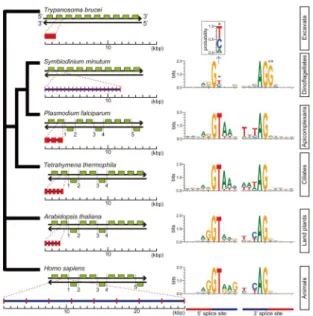
(Regulator of Chromosome Condensation 1)遺伝子が 含まれていた.この遺伝子は RCC1-like リピートを 持ち,このリピートを持つ遺伝子はバクテリアゲノ ムの中にも存在する.RCC1-like リピートを持つ遺伝 子は S. minutum ゲノム中の 189 の領域に存在した. その中の 86 のタンパク質の配列を用いて分子系統 学的解析を行ったところ,52 のタンパク質はシアノ バクテリアとプロテオバクテリアのオーソログであ り,一方 34 は真核生物のオーソログであった.す なわち,S. minutum の RCC1 遺伝子には真核と原核 の両方のタイプが含まれていた.脊椎動物の RCC1-like リピートドメインを持つタンパク質の機能は多 様 化 し てい る こ とが 知 られ てい る(Hadjebi et al., 2008).これらのタンパク質のいくつかが独特な染 色体構造と関係しているものと思われる. イントロン 渦鞭毛藻の遺伝子のエクソン−イントロン構造に関 しては,その情報が数種類の遺伝子に限られてきたた め,よく分かっていなかった.一方で,マラリア原虫 やテトラヒメナのイントロンに関してはよく調べら れており,その数は比較的少なく(Table 1),アルベ オラータの進化におけるイントロン数の変化は比較 的短期間に起こったのではないかという議論がなさ れている(Nguyen et al., 2007).驚いたことに S. minutum の遺伝子には平均すると 1 遺伝子あたり 18.6 個という非常に多くのイントロンが存在するこ とが明らかになった(Table 1 and Fig. 2).その 5‟ ス プライスサイトの配列としては,GT 以外にも GC や GA タイプのものが存在していた.一方で 3‟ スプライ スサイトのエクソンの 1 番目のサイトが G である傾向 が認められた(Fig. 2).このサイトが G の傾向はヒ トのイントロンのマイナータイプのパターンに一致 している(Thanaraj et al., 2001).このように,多くの GT-AG ルールに従わないイントロンが短期間で生じ たものなのかどうかは,近縁種間におけるゲノム配列 比較により明らかになっていくであろう.また S. minu-tum のスプライセオソーム関連遺伝子の特徴を調べ たところ,snRNA 遺伝子のすべてがある領域にクラ
Fig. 2. Gene arrangements and exon-intron structures in nuclear genomes of representative eukaryotes and alveo-lates. Yellow-green boxes indicate typical patterns of ten-gene arrangements with the number of strand-switch re-gions (SSRs), although the SSRs shown in P. falciparum,
T. thermophila, A. thaliana and H. sapiens are not always
typical. The unusual ten-gene organization on the same strand of DNAs that have no SSRs, is similar in S.
minu-tum and T. brucei. Gene architecture shows average gene
lengths (exons in red and introns in blue) with the average intron number per gene. The sequence motif of the splice site was illustrated with WebLogo (http://weblogo.threeplu sone.com/). The probability of position 2 at the 5‟ splice site of S. minutum is shown in the insert. Only two genes with spliceosomal introns in T. brucei have been reported and the motif was not shown. Analyses of intron richness and weakness of 5‟ splice site signals (asterisk) indicate that S. minutum has the most unusual eukaryote genome organization to date. A double asterisk shows Gs of first nucleotides of exons conserved at the 3‟ splice site. A similar phenomenon is known from human minor alterna-tive splice sites (Thanaraj et al., 2001). (From Shoguchi et al. (2013), with permission of Elsevier)
く,RNA プロセッシングや翻訳,またはまだ知られ ていないようなレベルで発現が調節されているのか もしれない.また small RNA や non-coding RNA に よる調節も考慮していく必要があるかもしれない (Baumgarten et al., 2013). おわりに これまで,ゲノムサイズが大きいなどの理由か ら,渦鞭毛藻核ゲノムの進化の問題へ全ゲノム解読 からアプローチすることはできなかった.シーケン シング技術が急激に進展していることを考慮する と,今後はますます全ゲノム配列の比較から多様な 渦鞭毛藻にアプローチが可能になってくるはずであ る.例えば,我々が解読したような共生性の褐虫藻 は 100 種類以上はいるとされており,さらなるゲノ ム解読とその比較解析が進めば,褐虫藻のゲノム進 化の独自性と多様性が明らかになってくるであろ う.同時にサンゴのような宿主のゲノム(Shinzato et al., 2011, 2014)との比較も,ゲノム進化の視点から 生物間の相互作用を考える上で重要になってくると 思われる. 謝辞 本稿の執筆にあたり,沖縄科学技術大学院大学マ リンゲノミックスユニットの方々に,ご意見を頂い た.また電子顕微鏡の写真は,沖縄科学技術大学院 大学の佐々木敏雄氏により撮影されたものである. ここに御礼申し上げる.本稿を執筆する機会を頂 き,編集委員の岩本政明博士に厚く御礼申し上げ る. 引用文献
Adl, S. M., Leander, B. S., Simpson, A. G., Archibald, J. M., Anderson, O. R., Bass, D., Bowser, S. S., Brugerolle, G., Farmer, M. A., Karpov, S. et al. (2007) Diversity, nomenclature, and taxonomy of protists. Syst. Biol., 56, 684–689.
Bachvaroff, T. R., Gornik, S. G., Concepcion, G. T., Wal-ler, R. F., Mendez, G. S., Lippmeier, J. C. and Delwiche, C. F. (2014) Dinoflagellate phylogeny revisited: using ribosomal proteins to resolve deep branching dinoflagellate clades. Mol. Phylogenet. Evol., 70, 314–322.
Baumgarten, S., Bayer, T., Aranda, M., Liew, Y. J., Carr, A., Micklem, G. and Voolstra, C. R. (2013) Inte-grating microRNA and mRNA expression profil-スターとして存在することがわかった.スプライセオ ソームの構造に関わる遺伝子の詳細な比較解析によ り特殊な構造がみつかってくるかもしれない. ゲノム上の遺伝子配置と転写 離れた系統関係にもかかわらず,渦鞭毛藻とユー グレノゾア(トリパノソーマ)のゲノム構造に類似 性がみられるという議論がなされてきた(Lukes et al., 2009).核ゲノムに関しては,トランススプライ シングと,遺伝子がタンデムに並ぶという点であ る.渦鞭毛藻のタンデムな並びに関しては,同じ遺 伝子のコピーが並んでいて,それらの遺伝子はポリ シストロニックに発現しているようであるというこ とで議論されてきた.一方で,トリパノソーマに関 しては,異なる遺伝子であってもゲノム全体にわ たって遺伝子の一方向性の並びが明らかになってい た(Fig. 2). 我々は,S. minutum のゲノム全体にわたって遺伝 子が同じ方向に並んでいることを明らかにした(Fig. 2).Spliced leader trans-splicing(SLTS)に 関 し て は,トリパノソーマではすべての遺伝子が SLTS を 受けるのに対し,S. minutum の転写開始点(TSS)の 解析は,約 20% の mRNA が SLTS をうけていると いうことを示している.すなわち,すべてが常に SLTS をうけているわけではないことが示唆され,同 様 の 結 果 は 渦 鞭 毛 藻 Lingulodinium polyedrum の
RNA-seq 解析でも示唆されている(Beauchemin et al., 2012).渦鞭毛藻の SL(22 ヌクレオチド)配列は これまで調べられてきた渦鞭毛藻間で完全に保存さ れており,このメカニズムが渦鞭毛藻の遺伝子発現 調節において重要であることを示唆している(Fig. 1B).トリパノソーマでは,同じ向きに並んだ遺伝 子がポリシストロニックに発現していることが報告 さ れ て い る.S. minutum で は ど う で あ ろ う か.S. minutum では,トリパノソーマのようにほとんどの 遺伝子がポリシストロニックに発現しているという ことはなさそうである. 渦鞭毛藻の転写に関して示唆されてきたことの一 つは,配列特異的な転写因子遺伝子がアピコンプ レックス類のように少ないということである.今回 のゲノム解読で,S. minutum のゲノムにコードされ る,真核生物間で保存されているような転写因子遺 伝子の数は少ないということが明らかになった.ま た TATA box のないプロモーターによる転写に関し ては,哺乳類のゲノムにおいても議論されてきてお り(Wu and Sharp, 2013),渦鞭毛藻ゲノム上にある プロモーター領域を同定し,比較していくことが重 要であると思われる.大部分の遺伝子は転写ではな
ing in Symbiodinium microadriaticum, a dinoflag-ellate symbiont of reef-building corals. BMC Ge-nomics, 14, 704.
Beauchemin, M., Roy, S., Daoust, P., Dagenais-Bellefeuille, S., Bertomeu, T., Letourneau, L., Lang, B. F. and Morse, D. (2012) Dinoflagellate tandem array gene transcripts are highly conserved and not polycistronic. Proc. Natl. Acad. Sci. U S A, 109, 15793–15798.
Berriman, M., Ghedin, E., Hertz-Fowler, C., Blandin, G., Renauld, H., Bartholomeu, D. C., Lennard, N. J., Caler, E., Hamlin, N. E., Haas, B. et al. (2005) The genome of the African trypanosome Trypanosoma
brucei. Science, 309, 416–422.
Burki, F., Shalchian-Tabrizi, K., Minge, M., Skjaeveland, A., Nikolaev, S. I., Jakobsen, K. S. and Paw-lowski, J. (2007) Phylogenomics reshuffles the eukaryotic supergroups. PLoS ONE, 2, e790. Colbourne, J. K., Pfrender, M. E., Gilbert, D., Thomas, W.
K., Tucker, A., Oakley, T. H., Tokishita, S., Aerts, A., Arnold, G. J., Basu, M. K. et al. (2011) The ecoresponsive genome of Daphnia pulex. Science, 331, 555–561.
Dodge, J. D. (1965) Chromosome structure in the dino-flagellates and the problem of the mesocaryotic cell. Excerpta Med. Int. Congr. Ser., 91, 339–345. Eisen, J. A., Coyne, R. S., Wu, M., Wu, D., Thiagarajan,
M., Wortman, J. R., Badger, J. H., Ren, Q., Amedeo, P., Jones, K. M. et al. (2006) Macronu-clear genome sequence of the ciliate Tetrahymena
thermophila, a model eukaryote. PLoS Biol., 4, e286.
Fojtova, M., Wong, J. T., Dvorackova, M., Yan, K. T., Sykorova, E. and Fajkus, J. (2010) Telomere maintenance in liquid crystalline chromosomes of dinoflagellates. Chromosoma, 119, 485–493. Gardner, M. J., Hall, N., Fung, E., White, O., Berriman,
M., Hyman, R. W., Carlton, J. M., Pain, A., Nel-son, K. E., Bowman, S. et al. (2002) Genome sequence of the human malaria parasite
Plasmodi-um falciparPlasmodi-um. Nature, 419, 498–511.
Gornik, S. G., Ford, K. L., Mulhern, T. D., Bacic, A., McFadden, G. I. and Waller, R. F. (2012) Loss of nucleosomal DNA condensation coincides with appearance of a novel nuclear protein in dinoflag-ellates. Curr. Biol., 22, 2303–2312.
Guillebault, D., Sasorith, S., Derelle, E., Wurtz, J. M., Lozano, J. C., Bingham, S., Tora, L. and Moreau, H. (2002) A new class of transcription initiation factors, intermediate between TATA box-binding
proteins (TBPs) and TBP-like factors (TLFs), is present in the marine unicellular organism, the dinoflagellate Crypthecodinium cohnii. J. Biol. Chem., 277, 40881–40886.
Hackett, J. D., Scheetz, T. E., Yoon, H. S., Soares, M. B., Bonaldo, M. F., Casavant, T. L. and Bhattacharya, D. (2005). Insights into a dinoflagellate genome through expressed sequence tag analysis. BMC Genomics, 6, 80.
Hadjebi, O., Casas-Terradellas, E., Garcia-Gonzalo, F. R. and Rosa, J. L. (2008) The RCC1 superfamily: from genes, to function, to disease. Biochim. Bio-phys. Acta, 1783, 1467–1479.
Hou, Y. and Lin, S. (2009). Distinct gene number-genome size relationships for eukaryotes and non-eukaryotes: gene content estimation for dinoflagel-late genomes. PLoS ONE, 4, e6978.
Huang, J., Mullapudi, N., Sicheritz-Ponten, T. and Kissin-ger, J. C. (2004) A first glimpse into the pattern and scale of gene transfer in Apicomplexa. Int. J. Parasitol., 34, 265–274.
Jaeckisch, N., Yang, I., Wohlrab, S., Glöckner, G., Kroy-mann, J., Vogel, H., Cembella, A. and John, U. (2011) Comparative genomic and transcriptomic characterization of the toxigenic marine dinoflag-ellate Alexandrium ostenfeldii. PLoS ONE, 6, e28012.
Janouškovec, J., Tikhonenkov, D. V., Mikhailov, K. V., Simdyanov, T. G., Aleoshin, V. V., Mylnikov, A. P. and Keeling, P. J. (2013) Colponemids represent multiple ancient alveolate lineages. Curr. Biol., 23, 2546–2552.
Kasinsky, H. E., Lewis, J. D., Dacks, J. B. and Ausió, J. (2001) Origin of H1 linker histones. FASEB J., 15, 34–42.
Koyanagi, R., Takeuchi, T., Hisata, K., Gyoja, F., Sho-guchi, E., Satoh, N. and Kawashima, T. (2013) MarinegenomicsDB: an integrated genome viewer for community-based annotation of genomes. Zool. Sci. 30, 797–800.
Lin, S. (2011) Genomic understanding of dinoflagellates. Res. Microbiol., 162, 551–569.
Liu, L. and Hastings, J. W. (2006) Novel and rapidly di-verging intergenic sequences between tandem repeats of the luciferase genes in seven dinoflagel-late species. J. Phycol., 42, 96–103.
Lukes, J., Leander, B. S. and Keeling, P. J. (2009) Cas-cades of convergent evolution: the corresponding evolutionary histories of euglenozoans and
dino-flagellates. Proc. Natl. Acad. Sci. U S A, 106, 9963–9970.
Madhani, H. D. (2013) The frustrated gene: origins of eukaryotic gene expression. Cell, 155, 744–749. Moestrup, Ø. and Daugbjerg, N. (2007) On dinoflagellate
phylogeny and classification In: Unravelling the algae. Brodie, J. and Lewis, J. (ed.). CRC press, pp. 215–230.
Moreno Diaz de la Espina, S., Alverca, E., Cuadrado, A. and Franca, S. (2005) Organization of the genome and gene expression in a nuclear environment lacking histones and nucleosomes: the amazing dinoflagellates. Eur. J. Cell Biol., 84, 137–149. Moustafa, A., Beszteri, B., Maier, U. G., Bowler, C.,
Val-entin, K. and Bhattacharya, D. (2009) Genomic footprints of a cryptic plastid endosymbiosis in diatoms. Science, 324, 1724–1726.
Nguyen, H. D., Yoshihama, M. and Kenmochi, N. (2007) The evolution of spliceosomal introns in alveo-lates. Mol. Biol. Evol., 24, 1093–1096.
Onuma, R. and Horiguchi, T. (2013) Morphological transi-tion in kleptochloroplasts after ingestransi-tion in the dinoflagellates Amphidinium poecilochroum and
Gymnodinium aeruginosum (Dinophyceae).
Pro-tist, 164, 622–642.
Reyes-Prieto, A., Moustafa, A. and Bhattacharya, D. (2008) Multiple genes of apparent algal origin suggest ciliates may once have been photosynthet-ic. Curr. Biol., 18, 956–962.
Sala-Rovira, M., Geraud, M. L., Caput, D., Jacques, F., Soyer-Gobillard, M. O., Vernet, G. and Herzog, M. (1991) Molecular cloning and immunolocaliza-tion of two variants of the major basic nuclear protein (HCc) from the histone-less eukaryote
Crypthecodinium cohnii (Pyrrhophyta).
Chromo-soma, 100, 510–518.
Shinzato, C., Shoguchi, E., Kawashima, T., Hamada. M., Hisata, K., Tanaka, M., Fujie, M., Fujiwara, M., Koyanagi, R., Ikuta, T. et al. (2011) Using the
Acropora digitifera genome to understand coral
responses to environmental change. Nature, 476, 320–323.
Shinzato, C., Inoue, M. and Kusakabe, M. (2014) A snap-shot of a coral “holobiont”: a transcriptome assem-bly of the scleractinian coral, Porites, captures a wide variety of genes from both the host and sym-biotic zooxanthellae. PLoS ONE, 9, e85182.
將口栄一(2013)サンゴに共生する渦鞭毛藻類のユ ニークなゲノム構造.生物の科学 遺伝, 67, 466–471.
Shoguchi, E., Shinzato, C., Kawashima, T., Gyoja, F., Mungpakdee, S., Koyanagi, R., Takeuchi, T., Hisa-ta, K., Tanaka, M., Fujiwara, M. et al. (2013) Draft assembly of the Symbiodinium minutum nuclear genome reveals dinoflagellate gene structure. Curr. Biol., 23, 1399–1408.
Slamovits, C. H. and Keeling, P. J. (2008) Widespread recycling of processed cDNAs in dinoflagellates. Curr. Biol., 18, R550–R552.
Stover, N. A., Kaye, M. S. and Cavalcanti, A. R. (2006) Spliced leader trans-splicing. Curr. Biol., 16, R8– R9.
Thanaraj, T. A. and Clark, F. (2001) Human GC-AG alter-native intron isoforms with weak donor sites show enhanced consensus at acceptor exon positions. Nucleic Acids Res., 29, 2581–2593.
Wisecaver, J. H., Brosnahan, M. L. and Hackett, J. D. (2013) Horizontal Gene transfer is a significant driver of gene innovation in dinoflagellates. Ge-nome Biol. Evol., 5, 2368–2381.
Wisecaver, J. H. and Hackett, J. D. (2011) Dinoflagellate genome evolution. Annu. Rev. Microbiol., 65, 369 –387.
Woehle, C., Dagan, T., Martin, W. F. and Gould, S. B. (2011) Red and problematic green phylogenetic signals among thousands of nuclear genes from the photo-synthetic and apicomplexa-related Chromera
vel-ia. Genome Biol. Evol., 3, 1220–1230.
Wong, J. T., New, D. C., Wong, J. C. and Hung, V. K. (2003) Histone-like proteins of the dinoflagellate
Crypthecodinium cohnii have homologies to
bac-terial DNA-binding proteins. Eukaryot. Cell, 2, 646–650.
Wu, X. and Sharp, P. A. (2013) Divergent transcription: a driving force for new gene origination? Cell, 155, 990–996.
山口晴代,中山剛,井上勲(2008)クレプトクロロ プラストを持つ原生生物,特に渦鞭毛藻につ いて.原生動物学雑誌, 41, 9–13.
Zhang, H., Hou, Y., Miranda, L., Campbell, D. A., Sturm, N. R., Gaasterland, T. and Lin, S. (2007) Spliced leader RNA trans-splicing in dinoflagellates. Proc. Natl. Acad. Sci. U S A, 104, 4618–4623.