Methods of Extracting Year References
for Chronological-table-generating Text Searching
Yasusi Kanada
Central Research Laboratory, Hitachi Ltd.
Higashi-Koigakubo 1-280, Kokubunji, Tokyo 185, Japan E-mail: [email protected]
Abstract
A method of extracting year references for a textual information retrieval method called the thematic chronological-table search method is explained in this paper. This search method generates an index by extracting and collecting year references from a text collection. The resulting index and a full-text index are used for searching sentences that contain year references and search words. The results are dis- played in the form of a chronological table with hy- perlinks to the original text.
Seven forms of year or century references are ex- tracted and normalized using string matching pat- terns. The extraction error rate is reduced by using both local and non-local contexts. If the lower two digits of a Gregorian year, which matches a form, occurs, it is normalized by supplementing the upper digits using the non-local context. This method has been applied to a Japanese encyclopedia. An evalua- tion shows the precision of extraction to be higher than 99% in most cases.
Keywords
Full-text search, Number extraction, Chronological- table, Encyclopedia, Hypertext, Information extrac- tion, Information retrieval.
1 Introduction
New methods of searching text through which end users can find desired information by using a simple input, and through which they can discover knowl- edge distributed in a large volume of text will soon be needed as interest in the Internet grows and as more CD-ROM contents are developed. In our attempts to address these needs, we have developed the axis- specified search method [Kan 98] [Kan 98a]. In this method, the user specifies words in the same way as in conventional full-text search. The difference, how- ever, is that the user also selects an axis from a menu.
This generates a search-result list ordered along the specified axis. This method allows two or more topics described in a document to be put at the different
*Errata and an updated version of this paper will be avail- able from http://www.kanadas.com/Papers/- Search-papers-j.html#ISDL99.
coordinates on the axis so that the search results on these topics can be extracted separately and sorted. A more fine-grained search is therefore made possible by the axis-specified search.
Thematic chronological-table searching is axis- specified searching with a year axis, and thematic geographical searching [Kan 99] is axis-specified searching with a geographical axis. Hitachi Digital Heibonsha1provides these services as a part of the members-only network service called “Encyclopædia on the Net” (“” in Japanese) for users wishing to search the World Encyclopædia [HDH 98]. This service is a first step toward imple- menting axis-specified searching of encyclopedia text on various axes. In implementing chronological-table searching, however, we have to develop a very precise method of extracting year references. The next sec- tion outlines the thematic chronological-table search.
The method of extracting year references is explained in Section 3. Examples of extraction errors are shown in Section 4, and the precision is evaluated in Sec- tion 5.
2 Outline of Thematic Chronological- table Search
The thematic chronological-table search method is part of the axis-specified search method. The axis- specified search method is overviewed here, and then the function and its method of implementation are explained.
In an axis-specified search, the user selects an axis, and inputs keywords. The keywords represent the theme of the search, and the axis specifies the gen- eral-purpose method of ordering the search result.
The search results are ordered along the axis. The result items are distributed in a space that is specified by the axis. In a conventional clustering-based method for organizing search results, a criterion for the organization is selected by the system. However, because the candidates of the axis, i.e., the criterion for organization, is selected by the user in the axis- specified search, the results are ordered just as the user intended. The candidates of the axis are prede- fined by the search system. In the thematic chrono-
1A Japanese company that publishes CD-ROM and net- worked versions of encyclopedias (http://www.hdh.co.jp/).
logical-table search, the axis “year” is fixed when the user chooses “thematic chronological-table search”
from a menu. The range on the axis can also be specified by the user. When the range is specified, result items out of the range are eliminated.
There are three methods of specifying the axis:
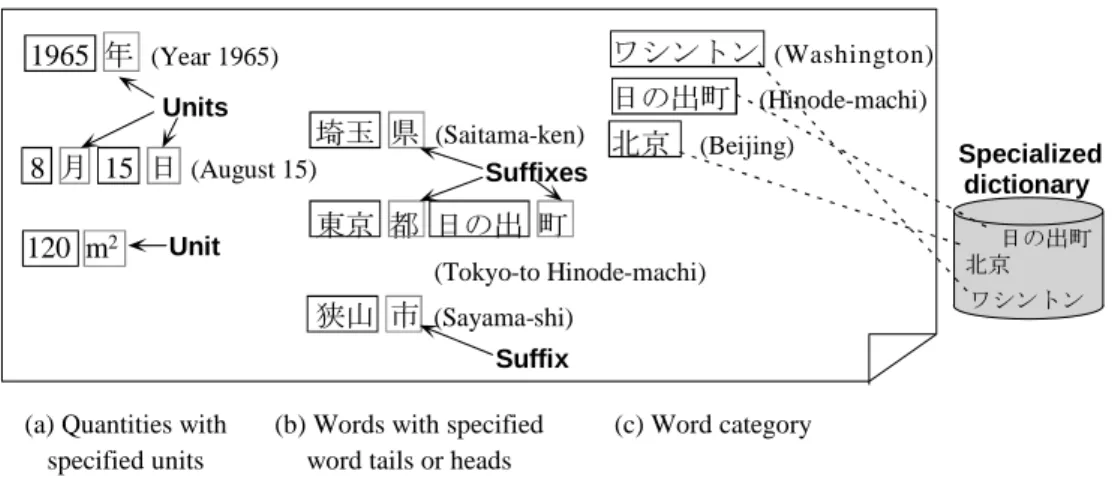
specification by the unit of a quantity, specification by the word tail, and specification by the word category (Figure 1). Searching in which the axis is specified by the unit of a quantity is called quantity searching.
Thematic chronological-table searching is a type of quantity searching. Each sentence that is close to both a year reference and a search word is retrieved, the sentences are sorted by year, and the result is dis-
played in the form of a chronological table. Figure 2 shows the user interface used for the Internet search service of the World Encyclopædia. This interface was developed by Hitachi Digital Heibonsha and runs on Microsoft Windows and Windows NT. The figure shows an example of search for “industrial revolu- tion”. The user can generate a chronological table on a desired theme dynamically.
A query is specified by a combination (conjunction) of search words (with a specification of
“and” / “or”) and year range (input by Gregorian or Japanese year). If only the search words are specified, sentences close to the search words on all years are collected. And if only the year range is specified, all 1965(Year 1965)
815 (August 15) Units
120 m2 Unit
(Saitama-ken)
(Tokyo-to Hinode-machi)
(Sayama-shi)
Suffixes
Suffix
(Washington)
(Hinode-machi)
(Beijing)
Specialized
dictionary
(a) Quantities with specified units
(b) Words with specified word tails or heads
(c) Word category
Figure 1. Three types of axis specification in axis-specified searching
Words for full-text search Genres
Input
Output
Year range
Year Article title Article read Subtitle Excerpts Score Display
button
Axis menu
Figure 2. The user interface for the thematic chronological-table search
the sentences in the year range are collected. If these inputs are combined, the number of search results can be effectively limited. The year range is specified by Gregorian year, but it can be inputted by Japanese year, such as thenth year of Heisei, and converted by using another window. The result can also be limited by specifying genres in “Encyclopædia on the net”.
Each output item contains a year, a sentence ex- tracted from the text, and a hyperlink to the original sentence. By using an optional input, the user can choose whether sentences that contain a year refer- ence or the search word are to be displayed. (The sentences in Figure 2 contain year references because
“Year” was chosen as an option.) The user can also choose year, century, or both as the unit of time to be searched. Units such as month, day, or hour are not as important as year or century in an encyclopedia, so they are not collected in the current version of the system.
A hyperlink into the original text is embedded in each row of the chronological table. Thus, the ency- clopedia article can be displayed by a Web browser, clicking on a row causes that sentence to be displayed and highlighted at the top of another window that pops up, along with the article in which that sentence ap- pears. If the user scrolls the window, the user can see the whole topic that contains the sentence or whole article.
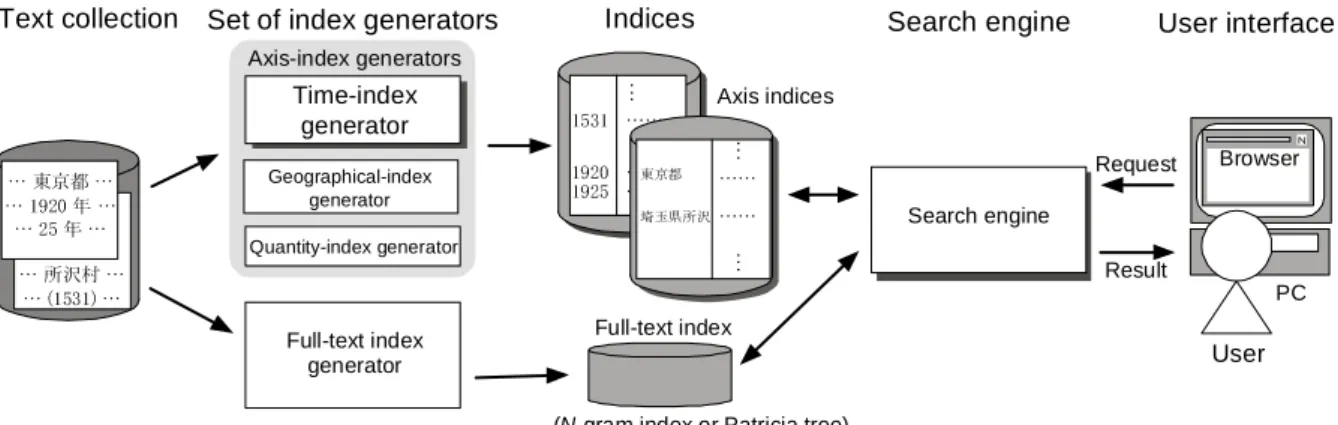
The implementation of thematic chronological- table searching is now explained. The search server consists of an index generator and a search engine (Figure 3). The index generator generates the year- axis index and the full-text index before the user query is made. The year-axis index generator, part of the index generator, extracts character strings that match predefined patterns of year references, normalizes them, and enters them into the year-axis index. The method of information extraction to generate the year-axis index is explained in Section 3. The time required for the search is drastically reduced by using the year-axis index. The full-text index generator, another part of the index generator, generates the full-text index, which is similar to conventional N-
gram search indices. The unit of the full-text search is a sentence, but long sentences are partitioned at par- ticular commas. The number of resulting “sentences”
is approximately 2.7 million.
The search engine invoked by the user searches the year-axis index for sentences that are close to the year references within the specified range. It also searches the full-text index for the specified words in the sen- tences. It then filters and sorts the results by year, and outputs them. The search results are scored, and those scored too low are dropped.
A score is computed using the distance between the year reference and the nearest word when the search engine is invoked by specifying both an axis and search words.
3 Method of Extracting Year References 3.1 Outline of year references extraction
The index generator inputs all the documents and extracts character strings that match predefined pat- terns in the axis-specified search. Strings are matched character by character. No natural language process- ing methods, such as morpheme analysis, are not used. Morpheme analysis is not used for two reasons.First, there are few advantages to morpheme analysis in extracting numbers. Second, a simpler method was preferred in our development because time was lim- ited. In some cases, however, a year reference can be more easily and precisely extracted by using mor- pheme analysis.
In the axis-specified search, a set of matching pat- terns is defined for each axis. Extracted strings are normalized and entered into the axis index. In a the- matic chronological-table search, some year refer- ences are extracted using context-free rules. How- ever, context-sensitive rules are required for extract- ing certain year references such as abbreviated Gre- gorian years. Matching patterns and the normaliza- tion method for matched strings must be customized to the text type, whether it be encyclopedia-, newspa- per-, or Web-based.
The following forms of year references are ex- tracted.
Text collection
Axis-index generators
Set of index generators
Full-text index generator
Indices
Axis indices
Full-text index
PC
N
Browser
User Search engine User interface
Request
Result Time-index
generator
Geographical-index generator Quantity-index generator
Search engine
(N-gram index or Patricia tree)
Figure 3. Outline of system structure for axis-specified searches
1. One to four digits of Gregorian years followed by
“” (which means “year”). E.g., “1989.”
2. The lower two digits of Gregorian years followed by “”, e.g., “89”, which means the year 1989.
3. One to two digits of Japanese years that are pre- ceded by an era name and followed by “”. E.g.,
“ 10” (10th year of the Heisei era).
4. “…000” or “…”, where “”
means “years ago” and “” means “tens of thousands of years ago.”
5. A parenthesized year. E.g., “(1917)”
(Russian Revolution (1917))
6. Years of birth and/or death. E.g., Albert Einstein 18791955.
7. “…” (… century A.D.) or “…” (…
century B.C.).
Forms 1 to 4 and form 7 can also be applied to texts other than the World Encyclopædia. Applying forms 5 and 6 to other texts is highly likely to produce gar- bage. Although most of the above patterns can only be used for Japanese, the patterns in 1, 2, 4, 5, and 7 could be modified and applied to another language, such as English. This will be discussed again later.
Extracted years are normalized to Gregorian years.
For example, the first two digits (or one digit) of a year reference in the second form is supplemented by using a preceding four-digit Gregorian year reference.
For a year reference before Christ, a negative value is used for the internal representation. Because the year before 1 A.D. is 1 B.C., zero is not used.
The expression “…” (… era), such as “ ” (Yayoi era) or “” (Edo era) can be extracted, but it is not extracted in the current version because these expressions usually accompany Gre- gorian year references in the encyclopedia, and thus their extraction is redundant.
3.2 Extraction of year references that have
“
” (year)The method of extracting numbers followed by “” (year) but not followed by “” (years ago) is ex- plained using some examples.1
•
References that have a Japanese year name If a Japanese year name such as “” (Taika) or“ ” (Heisei) precedes the number, the number is interpreted as a Japanese year, and it is con- verted to a Gregorian year. For example, from the expression “ ! 60 " 4 #$%&'(”
(Four mines existed until sometime between the 60th and 69th year of the Showa era), the year 1985 (60th year of the Showa era) is extracted.
1 All examples in this paper are quoted from the World Encyclopædia, 2nd version [HDH 98]. The underline has been added by the author of this paper.
Some year names other than Japanese ones, e.g., Chinese year names, are also recognized as year names, but currently they are not extracted.2 For example, the following strings are regarded as year names.
)*+,-+./+…, 01+23+45.
•
References that are preceded by “” (A.D.)“6”, which precedes the number, usually means A.D. Thus, this type of year reference is inter- preted as a Gregorian year. For example, from the expression “6 70 789:%; 2 <=>?
@AB” (Romans destroyed the second shrine in 70 A.D.), the year 70 is extracted. However, the numbers coming after “CD6” (after that), “ED 6” (after this), “FG6” (after returning to home country), “.G6” (after building the country),
“HI6” (after the infection), and so on, are not regarded as Gregorian years, and are not ex- tracted.
•
References that are preceded by “” (B.C.)“”, which precedes the number, usually means B.C. Thus, the negative number is extracted as the Gregorian year. For example, from the expression
“ 184 DJK8DLMKN” (the basilica of Cato Major in 184 B.C.), the year –184 is ex- tracted.
•
References that are followed by a word that implies a periodWhen a word that apparently implies a period of years immediately follows “”, it is not extracted.
For example, no year reference is extracted from
“10O” (10 years). Examples of words that im- ply periods of years are listed:
P (first half)+6P (last half)+P (half)+Q (from)+R (-th)+7ST (as long as)+7UV (once a …)+7<n>W (<n> times a …)+DXY (… years of history)+ D Z [ (… years of tragedy)+…, (born in …)+\ (greater than)+] (less than).
However, even if no such word follows “”, the number may still mean a period of years. Conse- quently, extraction errors cannot be completely avoided.
•
References that are preceded by a word that implies a year relative to another year In this case, the year expressions in the text are not regarded as year references, and they are not ex- tracted. For example, nothing is extracted from the expression “^_200 ” (200 years after in-2Non-Japanese year names with two-digit year numbers should be recognized for the sake of reducing the error rate of Gregorian years.
dependence). Examples of words that imply rela- tive years are: “`” (age), “a” (death), “bc”
(approximately), “d” (birth).
•
References that have three to four digits When a word that implies range does not follow the digits, a word that implies non-year does not precede them, and the number of digits is three to four, the value is interpreted as a Gregorian year, and it is extracted as is.•
References that have two digitsWhen year reference that have two digits occurs after a year reference that have three or four digits, the first two digits of the latter are prefixed to the former. For example, when “64” (the year 64) appears after “1960” (the year 1960), the for- mer is regarded as the year 1964. In the World Encyclopædia, more than 99% of two-digit year references are correctly supplemented.
•
References that have a century and a two- digit yearA year is extracted from a reference that contains a century and a two-digit year, such as “16D 80” (80th year in the 16th century), only when the string between them matches predefined pat- terns.
•
References that have an intervalIn expressions that have an interval, such as “1960 ef80” (from 1960 to ’80) or “60g80”
(from ’60 to ’80), the beginning year (usually the first half) is always to be extracted, but the ending year (the last half) may be discarded.
A pattern of one to four digits followed by “” can only be used for Japanese. However, Gregorian years in other languages may be extracted in a similar method. For example, Gregorian years in English may be extracted using the pattern of one to four digits preceded by “in”.
3.3 Extraction of year references that have
“
” (years ago)There are three cases of extracting numbers followed by “” (years ago).
•
References for years not in units of 10,000 If the year value is not in units of 10,000 but is more than 10,000, the Gregorian year to be ex- tracted is 2000 minus the value. This is because we are now approximately at 2,000 A.D. For example, the expression “1 5000 ” ((approximately) fifteen thousand years ago) is interpreted as 13,000 B.C. (–13000).•
Reference for years in units of 10,000 The Gregorian year to be extracted is a negative year value. 2000 is not added because the fourthdigit is not significant. For example, the expres- sion “1” ((approximately) ten thousand years ago) is interpreted as 10,000 B.C. (–
10000).1
•
References that have an intervalIf the year reference contains an interval, such as
“h1g15000” (approximately 10,000 to 15,000 years ago), the older year value is ex- tracted. In this case, –13000 is extracted.
If the language is English, this type of year refer- ence may also be extracted using the pattern of a number followed by “years ago”.
3.4 Extraction of year references enclosed by parentheses
If a year reference in a pair of parentheses matches one of the patterns explained in Sections 3.1 to 3.3, the method for that pattern is applied. However, a parenthesized number without “” (year) is also extracted in the following manner. Numbers between 57 to 2100 that are enclosed by parentheses are ex- tracted from the encyclopedia as years. For example, the year 1917 is extracted from the expression “ (1917)” (Russian Revolution (1917)). A value less than 57 or greater than 2100 is not extracted because such a value usually means a number that does not mean a year in the World Encyclopædia (See Section 4.3). Expressions such as “(1)” or “(2)”, especially, are often used for itemization.2
This year reference pattern can probably be used for other languages including English, but whether it is possible depends on the text type.
3.5 Extraction of years of birth/death
Extraction of years of birth and/or death from ency- clopedia articles on a specific person is explained here. In the SGML text of the World Encyclopædia, years of birth/death are parenthesized by special tags.
The strings between these tags are therefore extracted as years of birth/death when extracting a year refer- ence. The years of birth/death are often fuzzy, and they are expressed using “?”, “Ei” (about), “e”
(or), “j” (before), or “j6” (after). For example, the following expressions can be seen.
1. “klmnopqrms– 752s (2t1 4s)”
(Gyoshin ? – 752?)ÞThe year 752 is extracted.
1If “1” ((approximately) ten thousand years ago) means about 8,000 B.C., i.e., two digits are significant, this interpretation is not correct. (See the next item.) In addi- tion, “1 1000 ” ((approximately) eleven thousand years ago) is probably older than “1 ” ((approximately) ten thousand years ago), but the order is reversed in the extracted information.
2The numbers between 57 and 2100 are extracted in our current system except for a few exceptional cases. How- ever, there are non-years even in this range, and they may be wrongly extracted.
2. “uvwmStrabonm 64 e 63 – 6 23 Ei”
(Strabon 64 B.C. to 23 A.D.)ÞThe years –64 and 23 are extracted, but the year –63 is not extracted.
In our system, it is asserted that there is no abbre- viation in the description of a year of birth. However, the year of death is often described by two-digit ab- breviated form. So it is supplemented using the year of birth. If “” (before or B.C.) precedes the num- ber, the number is negated.
3.6 Extraction of year references that have
“
” (century)If a number that consists of one or two digits precedes
“” (century), e.g., “20 ” (20th century), the number is regarded as a year reference, and is ex- tracted. If “” (before) precedes the number, e.g.,
“2” (the second century B.C.), the number is negated because the century is B.C. However, if a word that implies an interval follows “ ” (century), it is not extracted. Zero is not used for representing a century.
4 Examples of Year Extraction Errors
As described in the previous section, detailed rules and exceptions for extracting year references are defined to avoid extraction errors. However, extrac- tion errors cannot always be avoided. Examples of extraction errors are shown in this section. Note that some of the problems below have already been solved.
4.1 Numbers followed by “
” (year)The following expressions may be wrongly extracted.
•
References that have “” (after) before the numberIn the expression “xMKyrz6 73 ef {|88}~q” (studied in America, and was active in Wuppertal Dance Group since the year 73), “73” means the year 1973, but it was extracted as 73 A.D. The possi- bility that “673” means “73 A.D.” cannot be ignored unless the semantics of the sentence are analyzed.
•
References that have “” (before) before the numberIn the expression “ 72D
D>B&” (the tran- sitory income exceeds the average transitory in- come of the preceding 2 years), “2” means an interval of two years, but it was extracted as 2 B.C.
•
References that have a word implying a pe- riod following the numberYears are not extracted from expressions such as
“…DXY” (… years of history) or “…DZ [” (… years of tragedy). However, if there are
other words between “” (year) and a word that implies periods of years (history, life, etc.), an ex- traction error may occur. For example, in the ex- pression “bc 100 DY” (the al- most 100-year history of accepting Heine), “Y”
(history) implies relative years, but two words ex- ist between the year and “Y”.
It is more difficult to eliminate errors in two-digit Gregorian year references than in three- or four-digit year references. In the latter, the precision can be improved by sacrificing the recall by suppressing the years. However, this may increase the error rate of two-digit year references that depend on the three- or four-digit year reference, and thus reduce the preci- sion. For example, if “1900” (the year 1900) oc- curring after “1890” (the year 1890) is not ex- tracted for some reason, “20” (the year 20), which appears after “1900” and actually means 1920, is normalized to 1820.
4.2 Numbers followed by “
” (years ago) Even when “” (years ago) follows the number,“” may be a part of a word. For example, “1866
7” (transferred to Maebashi () in
1866), or “33.DJ
Unit OneN> q” (formed a group of avantgarde () artists and architects called “Unit One” in the year 33). It is important not to make extraction errors in such expressions. This problem would probably not occur if morpheme analysis was used.
4.3 Years enclosed in parentheses
The following numbers enclosed by parentheses may be wrongly extracted.
1. In the expression “…, (110), (111)D 23= 8¡
¢£B” (The number of messages, …, (110), and (111), is 23 = 8), 110, 111, and others were wrongly extracted as Gregorian years.
2. In the expression “¤¥¦ (161)+§¨¦ (22)+©
¦ (18)+ªMu«¥¬¤ (15)+®¯¦ (26)+
°±¦ (27)+²³¦ (80)” (Social Democratic Party (161), Left Wing Party (22), Green Party (18), Gregorian Democratic Social (15), Liberal Party (26), Central Party (27), Conservative Party (80)), where the parenthesized numbers mean the number of seats, were extracted as Gregorian years.
3. In the expression “´µ>¶p¶7+·¸
(61)+¹º (70)+»µ (77)+¼µ (88) £½%&
B” (Celebrations of long life includes the sixtieth (61), seventies (70), seventy-seventh (77), and eighty-eighth (88) birthday celebration, and so on), the ages in parentheses were extracted as Gregorian years.
4.4 Numbers followed by “
” (century) The following expressions may be wrongly extracted.1. In the expression “CD¾.%16D
¿ÀÁqe£¢AÂÔ (If the modern archi- tecture will stay for only around a century), “1
” means an interval (a century). However, it is difficult to recognize this.
2. In the expression “}Äu (}Åu) Æ
( 190 1 +J}xÇGN¢ÈÉ
T)” (the Altaces Dynasty (from (the) 190(th) to the first century B.C. and called “the Great Arme- nian Kingdom”), “190” means a year, but it is extracted as the 190th century B.C. because the last half of the range contains “” (century).
5 Precision of Year Reference Extrac- tion
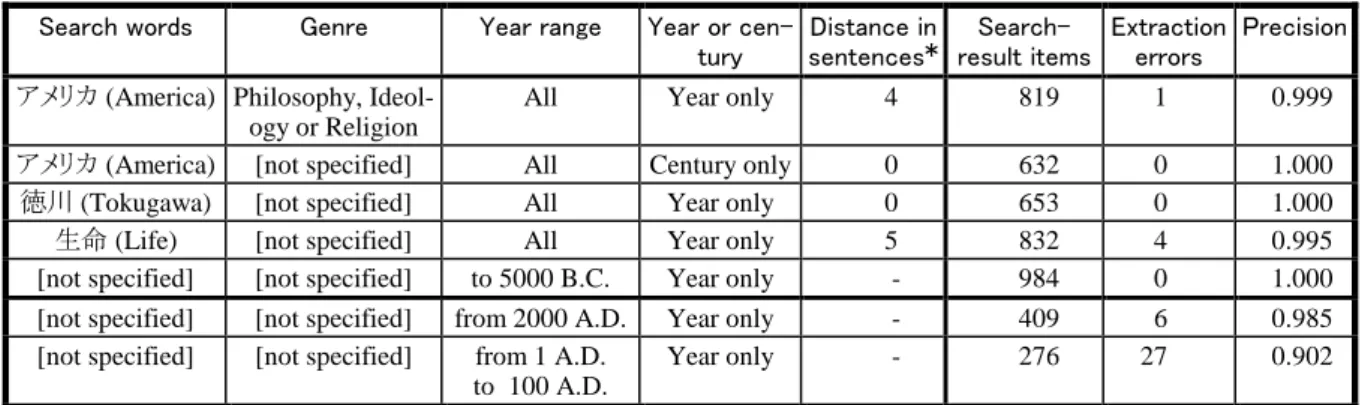
Table 1 evaluates the precision of extracting year references. Five thematic chronological-table search problems are used for this evaluation. The first five columns show the search conditions, and the last three show the results. Each result item contains a year reference.1 The correctness of year references in all the search-result items was judged by human for each search condition. The extraction error rate was less than 1% in most cases in this evaluation; i.e., the precision was better than 0.99. However, the error rate exceeded 1% in certain cases. The precision of the year range from 1 to 100 A.D. (the bottom row in the table) was the worst because this range contains many error cases of two-digit year references.
Recall has not yet been evaluated because preci- sion is more important in the encyclopedia search.
Improving recall is the next step.
6 Related Work
There has been much research on information extrac- tion from English text. Examples of research on
1 A result item contains a sentence, and a sentence may contain two or more year references. However, each search result focuses on only one year reference.
information extraction from Japanese text are Saito et al. [Sai 98], Sato et al. [Sat 95], Takao et al.
[Tak 99]+and Hisamitsu et al. [His 97]. Much re- search remains to be done on extracting year informa- tion precisely enough for encyclopedia searches, however.
7 Conclusion
A method of searching text and organizing the result called thematic chronological-table search has been developed. This method generates a year-axis index by extracting year references from the text.
An elaborate method of year information extrac- tion for seven forms of year or century references has been developed, as have techniques for reducing the number of extraction errors. The measured average precision was greater than 99%. Most year references of the form of abbreviated Gregorian years with two digits were also extracted correctly. However, ex- traction errors in this form causes the precision of references to other years to be lower, especially years between 1 to 100 A.D. Improving the precision is not an easy task because it requires the exhaustive extrac- tion of three- and four-digit year references.
The rules described here were developed for the World Encycloædia among the year extraction rules.
However, most of the rules can be applied to other type of texts, such as newspaper text. Most of the rules can probably be modified and applied to texts in other languages, such as English, too.
Future work on extracting year references includes devising more year extraction techniques that increase the precision, extracting year references that are not currently extracted because increasing the precision of the current version was not possible, and applying this method to other types of text, such as text in newsgroups and on the WWW.2
2However, the axis-specified search method has already been applied to the Mainichi Newspaper [Kan 98].
Table 1. Evaluation of year extraction
(America) Philosophy, Ideol-
ogy or Religion
All Year only 4 819 1 0.999
(America) [not specified] All Century only 0 632 0 1.000 (Tokugawa) [not specified] All Year only 0 653 0 1.000 (Life) [not specified] All Year only 5 832 4 0.995
[not specified] [not specified] to 5000 B.C. Year only - 984 0 1.000
[not specified] [not specified] from 2000 A.D. Year only - 409 6 0.985
[not specified] [not specified] from 1 A.D.
to 100 A.D.
Year only - 276 27 0.902
* This is the maximum number of sentences between the search word and the year references.
Acknowledgments
I am grateful to Yasufumi Fujji and other members of the Hitachi Digital Heibonsha for allowing use of the text of the World Encyclopædia, and for helping me improve the extraction and sorting methods. I also thank Mikio Yamazaki from the Hitachi Tohoku Software Company, who developed the user interface.
References
[HDH 98] DVD/CD-ROM World Encyclopædia, version 2, Hitachi Digital Heibonsha, 1998.
[His 97] Hisamitsu, T., and Niwa, Y.: Acquisition of Person Names from Newspaper Articles by Lexical Knowledge and Co-occurrence Analysis, SIG on Natural Language Processing, Information Proc- essing Society of Japan, 118-1, pp. 1–6, 1997 (in Japanese).
[Kan 98] Kanada, Y.: Axis-specified Search: A New Full-text Search Method for Gathering and Struc- turing Excerpts, 3rd Int’l ACM Conf. on Digital Li- braries, pp. 108–117, 1998.
[Kan 98a] Kanada, Y.: Axis-specified Search: A Full-text Search Method for Extracting and Order- ing Excerpts from Documents, Technical Report 98-FI-50-4, SIGFI, Information Processing Society of Japan, pp. 25-32, 1998
[Kan 99] Kanada, Y.: A Method of Geographical Name Extraction from Japanese Text for Thematic Geographical Search, 18th Int’l Conference on In- formation and Knowledge Management (CIKM 99), submitted.
[MUC 98] Proceedings of the Seventh Message Understanding Conference (MUC-7), SAIC, 1998.
[Sai 98] Saito, K., Sakota, A., Nakae, T., Iwai, S., Tamura, N., and Nakagawa, H.: Numerical Infor- mation Extraction from Newspaper Articles, SIG on Natural Language Processing, Information Processing Society of Japan, 125-6, pp. 63–70, 1998 (in Japanese).
[Sat 95] Sato, M., Sato, T., and Shinoda, Y.: Auto- mated Editing for Packaging Netnews Articles, Transaction of the Information Processing Society of Japan, Vol. 36, No. 10, 2371–2379, 1995 (in Japanese).
[Tak 99] Takao, Y., Nagai, H., Nakamura, S., and Nomura, H.: Information Extraction from Newspa- per Articles of Multiple Products — classification of expression patterns —, SIG on Natural Lan- guage Processing, Information Processing Society of Japan, 129-17, pp. 117–124, 1999 (in Japanese).