C o m m e N ta r y
INtroduCtIoN
An ever-increasing volume of publica- tions on the changing ocean environ- ment underscores the requirement for long-term observations to understand and predict ocean and climate change.
Such observations must be globally distributed and carried out over long time periods. But a means of obtain- ing those observations—particularly in the ocean—is not in place today. There is no global system of routinely funded, long-term, high-quality measurements to provide the necessary understand- ing of climate in general and the ocean
in particular. The scientific literature is full of examples of tantalizing short records that do not illuminate the physi- cal problems. Long-term biological measurements are in an even more lim- ited state of development. With society demanding better forecasts, and the need to quantify the human role in climate change, it is more important than ever that we find ways to establish the neces- sary institutional basis for and achieve the proper levels of funding for long- term measurements.
Because of the large sums involved, government resources must remain the primary sources for funding satellites and in situ instruments, their deploy- ment, and associated data systems. But governments have been slow to respond to the needs. Today, less than half of an initial global system is being funded, and most of that is coming from research funding. How can we convince govern- ments to maintain a system of long-term measurements in an operational mode, where properly calibrated observa- tions are supported on a routine basis for the indefinite future? New modes of funding, in addition to continuing and enhanced government support, and most probably involving large endow- ments, can help to stimulate government
funding, keep these measurements going, and add to the support of the associated science and technology development. To make this happen, new thinking about institutions and funding for long-term observations is required, and here we outline some possible directions. Our ideas are based on discussions that we have had with ocean scientists and rep- resentatives from government funding agencies, industry, and international bodies that are all grappling in different ways with the problems of observing the oceans and climate.
today’s reCords are too short for uNderstaNdINg earth’s ClImate
It is a truism of science that to under- stand a phenomenon, one must observe it. What we perceive today as climate change is the summation of variations on time scales ranging from the age of the earth, circa 4.5 billion years, to inter- annual fluctuations. This summation is a major problem in understanding cli- mate change today, because of the need to separate the differing time scales. To the extent that climate variability occurs on some time scale, T, and has a stochas- tic component to it, it must be observed over many multiples of T. Thus, a scien-
endowments and New Institutions for
long-term observations
B y d . J a m e s B a K e r , r ay m o N d W. s C h m I t t, a N d C a r l W u N s C h
d. James BaKer (djamesbaker@
comcast.net) is an oceanographer, for- mer Administrator of the US National Oceanic and Atmospheric Administration, and a Science and Management
Consultant in Philadelphia, PA, USA.
raymoNd W. sChmItt (rschmitt@
whoi.edu) is Senior Scientist, Department of Physical Oceanography, Woods Hole Oceanographic Institution, Woods Hole, MA, USA. Carl WuNsCh (cwunsch@
mit.edu) is Cecil and Ida Green Professor of Physical Oceanography, Department of Earth, Atmospheric and Planetary Sciences, Massachusetts Institute of Technology, Cambridge, MA, USA.
This article has been published in Oceanography, Volume 20, Number 4, a quarterly journal of The oceanography society. Copyright 2007 by The oceanography society. all rights reserved. Permission is granted to copy this article for use in teaching and research. republication, systemmatic rep or collective redistirbution of any portion of this article by photocopy machine, reposting, or other means is permitted only with the approval of The oceanography society. send all correspondence to: info@tos.org or Th e oceanography society, Po Box 1931, rockville, md 20849-1931, usa
tist trying to understand ocean surface waves is unlikely to agree that observing one wave over one wave period would be sufficient for understanding the physics of such waves.
To grasp what is going on over the time scales of immediate interest to human society (somewhat arbitrarily chosen to be decades to hundreds of years), scientists need observations, minimally, over those same time scales.
In practice, the instrumental record use- ful for understanding climate change is woefully short.
Much of what we know about the cli- mate system comes from a rare long time series of meteorological data extending back about 350 years. The longest instru- mental atmospheric record appears to be the central England temperature composite that began in 1659 (Manley,
1975). Many of the early long records included originated when a lone indi- vidual started making daily weather observations, perhaps to aid the manage- ment of a farm, but sometimes out of scientific curiosity. The dutiful logging of meteorological data was a long tradi- tion among farmers and sailors. Thomas Jefferson and George Washington kept their own measurements to guide their plantings, and Benjamin Franklin kept his as a student of weather. While these
statesmen had their own reasons for recording the data, no doubt there was a sense of responsibility for posterity, an intuition that someone would some- day make sense of the weather. The first coherent view of ocean currents was assembled from numerous ship logs by Matthew Fontaine Maury. Clearly, both data collector and data analyst are neces- sary for progress.
Nearly all environmental records are much shorter than those for air temperature at a few sites. Truly useful global atmospheric observations began only after World War II. Global ocean observations with near-adequate cover- age began after 1990, and accurate mea- surements of glacial ice volume, which require satellite coverage, began little more than five years ago. The global sea- level rise record is accurate only in the
satellite altimetry era of about 15 years’
duration, and sea-surface temperature records are accurate only in the satellite age, about 30 years; significant informa- tion about the changing ocean at depth is only now becoming available. Similar issues plague the wider problems of climate change on land, but we focus here on the ocean, as a clear example of the wider problem.
The extremely limited observational record is probably the major obstacle
to understanding global change as it is taking place today. Short instrumental records have driven scientists to explor- ing the so-called paleorecord—essen- tially the geological and geochemical sig- natures of climate change as recorded in the seafloor and in ice, and as preserved in the rock record. Interesting and use- ful as these are, paleorecords are limited in spatial and temporal coverage, and are always laden with serious questions of interpretation. The alternative has been the use of numerical models, some now quite sophisticated, but many ques- tions linger about their subgrid-scale parameterizations. In the absence of adequate data to test them, they remain of uncertain skill.
What is to be done? The scientific community must continue to explore the construction and utility of better climate models, and work to greatly extend the paleoclimate database. But the models and database, whatever their promise, are unlikely ever to be an adequate sub- stitute for good instrumental records.
Looking to the future, to our successors over coming generations, we need as a society to extend the instrumental record indefinitely into the future. Those com- ing generations will require instrumental records spanning decades and centuries.
Can such extended records be achieved?
oBstaCles to loNg- term tIme serIes
Significant challenges loom in the col- lection of open-ocean data of any kind. Since the cessation of the limited weather ship records in the 1970s, only a handful of oceanic time series have sur- vived. These data are proving invaluable in documenting the nature and magni- tude of oceanic variability in a handful
It would make a truly extraordinary
difference in our understanding of the climate system to have some key oceanic
time series endowed in perpetuity
of possibly representative locations. Yet, most ocean time series are maintained by a fragile, patchwork funding scheme in increments of three to five years. The toll on those committed individuals who try to maintain such sampling programs is considerable.
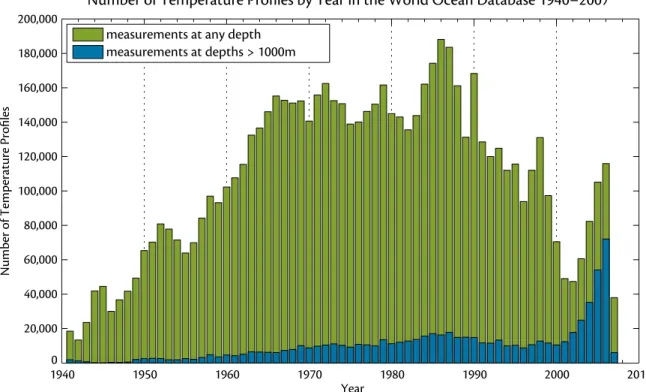
It has always been difficult for gov- ernments to sustain measurement pro- grams over years and decades. Even weather observations are under threat from competing interests. The number of radiosonde profiles collected each year peaked in 1988 as did ocean tem- perature profiles in 1986 (Figure 1). The World Meteorological Organization still struggles to establish a Global Climate Observing System. International fund- ing for the global array of Argo floats
appears to have reached a plateau, and long-term funding is not secure. In the United States, we still do not see long- term commitments for the Integrated Ocean Observing System. NASA has downgraded the priority of Earth remote sensing, and NOAA has not been able to find funding for continuation of critical operational altimeter and scatterometer satellites. In Europe, the good news of commitment to a Global Monitoring for Environmental Security program of both in situ and satellite systems is counter- balanced by the bad news of a continual push for meteorological agencies to charge for data, which largely defeats the purpose of free and open data exchange.
In short, we are facing the uncom- fortable prospect of knowing less about
our environment than we did a few years ago—just as the world enters new regimes of CO
2, methane, aerosol, and other forcings. Given the short time hori- zon of the political process, can govern- ments meet the new long-term responsi- bilities of collecting useful ocean or, more generally, climate data without substan- tial new commitments? The new institu- tions discussed below could go a long way toward convincing governments to make the necessary new commitments.
Any oceanographer who has attempt- ed to sustain long-duration measure- ments for scientific use usually comes up against numerous practical obstacles.
(1) Such measurements need to become essentially routine and hence removed from the quality control of those who use
figure 1. Number of temperature profiles entered per year in the World ocean database. The total peaked in 1986, but the decrease in us Navy deployment of XBts (expendable bathythermographs) caused a steep decline in the following decades. since the turn of the century, the argo float program has helped to reverse the downward trend.
(Note: the data for 2007 are incomplete.) Tim Boyer, National Oceanographic Data Center 20,000
19400 1950 1960 1970 1980 1990 2000 2010
40,000 60,000 80,000 100,000 120,000 140,000 160,000 180,000 200,000
Year
Number of Temperature Profiles
Number of Temperature Profiles by Year in the World Ocean Database 1940−2007
measurements at any depthmeasurements at depths > 1000m
the data for research. (2) All technologies become obsolescent, and have to be replaced. Instrument design, and instru- ment testing, construction, calibration, and deployment for use over decades requires different skills and sources of funding support from the usual research efforts. (3) Long records are typically worth reanalyzing when they double in length. A scientist with a 30-year record to work with has a long wait, and little personal incentive, to try and produce a record twice as long. (4) New scientific insights or technical developments can lead to difficult decisions to augment or entirely stop some measurements.
(5) Funding cycles, government elec- tions, and time allowances for academic promotion and tenure are all extremely short compared to the open-ended time scales required for understanding the climate system. A junior scientist is not well advised to become involved with a program whose record will be interest- ing 20 years from now, and whose main- tenance relies on grants that must be renewed every three years.
NeW INstItutIoNs aNd fuNdINg for loNg-term data ColleCtIoN
What can we do? This problem is only partially a scientific and techni- cal one—it is also one of sociology and politics. Few governments or govern- ment agencies willingly commit them- selves to multidecadal programs. (Some rare exceptions exist: the international weather network, sustained by acute national awareness of damage and loss of life from short-term weather; the nuclear fusion program, sustained by the national goal of cheap energy; and some space agency programs requir-
ing a decade or more for development, construction, and flight, among a very few others, driven by a national interest in maintaining cutting-edge space tech- nology.) Given the long-term nature of ocean and climate issues, and the year- to-year budget cycles and vicissitudes, it is difficult to imagine any government anywhere funding an open-ended obser- vation system for oceans and climate in which the requisite scientific oversight and quality control would be present. In addition, few individuals are willing or able to take a long view of their science, extending out decades and longer.
Is there a way to maintain that sci- entific oversight and quality control for data-collection networks that would enhance and prove more reliable than government agency programs alone?
These are data sets that, in general, we want to perpetuate indefinitely, as the scientific value increases greatly with the duration of the record. While we may not individually reap the benefits of long-term records in our lifetime (though it is possible), they will certainly enhance the lives of our grandchildren and great-grandchildren.
aN eNdoWed INstItute for ClImate studIes One useful model to consider is the endowed institution. Many major uni- versities have survived, a few for a mil- lennium, by conservative management of endowments. Major science institutes have been established in the past by will- ing benefactors, particularly in medical sciences. Consider the establishment of an institute, probably not in a single location, appropriate for long-term ocean and climate studies. It would have to be privately endowed to render it
independent of any particular govern- ment funding source or governmental interests existing at a particular time.
Such an institute could be thought of as a global college of wise men and women, dedicated to the goal of working together with government to sustain instrumental records of climate and ocean processes indefinitely. They should be the best sci- entists, people willing to take a long view.
They would clearly need to sustain their scientific careers with other, shorter- range problems. How might one induce such a group to coalesce and to work toward a common goal, and to be self- renewing as the generations changed?
Suppose that about 50 such experts could be gathered from around the world. Each, at mid-career, would be offered a “deal”: in exchange for (per- haps) 30% of their time, 50% of their salaries would be paid, and each would be guaranteed support for one gradu- ate student and one postdoc (or equiva- lent)—to do whatever the scientist wanted, not necessarily connected to the climate-change effort. In exchange, each scientist would devote his or her 30% effort to sustaining a major ele- ment of the observing system—be it through continual lobbying for a new generation of satellites, the design of new instruments to measure trace gases, the sustained calibration of in situ ocean instruments, or other useful activity.
They would be unlikely to deploy such systems themselves, but would under- take to advise (and pressure) the appro- priate governmental bodies to do so.
Collectively, they would function as a
kind of senate, perhaps meeting once or
twice a year to review the health of their
enterprise. In conjunction with an exec-
utive committee, they would nominate
younger, successor members. Perhaps the combination of financial, profes- sional, and multigenerational contribu- tions would attract people to participate.
One could imagine some kind of review of individual participation about every 10 to 15 years. An existing oceanographic institution might be persuaded to house the administrative component of such an institute and some of its individual scientists and engineers.
fuNdINg for the INstItute How would the funding be established for such an effort? At present, the costs of doing research are growing while insti- tutional funding for science is declining.
This trend is unlikely to reverse anytime soon. Given other urgent national priori- ties, it is unlikely that new funds will be easily forthcoming for long-term opera- tional measurements. Current US fund- ing for science is about 10% of the dis- cretionary budget and has been at that level for 30 years (Science, 11 May 2007, p. 817). The last time that funding per- centage was above 10% was during the Apollo program—a recognition of the decision to build a strong space program.
We might anticipate that the US govern- ment will continue to provide support at the existing level, with inflationary increases, but not more than that until there is an increased understanding of the risks to society from climate change and other sources. Thus, new endow- ments are required.
What is the magnitude of such an endowment? Taking very round num- bers, suppose each scientist required a salary contribution of $200,000 per year with institutional overhead, and that the combination of a postdoc and a stu- dent required another $150,000 per year
for a total for each scientist of $350,000 per year. Fifty such individuals would then require $17.5 million annually. If an endowment were assumed to return 5% per year, it would need to total
$350 million to provide this income.
This value should probably be doubled so that the endowment could outgrow inflation, and it would be desirable to have some funding for exploratory instrumentation and ideas. Thus, for an endowment of under $1 billion, such an institute might make, over decades and even centuries, a serious contribu- tion to understanding climate change in a way that no existing program can.
This endowment would provide strong leverage on the billions that are currently spent by governments on observations alone. With its people focusing on the observational and long-term issues of climate change, the new institute would help our government understand the need to make climate change a priority, and then maybe national spending pri- orities could change—as they did with the Apollo program.
the feasIBIlIty of r aIsINg
$1 BIllIoN
The $1 billion necessary to maintain an institute in support of a useful ocean- observing system for climate may seem a large sum, but in an age of multibillion- aires, is construction of such an organi- zation and resources beyond reach?
We think it is not only feasible, but also fully in line with what is happening across the United States. For example, the Chronicle of Higher Education recently reported that more than 50 US campuses have completed or are waging campaigns to raise $1 billion or more. Stanford University raised more than $900 million
just in 2006. In an eight-day period from late May to early June of this year, four universities announced donations of at least $100 million each. Successful new businesses and rapidly growing economies across the world have pro- duced much private wealth, and many of these donors want to build a better world. These examples show that a suf- ficiently justified fund-raising cam- paign for a $1 billion endowment would not be unreasonable.
The point is that we must do some- thing new. In the past, major bene- factors such as Andrew Carnegie, John D. Rockefeller, and Howard Hughes provided endowments for science insti- tutions. More recently, the basic sci- ence community has benefited greatly from the Kavli Foundation’s network of institutes in the physical sciences (Science, 21 January 2005, p. 340). The example of mixing funding modes so successful in the medical sciences world should be followed.
Are there billionaires among us who capable of taking on the sort of personal responsibility displayed by the Carnegies and Rockefellers of the past? Could they provide the key support necessary for those who emulate Franklin and Maury in attempting to understand the world about them? It would make a truly extraordinary difference in our under- standing of the climate system to have some key oceanic time series endowed in perpetuity. We look forward to further discussion and would welcome readers’
views on these issues.
refereNCe
Manley, G. 1974. Central England temperatures:
Monthly means 1659 to 1973. Quarterly Journal of the Royal Meteorological Society 100:389–405.