• 検索結果がありません。

NEIGHBORHOOD CULTIVATION GENETIC ALGORITHM FOR MULTI-OBJECTIVE OPTIMIZATION PROBLEMS

N/A
N/A
Protected

Academic year: 2021

シェア "NEIGHBORHOOD CULTIVATION GENETIC ALGORITHM FOR MULTI-OBJECTIVE OPTIMIZATION PROBLEMS"

Copied!
6
0
0

読み込み中.... (全文を見る)

全文

(1)

NEIGHBORHOOD CULTIVATION GENETIC ALGORITHM FOR MULTI-OBJECTIVE OPTIMIZATION PROBLEMS

Shinya Watanabe, Tomoyuki Hiroyasu, and Mitsunori Miki

Doshisha University

1-3 Tatara Miyakodani,Kyo-tanabe, Kyoto, 610-0321, JAPAN

ABSTRACT

In this paper, a new genetic algorithm for multi-objective optimization problems is introduced. That is called ”Neigh- borhood Cultivation GA (NCGA)”. In the recent studies such as SPEA2 or NSGA-II, it is demonstrated that some mechanisms are important; the mechanisms of placement in an archive of the excellent solutions, sharing without param- eters, assign of fitness, selection and reflection the archived solutions to the search population. NCGA includes not only these mechanisms but also the neighborhood crossover. The comparison of NCGA with SPEA2 and NSGA-II by some test functions shows that NCGA is a robust algorithm to find Pareto-optimum solutions. Through the comparison between the case of using neighborhood crossover and the case of using normal crossover in NCGA, the effect of neigh- borhood crossover is made clear.

1. INTRODUCTION

Recently, the study of evolutionary computation of multi- objective optimization has been researched actively and made great progress [1, 2]. The many approaches have been in- troduced and genetic algorithm (GA) is a main approach among them [1]. GA can derive a set of Pareto-optimum solution in one trial, since GA is one of multi point search methods.

In the past years, several new algorithms that can find good Pareto-optimum solutions with small calculation cost have been developed [1]. Those are NSGA-II [1], SPEA2 [2], and so on. These new algorithms have the same search mechanisms; those are preservation scheme of excellent so- lutions that are found in the search, allocation scheme of appropriate fitness values and sharing scheme without pa- rameters.

We proposed the parallel model of multi-objective GA that is called DRMOGA [3]. In this model, we discussed the difference of the parallel models between single objective problems and multi-objective problems. We also proposed the neighborhood crossover and showed the effectiveness of the neighborhood crossover through the numerical ex- amples.

In this paper, we propose a new GA for multi-objective optimization problems. That is called Neighborhood Cul- tivation GA (NCGA). NCGA includes not only the mech- anisms of NSGA-II and SPEA2 that derive the good solu- tions but also the mechanism of neighborhood crossover.

Through the numerical experiments, the effectiveness of NCGA is discussed. In the experiments, the results of NCGA are compared with those of NSGA-II, SPEA2 and non-NCGA (nNCGA). nNCGA is the same algorithms as NCGA but without neighborhood crossover.

2. MULTI-OBJECTIVE OPTIMIZATION PROBLEMS BY GENETIC ALGORITHMS Genetic Algorithm is an algorithm that simulates the hered- ity and evolution of living things [1]. Since GA is one of multi point search methods, an optimum solution can be determined even when the landscape of the objective function is multi modal. In multi-objective optimization, GA can find a Pareto-optimum set with one trial because GA is a multi point search. As a result, GA is a very ef- fective tool especially in multi-objective optimization prob- lems. Thus, there are many researchers who are working on multi-objective GA and there are many algorithms of multi-objective GA [1, 2, 3, 4]. These algorithms of multi- objective GA are roughly divided into two categories; the algorithms that treat Pareto-optimum solution implicitly or explicitly [1]. The most of the latest methods treat Pareto- optimum solution explicitly.

The following topics are the mechanisms that the recent GA approaches have.

1) Reservation mechanism of the excellent solutions 2) Reflection to search solutions mechanism of the re-

served excellent solutions

3) Cut down (sharing) method of the reserved excellent solutions

4) Assignment method of fitness function

5) Unification mechanism of values of each objective

These mechanisms derive the good Pareto-optimum so-

lutions. Therefore, the developed algorithm should have

these mechanisms.

(2)

3. NEIGHBORHOOD CULTIVATION GENETIC ALGORITHM

In this paper, we extend GA and develop a new algorithm that is called Neighborhood Cultivation Genetic Algorithm (NCGA). NCGA has the neighborhood crossover mecha- nism in addition to the mechanisms of GAs that are ex- plained in the former chapter. In GAs, the exploration and exploitation are very important. By exploitation, an opti- mum solution can be found in a global area. By exploration, an optimum solution can be found around the elite solution.

In NCGA, the exploitation factor of the crossover is rein- forced. In the crossover operation of NCGA, a pair of the individuals for crossover is not chosen randomly, but indi- viduals who are close each other are chosen. Because of this operation, child individuals that are generated after the crossover may be close to the parent individuals. Therefore, the precise exploitation is expected.

The following steps are the overall flow of NCGA where P t : search population at generation t

A t : archive at generation t.

Step 1: Initialization: Generate an initial population P 0 . Pop- ulation size is N . Set t = 0 . Calculate fitness values of initial individuals in P 0 . Copy P 0 into A 0 . Archive size is also N .

Step 2: Start new generation: set t = t + 1 .

Step 3: Generate new search population: P t = A t−1 . Step 4: Sorting: Individuals of P t are sorted with along to

the values of focused objective. The focused objec- tive is changed at every generation. For example, when there are three objectives, the first objective is focused in this step in the first generation. The third objective is focused in the third generation. Then the first objective is focused again in the forth generation.

Step 5: Grouping: P t is divided into groups which consists of two individuals. These two individuals are chosen from the top to the down of the sorted individuals.

Step 6: Crossover and Mutation: In a group, crossover and mutation operations are performed. From two par- ent individuals, two child individuals are generated.

Here, parent individuals are eliminated.

Step 7: Evaluation: All of the objectives of individuals are derived.

Step 8: Assembling: The all individuals are assembled into one group and this becomes new P t .

Step 9: Renewing archives: Assemble P t and A t−1 together.

Then N individuals are chosen from 2 N individu- als. To reduce the number of individuals, the same operation of SPEA2 (Environment Selection) is also performed. In NCGA, this environment selection is applied as the selection operation.

Step 10: Termination: Check the terminal condition. If it

is satisfied, the simulation is terminated. If it is not satisfied, the simulation returns to Step 2.

In NCGA, most of the genetic operations are performed in a group that is consisted of two individuals.

The following features of NCGA are the differences of the recent major algorithm like SPEA2 and NSGA-II.

1) NCGA has the neighborhood crossover mechanism.

2) NCGA has only the environment selection and it does not have the mating selection.

4. NUMERICAL EXAMPLES

In this section, NCGA is applied to the some test functions.

The results are compared with those of SPEA2 [2], NSGA- II [1] and non-NCGA (nNCGA). nNCGA is the same algo- rithm of NCGA without neighborhood crossover.

4.1. Test Functions

In this paper, we use two continuous functions and a knap- sack problem. These problems are explained as follows. In these equations, f denotes an objective function and g ( g 0) indicates a constraint.

ZDT 4 :

min f 1 (x) = x 1

min f 2 (x) = g(x)[1

x 1 g ( x ) ] g(x) = 91 +

10 i =2 [x 2 i 10 cos(4πx i )]

x 1 [0, 1], x i [−5, 5], i = 2, . . . ,10

KUR :

min f 1 =

n i =1 (−10 exp(−0.2

x 2 i + x 2 i +1 )) min f 2 =

n i =1 (|x i | 0 . 8 + 5 sin(x i ) 3 )

x i [−5, 5], i = 1, . . . , n, n = 100

KP 750 2 :

min f i (x) =

n i =1 x i · p i,j

s.t.

g(x) =

n i =1 x i w ˙ i,j W j

p i,j (profit value) w i,j (weight value) 1 j 2

ZDT4 was use by Zitzler and Deb [1]. This test function is a multi-model function. KUR was used by Kursawa [1].

It has a multi-modal function in one component. At the same time, there are interactions among the variables in the other component. KP750-2 is a 0/1 knapsack problem and it is a combinatorial problem [1, 2]. There are 750 items and two objects.

4.2. Parameters of GAs

In this paper, to discuss the effectiveness of the algorithm,

simple methods are applied for all the problems. Therefore

the bit coding is used in the experiments. Similarly, one

(3)

f1

f2 X Y

Figure 1: Sampling of the Pareto frontier lines of intersec- tion

point crossover is used for the crossover and bit flip method is used for the mutation. The length of the chromosome is 20 bit per one design variable for the continuous problems and 750 bit for the knapsack problems. In the continuous problems, population size is 100. The simulation is termi- nated when the generation is got over 250. In the knapsack problems, population size is 250. The simulation is termi- nated when the generation is exceeded 2000.

4.3. Evaluation methods

To compare the results derived by each algorithm, the fol- lowing evaluation methods are used in this paper.

4.3.1. Sampling of the Pareto frontier lines of intersec- tion

This comparison method is presented by Knowles and Corne [4].

The concept of this method is shown in figure 1. In this fig- ure, two solutions sets of X and Y that are derived by the different methods are illustrated.

At first, the attainment surfaces defined by the approxi- mation sets are calculated. Secondly the uniform sampling lines that cover the Pareto tradeoff area are decided. For each line, the intersections of the line and the attainment surfaces of the derived sets are obtained. These intersec- tions are compared. Finally, the Indication of Lines of Inter- section (I LI ) is derived. When the two approximation sets X and Y are considered, then I LI ( X, Y ) indicates the av- erage number of the points that X are ranked higher than Y . Therefore the most significant outcome would be I LI ( X, Y ) = 1 . 0 and I LI ( Y, X ) = 0 . 0 .

In order to focus on only the Pareto tradeoff area as de- fined by the approximation sets and to derive the intuitive evaluation value, the following terms are considered.

The objective values of approximation sets are nor- malized.

The sampling lines are located in the area where the approximation sets are existed.

Many sampling lines are prepared. In the following experiment, 1000 lines are used.

0.0 0.5 1.0

2 4 6

SPEA2 NSGA-II NCGA nNCGA SPEA2 NSGA-II NCGA nNCGA

f2(x)

f1(x)

Figure 2: Max-Min values of ZDT4

-800 -760 -720

-250 -200 -150 -100

f2(x)

f1(x)

SPEA2 NSGA-II NCGA nNCGA SPEA2 NSGA-II NCGA nNCGA

Figure 4: Max-Min values of KUR

4.3.2. Maximum, Minimum and Average values of each object of derived solutions (MMA)

To discuss the expanse of the solutions, the maximum, min- imum and average values of each object are considered.

4.4. Results

Proposed NCGA, SPEA2, NSGA-II and nNCGA (NCGA without neighborhood crossover) are applied to test func- tions. 30 trials have been performed and all the results are the average of 30 trials.

4.4.1. ZDT4

The results of I LI and MMA of ZDT4 are shown in Figure 2 and 3 respectively.

From figure 2 and 3, it is found that NCGA derived bet- ter solutions than the other methods. According to right fig- ure in figure 2 , NCGA could get the best accuracy of the solutions.

And these results show that nNCGA could get almost the same quality solutions as NCGA gets. NCGA and nNCGA don’t perform Mating selection, but only perform environ- mental selection. NCGA and nNCGA are different from SPEA2 and NSGA-II in this respect. As this problem is multi-model function, strong selection should let solutions centralize, and perform bad effect on solutions search.

4.4.2. KUR

In this problem, there are 100 design variables. Therefore, a

lot of generations should be needed to derive the solutions.

(4)

0 20 40 60 80 100

0 20 40 60 80 100

0 20 40 60 80 100

0 20 40 60 80 100

0 20 40 60 80 100 0 20 40 60 80 100

SPEA2

NSGA-II

NCGA

51% 49%

25% 75%

32% 68%

28% 72%

34% 66% 52% 48%

nNCGA SPEA2 NSGA-II NCGA

0 20 40 60 80 100

Method A

Method B

a % b %

50 %

nNCGA

Figure 3: I LI of ZDT4

0 20 40 60 80 100

0 20 40 60 80 100

0 20 40 60 80 100

0 20 40 60 80 100

0 20 40 60 80 100 0 20 40 60 80 100

SPEA2

NSGA-II

NCGA

40% 60%

5% 95%

36% 64%

7% 93%

46% 54% 92% 8%

nNCGA SPEA2 NSGA-II NCGA

nNCGA Figure 5: I LI of KUR

300 –250 –200 –150 –100 –50

–900 –800 –700

–300 –250 –200 –150 –100 –50

–900 –800 –700

–300 –250 –200 –150 –100 –50

–900 –800 –700 –300

–250 –200 –150 –100 –50

–900 –800 –700

– SPEA2

nNCGA NSGA-II

NCGA

f1(x)

f 2(x)

f1(x)

f 2(x)

f1(x)

f 2(x)

f1(x)

f 2(x)

Figure 6: Pareto optimum individuals(KUR)

(5)

0 20 40 60 80 100

0 20 40 60 80 100

0 20 40 60 80 100

0 20 40 60 80 100

0 20 40 60 80 100 0 20 40 60 80 100

SPEA2

NSGA-II

NCGA

49% 51%

21% 79%

56% 46%

19% 81%

60% 40% 97% 3%

nNCGA SPEA2 NSGA-II NCGA

nNCGA

Figure 7: I LI of KP-2

-28500 -27000 -25500

-28500 -27000 -25500

f2(x)

f1(x)

SPEA2 NSGA-II NCGA nNCGA SPEA2 NSGA-II NCGA nNCGA

Figure 8: Max-Min values of KP750-2

The results of I LI and MMA are shown in figure 4 and 5.

Figure 6 indicates Pareto solutions in KUR. In this figure, all the Pareto-optimum solutions that are derived in 30 trials are plotted.

It is clear from the figure 5 that NCGA derived better so- lutions than the other methods. The solutions of NCGA are also wider spread than those of the other methods. In com- parison with nNCGA, NCGA can get better solutions obvi- ously. Therefore, the mechanism of neighborhood crossover acts effectively to derive the solutions in this problem.

4.4.3. KP750-2

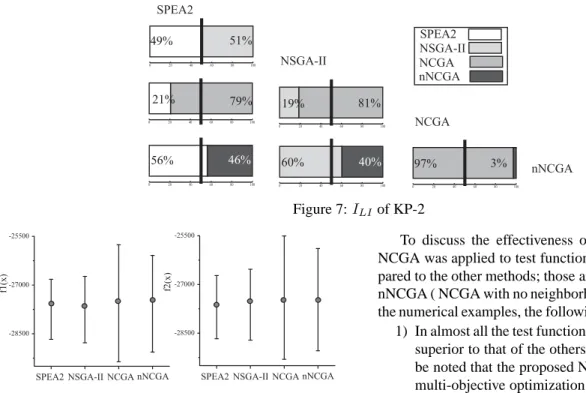
KP750-2 is the knapsack problem and it is very difficult to search the real Pareto-optimum solutions. The results of I LI and MMA are shown in figure 7 and 8.

From figure 8, NCGA found the wide spread solutions compared to the other methods. According to figure 7, the accuracy of the solutions of NCGA is better than those of the other methods. And nNCGA derived worse solutions than those of SPEA2 and NSGA-II, but NCGA could get better solutions than these methods.

5. CONCLUSION

In this paper, a new algorithm for multi-objective problems is proposed. The proposed algorithm is called ”Neighbor- hood Cultivation Genetic Algorithm (NCGA)”. NCGA has not only important mechanism of the other methods but also the mechanism of neighborhood crossover selection.

To discuss the effectiveness of the proposed method, NCGA was applied to test functions and results were com- pared to the other methods; those are SPEA2, NSGA-II and nNCGA ( NCGA with no neighborhood crossover). Through the numerical examples, the following topics are made clear.

1) In almost all the test functions, the results of NCGA is superior to that of the others. From this result, it can be noted that the proposed NCGA is good method in multi-objective optimization problems.

2) Comparing to NCGA and NCGA without neighbor- hood crossover, the former is obviously superior to the latter in all problems. Therefore, the results em- phasize that the neighborhood crossover acts to derive the good solutions.

3) Comparing to SPEA2 and NSGA-II, two methods have almost the same ability to find Pareto optimum solu- tions.

6. REFERENCES

[1] K. Deb. Multi-Objective Optimization using Evolution- ary Algorithms. Chichester, UK : Wiley, 2001.

[2] E. Zitzler, M. Laumanns, and L. Thiele. SPEA2: Im- proving the Performance of the Strength Pareto Evolu- tionary Algorithm. In Technical Report 103, Computer Engineering and Communication Networks Lab (TIK), Swiss Federal Institute of Technology (ETH) Zurich, 2001.

[3] T. Hiroyasu, M. Miki, and S. Watanabe. The New Model of Parallel Genetic Algorithm in Multi- Objective Optimization Problems -Divided Range Multi-Objective Genetic Algorithms. In IEEE Proceed- ings of the 2000 Congress on Evolutionary Computa- tion, pp. 333–340, 2000.

[4] J. D. Knowles and D. W. Corne. Approximating the

nondominated front using the pareto archived evolution

strategy. Evolutionary Computation, Vol. 8, .

(6)

The source

Shinya Watanabe, Tomoyuki Hiroyasu and Mitsunori Miki,

”Neighborhood Cultivation Genetic Algorithm for Multi-

Objective Optimization Problems”, Proceedings of the 4th

Asia-Pacific Conference on Simulated Evolution And Learn-

ing (SEAL-2002), pages = 198–202, 2002

Figure 1: Sampling of the Pareto frontier lines of intersec- intersec-tion
Figure 6: Pareto optimum individuals(KUR)
Figure 8: Max-Min values of KP750-2

参照

関連したドキュメント

I give a proof of the theorem over any separably closed field F using ℓ-adic perverse sheaves.. My proof is different from the one of Mirkovi´c

Using right instead of left singular vectors for these examples leads to the same number of blocks in the first example, although of different size and, hence, with a different

He thereby extended his method to the investigation of boundary value problems of couple-stress elasticity, thermoelasticity and other generalized models of an elastic

Keywords: continuous time random walk, Brownian motion, collision time, skew Young tableaux, tandem queue.. AMS 2000 Subject Classification: Primary:

The idea of applying (implicit) Runge-Kutta methods to a reformulated form instead of DAEs of standard form was first proposed in [11, 12], and it is shown that the

This paper presents an investigation into the mechanics of this specific problem and develops an analytical approach that accounts for the effects of geometrical and material data on

The object of this paper is the uniqueness for a d -dimensional Fokker-Planck type equation with inhomogeneous (possibly degenerated) measurable not necessarily bounded

In the paper we derive rational solutions for the lattice potential modified Korteweg–de Vries equation, and Q2, Q1(δ), H3(δ), H2 and H1 in the Adler–Bobenko–Suris list.. B¨