平成 26 年度電気関係学会四国支部連合大会 講演論文集 (2014 徳島大学)
2014 SHIKOKU-SECTION JOINT CONVENTION RECORD OF THE INSTITUTES OF ELECTRICAL AND RELATED ENGINEERS (TOKUSHIMA)
Hopfield Neural Network with Random Cutting for Traveling Salesman Problem
Ryota OSHIMA Yuki SHOJI Yoko UWATE Yoshifumi NISHIO ( Tokushima University)
1. Introduction
Hopfield neural network is applied to various fields such as associative memory, optimization problem and so on.
However, the Hopfield neural network often leads to the local minimum. It makes difficult to optimize the problem because of stopping the solutions at local minimum. On the other hand, some synapses are pruned in the process of growing a brain of baby in order to inhibit the noises. We expect that precision of the solution is increased by intro- ducing this phenomenon to the Hopfield neural network for solving TSP. In this study, we propose the Hopfield neural network with random cutting of the connections.
Moreover, we carry out the simulation and discuss influ- ence of the Hopfield neural network with random cutting for TSP.
2. Proposed method
In this study, we focus on influences of the Hopfield neural network with random cutting for TSP. In particu- lar, we cut some connections between the neurons. The cutting conditions are described below.
• Cutting ratio sets constantly.
• We carry out the cutting at a regular interval.
• The internal states are retained till next cutting.
• We cut the connections between the neurons after resetting the connections at each interval.
We fix the length of regular interval as 5, 10, 15 and 20. The unneccessary connections are decided completely random. In addition to this, we discuss the simulation results by the average distance in next section.
3. Simulation results
In this simulation, we discuss the optimization in the case of the disposition with 22 cities as shown in Fig. 1.
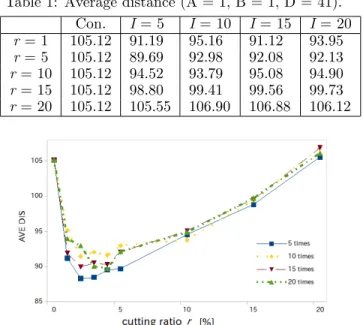
We simulated 5000 times per one trial. In addtion, the cutting ratio r is defined from 1 to 20 %. We compare the average distance, and we simulated ten times of trials with different initial values. The shortest distance to go around all cities is about 75.67.
The simulation results are shown in Table 1. It is ex- pressed the comparsion between average distances of pro- posed and the conventional methods. The cutting ratio shows r. In addition, the regular interval shows I. The differences of each average distance with the low cutting rate is smaller than the one with the high cutting rate.
In other simulation results, the precision of the solution decreases when the cutting ratio is raised. This cause in- cludes that we may cutting necessary connections between the neurons by random cutting.
Figure 1: Disposition with 22 cities.
Table 1: Average distance (A = 1, B = 1, D = 41).
Con. I= 5 I= 10 I= 15 I= 20 r= 1 105.12 91.19 95.16 91.12 93.95 r= 5 105.12 89.69 92.98 92.08 92.13 r= 10 105.12 94.52 93.79 95.08 94.90 r= 15 105.12 98.80 99.41 99.56 99.73 r= 20 105.12 105.55 106.90 106.88 106.12
Figure 2: Comparsion between the proposed and the con- ventional methods.
4. Conclusions
We studied the solution abilities of the Hopfield neu- ral network with the random cutting for the Traveling Salesman Problem. As the simulation results, the pro- posed method shows smaller average distances than the conventional method. However, the precision of the pro- posed method decreases if the cutting ratio is defined as the large value. In future work, we would like to devise various algorithms to cut the connections. Furthermore, we increase city numbers and simulate it.
1-20
20