1. Witt vectors
The purpose of this note is to give a self-contained introduction to Witt vectors.
We cover both the classical p-typical Witt vectors of Teichm¨ uller and Witt [4] and the generalized or big Witt vectors of Cartier [1]. In the approach taken here all necessary congruences are isolated in the lemma of Dwork. A slightly different but very readable account may be found in Bergman [3, Appendix]. We conclude with a brief treatment of special λ-rings and Adams operations. The reader is referred to Langer-Zink [2, Appendix] for a careful analysis of the behavior of the ring of Witt vectors with respect to ´ etale morphisms.
Let N be the set of positive integers, and let S ⊂ N be a subset with the property that, if n ∈ S, and if d is a divisor in n, then d ∈ S. We then say that S is a truncation set. The big Witt ring W S (A) is defined to be the set A S equipped with a ring structure such that the ghost map
w : W S (A) → A S
that takes the vector (a n | n ∈ S) to the sequence (w n | n ∈ S), where w n = X
d|n
da n/d d ,
is a natural transformation of functors from the category of rings to itself. Here, on the right-hand side, A S is considered a ring with componentwise addition and multiplication. To prove that there exists a unique ring structure on W S (A) that is characterized in this way, we first prove the following result.
Lemma 1.1 (Dwork) . Suppose that, for every prime number p, there exists a ring homomorphism φ p : A → A with the property that φ p (a) ≡ a p modulo pA. Then a sequence (x n | n ∈ S) is in the image of the ghost map
w : W S (A) → A S
if and only if x n ≡ φ p (x n/p ) modulo p vp(n)A, for every prime number p, and for every n ∈ S with v p (n) > 1. Here v p (n) denotes the p-adic valuation of n.
Proof. We first show that, if a ≡ b modulo pA, then a pv−1 ≡ b pv−1 modulo p v A. If we write a = b + p, then
modulo p v A. If we write a = b + p, then
a pv−1 = b pv−1+ X
+ X
16
i
6p
v−1p v−1 i
b pv−1−ip i i .
In general, the p-adic valuation of the binomial coefficient m+n n
is equal to the number of carriers in the addition of m and n in base p. So
v p
p v−1 i
= v − 1 − v p (i), and hence,
v p
p v−1 i
p i
= v − 1 + i − v p (i) > v.
This proves the claim. Now, since φ p is a ring-homomorphism, φ p (w n/p (a)) = X
d|(n/p)
dφ p (a n/pd d )
1
which is congruent to P
d|(n/p) da n/d d modulo p v
p(n)A. If d divides n but not n/p, then v p (d) = v p (n), and hence this sum is congruent to P
d|n da n/d d = w n (a) modulo p v
p(n)A as stated. Conversely, if (x n | n ∈ S) is a sequence such that x n ≡ φ p (x n/p ) modulo p vp(n)A, we find a vector a = (a n | n ∈ S) with w n (a) = x n as follows. We let a
1= x
1 and assume, inductively, that a d has been chosen, for all d that divides n, such that w d (a) = x d . The calculation above shows that the difference
x n − X
d|n,d6=n
da n/d d
is congruent to zero modulo p vp(n)A. Hence, we can find a n ∈ A such that na n is
equal to this difference.
Proposition 1.2 . There exists a unique ring structure such that the ghost map w : W S (A) → A S
is a natural transformation of functors from rings to rings.
Proof. Let A be the polynomial ring Z [a n , b n | n ∈ S]. Then the unique ring homomorphism
φ p : A → A
that maps a n to a p n and b n to b p n satisfies that φ p (f ) = f p modulo pA. Let a and b be the sequences (a n | a ∈ S) and (b n | n ∈ S). Since φ p is a ring homomorphism, Lemma 1.1 shows immediately that the sequences w(a) + w(b), w(a) · w(b), and
−w(a) are in the image of the ghost map. It follows that there are sequence of polynomials s = (s n | n ∈ S), p = (p n | n ∈ S), and ι = (ι n | n ∈ S) such that w(s) = w(a) + w(b), w(p) = w(a) · w(b), and w(ι) = −w(a). Moreover, since A is torsion free, the ghost map is injective, and hence, these polynomials are unique.
Let now A
0be any ring, and let a
0= (a
0n | n ∈ S) and b0 = (b
0n | n ∈ S) be two vectors in W S (A0). Then there is a unique ring homomorphism f : A → A
0
such that W S (f )(a) = a
0 and W S (f )(b) = b
0. We define a
0+ b
0 = W S (f )(s), a · b = W S (f)(p), and −a = W S (f )(ι). It remains to prove that the ring axioms are verified. Suppose first that A
0 is torsion free. Then the ghost map is injective, and hence, the ring axioms are satisfied in this case. In general, we choose a surjective ring homomorphism g : A
00→ A
0 from a torsion free ring A
00. Then
). Then there is a unique ring homomorphism f : A → A
0such that W S (f )(a) = a
0and W S (f )(b) = b
0. We define a
0+ b
0= W S (f )(s), a · b = W S (f)(p), and −a = W S (f )(ι). It remains to prove that the ring axioms are verified. Suppose first that A
0is torsion free. Then the ghost map is injective, and hence, the ring axioms are satisfied in this case. In general, we choose a surjective ring homomorphism g : A
00→ A
0from a torsion free ring A
00. Then
W S (g) : W S (A
00) → W S (A
0)
is again surjective, and since the ring axioms are satisfied on the left-hand side,
they are satisfied on the right-hand side.
If T ⊂ S are two truncation sets, then the forgetful map R S T : W S (A) → W T (A)
is a natural ring homomorphism called the restriction from S to T. If n ∈ N , and if S ⊂ N is a truncation set, then
S/n = {d ∈ N | nd ∈ S}
is again a truncation set. We define the nth Verschiebung map V n : W S/n (A) → W S (A)
2
by
V n ((a d | d ∈ S/n)) m =
( a d , if m = nd, 0, else.
Lemma 1.3 . The Verschiebung map V n is additive.
Proof. There is a commutative diagram W S/n (A) w //
V
nA S/n
V
nwW S (A) w // A S where the map V n w is given by
V n w ((x d | d ∈ S/n)) m =
( nx d , if m = nd, 0, else.
Since the map V n w is additive, so is the map V n . Indeed, if A is torsion free, the horizontal maps are both injective, and hence, V n is additive in this case. In the general case, we choose a surjective ring homomorphism g : A
0→ A and argue as
in the proof of Prop. 1.2 above.
Lemma 1.4 . There exists a unique natural ring homomorphism F n : W S (A) → W S/n (A)
such the diagram
W S (A) w //
F
nA S
F
nwW S/n (A) w // A S/n , where F n w ((x m | m ∈ S)) d = x nd , commutes.
Proof. We construct the Frobenius map F n in a manner similar to the con- struction of the ring operations on W S (A) in Prop. 1.2. We let A be the polynomial ring Z [a n | n ∈ S], and let a be the vector (a n | n ∈ S). Then Lemma 1.1 shows that the sequence F n w (w(a)) ∈ A S/n is the image of a (unique) element
F n (a) = (f n,d | d ∈ S/n) ∈ W S/n (A)
by the ghost map. If A
0is any ring, and if a
0= (a
0n | n ∈ S) is a vector in W S (A0), then we define F n (a
0) = W S/n (g)(F n (a)), where g : A → A
0 is the unique ring homomorphism that maps a to a
0. Finally, since F n w is a ring homomorphism, an argument similar to the proof of Lemma 1.3 shows that also F n is a ring homomor-
phism.
The Teichm¨ uller representative is the map [−] S : A → W S (A)
3
defined by
([a] S ) n =
( a, if n = 1, 0, else.
It is a multiplicative map. Indeed, there is a commutative diagram A
[−]S
A
[−]wS
W S (A) w // A S , where ([a] w S ) n = a n , and [−] w S is a multiplicative map.
Lemma 1.5 . The following relations holds.
(i) a = P
n∈S V n ([a n ] S/n ).
(ii) F n V n (a) = na.
(iii) aV n (a
0) = V n (F n (a)a
0).
(iv) F m V n = V n F m , if (m, n) = 1.
Proof. One easily verifies that both sides of each equation have the same image by the ghost map. This shows that the relations hold, if A is torsion free,
and hence, in general.
Proposition 1.6 . The ring W S ( Z ) of big Witt vectors in the ring of rational integers is equal to the product
W S ( Z ) = Y
n∈S
Z · V n ([1] S/n ) with the multiplication given by
V m ([1] S/m ) · V n ([1] S/n ) = c · V d ([1] S/d ),
where c = (m, n) and d = mn/(m, n) are the greatest common divisor and the least common multiple of m and n.
Proof. The formula for the multiplication follows from Lemma 1.5 (ii)-(iv).
Suppose first that S is finite. If S is empty, the statement is trivial, so assume that S is non-empty. We let m ∈ S be maximal, and let T = S r {m}. Then the sequence of abelian groups
0 → W
{1}( Z ) −−→ Vm W S ( Z ) R
S
−−→
TW T ( Z ) → 0 is exact, and we wish to show that it is equal to the sequence
0 → Z · [1]
{1}−−→ Vm Y
n∈S
Z · V n ([1] S/n ) R
S
−−→
TY
n∈T
Z · V n ([1] T /n ) → 0.
The latter sequence is a sub-sequence of the former sequence, and, inductively, the left-hand terms (resp. the right-hand terms) of the two sequences are equal. Hence, middle terms are equal, too. The statement for S finite follows. Finally, a general truncation set S is the union of the finite sub-truncation sets S α ⊂ S, and hence,
W S ( Z ) = lim
α W S
α( Z ).
This proves the stated formula in general.
4
The action of the restriction, Frobenius, and Verschiebung operators on the generators V n ([1] S/n ) is easily derived from the relations Lemma 1.5 (ii)–(iv). To give a formula for the Teichm¨ uller representative, we recall the M¨ obius inversion formula. Let g : N → Z be a function, and let f : N → Z be the function given by
f (n) = X
d|n
g(d).
Then the function g is given by f by means of the formula g(n) = X
d|n
µ(d)f (n/d),
where µ : N → {−1, 0, 1} is the M¨ obius function. Here µ(d) = (−1) r , if d is a product of r > 0 distinct prime numbers, and µ(d) = 0, otherwise.
Addendum 1.7 . Let m be an integer. Then [m] S = X
n∈S
1 n
X
d|n
µ(d)m n/d
V n ([1] S/n ), where µ : N → {−1, 0, 1} is the M¨ obius function.
Proof. It suffices to prove that the formula holds in W S ( Z ). We know from Prop. 1.6 that there are unique integers r d , d ∈ S, such that
[m] S = X
d∈S
r d V d ([1] S/d ).
Evaluating the nth ghost component of this equation, we get m n = X
d|n
dr d ,
and the stated formula now follows from the M¨ obius inversion formula.
Lemma 1.8 . Suppose that A is an F p -algebra, and let ϕ : A → A be the Frobenius endomorphism. Then
F p = R S S/p ◦ W S (ϕ) : W S (A) → W S/p (A).
Proof. We recall from the proof of Prop. 1.4 that F p (a) = (f p,d (a) | d ∈ S/p),
where f p,d are the integral polynomials defined by the equations X
d|n
df p,d n/d = X
d|pn
da pn/d d
for all n ∈ S. Let A = Z [a n | n ∈ S]. We shall prove that for all n ∈ S/p, f p,n ≡ a p n
modulo pA. This is equivalent to the statement of the lemma. If n = 1, we have f p,1 = a p1+pa p , and we are done in this case. So let n > 1 and assume, inductively, that the stated congruence has been proved for all proper divisors in n. Then, if d is a proper divisor in n, f p,d ≡ a p d modulo pA, so
df p,d n/d ≡ da pn/d d
5
modulo p vp(n)+1A; compare the proof of Lemma 1.1. Rewriting the defining equa- tions
X
d|n
df p,d n/d = X
d|n
da pn/d d + X
d|pn,d
-n
da pn/d d
and noting that if d | pn and d - n, then v p (d) = v p (n) + 1, we find nf p,n ≡ na p n
modulo p vp(n)+1A. Since A is torsion free, we conclude that f p,n ≡ a p n modulo pA
as desired.
We consider the truncation set P = {1, p, p
2, . . . } ⊂ N that consists of all powers of a fixed prime number p. The proper non-empty sub-truncation sets of P all are of the form {1, p, . . . , p n−1 }, for some positive integer n. The rings
W (A) = W P (A)
W n (A) = W
{1,p,...,pn−1}(A)
are called the ring of p-typical Witt vectors in A and p-typical Witt vectors of length n in A, respectively. We shall now show that, if A is a Z
(p)-algebra, the rings of big Witt vectors W S (A) decompose canonically as a product of rings of p-typical Witt vectors. We begin with the following result.
Lemma 1.9 . Let m be an integer and suppose that m is invertible (resp. a non- zero-divisor) in A. Then m is invertible (resp. a non-zero-divisor) in W S (A).
Proof. It suffices to prove the lemma, for S finite. Indeed, in general, W S (A) is the limit of W T (A), where T ranges over the finite sub-truncation sets of S. So assume that S is finite and non-empty. Let n ∈ S be maximal, and let T = S r {n}.
Then S/n = {1} and we have an exact sequence 0 → A − V − →
nW S (A) R
S
−−→
TW T (A) → 0
from which the lemma follows by easy induction.
Proposition 1.10 . Let p be a prime number, and let A be a Z
(p)-algebra. Let S be a truncation set, and let I(S) = {k ∈ S | p - k}. Then the ring W S (A) has a natural idempotent decomposition
W S (A) = Y
k∈I(S)
W S (A)e k where
e k = Y
l∈I(S),l6=1
1
k V k ([1] S/k ) − 1
kl V kl ([1] S/kl )
. Moreover, the composite map
W S (A)e k , → W S (A) − F − →
kW S/k (A)
R
S/kS/k∩P−−−−−→ W S/k∩P (A) is an isomorphism.
6
Proof. We calculate w n ( 1
k V k ([1] S/k )) =
( 1, if k ∈ S ∩ k N , 0, else,
and hence,
w n (e k ) =
( 1, if k ∈ S ∩ kP , 0, else.
It follows that the elements e k , k ∈ I(S), are orthogonal idempotents in W S (A).
This proves the former part of the statement. To prove the latter part, we note that multiplication by k defines a bijection
S/k ∩ P = (S ∩ kP )/k −
∼→ S ∩ kP and that the following diagram commutes:
W S (A)e k w //
R
S/kS/k∩PF
kA S∩kP
∼
k
∗W S/k∩k (A) w // A S/k∩P .
We first assume that A is torsion free and has an endomorphism φ p : A → A such that φ p (a) ≡ a p modulo pA. Then the horizontal maps w are both injective.
Moreover, Lemma 1.1 identifies the image of the top horizontal map w with the set of sequences (x d | d ∈ S ∩ kP ) such that x d ≡ φ p (x d/p ) modulo p vp(d)A. Similarly, the image of the lower horizontal map w is the set of sequences (y d | d ∈ S/k ∩ P) such that y d ≡ φ p (y d/p ) modulo p vp(d)A. Since the right-hand vertical map k
∗
induces an isomorphism of these subrings, the left-hand vertical map R S/k S/k∩P F k is
A. Since the right-hand vertical map k
∗induces an isomorphism of these subrings, the left-hand vertical map R S/k S/k∩P F k is
an isomorphism in this case.
Example 1.11 . Let S = {1, 2, . . . , n} such that W S (A) is the ring W n (A) of big Witt vectors of length n in A. Then S/k ∩ P = {1, p, . . . , p s−1 } where s = s(n, k) is the unique integer with p s−1 k 6 n < p s k. Hence, if A is a Z
(p)-algebra,
W n (A) −
∼→ Y W s (A)
where the product ranges over 1 6 k 6 n with p - k, and where s = s(n, k) is given as above.
We now consider the ring W n (A) of p-typical Witt vectors of length n in A in more detail. The ghost map
w : W n (A) → A n
takes the vector (a
0, . . . , a n−1 ) to the sequence (w
0, . . . , w n−1 ) where w i = a p0i+ pa p1i−1+ · · · + p i a i .
+ · · · + p i a i .
If φ: A → A is a ring homomorphism with φ(a) ≡ a p modulo pA, then Lemma 1.1 identifies the image of the ghost map with the subring of sequences (x
0, . . . x n−1 ) such that x i ≡ φ(x i−1 ) modulo p i A, for all1 6 i 6 n − 1. We write
[−] n : A → W n (A)
7
for the Teichm¨ uller representative and
F : W n (A) → W n−1 (A) V : W n−1 (A) → W n (A) for the pth Frobnenius and pth Verschiebung.
Lemma 1.12 . If A is an F p -algebra, then V F = p.
Proof. For any ring A, the composite V F is given by multiplication by the element V ([1] n−1 ). Suppose that A is an F p -algebra. The exact sequences
0 → A V
n−1
−−−→ W n (A) − R → W n−1 (A) → 0
show, inductively, that W n (A) is annihilated by p n . Hence, V ([1] n−1 ) is annihilated by p n−1 . We show by induction on n that V ([1] n−1 ) = p[1] n , the case n = 1 being trivial. The formula from Addendum 1.7 gives that
[p] n = p[1] n + X
0<s<n
p ps− p ps−1
p s V s ([1] n−s ).
Since [p] n = 0, and since, inductively, V s ([1] n−s ) = p s−1 V ([1] n−1 ), for 0 < s < n, we can rewrite this formula as
0 = p[1] n + (p pn−1−1− 1)V ([1] n−1 ).
But p n−1 − 1 > n − 1, so we get p[1] n = V ([1] n−1 ) as stated.
We now suppose that A is a p-torsion free ring and that there exists a ring homo- morphism φ : A → A such that φ(a) ≡ a p modulo pA. It follows from Lemma 1.1 that there is a unique ring homomorphism
s φ : A → W (A) such that the composite
A −→ sφ W (A) − w → A
N0
maps a to (a, φ(a), φ
2(a), . . . ). We then define
t φ : A → W (A/pA)
to be the composite of s φ and the map induced by the canonical projection of A onto A/pA. We recall that the F p -algebra A/pA is said to be perfect, if the Frobenius endomorphism ϕ: A/pA → A/pA is an automorphism.
Proposition 1.13 . Let A be a p-torsion free ring, and let φ: A → A be a ring homomorphism such that φ(a) ≡ a p modulo pA. Suppose that A/pA is a perfect F p -algebra. Then the map t φ induces an isomorphism
t φ : A/p n A −
∼→ W n (A), for all n > 1.
Proof. The map t φ factors as in the statement since
V n W (A/pA) = V n W (φ n (A/pA)) = V n F n W (A/pA) = p n W (A/pA).
8
The proof is not completed by an induction argument based on the following com- mutative diagram:
0 // A/pA p
n−1
//
ϕ
n−1A/p n A
pr//
t
φA/p n−1 A //
t
φ0
0 // A/pA V
n−1
// W n (A/pA) R // W n−1 (A/pA) // 0.
The top horizontal sequence is exact, since A is p-torsion free, and the left-hand vertical map is an isomorphism, since A/pA is perfect. The statement follows by
induction on n > 1.
We return to the ring of big Witt vectors.
Proposition 1.14 . There is a natural commutative diagram W(A) γ //
w
(1 + tA[[t]])
∗t
dtd logA
Nγ
w
// tA[[t]]
where
γ(a
1, a
2, . . . ) = Y
n
>1(1 − a n t n )
−1, γ w (x
1, x
2, . . . ) = X
n
>1x n t n ,
and the horizontal maps are isomorphisms of abelian groups.
Proof. It is clear that γ w is an isomorphism of additive abelian groups. We show that γ is a bijection. We have
Y
n
>1(1 − a n t n )
−1= (1 + b
1t + b
2t
2+ . . . )
−1where the coefficient b n is given by the sum
b n = X
(−1) r a i1. . . a ir
that runs over all 1 6 i
1< · · · < i r 6 n such that i
1+ 2i
2+ · · · + ri r = n.
This formula shows that the coefficients a n , n > 1, are determined uniquely by the coefficients b n , n > 1. Indeed, we have the recursive formula
a n = b n − X
(−1) r a i1. . . a ir,
,
where the sum on the right-hand side ranges over 1 6 i
1< · · · < i r < n such that i
1+ 2i
2+ · · · + ri r = n. To prove that the map γ is a homomorphism from the additive group W(A) to the multiplicative group (1 + tA[[t]])
∗, it suffices as usual to consider the case where A is torsion free. In this case the vertical maps in the
9
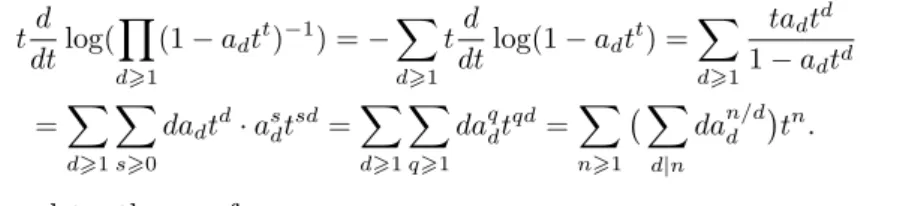
diagram of the statement are both injective, and hence, it suffices to show that the diagram of the statement commutes. We calculate:
t d
dt log( Y
d
>1(1 − a d t t )
−1) = − X
d
>1t d
dt log(1 − a d t t ) = X
d
>1ta d t d 1 − a d t d
= X
d
>1X
s
>0da d t d · a s d t sd = X
d
>1X
q
>1da q d t qd = X
n
>1X
d|n
da n/d d t n .
This completes the proof.
Addendum 1.15 . The map γ induces an isomorphism of abelian groups γ S : W S (A) −
∼→ Γ S (A)
where Γ S (A) is the quotient of the multiplicative group Γ(A) = (1 + tA[[t]])
∗by the subgroup I S (A) of all power series of the form Q
n∈
NrS (1 − a n t n )−1. Proof. The kernel of the restriction map
R
NS : W(A) → W S (A)
is equal to the subset of all vectors a = (a n | n ∈ N ) such that a n = 0, if n ∈ S.
The image of this subset by the map γ is the subset I S (A) ⊂ Γ.
Example 1.16 . If S = {1, 2, . . . , m}, then I S (A) = (1 + t m+1 A[[t]])
∗. Hence, in this case, Addendum 1.15 gives an isomorphism of abelian groups
γ S : W m (A) −
∼→ Γ S (A) = (1 + tA[[t]])
∗/(1 + t m+1 A[[t]])
∗.
The structure of this group, for A a Z
(p)-algebra, was examined in Example 1.11.
Lemma 1.17 . Let p be a prime number, and let A be any ring. Then the ring homomorphism F p : W(A) → W(A) satisfies that F p (a) ≡ a p modulo pW(A).
Proof. We first let A = Z [a
1, a
2, . . . ] and a = (a
1, a
2, . . . ). If suffices to show that there exists b ∈ W(A) such that F p (a) − a p = pb. By Lemma 1.9, the element is necessarily unique; we use Lemma 1.1 to prove that it exists. We have
w n (F p (a) − a p ) = X
d|pn
da pn/d d − X
d|n
da n/d d p
which is clearly congruent to zero modulo pA. So let x = (x n | n ∈ N ) with x n = 1
p (F p (a) − a p ).
We wish to show that x = w(b), for some b ∈ W(A). The unique ring homomor- phism φ ` : A → A that maps a n to a ` n satisfies that φ ` (f ) = f ` modulo `A, and hence, Lemma 1.1 shows that x is in the image of the ghost map if and only if
x n ≡ φ ` (x n/` )
modulo ` v`(n)A, for all primes ` and all n ∈ ` N . This is equivalent to showing that w n (F p (a) − a p ) ≡ φ ` (w n/p (F p (a) − a p ))
10
modulo ` v`(n)A, if ` 6= p and n ∈ ` N , and modulo ` v`(n)+1A, if ` = p and n ∈ ` N . If
A, if ` = p and n ∈ ` N . If
` 6= p, the statement follows from Lemma 1.1, and if ` = p and n ∈ ` N , we calculate w n (F p (a) − a p ) − φ p (w n/p (F p (a) − a p ))
= X
d|pn,d
-n
da pn/d d − X
d|n
da n/d d p
+ X
d|(n/p)
da n/d d p
.
If d | pn and d - n, then v p (d) = v p (n) + 1, so the first summand is congruent to zero modulo p vp(n)+1A. Similarly, if d | n and d - (n/p), then v p (d) = v p (n), and hence,
X
d|n
da n/d d ≡ X
d|(n/p)
da n/d d
modulo p vp(n)A. But then X
d|n
da n/d d p
≡ X
d|(n/p)
da n/d d p
modulo p vp(n)+1A; compare the proof of Lemma 1.1. This completes the proof.
Let : W(A) → A be the ring homomorphism that takes a = (a n | n ∈ N ) to a
1. Proposition 1.18 . There exists a unique natural ring homomorphism
∆ : W(A) → W(W(A))
such that w n (∆(a)) = F n (a), for all n ∈ N . Moreover, the functor W(−) and the ring homomorphisms ∆ and form a comonad on the category of rings.
Proof. By naturality, we may assume that A is torsion free. Then Lemma 1.9 shows that also W(A) is torsion free, and hence, the ghost map
w: W(W(A)) → W(A)
Nis injective. Lemma 1.17 and Lemma 1.1 show that the sequence (F n (a) | a ∈ N ) is in the image of the ghost map. Hence, the natural ring homomorphism ∆ exists.
The second part of the statement means that
W(∆ A ) ◦ ∆ A = ∆
W(A)◦ ∆ A : W(A) → W(W(W(A))) and
W( A ) ◦ ∆ A =
W(A)◦ ∆ A : W(A) → W(A).
Both equalities are readily verified by evaluating the ghost coordinates.
Definition 1.19 . A special λ-ring is a ring A and a ring homomorphism λ: A → W(A)
that makes A a coalgebra over the comonad (W(−), ∆, ).
Let (A, λ: A → W(A)) be a special λ-ring. Then the associated nth Adams operation is the ring homomorphism defined by the composition
ψ n : A − → λ W(A) −−→ wn A of the structure map and the nth ghost map.
11
References
[1] P. Cartier, Groupes formels associ´ es aux anneaux de Witt g´ en´ eralis´ es, C. R. Acac. Sci. Paris, S´ er. A–B 265 (1967), A129–A132.
[2] A. Langer and T. Zink, De Rham-Witt cohomology for a proper and smooth morphism, J.
Inst. Math. Jussieu 3 (2004), 231–314.
[3] D. Mumford, Lectures on curves on an algebraic surface, Annals of Mathematics Studies, vol. 59, Princeton University Press, Princeton, N.J., 1966.
[4] E. Witt, Zyklische K¨ orper und Algebren der Charakteristik p vom Grad p
n, J. reine angw.
Math. 176 (1937), 126–140.
Massachusetts Institute of Technology, Cambridge, Massachusetts E-mail address: [email protected]
Nagoya University, Nagoya, Japan E-mail address: [email protected]
12