PAPER
Multi-Tree-Based Peer-to-Peer Video Streaming with a Guaranteed Latency ∗
Satoshi FUJITA†a),Member
SUMMARY This paper considers Peer-to-Peer (P2P) video streaming systems, in which a given video stream is divided intobstripes and those stripes are delivered tonpeers throughbspanning trees under the constraint such that each peer including the source can forward at mostbstripes. The delivery of a stripe tonpeers is said to be ak-hop deliveryifall peers receive the stripe through a path of length at mostk. LetBk =k−1
i=0bi. It is known that under the above constraint,k-hop delivery ofbstripes tonpeers is possible only ifn ≤ Bk. This paper proves that (k+1)- hop delivery ofbstripes tonpeers is possiblefor any n≤ Bk; namely, we can realize the delivery of stripes with aguaranteed latencywhile it is slightly larger than the minimum latency. In addition, we derive a necessary and sufficient condition onnto enable ak-hop delivery ofbstripes for Bk−b+2≤n≤Bk−1; namely forn’s close toBk.
key words: P2P video streaming system, guaranteed latency, tree- structured overlay
1. Introduction
Video streaming over Peer-to-Peer (P2P) networks has at- tracted considerable attention in the past two decades[4]–
[6], [13], [17], [19]–[21], [23], [24], [26], [27]. In P2P video streaming, peers participating in the network con- tribute their upload capacity to help a stable dissemina- tion of the streaming data. For example, in tree-based systems[5],[6], [20], [28], peers are organized in a tree- structured overlay and the streaming data which is “pushed”
by the media server located at the root of the tree, is deliv- ered to the downstream peers by repeating store-and-relay operation. It is known that the efficiency of a tree-structured streaming could be effectively improved by adoptingmulti- ple treesinstead of a single tree[4],[19]; namely by dividing the given stream intobstripess1,s2, . . . ,sband by deliver- ing those stripes through different spanning trees. Such a di- vision of a video stream is generally realized in such a way that the jth stripe, for 1 ≤ j ≤ b, consists of the (bi+ j)th chunks in the given stream fori≥0[1].
Let us consider a P2P system consisting ofn+1 peers.
We assume that any two peers in the system are connected by bi-directional communication links (e.g., through UDP or TCP connections) so that they can directly communicate
Manuscript received December 2, 2018.
Manuscript revised March 5, 2019.
Manuscript publicized June 10, 2019.
†The author is with the Department of Information Engi- neering, Graduate School of Engineering, Hiroshima University, Higashi-Hiroshima-shi, 739–8527 Japan.
∗This work was partially supported by KAKENHI, the Grant- in-Aid for Scientific Research (B), Grant Number 16H02807.
a) E-mail: [email protected] DOI: 10.1587/transinf.2018EDP7408
with each other. A video stream is issued by a designated peer calledsource, and is subscribed by the othern peers.
Each peer including the source has an upload capacity of amount b so that it can simultaneously upload at mostb stripes to other peers, while the capacity of each link and the download capacity of each peer are assumed to be suf- ficiently large[1]. In other words, each peer can forward received stripes to other peers as long as the amount of si- multaneous uploads does not exceedb.
Delivery of a stripe tonpeers is said to be ak-hop de- liveryifall peersreceive the stripe through a path of length at most k[1]. In P2P video streaming systems, it is natu- rally requested to realize ak-hop delivery ofall stripesfor smallk’s such as two or three[4],[25]. When the capacity of each peer is b, the number of peers which enable ak- hop delivery of a stripe is at mostBk=k−1
i=0 bi(see Sect. 3 for the details), but as will be described later, 2-hop deliv- ery ton ≤b+1 peers isnot always possibleas long as the capacity of peers is bounded byb. To overcome such a situ- ation[1], we examined cases in which the capacity of every peer increases to ˜b(≥b), and derived a necessary and suf- ficient condition on ˜b to enable 2-hop delivery ofbstripes tonpeers. In addition, we clarified that 2-hop delivery of bstripes tonpeers is possible if the capacity of the source is augmented byn/bby an external server[10]. In the cur- rent paper, we slightly relax the requirement on the number of hops and prove that (k+1)-hop delivery ofbstripes to npeers is possible for anyn ≤Bk; namely, we can always realize the delivery ofb stripes with aguaranteed latency while it is slightly greater than the minimum latency. In ad- dition, concerned with the possibility ofk-hop delivery ofb stripes toBk−δkpeers, we derive a necessary and sufficient condition for 1 ≤ δk ≤ b and several sufficient conditions forδk≥b+1. Such a performance guarantee is crucial for delay-sensitive applications such as patient monitoring and real-time manufacturing.
The remainder of this paper is organized as follows.
Section 2 overviews related work. Section 3 gives prelim- inaries. Section 4 proves a theorem concerned with the (k+1)-hop delivery ofbstripes ton≤Bkpeers. Sections 5 and 6 are concerned with thek-hop delivery ofbstripes to n=Bk−δkpeers for 1≤δk≤bandδk≥b+1, respectively.
Finally, Sect. 7 concludes the paper with future work.
2. Related Work
Video streaming systems based on the P2P technology have Copyright c2019 The Institute of Electronics, Information and Communication Engineers
been widely used in recent years. Those systems can be clas- sified into several types by the way of delivering video con- tents to the subscribers, e.g., mesh type such as Bullet[12], PRIME[16], CoolStreaming/DONet[24] and a hybrid of mesh and tree such as mTreebone[22]. In particular, the demonstration experiments conducted by NHK science &
technology research laboratories during London Olympics in 2012[18]shows that mesh-based P2P realizes the deliv- ery of live contents (e.g., the final of the men’s singles of ten- nis tournament) to more than 1600 subscribers in 1.5 Mbps in a stable manner. Among those systems, in this paper, we focus on multiple trees as the underlying topology of the overlay network.
The idea of using multiple trees for the delivery of video streams was firstly adopted in SplitStream[4].
SplitStream divides a given video stream into several sub- streams (i.e., stripes) and delivers those sub-streams through different spanning trees to have disjoint sets of internal nodes. In other words, in SplitStream, each peer joins at most one spanning tree as an internal node and joins all of the other spanning trees as a leaf node. Such a construction of the set of spanning trees enables peers to contribute their upload capacity with low cost, which balances the load of all peers participating in the streaming system[2],[4],[7].
Theoretical aspects concerned with multiple-tree-based P2P video streaming have also been studied in recent years.
Liu[14]considered the problem of minimizing the broad- cast time of each chunk contained in the given stream under the constraint such that each peer can upload at most one chunk at a time, and proposed an algorithm which broad- casts every chunk to n subscribers in log2n hops. In this algorithm, any two consecutive chunks are delivered through different binomial trees since in order to enable the delivery of chunks inlog2nhops, every peer receiving a chunk at timetmust continuously upload the chunk until the chunk is received by all subscribers (i.e., note that to com- plete the broadcast of a chunk ton subscribers inlog2n steps, the number of subscribers receiving the chunk must doublein each step). A generalization of the Liu’s result to the cases in which each peer can upload at mostkchunks at a time, was done in[3]and an extension to the cases in which each peer has constant number of neighbors in the overlay and the upload capacity of peers is not uniform was given in [8]and[9], respectively. In addition to the above results, the upper bound on the network capacity of multiple-tree-based P2P was discussed in different contexts; e.g.,[15]discussed the network capacity of peer-assisted live streaming systems and[11] considered the problem of constructing multiple trees which maximize the network capacity by considering the topology of the underlying physical network.
Zhaoet al.analyzed the network capacity of multiple- tree-structured P2Ps in the context of one-view multiparty video conferencing (MPVC, for short)[25]. In one-view MPVC, each user participating in the video conference can watch the stream published by a specific peer selected be- forehand. The delivery of each stream is conducted with the support of helper peers in addition to the publisher and
subscribers, and to provide theoretical bounds on the net- work capacity, they assume that each stream can be divided into sub-streams witharbitrary fractions; e.g., a stream with bit-ratercan be divided into two sub-streams of bit-rater and (1−)rfor arbitrary > 0, while the length of each delivery path is bounded by two.
In[1], Ando and Fujita introduced the notion ofk-hop delivery for multiple-tree-structured P2P video streaming.
They considered P2P systems consisting of homogeneous peers and focused on the upload capacity of peers which en- ables the 2-hop delivery ofbstripes tonsubscribing peers.
They derived tight lower bounds on the upload capacity for anycombination ofb andn[1]. Although tight lower boundsequals to b or slightly greater than bforn≤b+1, it linearly increases asnincreases forn>b+1, and requests each peer to have an ability of forwardingcvideo streams when the number of peers becomesc×b.
3. Preliminaries
3.1 Model of P2P Video Streaming
This paper considers the problem of delivering b stripes from the source to n subscribers with as short latency as possible. Each peer including the source has upload capac- ity b so that it can forwardb stripes to other peers at the same time, wherebstripes and their receivers might be dif- ferent. Since the capacity of each peer isband there areb stripes to be delivered tonsubscribers, whenn>1, at least one peer must receive a stripe through intermediatepeers;
namely it needs two or more hops. We say that the delivery of a stripe isk-hop delivery[1]if all ofnpeers receive the stripe withinkhops from the source. By definition, there are at most
Bk=1+b+b2+· · ·+bk−1
peers which can receive a stripe within k hops from the source (recall that the upload capacity of the source is bounded byb). In fact, one-hop delivery of a stripe is pos- sibleif and only if n=1. On the other hand, 2-hop delivery of a stripe is possibleonly if n≤1+b.
3.2 Elementary Bound fork=2
At first, let us consider the case ofk=2. Whenn =1+b (=B2), 2-hop delivery ofbstripes tonpeers can be done in the following manner: 1) in the first hop, the source sends bstripes tob(≤n) peers so that each peer receives exactly one stripe; and 2) in the second hop, each peer receiving a stripe forwards it to the othern−1 (≤ b) peers. Although such a simple scheme correctly works even for n = b, it collapses for smallern’s, since it forces at least one peer to forward b ≥ b/n ≥ 2 stripes to the other peers in the second hop. Such a forwarding ofbstripes ton−1 peers is possible only if b×(n−1) ≤ b. Conversely, ifb× (n−1) ≤ b, 2-hop delivery ofb stripes tonpeers can be
Fig. 1 3-hop delivery of five stripes to four peers, where (a) represents the delivery of stripess1ands4, and (b) represents the delivery of stripes5.
realized in the following manner: 1) in the first hop, the source sendsb strips ton peers so that each peer receives at mostb/nstripes; and 2) in the second hop, each peer forwards received stripes to the othern−1 peers. Hence the following elementary claim follows.
Theorem 1: 2-hop delivery ofbstripes tonpeers is possi- ble iff
b n
×(n−1)≤b.
This theorem indicates that 2-hop delivery of 5 stripes to 4 peers isimpossible, while it is possible forn=3 or 5 (i.e., it is not monotonic). However, it is also true that the delivery of 5 stripes is possible for anyn≤6 (=B2) if we allow one more hop for the delivery of stripes; e.g., 3-hop delivery of 5 (= b) stripes to 4 (= n) peers can be realized as follows (see Fig. 1 for illustration):
1. in the first hop, the source sends stripesito peerpifor each 1≤i≤4, and stripes5to peerp4;
2. in the second hop,piforwardssito the other three peers for each 1 ≤ i ≤ 4, and simultaneously, p4 forwards stripes5to peersp1andp2(note thatp4uses its capac- ity of amount 3 for stripes4and capacity of amount 2 for stripes5); and
3. in the third hop,p1forwards stripes5top3.
The reader should note that in this extended scheme, several stripes sharethe capacity of peers p1 and p4 in realizing their 3-hop delivery, while such a sharing is not possible if we need to deliver all stripes within 2 hops.
3.3 Equivalent Decision Problem fork≥3
In this paper, we will extend the above argument to the case ofk≥3. At first, assumingn=Bk, we introduce two values XiandYidefined as follows:
Xi
def= bi−1and Yi
def= 1+b+· · ·+bi−2= bi−1−1 b−1 .
Xi is the maximum number of peers which can receive a stripe in exactlyihops from the source, andYidenotes the number of peers which mustexclusivelyuse its upload ca- pacity for the delivery of a stripe provided thatbi−1 (= Xi)
peers receive the stripe in theith hop. Here, word “exclu- sive” means that the peer fully uses its upload capacity of amount b for the delivery of the stripe (if the capacity of amount b < b is used for the stripe, it is not considered to be an exclusively used peer even if the remaining capac- ity is not used for the other stripe). For example, Y2 = 1 holds, since to deliver a stripe tob(=X2) peers in the sec- ond hop, exactly one peer must exclusively use its upload capacity of amountbfor the stripe. The reader should note that those Yi peers cannot besharedwith other stripes, as long as n = Bk. With the above notions, value Bk can be represented asBk=Yk+1=bYk+1=Xk+Yk.
Ak-hop delivery ofb stripes tonpeers is possible if Bk−1≤n≤Bk, and it is trivially impossible ifn≥Bk+1.
Thus in the following, without loss of generality, we assume n = Bk−δkfor someδk ≥ 2. According to the reduction ofnbyδk, the total capacity used for the delivery of a stripe also reduces byδk, sincenequals to the number of nodes in the delivery tree, and the total capacity equals to the number of edges in the delivery tree. In other words, according to the reduction ofn, at mostδkpeers become “sharable” with other stripes, and the total amount of capacity used for a stripe reduces by exactlyδk. Let
S(s)={u1,u2, . . . ,uδk}
be the set of such peers (the reader should note that we do not need to mind the location of those peers in the delivery tree, and should just mind that such a setS(s) exists for any δkands).
In this paper, we are interested in the assignment ofre- ductions of the upload capacityto peers in setS(s) so that:
1) the total amount of reductions for a stripe equals to δk, and 2) it enables as much sharing of peers with other stripes as possible. The reader should note that sinceYk−δkpeers have already been exclusively used for each stripe, we can exclude them from the candidate for sharing. Thus, the num- ber of peersmwhich are not exclusively used for any stripe, i.e., peers which can be shared with other stripe under an appropriate assignment of reductions, is given as
m=(Bk−δk)−b(Yk−δk)
=Bk−bYk+(b−1)δk
=(b−1)δk+1
=bδk−δk+1,
where the third equality uses equalityBk=bYk+1. To sim- plify the exposition, in the following, we merely consider thosempeers and will neglect the other peers. For exam- ple, we often use an argument such that: If no peer in S(s) is shared with other stripe for any s, then at least bδkpeers must be used for the k-hop delivery of b stripes, but it is impossible since it exceeds the number of available peers m=bδk−δk+1≤bδk−1, where the last inequality is due toδk≥2.
For the same reason, k-hop delivery of b stripes to Bk−δkpeers is possibleonly if the capacity of peers can
Fig. 2 SetS(si) for four (= b) stripes. (a) it first reduces the upload capacity of peers inS(si) byδk=2 and then conducts the sharing of peers by several stripes. (b) shows a part of resulting overlay according to the sharing of upload capacity.
be shared so that the total number of peers used for the de- livery ofbstripes does not exceedm. Conversely, if such a sharing of capacity is possible and ifδk≤bk−2,k-hop deliv- ery ofbstripes toBk−δkpeers is also possible. In fact, given such a sharing of capacity,k-hop delivery ofbstripes can be realized by simply reducing the number of peers receiving the stripe in thekthhop byδk. More concretely, we may con- struct an overlay so that: 1)S(s) consists ofδkpeers which receive stripesin the (k−1)st hop and 2) the upload capacity of peers inS(s) is shared with other stripe according to the given sharing of capacity. See Fig. 2 for illustration.
The above observation implies that if δk ≤ bk−2, the k-hop delivery ofb stripes to Bk−δk peers is possible if and only if the answer to the following simplified decision problem is “yes,” whered corresponds toδkin the original problem.
Equivalent Decision Problem
Input: Prepareb boxes of width d and height b, and fill each box withditems of width one and heightb. See Fig. 3 for illustration. Note that each box corresponds to a stripe s, the height of items corresponds to the upload capacity of peers, and the width of box corre- sponds to the size of setS(s).
Fig. 3 Equivalent decision problem forb=4 andd=3. There are four (=b) boxes with three (=d) columns, where each column is filled with an item of height four (=b).
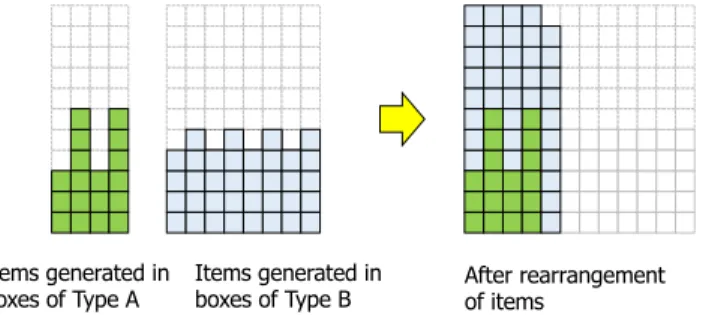
Fig. 4 Reduction of the size of items and the rearrangement of resulting items, which increases the number of unused items to three (≥d−1).
Operation: For each box, reduce the length of items in the box so that the total amount of reductions equals tod, and rearrange all items so that the total size of items packed into each column does not exceedb. After the rearrangement, a column is said to be used if it contains at least one item.
Question: Is it possible to realize reductions and rearrange- ment so that the number of unused columns is at least d−1. Note that if the number of unused columns is d−1, the number of used columns becomesb×d−d+ 1=m.
In Fig. 4, the size of items in a box reduces by three (=d), and after conducting rearrangement of resulting items, the number of unused columns becomes three (≥d−1). In the following, to clarify the exposition, we often prove claims by using this simplified decision problem. For example, since several items can be packed into one column only if d ≥ b/2, we have the following claim concerned with the impossibility ofk-hop delivery.
Lemma 1: k-hop delivery ofbstripes toBk−δkpeers is impossible if 2≤δk<b/2.
4. Main Theorem on (k+1)-Hop Delivery This section proves the following theorem.
Theorem 2: (k+1)-hop delivery ofbstripes tonpeers is possible for anyn≤Bk.
This theorem indicates thatby allowing one more hop, we can always complete the delivery ofbstripes to at mostBk
peers with a guaranteed latency. Proof of the theorem relies on the following lemma.
Lemma 2: k-hop delivery of b stripes to Bk −δk peers is possible if δk = pb−q for some integers p ≥ 1 and 0≤q≤p.
Proof. Consider the corresponding simplified problem. Ifd is a multiple ofbwithd≥b, we can reduce the size ofd/b (≥1) items in each box to zero, which generatesb×d/b=d unused columns. Ifdis a multiple ofb−1 withd≥b−1, we can reduce the size ofb−1d (≥1) items in each box to one and rearrange them so that each column contains exactlybsuch items, which generatesb×bd−1 −b−1d =dunused columns.
Ifd=pb+p(b−1) for somepandpwithp+p≥1, by lettingd1=pbandd2=p(b−1), we can apply the first and the second reductions tod1 andd2, respectively, which generatesd = d1+d2 unused columns. Finally, since the above equality can be restated as
d=pb+p(b−1)=(p+p)b−p,
the claim follows. Q.E.D.
Ifδk≥(b−1)2, we can be restateδkasδk=pb+p(b−1) by using two integersp≥0 andp≥1. Thus by Lemma 2, k-hop delivery ofb stripes to Bk−δk peers is possible if δk≥(b−1)2. SinceBk+1−Bk=bk≥(b−1)2for anyb≥2 andk≥2, the theorem follows.
5. Bound onk-Hop Delivery for Smallδk
Unlike (k+1)-hop delivery, k-hop delivery is not always possiblefor anyn≤Bk. The following Lemma holds.
Lemma 3: k-hop delivery ofb stripes toBk−δk peers is possible ifδk=b− b/σfor some integerσ≥2.
Proof. We prove the claim on the simplified problem. If d=b− b/σfor someσ≥2, then we can reduce the size of an item in each box to b/σ, and pack resultingσitems into a column since b/σ ×σ ≤bholds, where equality holds iffbis a multiple of σ. Since it generatesb/σcolumns containing item of size b/σ, such a rearrangement reduces the number of used columns to
b(d−1)+b/σ=bd−(b− b/σ)≤bd−d+1, where the last inequality is due tod=b− b/σ. Hence the
lemma follows. Q.E.D.
The next theorem gives anecessary and sufficient condition to enable k-hop delivery ofb stripes to Bk−δk peers for δk≤b.
Theorem 3: Whenδk<b−1,k-hop delivery ofbstripes to Bk−δkpeers is possible iffδk=b− b/σfor some integer σ≥2 orδk=b−b/σ+1 for some integerσ≥1 dividing b.
Proof. By Lemma 3, it is enough to prove that: Ifδkb− b/σfor any integerσ≥2, thenk-hop delivery is possible iffδk = b−b/σ+1 for some integerσ ≥ 1 dividing b.
Assume thatδksatisfies
b− b/σ< δk<b− b/(σ+1) (1)
for someσ≥1. Sinceδk<b−1, this condition is equivalent toδkb− b/σfor anyσ≥2. Then, in the corresponding simplified problem, since we can pack at mostσitems into a column, and the number of columns containing an item with a reduced size is at leastb/σ, the number of used columns is at least
b(d−1)+b/σ=bd−(b− b/σ)
≥bd−(b− b/σ)+f(b, σ)
>bd−d+f(b, σ),
where f(x,y) is a function which returns 0 ifx≡0 (mody) and returns 1 otherwise, and the last inequality is due tod>
b− b/σ. This implies thatk-hop delivery is possible if and only ifσdividesbandd=b−b/σ+1. Hence the theorem
follows. Q.E.D.
In the following, we explore the case ofδk ≥b, and derives several sufficient conditions to enable k-hop delivery of b stripes toBk−δkpeers. Recall that we have known thatk- hop delivery toBk−δkpeers is possible ifδk≥(b−1)2for any givenb≥2.
6. Sufficient Conditions for Largerδk
This subsection derives several sufficient conditions to en- able k-hop delivery of b stripes to n = Bk−δk peers for δk ≥b. Let us consider the corresponding simplified prob- lem. Ifn = Bk−b, i.e., ifd = b, the size of an item in a box can be reduced frombto zero which generatesb(=d) unused columns. Similarly, ifd =b+1, we can generateb (=d−1) unused columns. Hence we can conclude thatk- hop delivery ofbstripes toBk−δkpeers is possible ifδk=b orb+1. As forδk=b+2, we have the following lemma.
Lemma 4: For anyb ≥ 6, k-hop delivery ofb stripes to Bk−(b+2) peers is possible.
Proof. Ifb11, we can solve the corresponding simplified problem in the following manner. Letx= b/3,y=b−3x andη = (x+y)/4. By definition, it holdsx≥2 and 0≤ y≤2. Sinceb=3x+y, we have
2η+x≥(3x+y)/2=b/2;
namely we can pack two items of sizeb−(2η+x) into one column. Similarly, sincex≤b/3, we can pack three items of sizexinto one column.
• The size of several items is reduced as follows. For eachi∈ {1,2, . . . , η}, 1) select six boxes; 2) select two items from each box; and 3) reduce the size of selected items tox+2(i−1) andb−(2i+x), respectively. Since
b− {x+2(i−1)}+b− {b−(2i+x)}
=b+(2i+x)− {x+2(i−1)}
=b+2,
we can certainly generate such a pair of items by using
Fig. 5 Explanation of Lemma 4. At first, we select six boxes and select two items from each of selected boxes. We then reduce the size of the first item tox= b/3(painted green) and the size of the second item to b−(2+x) (painted light blue). Ifη=1, then we rearrange the resulting 12 items so that three items of sizexare packed into a column and two items of sizeb−(2+x) are into a column.
Fig. 6 Ad hoc method forb=11 in the proof of Lemma 4.
the amount of reductionsd(=b+2). Note that it gen- erates 12ηitems in 6ηboxes. See Fig. 5 for illustration.
• Since there are six items of size x, pack them into two columns so that each column contains three items of size x. Next, for each i ∈ {1,2, . . . , η−1}, pack an item of sizeb−(2i−x) and an item of size 2i+xinto the same column, which generates six such columns.
Finally, pack two items of sizeb−(2η+x) into a column, which generates three such columns.
Sinceη=(x+y)/4andb=3x+y, we have b−6η≥b−6
x+y 4 +3
4
=b−3 2
b−y 3 +y
−9 2
= b
2−9+2y 2 ,
which implies thatb−6η≥0 holds if 6≤b≤10 orb≥12.
Ifb−6η≥1, for each of thoseb−6ηboxes, we may simply select one item and reduce its size to zero. Then, the number of unused columns becomes
(b−6η)+{12η−(2+6(η−1)+3)}
=(b−6η)+(6η+1)
=b+1=d−1.
On the other hand, ifb = 11, we can use the followingad hocmethod for the rearrangement of items. See Fig. 6 for illustration.
• Classify 11 boxes into three types so that two boxes are of Type A, four boxes are of Type B, and five boxes are of Type C. For Type A boxes, generate an item of size 3 and an item of size 6 (note that such a reduction is possible since (b−3)+(b−6)=2b−9=13=b+2);
for Type B boxes, generate an item of size 4 and an item of size 5; and for Type C boxes, reduce the size of an item to 0.
• Rearrange the resulting items so that two columns con- tain three items of size 3, 4, and 4; two columns contain two items of size 5 and 6; and one column contains two items of size 5.
Then, the number of unused columns becomes 5+(12−5)= 12=d−1. Hence the lemma follows. Q.E.D.
The argument used in the proof of Lemma 4 can be extended as follows.
Theorem 4: For anyb ≥ 18, k-hop delivery ofb stripes toBk−(b+c) peers is possible for any integercsatisfying 3≤c≤ √
b/2.
Proof. Ifb ≥ 2c2 ≥ 18, we can solve the corresponding simplified problem in the following manner. Letx= b/2c, y=b−2cx, and
η=
(2c−2)x+y 2c
=
x+y−2x 2c
.
Note thatx≥2cholds. Since cη+x≥(2c−2)x+y
2 +x
=2cx+y
2 =b
2,
we can pack two items of sizeb−(cη+x) into a column.
Similarly, since x ≤ b/2c, we can pack 2citems of sizex into one column.
• The size of several items is reduced as follows. For eachi∈ {1,2, . . . , η}, 1) select 2cboxes; 2) select two items from each box; and 3) reduce the size of selected items tox+c(i−1) andb−(ci+x), respectively. Note that it generates 4cηitems of reduced size in 2cηboxes.
• Since there are 2citems of size x, pack them into one column. Next, for eachi ∈ {1,2, . . . , η−1}, pack an item of sizeb−(ci+x) and an item of sizeci+xinto one column, which generates 2csuch columns. Finally, pack two items of sizeb−(cη+x) into a column, which generatescsuch columns.
Now let us certify that we can select 2cηsuch boxes ifb≥ 2c2. Ifb≥2c2, it holdsx≥csince
x= b/2c ≥ 2c2/2c=c.
Sincey≤2c−1,x≥cimpliesy≤2x, which further implies x=ηby the definition ofη. Finally, ifx=ηthenb ≥2cη sinceb=2cx+y≥2cx.
Table 1 The value ofccovered by Corollary 1.
b c
2 1
3 1
4 1, 2
5 1, 2
6 1, 2, 3
7 1, 3
8 1, 2, 3, 4
9 1, 2, 4
10 1, 2, 4, 5
11 1, 2, 5
12 1, 2, 3, 4, 5, 6 13 1, 2, 3, 6 14 1, 2, 3, 6, 7 15 1, 2, 3, 7 16 1, 2, 3, 4, 7, 8 17 1, 2, 4, 8 18 1, 2, 3, 4, 8, 9 19 1, 2, 3, 4, 9 20 1, 2, 3, 4, 5, 9, 10
Ifb−2cη≥1, for each of the remainingb−2cηboxes, we may simply select one item and reduce its size to zero.
Then, the number of unused columns becomes (b−2cη)+{4cη−(1+2c(η−1)+c)}
=b+c−1=d−1.
Hence the claim follows. Q.E.D.
The reader should note that the argument used in the above proof correctly works as long as x = η ≥ 1. This condition can be restated asy ≤ 2x; i.e.,b ≤ 2(c+1)x = 2(c+1) b/2c. Hence we have the following claim.
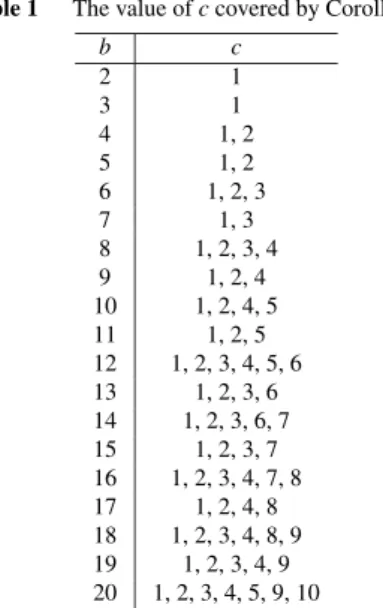
Corollary 1: k-hop delivery of b stripes to Bk−(b+c) peers is possible for any integer c satisfying 2c ≤ b ≤ 2(c+1) b/2c.
For each 2≤b≤20, the value ofcsatisfying the above inequality is summarized as follows: Theorem 4 indicates thatk-hop delivery ofbstripes toBk−(b+3) peers is possible for anyb≥18, but it does not clarify whether it is possible for b ≤ 17; which implies that even if it is possible, we need to use an ad hoc method forb=9,10,11, and 17. For example, the above construction can be extended as follows.
Lemma 5: For any evenb≥2,k-hop delivery ofbstripes to Bk − {3b/2 − b/2σ} peers is possible for any integer σ≥2.
Proof. Consider the corresponding simplified problem. By lettingx= b/σ, we haved=(3/2)b− x/2. For each box, select two items, and reduce the size of an item tob/2−x/2 and the size of another item tox. Since (b−x)+b/2+x/2= (3/2)b− x/2 = d, we can generate such a pair of items.
We then rearrange 2bitems so that: 1)b/2 columns contain two items of sizeb/2− x/2and one item of size x; and 2) the remaining items of size xare packed into as small number of columns as possible. Note that the first packing is possible since 2× x/2 ≥xand the second packing uses
b/2σcolumns since it should packb/2 items of sizexso that each column containsσsuch items.
The number of unused columns becomes 2b−(b/2+b/2σ)=(3/2)b− b/2σ
≥(3/2)b− b/2σ −1=d−1.
Hence the claim follows. Q.E.D.
The argument used in the above proof correctly works for any x ≥ 2 ifb/2 items of size xcan be packed intox/2 columns, which is realized if 2x2≤b; namely ifx≤ √
b/2.
Hence the following claim follows.
Corollary 2: For any even b ≥ 2, k-hop delivery of b stripes to Bk−(3/2)b−xpeers is possible for any integer x≤ √
b/2.
7. Concluding Remarks
This paper considers the problem of deliveringbstripes ton peers with a guaranteed latency. More concretely, we prove that (k+1)-hop delivery ofbstripes to npeers is possible for any n≤k−1
i=0 bi. A future work is to derive a necessary and sufficient condition onnto enable ak-hop delivery ofb stripes forn≤Bk−b−2.
References
[1] H. Ando and S. Fujita, “Tight Bounds for Two-Hop Delivery in Ho- mogeneous P2P Video Streaming Systems,” Proc. 4th International Symposium on Computing and Networking (CANDAR), pp.1–8, 2016.
[2] B.A. Alghazawy and S. Fujita, “A Scheme for Maximal Resource Utilization in Peer-To-Peer Live Streaming,” International Journal of Computer Networks & Communications (IJCNC), vol.7, no.5, pp.13–28, 2015.
[3] G. Bianchi, N.B. Melazzi, L. Bracciale, F.L. Piccolo, and S. Salsano,
“Streamline: An Optimal Distribution Algorithm for Peer-to-Peer Real-Time Streaming,” IEEE Trans. Parallel Distrib. Syst., vol.21, no.6, pp.857–871, 2010.
[4] M. Castro, P. Druschel, A.-M. Kermarrec, A. Nandi, A. Rowstron, and A. Singh, “SplitStream: High-capacity multicast in cooperative environments,” Proc. 19th ACM Symp. on Operating Systems Prin- ciples (SOSP), pp.298–313, 2003.
[5] M. Castro, P. Druschel, A.-M. Kermarrec, and A.I.T. Rowstron,
“SCRIBE: A Large-Scale and Decentralized Application-Level Multicast Infrastructure,” IEEE J. Sel. Areas Commun., vol.20, no.8, pp.1489–1499, 2006.
[6] Y. Chu, S.G. Rao, and H. Zhang, “A Case for End System Multicast,”
Proc. ACM Int’l Conf. on Measurement and Modeling of Computer Systems (SIGMETRICS), pp.1–12, 2000.
[7] G. Dan, V. Fodor, and I. Chatzidrossos, “On the Performance of Multiple-Tree-Based Peer-to-Peer Live Streaming,” Proc. 26th IEEE Int’l Conf. on Computer Communications (INFOCOM), pp.2556–2560, 2007.
[8] S. Fujita, “Optimal Serial Broadcast of Successive Chunks,” Theo- retical Computer Science, vol.575, pp.3–9, 2015.
[9] S. Fujita, “Broadcasting a Stream of Chunks in Heterogeneous Net- works with a Short Maximum Broadcast Time,” Journal of Intercon- nection Networks (JOIN), vol.18, no.2n03, 2018.
[10] S. Fujita, “Cloud-Assisted Peer-to-Peer Video Streaming with Min- imum Latency,” IEICE Trans. Inf. & Syst., vol.E102-D, no.2,
pp.239–246, 2019.
[11] X. Jin, W.-P.K. Yiu, S.-H.G. Chan, and Y. Wang, “On maximiz- ing tree capacity for topology-aware peer-to-peer streaming,” IEEE Trans. Multimedia, vol.9, no.8, pp.1580–1592, 2007.
[12] D. Kosti´c, A. Rodriguez, J. Albrecht, and A. Vahdat, “Bullet: high capacity data dissemination using an overlay mesh,” Proc. 19th ACM Symp. on Operating Systems Principles (SOSP), pp.282–297, 2003.
[13] S.-H. Lin, R. Pal, B.-C. Wang, and L. Golubchik, “On Market- Driven Hybrid-P2P Video Streaming,” IEEE Trans. Multimedia, vol.19, no.5, pp.984–998, 2017.
[14] Y. Liu, “On the Minimum Delay Peer-to-Peer Video Streaming:
How Realtime Can It Be?” Proc. 15th ACM Int’l Conf. on Mul- timedia, pp.127–136, 2007.
[15] S. Liu, Z.-S. Rui, W. Jiang, J. Rexford, and M. Chiang, “Per- formance bounds for peer-assisted live streaming,” Proc. ACM Int’l Conf. on Measurement and Modeling of Computer Systems (SIGMETRICS), pp.313–324, 2008.
[16] N. Magharei and R. Rejaie, “PRIME: Peer-to-Peer Receiver-Driven Mesh-Based Streaming,” IEEE/ACM Trans. Netw., vol.17, no.4, pp.1052–1065, 2009.
[17] L. Natali and M.L. Merani, “Successfully Mapping DASH Over a P2P Live Streaming Architecture,” IEEE Trans. Circuits Syst. Video Technol., vol.27, no.6, pp.1326–1339, 2017.
[18] https://www.nhk.or.jp/strl/publica/rd/rd137/PDF/P57-62.pdf (in Japanese)
[19] V.N. Padmanabhan, H.J. Wang, P.A. Chou, and K. Sripanidkulchai,
“Distributing Streaming Media Content using Cooperative Network- ing,” Proc. NOSSDAV’2, pp.177–186, 2002.
[20] S. Ratnasamy, M. Handley, R. Karp, and S. Shenker, “Applica- tion-Level Multicast Using Content-Addressable Networks,” Proc.
NGC’1, pp.14–29, 2001.
[21] H. Shen, Y. Lin, and J. Li, “A Social-Network-Aided Efficient Peer- to-Peer Live Streaming System,” IEEE/ACM Trans. Netw., vol.23, no.3, pp.987–1000, 2015.
[22] F. Wang, Y. Xiong, and J. Liu, “mTreebone: A Collaborative Tree-Mesh Overlay Network for Multicast Video Streaming,” IEEE Trans. Parallel Distrib. Syst., vol.21, no.3, pp.379–392, 2010.
[23] W. Wu, H. Mao, Y. Wang, J. Wang, W. Wang, and C. Tian,
“CoolConferencing: Enabling Robust Peer-to-Peer Multi-Party Video Conferencing,” IEEE Access, vol.5, pp.25474–25486, 2017.
[24] X. Zhang, J. Liu, B. Li, and Y.-S.P. Yum, “CoolStreaming/DONet: A Data-Driven Overlay Network for Peer-to-Peer Live Media Stream- ing,” Proc. 24th Annual Joint Conf. of the IEEE Computer and Com- munications Societies, vol.3, pp.2102–2111, 2005.
[25] Y. Zhao, Y. Liu, C. Chen, and J. Zhang, “Enabling P2P One-View Multiparty Video Conferencing,” IEEE Trans. Parallel Distrib. Syst., vol.25, no.1, pp.73–82, 2014.
[26] C. Zhao, J. Zhao, X. Lin, and C. Wu, “Capacity of P2P On-De- mand Streaming With Simple, Robust, and Decentralized Control,”
IEEE/ACM Trans. Netw., vol.24, no.5, pp.2607–2620, 2016.
[27] Y. Zhou, T.Z.J. Fu, and D.M. Chiu, “A Unifying Model and Analysis of P2P VoD Replication and Scheduling,” IEEE/ACM Trans. Netw., vol.23, no.4, pp.1163–1175, 2015.
[28] S.Q. Zhuang, B.Y. Zhao, A.D. Joseph, R.H. Katz, and J.D.
Kubiatowicz, “Bayeux: An Architecture for Scalable and Fault- Tolerant Wide-Area Data Dissemination,” Proc. NOSSDAV’1, pp.11–20, 2001.
Satoshi Fujita received the B.E. degree in electrical engineering, M.E. degree in sys- tems engineering, and Dr.E. degree in informa- tion engineering from Hiroshima University in 1985, 1987, and 1990, respectively. He is a Professor at Graduate School of Engineering, Hiroshima University. His research interests in- clude communication algorithms, parallel algo- rithms, graph algorithms, and parallel computer systems. He is a member of the Information Processing Society of Japan, SIAM Japan, and IEEE Computer Society.