1878
IEICE TRANS. INF. & SYST., VOL.E102–D, NO.9 SEPTEMBER 2019
LETTER
Gradual Switch Clustering Based Virtual Middlebox Placement for Improving Service Chain Performance
Duc-Tiep VU†a),Nonmember andKyungbaek KIM†b),Member
SUMMARY Recently, Network Function Virtualization (NFV) has drawn attentions of many network researchers with great deal of flexibili- ties, and various network service chains can be used in an SDN/NFV en- vironment. With the flexibility of virtual middlebox placement, how to place virtual middleboxes in order to optimize the performance of service chains becomes essential. Some past studies focused on placement prob- lem of consolidated middleboxes which combine multiple functions into a virtual middlebox. However, when a virtual middlebox providing only a single function is considered, the placement problem becomes much more complex. In this paper, we propose a new heuristic method, the gradual switch clustering based virtual middlebox placement method, in order to improve the performance of service chains, with the constraints of end-to- end delay, bandwidth, and operation cost of deploying a virtual middle- box on a switch. The proposed method gradually finds candidate places for each type of virtual middlebox along with the sequential order of ser- vice chains, by clustering candidate switches which satisfy the constraints.
Finally, among candidate places for each type of virtual middlebox, the best places are selected in order to minimize the end-to-end delays of ser- vice chains. The evaluation results, which are obtained through Mininet based extensive emulations, show that the proposed method outperforms than other methods, and specifically it achieves around 25% less end-to- end delay than other methods.
key words: middlebox, placement problem, gradual switch clustering, ser- vice chain, NFV, SDN
1. Introduction
In these days, various network services have been devel- oped and some network applications require a set of net- work services, which is called as a service chain for a net- work application. A network service is supported by de- ploying a middlebox which is a separate network appliance that performs a specialized function such as filtering, load balancing, and packet inspection. Earlier middleboxes are deployed with dedicated hardware in networks and the traf- fic of a service chain should go through middleboxes in a given specific order which requires a complicated routing scheme. As the scale of network and the variety of service chains grow quickly, more efficient way to support service chains is required.
With the popularity of SDN (Software Defined Net- working) technique, some past works have focused on sup- porting efficient service chains with middleboxes by config-
Manuscript received November 17, 2018.
Manuscript revised March 31, 2019.
Manuscript publicized June 5, 2019.
†The authors are with the Department of Electronics and Computer Engineering, Chonnam National University, Gwangju, Korea.
a) E-mail: [email protected]
b) E-mail: [email protected] (Corresponding author) DOI: 10.1587/transinf.2018EDL8240
uring routing paths of each service chain dynamically[1].
Moreover, some works assume that the considered mid- dlebox is a consolidated middlebox which provides mul- tiple service functions within one middlebox in order to improve the scalability of the dynamic routing configura- tion[2]. However, these works basically assume that a mid- dlebox has the fixed location, and there are limitations of enhancing the performance of service chains.
Recently, the rapid development of NFV (Network Function Virtualization) allows deploying a middlebox function as an application which can be installed at a VM (Virtual Machine) running on a common hardware. A vir- tual middlebox may support a single service function and multiple service functions (a consolidated middlebox)[3].
A virtual middlebox can be easily moved to a different lo- cation on a network by migrating its virtual machine from its original host machine to another host machine. With the flexibility of locating virtual middleboxes, the position of virtual middleboxes can be optimized to improve the perfor- mance of service chains, and it is considered as positioning problem of virtual middleboxes.
Some recent works have been studied on how to place middleboxes, especially consolidated middleboxes, for im- proving the performance of service chains[4]–[6]. How- ever, the consolidated middlebox is a special case of a virtual middlebox, and when we consider the case where a virtual middlebox provides a single function, the placement prob- lem becomes much more complex. Moreover, some of these works did not consider important parameters such as switch memory, virtual machine capacity, and end-to-end delay.
In this paper, we propose a new heuristic method, the gradual switch clustering based virtual middlebox place- ment method, in order to minimize end-to-end delay of network flows corresponding to service chains while sat- isfying the constraints of service chains (the correspond- ing flow must visit a specific type of virtual middlebox in pre-defined order) as well as the constraints of network re- sources (bandwidth, switch memory and virtual machine ca- pacity). Because the complexity of the placement problem of virtual middlebox with multiple constraints is very high, the proposed heuristic method gradually solves the place- ment problem step by step. The proposed method finds can- didate locations for each type of virtual middleboxes along with the sequential order of service chains by clustering switches which satisfy the constraints on each step. After gathering candidate locations, the best location is selected for each type of virtual middlebox among the corresponding Copyright c2019 The Institute of Electronics, Information and Communication Engineers
LETTER
1879
candidates in order to minimize the end-to-end delay of ser- vice chains. Through Mininet based emulation, it is shown that the proposed method outperforms than other methods.
2. Related Works
In[4], the placement of consolidated middleboxes was ad- dressed with delay and bandwidth constraints. This work proposed a greedy solution, which assigning locations of middleboxes based on the degree of usage of switches. Each switch counts how many times it is used for the shortest paths between ingress and egress switches for service chain flows. Then, consolidated middleboxes are assigned to switches in the order of usage of middleboxes and switches.
However, this work did not consider some important re- source constraints such as switch memory and virtual ma- chine capacity.
In [5], a consolidated middlebox positioning prob- lem was addressed with consideration of end-to-end delay, switch memory and virtual machine capacity. This work proposed a flow clustering method for placing a consoli- dated middlebox. However, this method is not applicable to the placement problem of virtual middleboxes providing a single function which should consider the order of mid- dleboxes of a service chain. Also, this method lacks the consideration of bandwidth constraints of service chains.
In [7], a virtual machine placement scheme based on mutual bandwidth usage between virtual machines was pro- posed in order to minimize the product of traffic rate and the number of switches on each flow path. However, this method did not consider end-to-end delay and other re- sources such as switch memory and server capacity.
3. Gradual Switch Clustering Based Virtual Middle- box Placement
We consider a graphG = (V0,E0), whereV0 is the set of nodes andE0is the set of edges. A nodev∈V0corresponds to a switch, and an edgee∈ E0 corresponds to a link con- necting two switches. We assume that the bandwidth of a link (be) is given and the delay of a link (de) is also given. A nodevcan hold routing rules, and the number of rules of a nodevis denoted asrvand the maximum number of rules of a nodevisRv. Also, we assume that every switch supports NFV which deploys any virtual middleboxes.
A network service chain is defined as a flow f and the set of flows is denoted asF = {f1,f2, . . . ,fm}. A flow
f is described as f = {vsrcf, vdestf,mt11
f,mt22
f, . . . ,mtll
f,BWf},
wherevsrcf is the source switch andvdestf is the destination switch. mtii
f means theith virtual middlebox, and deployed switches of virtual middleboxes will be decided by the pro- posed placement algorithm described later. lis the number of virtual middleboxes required by this service chain andti
is the type of theith virtual middlebox. We assume that there arendifferent types of virtual middleboxes, and the number of available virtual middleboxes for typetcan be limited as
qt.BWf is the required bandwidth of the flow f, and it rep- resents how much bandwidth the flow is expected to occupy per unit of time (Mbps).
The end-to-end delay of a flow f (df) is determined by the sum of the delay between the source switch and the first virtual middlebox, the delay between the last virtual middlebox and the destination switch, and the delays of sequential pairs of virtual middleboxes in the correspond- ing network service chain. Accordingly, it is denoted as df =d(vsrcf,mt11
f)+d(mtll
f, vdestf)+l−1
i=1d(mtii
f,mt(ii+1+1)
f).
The bandwidth usage of a linke is calculated as the summation of the bandwidth allocated to all of the flows which travel through the linke. Accordingly, it is denoted as
f∈FeBWf, whereFeis the subset ofF whose member flows travel over a given linke.
Each virtual middlebox may have different processing power which is how much network bandwidth it can deal with per unit of time, and the processing power of a typet virtual middlebox is denoted asOmtj, where 1≤ j≤qt.
With the given G, F and constraints of virtual mid- dleboxes (n,qt), our placement problem is finding suitable switches for the required virtual middleboxes of flows, so that the end-to-end delay of each flow is minimized and re- source constraints (bandwidth of a link, processing power of a virtual middlebox and number of rules of a switch) are satisfied. The problem formalization is as follows:
minimize
∀f∈F df
subject to
(1)
f∈Fe
BWf ≤be,∀e∈E0 (2)
f∈Ft
BWf ≤
qt
j=1
Omtj,1≤t≤n (3)
rv≤Rv,∀v∈V0 (4)
The objective (1) represents our primary goal to min- imize the end-to-end delay of flows. The constraint (2) is the bandwidth constraint of a link, and the total bandwidth consumption of flows which travel through a link should be lower than the given bandwidth capacity of the link. The constraint (3) is the processing power constraint of a virtual middlebox, and the total processing demand of flows corre- sponding to typetvirtual middleboxes (Ft) should be lower than the maximum processing capacity of the typetvirtual middleboxes. The constraint (4) is the switch memory con- straint, and a switch should have available memory to store all of the required flow table entries. Accordingly, the for- malized problem is a kind of a knapsack problem with mul- tiple constraints, and it is NP-complete[8]. In a brute force manner, the complexity of evaluating constraints of every switch selection takes aroundO(|V0|Cnt=1qt× |F|).
To solve the problem, we propose a heuristic method which selects proper switches for virtual middleboxes in a gradual manner by using a switch clustering algorithm. De- tails of the proposed method is shown in Algorithm 1 and
1880
IEICE TRANS. INF. & SYST., VOL.E102–D, NO.9 SEPTEMBER 2019
Algorithm 1 Virtual Middlebox (VMB) Placement with Gradual Switch Clustering
Input:G={V0,E0},F,l,n,qtwhere 1≤t≤n
Output: P={P1,P2, . . . ,Pn}wherePt={p1,p2, . . . ,pqt},pi∈V0
fort←1 tondo Pt: final mapping of switches to typetVMB Pt← ∅,Tt← ∅ Tt: candidates of switch selection forPt
fori←1 toldo Selecting candidate switches gradually fort←1 tondo Handling each type of VMB
Ft← ∅,St← ∅
foreachf∈Fdo Sorting out flows for typetVMB (Ft) iftypeof(mtii
f)==tthen
addftoFt
foreachf∈Ftdo Preparing source switches (St) ifi==1then Adding previous switch for the first VMB
addvsrcftoSt
else Adding candidate previous switches for other VMB x←typeof(mt(p(p−1)−1)
f) Checking type of previous VMB addTxtoSt Adding corresponding candidate switches Ct=SwitchClustering(St,G,qt) Partitioningqtswitch clusters foreachCtj∈Ctdo Ct={Ct1,Ct2, . . . ,Ctj},1≤j≤qt
Atj← ∅,Ftj← ∅
foreachv∈Ctjdo Preparing adjacent switches of clusters (Atj) Vad jv=GetAdjacentSwitches(v,Ft,G)
addVad jvtoAtj Vad jv: Adjacent switches ofv Fv=GetCorrespondingFlows(v,Ft,T) T={T1,T2, . . . ,Tn} addFvtoFtj Fv: Flows corresponding tov foreachv∈Atjdo Calculating flow delays for candidates
dtotv ←0
foreachf∈Ftjdo
dvtot←dvtot+d(vsrcf, v)+d(v, vdestf)
SortAtjin increasing order withdvtot Objective 1 foreachv∈Atjdo Choosing candidate switches (Tt)
ifrv≥Rv Constraint 4
or
f∈Ft jBWf ≥Omt Constraint 3 or∃e∈Esuch that
fe∈Ft jBWf ≥be then Constraint 2 continue
else
addvtoTt addingvas candidate switches (Tt) fort←1 tondo Final selection ofqtswitches for typetmiddlebox Ct=SwitchClustering(Tt,G,qt) Clustering candidate switches foreachCtj∈Ctdo
v←GetCentroid(Ctj) Finding the centroid of each cluster addvtoPt Centroid of each cluster as final selection
Fig. 1 Overall procedure of the proposed algorithm.
the overall procedure of the algorithm is depicted in Fig. 1.
The proposed algorithm selects candidate switches of virtual middleboxes (Tt) along with the sequence of network ser- vice chains, and the selected candidates are used for the next stage of placement. That is, at first, the proposed method selects candidate switches for the first required virtual mid- dleboxes of flows (mt11
f), then this procedure continues until finding candidate switches for the last required virtual mid-
Algorithm 2SwitchClustering(S, G, k)
Input: S,G={V0,E0},k S={s1,s2, . . . ,sn},si∈V0
Output: C={C1,C2, . . . ,Ck} Ci={c1,c2, . . . ,cm},m≤n,ci∈S Preparing the initial centroidsZ={z1,z2, . . . ,zk}withkrandom switches InitializingC={C1,C2, . . . ,Ck} ziis the centroid ofCi
repeat
foreachsi∈Sdo Pre-Clustering
dmin← ∞,q←0 foreachzj∈Zdo
Calculatingd(si,zj) Delay between a switch and the centroid ifd(si,zj)<dminthen Finding a cluster with minimum delay
dmin←d(si,zj),q←j
AddsitoCq Assigning a switch to the nearest cluster foreachCi∈Cdo Updating centroids with pairwise delay
dmin← ∞,q←0
foreachcj∈Cido Calculating pairwise delay Calculatingdctotjd(cj,cx),∀cx∈Ci,cxcj
ifdctotj <dminthen Finding a switch with minimum delay dmin←dtotcj,q←j
zi←cq cq∈Ci
untilNo changes inZ
deboxes of flows (mtll
f).
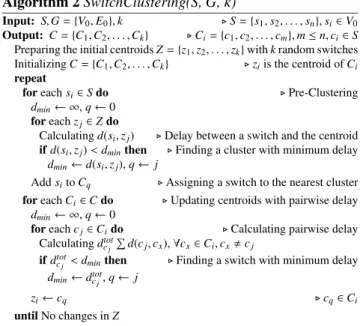
The procedure of selecting candidates is composed of gathering source switches for the current target middle- boxes (St), clustering source switches (Ct), finding adjacent switches of each switch cluster (At) and selecting candidate switches with the given constraints (Tt). When gathering the source switches for the second or other virtual middleboxes, the previously selected candidate switches (Tt) are used as source switches for the further procedure. The objectives of switch clustering (Algorithm 2) are 1) selecting the given number of switches for the specific type of virtual middle- boxes (qt) and 2) minimizing the total end-to-end delay of flows corresponding to candidate switches for the given vir- tual middleboxes.
After finding all the candidate switches for every re- quired virtual middleboxes of flows, the final selection of switches for eachttype of virtual middleboxes (Pt) are ob- tained by using switch clustering algorithm. Consequently, with this gradual heuristic method, the evaluation of candi- date switches is conducted along with the sequence of ser- vice chain (l) and different types of virtual middlebox (n, qt), and the complexity of finding proper switches can be relaxed down toO(l×n×qt× |F|).
4. Evaluation
In order to evaluate the proposed method, an SDN/NFV testbed with Opendaylight SDN controller and Mininet is implemented. On this testbed, the locations of virtual mid- dlebox on a given network topology are deployed by us- ing various placement methods (the random placement, the most used switch placement[4]and our proposed method).
Then, the network traffic of service chains are emulated with Iperf and the performance parameters such as end-to-end delay per flow, bandwidth consumption and the number of rules per a switch are measured.
LETTER
1881
Table 1 Parameters setting in the performance evaluation.
Parameter Value/Range
FatTree-4 Link delay (ms) From 1 to 30
The number of type of virtual middlebox 5 The number of middleboxes in a service chain 3
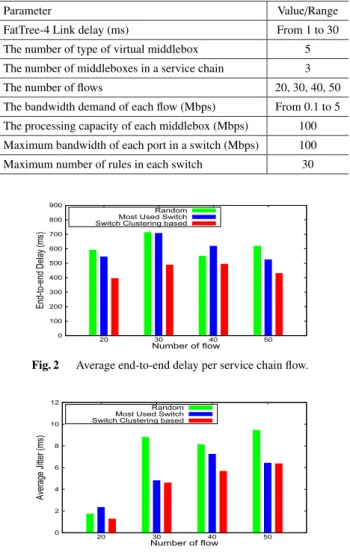
The number of flows 20, 30, 40, 50
The bandwidth demand of each flow (Mbps) From 0.1 to 5 The processing capacity of each middlebox (Mbps) 100 Maximum bandwidth of each port in a switch (Mbps) 100 Maximum number of rules in each switch 30
Fig. 2 Average end-to-end delay per service chain flow.
Fig. 3 Average jitter per service chain flow.
For a network topology, the well-known FatTree net- work topology is used[4]. Particularly, the FatTree-4 with 20 switches and 32 links is used. Through the evaluation, we assume that there are various kinds of service chains and various number of flows corresponding to a service chain.
Details of parameter settings are summarized in Table 1.
The evaluation results are illustrated in Figs. 2, 3, 4, and 5. In the results, the proposed method achieves the best performance. Especially, though the average number of rules per switch of the most used switch method is sim- ilar to our proposed method (Fig. 5), our proposed method achieves around 25% lower end-to-end delay (Fig. 2) and around 20% lower bandwidth consumption (Fig. 4) than the most used switch method.
5. Conclusion
In this paper, a new heuristic method with gradual switch clustering is proposed for solving placement problem of vir- tual middleboxes in order to improve service chain perfor- mance. Through extensive evaluation, it is demonstrated that the proposed method outperforms the random method
Fig. 4 Total bandwidth consumption.
Fig. 5 Average number of rules per switch.
and the most used switch method. The proposed heuris- tic method can be used for real-time provisioning service chains.
Acknowledgments
This research was supported by Basic Science Research Pro- gram through the National Research Foundation of Korea (NRF) funded by the Ministry of Science, ICT & Future Planning (NRF-2017R1A2B4012559).
References
[1] Z. Cao, M. Kodialam, and T.V. Lakshman, “Traffic steering in soft- ware defined networks: Planning and online routing,” Proc. ACM DCC, pp.65–70, 2014.
[2] A. Gushchin, A. Walid, and A. Tang, “Scalable routing in SDN- enabled networks with consolidated middleboxes,” Proc. ACM SIG- COMM HotMiddlebox, pp.55–60, 2015.
[3] V. Sekar, N. Egi, S. Ratnasamy, M. Reiter, and G. Shi, “Design and implementation of a consolidated middlebox architecture,” Proc.
NSDI, 2012.
[4] J. Liu, Y. Li, Y. Zhang, L. Su, and D. Jin, “Improve service chaining performance with optimized middlebox placement,” IEEE Trans. Ser- vices Comput., vol.10, no.4, pp.560–573, 2017, doi: 10.1109/TSC.
2015.2502252.
[5] D.T. Vu and K. Kim, “Flow clustering based efficient consolidated middlebox positioning approach for SDN/NFV-enabled network,”
IEICE Trans. Inf. & Syst., vol.E99-D, no.8, pp.2177–2181, 2016.
[6] M. Huang, W. Liang, Z. Xu, and S. Guo, “Efficient algorithms for throughput maximization in software-defined networks with consoli- dated middleboxes,” IEEE Trans. Network and Service Management, vol.14, no.3, pp.631–645, Sept. 2017.
[7] X. Meng, V. Pappas, and L. Zhang, “Improving the scalability of data center networks with traffic-aware virtual machine placement,” Proc.
IEEE INFOCOM, pp.1–9, 2010.
[8] H. Kellerer, U. Pferschy, and D. Pisinger, “Introduction to NP- completeness of knapsack problems,” Knapsack Problems, pp.483–
493. Springer, Berlin, Heidelberg, 2004.