PAPER
A Universal Two-Dimensional Source Coding by Means of Subblock Enumeration ∗
Takahiro OTA†a),Member, Hiroyoshi MORITA††b),Senior Member,andAkiko MANADA†††c),Member
SUMMARY The technique of lossless compression via substring enu- meration (CSE) is a kind of enumerative code and uses a probabilistic model built from the circular string of an input source for encoding a one-dimensional (1D) source. CSE is applicable to two-dimensional (2D) sources, such as images, by dealing with a line of pixels of a 2D source as a symbol of an extended alphabet. At the initial step of CSE encoding process, we need to output the number of occurrences of all symbols of the extended alphabet, so that the time complexity increases exponentially when the size of source becomes large. To reduce computational time, we can rearrange pixels of a 2D source into a 1D source string along a space- filling curve like a Hilbert curve. However, information on adjacent cells in a 2D source may be lost in the conversion. To reduce the time complexity and compress a 2D source without converting to a 1D source, we propose a new CSE which can encode a 2D source in a block-by-block fashion instead of in a line-by-line fashion. The proposed algorithm uses the flat torus of an input 2D source as a probabilistic model instead of the circular string of the source. Moreover, we prove the asymptotic optimality of the proposed algorithm for 2D general sources.
key words: compression via substring enumeration, enumerative code, universal source coding, two-dimensional, general source
1. Introduction
Dubé and Beaudoin proposed an efficient off-line lossless data compression algorithm for a binary source known as Compression via Substring Enumeration(CSE)[1]. In[2], Yokoo proposed a universal CSE algorithm for an ergodic source with a binary alphabet, and various versions of CSE for a binary source have been proposed so far[3]–[5]. Re- portedly, the performance of compression ratios of CSE[4]is better than that of an efficient off-line data compression algo- rithm using the Burrows-Wheeler transformation (BWT)[6].
It was proven that encoders of CSE and the antidictionary coding[7] are isomorphic for a binary source[8]. More- over, an antidictionary coding algorithm [9] provided the
Manuscript received March 30, 2018.
Manuscript revised September 10, 2018.
†The author is with Dept. of Computer & Systems Engineering, Nagano Prefectural Institute of Technology, Ueda-shi, 386-1211 Japan.
††The author is with Dept. of Computer and Network Engineer- ing, Graduate School of Informatics and Engineering, The Univer- sity of Electro-Communications, Chofu-shi, 182-8585 Japan.
†††The author is with Dept. of Information Science, Shonan In- stitute of Technology, Fujisawa-shi, 251-0046 Japan.
∗This paper was presented in part at the IEEE Interna- tional Symposium on Information Theory, Aachen, Germany, July 2017[18].
a) E-mail: [email protected] b) E-mail: [email protected]
c) E-mail: [email protected] DOI: 10.1587/transfun.E102.A.440
first CSE forq-ary (q>2) alphabet sources as a byproduct.
It was also shown that encoders of the antidictionary cod- ing and CSE are isomorphic for aq-ary source (q >2)[9].
Iwata and Arimura modified CSE and evaluated the max- imum redundancy rate of CSE for the k-th order Markov sources[10]. Furthermore, a universal CSE algorithm for an ergodic source with a finite alphabet source has been proposed[11].
CSE uses a probabilistic model built from the circular string which is obtained by concatenating the first symbol to the last symbol of an input source. The probabilistic model is also useful for the BWT and antidictionary coding[8],[9].
It was shown that the antidictionary built from the circular string is useful for genome comparison such as deoxyribonu- cleic acid (DNA)[12]. However, for a 2D source (e.g., an image), the computational time of CSE is exponential with respect to the line length because CSE works in a line-by-line fashion. CSE deals with a line of a 2D source as a symbol of an extended alphabet. At the initial step of CSE encoding process, CSE needs to output frequencies including zero of all symbols of the extended alphabet. To reduce computa- tional time, we can convert a 2D source to a 1D source by using space-filling curves as Hilbert curve, and the technique is used in image compression algorithms[13]. However, in converting, a 2D-ness has not been truly incorporated and information on adjacent cells in a 2D source may be lost.
To reduce the computational time and compress a 2D source without a space-filling curve, we propose a new CSE for a 2D source which uses the flat torus of an input 2D source as a probabilistic model instead of the circular string of the source. In the initial step, the total number of output blocks is constant because the new CSE works in a block-by-block fashion. Moreover, we prove the asymptotic optimality of the proposed algorithm for 2D general sources.
This paper is organized as follows. Section 2 gives the basic notations and definitions. Then, in Sect. 3, we review a conventional (1D) CSE. Section 4 proposed a 2D CSE algorithm. Section 5 proves that the proposed coding algorithm is asymptotically optimal for a 2D general source.
Section 6 summarizes our results.
2. Basic Notations and Definitions
2.1 Alphabet and Block
Let X be a finite source alphabet {0,1, . . . ,J−1} and let
|X | be the cardinality ofX, that is, |X | = J. Let X[m,n]
Copyright © 2019 The Institute of Electronics, Information and Communication Engineers
Fig. 1 A 3×3 blockp.
be the set of allm×nfinite blocksp=(p(i,j))1≤i≤m,1≤j≤n overX, where p(i,j) ∈ X is the element of p at the (i,j)- coordinate. The (i,j)-coordinate in a block represents the location on thei-th row and the j-th column in the block where the numbers of the rows that increase downwards and the columns that does to the right andi,j ≥1. For example, the (1,2)-coordinate in a block represents the location on the top (first) row and the second column from the left in the block. Furthermore, letX[∗,∗] :=∪m,n≥0X[m,n],where X[m,n]includes theempty blockλ[m,n]whenm=0 orn=0.
For convenience, X[m,0] andX[0,n] are defined as {λ[m,0]} and{λ[0,n]}, respectively. Let|p|r and|p|cbe the numbers of rows (theheight) and columns (thewidth), respectively.
As an example, Fig. 1 illustrates a blockp∈ X[3,3]. 2.2 Subblock, Concatenation, and Dictionary
For p ∈ X[m,n], thesubblock p(i+k−(i,j) 1,j+l−1) ∈ X[k,l]is de- fined as
p(i,(i+kj)−1,j+l−1):=
λ[0,l] (k=0 andl ≥0), λ[k,0](k≥0 andl=0),
* . . ,
p(i,j) · · · p(i,j+l−1)
... . .. ...
p(i+k−1,j)· · · p(i+k−1,j+l−1) + / / - (k>0 andl >0)
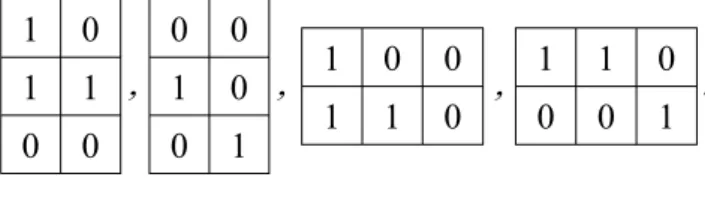
where 1 ≤ i ≤ m, 1 ≤ j ≤ n, 0 ≤ k ≤ m−i+1, and 0 ≤ l ≤ n−j+1. Hereafter, without notice, we assume that the height and the width of pare respectively given by m (≥ 2) andn (≥ 2). For a given q ∈ X[k,l] (k,l ≥ 0), the (k−1)×l subblocks q(k(1,1)−1,l) (the subblock obtained by deleting thek-th row) andq(k,l)(2,1) (the subblock obtained by deleting the first row) are denoted byπr(q)andσr(q), respectively, where bothπr(q) andσr(q) are λ[0,l] when k=0 and 1. Similarly, thek×(l−1)subblocksq(k,l−(1,1)1)and q(k,l)(1,2)are denoted byπc(q)andσc(q), respectively, where bothπr(q)andσr(q)areλ[k,0]whenl=0 and 1. Figure 2 showsπc(p),σc(p),πr(p), andσr(p)from left to right for p in Figure 1. The dictionary ofpis defined as the set of all subblocks ofp; that is,
D(p):={p(i+k−(i,j) 1,j+l−1)|1≤i ≤m,1≤j ≤n,
0≤k≤m−i+1,0≤l≤n−j+1}.
Now we define a column-wise concatenation of blocks.
For two blockss,t ∈ X[∗,∗]such that|s|r = |t|r, define s:
Fig. 2 πc(p),σc(p),πr(p), andσr(p)ofpin Fig. 1.
t ∈ X[|s|r,|s|c+|t|c]to be the block obtained by concatenating tat the end ofsin columns. Similarly, for two blocksu,v ∈ X[∗,∗]such that|u|c=|v|c, defineu/v ∈ X[|u|r+|v|r,|u|c]to be the block obtained by concatenating vat the end ofuin rows.
2.3 Flat Torus, Primitive, and Frequencies of Subblocks Theflat torusofp, denoted bypT, is constructed by concate- nating the leftmost column (resp. the top row) to the right- most column (resp.the bottom row) ofp. The flat torus can be treated as an infinite pattern such thatp(i,j)=pT(i+km,j+ln) for non-negative integerskandl.
For q ∈ X[m,n]and the 2m×2n subblock ¯p := (p : p)/(p: p)ofpT, we say thatpandqare equivalent, denoted by p 'q, if there exist positive integersi(1≤i ≤m)and j (1≤ j ≤n)such thatq =p¯(i,(i+m−j) 1,j+n−1). In other words, p ' q if and only if q ∈ D(p¯). Indeed, it satisfies the conditions to be an equivalence relation. Let [p] be the set of all blocksqsuch thatq 'p; that is,
[p] :={q ∈ X[m,n]|q ∈ D(p¯)}. (1) For a blockp ∈ X[m,n],p†is defined as the smallest element in [p] in column-wise lexicographical order. From the defi- nition,p†is equal toq†for any blockq∈[p]. If|[p]|=mn, pis calledprimitive. Hereafter, we always assume thatpis primitive. For example, p shown in Figure 1 is primitive.
For pandu∈ X[k,l](0≤k≤mand 0≤l ≤n), define N(u|p):=| {r|u=r(1,1)(k,l),r ∈[p]} |, (2) whereN(λ[k,l]|p) =mn(k =0 orl =0). Thus, N(u|p) represents the frequency of uin pT. For convenience, we often adopt the notation N(u)instead of N(u|p). For 0≤ k≤mand 0≤l ≤n, observe that
X
u∈X[k,l]
N(u)=mn. (3)
Moreover, for v ∈ X[i,j] (0 ≤ i ≤ m,0 ≤ j < n) and v0∈ X[k,l](0≤k<m,0≤l ≤n), we have
N(v)= X
c∈X[i,1]
N(c:v)= X
c∈X[i,1]
N(v :c), (4) N(v0)= X
r∈X[1,l]
N(r/v0)= X
r∈X[1,l]
N(v0/r). (5) 2.4 Classifications of Flat Tori and Core
For a block p ∈ X[m,n]and integers k (0 ≤ k ≤ m)and
l(0≤l≤n), define
T(p,k,l):={q† |N(w|q)=N(w|p),
∀w∈ X[k,l],q ∈ X[m,n],qis primitive}.
(6) For convenience, we writeT(k,l)instead ofT(p,k,l).
For example, T(m,n) = {p†}, that is |T(m,n)| =1.
The cardinality|T(k,l)|represents the number of the small- est (primitive)m×nblocksq†such thatN(w|q)=N(w|p) for any w ∈ X[k,l]. For 0 ≤ k < n and fixed 0 ≤ l ≤ n, T(k,l)satisfies the subset relation in descending order ofk;
that is,T(k+1,l) ⊆ T(k,l). Similarly, for fixed 0≤k0≤n and 0≤l0<n,T(k0,l0+1)⊆ T(k0,l0)holds.
We defineB(p), which is used to encode p, to be B(p):={b ∈ X[k,l]|πr(b)∈ D(p), σ¯ r(b)∈ D(p¯),
πc(b)∈ D(p¯), σc(b)∈ D(p¯), 1≤k≤m,1≤l≤n} ∪ {λ[0,0]}.
(7) We assume that the elements of B(p) are ordered in as- cending order of their heights (if the heights of the elements are equal, then the elements are ordered with respect to their widths; if the widths of the elements are also equal, then the elements are ordered in column-wise lexicographical order), wherebiis thei-th element ofB(p).
For an integeri(1≤i ≤ |B(p)|), define
T(B(p),p,i):={q† |N(bj|q)=N(bj|p), 1≤∀j≤i,q∈ X[m,n],qis primitive}.
(8) For convenience, we writeT(i)instead of T(B(p),p,i). For example,T(|B(p)|) = {p†}, that is |T(|B(p)|)| =1.
The cardinality |T(i)| represents the number of represen- tative (primitive) m×n blocks at encoding step i. For 1 ≤ i < |B(p)|, T(i) satisfies the subset relation in de- scending order ofi; that is,T(i+1) ⊆ T(i). For a block u ∈ B(p), the blockσc(πc(u))is calledc-core(column- core) if a : u,b : u,u : c,u : d ∈ D(p¯), where a,b(, a),c,d(, c) ∈ X[|u|r,1]. Similarly, for a block v ∈ B(p), the blockσr(πr(v))is called r-core(row-core) ife/v,f/v,v/g,v/h∈ D(p)¯ , wheree,f(,e),g,h(,g)∈ X[1,|v|c]. C-cores and r-cores are used to determine whether an element ofB(p)is encoded. The details will be described in Sects. 3 and 4.
3. Review of Conventional CSE
The conventional CSE is a lossless compression algorithm for a 1D source. We can regard p ∈ X[m,n]as a 1D source x ∈ Xˆ[1,n]over an extended alphabet ˆX(=X[m,1]), so that CSE can encode p as a 1D source x. For x in [x], let rank(x) be the number assigned forxwhen elements in [x]
are arranged in lexicographical order, and(rank(x)) be the encoding of rank(x) in binary (indlog2nebits). CSE outputs (E(n),e(b2,b3, . . . ,b| B(x)|), (rank(x))), (9) whereE(n)denotes the encoding ofnby means of the Elias code for integers[14], ande(b2,b3, . . . ,b| B(x)|)represents the sequence of N(bi)(=N(bi|x)), 2≤i ≤ |B(x)|, which are encoded by an entropy coding. In encoding, an indexi forbi ∈ B(x)is chosen between 2 and|B(x)|because when i=1,N(b1)=N(λ[0,0])=nandnis encoded asE(n). Let b|X |ˆ+1be the element of ˆXhaving the largest index inB(x). For 2≤i ≤ |B(x)|,N(bi)is encoded based on the following conditions.
(C-i) When|bi|c=1: EncodeN(bi)ifbi ,b|X |ˆ+1, (C-ii) When|bi|c ≥2: Encode N(bi)if (10) below holds
anda,c∈X\{ˆ b|X |ˆ+1}, wherebi =a:w:c.
When we encode N(bi) based on conditions (C-i) and (C- ii), we first assign the probability (as shown in (13), (14), or (15)) to N(bi). We then encode the probability by using entropy coding.
Inequality (10) was first shown in[10]. Note that im- proved inequalities of (10) have been presented in[10]and [15]. They are omitted here to simplify discussions because they are complicated and only (10) is necessary for an asymp- totic analysis. It is noteworthy that N(bi) is encoded even thoughN(bi)=0 in (C-i).
In (C-i), N(b|X |ˆ+1) can be inferred by using (3) and bj(j <|X |ˆ +1)which has been encoded. Similarly, in (C- ii), N(bi)such that the first column of bi is b|X |ˆ+1 or the last column of bi isb|X |ˆ+1can be inferred by using (4) and bk (k<i). Therefore,N(bi)is not needed to be encoded.
min(N(a:w),N(w:c),N(w)−N(a:w),
N(w)−N(w:c))≥1. (10) As forbi(=a:w:c)in (C-ii), satisfying (10) is equivalent to satisfying the three conditions, w is a c-core, a : w ∈ D(x¯), andw:c∈ D(x¯).
In (C-i),N(bi)satisfies the following inequality
0≤N(bi)≤n−1. (11)
In (C-ii),N(bi)satisfies the following inequality[9]
max{0,N(a:w)−X
d∈X\ {cˆ }
N(w:d),N(w: c)−X
b∈X\ {aˆ }
N(b:w)}
≤N(a:w:c) ≤min{N(a:w),N(w: c)}. (12) The left-hand side of (10) is given by the difference between the upper bound and the lower bound of N(a : w : c) obtained in (12). Therefore, if (10) does not hold, then the upper bound and the lower bound turn out to be equal. In other words, N(bi) =min{N(a : w),N(w : c)}holds, so that N(bi)can be inferred. Hence,N(bi)is not encoded if (10) does not hold. We define thatI(a : w: c)for a given a:w:cis the left-hand side of (10) plus one; that is,
I(a:w:c):=
min(N(a:w),N(w:c),
N(w)−N(a:w),N(w)−N(w:c))+1. For encodingN(bi)by an entropy coding, the probability is assigned toN(bi)[2], as
1
n (|bi|c=1), (13)
1
I(bi) (2≤ |bi|c≤log2log2n), (14)
|T(i)|
|T(i−1)| (|bi|c≥log2log2n+1). (15) The assigned probabilities are encoded by an entropy coding such as an arithmetic coder or something like that[16].
The computational time results in a serious issue when encoding a 2D sourcep by the conventional CSE. In (C-i), the number of encodedN(bi) (2 ≤i ≤ |X |)ˆ is exponential with respect tom because |X |ˆ = |X |m. In practice, mis greater than 1000 for an imagep∈ X[m,n], so that the number turns out to be greater than 21000even though|X |=2. It is noteworthy that the number of encodedN(bi)is polynomial with respect tomandnin (C-ii), for the following reasons.
Since wis a c-core, from (3) and (4), the total number of c-cores is polynomial with respect tomandn. Moreover, as N(a :w) ≥1 and N(w:c) ≥1 in (10),a,c ∈ D(x)¯ ∩Xˆ also holds. From (3) and (4), |D(x)¯ ∩X |ˆ never exceeds mn. Hence, the total number of candidatesbi(=a : w:c) for encoding in (C-ii) is polynomial with respect tomand n. The set of all the candidates can be used to encode x instead of B(x) in (C-ii) for reducing the computational time. Furthermore, only the relation on columns is used as shown in (10) and a relation on rows is not used in encoding of the conventional CSE.
4. Proposed Algorithm
Assume thatm ≤ n, and let K = q
log| X |log| X |m and L=q
log| X |log| X |n
. We selectKandLdescribed above for the following reasons. We use the number of occurrences ofK×Lblocksq ∈ B(p)(that is the empirical distribution of q ∈ X[K,L]) to analyze remarkable properties of p that appear when the size of p goes to infinity. Therefore, it is desirable to chooseKandLsuch thatKandLgrow withm andn, respectively. On the other hand, we need to store the K×Lblocks for encoding the number of their occurrences.
Since we want to make the cost of storing theK×Lblocks smaller with respect to data compression, we selectKandL such that the cost over the size ofpconverges to zero when the size ofpgoes to infinity. Hence, KandLare set to be small values compared withmandn, respectively. Observe thatKandLabove satisfy those two requirements.
We divideB(p)into four disjoint subsets, with respect to the size of elements, as
B0(p):={λ[0,0]},
B1(p):=X,
B2(p):={b ∈ B(p) | 1≤ |b|r ≤K,1≤ |b|c ≤L,b<X}, B3(p):={b ∈ B(p) | K<|b|rorL<|b|c,b <X}.
The elements ofBi(p) (i=0,1,2,3)are arranged in ascend- ing order of their heights (if the heights of the elements are equal, then the elements are arranged in ascending order of their widths; if the widths of the elements are also equal, then the elements are arranged in column-wise lexicographical or- der.) The elements ofB(p)are further reordered based on the ascending order of indexes forBi(p); that is, elements of Bi(p)are lined up beforeBi0(p)wheni<i0. For simplicity, we represent the fact as(B0(p),B1(p),B2(p),B3(p)).
For a given integerk,x(k,1)(resp. x(1,k)) is defined to be the last element (in ascending order) amongst all elements ofX[k,1]∩ B(p)(resp.X[1,k]∩ B(p)). For 2≤i≤ |B(p)|, N(bi)is encoded based on the following conditions.
(P-i) Ifbi ∈ B1(p): EncodeN(bi)ifbi ,J−1, (P-ii) Ifbi ∈ B2(p)∪ B3(p):
1) If |bi|c = 1: Encode N(bi) if (10) holds and a,c ∈ X\{J−1}, wherebi=a:w: c,
2) If |bi|r = 1: Encode N(bi) if (16) holds and e,g ∈ X\{J−1}, wherebi=e/v/g,
3) If|bi|c ≥2 and |bi|r ≥2: Encode N(bi) if both (10) and (16) hold, where a,c∈ X[|bi|r,1]\{x(|bi|r,1)}and e,g ∈ X[1,|bi|c]\{x(1,|bi|c)}.
When we encodeN(bi)based on conditions (P-i) and (P-ii), we first assign the probability (as shown in (18), (19), or (20)) to N(bi). We then encode the probability by using entropy coding.
min(N(e/v),N(v/g),N(v)−N(e/v),
N(v)−N(v/g))≥1. (16)
As for bi(= e/v/g) in 2) and 3) of (P-ii), satisfying (16) is equivalent to satisfying the three conditions that v is an r-core,e/v∈ D(p)¯ , andv/g ∈ D(p)¯ .
The conventional CSE uses only condition (10) with respect to columns, while the proposed algorithm uses con- ditions (10) and (16) with respect to columns and rows, respectively. In 1) and 2) of (P-ii), bi has one row and one column, so that (10) and (16) are used, respectively. In (P-i), N(bi)satisfies 0≤ N(bi) ≤mn−1. In (P-ii),N(bi)such that |bi|c ≥2 satisfies a modified inequality (12) obtained by replacing ˆX byX[|a|r,1], and N(bi)such that |bi|r ≥ 2 satisfies the following inequality
max{0,N(e/v)− X
h∈X[1,|e|c]\ {g}
N(v/h),N(v/g)− X
f∈X[1,|e|c]\ {e}
N(f/v)}
≤N(e/v/g) ≤min{N(e/v),N(v/g)}. (17)
Similarly, the left-hand side of (16) is given by the difference between the upper bound and the lower bound ofN(e/v/g) obtained in (17). Therefore, if (16) does not hold, then the upper bound and the lower bound turn to be equal. In other words,N(bi)=min{N(e/v),N(v/g)}holds, so thatN(bi)
can be inferred. Hence,N(bi)is not encoded if (16) does not hold. Therefore, in 3),N(bi)is encoded if both (10) and (16) hold. Moreover,I0(e/v/g)for a givene/v/gis defined as the left-hand side of (16) plus one; that is,
I0(e/v/g):=
min(N(e/v),N(v/g),
N(v)−N(e/v),N(v)−N(v/g))+1.
For encodingN(bi)by an entropy coding, the probability is assigned toN(bi), as
1
mn (bi ∈ B1(p)), (18)
max 1
I(bi), 1 I0(bi)
!
(bi ∈ B2(p)), (19)
|T(i)|
|T(i−1)| (bi ∈ B3(p)). (20) The assigned probabilities are encoded by an entropy coding such as an arithmetic coder or something like that. The proposed algorithm outputs the following quadruple
(E(m),E(n),e(b2,b3, . . . ,b| B(p)|), (rank(p))). (21) In (21),E(m)andE(n)represent encodedmandnby means of the Elias code for integers, respectively. In addition, rank(p) represents an index for identifying p in [p] such as the rank of pin [p] with lexicographical order column- wisely. Then,(rank(p)) is the encoding of rank(p) in binary (indlog2mnebits), ande(b2,b3, . . . ,b| B(p)|)represents the sequence ofN(bi) (2 ≤i ≤ |B(p)|) which is encoded by an entropy coding.
In the proposed algorithm, the number of encoded N(bi) in (P-i) is |X | −1 (a constant), while that in (C-i) is|X |m−1, which is exponential with respect tom. As for (P-ii), the number of candidatesN(bi)for encoding is poly- nomial with respect tomandn, for the following reasons.
As for 1), it is the same as (C-ii). As for 2) and 3), sincev is an r-core, from the discussions on a c-core described in Sect. 3, the total number of candidates N(bi)for encoding is also polynomial with respect tomandn. The set of all the candidates can be used to encode p instead ofB(p)in (P-ii) for reducing the computational time. Hence, for a 2D sourcep, the total number of output blocks of the proposed algorithm is polynomial with respect tomandn, while that of the conventional CSE is exponential with respect tom.
5. Evaluation of the Proposed Algorithm A general sourceXis defined as
X:=
{X[m,n]=(X<m,n>
(1,1) ,X<m,n>
(1,2) , . . . ,X<m,n>
(m,n) )}∞,∞
m=1,n=1, where a random variableX[m,n]takes a value in them×n Cartesian productX[m,n]ofX[17]. The probability distri- bution of a random variable X[m,n] is denoted by PX[m,n].
The sup-entropy rate ofXis defined as H(X)ˆ :=lim sup
m,n→∞
1
mnH(X[m,n]). (22)
For p, let `(p) be the codeword length of the pro- posed algorithm. Let`0(p)be the total codeword lengths of E(m), E(n), and (rank(p)) in (21). The codeword length ofe(b2,b3, . . . ,b| B(p)|)consists of three parts`1(p),
`2(p), and `3(p), where `1(p), `2(p), and `3(p) are the total codeword lengths of N(bi) for bi ∈ B1(p), bi ∈ B2(p), and bi ∈ B3(p), respectively. Observe that
`(p)=`0(p)+`1(p)+`2(p)+`3(p). Theorem 1 is one of our main results.
Theorem 1. For a general sourceX,
lim sup
m,n→∞E
"`(X[m,n]) mn
#
=H(X).ˆ
To prove Theorem 1, we show four lemmas: Lemma 1, Lemma 2, Lemma 3, and Lemma A. Lemmas 1 and 2 are 2D versions of Lemma 6 in[11]and Lemma 3 in[2], respec- tively. Lemma A is stated without proof since it is equivalent to Corollary 2 in[11]. Note that we assign alphabetic letters to the lemma.
Lemma 1. If bi+1 ∈ B(p)such that |bi+1|c ≥2 does not satisfy (10), thenT(i+1)=T(i). Similarly, ifbi+1 ∈ B(p) such that|bi+1|r ≥2does not satisfy (16), thenT(i+1) = T(i).
Proof. T(i+1) ⊆ T(i) holds from the monotonicity on the cardinalities, so we focus on showingT(i+1)⊇ T(i). Also, we only argue the first case since the latter case is obtained by swapping column and row.
From the assumption on bi+1, bi+1 can be written as a :w: cfora,c∈ X[|bi+1|r,1]andw∈ X[∗,∗]. Suppose that bi+1does not satisfy (10). When (10) does not hold, a case among the four following ones has to hold
N(a:w)=0 or, (23)
N(w:c)=0 or, (24)
N(w)−N(a:w)=0 or, (25) N(w)−N(w:c)=0. (26) If (23) holds, then N(a : w : d) =0 for any column d ∈ X[|bi+1|r,1]. Therefore, ifyis an element of
T(i)={q†|N(bj|q)=N(bj|p),1≤∀j ≤i, N(a:w|q)=N(a :w|p)=0, q ∈ X[m,n],qis primitive} thenyis also an element of
T(i+1)={s†| N(bj|s)=N(bj|p),1≤∀j ≤i, N(a:w|s)=N(a:w|p)=0, N(a:w:c|s)=N(a:w:c|p)=0,
s∈ X[m,n],sis primitive}.
Hence,T(i+1)⊇ T(i)holds. Similarly, if (24) holds, then T(i+1)⊇ T(i)holds.
If (25) holds, thenN(d : w) =0 for any columnd ∈ X[|bi+1|r,1]\{a}
because N(w) = N(a : w). Hence, we have N(w : c) = N(a : w: c)because N(d : w) =0 for any columnd ∈
X[|bi+1|r,1]\{a}
. Let N(w : c) = N(a : w:c)=C≥0. Ifyis an element of
T(i)={q†|N(bj|q)=N(bj|p),1≤∀j ≤i,
N(w|q)=N(w|p)=N(a:w|q)=N(a:w|p), N(w:c|q)=N(w:c|p)=C,
q∈ X[m,n],qis primitive} thenyis also an element of
T(i+1)={s†|N(bj|s)=N(bj|p),1 ≤∀j≤i, N(w|s)=N(w|p)=N(a:w|s)=N(a:w|p), N(w:c|s)=N(w:c|p)=C,
N(a:w:c|s)=N(a:w:c|p)=C, s∈ X[m,n],sis primitive}.
Therefore,T(i+1) ⊇ T(i)holds. Similarly, if (26) holds, thenT(i+1)⊇ T(i)holds.
Hence, in any case, we haveT(i+1) ⊇ T(i), which
completes the proof.
Remark 1. Lemma 1 holds when the rearranged order of elements of B(p) is used, that is (B0(p), B1(p), B2(p), B3(p)). When bi+1 (= a : w : c) such that |bi+1|c ≥ 2 (resp. bi+1 (= e/v/g) such that |bi+1|r ≥ 2) is encoded based on the rearranged order, N(a : w),N(w : c), and N(w)(resp. N(e/v),N(v/g), andN(v)) have been already encoded or can be inferred.
We give the reasons why Remark 1 holds. Since
|bi+1|c ≥ 2 (resp. |bi+1|c ≥ 2) from the assumption, bi+1 ∈ (B2(p)∪ B3(p)). For bi+1 ∈ (B2(p)∪ B3(p)), any blockx ∈ {a : w,w : c,w}(resp. {e/v,v/g,v}) is the empty block or an element ofB(p)because x is a proper subblock ofbi+1and any proper subblock ofbi+1is inD(p)¯ from the definition of B(p). When x is the empty block, N(x)=mnfrom the definition, soN(x)can be inferred.
In case thatbi+1 ∈ B2(p), any blockx ∈ {a : w,w : c,w}(resp. {e/v,v/g,v}) is the empty block or an element of (B1(p)∪ B2(p)). For x ∈ (B1(p)∪ B2(p)),x comes beforebi+1in the rearranged order because|x|r <|bi+1|ror
|x|r=|bi+1|r and|x|c<|bi+1|r.
In case thatbi+1 ∈ B3(p), any blockx ∈ {a : w,w : c,w}(resp.{e/v,v/g,v}) is the empty block or an element of (B1(p)∪B2(p)∪B3(p)). Forx ∈(B1(p)∪B2(p)∪B3(p)), xcomes beforebi+1in the rearranged order because|x|r <
|bi+1|ror|x|r =|bi+1|rand|x|c<|bi+1|r.
Therefore, N(x) has been already encoded or can be inferred whenN(bi+1) is encoded based on the rearranged
order, wherex ∈ {a:w,w:c,w}(resp.{e/v,v/g,v}).
Lemma A(Corollary 2[11]). For a positive integernsuch that n = a1 +a2 +· · ·+ad and non-negative integers a1,a2, . . . ,ad,
n!
Πi=1d ai! ≤ nn Πi=1d aaii, where0!=1and00 =1.
Lemma 2. For1≤k≤mand1≤l ≤n, we have log2|T(k,l)| ≤ −mn
kl X
w∈X[k,l]
N(w)
mn log2N(w) mn . Proof. When |T(k,l)| is calculated, |T(k − 1,l)| and
|T(k,l −1)| are known. Therefore, N(u) and N(v) for u ∈ X[k−1,l]andv∈ X[k,l−1]are also known.
We show the statement based on the following claim.
Claim:For any 1≤k≤mand 1≤l ≤n,
|T(k,l))|kl≤ (mn)! Y
w∈X[k,l]
N(w)!. (27)
Once the claim is shown, then we have from (27) that kllog2|T(k,l))| ≤log2 (mn)!
Y
w∈X[k,l]
N(w)! (28) Hence, from Lemma A,
log2|T(k,l)| ≤ −mn kl
X
w∈X[k,l]
N(w)
mn log2N(w) mn (29) as desired. Thus, we focus on showing the claim in accor- dance with the following steps.
Step 1: Fork=1 and 1≤l≤nor for 1≤k ≤mand l=1, show
|T(k,l)| ≤* . ,
Y
y∈X[k,l−1]
N(y)
N(y:c0), . . . ,N(y:c| X |k−1)
! + / - 1 k
(30)
|T(k,l)| ≤* . ,
Y
z∈X[k−1,l]
N(z)
N(z/r0), . . . ,N(z/r| X |l−1)
! + / - 1 l
(31) whereX[k,1]={c0, . . .c| X |k−1}andX[1,l]={r0, . . .r| X |l−1}.
Step 2: Fixmandn. For any 1≤k≤m, show
|T(k,1)|k ≤ (mn)! Y
w∈X[k,1]
N(w)!. (32)
Step 3: For any 1≤ k ≤mand 1 ≤l ≤n, show (30) and (31) hold.
Step 4:Show that the claim holds.
Proof of Step 1:For k = 1 and 1 ≤ l ≤ n, |T(k,l)|
never exceeds the product of these possible combinations over all substrings of lengthl, so that (30) holds. Similarly, for 1≤k ≤mandl=1, (31) holds.
Proof of Step 2: When k = 1, the right-hand side of (32) is given by
(mn)! Y
w∈X[1,1]
N(w)!
= Y
z∈X[0,1]
N(z)
N(z/r0), . . . ,N(z/r| X |−1)
!
. (33)
From Step 1, (32) holds fork=1. We assume that (32) holds whenk=i≥1. Whenk=i+1, from Step 1,
|T(i+1,1)| ≤ Y
z∈X[i,1]
N(z)
N(z/r0), . . . ,N(z/r| X |−1)
! . (34) Since|T(k+1,l)| ≤ |T(k,l)|, we have from (34) that
|T(i+1,1)|i+1
≤ |T(i,1)|i Y
z∈X[i,1]
N(z)
N(z/r0), . . . ,N(z/r| X |−1)
! (35)
≤ (mn)! Y
z∈X[i,1]
N(z)!
Y
z∈X[i,1]
N(z)! Y
z∈X[i,1]
N(z/r0)!· · ·N(z/r| X |−1)!
(36)
= (mn)! Y
w∈X[i+1,1]
N(w)!. (37)
Therefore, (32) holds for any 1≤k≤m.
Proof of Step 3:Observe that (32) is equivalent to
|T(k,1)| ≤
* . . . . . ,
(mn)! Y
y∈X[k,1]
N(y)! + / / / / / - 1k
=* . ,
Y
y∈X[k,0]
N(y)
N(y:c0), . . . ,N(y:c| X |k−1)
! + / - 1 k
. (38) From (38), (30) holds for 1 ≤ k ≤ mandl =1. We then prove that (30) holds for any 1≤k ≤mand 1≤l ≤n by mathematical induction onlfor fixedk ≥1,mandn.
Assume that (30) holds whenl = j ≥ 1. For l = j, from the assumption,
|T(k,j)| ≤
* . ,
Y
y∈X[k,j−1]
N(y)
N(y:c0), . . . ,N(y:c| X |k−1)
! + / - 1 k
=
* . . . . . ,
Y
y∈X[k,j−1]
(N(y)!) Y
y0∈X[k,j]
(N(y0)!) + / / / / / - 1 k
(39)
From (39),|T(k,j)|knever exceeds the product of pos- sible combinations over all subblocks y0 = y : ca (0 ≤ a ≤ |X |k −1) for all y. Moreover, since N(y0) = N(y0 : c0)+· · ·+N(y0 : c| X |k−1), |T(k,j+1)|k never exceeds the product of possible combinations over all subblocks y0:ca (0≤a ≤ |X |k−1)for ally0. Therefore,
|T(k,j+1)| ≤
* . . . . . ,
Y
y0∈X[k,j]
N(y0)! Y
y0∈X[k,j]
N(y0:c0)!· · ·N(y0:c| X |k−1)! + / / / / / - 1 k
(40)
=* . ,
Y
y0∈X[k,j]
N(y0)
N(y0:c0), . . . ,N(y0:c| X |k−1)
! + / - 1 k
(41) Hence, (30) holds for 1 ≤k ≤mand 1≤l ≤n. Similarly, by swapping the rowkand the columnl, (31) holds.
Proof of Step 4:From (32), (27) holds for 1 ≤ k ≤ m andl=1. We next prove that (30) holds for any 1≤k≤m and 1≤l ≤nby induction onkfor fixedl ≥1,mandn.
Assume that (27) holds whenk=i≥1. Fork=i+1, from (31),
|T(i+1,l)|l ≤ Y
w∈X[i,l]
N(w)
N(w/r0), . . . ,N(w/r| X |l−1)
!
. (42)
From (34),
|T(i+1,l)|(i+1)l
≤ |T(i,l)|il Y
w∈X[i,l]
N(w)
N(w/r0), . . . ,N(w/r| X |l−1)
!
(43)
= (mn)! Y
w∈X[i,l]
N(w)!
Y
w∈X[i,l]
N(w)! Y
w∈X[i,l]
N(w/r0)!· · ·N(w/r| X |l−1)! (44)
= (mn)! Y
w0∈X[i+1,l]
N(w0)!. (45)
Hence, (27) holds for 1≤k≤mand 1≤l≤n. From (27), kllog2|T(k,l))| ≤log2 (mn)!
Y
w∈X[k,l]
N(w)!. (46) Hence, from Lemma A,
log2|T(k,l)| ≤ −mn kl
X
w∈X[k,l]
N(w)
mn log2N(w) mn . (47)
Lemma 3. For K = q
log| X |log| X |m
and L = q
log| X |log| X |n
,
lim sup
m,n→∞− 1 K L
X
w∈X[K,L]
E
"
N(w|X[m,n]) mn
#
log2E
"
N(w|X[m,n]) mn
#!
=Hˆ(X).
Proof. Forw∈ X[K,L],PX[m,n](w)can be written as E
|{(i,j)s.t. X(i,(i+K−j) 1,j+L−1)=w,1≤i≤m0,1≤ j ≤n0}|
m0n0
where m0 and n0 are m−K +1 and n−L +1, respec- tively, and(i,j)is the coordinate. For p, let N0(w|p)be
|{(i,j)s.t. p(i,(i+K−j) 1,j+L−1) = w,1 ≤ i ≤ m0,1 ≤ j ≤ n0}|. Moreover, N(wmn|p) can be written as N0(w|p)+δ
m0n0
m0n0 mn
where 0 ≤ δ ≤ (K−1)(n−L+1)+(L−1)mfrom (2).
BecauseK andL are respectively q
log| X |log| X |m and q
log| X |log| X |n
, N(wmn|p) converges to Nm0(w0n|p)0 asmandn go to infinity. SinceE
N0(w|X[m,n]) m0n0
=PX[m,n](w),
lim sup
m,n→∞− 1 K L
X
w∈X[K,L]
E
"
N(w|X[m,n]) mn
#
log2E
"
N(w|X[m,n]) mn
#!
=lim sup
m,n→∞− 1 K L
X
w∈X[K,L]
PX[m,n](w)log2PX[m,n](w)
=lim sup
m,n→∞
H(X[K,L])
K L =Hˆ(X).
We are now in a position of proving Theorem 1.
(Proof of Theorem 1). As for `0(p), from the assumption andm≤n, we have`0(p) ≤2(2dlog2ne+1)+dlog2mne, where (2dlog2ne+1) and dlog2mne are the costs of the
Elias code for integersnand(rank(p)), respectively. As for
`1(p), the cost ofN(bi)in Condition (P-i) isdlog2mnebits from (18), so that`1(p)≤(|X | −1)dlog2mne. As for`2(p), sinceI(bi) ≤ mnandI0(bi) ≤ mn, the costs of I(bi)and I0(bi)are at most log2mnbits. Moreover, becausem ≤n andK ≤L,
`2(p)≤
K
X
h=1 L
X
w=1
|X |hwlog2mn≤L2|X |L2log2mn
≤2(log| X |log| X |n)(log| X |n)(log2n).
Therefore,
m,n→∞lim (`0(p)+`1(p)+`2(p))/mn=0. (48) As for `3(p), the cost of N(bi) is −log2(|T(i)|/|T(i − 1)|) bits from (20). Similarly, the cost of N(bi+1) is
−log2(|T(i+1)|/|T(i)|)whereN(bi+1)is encoded subse- quent to N(bi)which has been encoded. The denominator
|T(i)|forN(bi+1)is equal to the previous numerator|T(i)|
forN(bi), so that they are canceled. In other words,
−log2(|T(i)|/|T(i−1)|)−log2(|T(i+1)|/|T(i)|)
=−log2(|T(i+1)|/|T(i−1)|)).
On the other hand,N(bi+1)may not be encoded when N(bi+1) does not satisfy the conditions as shown in (P-ii).
We assume thatN(bj)is encoded whileN(bi+k)(1≤k< j) are not encoded. The cost ofN(bj)is−log2(|T(j)|/|T(j− 1)|). From Lemma 1, |T(j−1)| = |T(i)|holds because any N(bi+k) (1 ≤ k < j) does not satisfy the conditions as shown in (P-ii) from the assumption. Therefore, they are also canceled. In other words,
−log2(|T(i)|/|T(i−1)|)−log2(|T(j)|/|T(j−1)|)
=−log2(|T(j)|/|T(i−1)|)).
Moreover, since|T(|B(p)|)|=1,
`3(p)=log2|T(S−1)|, (49)
whereSis the index of the first blockbS ∈ B3(p)which is encoded by an arithmetic coder or something like that. From Lemma 1,|T(S−1)|=|T(K,L)|. Therefore,
`3(p)=log2|T(K,L)|. (50)
From (50) and Lemma 2,
`3(p)≤ −mn K L
X
w∈X[K,L]
N(w)
mn log2 N(w)
mn . (51) Therefore,
E
"`3(X[m,n]) mn
#
≤
− 1 K L
X
w∈X[K,L]
E
"
N(w|X[m,n])
mn log2 N(w|X[m,n]) mn
# .
From Jensen’s inequality, E
"
N(w|X[m,n]) mn
# E
"
log2 N(w|X[m,n]) mn
#
≤ E
"
N(w|X[m,n])
mn log2 N(w|X[m,n]) mn
# .
Therefore, from Lemma 3, lim sup
m,n→∞E
"`3(X[m,n]) mn
#
≤Hˆ(X). (52)
From (48) and (52), lim sup
m,n→∞E
"`(X[m,n]) mn
#
≤H(X).ˆ (53)
The proposed code is a prefix code, so Kraft’s inequality holds. Therefore,
lim sup
m,n→∞E
"`(X[m,n]) mn
#
≥H(X).ˆ
From Remark 1.7.3 [17], if Xis a stationary source, H(X)ˆ can be expressed by H(X)(:=limm,n→∞H(X[m,n])
mn ), which is the entropy rate of X. Therefore, if X is a sta- tionary source, the average codeword length of the proposed algorithm converges toH(X)asmandngo to infinity.
6. Conclusion
We proposed a new CSE for a 2D source which uses the flat torus of the source for reducing the computational time and compress a 2D source without converting to a 1D source.
The total number of output blocks of the new CSE is poly- nomial, while that of the conventional CSE is exponential with respect to the source size. The new CSE encodes the source in a block-by-block fashion, while the conventional CSE does in a line-by-line fashion. Moreover, we proved that an upper bound on the average codeword length of the proposed CSE converges to the sup-entropy rate for a 2D general source as the size of the input source goes to infin- ity. In other words, we proved the asymptotic optimality of the proposed CSE for a 2D general source. Furthermore, if a 2D general source is a stationary source, then the length converges to the entropy rate of the source as the size goes to infinity.
Acknowledgements
The authors truly thank the anonymous reviewers for their valuable comments. This work was supported by JSPS KAK- ENHI Grant Numbers JP17K00147 and JP17K00400.
References
[1] D. Dubé and V. Beaudoin, “Lossless data compression via sub- string enumeration,” Proc. Data Compression Conference, pp.229–
238, March 2010.
[2] H. Yokoo, “Asymptotic optimal lossless compression via the cse tech- nique,” Proc. Data Compression, Communications and Processing, pp.11–18, June 2011.
[3] D. Dubé and H. Yokoo, “The universality and linearity of compres- sion by substring enumeration,” Proc. IEEE International Sympo- sium on Information Theory, pp.1619–1623, Aug. 2011.
[4] M. Béliveau and D. Dubé, “Improving compression via substring enumeration by explicit phase awareness,” Proc. Data Compression Conference 2014,p.399, March 2014.
[5] S. Kanai, H. Yokoo, K. Yamazaki, and H. Kaneyasu, “Efficient im- plementation and empirical evaluation of compression by substring enumeration,” IEICE Trans. Fundamentals, vol.E99-A, no.2, pp.601–
611, Feb. 2016.
[6] M. Burrows and D.J. Wheeler, “A block-sorting lossless data com- pression algorithm,” SRC Research Report, pp.73–93, May 1994.
[7] M. Crochemore, F. Mignosi, A. Restivo, and S. Salemi, “Data com- pression using antidictionaries,” Proc. IEEE, vol.88, no.11, pp.1756–
1768, Nov. 2000.
[8] T. Ota and H. Morita, “On antidictionary coding based on com- pacted substring automaton,” Proc. IEEE International Symposium on Information Theory, pp.1754–1758, July 2013.
[9] T. Ota and H. Morita, “On a universal antidictionary coding for stationary ergodic sources with finite alphabet,” Proc. International Symposium on Information Theory and its Applications, pp.294–
298, Oct. 2014.
[10] K. Iwata and M. Arimura, “Lossless data compression via substring enumeration for k-th order Markov sources with a finite alpha- bet,” IEICE Trans. Fundamentals, vol.E99-A, no.12, pp.2130–2135, Dec. 2016.
[11] T. Ota and H. Morita, “A compact tree representation of an antidic- tionary,” IEICE Trans. Fundamentals, vol.E100-A, no.9, pp.1973–
1984, Sept. 2017.
[12] M. Crochemore, G. Fici, R. Marcuş, and S.P. Pissis, “Linear- time sequence comparison using minimal absent words & applica- tions,” Proc. Latin American Symposium on Theoretical Informatics, pp.334–346, April 2016.
[13] D. Salomon and G. Motta, Handbook of Data Compression, Springer, 2010.
[14] P. Elias, “Universal codeword sets and representations of the inte- gers,” IEEE Trans. Inf. Theory, vol.IT-21, no.2, pp.194–203, March 1975.
[15] T. Ota, H. Morita, and A. Manada, “Compression by substring enu- meration with a finite alphabet using sorting,” Proc. International Symposium on Information Theory and its Applications, pp.587–
591, Oct. 2018.
[16] A. Moffat and A. Turpin, Compression and Coding Algorithms, Kluwer Academic Publishers, 2002.
[17] T.S. Han, Information-Spectrum Methods in Information Theory, Springer-Verlag, 2002.
[18] T. Ota and H. Morita, “Two-dimensional source coding by means of subblock enumeration,” Proc. IEEE International Symposium on Information Theory, pp.311–315, June 2017.
Takahiro Ota received the B.E. and Ph.D. degrees from the University of Electro- Communications, Tokyo, Japan, in 1993 and 2007, respectively. In 1997, he joined Nagano Prefectural Institute of Technology, Nagano, Japan, first a Lecturer at Department of Elec- tronic Engineering, where from 2009, he was an Associate Professor. Since 2012, he is an Asso- ciate Professor with the Department of Computer
& Systems Engineering. His current research in- terests are in information theory, source coding, and bio-informatics.
Hiroyoshi Morita received the B.E., M.E., and D.E. degrees from Osaka University, Osaka, Japan, in 1978, 1980 and 1983, respectively. In 1983, he joined Toyohashi University of Tech- nology, Aichi, Japan as a Research Associate in the School of Production System Engineering.
In 1990, he joined the University of Electro- Communications, Tokyo, Japan, first an Assis- tant Professor at the Department of Computer Science and Information Mathematics, where from 1992, he was an Associate Professor. Since 1995, he has been with the Graduate School of Information Systems, where from 2005, he is a Professor. He was a Visiting Fellow at the Institute of Experimental Mathematics, University of Essen, Essen, Germany during 1993–1994. His research interests are in combinatorial theory, information theory, and coding theory, with applications to the digital communication systems.
Akiko Manada received the M.S. degree from Tsuda College, Tokyo, Japan, in 2004, and the Ph.D. degree in Mathematics from Queen’s University, Kingston, Canada, in 2009. She then worked at Claude Shannon Institute at Univer- sity College Dublin, Ireland, as a postdoctoral fellow from 2009 through 2011. She was an assistant professor at Graduate School of In- formation Systems, the University of Electro- Communications, Tokyo, Japan from 2012 to 2018. Since April 2018, she has been a lecturer at Dept. of Information Science, the Shonan Institute of Technology, Kana- gawa, Japan. Her research interests are discrete mathematics (especially in graph theory) and its applications towards coding theory.