
九州大学学術情報リポジトリ
Kyushu University Institutional Repository
プルシアンブルー類縁体による水素分子の核スピン 異性体変換
大坪, 宥太
https://doi.org/10.15017/4059995
Nuclear Spin Isomer Conversion of Molecular Hydrogen
in Prussian Blue Analogs
Yuta Ohtsubo
March 2020
Department of Chemistry Graduate School of Science
Kyushu University
Contents
General Introduction 1
Hydrogen Energy 1
Hydrogen Storage 2
Nuclear Spin Isomers of Molecular Hydrogen 4 Ortho-Para Conversion and Boil-Off Problem 6 Ortho-Para Conversion Acceleration by Solid Catalysts 8 Ortho-Para Conversion by Porous Coordination Polymers 10 Prussian Blue (PB) and Prussian Blue Analogs (PBAs) 13
Purpose of This Research 16
Reference 17
Chapter 1 24
Abstract 24
Introduction 25
Physical Measurements 26
Sample Preparation 27
Results and Discussion 33
Conclusions 79
References 80
Chapter 2 85
Abstract 85
Introduction 86
Physical Measurements 89
Sample Preparation 91
Results and Discussion 93
Conclusions 114
References 115
Concluding Remarks 119
List of Publications 120
Acknowledgments 121
General Introduction
Hydrogen Energy
Molecular hydrogen (H2) is the simplest and lightest molecule consisting of two hydrogen atoms and exists as a gas at a wide temperature range because of the extremely low melting point (13.99 K) and boiling point (20.27 K) at ambient pressure (Table 1).
The gravimetric energy density of H2 is 33.3 kWh/kg, which is approximately 2.7 times larger than that of general types of gasoline and the highest value in all materials due to the extremely low density (0.0899 g L−1) at standard temperature and pressure (STP).1 The combustion process of H2 to release the latent energy produces only water (H2O), an environmentally-friendly material as the combustion product. In addition to the abovementioned industrial and environmental aspects, from the viewpoints of the renewability and richness in supply, H2 is receiving a lot of attention as a promising energy carrier to replace conventional fossil fuels (e.g. petroleum and coal) which are limited in quantity and produce carbon dioxide (CO2), a greenhouse gas during the energy production process. Therefore, the diverse research fields regarding H2 including systems of production, storage, delivery, and energy conversion have been vigorously investigated to realize a hydrogen society.2 Among them, the establishment of highly efficient hydrogen storage methods has been one of the most important challenges over recent decades.
Table 1. Physical and chemical properties of molecular hydrogen (H2).
Molecular Weight 2.01588
Interatomic Distance 0.74 nm Molecular Diameter 0.269 nm
Density 0.0899 g L−1 (STP)
Bond Energy 432 kJ mol−1
Melting Point (m.p.) 13.99 K Boiling Point (b.p.) 20.27 K
Triple Point 13.80 K, 7.041 kPa Critical Point 32.94 K, 1.286 MPa Heat of Fusion (ΔHfus) 0.117 kJ mol−1 Heat of Vaporization (ΔH ) 0.904 kJ mol−1
Hydrogen Storage
The United States Department of Energy (DOE) has roughly classified hydrogen storage methods into two types: material-based and physical-based methods. Each method is subdivided into additional detail based on several physical and chemical factors (e.g. volumetric density, gravimetric density, storage materials, storage pressure, and operating temperature; Figure 1).3
In the case of the material-based methods (e.g. porous materials, metal hydrides, and organic molecules), hydrogen is stored both molecularly and atomically. Porous materials (e.g. activated carbon4 and zeolite5) feature easy uptake and release processes due to the physisorption; however, the storage amount at mild condition is relatively low both volumetrically and gravimetrically. Metal hydrides (e.g. LaNi5H6 and NaAlH4)6 also have been widely investigated as the storage materials and can generally store hydrogen with high volumetric density; however, the gravimetric density is considerably lower because of the metal element components. 3-Methyl-1,2-BN-cyclopentane and ammonia borane (NH3BH3) are the representative materials classified into chemical hydrogen methods.7 These compounds have a high density for hydrogen both volumetrically and gravimetrically; however, because the hydrogen is atomically stored through strong chemical bonds, appropriate catalytic treatments are required to release hydrogen by breaking the chemical bonds and to restore hydrogen into the materials after the release.
In terms of subjects described above, physical-based methods are practically used much more than material-based methods thanks to the relatively high volumetric density and the superior reversibility.
The properties of basic physical-based hydrogen storage methods are tabulated (Table 2).8 Although each storage method has both advantages and disadvantages in terms of the energy density and storage condition, compression and liquefaction have been widely used as storage methods thanks to the higher delivery efficiency. For example, as one of the disadvantages, compressed H2 gas needs to be handled carefully because of the extremely strong reactivity and the high diffusion coefficient. In the case of liquid H2
storage, which is also a superior and promising method for efficient H2 transport, one of the most obvious problems is ascribed to the extremely low storage temperature. Liquid H2 is stored in a cryogenic tank at 20 K and ambient pressure because of the low boiling point of 20.27 K at 1 atm (Table 1). Therefore, an efficient cooling process for liquefaction has been required; however, the most essential and latent problem in liquid H2 storage is the wasted consumption by boil-off caused by interconversion between nuclear spin isomers of H2 as well as the technical aspect of the storage vessel.
Table 2. Properties of basic physical-based hydrogen storage methods.8 Compression Liquefaction Ultimate Target
by DOE Volumetric Density / kg m−3 < 40 70.8 70
Gravimetric Density / wt% 13 Size-dependent 7.5
Storage Pressure / bar 800 1 5–12
Operating Temperature / K 298 21 230–330
Nuclear Spin Isomers of Molecular Hydrogen
Nuclear spin isomers exist in molecules containing two or more same atomic nuclei of which nuclear spin angular momentum is not zero (e.g. molecular hydrogen (H2), molecular deuterium (D2), and methane (CH4)) in equivalent positions of the molecule.
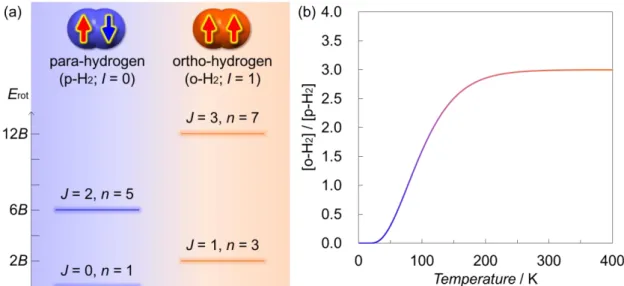
For example, because atomic hydrogen (1H) is a fermion with a nuclear spin angular momentum of 1/2, H2 comprises of two different nuclear spin isomers: ortho-hydrogen (o-H2) with a parallel nuclear spin pair (I = 1) and para-hydrogen (p-H2) with an antiparallel nuclear spin pair (I = 0), where I is the total nuclear spin angular momentum (Figure 2a).9 The chemical properties (e.g. boiling point) of the two nuclear spin isomers are quite similar because their electronic structures are the same; however, the physical properties (e.g. specific heat capacity and thermal conductivity) are slightly different to a certain extent owing to the different internal energy originating from the rotational levels.9b,c The rotational energy (Erot) of the nuclear spin isomers is quantized by rotational quantum number (J) according to Pauli exclusion principle and expressed by an equation of Erot = BJ(J + 1), where B is the rotational constant and approximately 7.35 meV for H2
in a free rotational state and J is exclusively even and odd values for p-H2 and o-H2, respectively (Equation 1 and Figure 2a). The abundance ratio of the nuclear spin isomer ([o-H2]/[p-H2]) at a thermal equilibrium state is temperature-dependent based on Boltzmann distribution, where kB and T are Boltzmann constant and temperature, respectively (Equation 1 and Figure 2b).9d The [o-H2]/[p-H2] value is almost precisely 3 over room temperature (RT) because of the almost simillar statistical multiplicity in the rotational states, and this mixture is usually regarded as normal-hydrogen (n-H2). With decreasing temperature, the p-H2 proportion gradually increases and the [o-H2]/[p-H2] value reaches approximately 1 around liquid N2 temperature (77 K). Below liquid H2
temperature (20 K), p-H2 accounts for approximately 99.8 % in the isomeric mixtures because almost only the lowest rotational level of p-H2 with J = 0 is populated due to the sufficiently large value of B.
o–H2 p–H2 =
3 2𝐽+ 1 exp −𝐸rot 𝑘𝐵𝑇
𝐽=odd
2𝐽+ 1 exp −𝐸rot
𝑘𝐵𝑇
𝐽=even
=
3 2𝐽+ 1 exp −𝐵𝐽 𝐽+ 1 𝑘𝐵𝑇
𝐽=odd
2𝐽+ 1 exp −𝐵𝐽 𝐽+ 1 𝑘𝐵𝑇
𝐽=even
Figure 2. (a) Nuclear spin isomers for H2 (p-H2 and o-H2) andtheir rotational energy diagram, where I, Erot, B, J, and n denote total nuclear spin angular momentum, rotational energy, rotational constant, rotational quantum number, and degeneracy number, respectively. (b) Temperature-dependent nuclear spin isomer ratio ([o-H2]/[p-H2]) for H2
in the free rotational state.
Ortho-Para Conversion and Boil-Off Problem
The nuclear spin conversion for H2 corresponding to a transition from o-H2 to p-H2
(J = 0 ← 1), referred to as ortho-para (o-p) conversion, is theoretically a spin forbidden process according to a nuclear spin selection rule. Therefore, the o-p conversion expressed as a second-order reaction is extremely slow. In an isolated state (e.g. gas phase), the o-p conversion proceeds with a conversion time of the order of 1020 s because of the almost negligible intermolecular interaction.10a The conversion rate for liquid H2 is
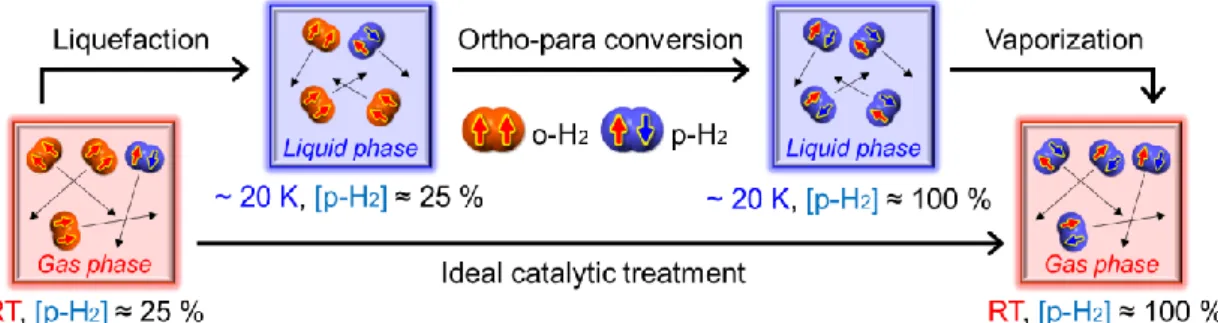
~1.14% h−1.10b In the solid phase, the rate was calculated to be 1.94% h−1,10c which was in good agreement with the experimental results of ~1.9% h−1.10d,e Because of the extremely slow conversion rates, the [o-H2]/[p-H2] value in n-H2 remains constant for a while even after liquefaction by an immediate cooling process; however, the o-p conversion slightly and gradually proceeds in liquefied H2 through interactions with the inner wall of the storage vessel and intermolecular collisions between H2 (Figure 3).
Because the gradual interconversion generates a conversion heat of ~1400 J mol−1 per n- H2 (~1050 J mol−1 per o-H2), which is sufficiently higher than the heat of vaporization of
~900 J mol−1 (Table 1), the immediately liquefied H2 is easily evaporated again, which is referred to as a “boil-off” problem (Figure 3).11a If n-H2 at RT is liquefied without any catalytic treatment, the estimated weight loss by the boil-off is ~50% after 1 week and 63.8% of the initial weight is evaporated at the end with a rate of ~18% day−1.11b According to the requirement from the DOE, the content of p-H2 should be usually 95%
or more for the liquid storage.8b,11c In order to solve the boil-off problem in advance, o- H2 should be converted to p-H2 as smoothly and completely as possible by solid catalyst before liquefaction (Figure 3). In industrial applications, catalytic treatment is used to accelerate the o-p conversion until an equilibrium state is reached at each temperature.
The continuous conversion with the temperature lowering is the most theoretically efficient process because the more the conversion process becomes stepwise, the lower the energy loss becomes.11c
Figure 3. Schematic processes of liquefaction, ortho-para (o-p) conversion, vaporization and ideal catalytic treatment for H2, and the o-p ratio at each point.
Ortho-Para Conversion Acceleration by Solid Catalysts
The conversion rate rapidly increases with pressure, increasing to 58% h−1 at 12.8 GPa12a and ~260% h−1 at 58 GPa;12b however, high pressurization is impractical due to difficulties with handling and the potential explosion hazard. In order to accelerate o-p conversion through a catalytic process, a two-step method is practically used in industries, where H2 at RT is cooled down to first liquid N2 temperature (77 K) and subsequently to liquid H2 temperature (20 K). As the conversion catalyst, metal oxides or hydroxides (e.g.
FeO(OH) and Cr2O3)13 and diamagnetic metals (e.g. Cu and Ag)14 have been vigorously investigated and industrially used. The conversion time from the p-H2 concentration of 25% to 90% is ~330 min for FeO(OH) at 20 K and 1 atm, which is 6.6 times faster than that of Cr2O3.13d However, there is still room to improve the conversion rate and efficiency due to low contact frequency between o-H2 and the catalyst because only the surface of the solid catalysts is available for the acceleration of the o-p conversion.
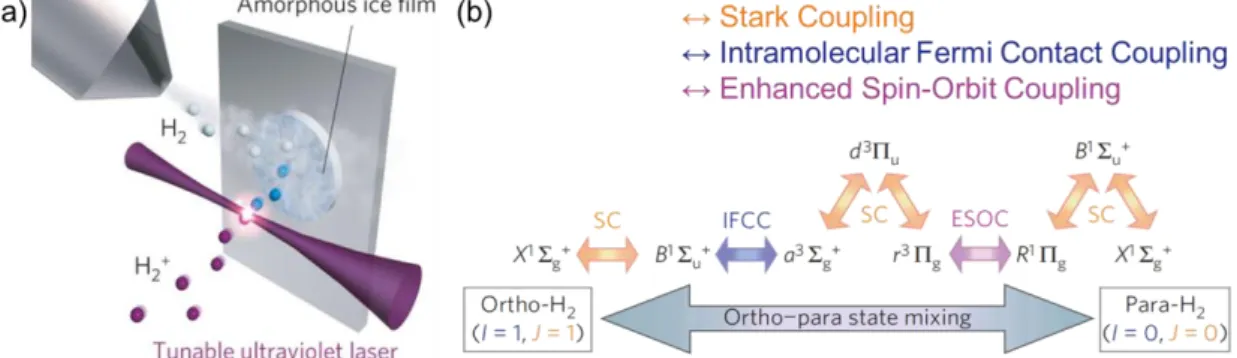
Highly pure amorphous solid water (ASW) systems have also been widely investigated for utility as the o-p conversion catalysts,15 where o-p conversion at a time of ~370 s on the surface has been observed by resonance-enhanced multi-photon ionization (REMPI) for the highly sensitive and rotational-state selective detection.15b In addition to the conversion acceleration by the ASW system, a mechanism of o-p conversion through excitation and relaxation processes induced by an inhomogeneous electric-field of 1010–1011 V m−1 on the catalyst surface has been proposed based on experimental results and theoretical analysis (Figure 4).15b In addition, there have been several proposed mechanisms for the activation of o-p conversions by giant inhomogeneous surface electric fields of non-magnetic materials.14g,16 However, in the case of ASW, sophisticated techniques for sample preparation and extremely low handling temperatures are required.
Figure 4. (a) Schematic experimental setup of resonance-enhanced multi-photon ionization (REMPI) for amorphous solid water (ASW) systems. (b) The state mixing of o-H2 and p-H2 under giant and inhomogeneous electric fields through stark coupling (SC:
orange), intramolecular Fermi contact coupling (IFCC: blue) and enhanced spin-orbit coupling (ESOC: purple).15b
Ortho-Para Conversion by Porous Coordination Polymers
In terms of contact probability with substrates and efficient excitation field, porous coordination polymers (PCPs), also known as metal-organic frameworks (MOFs), are expected to be effective as next generation o-p conversion catalysts that can be easily prepared and can replace conventional catalysts because of their high specific surface area and the local electric field in the pores. PCPs are a class of porous materials synthesized by self-assembly of metal ions or clusters as versatile nodes and organic ligands as bridging linkers and exhibit a variety of physical and chemical properties based on the component properties and the periodically ordered porous structure (Figure 5).17 Because molecules and ions can be adsorbed in the coordination space of PCPs through host-guest interactions (e.g. coordination bonds, van der Waals forces, electrostatic interactions, and π-π interactions), PCPs have been widely investigated to utilize as materials for various purposes (e.g. storage, separation, and catalysis; Figure 5). Contrary to the cases of conventional solid catalysts for o-p conversion, the improvement in o-p conversion efficiency of PCPs is expected because the coordination space, which limits the mobility of adsorbed H2 and enhances the effective surface area as well as the subsequent contact probability between the confined H2 and the framework.
The fundamental properties and quantum dynamics of H2 adsorbed in {ZnII4O(bdc)3} (MOF-5; bdc2− = 1,4-benzenedicarboxylate) were analyzed by in-situ diffuse reflectance infrared Fourier transform spectroscopy (DRIFTS), where slow o-p conversion was observed with a conversion rate of approximately 25 % h−1 at 30 K, although the o-p ratio [o-H2]/[p-H2] remains close to 3 for several hours in the adsorbent.18a In other PCPs, {MII2(dobdc)} (MOF-74(M); M = Mg, Co, Ni, and Zn;
dobdc4− = 2,5-dioxidobenzene-1,4-dicarboxylate), o-p conversions were spectroscopically confirmed as well.18b An extremely fast o-p conversion was observed in MOF-74(Zn) with a conversion time of ~10 min at 40 K by in-situ DRIFTS, whereas the o-p conversion observed in MOF-5 occurred over a few hours (Figure 6).18c However, no further analysis and discussion concerning the details (e.g. mechanism and driving force) were given unfortunately in both cases of MOF-5 and MOF-74(M).
Figure 6. (a) Schematic structure and components of MOF-5 and MOF-74(Zn). (b) Energy level diagram showing the rotational-vibrational transitions for H2, where ν is the vibrational quantum number. (c) In-situ diffuse reflectance infrared Fourier transform spectra (DRIFTS) of MOF-74(Zn) with different times of 55, 95, 135, 175, 280, 600, and 2700 s (from light green to brown) after loading 1.8 H2 per Zn at 40 K.18b
In order to investigate the mechanism of o-p conversion in PCPs, an experimental demonstration was performed for the first time using a Hofmann-type PCP, {FeII(pz)[PdII(CN)4]} (FePd-pz; pz = pyrazine) as a material for o-p conversion.19 At a gas pressure of 80 kPa, FePd-pz adsorbed H2 with the amount of 2.7 and 3.5 molecule pore–1 at 65 and 35 K, respectively (Figure 7a). Using a combination of in-situ powder X-ray diffraction (PXRD) measurement under an H2 atmosphere and a maximum entropy method (MEM), the adsorption sites of H2 were determined to be the pore center (site-I) and several sites scattered between adjacent pyrazine ligands (site-II) at 65 K, and a diagonally-extended site including the site-I region (site-III) at 35 K (Figure 7b). Site-III has a large local electric field of 7.62 × 10¹⁰ V m−1 at the diagonal ends, while site-I has almost no electric field, meaning that H2 confined in FePd-pz at 35 K receives a large electric field gradient through site-exchange inside site-III. During the cooling process, in-situ Raman spectroscopy under an H2 atmosphere revealed o-p conversion within 600 s, indicating that the large electric field gradient applied during the site-exchange of the confined H2 is effective for the swift o-p conversion (Figure 7c). Although the acceleration and the experimental elucidation of the mechanism of o-p conversion were successfully achieved, the observed conversion temperature was still around the boiling point of H2 (20.27 K), which is not suitable for practical catalytic acceleration.
Figure 7. (a) Schematic crystal structure and temperature-dependent H2 isotherm of {Fe(pz)[Pd(CN)4]} (FePd-pz; pz = pyrazine). (b) MEM charge densities as equidensity contour surfaces in H2 adsorption and one-dimensional absolute electric fields in the desorbed state along the [110] direction on the (001) plane at 35 and 65 K. (c) In-situ
Prussian Blue (PB) and Prussian Blue Analogs (PBAs)
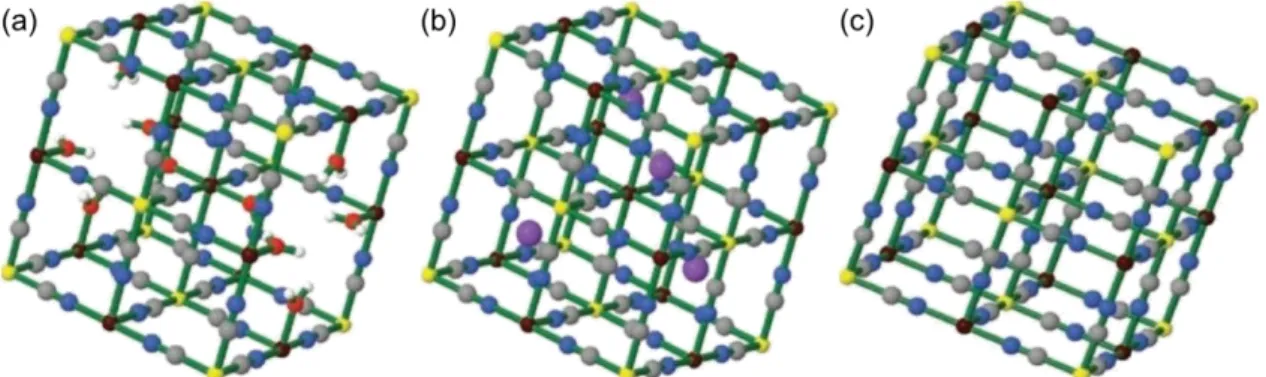
In order to improve o-p conversion temperature, we focused on Prussian Blue analogs (PBAs) as the next potential catalysts because of the H2 adsorption ability, ease of synthesis, diverse components, and local anisotropy derived from the defective structure. Prussian blue (PB), which is a dark blue metal complex with a chemical formula of {FeIII4[FeII(CN)6]3}, has been used as a blue pigment over 300 years ago and widely studied in various functional materials for several decades.20 Because PB is a mixed- valence complex, a combination of Fe2+ and [FeIII(CN)6]3− instead of that of Fe3+ and [FeII(CN)6]4− during synthetic process provides the same compound. The structure of PB was determined to be a 3-D cyano-bridged structure including water molecules (Figure 8a).21 Remarkably, PB is an aperiodic system because one-fourth of the [FeII(CN)6]4−
units result defects from the ideal framework structure because of the charge balance, and 1.5 H2O molecules on average are coordinated to the unsaturated octahedral Fe3+ site.
Alternatively, PBAs have a similar framework structure with a general chemical formula of {AxMay[Mb(CN)6]z}, where A are monovalent cations (e.g. alkali cations and quaternary ammonium ions), and Ma and Mb are divalent or trivalent metal ions in an octahedral geometry (Figure 8). When A+ ions are included into the framework or Ma and Mb ions have the same valence, the ideal frameworks can be the non-defective framework structure with the formula of {AIMaII[MbIII(CN)6]} and {MaIII[MbIII(CN)6]}, respectively (Figure 8b and Figure 8c). On the other hand, when Ma ions are divalent and Mb ions are trivalent, one-third of defects in [MIII(CN)6]3− moieties are formed in the framework structure of {Ma3[Mb(CN)6]2} (Figure 8a). The degree of freedom in the material design of PBAs is high thanks to a variety of metal ions.
Figure 8. Schematic crystal structure of Prussian Blue (PB) and Prussian Blue Analogs (PBAs). (a) {FeIII4[FeII(CN)6]3} or {MaII3[MbIII(CN)6]2}. (b) {AMaII[MbIII(CN)6]}. (c) {MaIII[MbIII(CN)6]}. All lattice water molecules are omitted for clarity. Color codes; H:
white, C: gray, N: blue, O: red, A: purple, FeIII for PB and Ma for PBAs: brown, FeII for
From the viewpoint of their porous structure, PBAs have been investigated as adsorbents for several kinds of small molecules and ions (e.g. CO2,22 ammonia (NH3)23, cesium ion (Cs+)24, and noble gases25). H2 adsorption in PBAs was performed for the first time using {MII3[CoIII(CN)6]2} (M3Co2; M = Mn, Fe, Co, Ni, Cu, Zn, and Cd) series.26a,b Moreover, H2 adsorption in other PBAs based on [MbII(CN)6]4– (M = Fe and Ru) unit27 and nitroprusside ([FeIII(CN)5(NO)]2–) unit28 has widely been reported as well as hexacyanometallate ([MIII(CN)6]3–; M = Fe, Co, Rh, and Ir) series.26
In terms of H2 adsorption sites in PBAs, the host-guest interactions between adsorbed H2 and PBA framework were directly observed in {MnII3[CoIII(CN)6]2} (Mn3Co2) by a differential X-ray and neutron pair distribution function (PDF) analysis, which revealed that the adsorbed H2 molecules are disordered at a single position of the pore center to obtain maximal van der Waals interactions.29a In {CuII3[CoIII(CN)6]2} (Cu3Co2), Rietveld structural refinement of the in-situ powder neutron diffraction measurement exhibited two H2 adsorption sites, which are the pore center as the most prominent adsorption site and the coordination site of the exposed Cu2+ center resulting from [CoIII(CN)6]3– vacancies (Figure 9a).29b Furthermore, in-situ neutron vibrational spectroscopy of Cu3Co2 showed that an energy band around 14.7 meV was distributed, which is assigned to a rotational transition between the ground states of o-H2 and p-H2 (J
= 0 ← 1), suggesting a range of local binding potentials of the adsorbed H2 because of the various potentials based on the different geometries of the Cu2+ sites (Figure 9b). In other words, the defective framework structure of PBAs can cause the split of rotational energy levels of adsorbed H2, possibly leading a change in [o-H2]/[p-H2] ratio from a theoretical ratio.
There is no report using PBAs as o-p conversion catalysts. In the case of FePd-pz which has regularly arranged pores, more than 2 molecules of H2 per pore can be absorbed and the swift o-p conversion occurs by a perturbation of the electric field gradient through site-exchange in a broadened adsorption site (site-III). On the other hand, the H2
adsorption amount in PBAs is usually less than 1 molecule per pore, which suggests that the adsorbed H2 has high mobility even in the pore and o-p conversion through the defective sites instead of the site-exchange is expected. Moreover, the relatively high structural stability of PBAs is the reason for selection, although PCPs with a defective framework usually tend to be structurally fragile. In addition to the dynamics of H2
molecules and the mechanical strength, from the aspect of the magnetic properties, while FeII-based Hofmann-type PCPs, {FeII(pz)[MII(CN)4]} (M = Ni, Pd, and Pt) has a diamagnetic framework at low temperature based on the Fe2+ in a low spin state,30 several PBAs can be porous magnets showing magnetic ordering at relatively higher temperature due to the short distances between the two different metal ions through the cyanide- bridge.31 Therefore, evaluation for o-p conversion under an external magnetic field can provide beneficial knowledge regarding the effect of the magnetic field induced in the pores of the PCP on the o-p conversion of H2. Among well-known hexacyanometallate units, because [MbIII(CN)6]3− (Mb = Co, Rh, and Ir) in d6 electron state is a diamagnetic unit and [FeIII(CN)6]3− unit in d5 electron state provides magnetic PBAs with low magnetic ordering temperature, we selected [CrIII(CN)6]3− in d3 electron state as the component unit of PBAs for o-p conversion catalysts. [CrIII(CN)6]3−-based PBAs usually have a higher magnetic ordering temperature than the boiling point of H2;31 however, their H2 adsorption property is quite unclear because of almost no reports about this property.
Hence, structural stability and adsorption ability of [CrIII(CN)6]3−-based PBAs are worth being investigated systematically for the evaluation of o-p conversion and other practical utilities.
Purpose of This Research
In this study, we systematically synthesized PBAs using [CrIII(CN)6]3− as a building unit. Then, their structural stability upon desolvation, adsorption capacity, and catalytic ability for the o-p conversion of H2 were investigated.
In Chapter 1, we have systematically synthesized defective [CrIII(CN)6]3−-based PBAs, {MII3[CrIII(CN)6]2} (M3Cr2; M = VO, Cr, Mn, Fe, Co, Ni, Cu, Zn, and Cd) and non-defective [CrIII(CN)6]3−-based PBAs,{InIII[CrIII(CN)6]} (InCr) as a control sample, based on a typical method for synthesizing PBAs and discussed their structural stability upon application of the desolvation process of vacuuming at different temperatures, using powder X-ray diffractometry (PXRD) and Fourier transform infrared spectroscopy (FT- IR) measurements. Moreover, their N2 and H2 adsorption measurements have been performed at 77 K. This research is the first report about H2 adsorption at liquid N2
temperature (77 K) in defective [CrIII(CN)6]3−-based PBAs with the chemical formula of {MII3[CrIII(CN)6]2} (M3Cr2), regardless of many reports about the H2 adsorption in PBAs based on other hexacyanometallates, [MIII(CN)6]3− (M = Fe, Co, Rh, and Ir).
In Chapter 2, we have aimed to improve o-p conversion temperature using defective PBAs, {MII3[CrIII(CN)6]2} (M3Cr2; M = Mn and Ni), which has local anisotropic pore spaces due to the structural defects and is expected to have the effect of a local electric field and magnetic field in the pores. We have confirmed the catalytic ability of M3Cr2 for the o-p conversion of H2 by in-situ Raman microspectroscopy under an H2 atmosphere at cryogenic temperatures (Figure 10). In the same way, we have evaluated the effect of the inner magnetic field of Mn3Cr2 on o-p conversion by the in- situ Raman microspectroscopy under an external magnetic field.
Reference
1. W. Zittel, R. Wurster, L. Bolkow, Advantages and Disadvantages of Hydrogen, Hydrog. in the Energy Sector. Systemtechnik Gmbitt, 1996.
2. (a) A. Züttel, A. Remhof, A. Borgschulte, O. Friedrichs, Philos. Trans. R. Soc. A Math. Phys. Eng. Sci., 2010, 368 (1923), 3329–3342.; (b) N. Gallandat, K.
Romanowicz, A. Züttel, J. Power Energy Eng., 2017, 5 (10), 34–49.
3. (a) R. von Helmolt, U. Eberle, J. Power Sources, 2007, 165 (2), 833–843.; (b) A.
Züttel, A. Remhof, A. Borgschulte, O. Friedrichs, Philos. Trans. R. Soc. A Math.
Phys. Eng. Sci., 2010, 368 (1923), 3329–3342.
4. (a) H. Jin, Y. S. Lee, I. Hong, Catal. Today, 2007, 120 (3–4), 399–406.; (b) G.
Hermosilla-Lara, G. Momen, P. H. Marty, B. L. Neindre, K. Hassouni, Int. J.
Hydrog. Energy, 2007, 32 (10–11), 1542–1553.; (c) Y. Feng, J. Wang, Y. Liu, Q.
Zheng, Cryogenics, 2019, 101, 36–42.
5. (a) F. Darkrim, A. Aoufi, P. Malbrunot, J. Chem. Phys., 2000, 112 (13), 5991–5999.;
(b) H. W. Langmi, A. Walton, M. M. Al-Mamouri, S. R. Johnson, D. Book, J. D.
Speight, P. P. Edwards, I. Gameson, P. A. Anderson, I. R. Harris, J. Alloys Compd., 2003, 356–357, 710–715.; (c) N. Bouaziz, M. B. Manaa, F. Aouaini, A. B. Lamine, Mater. Chem. Phys., 2019, 225, 111–121.
6. (a) M. A. El-Osairy, I. A. El-Osery, A. M. Metwally, M. M. Keshk, Int. J. Hydrog.
Energy, 1992, 17 (12), 961–964.; (b) B. Bogdanović, M. Schwickardi, Appl. Phys.
A Mater. Sci. Process, 2001, 72, 221–223.; (c) M. Resana, M. D. Hamptona, J. K.
Lomnessa, D. K. Slattery, Int. J. Hydrog. Energy, 2005, 30 (13–14), 1417–1421.;
(d) Y. Fu, M. Groll, R. Mertz, R. Kulenovic, J. Alloys Compd., 2008, 460 (1–2), 607–613.; (e) M. V. Lototskyy, V. A. Yartys, B. G. Pollet, R. C. Bowman Jr., Int. J.
Hydrog. Energy, 2014, 39 (11), 5818–5851.
7. (a) W. Luo, P. G. Campbell, L. N. Zakharov, S. Y. Liu, J. Am. Chem. Soc., 2011, 133 (48), 19326–19329.; (b) W. Luo, D. Neiner, A. Karkamkar, K. Parab, E. B.
Garner, D. A. Dixon, D. Matson, T, Autrey, S. Y. Liu, Dalton Trans., 2013, 42 (3), 611–614.; (c) M. E. Bluhm, M. G. Bradley, R. Butterick, U. Kusari, L. G. Sneddon, 2006, 128 (24), 7748–7749.; (d) R. J. Keaton, J. M. Blacquiere, R. T. Baker, J. Am.
Chem. Soc., 2007, 129 (7), 1844–1845.; (e) B. L. Davis, D. A. Dixon, E, B. Garner, J. C. Gordon, M. H. Matus, B. Scott, F. H. Stephens, Angew. Chem. Int. Ed., 2009, 48 (37), 6812–6816.
8. (a) A. Züttel, Mater. Today, 2003, 6 (9), 24–33.; (b) the United States Department of Energy (DOE), Target Explanation Document: Onboard Hydrogen Storage for
Energy, 2019, 44 (23), 11901–11919.
9. (a) A. Farkas, Orthohydrogen, Parahydrogen and Heavy Hydrogen, Cambridge Univ. Press, 1935.; (b) R. G. Bohn, C. F. Mate, Phys. Rev. B, 1970, 2 (6), 2121–
2126.; (c) J. E. Huebler, R. G. Bohn, Phys. Rev. B, 1978, 17 (4), 1991–1996.; (d) R. W. Harkness, W. E. Deming, J. Am. Chem. Soc., 1932, 54 (7), 2850–2852.
10. (a) J. C. Raich, J. R. H. Good, Astrophys. J., 1964, 139 (3), 1004–1013.; (b) R. B.
Scott, F. G. Brickwedde, H. C. Urey, M. H. Wahl, J. Chem. Phys., 1934, 2 (8), 454–
464.; (c) K. Motizuki, T. Nagamiya, J. Phys. Soc. Jpn., 1956, 11 (2), 93–104.; (d) F. Schmidt, Phys. Rev. B, 1974, 10 (10), 4480–4484.; (e) I. F. Silvera, Rev. Mod.
Phys., 1980, 52 (2), 393–452.
11. (a) N. S. Sullivan, D. Zhou, C. M. Edwards, Cryogenics, 1990, 30 (8), 734–735.;
(b) A. H. Larsen, F. E. Simon, C. A. Swenson, Rev. Sci. Instrum., 1948, 19 (4), 266–
269.; (c) C. R. Baker, R. L. Shaner, Int. J. Hydrog. Energy, 1978, 3 (3), 321–334.
12. (a) M. Pravica, I. Silvera. Phys. Rev. Lett., 1998, 81 (19), 4180–4183.; (b) J. H.
Eggert, E. Karmon, R. J. Hemley, H. K. Mao, A. F. Goncharov, Proc. Natl. Acad.
Sci. U.S.A., 1999, 96 (22), 12269–12272.
13. (a) K. F. Bonhoeffer, P. Harteck, Z. Phys. Chem., 1929, 4B (1), 113–141.; (b) L.
Farkas, L. Sandler, J. Chem. Phys., 1940, 8 (3), 248–251.; (c) D. H. Weitzel, O. E.
Park, Rev. Sci. Instrum., 1956, 27 (1), 57–58.; (d) D. H. Weitzel, W. V. Loebenstein, J. W. Draper, O. E. Park, J. Res. Natl. Bur. Std., 1958, 60 (3), 221–227.; (e) K. G.
Petzinger, D. J. Scalapino, Phys. Rev. B, 1973, 8 (1), 266–279.; (f) Y. Ishii, Prog.
Surf. Sci., 1986, 21 (2), 163–208.; (g) E. Ilisca, Prog. Surf. Sci., 1992, 41 (3), 217–
335.; (h) S. Paris, E. Ilisca, J. Phys. Chem. A, 1999, 103 (25), 4964–4968.
14. (a) P. Avouris, D. Schmeisser, J. E. Demuth, Phys. Rev. Lett., 1982, 48 (3), 199–
202.; (b) S. Andersson, J. Harris, Phys. Rev. Lett., 1982, 48 (8), 545–548.; (c) E.
Ilisca, Phys. Rev. Lett., 1991, 66 (5), 667–670.; (d) K. Fukutani, K. Yoshida, M.
Wilde, W. A. Diño, M. Matsumoto, T. Okano, Phys. Rev. Lett., 2003, 90 (9), 096103.; (e) K. Niki, T. Kawauchi, M. Matsumoto, K. Fukutani, T. Okano, Phys.
Rev. B, 2008, 77 (20), 201404.; (f) K. Fukutani, T. Sugimoto, Prog. Surf. Sci., 2013, 88 (4), 279–348.; (g) T. Sugimoto, K. Fukutani, Phys. Rev. Lett., 2014, 112 (14), 146101.
15. (a) N. Watanabe, Y. Kimura, A. Kouchi, T. Chigai, T. Hama, V. Pirronello,
A. Kouchi, Y. Kimura, T. Chigai, V. Pirronello, Astrophys. J., 2012, 757 (2), 185.;
(e) H. Ueta, N. Watanabe, T. Hama, A. Kouchi, Phys. Rev. Lett., 2016, 116 (25), 253201.
16. (a) E. Ilisca, Eur. Phys. Lett., 2013, 104 (1), 18001.; (b) E. Ilisca, F. Ghiglieno, Eur.
Phys. J. B, 2014, 87, 235.
17. (a) M. Eddaoudi, J. Kim, N. Rosi, D. Vodak, J. Wachter, M. O'Keeffe, O. M. Yaghi, Science, 2002, 295 (5554), 469–472.; (b) S. Kitagawa, R. Kitaura, S. Noro, Angew.
Chem., Int. Ed., 2004, 43 (18), 2334–2375.; (c) J. L. C. Rowsell, O. M. Yaghi, Micropor. Mesopor. Mater., 2004, 73 (1–2), 3–14.; (d) G. Férey, Chem. Soc. Rev., 2008, 37, 191.; (e) G. Férey, C. Serre, Chem. Soc. Rev., 2009, 38 (5), 1380–1399.
18. (a) S. A. FitzGerald, K. Allen, P. Landerman, J. Hopkins, J. Matters, R. Myers, J.
L. C. Rowsell, Phys. Rev. B, 2008, 77 (22), 224301.; (b) N. Nijem, J.-F. Veyan, L.
Kong, H. Wu, Y. Zhao, J. Li, D. C. Langreth, Y. J. Chabal, J. Am. Chem. Soc., 2010, 132 (42), 14834–14848.; (c) S. A. FitzGerald, J. Hopkins, B. Burkholder, M.
Friedman, J. L. C. Rowsell, Phys. Rev. B, 2010, 81 (10), 104305.
19. T. Kosone, A. Hori, E. Nishibori, Y. Kubota, A. Mishima, M. Ohba, H. Tanaka, K.
Kato, J. Kim, J. A. Real, S. Kitagawa, M. Takata, R. Soc. open sci., 2015, 2 (7), 150006.
20. (a) L. Samain, F. Grandjean, G. J. Long, P. Martinetto, P. Bordet, D. Strivay, J. Phys.
Chem. C, 2013, 117 (19), 9693–9712.; (b) M. Ware, J. Chem. Educ., 2008, 85 (5), 612–621.
21. (a) H. J. Buser, D. Schwarzenbach, W. Petter, A. Ludi, Inorg. Chem., 1977, 16 (11), 2704–2710.; (b) F. Herren, P. Fischer, A. Ludi, W. Haelg, Inorg. Chem., 1980, 19 (4), 956–959.
22. (a) R. K. Motkuri, P. K. Thallapally, B. P. McGrail, S. B. Ghorishi, CrystEngComm, 2010, (12), 4003–4006.; (b) P. K. Thallapally, R. K. Motkuri, C. A. Fernandez, B.
P. McGrail, G. S. Behrooz, Inorg. Chem., 2010, 49 (11), 4909–4915.; (c) F. Karadas, H. El-Faki, E. Deniz, C. T. Yavuz, S. Aparicio, M. Atilhan, Micropor. Mesopor.
Mater., 2012, 162, 91–97.; (d) S. H. Ogilvie, S. G. Duyker, P. D. Southon, V. K.
Peterson, C. J. Kepert, Chem. Commun., 2013, 49 (82), 9404–9406.
23. (a) A. Takahashi, H. Tanaka, D. Parajuli, T. Nakamura, K. Minami, Y. Sugiyama, Y. Hakuta, S. Ohkoshi, T. Kawamoto, J. Am. Chem. Soc., 2016, 138 (20), 6376–
6379.; (b) D. Parajuli, H. Noguchi, A. Takahashi, H. Tanaka, T. Kawamoto, Ind.
Eng. Chem. Res., 2016, 55 (23), 6708–6715.; (c) S. Manakasettharn, A. Takahashi, T. Kawamoto, K. Noda, Y. Sugiyama, T. Nakamura, Anal. Chem., 2018, 90 (7),
Appl. Mater. Interfaces, 2018, 10 (17), 15065–15072.; (e) Y. Jiang, A. Takahashi, T. Kawamoto, M. Asai, N. Zhang, Z. Lei, Z. Zhang, K. Kojima, K. Imoto, K.
Nakagawa, S. Ohkoshi, T. Nakamura, Chem. Commun., 2018, 54 (84), 11961–
11964.; (f) Y. Jiang, A. Takahashi, T. Kawamoto, M. Asai, N. Zhang, Z. Lei, Z.
Zhang, K. Kojima, T. Nakamura, Inorg. Chim. Acta, 2020, 501, 119273.
24. (a) H. Parab, M. Sudersanan, Water Res., 2010, 44 (3), 854860.; (b) M. Ishizaki, S.
Akiba, A. Ohtani, Y. Hoshi, K. Ono, M. Matsuba, T. Togashi, K. Kananizuka, M.
Sakamoto, A. Takahashi, T. Kawamoto, H. Tanaka, M. Watanabe, M. Arisaka, T.
Nankawa, M. Kurihara, Dalton Trans., 2013, 42 (45), 16049–16055.; (c) R. Chen, H. Tanaka, T. Kawamoto, M. Asai, C. Fukushima, M. Kurihara, M. Ishizaki, M.
Watanabe, M. Arisaka, T. Nankawa, ACS Appl. Mater. Interfaces, 2013, 5 (24), 12984–12990.; (d) T. Tatsuma, Y. Kuroiwa, K. Ishii, K. Kudo, A. Sakoda, Chem.
Lett., 2014, 43 (8), 1281–1283.; (e) X. Liu, G.-R. Chen, D.-J. Lee, T. Kawamoto, H. Tanaka, M.-L. Chen, Y.-K. Luo, Bioresour. Technol., 2014, 160, 142–149.; (f) J.
Liu, X. Li, A. I. Rykov, Q. Fan, W. Xu, W. Cong, C. Jin, H. Tang, K. Zhu, A. S.
Ganeshraja, R. Ge, X. Wang, J. Wang, J. Mater. Chem. A, 2017, 5 (7), 3284–3292.;
(g) T. Koshiyama, M. Tanaka, M. Honjo, Y. Fukunaga, T. Okamura, M. Ohba, Langmuir, 2018, 34 (4), 1666–1672.; (h) A. Takahashi, H. Tanaka, K. Minami, K.
Noda, M. Ishizaki, M. Kurihara, H. Ogawa, T. Kawamoto, RSC Adv., 2018, 8, 34808–34816.
25. M. Kämper, D.-C. M. Wagner, A. Weiss, Angew. Chem. Int. Ed., 1979, 18 (6), 486–
487.
26. (a) S. S. Kaye, J. R. Long, J. Am. Chem. Soc., 2005, 127 (18), 6506–6507.; (b) K.
W. Chapman, P. D. Southon, C. L. Weeks, C. J. Kepert, Chem. Commun., 2005, (26), 3322–3324.; (c) S. Natesakhawat, J. T. Culp, C. Matranga, B. Bockrath, J.
Phys. Chem. C, 2007, 111 (2), 1055–1060.; (d) S. S. Kaye, J. R. Long, Catal. Today, 2007, 120 (3–4), 311–316.; (e) L. Reguera, C. P. Krap, J. Balmaseda, E. Reguera, J. Phys. Chem. C, 2008, 112, (40), 15893–15899.; (f) C. P. Krap, J. Balmaseda, L.
F. del Castillo, B. Zamora, E. Reguera, Energy Fuels, 2010, 24 (1), 581–589.; (g) A.-H. Yuan, C.-X. Chu, H. Zhou, P. Yuan, K.-K. Liu, L. Li, Q.-F. Zhang, X. Chen, Y.-Z. Li, Eur. J. Inorg. Chem., 2010, (6), 866–871.; (h) J. Jiménez–Gallegos, J.
Rodríguez–Hernández, H. Yee–Madeira, E. Reguera, J. Phys. Chem. C, 2010, 114
Wang, N. Yan, Cryst. Growth Des., 2012, 12 (5), 2257−2264.; (l) B. Zamora, A. A.
Al-Hajjaj, A. A. Shah, D. V. Bavykin, E. Reguera, Int. J. Hydrog. Energy, 2013, 38 (15), 6406–6416.; (m) P. Bhatt, S. Banerjee, S. Anwar, M. D. Mukadam, S. S.
Meena, S. M. Yusuf, ACS Appl. Mater. Interfaces, 2014, 6, 17579−17588.; (n) N.
Torres, H. Osiry, A. Rodríguez, L. Martínez-dlCruz, A. A. Lemus-Santana, E.
Reguera, Z. Anorg. Allg. Chem., 2018, 644 (8–9), 415–423.
27. (a) M. Avila, L. Reguera, J. Rodríguez-Hernández, J. Balmaseda, E. Reguera, J.
Solid State Chem., 2008, 181 (11), 2899–2907.; (b) N. L. López, J. Rodríquez- Hernández, L Reguera, E Reguera, Eur. J. Inorg. Chem., 2019, (25), 3023–3032.
28. (a) J. T. Culp, C. Matranga, M. Smith, E. W. Bittner, B. Bockrath, J. Phys. Chem.
B, 2006, 110 (16), 8325–8328.; (b) L. Reguera, J. Balmaseda, C.P. Krap, E. Reguera, J. Phys. Chem. C, 2008, 112 (28), 10490–10501.; (c) L. Reguera, J. Roque, J.
Hernández, E. Reguera, Int. J. Hydrog. Energy, 2010, 35 (23), 12864−12869.
29. (a) K. W. Chapman, P. J. Chupas E. R. Maxey, J. W. Richardson, Chem. Commun., 2006, (38), 4013–4015.; (b) M. R. Hartman V. K. Peterson, Y. Liu, S. S. Kaye, J. R.
Long, Chem. Mater. 2006, 18 (14), 3221–3224.; (c) Y. Zhao, H. Xu, L. L. Daemen, K. Lokshin, K. T. Tait, W. L. Mao, J. Luo, R. P. Currier, D. D. Hickmott, Proc. Natl.
Acad. Sci. U.S.A., 2007, 104 (14), 5727–5731.
30. (a) V. Niel, J. M. Martinez-Agudo, M. C. Muñoz, A. B. Gaspar, J. A. Real, Inorg.
Chem., 2001, 40 (16), 3838–3839.; (b) G. Molnár, V. Niel, A. B. Gaspar, J.-A. Real, A. Zwick, A. Bousseksou, J. J. McGarvey, J. Phys. Chem. B, 2002, 106 (38), 9701–
9707.; (c) G. Molnár, V. Niel, J.-A. Real, L. Dubrovinsky, A. Bousseksou, J. J.
McGarvey, J. Phys. Chem. B, 2003, 107 (31), 3149–3155.; (d) S. Bonhommeau, G.
Molnár, A. Galet, A. Zwick, J. A. Real, J. J. McGarvey, A. Bousseksou, Angew.
Chem. Int. Ed., 2005, 44 (26), 4069–4073.; (e) S. Cobo, G. Molnár, J. A. Real, A.
Bousseksou, Angew. Chem. Int. Ed., 2006, 45 (35), 5786–5789.; (f) G. Molnár, S.
Cobo, J. A. Real, F. Carcenac, E. Daran, C. Vieu, A. Bousseksou, Adv. Mater., 2007, 19 (16), 2163–2167.; (g) I. Boldog, A. B. Gaspar, V. Martínez, P. Pardo-Ibañez, V.
Ksenofontov, A. Bhattacharjee, P. Gütlich, J. A. Real, Angew. Chem. Int. Ed., 2008, 47 (34), 6433–6437.; (h) M. Ohba, K. Yoneda, G. Agustí, M. C. Muñoz, A. B.
Gaspar, J. A. Real, M. Yamasaki, H. Ando, Y. Nakao, S. Sakaki, S. Kitagawa, Angew. Chem. Int. Ed., 2009, 48 (26), 4767–4771.; (i) P. D. Southon, L. Liu, E. A.
Fellows, D. J. Price, G. J. Halder, K. W. Chapman, B. Moubaraki, K. S. Murray, J.- F. Létard, C. J. Kepert, J. Am. Chem. Soc., 2009, 131 (31), 10998–11009.; (j) G.
Agustí, R. Ohtani, K. Yoneda, A. B. Gaspar, M. Ohba, J. F. Sánchez-Royo, M. C.
(k) M. Ohba, K. Yoneda, S. Kitagawa, CrystEngComm, 2010, 12 (1), 159–165.; (l) H. Ando, Y. Nakao, H. Sato, M. Ohba, S. Kitagawa, S. Sakaki, Chem. Phys. Lett., 2011, 511 (4–5), 399–404.; (m) R. Ohtani, K. Yoneda, S. Furukawa, N. Horike, S.
Kitagawa, A. B. Gaspar, M. C. Muñoz, J. A. Real, M. Ohba, J. Am. Chem. Soc., 2011, 133 (22), 8600–8605.; (n) F. J. M. Lara, A. B. Gaspar, D. Aravena, E. Ruiz, M. C. Muñoz, M. Ohba, R. Ohtani, S. Kitagawa, J. A. Real, Chem. Commun., 2012, 48 (39), 4686–4688.; (o) J. A. Rodríguez-Velamazán, M. A. González, J. A. Real, M. Castro, M. C. Muñoz, A. B. Gaspar, R. Ohtani, M. Ohba, K. Yoneda, Y. Hijikata, N. Yanai, M. Mizuno, H. Ando, S. Kitagawa, J. Am. Chem. Soc., 2012, 134 (11), 5083–5089.; (p) M. M. Deshmukh, M. Ohba, S. Kitagawa, S. Sakaki, J. Am. Chem.
Soc., 2013, 135 (12), 4840–4849.; (q) Z. Arcís-Castillo, F. Muñoz-Lara, M. C.
Muñoz, D. Aravena, A. B. Gaspar, J. F. Sánchez-Royo, E. Ruiz, M. Ohba, R.
Matsuda, S. Kitagawa, J. A. Real, Inorg. Chem., 2013, 52 (21), 12777–12783.; (r) D. Aravena, Z. A. Castillo, M. C. Muñoz, A. B. Gaspar, K. Yoneda, R. Ohtani, A.
Mishima, S. Kitagawa, M. Ohba, J. A. Real, E. Ruiz, Chem. Eur. J., 2014, 20 (26), 12864–12873.; (s) M. Castro, O. Roubeau, L. Piñeiro-Lopez, J. A. Real, J. A.
Rodríguez-Velamazan, J. Phys. Chem. C, 2015, 119 (30), 17334–17343.; (t) D. M.
Sagar, F. G. Baddour, P. Konold, J. Ullom, D. A. Ruddy, J. C. Johnson, R. Jimenez, J. Phys. Chem. Lett., 2016, 7 (1), 148–153.; (u) R. Ohtani, S. Hayami, Chem. Eur.
J., 2016, 23 (10), 2236–2248.; (v) C. H. Pham, F. Paesani, J. Phys. Chem. Lett., 2016, 7 (19), 4022–4026.; (w) C. H. Pham, J. Cirera, F. Paesani, J. Am. Chem. Soc., 2016, 138 (19), 6123–6126.; (x) Z.-P. Ni, J.-L. Liu, Md. N. Hoque, W. Liu, J.-Y. Li, Y.-C. Chen, M.-L. Tong, Coord. Chem. Rev., 2017, 335, 28–43.; (y) A. Mishima, T.
Koshiyama, J. A. Real, M. Ohba, J. Mater. Chem. C, 2017, 5 (15), 3706–3713.; (z) M. Sawczak, R. Jendrzejewski, D. Maskowicz, Y. Garcia, A. C. Ghosh, M. Gazda, J. Czechowski, G. Śliwiński, Eur. J. Inorg. Chem., 2019, (27), 3249–3255.
31. (a) T. Mallah, S. Thiébaut, M. Verdaguer, P. Veillet, Science, 1993, 262 (5139), 1554–1557.; (b) S. Ferlay, T. Mallah, R. Ouahès, P. Veillet, M. Verdaguer, Nature, 1995, 378, 701–703.; (c) O. Sato, T. Iyoda, A. Fujishima, K. Hashimoto, Science, 1996, 272 (5262), 704–705.; (d) M. Verdaguer, A. Bleuzena, V. Marvaud, J.
Vaissermann, M. Seuleiman, C. Desplanches, A. Scuiller, C. Train, R. Garde, G.
Gelly, C. Lomenech, I. Rosenman, P. Veillet, C. Cartier, F. Villain, Coord. Chem.
Ohba, S. Kitagawa, Inorg. Chem., 2004, 43 (23), 7339–7345.; (i) M. Zentková1, Z.
Arnold, J. Kamarád, V. Kavečanský, M. Lukáčová, S. Mat'aš1, M. Mihalik, Z.
Mitróová, A. Zentko, J. Phys.: Condens. Matter., 2007, 19 (26), 266217.; (j) S. S.
Kaye, H. J. Choi, J. R. Long, J. Am. Chem. Soc., 2008, 130 (50), 16921–16925.;
(k) H. Ohmagari, R. Ohtani, M. Nakaya, M. Ohba, M. Nakamura, L. F. Lindoy, O.
Sato, S. Hayami, Dalton Trans., 2016, 45 (42), 16784–16788.
Chapter 1
Evaluation of Structural Stability and Hydrogen Adsorption Ability
of Prussian Blue Analogs
Abstract
Prussian Blue analogs (PBAs) are a class of cyano-bridged porous coordination polymers (PCPs) with 3-D framework structure which have superior physical properties such as gas adsorption. Although a variety of studies on their excellent chemical and physical properties such as magnetism have vigorously proceeded, there are only a few reports about molecule adsorption in defective PBAs based on [CrIII(CN)6]3− moiety as the building units because of their relatively lower structural stability than that of PBAs consisting of other hexacyanometallate building units. Therefore, in this chapter, [Cr(CN)6]3−-based defective PBAs {MII3[CrIII(CN)6]2·nH2O} (M3Cr2·nH2O; M = VO, Cr, Mn, Fe, Co, Ni, Cu, Zn, and Cd) and a non-defective PBA {InIII[CrIII(CN)6]·nH2O}
(InCr·nH2O) as a reference material were used for systematic investigations on their structural stability and H2 adsorption ability for practical usage. From the results of powder X-ray diffractometry (RXPD) and Fourier transform infrared (FT-IR) spectroscopy of the samples activated at different temperatures, the activation temperature was optimized to be 60℃. Moreover, several PBAs with unsaturated metal sites which have high stability upon application of the activation process of heating under vacuum exhibited a large Brunauer-Emmett-Teller surface area (SABET) of 415–684 cm3 g−1 and a great H2 uptake of 1.06–1.42 wt% at 77 K and 100 kPa, which are sufficiently comparable to the reported values of other PBAs.
Introduction
Prussian Blue analogs (PBAs) are a class of cyano-bridged porous coordination polymers (PCPs) having a 3-D framework structure with a general chemical formula of {AxMay[Mb(CN)6]z}, where A is monovalent cations (e.g. alkali cations and quaternary ammonium ions) and Ma and Mb are divalent or trivalent metal ions. When Ma ions are divalent and Mb ions are trivalent, one-third of [MIII(CN)6]3− moieties become vacancy in the framework structure of {MaII3[MbIII(CN)6]2} because of the charge balance.1 From the viewpoints of the porous and defective structures, adsorption properties and subsequent utilities of PBAs have been widely investigated toward several kinds of small molecules and ions (e.g. carbon dioxide (CO2),1 ammonia (NH3)3, cesium ion (Cs+)4, and noble gases5). H2 adsorption property of PBAs has been reported for mainly {MII3[CoIII(CN)6]2} (M3Co2; M = Mn, Fe, Co, Ni, Cu, Zn, and Cd) series because of the relatively higher stability of [CoIII(CN)6]3− moiety than other [MbIII(CN)6]3− units.6 In addition, the H2 adsorption sites in Mn3Co2 and Cu3Co2 have been defined by in-situ diffraction techniques as well as adsorption behavior and amount.7
On the other hand, [CrIII(CN)6]3−-based PBAs have investigated as magnetic materials because of the d electronic structure of (t2g)3 and a short distance between Cr3+
and the other metal centers through the bridging ligand of CN− ion.8 Moreover, the reports about molecule adsorption or ion adsorption using [CrIII(CN)6]3−-based PBAs as the absorbents are extremely rare in spite of interests on the development of unique framework property interlocked with the adsorption property.6g,6l,8j Regarding H2
adsorption in [CrIII(CN)6]3−-based PBAs, although the abilities have been evaluated for non-defective PBAs including alkali ions in the pores6g and core-shell type PBAs,6l there is no report using defective [CrIII(CN)6]3−-based PBAs as H2 adsorbents at liquid N2
temperature (77K) which is the most common and convenient temperature for practical utility. Therefore, in this study, several defective PBAs {MII3[CrIII(CN)6]2·nH2O}
(M3Cr2·nH2O; M = VO, Cr, Mn, Fe, Co, Ni, Cu, Zn, and Cd) and non-defective PBA {InIII[CrIII(CN)6]·nH2O} (InCr·nH2O) as a reference metarial were systematically synthesized using [CrIII(CN)6]3− as building units, and their structural stability upon application of the activation process of heating under dynamic vacuum and H2 adsorption ability at 77 K were evaluated.
Physical Measurements
Carbon, Hydrogen, and Nitrogen Elemental Analysis (CHN-EA)
CHN-EA of C, H, and N atoms was conducted as quickly as possible after sample loading by the staff of the Technical Support Division, Graduate School of Science, Kyushu University.
Energy Dispersive X-ray Fluorescence (EDXRF) Analysis
EDXRF analysis was conducted on a Shimadzu Rayny EDX-720 to detect elements with an atomic number greater than or equal to 12 in the ambient air at RT. The results were averaged over three runs. X-ray voltage: 50 kV, X-ray current: 30 µA.
Thermogravimetry analysis (TGA)
TGA was conducted on a PerkinElmer STA6000 as quickly as possible after sample loading under a dry N2 atmosphere. Sample weight: ~10 mg, temperature range:
25–725℃, heating rate: 10℃ min−1, N2 gas flow rate: 19.8 ml min−1. Fourier Transform Infrared (FT-IR) Spectroscopy
FT-IR spectroscopy was conducted on a PerkinElmer FT-IR Spectrometer Spectrum Two using a universal attenuated total reflection (UATR) method in the ambient air at RT. Wavenumber range: 4000–400 cm−1, resolution: 4 cm−1, integrated number: 4 times.
Powder X-ray Diffractometry (RXPD)
RXPD was conducted on a Rigaku Ultima IV diffractometer using graphite- monochromated CuKα radiation and reflection-free single-crystal Si sample holder in the ambient air at RT. X-ray wavelength: 1.54184 Å, X-ray voltage: 40 kV, X-ray current: 40 µA, angle range: 5–60°, scan rate: 1° min−1, data collecting step: 0.02°, integrated number: 1 time.
Adsorption and Desorption Measurements
N2 (99.999%) and H2 (99.999%) adsorption/desorption measurements were conducted on MicrotracBEL BELSORP-max volumetric adsorption equipment at 77 K
Sample Preparation
All the chemicals were purchased as reagent grade and used without further purification. All the prepared samples were stored in a vial with screw cap and allowed to stand at 20 ℃ in the dark right before the measurements, and characterized by carbon, hydrogen, and nitrogen elemental analysis (CHN-EA), energy dispersive X-ray fluorescence (EDXRF) analysis, thermogravimetry analysis (TGA), Fourier transform infrared (FT-IR) spectroscopy, and powder X-ray diffractometry (RXPD).
K3[CrIII(CN)6]
K3[Cr(CN)6] was synthesized according to a reported synthetic method with some modifications.9 Mossy Zn (6.0 g, 91.8 mmol) was activated by immersing in 1 M HCl for 5 min, thoroughly washed with distilled water, and dried well in advance. Then the activated mossy Zn was added to a degassed aqueous solution (40 mL) of CrCl3·6H2O (20.0 g, 75.1 mmol) under an N2 gas atmosphere at RT. After stirring over 3 h and removal of the remaining unreacted Zn by suction filtration, a solid CH3COONa·3H2O (24.0 g, 176.4 mmol) was added to the resultant deep blue solution, which resulted in a rapid precipitate of chromium(II) acetate as a bright red powder. The precipitate was collected by suction filtration under an N2 gas atmosphere, repeatedly washed with degassed water, and dissolved in a degassed aqueous solution (50 ml) of KCN (30.0 g, 460.7 mmol). After removal of the slight precipitate by suction filtration, an excess amount of methanol (~500 ml) was added to the dark green filtrate, which provided K4[CrII(CN)6] as a light green precipitate. The precipitate was collected by suction filtration, repeatedly washed with methanol, and allowed to stand over 2 h for the air oxidation of the CrII ion. After completion of color change to yellow, a few repeated reprecipitation from water by the addition of an excess amount of methanol gave pure K3[CrIII(CN)6]. Yellow crystalline powder. Yield: 15.5 g (47.7 mmol, 63.5% vs. CrCl3·6H2O). FT-IR (cm−1): ν(C≡N) = 2130;
ν(Cr–C) = 454 (vs). EDXRF analysis (%): [K]/[Cr] = 2.85. No other elements were detected.
(VIVO)3[CrIII(CN)6]2·nH2O} ((VO)3Cr2·nH2O)
All the operations for the synthesis were conducted in the dark to avoid the decomposition of K3[CrIII(CN)6]. An aqueous solution (10 mL) of K3[CrIII(CN)6] (325.4 mg, 1.0 mmol) was added dropwise to an aqueous solution (10 mL) of VIVOSO4·xH2O (x
= 3–4; 397.0 mg, ~1.8 mmol) with vigorous stirring at RT, resulting in precipitation of light green solid. After completing the drop and subsequent stirring for 10 mins, the dark gray suspension was allowed to stand at 10 ℃ for 1 week. After the standing, the dark gray precipitate was collected by centrifugation, repeatedly washed with distilled water to remove the unreacted reactants and the byproduct of K2SO4, and dried in the air. Dark gray powder. CHN-EA (%): Found: C 17.28, H 2.96, N 19.92; Calculated for {(VIVO)3[CrIII(CN)6]2·12H2O} (C12H24N12O15V3Cr2): C 17.30, H 2.90, N 20.17. FT-IR (cm–1): ν(H2O) = 3750–2800 (m, br), 3656 (w); ν(C≡N) = 2178 (m); δ(H2O) = 1675 (w), 1606 (m); ν(V=O) = 977; ν(Cr–C) = 500 (vs), 419 (s). EDXRF analysis (%): [V]/[Cr] = 1.63; [K]/[V] = 0.03; [S]/[V] = 0.03.
{CrII3[CrIII (CN)6]2·nH2O} (Cr3Cr2·nH2O)
All the operations for the synthesis were conducted in the dark and under an Ar atmosphere to avoid the decomposition of K3[CrIII(CN)6] and the oxidation of the Cr2+
ion, respectively. A deoxidized aqueous solution (10 mL) by Ar-bubbling of K3[CrIII(CN)6] (325.4 mg, 1.0 mmol) was added dropwise to a deoxidized aqueous solution (10 mL) by Ar-bubbling of CrIICl2 (221.2 mg, 1.8 mmol) with vigorous stirring at RT, resulting in precipitation of black solid. After completing the drop and subsequent stirring for 10 mins, the black suspension was allowed to stand at 10 ℃ for 1 week. After the standing, the black precipitate was collected by centrifugation, repeatedly washed with distilled water to remove the unreacted reactants and the byproduct of KCl, and dried in the air. Gray powder. CHN-EA (%): Found: C 17.26, H 3.71, N 19.78; Calculated for {CrII3[CrIII(CN)6]2·15H2O} (C12H30N12O15Cr5): C 17.11, H 3.59, N 19.95. FT-IR (cm–1):
ν(H2O) = 3750–2700 (m, br), 3658 (w); ν(C≡N) = 2187 (m); δ(H2O) = 1632 (m); ν(Mn–
C) = 522 (vs), 436 (s). EDXRF analysis (%): [K]/[Cr] = 0.01; [Cl]/[Cr] = 0.02.
{MnII3[CrIII (CN)6]2·nH2O} (Mn3Cr2·nH2O)
All the operations for the synthesis were conducted in the dark and under an Ar atmosphere to avoid the decomposition of K3[CrIII(CN)6] and the oxidation of the Mn2+
ion, respectively. A deoxidized aqueous solution (10 mL) by Ar-bubbling of K3[CrIII(CN)6] (325.4 mg, 1.0 mmol) was added dropwise to a deoxidized aqueous solution (10 mL) by Ar-bubbling of MnIICl2·4H2O (356.2 mg, 1.8 mmol) with vigorous stirring at RT, resulting in precipitation of light green solid. After completing the drop and subsequent stirring for 10 mins, the light green suspension was allowed to stand at 10 ℃ for 1 week. After the standing, the light green precipitate was collected by centrifugation, repeatedly washed with distilled water to remove the unreacted reactants and the byproduct of KCl, and dried in the air. Light green powder. CHN-EA (%): Found: C 16.47, H 3.77, N 19.18; Calculated for {MnII3[CrIII(CN)6]2·16H2O} (C12H32N12O16Cr2Mn3): C 16.53, H 3.70, N 16.53. FT-IR (cm–1): ν(H2O) = 3750–2800 (m, br), 3651 (w), 3600 (w);
ν(C≡N) = 2158 (m); δ(H2O) = 1607 (m); ν(Cr–C) = 472 (vs). EDXRF analysis (%):
[Mn]/[Cr] = 1.38; [K]/[Cr] = 0.01; [Cl]/[Cr] = 0.00.
{FeII3[CrIII(CN)6]2·nH2O} (Fe3Cr2·nH2O)
All the operations for the synthesis were conducted in the dark and under an Ar atmosphere to avoid the decomposition of K3[CrIII(CN)6] and the oxidation of the Fe2+
ion, respectively. A deoxidized aqueous solution (10 mL) by Ar-bubbling of K3[CrIII(CN)6] (325.4 mg, 1.0 mmol) was added dropwise to a deoxidized aqueous solution (10 mL) by Ar-bubbling of FeIICl2·4H2O (357.9 mg, 1.8 mmol) with vigorous stirring at RT, resulting in precipitation of orange solid. After completing the drop and subsequent stirring for 10 mins, the orange suspension was allowed to stand at 10 ℃ for 1 week. After the standing, the orange precipitate was collected by centrifugation, repeatedly washed with distilled water to remove the unreacted reactants and the byproduct of KCl, and dried in the air. Orange powder. CHN-EA (%): Found: C 16.51, H 3.71, N 19.22; Calculated for {FeII3[CrIII(CN)6]2·16H2O} (C12H32N12O16Cr2Fe3): C 16.53, H 3.70, N 19.28. FT-IR (cm–1): ν(H2O) = 3750–2800 (m, br), 3648 (w), 3600 (w); ν(C≡N)
= 2162 (m), 2102 (w); δ(H2O) = 1609 (m); ν(Cr–C) = 480 (vs). EDXRF analysis (%):
[Fe]/[Cr] = 1.75; [K]/[Fe] = 0.00; [Cl]/[Fe] = 0.04.
![Table 1-1. The observed and ideal values of carbon, hydrogen, and nitrogen elemental analysis (CHN-EA) and calculated number of H 2 O molecules (n) for the as-synthesized PBAs, {M II 3 [Cr III (CN) 6 ] 2 ·nH 2 O} (M 3 Cr 2 ·nH 2 O; M = VO, Cr, Mn, Fe, Co](https://thumb-ap.123doks.com/thumbv2/123deta/9794601.1877119/38.892.132.767.717.1044/observed-hydrogen-nitrogen-elemental-analysis-calculated-molecules-synthesized.webp)
![Figure 1-3. TGA curves of the as-synthesized PBAs {M II 3 [Cr III (CN) 6 ] 2 ·nH 2 O}](https://thumb-ap.123doks.com/thumbv2/123deta/9794601.1877119/48.892.139.754.161.846/figure-tga-curves-synthesized-pbas-ii-cr-iii.webp)
![Figure 1-5. PXRD patterns in the ambient air at RT and photographs of the as-synthesized sample {(V IV O) 3 [Cr III (CN) 6 ] 2 ·nH 2 O} ((VO) 3 Cr 2 ·nH 2 O: dark blue) and its activated](https://thumb-ap.123doks.com/thumbv2/123deta/9794601.1877119/53.892.142.762.157.933/figure-pxrd-patterns-ambient-photographs-synthesized-sample-activated.webp)
![Figure 1-6. PXRD patterns in the ambient air at RT and photographs of the as-synthesized sample {Cr II 3 [Cr III (CN) 6 ] 2 ·nH 2 O} (Cr 3 Cr 2 ·nH 2 O: green) and its activated samples heated at different activation temperatures (T act ) of 20,](https://thumb-ap.123doks.com/thumbv2/123deta/9794601.1877119/54.892.139.762.157.938/figure-patterns-photographs-synthesized-activated-different-activation-temperatures.webp)
![Figure 1-7. PXRD patterns in the ambient air at RT and photographs of the as-synthesized sample {Mn II 3 [Cr III (CN) 6 ] 2 ·nH 2 O} (Mn 3 Cr 2 ·nH 2 O: pink) and its activated samples](https://thumb-ap.123doks.com/thumbv2/123deta/9794601.1877119/55.892.138.760.153.928/figure-patterns-ambient-photographs-synthesized-sample-activated-samples.webp)
![Figure 1-8. PXRD patterns in the ambient air at RT and photographs of the as-synthesized sample {Fe II 3 [Cr III (CN) 6 ] 2 ·nH 2 O} (Fe 3 Cr 2 ·nH 2 O: orange) and its activated samples heated at different activation temperatures (T act ) of 20,](https://thumb-ap.123doks.com/thumbv2/123deta/9794601.1877119/56.892.139.761.159.923/figure-patterns-photographs-synthesized-activated-different-activation-temperatures.webp)
![化 学 1 7 [ 解答にあたって, 必要があれば次の値を用いること ] 原子量 :H 1. 0, C 12, O 16 Ⅰ プロペンと等しい物質量の臭化水素を瓶の中に封じ込めたところ, 反応が開始した この反応に ついて, 問 ₁ ~ ₆ に答えよ 問 ₁ この反応では,₂ 種類の可能な構造異性体](data:image/gif;base64,R0lGODlhAQABAIAAAP///wAAACH5BAEAAAAALAAAAAABAAEAAAICRAEAOw==)