A contrastive study of the lexicogrammar of 'modal verbs' in English and Japanese : a systemic functional approach
著者(英) Hiroshi Funamoto
journal or
publication title
Core
number 33
page range 27‑51
year 2004‑03‑15
URL http://doi.org/10.14988/pa.2017.0000015059
A Contrastive Study of the Lexicogrammar of 'Modal Verbs' in English and Japan凶:A eSystemic Functional Approach 27
A C o n t r a s t i v e Study o f t h e Lexicogrammar o f 'Modal V e r b s ' i n E n g l i s h and J a p a n e s e :
A Systemic F u n c t i o n a l Approach
H i r o s h i Funamoto
1. Introduction
This paper is aimed at examining the differences and similarities in the treatment of 'modal verbs' in English and the semantically equivalent expressions in Japaneseヲwhichare referred to generally as 'jodooshi' (='auxiliary verb') in traditional Japanese grammar. The focus will be on the contrastive analysis of modal verbs and 'jodooshi' in the two languages at the level of form, rather than describing the semantic interpretations of these expressions at the level of meaning.
It is generally assumed出atwe can safely recognize 'modal verb' as a relevant categoηT in grammar of English. For most scholars it includes the items can, could, mα:y, might,山ll,would, shαll, should, must, ought to, and perhaps dαre and need. Quirk et al. (1985: 137入forinstance, proposes four modal auxiliary criteria', which distinguish the central modals' from other auxiliaries and main verbs. Thus, the categorization of the set of these items into modal verb' in English grammar is primarily based on the view that the category can be defined explicitly in terms of some syntactic properties that these items have in common. At
28 A Contrastive Study of the Lexicogrammar of明日dalVerbs' in English aodJap組 問ASystemic Functional Approach the same time, however, it seems that the modal verbs, as its name implies, are characterized as a grammatical device which inherently expresses modality'. As we will shortly see, 1 will claim that the modal verbs' in fact have potential of carrying richer meanings than modality', and that the term 'modal verb' should be abolished in a functional analysis of English. CNonetheless, we will find that the term has some use as a label for a set of items at the level of form.)
In recent studies of J apanese linguistics, some scholars have attempted to apply the concept of modalityフtothe interpretation of cerlain auxiliary verbs', which are referred to generally as 'jodooshi' in Japanese. However, most of such descriptions are based primarily on English grammar. For those scholars, the expressions which are used to denote 'modality' are regarded as 'modal expressions', some of which are referred to particularly as 'jodooshi', because some meanings expressed in this item can be related, at a conceptual level, to the modal verbs in English. However, it is not in fact possible to identify a category in Japanese which is equivalent to the modal verbs' in English in terms of some syntactic criteria which can be seen in Section 2. The purpose of this paper is to examine the treatment of 'jodooshi' to see whether it actually recognized as a marker of the unified concept ofmodality'.
The theoretical framework adopted in this study is Systemic Functional Linguistics, as developed by M.A.K. Halliday and other scholars (e.g. Halliday 1993, 1994, 1998; Halliday and Matthiessen 1999).1 Note that the descriptive model of grammar is distinguished from the
A Contrastive Study of the Lexicogrammar of羽odalVerbs' in English and Japanese: A Systemic Functional Approach 29 theoretical framework of SFL in genera1.2 The general theory of SFL provides the essential views on language such as 'metafunction', 'level' and system', which are common basis of analyzing any language. Yet the relevant model of describing a particular language should be developed in its own terms so that the language can be described in the light of the actual use of linguistic expressions, i.e. a text¥In this paper 1 will particularly refer to Halliday and Matthiessen's grammatical model in the analysis of the modal verbs for English. On the other hand, in the analysis of 'jodooshi' in Japanese, 1 will draw on Tatsuki's model, which is recently referred to as the Kyoto Grammar.
2. Criteria for identifying the modal verbs in English
Halliday (1970: 330) shows the list of properties which are the criteria for identiちringthe modal verbs in English as follows:3
(i) they have only finite forms: there is no to cαn, Cαnning (forms such as to beαble are not modalities)
(ii) they form negative and interrogative without expansion, the negative also being reducible: he cαnnot (cαn't), Cαn he?, not he doesn't cαn, does he?
(iii) they are used as 'code verbs' in ellipsis:勺anyou swim?' yes 1 c
αn; so cαnI.
(iv) they have three prosodic values, remiss (unstressed), ictus (secondary stress) and tonic (primary stress): //八 hecan / go // ,
30 A Contrastive Study ofthe Lexi∞grammar ofModal Verhs' in English and J apanese: A Systemic Fnnctional Approach
/ /
^
he / can / go // , //^
he / can / go // , the unstressed formbeing normally reduced; these are systematic variants, differing in meaning in a regular way.
(v) they do not take ‑s on the third person sin♂Ilar: he cαn not he cαns
(vi) they do not occur in imperative (vii) they do not combine with each other
The properties in (v) to (vii) are of particular significance in distinguishing the modal verbs from other 'verbal auxiliaries', such as be, get, hαve and do. As you can see in this list, Hallidaデsseven criteria for identifying the modal verbs are based on the syntactic properties rather than their semantic interpretations. The list provides us with a common framework for comparing the sets of 'modal verbs' in English and Japanese at the level of form. But the question is:官owis it useful to identify the modal verbs in terms of some syntactic properties that they reveal? Is there any good reason to treat them as a category which realize the functions in a unified area of meaning such as 'modality'? In a functional analysis of language, we look at the instances of the language use from a functional point ofview.
In the next section, let us consider Halliday's FUNCTIONAL treatment of the modal verbs in English which fulfill the syntactic criteria shown above. Then, in the subsequent sections, we will inquire into the treatment of the lexicogrammar of 'jodooshi' in J apanese in comparison
ACo政側iveStudy of the IAxiωgramm訂of包odalVerbs' in English and Japanese: A Systemic Functional Approach 31 with the English modals from the viewpoint Systemic Functional Linguistics.
2.1 Further notes on Halliday's treatment of'modal verbs' in English In the previous section, we looked at the syntactic properties of modal verbs at the level of form. In this section we wiU explore the lexicogrammar of modal verbs in English from a functional viewpoint.
In Halliday's seminal bookヲIntroductionto Functionαl Grαm mαr (IFG) , modal verbs are regarded as an element which is referred to as 'Finite modal operator' or simply Finite'. Thus if we follow Hallidayan approach, the modal verbs can be interpreted in terms of a tripartite element carrying the properties of包nite','modal' and operator'. The term 官nite'is already seen in the first parameter of the syntactic criteria shown in Section 2 above. However, notice that it is used in different senses between Hal1iday (1970) and IFG. In IFG, Halliday define自'finite' in terms of a rather functional‑oriented point of view. He states as follows:4
The finite element, as its name implies, has the function of making the proposition finite. That is to say, it circumscribes; it brings the proposition down to earth, so that it is something that can be argued about.
Halliday goes on characterizing the function of the finite element as
32 ACon廿astiveStudy of仕leLexiωgramm釘of官!odalVerbs' in English and Jap組ese:A Systemic Functional Approach 'finiteness' in the systemic description of this element, which 'is thus expressed by means of a verbal operator which is either temporal or modal,•5 The system for 噴 出teness'can be illustrated in Figure 1.
I temporal finiten巴ss一一一寸
い modal
Figure 1: The system forfiniteness'
In the system for 官niteness'in Figure 1, if we choose the feature [modal ,]it will generate a modal verb. It should be noted, however, that the feature [modall leads to further system so that the relevant modal verb, such as mαy instead ofωill, cαn, etc., can be obtained proper1y. The system, or specifically the network of systems, is 児 島 町edto as 'modality'.
2.2 Modal verbs expressing modality' in English
According to Halliday, there are two broad types of 'modality' in English ‑those ofmodalization' and modulation', which are roughly equivalent to 'epistemic' and deontic' moda1ity in traditional grammar.
Halliday's system network for modality' which generates the modal verbs' is shown in Figur・e2.
Here, to avoid unnecessary discussion, let us ignore the features which are not relevant to the generation of the modal verbs'. According to Halliday,modality' consists of two major types of meaning,
A Contrastive S日七dyof the Lexicogrammar ofModal Verbs' in English and Japanese: A Syst~mic Functional Approach 33
r probability
modality
r modalization ‑一一一→l TVPE ~I L usuality
(4) . I
L modulation一一一一一一州
ORIENTATION (4)
VALUE (3)
POLARITY (3)
L obligation
ー [ 脚 ‑ f i s h
告LEad;
→
[::Led Fi♂lre 2: Halliday's system network for modality' (1994: 360)'modalization' and modulation', which lead to further two subtypes respectively, as shown in the system for 'TYPE' in Figure 2 ‑'probability' and 'usuality' as types ofmodalization', and 'inclination' and 'obligation' as types of 'modulation¥Hallidayar♂les that all of these four types of modality' can be expressed by a modal verb. Note that the features which distinguish the modal verbs from other verbal and non‑verbal
34 A Contrastive Study of the Lexicogrammar ofModal Verbs' in English and Japanese白ASystemic Functional Approach forms, such as be sure to and perhαps, can be found in the
ORIENTATION' network, which leads to two sub‑systems ‑one is concerned with the distinction between subjective' and objective', and the other is concerned with the distinction between explicit' and implicit'. In order to obtain the modal verbs, both [subjectivel and [implicitJ have to be chosen simultaneously from the two systems.
句TALUE' is another system which distinguishes the degree of speaker's confidence about the truth of proposition. For example, if the speaker's confidence is 'high', it is realized by must. Whereas ifthe speaker chooses the feature [low ,]it is realized by mα.y or cαn.
Consequently, modal verbs can be seen, in Ha1lidayan description in IFG, as an element which rea1izes the bundle offeatures that are chosen simultaneously from the system network for modality'.
2.3 Modal verbs expressing MOOD' meanings in English
Finally, let us examine the third property of modal verb as a tripartite element, i.e. the function of the 'operator'. Let us consider the following examples:
(1) His testimony can be credible. (2) Can his testimony be credible?
If we compare (1) and (2), we can find that the modal verb cαn contributes to expressing the communication role in an exchange of the
A Contrastive Study of出eLexicogrammar of'Modal Verbs' in English and Japanese: A Systemic Functional Approach 35 message. In (1), the speaker is giving information to the addressee, whereas in (2) he or she is seeking for the addressee's certification about 'yes' or 'no'. In SFL such meanings of information giver' and information seeker', or strictly polarity seeker', are referred to as types of MOOD, and the above examples clearly demonstrate that the modal verb contributes to expressing the MOOD meanings BY ITS PRESENCE AT A CERTAIN POSITION IN RELATION TO THE SUBJECT IN THE CLAUSE as well as 'modality'. For this reason, it is possible to regard a modal verb as an operator, in that it serves a grammatical function of forming the Mood structure in the clause. The function of the operator is syntactic rather than semantic, because the basic function of this element is to realize the MOOD meaning by changing the ORDER of the Subject and the Finite. Thus Halliday's term Finite modal operator' mixes up the properties which should be dealt with at different levels. On the one hand, 'modality' is an area of meaning which is described as the set of options which can be selected through the traversal of吐1esystem network at the level of meaning. The operator, on the other hand, functions as an element of structure of the clause at the level of form. Furthermore, it seems that the terms笥nite'andmodal' are redundant, because once you enter the system for finiteness', you must express either tense' or 'modality'.
Up to this point, we have come to the point that the functionallabel of the so‑called modal verbs in English is proposed in this paper. As we have see, Halliday's term 笥nitemodal operator' has problems of (i) the
36 A Contrastive Study ofthe Lexicogrammar of'Modal Verbs' io EngiJsh and Japa醐e:A Systemic Functional Approach confusion of different levels and (ii) the redundancy of the labels. In my opinion, the term Finite' should be abolished for the reason mentioned above. Instead, 1 suggest that the modal verbs are simply 児 島 町edto as the 'Operator' at the level ofform.6
3 The functional view on 'jodooshi' in Japanese
In the previous sections, we looked at a systemic functional approach to the treatment of the modal verbs in English with special reference to Halliday's descriptive model of SFL. We saw that the English modal verbs may express meanings which are said to be some types of 'modality¥However, if we analyze these items at the level of form, it serves the function ofrealizing the MOOD meaning by its presence in the clause. As a consequence, the grammatical function of the modal verbs should be regarded as an element of the clause, and this is referred to as the Operator. In this section, we willlook at the expressions which are referred to as 'jodooshi' (i.e. 'auxiliarてyverb') in Japanese.
3.1 Basic structure ofthe simple clause in Japanese
Before analyzing the lexicogrammar of 'jodooshi' in Japanese, let us consider the structure of the basic unit in J apanese. Generally speaking, Japanese is typologically classified as an SOV language, whereas English is classified as an SVO language. Howeverヲthefact is that a Japanese 'sentence' typically ends in a verbal element such as a verb, an adjective, or an adjectival, and the order of the other elements in the sentence is
A ContJ'astive StudyぱtheLexicogrammar of'Modal Verbs' in English and Japan飽:A eSystemic Functional Approach 37 relatively free ‑i.e. the order of S and 0 is determined by another factor. Consider the following example:
(3) Sono kanja wa kinoo byooin de kangofu ni shokuji 0
the patient yesterday hospital nurse meal tabe ‑sase ‑temorawa ‑nakerebanaranakatta ‑sooda ‑ne. eat CAUS BENEFAC msut ‑PAST TENSE HEARSAY P (1 heard that the patient had to be given hand of a nurse to eat the meal at the hospital yesterday, didn't he?)
The hyphen which is put at the initial part of the items in (3) indicates that it agglutinates to the preceding item and the order of the two items is not interchangeable. If you look at the example (3), you will find that all hyphenated items occur after the main verb t,αbe (eat), and each item carries the function of a grammatical marker rather than that of expressing a lexical meaning. The structure of (3) can be illustrated in Figure (3).
回竺担竺出型盟
i
│kinoo (adv町bial:TIME) ! lbyooin必(adv町b凶。PLACE)!
│gangofu ni (nominal) !
i !
‑qu一一n一
j
一m
一
一O一
一n一
:
一O一
]
一EH川d一一U守 一
‑LM‑
一O一 7n
‑
‑n
a一
L‑..I 1
Pre目Predicateelements Predicate Post‑Predicate elements Figure 3: The basic structure of a simple clause in J apanese
38 A Contrastive Study of the Lexicogrammar ofModal Verbs' in English and Japanese: A Systemic Functional Approach Let us assume that we can treat the main verb tαbe as a type of the 'Predicate' (which can be expounded by other types including so‑called adjectives and adjectivals). The basic structure of a Japanese simple clause consists of three parts, pre‑Predicate elements, a Predicate and Post‑Predicate elements.
A typical characteristic of the Japanese language is that any of these three parts can be ellipsed. For instance, we can have various combinations of the three parts as follows:
(4) A: Kimi wa sore 0 doko de tabeta? you it where eat‑past (Where did you eat it?)
B: Byooin de tabeta固
in hospital eat‑past (1 ate it in the hospital.)
(5) A: Kimi wa sore 0 itsu tabeta? You it when eat‑past (When did you eat it?)
B: Kinoo kamoshirena. i yesterday may
(1 may have eaten it yesterday.)
[pre‑Pred. +Pred.l
[pre‑Pred. + post‑Pred l.
Furthermore, it is possible that each part of these three can solely
A Contrastive Study of仕leLexicogrammar ofModal Verbs' in English and Japanese: A Systemic Fu且ctionalApproach 39 occur as ln:
(6) A: Nani ga hoshii? what want (What do you want?) B: Ringo園
apple (An apple.)
(7) A: Ashita no yotei wa nani? tomorrow plan what
(What is your plan of tomorrow?) B: Neru圃
sleep (1'11 sleep.)
(8) A: Ashita wa ame ga furimasu ka?
[pre‑Pred.l
[Pred.l
tomorrow rain fall QUESTION MARKER
(Does it rain tomorrow?) B: Kamoshirenai圃
may (It may.)
[post‑Pred.l
The examples in (4) to (8) demonstrate that it is possible for some
40 A Conlrastive Study of the Lexicograuuoar of 'Modal Verbs' in English and Japanese: A Systemic Functional Approach elements to be absent in Japanese, whereas some of the equivalent elements in English have to be expressed overtly (we cannot use the modal verb may solely as in Mαy. in (8) above).
ln the next section, we wi11 examine 'jodooshi' (auxiliary verb) in Japanese in comparison with the auxi1iary verbs in English.
3.2 Japanese auxiliary verb, 'jodooshi'
Throughout the history of the study of Japanese grammar, there is no agreed view on the treatment of so‑called 'jodooshi'. It is a remarkable fact that the term 'jodooshi' was first introduced as the translation of the term 'auxiliary verb' in English in early Meiji period.7 Thus the treatment of 'jodooshi' in the overall grammatical system is based on grammars of lndo困Europeanlanguages, especially English and Dutch, but not J apanese. However, this fact does not necessarily lead to discarding the concept of 'jodooshi' from Japanese grammar, because it provides us with a common ground for comparing the phenomena which can be found in both English and Japanese.
Thus Japanese 'jodooshi' covers various meanings which range from certain experiential meanings 自(uchas 'causative', 'giving and benefactive', 'excess' and aspect') to meanings concerning 'modality', as shown in (14) to (22), as follows:
(9) 'causative': e.g. ‑(sα:) seru (10) negative': e.g. ‑nαi
A Contrastive Study ofthe Lexicogra=ar ofModal Verbs' in English and Japanese: A Systemic Functional Approach 41 (11) 'giving and benefactive': e.g. ‑teα.geru, ‑temorau
(12) excess': e.g. ‑sugiru (13) aspect': e.g.イeshimαu (14) 'self‑evidence': e.g.イrα:)reru (15) probability': e.g・uru,‑kαnenαi
(16) possibiIity': e.g.みαmoshirenai,‑nichigαmαi (16) prediction': e.g. ‑dαroo
(17) 'guess': e.g. ‑kαshir<α
(18) 'hearsay': e.g・rαshii,‑soodα (19) 'wish': e.g. ‑tαt
(20) 'volition': e.g. ‑(y)oo
(21) 'intention': e.g. ‑tsumoridα
(22) 'obligation': e.g. ‑bekidα" ‑nebαnαrαnαi
The criteria for identifying 'jodooshi' listed above would generally be proposed in terms of morphological, syntactic and semantic properties. Firstly, the items classified in 'jodooshi' are said to be ancillary words. Secondly, these items are conjugated. Thirdly, they can be attached to a nominal or a verbal element so that they denote the speaker's intension or judgment about the experiential content expressed in it.
As we have seen, however, it is possible to present a counter example which does not fulfill the three criteria. For example, the item dαroo, which expresses the speaker's 'prediction', cannot be conjugated, and thus it cannot end with the past tense marker ‑tαas in (23), whereas
42 A Contrastive Study of the 1必討ωgrammぽof'Modal Verbs' in E昭;lishand J apanese: A Systemic Functional Approach hαmoshirenαi, which expressespossibi1ity', can be conjugated to take the past tense form as in (24):
(23) *Joe wa kuru daroo‑ta. J oe come will
(24) Joe wa kuru Ikamoshirenaka‑tta.
e 可mm氏e v
e
‑
m h
∞ 可
m e
e 3
hふ
よ (
Consequently, the well‑known criteria for 'jodooshi' in Japanese should be abolished, and 1 will tentatively propose an alternative criterion. In this paper 'jodooshi' is a grammatical category which is classified in the post‑Predicate elements except for the so‑called 'shuujoshi' (clause final particle), which includes yo, kα, ne, nα, sα,Wα, ze, and zo. In short, 'jodooshi' refers to items which can occur in‑between a Predicate and a clause‑final particle.
In the next section, 1 will compare the modal auxi1iaries in English with the set of the certain types of 'jodooshi' which are particularly concerned with modality'血 Japanese(i.e. in the list of the properties in (14) to (22) above).
3.3 Comparison ofthe auxiliaries in English and Japanese In comparing the two sets of the equivalent category ofauxiliary' in
A Contrastive Study ofthe Lexicogrammar of'Modal Verb' sin English and Japanese: A Systemic Functional Approach 43 English and Japanese, it will be helpful to borrow some of Halliday's seven criteria so that we can find certain properties that the auxiliaries in the two languages have in common or not in common.8
(i) Finite forms:
It is hardly possible to compare the two seωof auxiliaries in terms of the finite/non‑finite forms that they take. However, the following phenomena can be observed in Japanese:
(25a) Rena wa戸lbiwa0 kau tameni isshookemmei hataraita. Rena nng buy in order to hard work (Rena worked hard in order to buy the ring.)
(25b) *Rena wa yubiwa 0 kawa ‑nakerebanaranaitameni Rena ring buy must in order to isshookemmei hataraita.
hard work
(*Rena worked hard in order to must buy the ring.)
If we compare (25a) and (25b), these examples show that
引αkerebαnαrαnαi(= must) cannot precede a marker of 'motive' (i.e.ラin this case 'to buy the ring'). In this sense, Japanese auxiliaries are similar to the English modal verbs.
44 A Contrastive Study of the Lexi∞Igr山 間of'ModalVerbs' in English andJapanese: A Systemic Functional Approach (ii) forming negative and interrogative without expansion, the negative also being reducible:
Compare the following examples:
(26) Can you touch the ceiling?
(27) Kimi wa tenjoo 0 sawa ‑reru ‑ka?
you ceiling touch can QUESTION MARKER
As we say in example (8) in Section 3.1, a question marker ‑kαis used to express a meaning of a 'question' in J apanese. This clearly demonstrates that the element 'Operator' cannot be recognized in Japanese. That is, the Japanese auxiliary verb does not function as the Operator to contribute to the realization ofMOOD by moving it to certain position in the clause.
(ui) code verbs in ellipsis:
According to Sawada (1995: 290), a Japanese auxiliary cannot be used as a 'code verb' in an environment where the main verb is not expressed overtly:9
(28) A: Terebi mi ‑tai? TV watch want to (Do you want to watch TV?)
A Contrastive Study ofthe Lexicogrammar of羽odalVerbs' in English and Japanese: A Systemic Functional Approach 45 B: *Un, [CT 1 ‑tai.
yes (Yes, 1 do.)
It is true that ‑tαi requires an overt verb, but some other auxi1iary verbs in Japanese are not necessarily the case. For example, consider the speaker B's utterance ofみαmoshirenαiin (29) below:
(29) A: Terebi miru ‑kamoshirenai? TV watch may
(Do you watch TV perhaps?) B: Kamoshirel'1ai.
(Perhaps.)
(29) shows that the auxiliary expressing a certain type of 'modality' can be used in the similar way 加theEnglish modals.
(iv) taking ‑s on the third person singular
The attachment of the suffix of ‑s on the third person singular is entirely a language‑specific phenomenon, and the Japanese auxiliaries nor any verbal elements do undertake the suffixation to indicate the agreement between the Subject and the main verb. Thus the fact that both English and Japanese do not take ‑s on the auxiliary verbs Is a mere coincidence.
46 A Contrastive Study of the Le足ωgrammarof 'Modal VerrばinEnglish and J apanese: A Systemic Fnnctional Approach (v) no occurrence in imperative:
English and Japanese share this property. In Japanese the meaning of an order' is expressed by the conjugation of the main verb, which typically ends with the vowel /e/, such as Tobe! (Jump!), or with /0/, such as Miro! (Look!). Compare the following examples:
(30) *Must be quiet here!
(31) *Koko dewa shizukanishi 園nakerebanare回
here be quiet must (You must be quiet here.)
(vi) combination oftwo (or more) modal verbs
Here is another crucial difference of the grammatical features of modal verbs between English and Japanese. Consider the following examples:
(32) *Joe will can help Rena.
(33) Joe wa Rena 0 tasuke ‑I"areru 圃daroo. Joe Rena help can will (Joe will be able to help Rena.)
As (33) illustrates, two auxiliaries expressing certain types ofmoda1ity' can be combined with each other in Japanese. In (33), the auxiliaries for
A Contrastive Study of the Lexiωgramm位。f'Modal Verbs' in English and Japanese: A Systemic Functional Approach 47 'ability' and that for prediction' are combined. However, note that every auxiliary verb cannot be combined freely with any other auxiliary verb in Japanese. For exampleヲthefollowing example is ungrammatical:
(34) Joe wa Rena 0 tasuke ‑nakerebanar ‑00.
Joe Rena help must will (Joe must be willing to help Rena.)
It should also be noted here that the order of auxiliaries in the same clause is strictly fixed, as illustrated in the following examples:
(35a) Rena wa kuru beki kamoshirenai sooda. Rena come should may be said to (It is said that Rena should possibly come.)
(35b) *Rena wa kuru ‑sooda ‑kamoshirenai ゐeki. Rena come be said may should
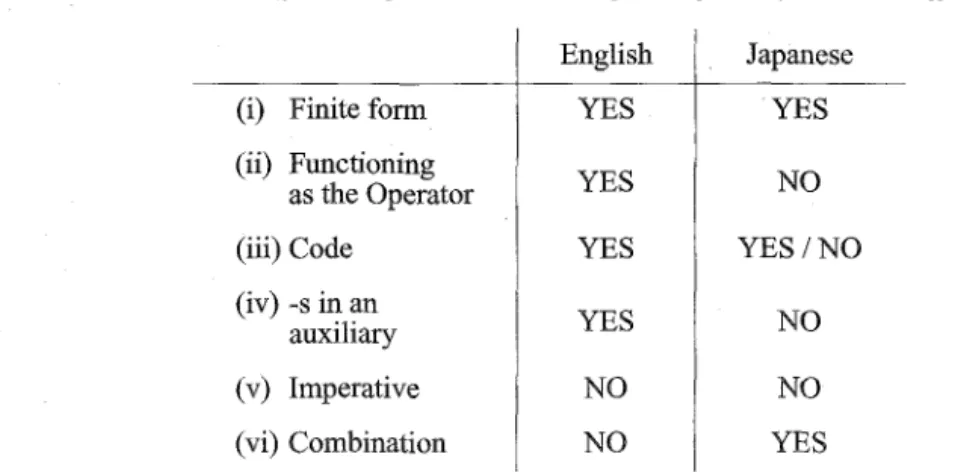
To sum, the two sets of auxi1iary verbs in English and Japanese share some properties, yet they reveal some crucial differences as well. The similarities / differences are summarized in Table 1:
48 A Conlrastive Study of the Lexicogrannnar of賞。dalVerbs' in English and Japanese: A Syslemic Functional Approach English Japanese
(i) Finite form YES YES (ii) Fu即 ti
as the OOIp1merg ator YES NO (iii) Code YES YES/NO (iv) ‑8 in an
YES NO auxiliary
(v) Imperative NO NO (vi) Combination NO YES
Table 1: Similarities and differences between English and Japanese
5. Conclusion
In this paper, 1 presented a description of modal verbs by comparing the set of syntactic properties which determines the nature of these items between English and Japanese. At this stage, the present paper should be seen as a preliminary study on the controversial issue about the treatment ofmodal verbs in English and Japanese.
In the first half of this paper, we looked at Halliday's treatment of modal verbs in English. In Halliday's descriptive model, the modal verb is referred to as the 'Finite modal operator' or simply the Finite'. There is no place for modal verb' as a technical term in his description. However, 1 claimed that the terms Finite' and modal' are misleading in that the concept of包nite'is rather semanticized in SFL, and it is not appropriate to use this term in syntax of English. As a consequence, 1 propose to use a simple term 'Operator¥
A Contrastive Study of the Lexicogrammar of明。dalVerbs' in English組dJap組 関 白ASystemic Functional Approach 49 In the latter half of this paper, 1 looked at the Japanese auxiliary verbs, which are referred to as 'jodooshi' in Japanese. As we saw in Section 3.2, much more items are regarded as an 'auxiliary verb' in Japanese than those in English. However, 1 pointed out that the term 'jodooshi' was not derived from considerations of the Japanese language in itself, but it was a translation from the English equivalents, as it was proposed by some grammarians in Meiji period in Japan. Thus it is not a surprising fact that the criteria to identify the Japanese auxiliary verbs do not provide us with a consistent basis for recognizing these items at any levels of description.
In a functional description of Japanese, there is no need to set out a unified category ofmodal auxiliary' at the level of form, because it is not possible to sort out the small number of items by means of the criteria presented above. As we have seen, more than one auxiliary verb are fairly freely occur in the same clause under the certain syntactic conditions, and 1 argue that it is desirable to treat them separately, and we can label each element in functional terms.
Notes
1 Halliday, M.A.K. (1993)Systemic Theory', in R.E. Asher (ωed.‑圃‑iin‑吃hiぬefわ7 Encyclopαediαof Lαnguαgesαnd Linguistics. Oxford: Pergamon Press, pp.4905同8.;(1994) An Introduction to Functionαl Grammαr, 2nd ed. London: Edward Arnold.; (1998) 'Things and relations: Regrammaticising experience as technical knowledge', in J.R. Martin and Robert Veel (eds.). Reαding Science: CriticalαndFunctionαl Perspectives on Discourse of Science. London: