論 文
BIXS 法によるトリチウム分圧の測定(Ⅰ)
−水素同位体の全圧依存性−
松山 政夫1)、洲 亘2)、鈴木 卓美2)、西 正孝2)
1)富山大学 水素同位体科学研究センター
〒930-8555 富山市五福3190
2)日本原子力研究所 トリチウム工学研究室
〒319-1195 茨城県那珂郡東海村
Measurement of Tritium Partial Pressure by BIXS (I) - Total Pressure Dependence of Hydrogen Isotopes -
M. Matsuyama1), W.M. Shu2), T. Suzuki2) and M.F. Nishi2)
1) Hydrogen Isotope Research Center, Toyama University, Gofuku 3190, Toyama 930-8555, Japan
2) Tritium Engineering Laboratory, Japan Atomic Energy Research Institute, Tokai-mura, Nka-gun, Ibaraki 319-1195, Japan
(Received May 24, 2004; accepted March 15, 2005)
ABSTRACT
The correlation between the intensity of X-rays induced by β-rays of tritium and the total pressure of hydrogen isotope mixtures was examined in a pressure range from 10-1 to 105 Pa by using three different tritium gases, i.e., pure T2, D2-1%T2 and H2-1%T2 mixtures. It was found that linear pressure dependence was obtained up to a few kPa for all of the measured gases by taking dead time of the X-ray detector into account. Above this pressure, however, downward deviation from the linear relation appeared. It was revealed that the effect of self-absorption of β-rays on the pressure dependence was not negligibly small, because the ratios of the counting rates corrected by dead time to total pressure, i.e., specific counting rates, could not be reproduced by a simple exponential function using the absorption coefficients of hydrogen isotopes as variables. The results suggested that an additional factor such as contribution of an X-ray formation on the surfaces of a measuring cell must be taken into consideration in changing in the specific counting rates.
1. Introduction
From a viewpoint of tritium safety and economy, quantitative measurements of high level tritium are indispensable for the tritium plant of a large D-T fusion facility such as ITER and future fusion devices. For this purpose, a variety of the measuring methods based on different principles have been developed so far: for example, a small ionization chamber [1], laser Raman spectrometer [2], mass spectrometer [3], and so on. Although these techniques are promising, there are some problems. The ionization current is influenced by changes in the total pressure and composition of the measuring gases, the lower detection limit of laser Raman spectrometer is not sufficient for the required detection limit, and the mass spectrometer consumes a part of the measuring gas during measurement.
On the other hand, Matsuyama et al. recently proposed β-ray-induced X-ray spectrometry (BIXS) for measurements of tritium partial pressure in tritium-containing gases [4]. This technique is based on detection of X-rays induced by interactions between materials and β-rays emitted from gaseous tritium in a specially designed cell. Intensity of the observed X-rays was proportional to the partial pressure of tritium in the cell, when the total pressure was lower than about 2 kPa. Above this pressure, the downward deviation from the linear relation increased with increasing total pressure because of self-absorption of β-rays in measuring gases. To apply the present technique in a wide range of tritium partial pressure, it is necessary to examine the pressure dependence of the self-absorption in a pressure region above a few kPa. In addition, effects of hydrogen isotope species in a measuring gas on the self-absorption are also important, because of the difference in the ionization energy among the isotope species.
From these viewpoints, correlation between the intensity of β-ray-induced X-rays and the total pressure of hydrogen isotopes has been examined using
three different tritium gases i.e., pure tritium,
deuterium-diluted tritium, and hydrogen-diluted tritium. NaI(Tl)
Scintillation Probe
Double sided flange VCR fitting
Metal bellows valve
Cu Cu
Probe guide
A
B
Au/Be window Be window
2. Experimental
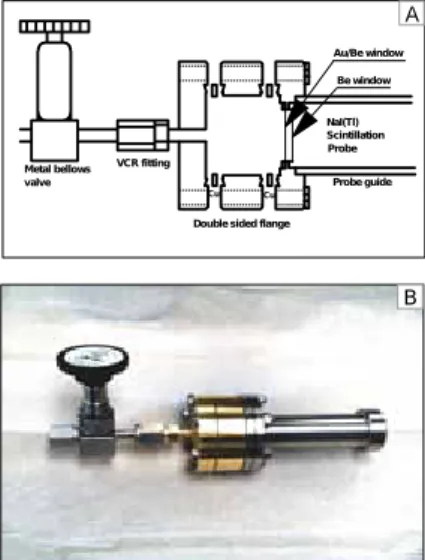
Figure 1 shows a schematic diagram (A) and a photograph (B) of the measuring cell used in this study. The measuring cell consisted of a double-sided flange, two Conflat flanges (ICF with 70 mm in diameter), a radiation window made of thin beryllium plate, and a metal bellows valve. All the flanges were made of stainless steel, and they were connected using copper gaskets. The inner surface of the radiation window as
Fig. 1 Cross-sectional view (A) and photograph (B) of the measuring cell.
well as flanges was coated with thin gold film in order to enhance the conversion of β-rays to X-rays and to impede ad/absorption of gaseous tritium on/in construction materials of the measuring cell.
Internal volume of the measuring cell was about 35 cm3. One of the two Conflat flanges was connected to a metal bellows valve for supply and recovery of tritium, and the other was used to measure X-rays by a conventional NaI(Tl) scintillation probe. Total pressure of hydrogen
isotopes in the measuring cell was measured using two capacitance manometers with different sensitivities.
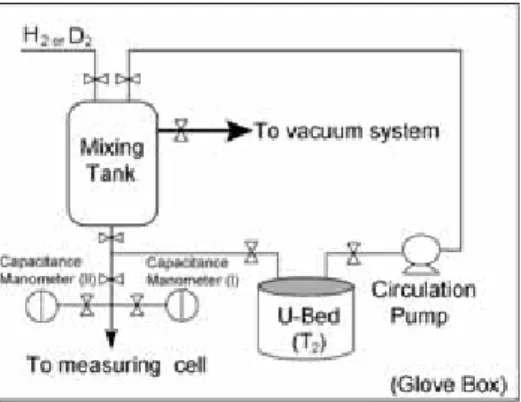
Fig. 2 Schematic diagram of the device used for preparation of tritium mixtures.
Fig. 2 shows the preparation device of different tritium gases, which consists of a mixing tank, U-bed, circulation pump and was connected with the metal bellows valve of the measuring cell. Both the measuring cell and preparation device except a radiation counter (electronics such as high voltage, scaler, and timer) were installed in a glove box to ensure safety. The glove box is constructed at Tritium Engineering Laboratory at Japan Atomic Energy Research Institute.
In the present study three different tritium gases were used: high purity tritium (the tritium concentration was determined as 99.2% by gas chromatography) and about 1% tritium gases diluted with deuterium or hydrogen. These hydrogen isotope mixtures were prepared by supplying a given amount of high purity tritium from the uranium bed to the mixing tank. In the measurements of high purity tritium, it was directly introduced into the measuring cell.
Pressure dependence of the X-ray intensity was measured by reducing stepwise the total pressure of T2 and mixture gasses from about 100 kPa to 0.1 Pa. Measuring time was varied depending on the counting rate of X-rays at each pressure.
10-1 100 101 102 103 104 105
100 101 102 103 104 105 106
Counting rate, N / counts s-1
Total pressure, P / Pa : H2 - T2(1%)
: D2 - T2(1%) : T2
3. Results and discussion
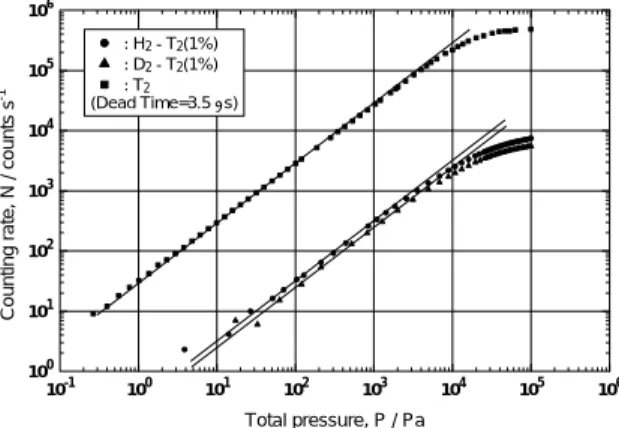
It has been already reported that a linear relation between the intensity of X-rays induced by β-rays and the total pressure of tritium-containing gas appears in a pressure region below about 2 kPa [5]. The results obtained by the present examination are illustrated by three symbols in Fig. 3.
Although three solid lines having a unit ramp
Fig. 3 Total pressure dependence of the counting rates for T2, D2-1%T2and H2-1%T2 mixtures.
are shown in the figure, they are only eye guides. As clearly seen, the counting rates for the high purity tritium were about 100 times greater than those for H2-T2 and D2-T2 mixtures. This difference is mainly based on a large difference in the partial pressures of tritium among those gases. On the other hand, the counting rates for H2-T2 and D2-T2 mixtures were proportional well to their total pressures up to about 4 kPa, whereas for the high purity tritium lower deviation from the linear relation appeared above a pressure of about 0.5 kPa. There are two plausible reasons for the downward deviation: one is the effect of dead time of the present detector, and the other is the effect of self-absorption of β-rays in the measuring gases. On the other hand, below 10 counts/s the counting rates scattered around the line. It is considered that this is mainly due to significant increase in the background level
caused by adsorption of tritium oxides on the inner surface of the measuring cell.
The dead tim
10-1 100 101 102 103 104 105 106
100 101 102 103 104 105 106
Counting rate, N / counts s-1
Total pressure, P / Pa : H2 - T2(1%)
: D2 - T2(1%) : T2
(Dead Time=3.5 µs)
Fig. 4 Total pressure dependence of the counting rates corrected by dead time of the X-ray detector.
10-1 100 101 102 103 104 105
10-2 10-1 100 101 102
D2-1%T2 mixture H2-1%T2 mixture
T2
Specific counting rate, NS / counts s-1 Pa-1
Total pressure, P / Pa
Fig. 5 Total pressure dependence of the specific counting rates for T2, D2-1%T2 and H2-1%T2 mixtures.
e of the present radiation counter was 3.5 µs. When τ is the dead time of the coun
bs) + τN(obs) N(true) . −−−−− (1)
Figure d above 104
ritium concentration in three measured gases was kept
ting system and N(obs) the observed counting rate, the unconcerned fraction in N(obs) counts is τN(obs). If N(true) is the true counting rate, the number of counts lost is τN(obs) N(true). Therefore,
N(true)=N(o
4 shows the results calculated by Eq. (1). The dead-time correction appeare
counts/s. Namely, the linearity of the counting rates for the high purity tritium was improved in a pressure region higher than a few kPa.
During the present examinations, each t
constant at a whole pressure region. Specific counting rate (Ns), i.e., the ratio of the corrected counting rate by Eq. (1) to total pressure, should be constant, if the self-absorption of β-rays in a measuring gas is negligibly small. To confirm this effect, the specific counting rates (closed symbols) were plotted against the total pressure as shown in Fig. 5. At a pressure region above around a few kPa, the specific counting rate for each gas became lower than the respective constant value with increasing total pressure. This indicates clearly that the
self-absorption of β-rays in the gas phase is not negligible.
Supposing that the effect of self-absorption can be represented by a simple exponential func
exp (- µ P)} / µ P, --- (2) whe
µ the absorption coefficient of
Disa appeared in a
strikes on the gold surfaces on both
the specific counting rate. The diffe
Nam as can be written
tion, the specific counting rate can be described by the following equation as a first approximation:
Ns = a0 {1 –
re a0 is the true counting rate per unit pressure,
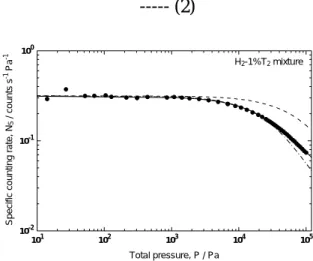
tritium β-rays for each gas, and P the total pressure. Figure 6 compares the observed specific counting rate with the estimated values by Eq. (2) for the H2-1%T2 mixture as an example (broken line). In this calculation, the absorption coefficient for pure hydrogen gas (1.8 cm-1 at 101.3 kPa [Ref]) was employed, because the tritium concentration was quite low. The broken line can be represented by the following equation:
Ns = 0.317{1-exp (-1.8P/101300)}/(1.8P/101300) ---(3)
101 102 103 104 105
10-2 10-1 100
H2-1%T2 mixture
Specific counting rate, NS / counts s-1 Pa-1
Total pressure, P / Pa
Fig. 6 Comparison between the specific counting rates and those calculated by Eq. (2) for the H2-1%T2 mixture. Broken line: µ=1.8 cm-1, dotted and broken line: µ=5.5 cm-1.
greement between the observed specific counting rate and the broken line
pressure region above 1 kPa. Even though the different absorption coefficients were applied to Eq. (3), as shown by the dotted and broken line (µ=5.5 cm-1), they did not agree well in a high-pressure region. This indicates that the major change in the specific counting rates does not solely arise the self-absorption of β-rays in the gas phase.
A certain fraction of β-rays emitted in the measuring cell
the beryllium window and stainless steel constructing the measuring cell, and then contributes X-ray emission. A part of such X-rays can penetrate through the beryllium plate.
Namely, it is considered that the observed counting rate include contribution of X-rays produced at the gold surfaces of stainless steel as well as beryllium. The intensity of the former X-rays may also increase with increasing total pressure, but a linear increase in the X-ray intensity can not be expected owing to the self-absorption of β-rays. It is hard to evaluate quantitatively the contribution of such X-rays to the observed counting rate, because a complex structural factor has to be taken into account.
The solid line in the Fig. 6 shows a fitting curve of
rence (A) between the broken and the solid lines could be described as A = 0.496 + 0.489exp(-3.84P/101300). --- (4) ely, the pressure dependence of the counting rate for H2-1%T2 mixture g by the following equation.
(1) H2-1%T2 mixture gas:
300)}/(1.8P/101300){0.496+0.489exp(-3.84P/101300)}
In 2-1%T2
300)}/(2.1P/101300){0.524+0.471exp(-3.85P/101300)} ,
-exp(-2.2P/101300)}/(2.2P/101300){0.344+0.626exp(-2.67P/101300)} .
ced wel
eneral, depends on some factors such as electron dens
4. Conclusions
Total pressure dependence of the X-ray intensities induced by β-rays of three different
ty of X-rays induced by β-rays of tritium and the total
(2) r relation still appeared
Ns=0.317{1-exp(-1.8P/101
a similar manner, the pressure dependence of specific counting rates for the D mixture gas and the T2 gas were described by the following equations:
(2) D2-1%T2 mixture gas;
Ns=0.248{1-exp(-2.1P/101 (3) T2 gas;
Ns=29.6{1
The specific counting rates for three hydrogen isotopes were finally reprodu
l using above equations as shown in Fig.
7. The first numerical values in the three equations mentioned above depend on the tritium concentration in the measuring gases.
Since the chemical purity of T2 gas determined by gas chromatography was 99.2%, those of the H2-1%T2 and D2-1%T2 mixtures used in this study were evaluated as 1.06 and 0.83%, respectively. In addition, the absorption coefficients for pure D2 and T2 gases estimated to be 2.1 and 2.2, respectively.
Absorption coefficient of β-rays, in g
101 102 103 104 105
10-2 10-1 100 101 102
D2-1%T2 mixture H2-1%T2 mixture
T2
Specific counting rate, NS / counts s-1 Pa-1
Total pressure, P / Pa
Fig. 7 Comparison between the specific counting rates and the reproducing equations.
ity in a given volume, energy of β-rays, and average excitation energy of each hydrogen isotope species. The average excitation energy includes excitation and ionization energies of each hydrogen isotope species. In the present case, the former two factors are the same, while the last one may be different among H2, D2, and T2 molecules, because there is a little difference in ionization energy among them, i.e., H2: 15.43, D2: 15.47 and T2: 15.49 eV [6].
tritium gases such as pure T2, D2-1%T2 and H2-1%T2 mixtures was examined. The results obtained in this study were as follows:
(1) Linear relations between the intensi
pressure of hydrogen isotope mixtures were obtained up to a few kPa for all the measured gases by taking the dead time of the X-ray counting into account.
Above this pressure, however, downward deviation from the linea
even though the observed counting rates were corrected by self-absorption of β-rays in gas phase.
Change
(3) s in the observed counting rates with total pressure were finally reproduced by
References
) M. Matsuyama and K. Watanabe, Fusion Eng. Design, 18 (1991) 91.
9.
1981) 1062.
ss, taking a structural factor in addition to two factors of the dead time and self-absorption into account.
(1
(2) S. O’hira, T. Hayashi, H. Nakamura, et al., Nucl. Fusion, 40 (2000) 51 (3) R.E. Ellefson, W.E. Moddeman and H.F. Dylla, J. Vac. Sci. Technol., 18 (
(4) M. Matsuyama, H. Nakatani and K. Watanabe, Fusion Eng. Design, 10 (1989) 405.
(5) M. Matsuyama, K. Watanabe and T. Yamazaki, Fusion Technol., 28 (1995) 1045.
(6) P.C. Sours, “Hydrogen Properties for Fusion Energy”, University of California Pre London, (1986), p. 257.