A Study on the Creative Class in China
著者 Mitsunami Kohei, Sakakibara Yuichiro journal or
publication title
Kansai University review of economics
volume 18
page range 53‑67
year 2016‑03
URL http://hdl.handle.net/10112/00017205
A Study on the Creative Class in China
Kohei Mitsunami*, Yuichiro Sakakibara**
1. Preface
1-1 Backgrounds
This study seeks to clarify the actual state of intensive, or "qualitative," economic development in major Chinese cities with significant extensive, or "quantitative,"
economic development from the perspective of the "creative class," which has been attracting attention in the recent theories on urban development of Richard Florida.
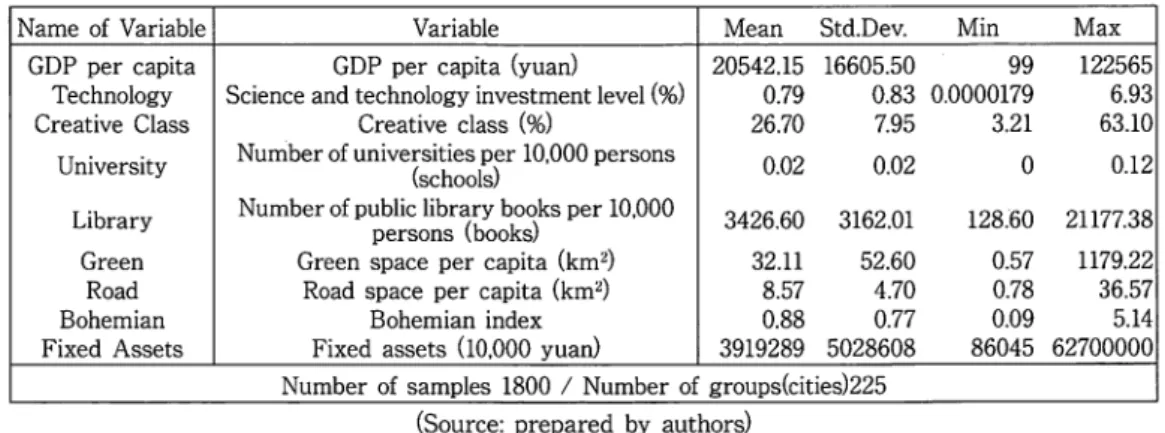
Our empirical study performs a statistical analysis using panel data covering 2003 to 2010.
As Krugman (1994) notes, China's astounding economic development following economic reforms has been due to increased large-scale investment. China has pushed ahead with extensive economic development as the "Workshop of the World,"
using and acquiring mainly foreign-owned enterprises for new technology. However, China has fallen into the "middle-income trap," risking^^ economic stagnation.
The middle-income trap is a phenomenon whereby countries that have progressed from low- to middle-income through increased investments of capital and labor fail to become high-income due to insufficient innovations^ (technological innovation) capacity, which keeps their economies stagnant for a long time (Gill & Kharas, 2007).
The Chinese government is tackling this problem head-on. Starting with the State Council's February 2006 "National Outline for Medium and Long-Term Science and Technology Development Planning," it has been actively promoting science and tech nology. China is now promoting public-private partnerships and striving to transition
* Research Fellow, Graduate School of Economics. Kobe University.
" Faculty of Economics. Kansai University.
1) For example, see China 2030 issued in 2013 by the World Bank and Development Research Center of the State Council of China.
2) In this paper, "innovation" is defined as the "creation of any new value" as in Schumpeter (1912) and covers l) The introduction of a new good, 2) a new method of production, 3) the opening of a new market, 4) the conquest of a new source of supply of raw materials or half-manufactured goods, and 5) carrying out of the new organization.
53
its economic growth pattern from one of extensive economic development, to one of intensive economic development centered on indigenous innovations^ (e.g., Kan, 2013).
Studies on China's economic development and economic system have largely focused on the "quantitative" development of local economies against a backdrop of rapid growth. However, regional economics experts in the U.S., Europe, and Japan as well as researchers in China have finally begun to study economic systems designed to produce sustainable economic growth—in other words, "qualitative"
development in China. Nevertheless, such studies are fewer than those on "quantita tive" development.
Jane Jacobs argues that a country's economy will grow depending upon develop ment in its cities and that their development depends upon how they manage the
"import substitution" of various goods and services. In import substitution, a city begins self-producing goods they have imported from other cities either domestically or abroad and then begins exporting them. Import substitution requires the impro visation"^^ of production goods and services (Jacobs, 1969, 1984). Jacobs stresses the importance of the creative urban residents, who drive the diversification and import substitution of city industries. Her arguments have had a significant influence upon Robert Lucas' discussions of urban and regional economic development (e.g., Lucas, 1988) and on Edward Gleaser (e.g., Gleaser, 2012).
Based on the above arguments emphasizing the importance of cities, Florida discusses the creative class by fusing the past economic growth theory of human capital accumulation and technological innovation—and the economic development—
with an economic geography argument for the "locational" determination of human capital (e.g., Florida, 2008, 2014). He indicates that three factors (or "3Ts"), the tech nology, talent, and level of "tolerance" of a city, are required in order for an urban class to foster urban economic development.
1-2 The Debate on Urban Development in China
Most arguments on urban development in China have occurred from the perspec tive of rural urbanization. Urbanization is the process by which urban areas expand outwardly into surrounding rural areas in parallel with structural changes to existing urban interiors (Kato, 2012). Nakagane (1999) has formulated Western examples into a process defined by "economic development=industrialization=urbanization = modernization."
3) Indigenous innovation is any independent creation or innovation by Chinese corporations aimed at estab lishing technology, standards, or brands with property rights and that are distinct from past technology introduced from overseas or copied (Kan, 2013).
4) "Improvisation" refers to improvements made in response to circumstances.
However, "urban" does not always mean the same thing for China as it does in Jacobs' argument. Jacobs defines cities as communities sustainably creating economic growth from the local economy via active improvisation by creative talent. However, she sees towns as being different from cities, in that they are communities where a large number of people have gathered who cannot create or maintain self-sustaining economic growth. Because of her perspective at this point, we can consider the former "qualitative" urbanization and the latter "quantitative" urbanization. Past Chinese urbanization emphasized the quantitative aspect of how to transform poor rural villages into cities, while paying little attention to the qualitative aspect of human capital accumulation, spillover, and innovation in the cities themselves.
However, such discussions have come to the fore in recent years with increasing economic development, and studies of creative capital—which were largely focused upon Europe and the U.S.—now include China. For example, Florida et al. (2008b) use the same techniques and provincial-level data as are used in Florida et al. (2008a) to analyze the relationship between regional development and its openness/amenities, creative class, and technological level of cities, focusing on China. However, the study produces different results from those produced by studies on the U.S. and Europe.
Although the behavior of the creative class in selecting locations showed that cities' tolerance—specifically "low barriers to entry" for individuals; the openness or ameni ties—levels and university environments were influential, the direct effect of talent upon local economic development was insignificant, and its indirect influence through technology was negatively significant.
Li (2013), a pioneering researcher of creative industries in China, argues that creative industries (which he also calls "Chuangyi Chanye) are based upon individual originality (creativity), skill, or talent and include fashion, advertising, publishing, movies, music, and recreation. This definition emphasizes the cultural aspect but is otherwise close to Florida's.
Li (2013) stresses that China must enhance and combine both its scientific/tech nological and cultural inventiveness and transition from "Made in China" production to "Created in China" production to ensure future development. Drawing upon Florida's definition, Li indicates that Chinese cities with high "tolerance" have free and casual social environments and creative atmospheres, thus providing environ ments abundant in laboring, learning, and living. Li says tolerant cities that attract the creative class are inclusive of different cultures and new ideas and have free- flowing environments, making special mention of Shanghai's creative industry zones, such as Tian Zi Fang.
However, most studies on China's creative class merely introduce Florida's ideas
and offer statistical considerations. Data-based empirical analyses such as Hong et al.
(2011) are few and simply provide regression analyses of the distribution of the creative class in China. The only empirical, comprehensive, and multifaceted discus sion of "qualitative" economic development using all of Florida's 3Ts (i.e., tolerance, talent, and technology) is his own work, Florida et al. (2008b). Even this is a provin cial-level analysis. A more detailed study of urban and regional economic development is required.
1-3 Issues and the Hypothesis
A qualitative development perspective is important for grasping how China might have a sustainable economic system in the future, rather than just a discussion of the quantitative development that led to China's past economic development. Florida's
"creative class" notion is attracting attention as a new theory of urban development in China.
As mentioned, however, such studies of China are extremely rare, and the only data-based empirical analyses are at the provincial level, such as Florida et al.
(2008b). We have seen that their results differed from those of studies on the U.S.
and Europe: the direct effect of talent upon local economic development was insig nificant, and their indirect influence through technology was negatively significant.
If the mechanism by which urban and regional economies develop through each of the 3Ts is defined as a mechanism of the creative economy, then Florida's study indicate that China's mechanism is not functioning effectively.
However, if we look at industry in China's coastal areas, which have recently seen significant economic development, we see emergent businesses in IT and other fields in firms such as Xiaomi, which enjoys an overwhelming market share in China's smartphones. The ideas and inventiveness of the creative class are decisively impor tant in the IT industry, as pointed out by Florida. Advanced IT companies will gradually appear in China as the creative class slowly grows in advanced major cities, and may thus contribute to urban and regional development.
We thus turn our attention to the data used by Florida, as China's current status
diverges from what is suggested in the research in Florida et al. (2008b). Since their argument about the creative class was based on cities, bias may appear in the esti mation results in analyses using provincial-level data, including those on the expan sive rural areas outside the cities.^^ Therefore, this study focuses on cities as statis tical subjects, adjusts the city-level panel data introduced in the next chapter, and
5) For example, some Chinese provinces have a population exceeding 100 million, such as Guangdong. In
terms of surface area, some provinces are larger than Shikoku in Japan.
re-examines the influence on regional economic development of each of Florida's 3Ts.
Florida et al. (2008b) indicate that the status of China's accumulating creative class is different from that in Europe and the U.S. and point out that the mechanism of China's creative economy is not functioning effectively. However, they use provin cial-level data, producing an estimation bias. Using city-level data will produce different results. We thus hypothesize that each of Florida's 3Ts may be having a signiflcantly positive effect upon urban and regional development. Empirically testing this hypothesis will clarify the state of intensive, or qualitative, economic development in major Chinese cities that have seen signiflcant extensive, or quantitative, economic development from the perspective of Florida's notion of "creative class."
2. Empirical Analysis
This chapter assembles city-level panel data based on Formula (1) and then empirically studies it.
Regional Development^^ = Technology+ Talent+ Tolerance+ X+<2- + * * • (1)
The dependent variable is the economic level of each city (GDP per capita), while the independent variables consist of each of the 3Ts and control variables. Below, we introduce the former and then explain the control variables.
2-1 Technology
Florida et al. (2008a) measure the technology level of each city using the Tech
Pole Index that includes the output of high-tech industries, and Boschma & Fritsch
(2009) measure it using the number of patents per 10,000 residents. Although these
measures vary depending on the researcher and subject area, we measure the tech
nology level of a city in terms not of non-governmental activities (e.g., corporate R&D
investment) but of governmental activities. We adopt this approach because, first, it
is difficult to obtain the data on the technology level of a population at the city level
(using the amount of research and development as input and the number of patents
as output, for example). Second, through to the 1980s, the main drivers of Chinese
scientific and technological development were not corporations but university and
government research institutes, which still play critical role, particularly in the devel
opment of high technology (Seki, 2007). Consequently, we define the technology level
of a city as the percentage of municipal expenditures devoted to investment in
science and technology.
2-2 Talent
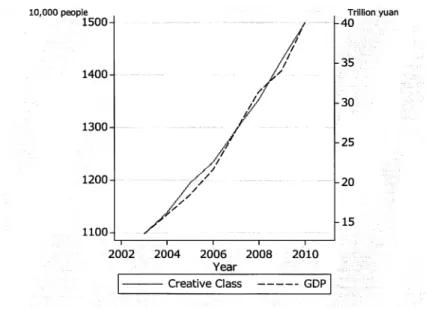
Florida (2008, 2014) defines the creative class as those who "engage in complex problem solving that involves a great deal of independent judgment and requires high levels of education or human capital". Specifically, it includes scientists and engineers, university professors, software programmers, and workers in industries such as high tech, finance, law, medicine, education, the arts, music, and entertainment. As this definition is broad and loose, we link it with data-based industry classifications and consider the creative class as all those engaged in the computer, software, finance, scientific research, technical services, education, healthcare, culture, sports, and entertainment industries. The "Talent" variable is accordingly defined as the percentage of a city's total laboring population composed of the creative class. As Figurel shows, the creative class in China has greatly increased through economic development.
10,000 people
1500H
1400-
1300-
1200
1100
i 1 i 1
2002 2004 2006 2008 2010 Year
TriHlon yuan 40
35
-30
-25
20
15
Creative Class GDP
(Source: prepared by authors using the China Statistical Yearbook and China City Statistical Yearbook, annual versions)
Figure 1: Creative Class and Changes in GDP (2003-2010)
2-3 Tolerance
In this paper, "tolerance" is defined based on two concepts. One is put forward in Florida (2002a, 2002b) and Boschma & Fritsch (2009) and concerns the factors that attract the creative class to a city: its levels of culture, diversity and openness.
The other is expressed by Gleaser et al. (2001) and concerns the "Consumer City."
Accordingly, we define a city's tolerance as the degree to which its environment attracts the creative class, encourages innovation, and serves as a foundation for stimulating urban and regional economic development. Entering all of the variables below into an econometric model measures the tolerance of a city from multiple perspectives (the words in parentheses are the names of the variables). The variables are ® the number of universities per 10,000 residents (University), ® the number of public library books per 10,000 residents (Library), (D the green space per capita (Green), ® the road space per capita (Road), and (5) the Bohemian index (Bohemian).
We calculated the Bohemian index using this formula:
/ Bohemians,. \,/ Bohemians , \
Bohemian = —) \
Donemian,, \ !
Bohemian-^ is the Bohemian index in city i in year ft Bohemians^^ is the number of Bohemians in city i in year ft Population - ^ is the population in city i in year t\
Bohemians ^ is the number of Bohemians in all cities subject to analysis in year t\
and Population^n ^ is the population in all cities subject to analysis in year ft Studies indicate that cities in which many people who are considered Bohemians can be active have a dense culture, including in the arts and music, and are open-minded cities that accept people of diverse cultures and values. The Bohemian index thus serves as a proxy index of openness and diversity.
However, data constraints render it impossible to identify those engaged in profes sions considered "bohemian" (e.g., painters, sculptors, musicians, composers, designers, dancers) in studies of the U.S. and Europe. Therefore, following data-based occupa tional classifications, we consider as "bohemian" those engaged in the cultural, sports, and entertainment industries. The occupational classifications are quite broad and vague and may thus include many people who do not fit what Florida considers
"bohemian." While this might not allow us to extract only true bohemians, we would like to use this Bohemian index as an experimental proxy variable in order to ascer tain the cultural aspects and trends of each city. We have thus produced a multifac- eted definition of a city's tolerance based on its amenities in terms of municipal education, public services, scenery and environment, and the organization of trans portation networks, as well as its diversity and openness according to the Bohemian
index.
As Table 1 shows, we find that, whatever the variable, some correlation appears
with any differences in degree to a city's economic development level. The Bohemian
index characteristic of Florida's research has a positive correlation with the numbers
of the creative class, as shown in Figure2. This figure suggests that a larger creative
Table 1: Correlation Coefficient of Each Tolerance Variable and Economic Development Level (2010)
University Library Green Road Bohemian
GDP per capita 0.49 0.57 0.21 0,52 0.45
(Source: prepared by authors based on 2011 China City Statistical Yearbook)
10,000 people 200
150-
100-
50-
• Beijing
iShanghai
I ^ ^Wuiumuqi
10
Bohemian index