1
星・惑星系の形成過程 入門
中本泰史
(東工大)
2012年9月10-13日 惑星科学フロンティアセミナー:北海道むかわ町
1. 形成過程の概観
2. 分子雲の重力収縮
3. 原始惑星系円盤
4. 固体微粒子の進化
5. 微惑星から惑星へ
6. 惑星系の形成
7. 特論:隕石の起源と惑星形成
1mm
隕石
鉄隕石
5%
石鉄隕石
1%
石質隕石
エイコンドライト
8%
コンドライト
86%
普通コンドライト
90%
炭素質コンドライト
4%
エンスタタイトコンドライト
2%
他
4%
H
L
LL
- T タウリ型星期
時期
~ 1 - 3 Myr after
CAI
期間
~ 2 Myr
- 溶融 & 固化
前駆体
< 650 K
温度上昇
> 10
4
K/hr
最高温度
~ 1600 -
2000 K
液体状態
継続時間
~ 数分
冷却
~ 1 - 1000
K/hr
- サイズ
0.1 – 1 mm
- 大量に存在 (up to 80%)
- 複数回加熱を受けている
1mm
“Flash Heating”による形成
コンドリュール
6
7
8
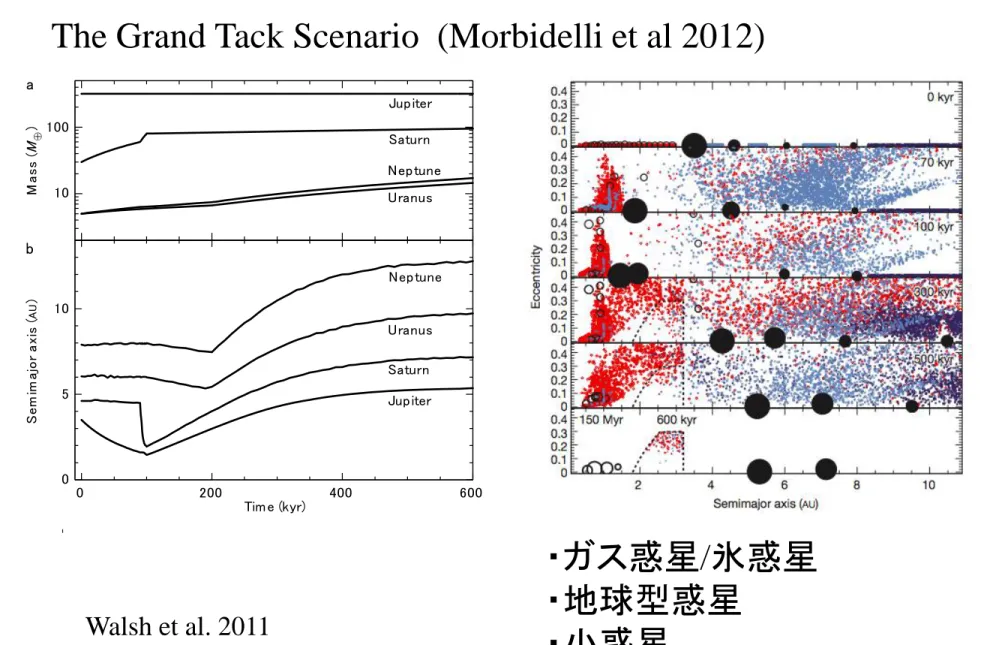
太陽系の形成に特化したモデル:
The Grand Tack Scenario (Morbidelli et al 2012)
LETTER
d oi: 1 0 . 1 0 3 8 /nature1 0 2 0 1A low m ass for M ars from Jupiter’s early
gas-driven m igration
K evin J. W alsh1,2, Alessan dro M orbidelli1, Sean N. Raym on d3,4, David P. O’Brien5& Avi M . M an dell6
Jupiter and Saturn formed in a few million years (ref. 1) from a gas-dominated protoplanetary disk, and were susceptible to gas-driven migration of their orbits on timescales of only 100,000 years (ref. 2). H ydrodynamic simulations show that these giant planets can undergo a two-stage, inward-then-outward, migration3–5. The
ter-restrial planets finished accreting much later6, and their
character-istics, including M ars’small mass, are best reproduced by starting from a planetesimal disk with an outer edge at about one astronom-ical unit from the Sun7,8(1
AU is the Earth–Sun distance). H ere we
report simulations of the early Solar System that show how the inward migration of Jupiter to 1.5AU, and its subsequent outward
migration, lead to a planetesimal disk truncated at 1AU; the
terrest-rial planets then form from this disk over the next 30–50 million years, with an Earth/M ars mass ratio consistent with observations. Scattering by Jupiter initially emptiesbut then repopulatestheaster-oid belt, with inner-belt bodies originating between 1 and 3AU and
outer-belt bodies originating between and beyond the giant planets. This explains the significant compositional differences across the asteroid belt. The key aspect missing from previous models of ter-restrial planet formation is the substantial radial migration of the giant planets, which suggests that their behaviour is more similar to that inferred for extrasolar planets than previously thought.
H ydrodynamicsimulationsshow that isolated giant planetsembed-ded in gaseous protoplanetary disks carve annular gaps and migrate inward9. Saturn migrates faster than Jupiter; if Saturn is caught in the
2:3 mean motion resonancewith Jupiter (conditionsfor thisto happen are given in Supplementary Information section 3), where their orbital period ratio is 3/2, generally the two planets start to migrate outward until the disappearance of the disk3–5,10. Jupiter could have migrated
inward only before Saturn approached itsfinal mass and wascaptured in resonance. The extents of the inward and outward migrations are unknown a priori owing to uncertainties in disk properties and in relativetimescalesfor thegrowth of Jupiter and Saturn. Thuswesearch for constraints on where Jupiter’s migration may have reversed (or ‘tacked’, using a sailing analogy).
The terrestrial planets are best reproduced when the disk of plane-tesimals from which they form istruncated, with an outer edge at 1AU
(refs 7, 8). These conditions are created naturally if Jupiter tacked at , 1.5AU. H owever, before concluding that Jupiter tacked at this
dis-tance, a major question needs to be addressed: can the asteroid belt, between 2 and 3.2AU, survive the passage of Jupiter?
Volatile-poor asteroids(mostly Stypes) arepredominantin theinner asteroid belt, while volatile-rich asteroids(mostly C types) arepredom-inant in theouter belt. Thesetwo main classesof asteroidshavepartially overlapping semimajor axis distributions11,12, though C types
outnum-ber Stypesbeyond , 2.8AU. W eran a suiteof dynamical simulationsto
investigate whether this giant planet migration scheme is consistent with the existence and structure of the asteroid belt. Because of the many unknownsin giant planet growth and early dynamical evolution,
we present a simple scenario that reflects one plausible history for the giant planets (Fig. 1). W e provide an exploration of parameter space (see Supplementary Information) that embraces a large range of pos-sibilities and demonstrates the robustness of the results. In all simula-tions, we maintain the fundamental assumption that Jupiter tacked at 1.5AU.
Figure 2 shows how the migration of the giant planets affects the small bodies. Thedisk interior to Jupiter hasa mass3.7 timesthat of the Earth (3:7M+ ), equally distributed between planetary embryos(large)
1Universite´deNice –Sophia Antipolis, CNRS, Observatoiredela Coˆted’Azur, BP4229, 06304 Nice Cedex4, France.2Department of Space Studies, Southwest Research Institute, 1050 Walnut Street, Suite
300, Boulder, Colorado 80302, USA.3Universite´de Bordeaux, Observatoire Aquitain des Sciences de l’Univers, 2 Rue de l’Observatoire, BP 89, F-33270 Floirac Cedex, France.4CNRS, UMR 5804,
Laboratoire d’Astrophysique de Bordeaux, 2 Rue de l’Observatoire, BP 89, F-33270 Floirac Cedex, France.5Planetary Science Institute, 1700 East Fort Lowell, Suite 106, Tucson, Arizona 85719, USA. 6NASA Goddard Space Flight Center, Code 693, Greenbelt, Maryland 20771, USA.
Jupiter Saturn Neptune Uranus Jupiter Saturn Uranus Neptune Tim e (kyr) S e m im a jo r a x is ( A U ) 100 10 10 5 0 0 200 400 600 M a s s ( M ) a b
Figure 1|The radial migration and mass growth imposed on the giant planets in the reference simulation. a, M ass growth; b, semimajor axis. A fully-formed Jupiter startsat 3.5AU, a location expected to be highly favourable
for giant planet formation owing to the presence of the so-called snow line21.
Saturn’s 30 M+ core is initially at , 4.5AUand grows to 60 M+ as Jupiter
migrates inward, over 105years. Inward type-I migration of planetary cores is inhibited in disks with a realistic cooling timescale23–26; thus Saturn’s core
remainsat 4.5AUduring thisphase. Similarly, thecoresof Uranusand Neptune
begin at , 6 and 8AUand grow from 5 M+ , without migrating. Once Saturn
reaches 60 M+ its inward migration begins25, and is much faster than that of
the fully grown Jupiter27. Thus, on catching Jupiter, Saturn is trapped in the 2:3
resonance3. H ere this happens when Jupiter is at 1.5
AU. The direction of
migration is then reversed, and the giant planets migrate outward together. In passing, they capture Uranus and Neptune in resonance and these planets are then pushed outwards as well. Saturn, Uranus and Neptune reach their full mass at the end of the migration when Jupiter reaches 5.4AU. The migration
rate decreases exponentially as the gas disk dissipates. The final orbital configuration of the giant planets is consistent with their current orbital configuration when their later dynamical evolution is considered28,29(see
Supplementary Information section 3 for extended discussion).
2 0 6 | N A T U R E | V O L 4 7 5 | 1 4 J U L Y 2 0 1 1
Macmillan Publishers Limited. All rights reserved
©2011
Walsh et al. 2011
・ガス惑星/氷惑星
・地球型惑星
・小惑星
・...
Walsh et al. 2011
(Kerr 2011)
コンドリュール形成モデル
・
衝撃波加熱
・雷加熱
・
X-Windモデル
3. 衝撃波加熱仮説: コンドリュール形成
衝撃波加熱
1. 衝撃波の発生
2. 衝撃波内部での加熱機構
3. ダスト粒子内部の現象
1. 衝撃波発生
1. 衝撃波発生
m
gr
C
gr
dT
gr
dt
=
p
a
2
1
2
r
gas
V
3
-4
p
a
2
s
T
gr
4
T
max
=
1
2
s
r
gas
V
3
é
ë
ê
ù
û
ú
1/ 4
簡単な見積もり
最高温度到達時:
dT
gr
dt
=
0
=
1700
n
gas
10
15
cm
-
3
æ
è
ç
ö
ø
÷
1/ 4
V
10 km s
-
1
æ
è
ç
ö
ø
÷
3 / 4
K
radius
a
gr
: 0.01
m
m – 1 cm
emissivity
: size dependent
evaporation rate : pure forsterite
r
gr
da
gr
dt
æ
è
ç
ö
ø
÷
evap
= -
J
evap
m
gr
dv
gr
dt
= -
p
a
gr
2
C
D
2
r
v
rel
2
m
gr
C
gr
dT
gr
dt
= -L
rad
- L
evap
Basic Equations for Dust Particles:
+G
rad,gas
+G
rad,dust
+G
drag
post-shock
pre-shock
Chemical Reactions:32 species, 167 reactions


x
( )
r
v
=
0


x
r
v
2
+
p
(
)
=
0


x
1
2
rv
2
+
E
+
P
æ
è
ç
ö
ø
÷
v
é
ë ê
ù
û ú
= G
H
2
form
- L
Ly
a
- L
H
2
diss
- L
H
2
O(V)
- L
H
2
O(R)
- L
CO(V)
- L
CO(R)
- L
OH(R)
- L
grain
dy
i
dt
=
n
H
j
=
1
32
å
k
jk
y
j
y
k
k
=
1
32
å
+
n
H
2
l
=
1
32
å
m
=
1
32
å
k
lmn
y
l
y
m
y
n
n
=
1
32
å
V
s
= 10 km s
-1
, n
pre
=10
14
cm
-3
, a
0
= 0.1 mm
Gas Temperature
Dust Temperature
Gas Number Density
衝撃波後面の構造
Iida, Nakamoto, Susa, & Nakagawa (2001) Icarus
Chondrule Forming Shock Waves: Peak Temperature
1. 衝撃波発生
複合コンドリュ−ル
▶二個以上のコンドリュールが付着
二つのコンドリュールが
溶融状態を経験中に
衝突
▶コンドリュール全体の
数%
存在
原始太陽系星雲中のダストの直接衝突は低頻度
分裂ー衝突モデル
〜複合コンドリュール形成の1モデル〜
(Miura, Yasuda, and Nakamoto 2007)
衝突頻度
~0.36
存在割合
~0.05
コンドリュールの数
複合コンドリュールの数
>>
分裂片同士の衝突
衝突付着条件
25
50
75
100
0
0
0.25
0.50
0.75
1.00
We
imX
合体
振動分離
伸張分離
分裂片同士は
ほとんど付着。
パラメータ
X
相対速度:
u
d
s
d
l
x
1
0.5
0
We
0
50
100
液滴の衝突実験 (水)
(Ashgriz and Poo 1990)
We =
r
v
2
g
/
R
=
動圧
表面張力
計算結果(ns1-nl1)
伸張分離
合体
破壊
We
x
1200
600
200
100
相対速度(cm/s)
1
0.8
0.6
0.2
0
0.4
1
10
100
1000
計算結果(ns1-nl1)
伸張分離
合体
破壊
We
x
1200
600
200
100
相対速度(cm/s)
1
0.8
0.6
0.2
0
0.4
1
10
100
1000
1. 衝撃波発生
衝撃波の起源は何か?
・
降着衝撃波
分子雲コアからの降着流による衝撃波
・
自己重力円盤内密度波
自己重力不安定なガス円盤内の密度波
・
微惑星前面のバウショック
木星により大きなランダム運動を獲得した
微惑星前面に発生するバウショック
・
星風による円盤上層衝撃波
X線フレアによる星風とそれによる衝撃波
重力不安定による衝撃波の生成
Boss & Durisen 2005, ApJ
2AU
20AU
コンドリュール形成に
適当な衝撃波
ショック源は何か
– コンドリュール前駆体を融かせるほど強い
– 数百万年にわたって起こる
微惑星まわりの
バウショック
Hood (1998), Weidenschilling et al. (1998),
Ciesla et al. (2004)
木星による高速
微惑星形成と
微惑星前面の
バウショック形成
y = 110 km
直線上での
ガス密度分布
500
300
100
Planetesimal Bow Shocks