VDT (Visual Display Terminals)
作業中の姿勢フィードバックによる
姿勢アライメントと疼痛に関する効果
加 藤 禎 菜
*,福 田 早 紀
*,鈴 木 康 雄
**,太 田 進
*Effect of Posture Feedback Band on Posture Alignment and Pain
during a Visual Display Terminal Task
Yoshina KATO, Saki Fukuda, Yasuo SUZUKI, and Susumu OTA
Visual display terminal (VDT) tasks induce misaligned posture, resulting in increased neck and shoulder pain.
This study investigated the effect of a posture feedback band on posture alignment and pain during a VDT task. Eight
healthy individuals participated in which a custom-made posture feedback band with a length sensor sheet was applied
to provide postural feedback. All subjects were exposed to Condition C (without the band) and Condition F (with
feedback) on separate days during a 20-minute VDT task for all subjects. The angle of the forward head position was
significantly smaller in Condition F compared with Condition C, which indicated improvement of the forward head
position based on the feedback from the length between both scapulae. Eye, shoulder, and lumbar pain, however, were
all significantly increased by the VDT task, both with and without postural feedback.
Keywords: Posture feedback, Forward head position, Visual display terminals
1.緒 論
パソコン作業をはじめとした長時間の Visual Display
Terminals (VDT) 作業は現在どの職種でも必須であり,
視
覚系や筋骨格系の疼痛を増大させるとされている
1).先
行研究
2)により事務やドライバーなどの座位作業の多い
職業の人は重量運搬業などの職種と比較して椎間板変性
を原因とする腰痛になりやすいと報告されており,長時
間の座位姿勢は脊柱が屈曲した不良姿勢による腰椎構造
変化と関係がある
1).また,近年のスマートフォンの普
及により,頭部前方突出を特徴とする不良姿勢も報告さ
れている
3).頭部前方突出は,胸椎後弯や肩甲骨外転(肩
甲帯の protraction)とも関連している
4).これらの VDT
作業の不良姿勢が,頸部,肩関節,腰部などに生じる作
業関連性疼痛と関連すると考えられている.良姿勢とは,
矢状面上において耳垂,肩峰,大転子が一直線となり,
肩甲骨内転外転中間位,脊柱の生理的弯曲を維持した姿
勢である
5).長時間の VDT 作業に伴う頭部前方突出,肩
甲骨外転 (protraction) ,胸椎後弯,体幹屈曲のような不
良姿勢に対していち早く気が付くようにフィードバック
を行い,良姿勢に戻すことで,VDT 作業関連の筋骨格系
障害を予防できるのではないかと推察した.本研究の目
的は,すでに報告されている伸縮を感知するセンサを応
用し姿勢フィードバックバンドを作成し,VDT 作業中に
不良姿勢になったときにフィードバックを行い,良姿勢
へ戻すことで,VDT 作業により起こる不良姿勢の改善お
よび作業関連性疼痛の軽減効果を検証することである.
2.方 法
2.1 対 象
被験者は健常若年者で,脊柱に整形外科的疾患がない
20 歳代の星城大学学生(男性 4 名,女性 4 名,計 8 名)
とした.内訳は,平均年齢 21.3±0.4 歳,平均身長 165.8
±8.3 ㎝,平均体重 57.0±6.8 ㎏であった.被験者には文
書にて同意を得て実施した.なお,本研究は星城大学研
究倫理委員会の承認を得た後に実施した.
2.2 VDT 作業
VDT 作業中に姿勢変化が見られるのは,作業開始後
15~20 分とされており,20 分以上の VDT 作業が必要で
ある
6).このため,対象者に対する負担を最小限にした
上で姿勢変化を見ることができる 20 分間を VDT 作業時
間とした.作業内容は,実際の事務作業に近い「文章の
文字入力」とした.VDT 作業中のパソコン角度は頸部に
負担が少ないとされる 60~70°の角度
7)で対象者の見や
すさに合わせて調節し,椅子と机の高さはそれぞれ,一
般的な労働環境である 40 ㎝,70 ㎝とした
1).
2.3 姿勢フィードバックシステム
センサ部分にのみ伸縮が伝わるように,伸縮性のない
鎖骨バンド(クラビクルバンドⅡ,アルケア株式会社)
を基盤に織物状伸縮センサ(以下,布センサ,株式会社
槌屋製)を組み込み姿勢フィードバックバンドを作成し
た(Fig.1,松本義肢製作所作製).逸脱姿勢に反応する
ように設定した布センサは,矢状面(上位胸椎:胸椎後
弯の感知)と前額面および水平面(肩甲帯 protraction の
原稿受付 2016 年 11 月 8 日 * 非会員 星城大学リハビリテーション学科リハビリテー ション学部理学療法学専攻(〒476-8588 愛知県東海市富 貴ノ台 2 丁目 172 番地) ** 非会員 日本福祉大学健康科学部福祉工学科(〒475-0012 実験力学 Vol. 16, No. 4 pp.315319(2016 年 12 月) 315加藤,福田,鈴木,太田:VDT(Visual Display Terminals)作業中の姿勢フィードバックによる姿勢アライメントと疼痛に関する効果 316
実験力学 Vol. 16, No. 4(2016 年 12 月)
Table 2 Changes of posture alignment between before and after VDT task in two conditions (±SD) (unit: degree)
Condition before P value after P valueTrunk flexion angle C 10.2±7.2 P=0.58 15.0±6.2 P=0.21 F 10.1±6.9 15.0±6.2 P=0.67 Forward head position angle C 59.5±5.0 P=0.58 49.8±3.8 P=0.01 F 61.0±8.8 54.0±3.1 P=0.07 Thoracic kyphosis angle C 35.1±13.3 P=0.48 41.2±15.0 P=0.02 F 38.7±13.0 43.0±15.2 P=0.67
Table 3 Changes of posture alignment between before and after VDT task in two conditions (±SD) (unit: m×10
-3)
Condition before P value after P value Sensor on the frontal plane C 12.4±0.3 P=0.87 12.6±0.8 P=0.40 F 12.4±0.5 12.8±0.7 P=0.06 Sensor on the sagittal plane C 11.9±0.4 P=0.06 12.2±0.4 P=0.27 F 11.5±0.3 11.9±0.6 P=0.11
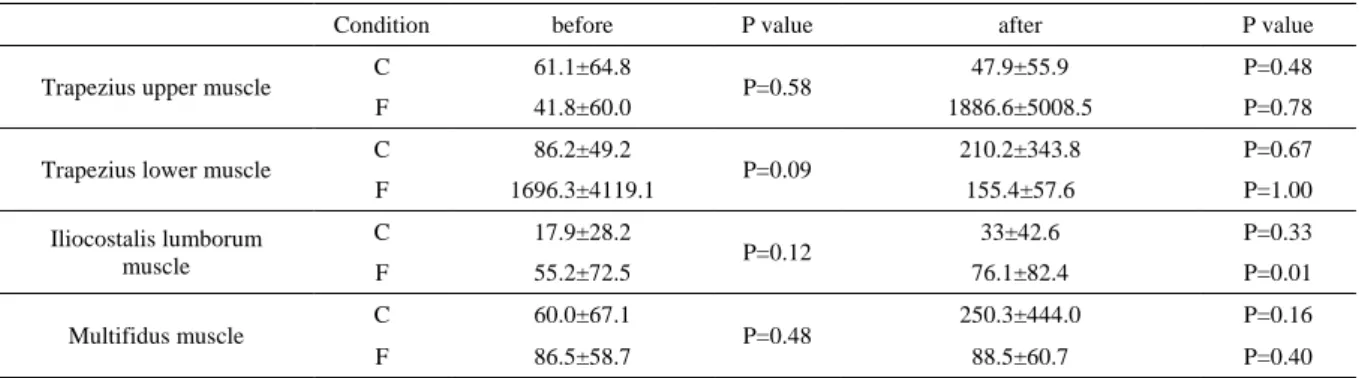
Table 4 Changes of integral EMG of muscles between before and after VDT task in two conditions (±SD) (unit: VS)
Condition before P value after P value Trapezius upper muscle C 61.1±64.8 P=0.58 47.9±55.9 P=0.48 F 41.8±60.0 1886.6±5008.5 P=0.78 Trapezius lower muscle C 86.2±49.2 P=0.09 210.2±343.8 P=0.67 F 1696.3±4119.1 155.4±57.6 P=1.00 Iliocostalis lumborum muscle C 17.9±28.2 P=0.12 33±42.6 P=0.33 F 55.2±72.5 76.1±82.4 P=0.01 Multifidus muscle C 60.0±67.1 P=0.48 250.3±444.0 P=0.16 F 86.5±58.7 88.5±60.7 P=0.40部前方突出は,筋緊張性頭痛
11),頸部痛
12),肩関節痛
13)などの作業関連性疼痛と関連があることが報告されてい
る. Woen らは,上肢動作(肩関節屈曲)時に頭部前方
突出があるほど,僧帽筋上部線維の活動が高いことを報
告している
13).また,Schüldt らは,良姿勢よりも頭部前
方突出姿勢で僧帽筋上部線維の活動が高いことを報告し
ている
4).上田らは,頭部前方突出が起こると,頸椎の
過伸展が起こり,僧帽筋上部線維や後頭下筋群の活動が
過活動となり,短縮しやすいと報告している
15).今回の
研究では,姿勢フィードバックにより頭部前方突出は予
防できたが,僧帽筋上部線維の活動を低下させることは
できなかった.そのため,肩の疼痛が軽減しなかった可
能性がある.今回,肩甲帯の動きのフィードバックを行
うことで,良姿勢の維持することを試みたが,腰部の安
定を司る深部筋(多裂筋)ではなく表在筋である腰腸肋
筋の活動が増加した.そのため,腰痛保持者に対して今
回同様に肩甲帯を意識した良姿勢のフィードバックを実
施する際には腰痛症状の悪化などの注意が必要である.
本研究の限界として,肩甲帯の protraction を感知する
目的で布センサを装着したが,実際は 2-4mm の変化量し
かなく,良姿勢を感知する部位に関しては,今後も検討
が必要である.今回は,事前の検討にて,最大伸張の 25%
や 30%とした場合は,1-2mm の変化量しかない対象者で
は,閾値が小さく体の揺れなどでもアラームが鳴ること
があり,便宜上,体動で反応しない閾値として条件 C の
最大伸張量の 50%とした.しかしながら,閾値の設定に
より結果が変わってくることも考えられ,適切な閾値の
検討も必要である.
ウェアラブルな姿勢フィードバックバンドを作成して
応用したが,被験者ごとに体格が異なるため,姿勢変化
とセンサの伸張量の関連は直線的ではない可能性がある.
そのため,Spearman の順位相関を用いてサブ解析を実施
した.その結果 (n=8),横方向の伸張変化量と頭部前方
突出は r=0.58 と有意な相関は得られなかった.
また, VDT 作業時に胸椎の後弯を感知する縦センサ
が鳴らなかったことから,胸椎部は変化させず,頭部を
前方に突出させて作業を行っていたと考えられる.さら
に,座位における筋活動を計測しているが,個人差およ
加藤,福田,鈴木,太田:VDT(Visual Display Terminals) 作業中の姿勢フィードバックによる姿勢アライメントと疼痛に関する効果 318び個人間においてもばらつきが大きいことも今後の課題
である.
今後は,センサのフィードバックの閾値やセンシング
する部位などを検討する必要があるが,本研究で用いた
伸縮を感知する布センサの生体への応用で一定のフィー
ドバック効果は得られたと考えられた.
5.結 論
20 分間の VDT 作業を行い,
開始前と開始 20 分で疼痛,
姿勢,筋活動の比較を行った.その結果,条件 F では条
件 C に比べ,頸部前方突出を抑制することが可能であっ
た,しかし,良姿勢を意識するために用いたフィードバ
ックバンドによる介入で眼,肩,腰の疼痛の減少は得ら
れなかった.
6.謝 辞
本研究にご協力いただきました星城大学リハビリテー
ション学部の学生の皆様に深謝致します.本研究は,
JSPS 科研費 15K12613 の助成を受けたものである.
参 考 文 献
1) Onai, K., Katsuhira, J. and Maruyama, H.: Effect of different instructions on head, thorax and pelvis angles in visual display terminals Work, Japan Ergonomics Society, 49-5(2013), 229-237. 2) Videman, T, Nurminen, M. and Troup, JD.: Lumbar spinal pathology in cadaveric material in relation to history of back pain occupation and physical loading, Spine, 15(1990), 728-740. 3) Kim, S.Y. and Koo, S.J.: Effect of duration smartphone use
muscle fatigue and pain caused by forward head posture in adults,
J. Phys. Ther. Sci., 28-6(2016), 1669-1672.
4) Schüldt, K., Ekholm, J., Harms-Tingdahl, K., Németh, G. and Arboelius, UP.: Effects of changes in setting work posture on
static neck and shoulder muscle activity, Ergonomics, 29-12(1986), 1525-1537.
5) Nakamura, R., Saito, H. and Nagasaki, H.: Kiso Undogaku (in Japanese), Ishiyaku Publishers, Inc. (2003), 336.
6) Fujimaki, G. and Ando, T.: Development of a human-friendly product (I) Psychological,change and human behavior during a prolonged sitting (in Japanese), Gifuken Seikatsu Gijutsu
Kennkyujo Kennkyu Houkoku, 10( 2007).
7) Fujisawa, Y., Fujimura, M., Kawamura, M. and Nara, I.: Effect of a Screen Angle Change of Notebook Personal Computer on Posture and Muscle Activities (in Japanese), Rigakuryoho
Kagaku, 16-4(2001), 209-213.
8) Igaki, M. and Sakamoto, I.: Improvement of eye complaints, visual function, and work efficiency by steamed towel application in VDT workers, Japanese society of occupational medicine and
traumatology, 62(2014), 8-12.
9) Ota,S. and Goto, H.: Relationship between standing postural alignments and physical function among elderly women using day service centers in Japan, J. Back Musculoskelet. Rehabil., 28-1(2015), 111-117.
10)Aldo, OP.: Kindenzu no tameno Kaibougaku Gaido (in Japanese), Nishimura Shoten (2007).
11)Fernández, PC., Alonso, BC., Cuadrado, ML. and Pareja JA.: Forward head posture and neck mobility in chronic tension-type headache: a blinded, Controlled study, Cephalalgia, 26-3(2006), 314-319.
12)Chiu, TT., Ku, WY., Lee, MH., Sum, WK., Wan, MP., Wong, CY. and Yuen, CK.: A study on the prevalence of and risk factors for neck pain among university academic staff in Hong Kong. J.
Occup. Rehabil., 12-2(2002), 77-91.
13)Woen, JH., Oh, JS., Cynn, HS., Kim, YW., Kwon, OY., and Yi, CH.: Influence of forward head posture on scapular upward rotators during isometric shoulder flexion. J. Bodyw. Mov. Ther., 14-4(2010), 367-374.
14)Greenfield, B., Catlin, PA., Coats, PW., Green, E. and McDonald, JJ.: North C. Posture in patients with shoulder overuse injuries and healthy individuals. J. Orthop. Sports Phys.
Ther., 21-5(1995), 287-295.
15)Ueda, Y., Fukui, T. and Kobayashi, K.: The Difference of Head Position Affects in Morphology of Suboccipital Musclis. Bunkyo
Journal of Health Science Technology, 4(2011), 13-18. 実験力学 Vol. 16, No. 4(2016 年 12 月)