Beneficial effect of pr econditioning on ischemia-r eper fusion
injur y in the r at bladder
in vivo
Yoshie Hisadome, Motoaki Saito, Tomoharu Kono, Itaru Satoh, Yukako
Kinoshita
and Keisuke Satoh
Department of Pathophysiological and Therapeutic Science, Division of Molecular Pharmacology, Tottori University Faculty of Medicine, Yonago, Japan
Cor r espondence:
Motoaki Saito, MD, PhD
Department of Pathophysiological and Therapeutic Science, Division of Molecular Pharmacology, Tottori University Faculty of Medicine, 86 Nishimachi, Yonago, 683-8503, Japan
Telephone: +81-859-38-6163 FAX: +81-859-38-6160
Abstr act
We investigated the effect of preconditioning on ischemia-reperfusion injury in the rat
bladder. Rat abdominal aorta was clamped with a small clip to induce
ischemia-reperfusion injury in the bladder. Twelve-week-old male SD rats were
divided into three groups; sham-operated control (Cont), 30 minutes ischemia-60
minutes reperfusion (IR) and three times of 5 minutes ischemia and then 30 minutes
ischemia-60 minutes reperfusion (PC) groups. The bladder functions were estimated
by cystometric and functional studies. Contractile response curves to increasing
concentrations of carbachol were constructed in the absence and presence of various
concentrations of subtype selective muscarinic antagonists, i.e. atropine
(non-selective) pirenzepine (M1 selective), methoctramine (M2 selective), and 4-DAMP
(M1/M3 selective). We also measured tissue levels of malonaldehyde (MDA) and
examined possible histological changes in these rat’s bladders. Preconditioning
partially prevented the reduction of bladder dysfunction induced by
ischemia-reperfusion. Estimation of the pA2 values for atropine, pirenzepine,
bladder dome is mediated through the M3 receptor subtype in all groups. The MDA
concentration in the IR group was significantly larger than that of the control group, and
preconditioning significantly reduced MDA production in the bladder. In histological
studies, the ischemia-reperfusion with or without preconditioning caused infiltration of
leukocytes and rupture of microcirculation in the regions of submucosa and smooth
muscle without a corresponding sloughing of mucosal cells. Our data indicate that
preconditioning has a beneficial effect on ischemia-reperfusion injury in the rat bladder.
Key words: urinary bladder, preconditioning, ischemia-reperfusion, muscarinic
Intr oduction
The functions of the urinary bladder include urine storage and subsequent micturition.
The urinary bladder requires an adequate supply of oxygen and nutrients via the
circulation system in order to maintain homeostasis and proper function (Parekh et al.,
2001). Both clinical and experimental evidences of ischemia and subsequent
reperfusion injury have been reported in many tissues, including such as kidney, liver,
stomach, and heart (Rauen et al., 1999). Ischemia and the following reperfusion of the
bladder are observed in age-related disorders, urinary retention, atherosclerosis,
vasospasm, embolization, and thrombosis (Parekh et al., 2001). Bladder
overdistention occurs in patients with acute urinary retention secondary to bladder outlet
obstruction (Carpenter et al., 1983). Overdistension, as a physiological or pathological
stress, has been shown to result in contractile and metabolic dysfunction of bladder (Lee
et al., 2000). Prolonged overdistension can result in injury to the neural pathways
responsible for micturition (Tammela et al., 1990), reduce bladder elasticity, alter the
biochemical and neuronal responsiveness of the bladder (Carpenter et al., 1983), and
catheterization/decompression induce reperfusion injury in the bladder and that reactive
oxygen species are one of the main contributing factors in this injury (Saito et al., 2001).
Ischemia-reperfusion injury may cause dysfunction of the urinary bladder, which results
in instability and impairment of detrusor contractility during urination (Greenland et al.,
2001). Experimentally we have reported that ischemia and subsequent reperfusion
significantly damage the bladder function measured by organ bath studies and
histological studies (Saito et al., 1998; Saito et al., 2002; Saito and Miyagawa, 1999).
Ischemic preconditioning (PC) is defined as brief, non-injurious ischemia-reperfusion
(IR) periods that render a tissue more resistant to the harmful effects of a subsequent
prolonged period of ischemia through endogenous cellular protective mechanisms. Its
protective effect from IR injury was first shown by Murry and coworkers on the canine
heart (Murry et al., 1986). Subsequently, benefits of PC in many other tissues, such as
central nervous system, skeletal muscle, kidney, liver, lung, and mesenteric endothelium
have been shown from many groups. PC may play an important role in the
development of bladder dysfunction caused by acute/chronic urinary retention and by
about the effect of PC in the bladder dysfunction. Lorenzi et al. reported the effect of
preconditioning in guinea-pig in vitro (Lorenzi et al., 2003). They suggest that in vitro
short periods of transient ischemia may be able to protect the guinea-pig bladder from
the impairment associate with longer periods of ischemia-reperfusion. However,
identified mechanisms of ischemia-reperfusion include altered Ca2+ homeostasis, free
radical formation, mitochondrial dysfunction, protease activation, altered gene
expression, and inflammation (Neumar, 2000). From these points, it is important to
perform in vivo study to understand effect of PC on the bladder. In order to clarify the
effect of PC on ischemia-reperfusion in the bladder, we investigated the role of PC on
Mater ials and Methods
Animal model
All animal experiments were performed in accordance with the guidelines set by the
Tottori University Committee for Animal Experimentation. Male Sprague Dawley rats,
12 weeks old and weighing 380-420 g (SLC, Shizuoka, Japan), were divided into 3
groups; sham-operated control (Cont), 30 minutes ischemia-60 minutes reperfusion (IR)
and three times of five minutes ischemia and then 30 minutes ischemia-60 minutes
reperfusion (PC) group (In each group, n= 6-8). Our protocol is shown in figure 1.
The ischemic condition was conducted according to previous reports with minor
modifications (Saito et al., 1999). Briefly, under anesthesia with ethyl carbamate
(1mg/kg, hypodermoclysis), the abdominal aorta just above the bifurcation of the aorta
was clamped with a small clip (Sugita standard aneurysm clip, holding force 145 g,
Mizuho Ikakogyo, Tokyo, Japan). The PC condition was initiated that before 30
minutes ischemia, aorta was clamped three times at the same site of aortic occlusion for
5 minutes followed by 5 minutes of reperfusion after each ischemic episode. In our
bladder to 5-10 % of the preclamping levels (Saito et al., 1999).
Cystometr ic studies.
The cystometric studies were performed according to methods used in our previous
report (Saito et al., 2007). Cystometry was performed under anesthesia with ethyl
carbamate (1.0 mg/kg, subcutaneously). In short, after the experimental periods, each
rat’s abdomen was opened using a lower midline incision and the bladder was exposed,
and cystometry was carried out with a 24 G catheter inserted into the apex of the
bladder dome for the purpose of recording pressure and in order to fill the bladder with
physiological saline (0.9 % NaCl). External bladder filling was carried out using an
infusion pump (5200, TOP, Tokyo) at a constant rate of 0.4 ml/min until micturition was
detected. A cystometry catheter was connected to an external pressure transducer
(P2310, Gould, Eastlake, OH) for the measurement of intravesical pressure.
Intravesical pressure was recorded on the personal computer (Macintosh G3, Apple
Computer, Cupertino, CA) via a bridge amplifier (ML112, AD Instruments, Castle Hill,
following parameters were evaluated: probability of urination, bladder capacity,
maximum detrusor pressure during voiding (Pdet), and residual urine volume. The
Pdet was defined as instantaneous pressure minus the post-contraction resting pressure
according to our previous reports. Probability of urination was defined as (total
number of animals – the number of animals with overdistention) / (total number of
animals). In each animal, approximately 5-6 voiding cycles were recorded and then
the means of the voiding cycles were calculated.
Tissue prepar ation and measurement of contr actile force in the bladder.
Functional studies were conducted according to methods used in our previous reports
(Saito et al., 2007). The rat bladder dome was immediately removed and separated
from the bladder base at the level of the ureteral orifices. Razor blades were used to
obtain uniform longitudinal strips of the posterior wall of the bladder dome (1.5 x 5
mm). One end was fixed to a hook in the bottom of the muscle chamber, and the other
end was fastened to a force displacement transducer. Muscle strips were mounted in
95% O2 (37℃). One hook was suspended from a transducer (type 45196A, San-ei
Instruments, Tokyo, Japan), and the lower hook was fixed to a plastic support leg
attached to a micrometer (Mitutoyo, Tokyo, Japan). Each strip was equilibrated
unstretched for 30 minutes. A load of 1.0 g was applied to each strip by micrometer
adjustment, and the load was readjusted to this level 30 minutes later. Changes in the
tone of the strips were measured isometrically by means of force transducers, and the
data were recorded on a personal computer (Macintosh G3, Apple Computer, Cupertino,
CA) with the use of Chart v 3.6.9 software and a Power Lab/16sp data acquisition
system (AD Instruments, Castle Hill, Australia). Cumulative concentration-response
curves to carbachol and KCl (100 mM) were constructed. These studies demonstrated
that the resting stress at which bladder dome developed maximum contractile forces was
in the range of 2.5-3.0 gm./mm2. Carbachol-induced contractile responses were
measured cumulatively in the presence or absence of various concentrations of
muscarinic antagonists: pirenzepine (PRZ; M1 selective), methoctramine (MTR; M2
selective), 4-diphenylacetoxy-N-methylpiperidine methiodide (4-DAMP; M1/M3
to the administration of carbachol. After completion of a concentration-response curve,
the tissue was washed until base-line force returned to the resting level, equilibrated for
60 minutes, and then the next consecutive concentration-response curve was
constructed.
Measurement of malonaldehyde (MDA) in the bladder
In order to investigate lipid peroxidation of the bladder during ischemia-reperfusion,
malonaldehyde (MDA), a marker of lipid peroxidation, concentrations were measured
in the experimental rat bladders. The tissues were chopped into small pieces and the
pieces were then homogenized in 9 volumes of PBS buffer in 5 mM BHT with five 10
second bursts using the Multi-beads Shocker○R
(YASUIKIKI, Osaka, Japan) with the
speed set at 1800 rpm. Then the MDA concentrations in the bladder were measured by
colorimetric assay according to the manufacturer’s instructions (BIOXYTECH
MDA-586TM kits, OXIS International, Portland, OR). The absorbance was measured
at 586 nm. The values were estimated based on the amount of protein in the tissue.
Pure Chemical, Osaka, Japan).
Histological examination of the r at bladder.
After each bladder was transected at the level of the ureteral orifice, the bladder dome
was immediately fixed with 10% formalin. After fixation, the tissues were embedded
in paraffin. Five micron-thick tissue sections were cut from these paraffin blocks.
All of the bladder specimens were stained using Hematoxylin and Eosin (H&E) staining.
Each section was viewed under a light microscope at a magnification of x40-400.
Data analysis.
Contractile data were calculated as grams of active force per cross sectional area in
square millimeters. The cross-sectional area was calculated using the following
equation:
cross-sectional area = weight / (length x 1.05),
where 1.05 is the assumed density of the muscle (Saito and Miyagawa, 1999; Saito et al.,
of agonist that produces half-maximal contractile responses) for carbachol in the
presence or absence of an antagonist.
pA2 values were obtained from Schild plots (Arunlakshana and Schild, 1959). Schild
plots were constructed by plotting the log of (dose ratio –1) against the log of the molar
concentration of antagonist. EC50 values were calculated as geometric means, whereas
Emax values were calculated as arithmetic means. A statistical comparison of
differences between groups was performed using analysis of variance and Fisher’s
multiple comparison tests. P< 0.05 was regarded as the level of significance.
Dr ug and Chemicals.
Ethyl carbamate was purchased from Wako Pure Chemical Co. (Osaka, Japan).
Carbachol, pirenzepine, methoctramine, 4-DAMP, and atropine were purchased from
Sigma Chemical Co. (St. Louis, Mo., USA). All other chemicals used were of reagent
Result
Cystometr ic studies.
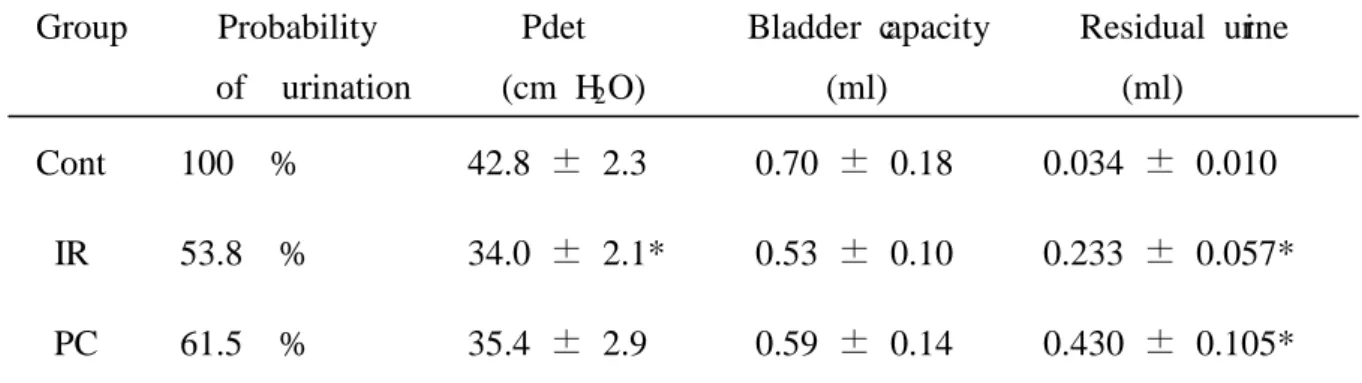
Table1 shows the data of cystometrogram in the experimental rats. In the IR group,
the probability of urination was decreased, and in the PC group probability of urination
was slightly greater than that in the IR group. The maximum detrusor pressure (Pdet)
in the IR group was significantly lower than that of the control group. The Pdet in the
PC group did not differ significantly from that in the both IR and Cont groups. In the
bladder capacity, although the IR rats treated with PC tended to be improved, the
differences in two groups were not significant statistically. The residual urine volume
in both the IR and PC rats was markedly greater than that of the controls. In
cystometric studies, we note that the PC group was closer to the control group in terms
of the probability of urination, Pdet, and the bladder capacity than IR group.
Contr actile force in the bladder.
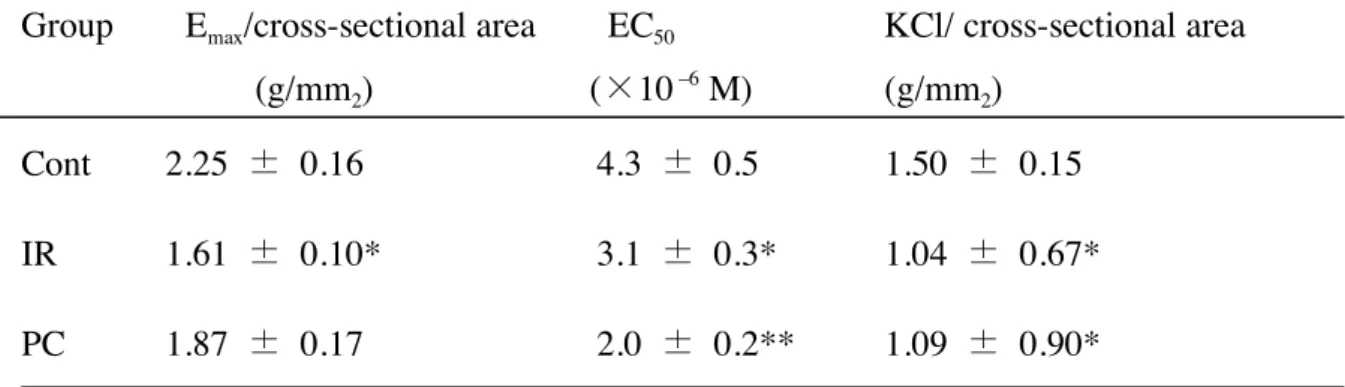
The data obtained by functional studies of the experimental animals are shown in
The Emax values of carbachol in the IR rats were markedly smaller than those of the
control rats. The Emax values were improved by treatment with PC. Contractile
responses to 100 mM KCl showed in the same manner as Emax
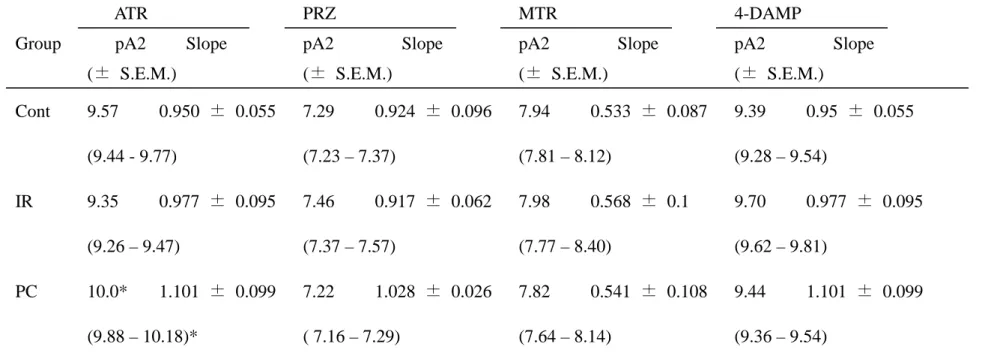
ATR≧4-DAMP>MTR>PRZ
values of carbachol in
each group. The pA2 values for a series of muscarinic antagonists were similar in all
groups and the rank order of the values is as follows;
Biochemical analysis.
The tissue concentrations of MDA are also shown in Table 4. The MDA
concentrations in the bladder of the IR group were significantly higher than those of the
control group. MDA concentrations were significantly decreased in PC rats compared
to IR and control groups.
Histological examination.
Fig. 3 shows H&E staining of the rat bladder. In control rats, high levels of normal
infiltration of leukocytes and ruptures of microcirculation in the regions of submucosa
and smooth muscle without a corresponding sloughing of mucosal cells. In the PC
group, ruptures of microcirculation and leukocyte infiltration in the bladder were also
observed. Significant protective effects of the PC were not observed in these
Discussion
In the present study, we investigated the effect of PC on ischemia-reperfusion injury
in the rat bladder. Our previous and present data indicated that ischemia-reperfusion
produced significant damages of bladder function estimated by cystometric and
functional studies. Treatment with three times of 5 minutes PC improved this injury.
We also demonstrated that one of these preventive mechanisms was to reduce the
production of free radicals produced by ischemia-reperfusion in the bladder.
In the past, much attention has focused on the effects of preconditioning on vital organs,
such as the heart and brain (Pong, 2004), but little has been reported about the effects of
PC in the bladder. Lorenzi and coworkers reported that in vitro short periods of
transient ischemia may be able to protect the guinea-pig bladder from the
impairment associated with longer periods of ischemia and reperfusion, which might
happen in obstructed micturition, and that the phenomenon affects mainly the
intrinsic nerves, which are more susceptible to ischemic damage than the smooth
muscle (Lorenzi et al., 2003). Furthermore, Yu et al reported that hypoxic PC
al., 2003). In their report, they concluded that hypoxia-reoxygeneration and
ischemia-reperfusion lead to the generation of reactive oxygen species (ROS), the
induction of Bcl-2 protein expression by hypoxic PC appears to reflect the bladder’s
up-regulation of the endogeneous antioxidant-induced defense system. The effects
enable to survive a subsequent ischemia-reperfusion stress by reducing an oxidative
insult and preserving bladder nerve activity and contractile function.
As we suspected that ROS played an important role to prevent ischemia-reperfusion
injury in the bladder, we measured the concentrations of MDA, a marker of lipid
peroxidation, in the experimental bladder. In the present study, the MDA
concentrations in the bladder were significantly increased in the IR group. Treatment
with PC significantly decreased MDA production by ischemia-reperfusion, and
interestingly, the MDA concentration in the PC group was significantly lower than that
of the Cont group. Gurucum and associates recently reported a preventive effect of
remote preconditioning in spinal cord ischemia-reperfusion injury (Gurcun et al., 2006).
In their study, both direct PC and remote PC caused by occlusion of left renal artery
MDA concentrations after ischemia-reperfusion with PC were significantly smaller than
pre-ischemia levels. These data suggest that at least PC has an effect to reduce ROS
production in the ischemia-reperfusion organs. As increases in lipid peroxidation can
produce nerve and smooth muscle membrane damage, PC may associate with defensive
mechanism that reduce lipid peroxidation.
It is known that PC activates a cellular survival program that requires the integration
of several processes including opening of surface KATP channels, regulation of fatty acid
metabolism, ROS production, regulation of the mitochondrial permeability transition
and opening of K+ channels in the mitochondrial inner membrane (Hanley and Daut,
2005). In the functional studies, contractile responses to carbachol and KCl were
significantly decreased by ischemia-reperfusion, which was partially prevented by
induction of PC. These observed decrease in contractile responses might indicate that
ischemia-reperfusion injures or alters the muscarinic receptors on the bladder smooth
muscle membrane and their second messenger system. Since we thought a possibility
of alterations of these systems, we calculated the pA2 values and their slopes for a series
there were no significant differences of the pA2 values and slopes between any groups
in all muscarinic antagonists. These data indicated that alterations of contractile
responses of bladder smooth muscles were due to quantitative rather than qualitative
changes of muscarinic receptors and their second messenger system.
In this study, we demonstrated the effect of PC during ischemia-reperfusion in the
bladder, and we also demonstrated that one of these mechanisms is to reduce production
of ROS in the bladder. However, roles of opening of surface KATP channels, regulation
of fatty acid metabolism, nitric oxide production, regulation of the mitochondrial
permeability transition and opening of K+ channels in the mitochondrial inner
membrane are not clear. In order to understand the precise mechanisms of PC, it is
important to investigate these effects on the bladder. However, the detailed mechanism
Conclusion
Ischemia-reperfusion injury significantly reduces the contractile force of the bladder
smooth muscle, which is partially prevented by PC. However, the changes of the
receptor characteristics concerned with the contractile responses to stimulus from
muscarinic receptors were not observed. Our data indicate that PC has a beneficial
effect on ischemia-reperfusion injury in the rat bladder, and one of the mechanisms is to
Refer ences
Arunlakshana, O., Schild, H.O., 1959. Some quantitative uses of drug antagonists.
British Journal of Pharmacolgy and Chemotherapy. 14(1), 48-58.
Carpenter, F.G., 1983. Impairment and restoration of rat urinary bladder responsiveness
following distension. American Journal of Physiology 244(1), R106-113.
Greenland, J.E., Brading, A.F., 2001. The effect of bladder outflow obstraction on
detrusor blood flow changes during the voiding cycle in conscious pigs. Journal of
Urology 165(1),245-248.
Gurcun, U., Discigil, B., Boga, M., Ozkisacik, E., Badak, M.I., Yenisey, C., Kurtoglu,
T., Meteoglu, I., 2006. Is remote preconditioning as effective as direct ischemic
preconditioning in preventing spinal cord ischemic injury? Journal of Surgical Research
Hanley, P.J., Daut, J.,2005. KATP channels and preconditioning: A re-examination of
the role of mitochondrial KATP channels and an overview of alternative mechanisms.
Journal of Molecular and Cellular Cardiology 39(1), 17-50.
Lee, T.M., Su, S.F., Chen, M.F., Tsai, C.H., 2000. Acute effects of urinary bladder
distention on the coronary circulation in patients with early atherosclerosis. Journal of
the American College of Cardiology 36(2), 453-460.
Lorenzi, B., McMurray, G., Jarvis, G., Brading, A.F., 2003. Preconditioning protects
the guinea-pig urinary bladder against ischaemic conditions in vitro. Neurourology and
Urodynamics 22(7), 687- 692.
Murry, C.E., Jennings, R.B., Reimer, K.A., 1986. Preconditioning with ischemia: a
delay of lethal cell injury in ischemic myocardium. Circulation 74(5), 1124-1136.
Emergency Medicine 36(5), 483-506.
Parekh, M.H., Lobel, R., O’Connor, L.J., Leggett, R.E., Levin, R.M., 2001. Protective
effect of vitamin E on the response of the rabbit bladder to partial outlet obstruction.
Journal of Urology 166(1), 341-346.
Pong, K., 2004. Ischemic preconditioning: therapeutic implications for stroke? Expert
Opinion of Therapeutic Targets 8(2), 125-139.
Rauen, U., Polzar, B., Stephan, H., Mannherz, H.G., de-Groot, H., 1999. Cold induced
apoptosis in cultured hepatocytes and liver endothelial cells: mediation by reactive
oxygen species. FASEB Journal 13(1), 155-168.
Saito, M., Kinoshita, Y., Satoh, I., Shinbori, C., Suzuki, H., Yamada, M., Watanabe, T.,
Satoh, K., 2007. Ability of cyclohexenonic long-chain fatty alcohol to reverse
Saito, M., Miyagawa, I., 2001. Bladder dysfunction after acute urinary retention in the
rat. Journal of Urology 165(5), 1745-1747.
Saito, M., Miyagawa, I., 1999. Direct detection of nitric oxide on rat urinary bladder
during ischemia-reperfusion. Journal of Urology 162(4), 1490-1495.
Saito, M., Suzuki, H., Yamada, M., Miyagawa, I., 2002. Preventive effect of
long-chain fatty alcohol on ischemia-reperfusion injury in the rat bladder. European
Journal of Pharmacology 454(1), 81-84.
Tammela, T., Lasanen, L., Waris, T., 1990. Effect of distention on adrenergic
innervation of the rat urinary bladder. Urological Research 18(5), 345-348.
Yu, H.J., Chien, C.T., Lai, Y.J., Lai, M.K., Chen, C.F., Levin, R.M., Hsu, S.M., 2003.
Figure legends
Fig 1. Protocol in this study.
Fig. 2. Contractile responses of rat bladder smooth muscle to carbachol.
Contractile data were calculated as grams of active force per cross sectional area in
square millimeters.
Fig 3. Typical H&E staining in the rat bladder.
Ruptures of microcirculation (short arrows) and leukocyte infiltration (long arrows) in
the regions of submucosa and smooth muscle of the bladder were observed in IR and
Table 1. cystometr ogr am data in the exper imental r ats
Group Probability Pdet Bladder capacity Residual urine of urination (cm H2
Cont 100 % 42.8 ± 2.3 0.70 ± 0.18 0.034 ± 0.010 O) (ml) (ml)
IR 53.8 % 34.0 ± 2.1* 0.53 ± 0.10 0.233 ± 0.057* PC 61.5 % 35.4 ± 2.9 0.59 ± 0.14 0.430 ± 0.105* Data are shown as mean ± S.E.M. of five to nine separated determinations in each group. Pdet means maximum contraction pressure of the detrusor. *:significantly different from the Cont group.
Table 2. Functional studies in the experimental rats
Group Emax/cross-sectional area EC50 KCl/ cross-sectional area (g/mm2) ( 10 –6 M) (g/mm2) Cont 2.25 0.16 4.3 0.5 1.50 0.15 IR 1.61 0.10* 3.1 0.3* 1.04 0.67* PC 1.87 0.17 2.0 0.2** 1.09 0.90* Data are shown as mean S.E.M. of six to eight separated determinations in each group. Emax and ED50 values are for carbachol. KCl means contractile force to 100 m mol/l KCL. *: significantly different from the Cont group. **: significantly different from the other groups.
Table 3. pA2 values and Slopes of Schlid Plots for muscar inic antagonists in the exper imental r at bladder
ATR PRZ MTR 4-DAMP
Group pA2 Slope pA2 Slope pA2 Slope pA2 Slope
(± S.E.M.) (± S.E.M.) (± S.E.M.) (± S.E.M.)
Cont 9.57 0.950 ± 0.055 7.29 0.924 ± 0.096 7.94 0.533 ± 0.087 9.39 0.95 ± 0.055 (9.44 - 9.77) (7.23 – 7.37) (7.81 – 8.12) (9.28 – 9.54) IR 9.35 0.977 ± 0.095 7.46 0.917 ± 0.062 7.98 0.568 ± 0.1 9.70 0.977 ± 0.095 (9.26 – 9.47) (7.37 – 7.57) (7.77 – 8.40) (9.62 – 9.81) PC 10.0* 1.101 ± 0.099 7.22 1.028 ± 0.026 7.82 0.541 ± 0.108 9.44 1.101 ± 0.099 (9.88 – 10.18)* ( 7.16 – 7.29) (7.64 – 8.14) (9.36 – 9.54)
Data are shown as mean ±S.E.M. of five to nine separated determinations in each group. *:significantly different from the other group. ATR: atropine; PRZ: pirenzepine; MTR: methoctoramine
Table 4. MDA concentrations in experimental rat bladders
Group MDA concentrations (n mol/mg protein) Cont 3.87 0.16
IR 4.72 0.29*
PC 3.05 0.24**
Data are shown as mean S.E.M. of six to eight separated determinations in each group. *: significantly different from the Cont group. **:significantly different from the other groups.
5-min Ischemia Control group
30 min Ischemia 60 min Reperfusion IR group
30 min Ischemia 60 min Reperfusion 30 min Reperfusion PC group 5-min Reperfusion Ischemia Reperfusion start experiments