Biosynthetic study of the phytotoxin neovasinin, produced by
the phytopathogenic fungus
N
eocosmospora vasinfecta
(1J:4o/J:WJ}ff(mi
Neocosmospora vasinfectaO)g:)fjf-g
Qtl4o/J$~ neovasininO)g:iJ1JXWfj"G)
TOSHIO FURUMOTO
r:!J7-js:
~J.~
CONTENTS
1. General Introduction References
2. Isolation and Structure Determination of Neovasipyrones, Neovasifuranones, and Vasinfectins
Introduction
Results and Discussion Experimental Section References 1 5 8 8 8 19 29 3. Isolation and Structure Determination of Neovasipyridones 3 3
Introduction
Results and Discussion Experimental Section References
4. Incorporation of 13C- and 2H-Labeled Precursors into Neovasinin, Neovasipyrones, and Neovasifuranones and the Conversion of Neovasifuranone A Aldehyde to Neovasifuranone A
Introduction
Results and Discussion Experimental Section References 5. Conclusion Acknowledgements Summary List of Publications 33 34 39 43 45 45 46 56 59 63 65 66 70
CHAPTER 1
General Introduction
The components of all plants, animals, and microorganisms are biosynthesized by enzyme reactions. The study of metabolism, a fundamental and vital procedure in living things, has provided us detailed understanding of the processes involved. A complex network of enzyme-catalyzed reactions, beginning with the photosynthetic reaction of carbon dioxide and water, is now evident that produces diverse compounds called primary metabolites (e.g., monomers such as amino acids, sugars, nucleotides, acetyl coenzyme A, and mevalonic acid, as well as polymers such as proteins, polysaccharides, lipids, and nucleic acids) [1]. This intricate network of vital biochemical reactions is referred to as primary metabolism. Several criteria distinguish secondary metabolites from primary metabolites. Secondary metabolites have restricted distributions that often are characteristic of individual genera, species, or strains. Moreover, they are formed from primary metabolites via specialized pathways. Unlike secondary metabolites, primary metabolites have a broad distribution and are common organic compounds in all living things. In particular, these latter metabolites are intimately involved in essential life processes. Although secondary metabolites probably are important to the organism that produces them, they are nonessential for life, and their roles are not apparent [2].
Secondary metabolites are biosynthesized from a small number of primary metabolites: acetyl coenzyme A (acetyl CoA), mevalonic acid, amino acids, sugars, and shikimic acid [3, 4]. In particular, acetyl CoA is an important intermediate of secondary metabolite biosynthesis because almost all other intermediates are directly or indirectly produced from it. The classification of secondary metabolites is based on biogenesis: terpenoids from isoprene units, polyketides from acetate units, metabolites from the shikimic acid pathway, alkaloids, and miscellaneous metabolites.
Polyketide-derived compounds abound in both procaryotes and eucaryotes; for example, in actinomycetes and fungi [5]. Polyketides are secondary metabolites that represent a large group of secondary natural products. They also are one of the major
.
sources of antibiotics, mycotoxins, plant growth regulators, pigments, enzyme inhibitor, and so on. Findings of a large number of previous investigations support the hypothesis that the mechanism of polyketide biosynthesis from short chain fatty acids, such as acetate, is closely related to that of fatty acid biosynthesis and is catalyzed by a multienzyme complex. In 1907 Collie [6] suggested that the [CHrCO] group could be made to yield a very large number of natural products by means of the simplest reactions. No biochemical support of his idea was provided until 1953 when Birch et al. [7] reported from the isotopic labeling patterns of several fungal metabolites that the biosynthesis of numerous secondary metabolites is correlated with repeating [CHrCO] units based on the acetate. Polyketide chain growth differs from fatty acid biosynthesis at several points (Fig. 1.1) [8]. In fatty acid biosynthesis, the addition of the next acetate unit (i.e., malonyl CoA) occurs together with fatty acid synthase (FAS) after reduction of the preceding unit is completed. polyketide biosynthesis, however, this addition may occur with polyketide synthase (PKS)
(ii'\'sH
~Sy
t :
(ii'\'s~
~SHt
+ acetyl CoA(ii'\'sH
~SH FAS 0 0 0 0(ii'\'sY~H
(ii'\'s~
~ ~t~
-C02_...-_...~SH
0 _.. ...j
+ 2H 0 OH....,
... ··· .....
-c:s~~
0 0 OHj
H20~s
~ :::::7~
... ~SH "· .. ···•·... 0 PKS ···... ··· ...(ii'\'s~
···...~SH
. ·..
j
+ 2H 0 '· 0(ii'\'s~(
(ii'\'sH
···(ii'\'s~
~SH
"'"'x:
o( • )~S~
~SH
0
before the reduction, leading to the incorporation of double bonds and hydroxyl and carbonyl groups into the growing chain; formation of aromatic, ether, or lactone ring system; and retention of acetate-derived oxygen atoms in the metabolites [9-11]. Another difference is addition of such moieties as methyl and acetyl groups, terpene chains, amino acids, and/or sugar residues to the polyketide metabolites [5]. C-methylation, particular, occurs before the release of the completed polyketide from the PKS enzyme [12-15]. In general, polyketides have the components of between four and ten acetate units. A large number of tetra-, penta-, hepta-, and octaketides are known, whereas tri-, hexa-, nona-, and decaketides are less common [ 4, 5].
The genus Neocosmospora belongs to the Sphaeriales, family Hypocreaceae, and occurs as a mild parasite on a wide range of host plants in tropical areas [16, 17]. Its frequent occurrence on soil or rhizosphere suggests that it may be a widely distributed root-infecting fungus. Neocosmospora vasinfecta E. F. Smith is a pathogen which causes root- and fruit-rot, and seedling damping-off in the Malvaceae, Leguminosae, Piperaceae, Cucurbitaceae, etc., including pepper, groundnuts, soybean, beans, coconuts, Albizzia, Crotalaria spp., and others. Soybean, Glycine ma:x L., an important crop for food, feed, and industrial uses, suffers Neocosmospora stem rot by this fungus [18]. The primary
~ymptom is reddish to dark brown discoloration of the pith and xylem with occasional
chlorosis and defoliation of the lower leaves. This fungus also damages pea plants and cress seedlings by its excretion of the phytotoxins javanicin and fusarubin which also have antifungal activity [ 16].
Neovasinin (Fig. 1.2) was isolated by Nakajima et al. from the culture filtrate of the strain (NHL2298) of Neocosmospora vasinfecta E. F. Smith var. africana (von Arx) Cannon et Hawksworth (Fig. 1.3), obtained from soil in Johannesburg (Republic of South Africa) [19]. It is phytotoxic to soybean, a host plant of this fungus [20]. Its structure has been deduced by spectroscopic methods and from a key reaction [ 19]. Its absolute stereochemistry has been established by X-ray analysis and from a degradation reaction [20]. A metabolite related to neovasinin, neovasinone (Fig. 1.2), also has been isolated from the same fungus [21].
2H,5H
- .-OH OH 0 H H.··
..
,,,~ H3G bH1·
~
CH3 CH3 CH 3....
.,,,~~OH I'
~
CH3 CH3 CH 3 H3G
Neovasinin NeovasinoneFig. 1.2. Structures of neovasinin and neovasinone.
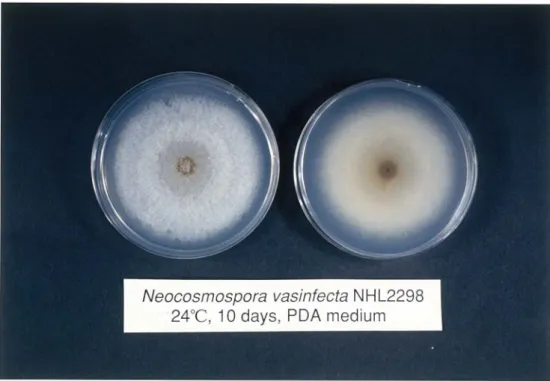
Fig. 1.3. Neocosmospora vasinfecta E. F. Smith, strain NHL2298 grown on potato-dextrose-agar medium at 24 °C for 10 days.
pyrano[ 4,3-b ]pyran-2-one, and that probably is biosynthesized from a hexaketide and five C1 units. There are a few reports on metabolites that have this bicyclic unit;
chlamydosporol [22], isochlamydosporol [23], and multiforisin C [24], but no biosynthetic investigations of these metabolites have been made [25]. In this research therefore my intention was to clarify the biosynthetic pathway of neovasinin, in particular the formation of the bicyclic unit.
In chapter 2, the isolation and structure determination of neovasipyrones A and B, neovasifuranones A and B, and vasinfectins A and B are described. In chapter 3, the isolation and structure determination of neovasipyridones A-F are described. In chapter 4, the incorporation of 13C-labeled precursors into neovasinin, neovasipyrones, and neovasifuranones is described. The incorporation of [S-13C2
H3]-L-methionine into
neovasinin, neovasipyrones, and neovasifuranones, as well as the replacement culture and enzymatic conversion of neovasifuranone A aldehyde to neovasifuranone A also are reported.
References
1. Simmonds, R. J. (1992) Chemistry of Biomolecules: An Introduction. The Royal Society of Chemistry, Cambridge.
2. Williams, D. H., Stone, M. J., Hauck, P. R., and Rahman, S. K. (1989) Why are secondary metabolites (natural products) biosynthesized? J. Nat. Prod. 52, 1189.
3. Nakanishi, K., Goto, T., Ito, S., Natori, S., and Nozoe, S., Eds. (1974) Natural Products Chemistry, Vol. 1. Kodansha, Tokyo; (1975), Yol.2.
4. Herbert, R. B. (1989) The Biosynthesis of Secondary Metabolites, 2nd Edn. Chapman and Hall, New York.
5. Turner, W. B. and Aldridge, D. C. (1983) Fungal Metabolites II. Academic Press, London.
6. Collie, J. N. (1907) Derivatives of the multiple keten group. J. Chem. Soc. 91, 1806.
7. Birch, A. J. (1967) Biosynthesis of polyketides and related compounds. Science 156,
202 and references cited therein.
8. Hopwood, D. A. and Shem1an, D. H. (1990) Molecular genetics of polyketides and its comparison to fatty acid biosynthesis. Annu. Rev. Genet. 24, 37.
9. Yue, S., Duncan, J. S., Yamamoto, Y., and Hutchinson, C. R. (1987) Macrolide biosynthesis. Tylactone formation involves the processive addition of three carbon units. J. Am. Chem. Soc. 109, 1253.
of a chain-elongation intermediate into erythromycin . .!. Am. Chem. Soc. 109, 1255. 11. Rawlings, B. J., Reese, P. B., Ramer, S. E., and Vederas, J.C. (1989) Comparison of
fatty acid and polyketide biosynthesis: stereochemistry of cladosporin and oleic acid formation in Cladosporium cladosporioides. J. Am. Chem. Soc. 111, 3382.
12. Steward, M. W. and Packter, N. M. (1968) Incorporation of 5-methylorcylaldehyde and methionine into the acetogenin (polyketide) gliorosein in Gliocladium roseum I.M.I 93065. Biochem . .!. 109, 1.
13. Yamazaki, M. and Shibata, S. (1966) Biosynthesis of lichen substances. II. Participation of C1-unit to the formation of ,B-orcinol type lichen depside. Chem.
Phann. Bull. 14, 96.
14. Colombo, L., Gennari, C., and Scolastico, C. (1979) Biosynthesis of ascochitine: incorporation studies with advanced precursors. J. Chem. Soc., Chem. Commun. 492. 15. Carter, R. H., Garson, M. J., and Staunton, J. (1979) Biosynthesis of citrinin:
incorporation studies with advanced precursors . .!. Chem. Soc., Chem. Commun. 1097.
16. Domsch, K. H., Garns, W., and Anderson, T.-H. (1980) Compendium of Soil Fungi, Vol. 1. Academic Press, London, pp. 509-510.
17. Udagawa, S. (1963) Neocosmospora in japan. Trans. Mycol. Soc. Japan 4, 121. 18. Sinclair, J. B., Ed. (1982) Compendium of Soybean Diseases, 2nd Edn. The
American Phytopathological Society, Minnesota, pp. 35-37.
19. Nakajima, H., Nishimura, K., Hamasaki, T., Kimura, Y., and Udagawa, S. (1987) Structure of neovasinin, a new metabolite produced by the fungus, Neocosmospora vasinfecta E. F. Smith, and its biological activity to lettuce seedlings. Agric. Biol. Chem. 51, 2831.
20. Nakajima, H., Fukuyama, K., Kimura, Y., and Hamasaki, T. (1992) Absolute stereochemistry of neovasinin, a phytotoxin produced by the fungus, Neocosmospora vasinfecta. Biosci. Biotech. Biochem. 56, 1148.
21. Nakajima, H., Nishimura, K., Hamasaki, T., Kimura, Y., Yokota, T., and Udagawa, S. (1987) Structure of neovasinone, a new a-pyrone plant growth regulator produced by the fungus, Neocosmospora vasit~f'ecta E. F. Smith. Agric. Biol. Chem. 51, 1221.
22. Grove, J. F. and Hitchcock, P. B. (1991) Metabolic products of Fusarium acuminatum: acuminatopyrone and chlamydosporol. J. Chem. Soc., Perkin Trans. 1 997.
23. Solfrizzo, M., Visconti, A., Savard, M. E., Blackwell, B. A., and Nelson, P. E. (1994) Isolation and characterization of new chlamydosporol related metabolites of Fusarium chlamydosporum and Fusarium tricinctum. Mycopathologia 127, 95. 24. Fujimoto, H., Satoh, Y., Nakayama, M., Takayama, T., and Yamazaki, M. (1995)
Isolation of some immunosuppressive components from an Ascomycete, Gelasinospora multiforis. Chem. Phann. Bull. 43, 547.
25. Visconti, A., Solfrizzo, M., Fruchier, A., and ApSimon, J. W. (1994) Acuminatopyrone: revised structure and production by Fusarium chlamydosporum and Fusarium tricinctwn. J. Nat. Prod. 57, 695.
CHAPTER2
Isolation and Structure Determination of Neovasipyrones,
Neovasifuranones, and Vasinfectins
Introduction
Neocosmospora vasinfecta E. F. Smith is a pathogen which causes root- and fruit-rot and seedling damping-off in various plants [1]. N. vasinfecta NHL2298 produces neovasinin (1) which is phytotoxic to soybean, a host plant of this fungus [2, 3]. Compound 1 is a new type of fungal metabolite that has a unique bicyclic unit,
2H,5H-pyrano[ 4,3-b]pyran-2-one, and that probably is biosynthesized from a hexaketide and five C1 units. To explore its biosynthetic pathway, in particular the fonnation of the bicyclic
unit, the isolation of the metabolites biogenetically related to neovasinin (1), produced by this fungus, was attempted. The isolation and structures of six new metabolites, named neovasipyrones A (2a) and B (2b ), neovasifuranones A (Sa) and B (Sb), and vasinfectins A (9a) and B (9b) are described in this chapter.
Results and Discussion
N. vasinfecta NHL2298 produced neovasipyrones (2), neovasifuranones (5), and vasinfectins (9) trace amounts on the conventional malt-peptone-sucrose medium, which had been used for production of neovasinin (1). Addition of L-methionine to this medium, according to the report on the biosynthesis of secondary metabolites in another fungus [ 4], stimulated a dramatic production of neovasipyrones (2), neovasifuranones (5), and vasinfectins (9) as well as 1. In this study I adopted this improved culture condition.
Neovasipyrones A (2a) and B (2b) in the acidic ethyl acetate extract of N. vasinfecta culture filtrate were purified by silica gel partition, silica gel, and Sephadex LH-20 column chromatography, successively. The separation of 2a from 2b was achieved by preparative thin-layer chromatography (TLC) to afford 2a and 2b both as pure compounds in
13 H3C OH 3 H13 3C OH R 0 1
~¥Hg
0 5 ·. 7 ,,, :;...""····rr
1.:°
: 12 CH3 H3C~OH
CH3~H3
0 CH3 12 CH3 15 16 1~
O
,,, 5YY'R1 10 R20 ' ~ 7!
CH3 H3C CH3 CH3 CH3 12 11 14 15 16 Sa R1 = a-OH, ~-H, R2 = H Sb R1 = a-H, ~-OH, R2 = H 6 R1 = a-OAc, ~-H, R2 = Ac 7 R1 = 0, R2 = COC(CH3)3 16 H3C 0 17 2a R =a-OH, ~-H 2b R = a-H, ~-OH 3 R = 0 CH3 17 8:-....1
./'...,.13 3~('''Y
10A
"'CH3 0 CH3 CH3 CH3 18 19 20 9a R =a-OH, ~-H 9b R = a-H, ~-OH 10 R = a-OAc, ~-H 11 R = 0respective yields of 72 and 31 mg/L. Neovasifuranones A (Sa) and B (Sb) in the neutral ethyl acetate extract were purified by silica gel and Sephadex LH-20 column chromatography, successively. The separation of Sa from Sb also was achieved by preparative TLC to afford Sa and Sb both in a pure state in respective yields of 3.0 and 1.9 mg/L. Vasinfectins A (9a) and B (9b) in the neutral ethyl acetate extract were purified by silica gel column chromatography preparative TLC, successively. The separation of
9a from 9b was achieved by reversed phase high performance liquid chromatography
(HPLC) to afford 9a and 9b both as pure compounds in respective yields of 0.48 and 0.50 mg/L.
Neovasipyrones A and B.
Neovasipyrone A (2a) had a molecular formula of C17H2606 [high resolution fast
atom bombardment mass spectrometry (HRFABMS) and 13C NMR data]. The 13C NMR
Table 2.1. NMR data (1H, 270.05 MHz and 13C, 67 .80 MHz) for
neovasipyrones A (2a) and B (2b) in acetone-d6•
-2a 2b Position 8c 8n 8cOH
1 164.9 164.7 2 100.6 100.7 3 167.7 167.5 4 110.4 110.7 5 163.5 163.3 6 75.5 75.2 7 132.7 5.74 dq (1.1, 1.2) 134.7 5.69 dq (0.7, 1.3)" 8 140.3 140.0 9 80.8 3.66 dd (1.1, 5.8) 83.2 3.54 br. d (8.6) 10 38.9 1.46 m 38.9 1.40m 11 27.6 1.05 m 26.1 1.08 m 1.35 m 1.71 m 12 12.4 0.83 t (7.7) 11.9* 0.82 t (7.4) 13 9.1 1.81 s 9.1 1.82s
14 58.8 4.80d(13.1) 58.7 4.85 d (13.4) 4.88 d (13.1) 4.88 d (13.4) 15 28.7 1.54s
28.1 1.55s
16 13.8 1.43 d (1.2) 12.4* 1.39 d (1.3) 17 14.7 0.81 d (6.9) 16.4 0.70 d (6.7)1H NMR data represent chemical shift, multiphcity (Jin Hz).
* Assignments may be interchanged.
to methylenes, three to methines, and seven to quaternary carbons from a distortionless enhancement by polarization transfer (DEPT) experiment [5], indicative of four hydroxyls in 2a. The five 13C resonances (8c 100.6, 110.4, 163.5, 164.9, and 167.7), together with
the ultraviolet (UV) absorption at 291 nm and the infrared (IR) absorption bands (3373, 1663, and 1567 cm-1
), indicated a trisubstituted 4-hydroxy-2H-pyran-2-one moiety in 2a
in a trisubstituted double bond. The structure of 2a was unambiguously deduced from analysis of 1H-1H correlation spectroscopy (HJ-I-COSY) [8, 9], C,H-COSY [10, 11], long-range C,H-COSY (COLOC) [10, 11], and nuclear Overhauser effect (NOE) difference spectral data. The COLOC spectrum of 2a was especially helpful in the assignment of the structure. The significant correlations in the COLOC spectrum are summarized in Fig. 2.1.
The structure of the side chain (C-6 to C-12) was deduced from H,H-COSY and COLOC data. The H,H-COSY data allowed the construction of a 1-hydroxy-2-methylbutyl group. Additionally, the olefinic proton, 7-H (Ou 5.74), had the allylic correlations with both the hydroxymethine proton, 9-H (8ll 3.66), and the methyl protons, 16-H3 (811 1.43), indicative of the attachment of a 1-hydroxy-2-methylbutyl group and•a
methyl group (C-16) to the olefinic carbon, C-8, in the double bond. The stereochemistry around the double bond was assigned as E on the basis of NOE data. Irradiation of the signal of the olefinic proton, 7-H (On 5.74), caused NOE enhancement on the signal of the hydroxymethine, 9-H (Ou 3.66), but had no effect on the signal of the methyl protons, 16-H3 (o11 1.43). The connection of C-6 and C-7 was deduced from COLOC data as follows.
First, the attachment of the methyl group, C-15, to the hydroxy quaternary carbon, C-6, was quite obvious from 1H and 13C NMR data. The two carbons, C-6 and C-7, had
correlations with the methyl protons, 15-H3, and in addition, C-6 had a correlation with the
olefinic proton, 7-H. Thus the establishment of the structure of the side chain was
.~OH
~~ \~14
H3C
0,~
' ' - /~3
I
OH
OH
\__ 1 5(/,h\
o(c/K~.~
H~
CH3
0
CH3
CH3
Fig. 2.1. Key long-range couplings detected in the COLOC experiment of neovasipyrone A (2a).
completed. The structure of the 4-hydroxy-2H-pyran-2-one portion was then established through the analysis of COLOC data. Three carbons, C-1, C-2, and C-3, were correlated with the methyl protons, 13-H3, and also three carbons, C-3, C-4, and C-5, were correlated
with the hydroxymethyl protons, 14-H2• The carbon, C-5, had correlations with both the
olefinic proton, 7-H, and the methyl protons, 15-H3. These correlations allowed the complete assignment of the 4-hydroxy-2H-pyran-2-one portion, and the entire structure therefore was established for 2a.
Neovasipyrone B (2b) had a molecular formula of C17H2606 (HRFABMS and 13C
NMR data) and the same structure as neovasipyrone A (2a) from their NMR data comparison (Table 2.1 ), that is, they are diastereomer of each other. Oxidation of 2a with Jones reagent [12] gave a 9-oxo derivative (3), which was identical with the derivative from 2b. This indicate that 2a and 2b are different only in the stereochemistry at C-9. To establish their stereochemistry by X-ray analysis, crystallization of 2a was attempted, but was unsuccessful. Fortunately, 2b was crystallized from acetone-benzene to afford plates containing one equivalent of benzene, and the crystals were adequate for X-ray analysis. The molecular structure of 2b is shown in Fig. 2.2. The relative configuration of 2b was found to be (6S*,9S*,10S*), and thus that of 2a was (6S*,9R*,10S*). Degradation of 2a
was carried out to establish its absolute stereochemistry. The reaction of 2a with osmium tetroxide (Os04) and sodium metaperiodate (NaI04) [13], followed by treatment with
N02
~~--N~CH3
N
H CH302N
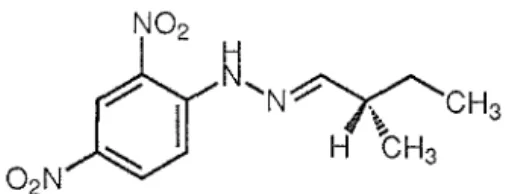
Fig. 2.3. Structure of 2,4-dinitrophenylhydrazone of (S)-2-methyl-1-butanal (4).
dinitrophenylhydrazine, afforded the 2,4-dinitrophenylhydrazone of 2-methyl-1-butanal ( 4,
Fig. 2.3). Its optical rotation ( +24.7°) was identical with that of the synthetic 2,4-dinitrophenylhydrazone of (S)-2-methyl-l-butanal (4, +23.3°) [3], indicative that the configuration of C-10 in 2a is S. Consequently, the absolute stereochemistry of 2a is (6S,9R,10S), and that of 2b is (6S,9S, lOS).
Neovasifuranones A and B.
Neovasifuranone A (Sa) had a molecular formula of C16H2604 [high resolution
electron ionization mass spectrometry (HREIMS) and 13C NMR data]. The 13C NMR
spectrum of Sa (Table 2.2) showed 16 resonances, five of which were due to methyls, three to methylenes, three to methines, and five to quaternary carbons, indicative of two hydroxyls in Sa. The four 13C resonances (Oc 91.0, 114.1, 194.0, and 208.2), together with the UV absorption at 268 nm and the IR absorption bands (1688 and 1611 cm-1
), indicated
a tetrasubstituted 2,3-dihydrofuran-3-one portion in Sa [14-16]. Two 13C resonances (Oc 124.4 and 146.0) were attributed to two olefinic carbons in a trisubstituted double bond. The structure of Sa was unambiguously deduced from analysis of H,H-COSY, C,H-COSY, COLOC, and NOE data in the same manner as in the structural elucidation of neovasipyrone A (2a). The significant correlations in the COLOC spectrum are summarized in Fig. 2.4. Acetylation of Sa afforded a diacetyl derivative (6), in the 1H
NMR spectrum of which two proton resonances associated with a hydroxymethine and a hydroxymethyl were shifted downfield (from
oil
3.68 to 4.92 and from OH 4.20 to 4.64 and 4.66), indicative that the two carbons, C-7 and C-13, in Sa bear free hydroxyl groups.The structure of the side chain (C-5 to C-10) was deduced to be 3-hydroxy-2,4-dimethyl- l-hexenyl from H,H-COSY and COLOC data. The stereochemistry of the
Table 2.2. NMR data (1"f-I, 270.05 MHz and 13C, 67 .80 MHz) for
neovasifuranones A (Sa) in CD30D and B (Sb) in CDC13•
Sa Sb Position
Oc
o,,
Oc
OH
1 194.0 189.5 2 114.1 111.9 3 208.2 205.6 4 91.0 88.5 5 124.4 5.45 dq (1.0, 1.1) 123.7 5.44 dq (l.2, 1.0) 6 146.0 143.5 7 82.3 3.68 dd (1.0, 6.5) 82.1 3.66 br. d (7.7) 8 39.5 1.49 m 37.5 1.50m 9 28.1 1.08 m 24.4* l.10m 1.38 m l.66m 10 12.7 0.90 t (7.3) 11.li'
0.89 t (7.3) 11 24.2 2.69 dq (14.6, 7.6) 22.5* 2.62 dq (13.9, 7.5) 2.75 dq (14.6, 7.6) 2.67 dq (13.9, 7.5) 12 11.6 1.25 t (7 .6) 10.61" 1.25 t (7 .5) 13 53.2 4.20 s 53.4 4.31 s 14 25.2 1.47 s 23.9 1.51 s 15 14.8 1.70 d (1.1) 12.81" 1.73 d (1.0) 16 15.2 0.84 d (6.7) 15.6 0.73 d (6.8)1H NMR data represent chemical shift, multiplicity (Jin Hz).
*,
i'
Assignments may be interchanged.CH3
CH3
Fig. 2.4. Key long-range couplings detected in the COLOC experiment of neovasifuranone A (Sa).
double bond was assigned as E on the basis of NOE data. Irradiation of the signal of the olefinic proton, 5-H (on 5.45), caused NOE enhancement on the signal of the hydroxymethine, 7-H (o11 3.68), but had no effect on the signal of the methyl protons,
15-H3 (on 1.70). A methyl, an ethyl, and a hydroxymethyl group in Sa were deduced from 1H
NMR data. The substitution pattern around the 2,3-dihydrofuran-3-one moiety was established on the basis of COLOC data. The three carbons, C-1, C-2, and C-3, were correlated with the hydroxymethyl protons, 13-H2, and the two carbons, C-1 and C-2, were correlated with the methylene protons, ll-H2• The three carbons, C-3, C-4, and C-5, had
correlations with the methyl protons, 14-H3, and furthermore, the carbon, C-4, had a correlation with the olefinic proton, 5-H. These correlations allowed the complete assignment of Sa, and the entire structure was established.
Neovasifuranone B (Sb) had a molecular formula of C16H2604 (HREIMS and 13C
NMR data) and the same structure as neovasifuranone A (Sa) from their NMR data
comparison (Table 2.2), that is, they are diastereomer of each other. The compound Sa
was treated with pivaloyl chloride and pyridine [17] and then oxidized with dimethyl sulfoxide (DMSO) and acetic anhydride (Ac20) [18] to afford 7-oxo derivative (7), which
was identical with the derivative from Sb. This indicate that Sa and Sb are different only
in the stereochemistry at C-7. The stereochemistries of C-7 and C-8 in neovasifuranones
(S) were determined by chemical reactions. Acetylation of Sa with Ac20 and pyridine
gave 6. The reaction of 6 with ruthenium trichloride (RuC13) and NaI04 [19], followed by
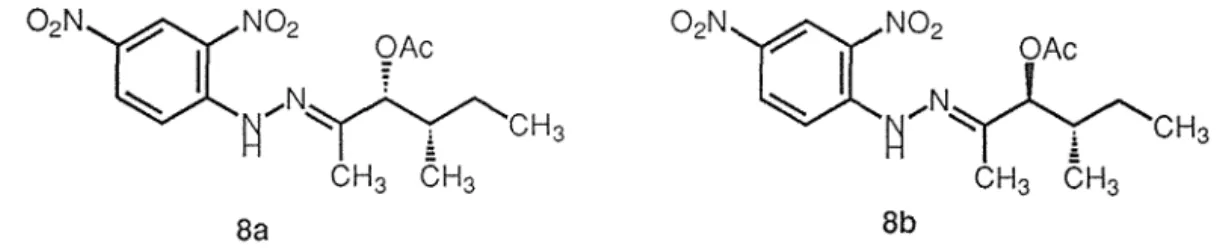
treatment of the product with dinitrophenylhydrazine, afforded the 2,4-dinitrophenylhydrazone of 3-acetoxy-4-methyl-2-hexanone (Sa, Fig. 2.5). The same treatments of Sb gave 8b (Fig. 2.5). Similar reactions of neovasipyrones A (2a) and B
~
I
~
02N'(XN02 OAc~ ~/N~CH3
02N'(XN02 OAcI
N.. ;__ /'._~ ~/I
'(
'CH3 CH3 CH3 CH3 CH3 Ba 8bFig. 2.5. Structures of 2,4-dinitrophenylhydrazone of 3-acetoxy-4-methyl-2-hexanone
(2b), whose absolute stereochemistries were established by X-ray analysis and chemical
reactions, respectively gave the same products, 8a and 8b. The configurations of C-7 and C-8 in Sa therefore are (R,S), and in Sb are (S,S). The stereochemistry of C-4 has yet to be resolved.
Vasinfectins A and B.
The 13C NMR (Table 2.3) and HREIMS spectra of vasinfectin A
(9a) gave the molecular formula C21H2804 (eight unsaturations). The 13C NMR spectrum of 9a had 21
resonances: six owing to methyl groups, two to methylenes, five to methines, and eight to quaternary carbons from its DEPT data. Acetylation of 9a afforded a monoacetyl derivative (10), in the 1H NMR spectrum of which proton resonance associated with~a
hydroxymethine was shifted downfield (from Orr 3.77 to 4.99), indicative that the carbon, C-10, in 9a bear free hydroxyl group. The 1H and 13C NMR spectra (Table 2.3) of 9a
indicate the presence of two carbonyl groups, three sp2 methines, and five sp2 quaternary carbons; therefore, 9a contains two rings in its structure. The structural fragments of 9a
shown in Fig. 2.6 were deduced from H,H-COSY, C,H-COSY, COLOC experiments, and a consideration of chemical shift. The stereochemistry of the olefinic bond (C-8 and C-9) was confirmed by NOE data. Irradiation of the methine proton, 10-H (On 3.77), caused NOE enhancement of the olefinic proton signal, 8-H (Orr 5.56), and irradiation of the 8-H proton induced NOE enhancement of the 10-H signal. The geometry of this double bond
0
~
16 15 CH3-CH2-11-AH,
18 04
__.t
r
/'...13 It"'-110
I
""CH3 CH3 CH3 19 20~
43a
I
a CH3 17 Fig. 2.6. Structural fragments of vasinfectin A (9a).-Table 2.3. NMR data (1H, 270.05 MHz and 13C, 67.80 MHz) for
vasinfectins A (9a) and B (9b) in CDC13•
9a 9b Position
Oc
Ou
Oc
On
2 90.8 90.7 3 202.4 202.3 3a 118.8 118.8 4 123.1 8.07 d (1.8) 123.1 8.10 d (1.8) 5 131.3 131.2 6 137.9 8.11 dq (1.8, 0.9) 138.0 8.14 dq (1.8, 0.9) 7 124.1 124.2 7a 172.6 172.5 8 122.6 5.56 dq (1.1, 1.1) 123.4 5.55 dq (l.2, 1.2) 9 144.0 144.1 10 80.7 3.77 br. d (6.1) 82.1 3.68 br. d (7.7) 11 37.4 1.50m 37.4 1.51 m 12 26.3 1.10 m 24.3 1.11 m 1.34 m 1.66m 13 11.6 0.88 t (7 .3) 11.1 0.88 t (7.3) 14 198.9 199.0 15 31.5 2.94 q (7.3) 31.5 2.97 q (7.3) 16 8.4 1.19 t (7.3) 8.4 1.21 t (7.3) 17 14.3 2.33 br. s 14.3 2.36 br. s 18 24.0 1.59s
24.0 1.62 s 19 13.7 1.66 d (l.1) 12.9 1.68 d (1.2) 20 13.6 0.82 d (6.8) 15.6 0.72 d (6.8)1H NMR data represent chemical shift, multiplicity (Jin Hz).
therefore was established as the E configuration. The connections of these structural fragments were deduced from the long-range 13C-1H correlation detected in the COLOC
spectrum (Fig. 2.7). The three carbon resonances, C-2, C-3, and C-8, were correlated with the 18-H3 signal, indicative that C-2 bound with C-3 and C-8. The connection of C-14
4-CH3
18Fig. 2.7. Key long-range couplings detected in the COLOC experiment of vasinfectin A (9a).
CH3
H, 6-H, and 15-H2 signals. The C-3 signal was correlated with the 4-H signal, indicative
of a bond between C-3 and C-3a. The unsaturation of 9a and chemical shifts of the aromatic carbon, C-7a (be 172.6), indicated a bond between C-7a and the oxygen atom on C-2. The chemical shifts of the signals produced by the benzofuranone ring carbons in the
13C NMR spectrum of 9a, especially those of the furanone ring carbons (C-2, C-3, C-3a,
and C-7a), are consistent with the shifts reported for other benzofuranone compounds [20-22]. Consequently, the planar structure for 9a was established.
Vasinfectin B (9b) had the same molecular formula, C21H2804 , as vasinfectin A (9a),
and its specu·al features are very similar to those of 9a. All 1H and 13C NMR signals were
assigned as shown in Table 2.3 by results of H,H-COSY and C,H-COSY experiments. The geometry of its double bond, E, was confirmed by NOE data. These findings suggested that 9b is a diastereomer of 9a. Oxidation of 9a with DMSO and Ac20 gave a
10-oxo derivative (11), which was identical with the de1ivative from 9b. Thus 9b is a diastereomer of 9a differing only in its stereochemistry at C-10. The stereochemisuies of C-10 and C-11 in vasinfectins (9) were determined by the same method as used for neovasifuranones (5). Acetylation of 9a with Ac20 and pyridine gave 10. The reaction
of 10 with RuC13 and NaI04, followed by treatment of the product with
2,4-dinitrophenylhydrazine, afforded 8a (Fig. 2.5). The same treatments of 9b gave 8b. The configurations of C-10 and C-11 in 9a therefore are (R,S), and in 9b are (S,S). The stereochemistry of C-2 has yet to be resolved. However, the absolute stereochemistries of
neovasinin (1) and neovasipyrones (2) suggest that the stereochemistry of the remaining asymmetric carbon in neovasifuranones (5) and vasinfectins (9) would be S as shown in the figure.
Neovasipyrones (2), neovasifuranones (5), and vasinfectins (9) have the same side chain, but they have different ring system; respectively, cx.-pyrone, 3(2H)-furanone, and 3(2H)-benzofuranone. In addition, these metabolites were isolated from the same fungus, each as a mixture of two diastereomers with respect to the hydroxymethine carbon on the side chain. It is noteworthy that this fungus produces three types of biogenetically related diastereomers simultaneously, probably by the enzyme-catalyzed reactions [23, 24].
Preliminary leaf spot bioassay indicated that neovasifuranones (5) and vasinfectins
(9) were phytotoxic to soybean, but neovasipyrones (2) were not. Neovasinin (1) caused necrosis at 2 µg per plant on soybean leaves; compounds 5 caused no symptom at 2 µg per plant, but caused necrosis at 5 µg per plant. Compounds 9 caused necrosis at 2 µg per plant, but the symptom size caused by 9 were fairly smaller than the size caused by 1 and
s.
Experimental Section
General procedure.
NMR spectra were recorded on a JEOL JNM GX-270 Ff NMR spectrometer or a JEOL JNM GX-400 FT NMR spectrometer. All NMR chemical shifts were referenced against the deuterated solvent used (CDCh oll 7.26, oc 77.0; Me2CO-d6,
0
11 2.00, oc 30.3;CD30D,
0
11 3.30, oc 49.8). Mass spectra were obtained with a JEOL DX-300 spectrometeror a JEOL AX-505 spectrometer. In FABMS, glycerol was used as matrix. In EIMS, the ionization voltage was 70 eV. IR spectra were measured with a JASCO FT/IR-7000 spectrometer, and UV spectra with a Shimadzu UV-2200 UV-vis recording spectrophotometer. Optical rotations were determined with a Horiba SEPA-200 high sensitive polarimeter. Circular dichroism (CD) spectra were measured with a JASCO J-720 spectrophotometer. Daisogel IR-60 was the silica gel used for the column chromatography. Preparative TLC was carried out on Merck Kieselgel 60 HF254 glass
plates (20 x 20 x 0.05 cm).
Fungal material.
Strain NHL2298 of
Neocosmospora vasinfecta
E. F. Smith var.africana
(von Arx) Cannon et Hawksworth used in this study was a gift from Dr. Shun-ichi Udagawa (National Institute of Hygienic Sciences, Tokyo) in 1983 and was maintained on potato dextrose agar.Fermentation and extraction.
The fungus was grown in 500-mL conical flasks (50) containing liquid medium (200 mL/flask) made up of sucrose (50 g/L), peptone (3 g/L), the extract from 100 g/L on malt, L-methionine (0.3 g/L), and water, without shaking at 24°C for 21 days in the dark. The culture filtrate was acidified to pH 2.0 with HCl and extracted with EtOAc (3 x 7 L). The EtOAc extracts were dried over sodium sulfate (Na2S04), concentrated, and washed with 1
M NaHC03 (2 x 0.5 vol.) to afford the neutral EtOAc-soluble (NE) fraction. The NaHC03
washings were acidified to pH 2.0 with HCI and extracted with EtOAc (3 x 1 vol.) to afford the acidic EtOAc-soluble (AE) fraction.
Isolation of neovasipyrones A (2a) and B (2b).
The residue (5.7 g) from AE fraction was purified by silica gel partition column chromatography (300 g, impregnated with 180 mL of 0.1 M HC02H, 4.6 i.d. x 44 cm).
Elution was performed with each 1.5 L (5 x 300 mL) of 10, 20, 30, 40, and 50% EtOAc in n-hexane saturated with 0.1 M HC02H. Fractions 15-21 were combined and
concentrated. The residue (1.9 g) was subjected to silica gel column chromatography (180 g, 3.2 i.d. x 44 cm). The column was developed with Me2CO-C6~-AcOH (40 : 60 : 0.5), and each 100 mL of eluate was collected as one fraction. The combined fractions (5-10, 1.6 g) were then subjected to Sephadex LH-20 column chromatography (3.2 i.d. x 135 cm) using CHClrMeOH (1 : 1) as the solvent. Each 10 mL of eluate was collected as one fraction, and fractions 60-80, which contained both 2a and 2b, were combined. The separation of 2a from 2b was achieved by preparative TLC [Me2CO-CHC13-AcOH (25 :
.•
75 : 1), quadruple development] to afford 720 mg of 2a (lower R1 band) and 310 mg of 2b (higher R1 band).
Isolation of neovasifuranones A (Sa) and B (Sb).
The combined NE fractions (5.9 g) from five cultivations (5 x 10 L of medium) were purified by silica gel column chromatography (140 g, 3.6 i.d. x 26 cm). The column was developed successively with 900 mL each of 2, 5, 10, 20, 30, 40, and 50% Me2CO in
n-hexane. The fraction (1.1 g), eluted with 30% Me2CO in n-hexane, was contained
neovasifuranones (S) and subjected to Sephadex LH-20 column chromatography (3.2 i.d. x
123 cm) using MeOH as the solvent. Each 10 mL of eluate was collected as one fraction, and fractions 60-69 were combined and concentrated. The residue (850 mg) was further purified by preparative TLC [Me2CO-CHC13 (1 : 3), triple development] to afford Sa (152
mg, lower R1 band) and Sb (97 mg, higher R1 band).
Isolation of vasinfectins A (9a) and B (9b ).
The 10% fraction (270 mg), eluted from silica gel column chromatography of NE fractions, was subjected to preparative TLC [Me2CO-CHC13 (1 : 19)]. The residue (70
mg) containing vasinfectins (9) was purified by reversed phase HPLC [COSMOSIL 5C
18-AR (10 i.d. x 250 mm), 75% aq. MeOH, 1.5 mL/min] to afford 9a (24 mg, R1 42.0 min)
and 9b (25 mg, R1 38.7 min).
Neovasipyrone A (2a).
Oil. [cx]n20 -235.4° (c 1.0, EtOH). UV (EtOH)
Amax nm (log £): 209 (4.29), 291
(3.90). IR (film) Vmax cm-1: 3373, 2963, 1663, 1567, 1414, 1244, 988. 1H and 13C NMR
spectral data: Table 2.1. FABMS m/z (rel. int.): 327 [M+Hf (39), 291 (35), 249 (26), 205 (36), 191 (40), 179 (33), 109 (58), 43 (100); exact mass calcd for C17H2706 327.1808,
found 327.1791.
Neovasipyrone B (2b).
Oil. [cx]n20 -124.0° (c 1.0, EtOH). UV (EtOH)
(3.87). IR (film) Vmax cm-1
: 3373, 2967, 1680, 1565, 1419, 1245, 1010. 1H and 13C NMR
spectral data: Table 2.1. FABMS m/z (rel. int.): 327 [M+Hf (30), 291 (12), 249 (16), 205 (15), 179 (12), 109 (18), 106 (26), 74 (44), 42 (100); exact mass calcd for C17H2706
327.1808, found 327.1804.
Crystal data for neovasipyrone B (2b).
C17H2606·CJ-l6, M = 404.5, orthorhombic, space group ?212121, a = 24.773(4), b =
r •3
11.525(2),
c
=
7.961(1) A, V=
2272.9(4) A (cell parameters by least squares from thesetting angles of 24 reflections), µ(Cu Ka)= 6.5 cm-1
, Z = 4, D, = 1.18 g cm-3, F(OOO)
=
872, T
=
293 K.X-ray crystal structure analysis.
Intensity data were measured on a Rigaku four-circle diffractometer using Ni-filtered Cu Ka radiation (A
=
1.5418 A) and a rotating anode generator. A crystal of dimensions 0.6 x 0.4 x 0.2 mm was used. The (1)-28 scan mode was employed, with background measurement at each end of the scan. Intensities of 1952 unique reflections were measured to 28max=
120° in the range 0s
hs
27, 0s
ks 12, 0s
ls 8, with (J.) scan widthof 0.9° + 0.15° tan 8, a scan speed of 4° min-1, and background counting time of 5 sec. No significant change was observed in the intensities of the 3 standard reflections measured every 100 reflections. Intensity data were coITected only for Lorentz and polarization effects. The structure was determined by direct methods using SHELX 86 [25] and refined by block diagonal least squares [261 on F using atomic scattering factors from International Tables for X-ray Crystallography (1974). All H atoms for 2b molecule were located in the difference Fourier map, but those for the C6H6 molecule were invisible in the
map. The oxygen and carbon atoms were refined anisotropically and the H atoms isotropically. Strongest reflection, 0 2 0, was omitted from the refinement. Weighting scheme used in the final stage of refinement was w
=
[a(F 0 )2 + 0.02F0 + O.OOlF02r
1• Theresidual electron densities in the final difference Fourier map ranged from -0.19 to 0.19 eA-3
• The final Rand Rw were 0.061 and 0.080, respectively, for 1728 unique reflections
been deposited at the Cambridge Crystallographic Data Centre. Oxidation of neovasipyrones A (2a) and B (2b).
A solution composed of chromium trioxide (Cr03, 500 mg), cone. H2S04 (0.5 mL),
and H20 (1.5 mL) was prepared, and 50 µL was added to a stirred solution of 2a (36.0 mg)
in 1.5 mL of Me2CO at 0°C. After 2 min, 20 µL of iso-PrOH was added to the reaction
mixture. After 1 min, the reaction mixture was diluted with 30 mL of H20, and the
solution was extracted with EtOAc (3 x 30 mL). The EtOAc solution was washed with brine, dried over Na2S04, filtered, and concentrated under reduced pressure. The residue
was subjected to preparative TLC [Me2CO-CHClrAcOH (20 : 80: 1)] to afford 6.4 mg of
compound 3 as an oil. [cx.]022 -96° (c 1.0, EtOH). 1H NMR (270 MHz, CDC13):
8
0.85(3H, t, J
=
7.0 Hz, H-12), 1.05 (3H, d, J=
7.0 Hz, H-17), 1.38 (lH, m, H-11), 1.59 (3H, s,H-15), 1.63 (lH, m, H-11), 1.76 (3H, br. s, H-16), 1.87 (3H, s, H-13), 3.11 (lH, ddq, J
=
7.0, 7.0, 7.0 Hz, H-10), 4.63 (lH, d, J
=
13.5 Hz, H-14), 4.95 (lH, d, J=
13.5 Hz, H-14), 6.73 (lH, br. S, H-7). EIMS m/z (rel. int.): 324 [Mr (3), 222 (8), 194 (42), 182 (51), 140(100), 57 (33). FABMS m/z (rel. int.): 325 [M+Hf (100), 307 (15), 291 (11), 249 (13), 223 (19), 183 (25), 57 (37). Compound 2b (31.9 mg) was subjected to the same procedure as for 2a to afford 3 (5.4 mg), [cx]D22 -83° (c 1.0, EtOH).
2,4-Dinitrophenylhydrazone of 2-methyl-1-butanal (4) from 2a.
A solution of 2a (118 mg), Os04 (5 mg), and Nal04 (221 mg) in dioxane (2 mL),
H20 (1.5 mL), and pyridine (0.1 mL) was stirred for 12 hr at room temperature. The reaction mixture was diluted with 20 mL of EtOAc, and the EtOAc solution was washed with brine (4 x 10 mL). A solution of 2,4-dinitrophenylhydrazine (308 mg) in EtOH (1.5 mL) and cone. H2S04 (1 mL) was added to the EtOAc solution at 0°C, and the reaction
mixture was stirred for 20 min. The reaction mixture was washed with brine (2 x 10 mL), dried over Na2S04, and concentrated to dryness. The residue was purified with silica gel
flash column chromatography [Wakogel FC-40, EtOAc-n-hexane (1 : 9)] and preparative HPLC [Whatman Partisil 5-0DS-2 (8.0 i.d. x 150 mm), 1.0 mL/min, 85% aq. MeOH] to afford 5.5 mg of 4 as a yellow solid. The spectroscopic data were in accordance with
those reported previously. [cx]1/ 2 +24.7° (c 0.3, CHC13).
Neovasifuranone A (Sa).
Oil. [cx]n22 -111.2° (c 0.4, EtOH). UV (EtOH)
Amax nm (log £): 202 (3.91), 268
(3.98). IR (film) Vmax cm-1: 3405, 2965, 1688, 1611, 1445, 1408, 1277, 1096, 1053, 1017. 1H and 13C NMR spectral data: Table 2.2. EIMS m/z (rel. int.): 282 [Mr (5), 264 (13),
246 (8), 235 (7), 225 (19), 207 (79), 189 (17), 151 (49), 121 (28), 111 (62), 109 (100), 57 ( 63); exact mass calcd for C16H2604 282.1831, found 282.1837.
Neovasifuranone B (Sb).
22 •
Oil. [cx]n -102.3° (c 0.4, EtOH). UV (EtOH) Amax nm (log £): 202 (3.93), 268
(4.01). IR (film) Vmax cm-1: 3356, 2965, 1688, 1611, 1464, 1412, 1277, 1115, 1051, 1011. 1H and 13C NMR spectral data: Table 2.2. EIMS m/z (rel. int.): 282 [Mr (9), 264 (12),
246 (5), 235 (3), 225 (14), 207 (90), 189 (15), 151 (48), 121 (21), 111 (68), 109 (100), 57 ( 62); exact mass calcd for C16H2604 282.1831, found 282.1831.
Diacetyl neovasifuranone A (6).
A solution of neovasifuranone A (Sa, 4.8 mg) in pyridine (0.1 mL) and Ac20 (50 µL)
was allowed to stand for 12 hr at room temperature. The reaction mixture was added to H20 (2.5 mL), and the solution was stirred for 5 hr. The products were extracted with
EtOAc (3 x 3 mL). The EtOAc solution was dried over Na2S04 and concentrated to
dryness under reduced pressure. The residue was purified by preparative TLC
[Me2CO-C6~ (1 : 4), double development] to afford 6 (5.1 mg) as an oil. UV (EtOH) Amax nm (log£): 202 (4.02), 266 (4.13). IR (film) Vmax cm-1: 2969, 1742, 1709, 1626, 1464,
1412, 1373, 1236, 1022. 1H NMR (400 MHz, CDC1 3 ):
8
0.73 (3H, d, J=
6.6 Hz, H-16), 0.82 (3H, t, J=
7.2 Hz, H-10), 1.04 (lH, m, H-9), 1.16 (3H, t, J=
7.5 Hz, H-12), 1.25 (lH, m, H-9), 1.41 (3H, s, H-14), 1.57 (lH, m, H-8), 1.67 (3H, d, J=
1.3 Hz, H-15), 1.96 (3H, s, Me of Ac), 2.00 (3H, s, Me of Ac), 2.59 (lH, dq, J=
14.7, 7.5 Hz, H-11), 2.62 (lH, dq, J=
14.7, 7.5 Hz, H-11), 4.64 (lH, d, J=
12.2 Hz, H-13), 4.66 (lH, d, J=
12.2 Hz, H-13), 4.92 (lH, br. d, J=
6.3 Hz, H-7), 5.35 (lH, dq, J=
1.3, 1.3 Hz, H-5). EIMS m/z (rel. int.): 366[Mt (3), 306 (18), 249 (100), 217 (57), 207 (67), 179 (34), 151 (19), 138 (38), 109 (28).
Oxidation of neovasifuranones A (Sa) and B (Sb).
To a solution of Sa (20.5 mg) in pyridine (10 µL) and CH2Cl2 (0.5 mL), pivaloyl
chloride (25 µL) was added, and the solution was stirred for 8 hr at 20°C. The reaction mixture was diluted with H20 (1 mL), stirred for 1 hr, and then diluted with EtOAc (20
mL). The solution was washed with 1 M NaHC03 (2 x 10 mL) and brine (2 x 10 mL),
dried over Na2S04, and concentrated to dryness under reduced pressure. A solution of the
residue (26.7 mg) in dry DMSO (0.3 mL) and Ac20 (0.2 mL) was stirred for 18 hr at 20°C.
EtOH (1.5 mL) was added to the reaction mixture, and the solution was stirred for 1 hr. The reaction mixture was diluted with H20 (10 mL), and the solution was extracted with
EtOAc (4 x 10 mL). The EtOAc solution was washed with brine (2 x 15 mL), dried over Na2S04, and concentrated to dryness under reduced pressure. The residue was purified by
preparative HPLC [COSMOSIL 5C18-AR (10 i.d. x 250 mm), 1.0 mL/min, 90% aq.
MeOH] to afford compound 7 (6.4 mg) as an oil. [a]022 -40.3° (c 0.3, EtOH). UV
(EtOH) Amax nm (log E): 235 (4.01), 266 (3.97). IR (film) Vmax cm-1: 2969, 1730, 1676,
1626, 1462, 1406, 1281, 1204, 1150, 1051. 1H NMR (270MHz, CDCl3): o0.80 (3H, t,J
=
7.4 Hz, H-10), 1.05 (3H, d, J=
6.8 Hz, H-16), 1.16 (9H, s, Me of pivaloyl), 1.25 (3H, t, J=
7.6 Hz, H-12), 1.35 (lH, m, H-9), 1.57 (3H, s, H-14), 1.62 (lH, m, H-9), 1.96 (3H, d, J=
1.3 Hz, H-15), 2.72 (2H, q, J
=
7.6 Hz, H-11), 3.08 (lH, ddq, J=
6.8, 6.8, 6.8 Hz, H-8), 4.74 (2H, s, H-13), 6.44 (lH, dq, J=
0.5, 1.3 Hz, H-5). Chemical ionization mass spectrometry (CIMS) m/z (rel. int.): 365 [M+Hf (37), 263 (100). Compound Sb (19.8 mg) was subjected to the same procedure as for Sa to afford 7 (3.2 mg), [a]022 -39.7° (c0.3, EtOH).
Vasinfectin A (9a).
Oil. [a]o20 -53° (c 0.5, EtOH). UV (EtOH) Amax nm (log c:): 202 (4.04), 243 (4.55),
274 (3.97), 329 (3.54). IR (film) Ymax cm-1: 3434, 1725, 1686, 1607, 1163. 1H and 13C
NMR spectral data: Table 2.3. EIMS m/z (rel. int.): 344 [Mt (7), 326 (13), 287 (100), 258 (43), 231 (21), 191 (43), 161(12),57 (19); exact mass calcd for C21H2804 344.1988, found
344.1983.
Vasinf ectin B (9b ).
Oil. [a]020 -41° (c 0.5, EtOH). UV (EtOH) Amax nm (log£): 202 (4.05), 243 (4.56),
274 (3.97), 329 (3.54). IR (film) Vmax cm-1: 3499, 1726, 1686, 1607, 1163. 1H and 13C
NMR spectral data: Table 2.3. EIMS m/z (rel. int.): 344 [Mr (5), 326 (10), 287 (100), 258 (34), 231 (15), 191 (34), 161 (10), 57 (15); exact mass calcd for C21H2804 344.1988, found
344.1992.
Monoacetyl vasinfectin A (10).
A solution of vasinfectin A (9a, 11.2 mg) in pyridine (0.2 mL) and Ac20 (0.1 mE)
was stirred for 6 hr at room temperature. The reaction mixture was added to H20 (5 mL),
and the solution was extracted with EtOAc (4 x 5 mL). The EtOAc solution was concentrated to dryness under reduced pressure. The residue was purified by preparative HPLC [COSMOSIL 5C18-AR (10 i.d. x 250 mm), 2.0 mL/min, 80% aq. MeOH] to afford
10 (10.5 mg) as an oil. UV (EtOH) Amax nm (log £): 202 (4.02), 243 (4.57), 274 (3.95),
329 (3.56). IR (film) Vmax cm-1: 1730, 1688, 1607, 1238. 1H NMR (270 MHz, CDC13):
8
0.79 (3H, d, J = 6.7 Hz, H-20), 0.89 (3H, t, J = 7.3 Hz, H-13), 1.12 (lH, m, H-12), 1.22 (3H,t,1=7.3Hz,H-16), 1.32(1H,m,H-12), 1.59(3H,s,H-18), 1.64(1H,m,H-11), 1.73 (3H, d, J = 1.2 Hz, H-19), 2.06 (3H, s, Me of Ac), 2.36 (3H, br. s, H-17), 2.97 (2H, q, J =
7.3 Hz, H-15), 4.99 (lH, br. d, J = 5.9 Hz, H-10), 5.51 (lH, dq, J = 1.2, 1.2 Hz, H-8), 8.10
(lH, d, J = 1.8 Hz, H-4), 8.14 (lH, dq, J = 1.8, 0.9 Hz, H-6). EIMS m/z (rel. int.): 386 [Mr (4), 326 (13), 300 (11), 287 (51), 258 (75), 218 (100), 191 (26), 161 (15), 127 (12), 57 (17).
Oxidation of vasinfectins A (9a) and B (9b).
A solution of 9a (19.6 mg) in dry DMSO (0.3 mL) and Ac20 (0.2 mL) was stirred for 18 hr at 20°C. EtOH (1.5 mL) was added to the reaction mixture, and the solution was stirred for 1 hr. The reaction mixture was added to H20 (10 mL), and the solution was
mL), dried over Na2S04, and concentrated to dryness under reduced pressure. The residue
was purified by preparative TLC [Me2CO-n-hexane (1 : 9), triple development] to afford
compound 11 (9.8 mg) as an oil. CD (EtOH) Acxi nm (L\E): 342 (+6.6), 311 (-3.5), 245
(-21.3). UV (EtOH) Amax nm (log E): 201 (3.94), 245 (4.63), 276 (3.91), 330 (3.56). IR
(film) Ymax cm-1: 1728, 1684, 1607, 1161. 1H NMR (270 MHz, CDC13):
o
0.80 (3H, t, J=
7.4 Hz, H-13), 1.07 (3H, d, J = 6.8 Hz, H-20), 1.22 (3H, t, J = 7.3 Hz, H-16), 1.34 (lH, m, H-12), 1.63 (lH, m, H-12), 1.69 (3H, s, H-18), 2.01 (3H, hr. d, J
=
1.3 Hz, H-19), 2.39 (3H, br. s, H-17), 2.97 (2H, q, J=
7.3 Hz, H-15), 3.09 (lH, ddq, J=
6.8, 6.8, 6.8 Hz, H-11), 6.53 (IH, q, J=
1.3 Hz, H-8), 8.12 (lH, d, J=
1.8 Hz, H-4), 8.17 (lH, dq, J=
1.8, 0.9 Hz, H-6). EIMS m/z (rel. int.): 342 [Mf (45), 313 (67), 285 (34), 258 (54), 229 (91), 191 (19), 152 (100), 123 (86), 57 (59). Compound 9b (20.2 mg) was subjected to the same procedure as for 9a to afford 11 (10.7 mg), CD (EtOH) Acxi nm (L\E): 342 (+6.6), 312(-3.6), 245 (-20.5).
2,4-Dinitrophenylhydrazone of 3-acetoxy-4-methyl-2-hexanone (8a) from 2a.
A solution of 2a (52.0 mg) in pyridine (0.2 mL), Ac20 (0.1 mL), and CH2Cl2 (0.4
mL) was stirred for 22 hr at room temperature. H20 (10 mL) was added to the reaction
mixture, and the solution was stirred for 1 hr. The reaction mixture was extracted with EtOAc (4 x 10 mL). The EtOAc solution was washed with brine ( 2 x 25 mL), dried over
Na2S04, and concentrated to dryness under reduced pressure. A solution of the residue
(71.0 mg), RuCh (5 mg), and NaI04 (130 mg) in CC~ (1 mL), CH3CN (1 mL), and H20
(1.5 mL) was stirred vigorously for 1 hr at room temperature. The reaction mixture was added to EtOAc (20 mL), and the solution was washed with brine (4 x 10 mL). A solution of 2,4-dinitrophenylhydrazine (160 mg) in EtOH (1 mL) and cone. H2S04 (0.5 mL) was
added to the EtOAc solution, and the solution was stirred for 40 min at room temperature. The reaction mixture was washed with brine (3 x 10 mL), dried over Na2S04, and
concentrated to dryness under reduced pressure. The residue was purified by preparative TLC [Me2CO-n-hexane (1 : 19), quintuple development] to afford 8a (28.5 mg) as a
yellow oil. [a]020 +24.9° (c 0.3, EtOH). IR (film) Vmax cm-1: 1744, 1618, 1595, 1518,
1339, 1235. 1H NMR (270 MHz, CDC1
Hz), 1.22 (lH, m), 1.43 (lH, m), 1.91 (lH, m), 2.04 (3H, s), 2.14 (3H, s), 5.26 (lH, d, J
=
7.0 Hz), 7.95 (lH, d, J
=
9.5 Hz), 8.33 (lH, ddd, J=
9.5, 2.6, 0.5 Hz), 9.13 (lH, d, J=
2.6 Hz), 11.05 (lH, br. s). EIMS m/z (rel. int.): 352 [Mr (67), 292 (45), 263 (91), 253 (56), 207 (45), 191 (37), 59 (100).2,4-Dinitrophenylhydrazone of 3-acetoxy-4-methyl-2-hexanone (8b) from 2b.
Compound 2b (52.0 mg) was subjected to the same procedure as for 2a to afford 8b
(22.4 mg) as a yellow oil. [cx]1/ 0 +14.0° (c 0.3, EtOH). IR (film) Ymax cm-1: 1742, 1618,
1595, 1518, 1339, 1233. 1H NMR (270 MHz, CDC13):
8
0.90 (3H, d, J=
6.8 Hz), 0.95(3H, t, J
=
7.3 Hz), 1.24 (lH, m), 1.59 (lH, m), 1.91 (lH, m), 2.04 (3H, s), 2.12 (3H, s), 5.19 (lH, d, J=
8.2 Hz), 7.96 (lH, d, J=
9.5 Hz), 8.32 (lH, ddd, J=
9.5, 2.6, 0.5 Hz), 9. (lH, d, J=
2.6 Hz), 11.03 (lH, br. s). EIMS m/z (rel. int.): 352 [Mr (36), 292 (22), 263 (43), 253 (30), 207 (25), 191 (20), 59 (100).Compound 8a from Sa and 8b from Sb.
A solution of Sa (52.3 mg) in pyridine (0.2 mL), Ac20 (0.1 mL), and CH2Cl2 (0.4
mL) was stirred for 22 hr at room temperature. H20 (5 mL) was added to the reaction
mixture, and the solution was stirred for 1 hr. The reaction mixture was extracted with EtOAc (4 x 5 mL). The EtOAc solution was washed with brine (2 x 10 mL), dried over Na2S04, and concentrated to dryness under reduced pressure. A solution of the residue
(64.0 mg), RuC13 (2 mg), and NaI04 (160 mg) in CC14 (0.5 mL), CH3CN (0.5 mL), and
H20 (0.75 mL) was stirred vigorously for 12 hr at 28°C. The reaction mixture was added
to EtOAc (10 mL), and the solution was washed with 1 M NaHC03 (2 x 5 mL) and brine
(2 x 5 mL). A solution of 2,4-dinitrophenylhydrazine (180 mg) in EtOH (1 mL) and cone. H2S04 (0.2 mL) was added to the EtOAc solution, and the solution was stirred for 40 min
at 28°C. The reaction mixture was washed with brine (3 x 10 mL), dried over Na2S04, and
concentrated to dryness under reduced pressure. The residue was purified by preparative TLC [Me2CO-n-hexane (1 : 19), quintuple development] to afford 8a (33.1 mg), [cx]020
+26.2° (c 0.3, EtOH). Compound Sb (54.8 mg) was subjected to the same procedure as
Compound Sa from 9a and Sb from 9b.
A solution of 9a (21.0 mg) in pyridine (0.2 mL), Ac20 (0.1 mL), and CH2Cl2 (0.4
mL) was stirred for 20 hr at room temperature. H20 (5 mL) was added to the reaction
mixture, and the solution was stirred for 1 hr. The reaction mixture was extracted with EtOAc (4 x 5 mL). The EtOAc solution was washed with brine (2 x 10 mL), dried over Na2S04, and concentrated to dryness under reduced pressure. A solution of the residue
(23.8 mg), RuC13 (2 mg), and NaI04 (55 mg) in CC~ (0.5 mL), CH3CN (0.5 mL), and H20
(0.75 mL) was stirred vigorously for 12 hr at 28°C. The reaction mixture was added to EtOAc (10 mL), and the solution was washed with 1 M NaHC03 (2 x 5 mL) and brine (2 x
5 mL). A solution of 2,4-dinitrophenylhydrazine (60 mg) in EtOH (1 mL) and cone. H2S04 (0.2 mL) was added to the EtOAc solution, and the solution was stirred for 40 min
at 28°C. The reaction mixture was washed with brine (3 x 10 mL), dried over Na2S04, and
concentrated to dryness under reduced pressure. The residue was purified by preparative TLC [Me2CO-n-hexane (1 : 19), quintuple development] to afford Sa (7 .9 mg), [a]020
+26.2° (c 0.3, EtOH). Compound 9b (21.3 mg) was subjected to the same procedure as for 9a to afford Sb (5.7 mg), [a]020+16.0° (c 0.3, EtOH).
References
1. Domsch, K. H., Garns, W., and Anderson, T.-H. (1980) Compendium of Soil Fungi, Vol. 1. Academic Press, London, pp. 509-510.
2. Nakajima, H., Nishimura, K., Hamasaki, T., Kimura, Y., and Udagawa, S. (1987) Structure of neovasinin, a new metabolite produced by the fungus, Neocosmospora vasinfecta E. F. Smith, and its biological activity to lettuce seedlings. Agric. Biol. Chem. 51, 2831.
3. Nakajima, H., Fukuyama, K., Kimura, Y., and Hamasaki, T. (1992) Absolute stereochemistry of neovasinin, a phytotoxin produced by the fungus, Neocosmospora vasinfecta. Biosci. Biotech. Biochem. 56, 1148.
of spiciferone A and spicifernin, bioactive metabolites of the phytopathogenic fungus, Cochliobolus spic(fer. J. Org. Chem. 58, 4526.
5. Burum, D. P. and Ernst, R. R. (1980) Net polarization transfer via a ]-ordered state for signal enhancement of low-sensitivity nuclei. J. Magn. Reson. 39, 163.
6. Gohbara, M., Hyeon, S.-B., Suzuki, A., and Tamura, S. (1976) Isolation and structure elucidation of colletopyrone from Colletotrichum nicotianae. Agric. Biol. Chem. 40, 1453.
7. Burka, L. T., Ganguli, M., and Wilson, B. J. (1983) Verrucosidin, a tremorgen from Penicillium verrucosum var cyclopium. J. Chem. Soc., Chem. Commun. 544.
8. Bax, A. and Freeman, R. (1981) Investigation of complex networks of spin-spin coupling by two-dimensional NMR. J. Magn. Reson. 44, 542.
9. Nagayama, K., Kumar, A., Wi.ithrich, K., and Ernst, R. R. (1980) Experimental techniques of two-dimensional correlated spectroscopy. J. Magn. Reson. 40, 321. 10. Maudsley, A. A., MUller, L., and Ernst, R. R. (1977) Cross-correlation of
spin-decoupled NMR spectra by heteronuclear two-dimensional spectroscopy. J. Magn. Reson. 28, 463.
11. Bodenhausen, G. and Freeman, R. (1977) Correlation of proton and carbon-13 NMR spectra by heteronuclear two-dimensional spectroscopy. J. Magn. Reson. 28, 471. 12. Pasto, D. J. and Johnson, C. R. (1969) Organic Structure Determination.
Prentice-Hall, N. J., pp. 361-363.
13. Pasto, D. J. and Johnson, C. R. (1969) Organic Structure Determination. Prentice-Hall, N. J., pp. 332-334.
14. Sampson, P., Roussis, V., Drtina, G. J., Koerwitz, F. L., andWiemer, D. F. (1986) The intramolecular Wadsworth-Emmons condensation of y-(acyloxy)-13-ketophosphonates. A new route to 3(2H)-furanones. J. Org. Chem. 51, 2525.
15. Yaginuma, S., Morishita, A., Ishizawa, K., Murofushi, S., Hayashi, M., and Mutoh, N. (1992) Sporeamicin A, a new macrolide antibiotic. I. Taxonomy, fermentation, isolation and characterization. J. Antibiot. 45, 599.
16. Morishita, A., Ishizawa, K., Mutoh, N., Yamamoto, T., Hayashi, M., and Yaginuma, S. (1992) Sporeamicin A, a new macrolide antibiotic. II. Structure determination. J.
Antibiot. 45, 607.
17. Griffin, B. E., Jarman, M., and Reese, C. B. (1968) The synthesis of oligoribonucleotides-IV. Preparation of dinucleoside phosphates from 2',5'-protected ribonucleoside derivatives. Tetrahedron 24, 639.
18. Albright, J. D. and Goldman, L. (1965) Dimethyl sulfoxide-acid anhydride mixtures. New reagents for oxidation of alcohols. J. Am. Chem. Soc. 87, 4214.
19. Carlsen, P.H. J., Katsuki, T., Martin, V. S., and Sharpless, K. B. (1981) A greatly improved procedure for ruthenium tetraoxide catalyzed oxidations of organic compounds. J. Org. Chem. 46, 3936.
20. Hatano, T., Fukuda, T., Miyase, T., Noro, T., and Okuda, T. (1991) Phenolic constituents of licorice. III. Structures of glicoricone and licofuranone, and inhibitory effects of licorice constituents on monoamino oxidase. Chem. Phann. Bull. 39, 1238. 21. Nishida, H., Tomoda, H., Cao, J., Okuda, S., and Omura, S. (1991) Purpactins, new
inhibitors of acyl-CoA:cholesterol acyltransferase produced by Penicillium purpurogenum. IL Structure elucidation of purpactins A, B and C. J. Antibiot. 44,
144.
22. Ye, T., Garcfa, C. F., and McKervey M. A. (1995) Chemoselectivity and stereoselectivity of cyclisation of cx-diazocarbonyls leading to oxygen and sulfur heterocycles catalysed by
Trans. 1 1373.
rhodium and copper catalysts. J. Chem. Soc., Perkin 23. Nakajima, H., Ishida, T., Otsuka, Y., Hamasaki, T., and Ichinoe, M. (1997) Phytotoxins and related metabolites produced by Bipolaris coicis, the pathogen of Job's tears. Phytochemistry 45, 41.
24. Yabe, K., Matsuyama, Y., Ando, Y., Nakajima, H., and Hamasaki, T. (1993) Stereochemistry during aflatoxin biosynthesis: conversion of norsolorinic acid to averufin. Appl. Environ. Microbial. 59, 2486.
25. Sheldrick, G. M. (1985) SHELX 86. In Crystallographic Computing 3. Sheldrick, G. M., KrUger, C., and Goddard, R., Eds. Oxford University Press, U.K., pp. 175-189. 26. Ashida, T. (1973) HBLS-V, The Universal Crystallographic Computing System.
z
~ Q) bJJ "Ci...
p::; ~ 0 :>-. ;.... 0 ... ro ;.... 0 ..0 ro ...:l-
ro c:: 0...
... roz
Q) bJJ 'di:2
..-"! ro 0 ...: ... I ~~
0::: () ,.---.. \0 r--0\ ,... '....-' ~0
c:: 0 ~ en c:: Cl'.l ..c 00
...
r--NCHAPTER3
Isolation and Structure Determination of Neovasipyridones
Introduction
In previous chapter, the structures of neovasipyrones A (2a) and B (2b ), neovasifuranones A (3a) and B (3b), and vasinfectins A and B are shown. These metabolites have the same side chain and were isolated from the culture filtrate of Neocosmospora vasinfecta NHL2298. To obtain other metabolites related to neovasinin (1) [1, 2], isolation of the metabolites from the mycelia was then attempted. The isolation and structures of six new metabolites, named neovasipyridones A (4a), B (4b), C (4c), D (4d), E (4e), andF (4f) are described in this chapter.
OH H3C H
. ··
..
,,,~ H 3G·~OH
CH3 CH3r
~
CH3 1~
o .~::::::
l "'
HO ~I"("
'CH3 H3C CH3 CH3 CH3 3a R = a-OH, ~-H 3b R = a-H, ~-OH OH H3C 'OH R.•
~ CH3 <;. H3C OH CH3 CH3 2a R =a-OH, ~-H 2b R = a-H, ~-OH 0 17 H3C ~ 10T:
l'J I 11 CH3 I I CH3 12 13 CH3 18 22 21 4a R = CH2CH(Me)CH2Me 18 21,22 4b R = CH2CH2CH(Me)2 18 20,21 4c R = CH2CH(Me)2 18 20-25 4d R = CH2CH2CsHs 18 19 4e R=
CH2Me 18 20 4f R = CH2CH2CH2CONH2Results and Discussion
Neovasipyridones A (4a), B (4b), C (4c), D (4d), E (4e), andF (4f) were isolated as oils with respective yields of 36, 23, 18, 35, 7.9, and 4.4 µg/g from air-dried mycelia of the fungus N.
vasinfecta
NHL2298 grown on a malt extract medium supplemented with peptone and L-methionine [3].Table 3.1. 13C NMR data for neovasipyridones A-E (4a-e) in CDC1 3 •
c
4a* 4b* 4c* 4d* 4et -2 76.7 76.1 76.3 76.5 76.7 3 71.1 70.9 71.0 70.9 70.8 4 191.7 191.6 191.7 191.7 191.7 5 104.9 104.8 104.8 104.9 104.8 6 158.8 158.7 158.1 158.1 157.8 7 127.6 127.7 127.5 127.7 127.7 8 140.1 140.0 140.1 140.1 139.9 9 34.0 34.0 34.0 34.0 34.0 10 30.1 30.1 30.1 30.0 30.1 11 11.8 11.8 11.8 11.8 11.9 12 13.1 13.0 13.l 12.9 13.1 13 20.6 20.6 20.6 20.7 20.7 14 28.8 28.6 28.9 28.6 28.5 15 197.6 197.6 197.6 197.5 197.7 16 34.9 34.8 34.9 34.8 34.9 17 8.5 8.6 8.5 8.5 8.6 18 61.2 53.6 62.7 56.0 50.1 19 33.7 37.6 27.2 35.3 14.3 20 26.4 25.7 19.8 136.5 21 10.8 22.0 20.1 129.0 22 16.8 22.5 128.6 23 127.3 24 128.6 25 129.0 * 67.8 MHz,t
100 MHz.The 13C NMR data (Table 3.1) and HRFAB mass spectrum of neovasipyridone A
(4a) showed its molecular formula to be C21H35N03 (five unsaturations). The 13C NMR
spectrum of 4a showed 21 resonances, seven of which were due to methyls, four to methylenes, five to methines, and five to quaternary carbons from a DEPT experiment [4], indicative that one of the protons in the molecule is bound to oxygen or nitrogen. The 2,3-dihydro-4-pyridinone portion in 4a was indicated by two IR absorption bands at 1647 and 1580 cm-1, three 13C resonances at Oc 191.7, 158.8, and 104.9, and a UV absorption at 322
nm [5, 6]. Two 13C resonances at Oc 127.6 and 140.1 were attributed to two olefinic
carbons of a trisubstituted double bond. One 13C resonance of Oc 197 .6 was characteristic
of a ketonic carbonyl carbon conjugated to a double bond. The structure of 4a was unambiguously deduced from analysis of H,H-COSY [7, 8], C,H-COSY [9, 10], COLOC [9, 10], and NOE data. The significant correlations in the COLOC spectrum are summarized in Fig. 3.2.
The partial structure A (Fig. 3.1) was deduced from H,H-COSY and COLOC data. The structure of the side chain (C-7 to C-11 ), deduced to be l ,3-dimethyl-1-pentenyl from H,H-COSY, was confirmed by COLOC data. The bonds between C-2 and C-7, and between C-2 and C-3, were deduced from COLOC data. The ally lie methyl carbon, C-12, was correlated with the methine proton, 2-H, indicative of the attachment of a 1,3-dimethyl-1-pentenyl group to the methine carbon, C-2. Furthermore, the oxygen-bearing quaternary carbon, C-3, was correlated both with the methine proton, 2-H, and the methyl protons, 14-H3, and the methyl carbon, C-14, was in turn correlated with the methine
proton, 2-H. These correlations indicated that the methyl carbon, C-14, is bound to the oxygen-bearing quaternary carbon, C-3, which is attached to the methine carbon, C-2.
0 11 0 CH3 L 1 7



![Fig. 2.2. Perspective view of neovasipyrone B (2b) drawn by ORTEP-II [27].](https://thumb-ap.123doks.com/thumbv2/123deta/5785500.1028173/14.893.293.603.766.998/fig-perspective-view-neovasipyrone-b-drawn-ortep-ii.webp)