愛知工業大学研究報告 Research note 第 50 号 平成 27 年
Idiosyncrasies of the Front-back Organization
小橋 勉✝、許斐ナタリー✝ ✝
Tsutomu Kobashi, Natalie Konomi
Abstract As a new kind of organization, the front-back (F/B) organization has been analyzed in many researches. Referring to them, we identify the idiosyncrasies of the F/B organization theoretically. In doing so, we will make a comparison among multi-divisional organization, F/B organization, and matrix organization. Next, based on the developmental model of global organization, we point out its idiosyncrasies.
1. Introduction: The Dilemma of Globalization
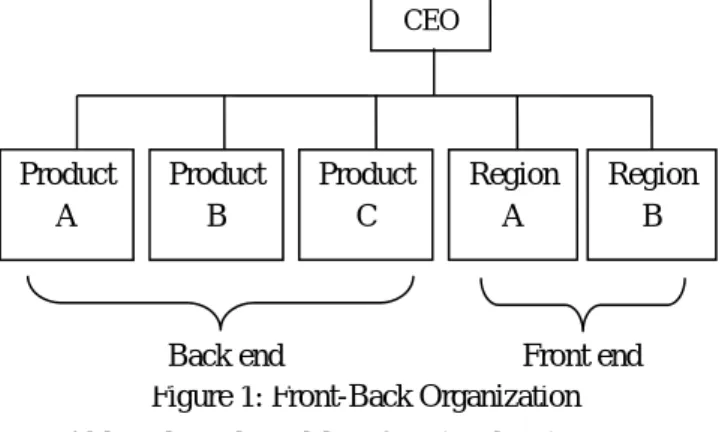
As a new kind of organization structure, the front-back (F/B) organization has been discussed mainly by Galbraith (1993, 2000). Here, the F/B organization consists of two major ends; front and back end. The former is organized based on region or country, and the latter focuses on products (Fig.1). The F/B organization appeared in the progress of globalization. Organizations have to meet global demands such as cost reduction through the uniformed product as well as the local demands such as customized products.
Figure 1: Front-Back Organization
Although each end has functional units, upstream functions such as R&D and production belong to back end and downstream ones such as sales and service consist of front end. In this sense, the F/B organization † Faculty of Business Administration,
Aichi Institute of Technology (Toyota city) †† International Center,
Kitami Institute of Technology (Kitami city)
is said to be different from the multi divisional organization and global matrix organization.
However, the F/B organization is often said to be a kind of hybrid organization (Galbraith, 2000). Here, we need to pay attention to the meaning of the term ‘hybrid.’ In other words, we need to identify the common and different aspects among several organizations such as multidivisional organizations and matrix organizations. This comparison will clarify the idiosyncrasies of the F/B organization.
Based on the discussion so far, we firstly clarify the characteristics and merits/demerits of the F/B organization. Next, we will make a comparison among multidivisional, F/B and global matrix organization. Then, we will refer to the developmental process of organizational structure of global corporations.
2. F/B organization: Its Characteristics and (Dis)advantages
2・1 Dilemma of Globalization and F/B Organization
As noted before, global corporations meet global and local demand at the same time. Pursuit of one may, however, sacrifice the others. We call this ‘a dilemma of globalization.’
The F/B organization is employed as a way to deal with this dilemma. In the back ends, development and some parts of productions are implemented in a uniformed way and this bring about high specialty and CEO Product A Region B Back end Product B Product C Region A Front end 200
愛知工業大学研究報告,第 50 号, 平成 27 年, Vol.50, Mar, 2015.
cost reduction. On the other hand, in front ends, each product is customized to meet the market demand. To make the F/B organization effective, Galbraith (2000) points out three aspects of coordination. The first is the arrangement of functions. Functions such as sales and after-sales service concerning response to the market belong in front end. On the other hand, functions, such as R&D and product design, for integration and efficiency go in back end. However, marketing activities, for example, can be understood from two standpoints, product marketing and customer marketing, and go in both the front and back ends. Therefore, the location of function is an important matter. The second is the power balance between front and back ends. This concerns the relative importance between global demand and local response. The appropriateness of the balance depends on the circumstance surrounding the organization. The third is ways to link both ends. Some corporations link both ends directly. Some locate managers who report to both product and market companies.
Through these mechanisms, the F/B organization can be made effective.
2・2 Merits and Demerits of F/B Organization To make F/B more effective, it is useful to grasp merits and demerits of the F/B organization. The merits are followings; achievement of duality, cultivation of human resources, and diversity for innovation.
The first is achievement of duality. Organizations overcome the dilemma of globalization by responding to each market and customer in front end and improve efficiency through the effort in back end. This meets global and local demands and leads to the achievement of duality. The second is cultivation of human resources. Those who are involved in the both ends and coordinate both ends’ behaviors understand global and local viewpoints and this broadens one’s horizon. The third is promotion of diversity for innovation. There is a difference between the knowledge gained through the relationship to market and customer and the one developed in front end. This difference is a wider one and will be a source of innovative ideas through
interaction between the two ends.
As the same in other organizations, however, there are disadvantages of the F/B organization. The first is a conflict between the two ends. As Galbraith (1993) noted, when front end tries to meet customer’s demand fully, it sometimes needs to buy components from suppliers other than back end. Back end, on the other hand, tries to sell its product to companies other than its frond end to increase its sales, though they are often front end’s competitors. The second is stress to those who connect the two ends. If both ends conflict with one another, it is difficult for the person to coordinate them and this could be huge stress. The third is an incomplete or halfway simultaneous achievement of duality. In some cases, it is difficult to strike a balance between two incompatible demands.
Although the F/B organization has these demerits, merits are valuable for corporations pursuing globalization. Therefore, this organizational structure is a powerful alternative.
3. Idiosyncrasies of F/B organization
Since the (dis)advantages of the F/B organization have been clarified, here, we analyze it from a
standpoint of organization design. Galbraith (1973) said, organization design includes distinguishing and
evaluating some alternative organizational structures. As such, we refer to multidivisional organization, F/B organization, and global matrix. Comparing these three organization, we will identify its idiosyncrasies. In comparing, we employ factors such as management cost, lateral communication, and
effectiveness. These have often been used in traditional organizational research.
3・1 Comparison with Multidivisional Organization
The Multidivisional organization organizes itself along with product or region. In case of the F/B organization, on the other hand, front end consists of region and back end is based on product. This is major difference from the multidivisional organization.
Idiosyncrasies of the Front-back Organization
Besides, each division in the multidivisional
organization, has its all necessary functions so that it can be a self-contained organization. However, in the F/B organization, functions close to the market belong to front end and the ones far from the market go to back end. This characteristic on the arrangement of functions is an idiosyncrasy of the F/B organization.
Based on this difference, we focus on management cost. Simply speaking, the multidivisional organization has divisions same as its products. On the other hand, in the F/B organization, numbers of region or nation units front end has are the same as markets, and back end has the same number units as products. In this point, the F/B organization is more complex and needs more managers, therefore, management cost is higher. Secondly we look at lateral communication. Though in the multidivisional organization there is no formal lateral communication, there are some people who connect the two ends in the F/B organization. They coordinate products and services front end need and the ones back end supplies.
Next, we focus on effectiveness in response to the dilemma of globalization, to achieve duality. The multidivisional organization is based on one dimension, products or regions. The product-based multidivisional organization aims at efficiency, and the region-based one does on the local market. Both meet one dimension of the dilemma and don’t achieve duality. On the other hand, the F/B organization does it because each end meets a different dimension of dilemma.
3・2 Comparison with Global Matrix
Same as the discussion above, firstly, we make the comparison from a standpoint of management cost. The major difference between the F/B organization and the matrix is the presence of double authority. Although in case of the F/B organization, the line of command is a
single line authority, there are double formal lines of command, such as products and regions. This leads to the difference of numbers of managers. And the scope of management is wider in the global matrix. Two boss managers in this organization engage in both product and region activities, and many functions. This leads to higher management cost in the global matrix.
Lateral communication, secondly, is formalized as an organizational structure in the global matrix. On the other hand, in the F/B organization, there are some people who connect activities in both ends. As Galbraith (1973) identified several mechanisms on lateral relationships, the matrix organization has the highest formality.
Thirdly, as to duality, both the F/B organization and the global matrix aim to meet global demands based on products and local demands based on regions or customers simultaneously. Here, lateral relationship is formalized as a structure and there are double lines of command in the global matrix. Therefore, it can achieve a higher level of duality than the F/B organization. We have compared three organizations so far and table 1 shows it. Based on it, the F/B organization is based on single line of command in the multidivisional organization on one hand, and aiming to achieve duality in the global matrix on the other hand. Therefore, we can conclude that the F/B organization is a kind of ‘dual multidivisional organization.’
4. F/B Organization in Developmental Stage
We have compared three organizations and concluded that the F/B organization has its own characteristics and is an idiosyncratic organizational structure. Therefore, we will consider the relationship among these organization next. The Since F/B organization
Table 1: Comparison among F/B, Multidivisional and Global Matrix Organization (modified, Kobashi(2004))
Multidivisional F/B Global Matrix
Management Cost Low Middle High
Lateral Communication None Middle High
Line of Command Single Single Double
Achievement of Duality None Middle High
愛知工業大学研究報告,第 50 号, 平成 27 年, Vol.50, Mar, 2015.
has appeared in the globalization of corporations, we can grasp it in the development process.
Stopford and Wells (1972) discussed that organizational structure develops from one with international division, then to region-based or product-based global multidivisional organization, to global matrix. Here, we can add the F/B organization into this process.
As noted, global corporations face the dilemma of globalization and. ones employing a product-based multidivisional structure will face local demands such as customization of product to the regional market in the expansion of their businesses. On the other hand, the ones taking a region-based multidivisional structure will have to meet global demands likewise.
Here, the F/B organization will be a powerful alternative. In other words, global corporations don’t shift to the global matrix directly, but they will choose the F/B organization before it, because the F/B organization needs less management cost although the extent of duality achievement is lower than the global matrix. Therefore, the necessity of a higher level of duality makes corporations employ the global matrix. From the discussion so far, we can point out that an organizational structure will develop as shown in Fig.2 depending on the level of environmental pressure, ‘the dilemma of globalization.’
4. Concluding Remarks
In this note, we have discussed idiosyncrasies of the F/B organization. Its aim of achieving duality is the same as the global matrix. However, there are differences between these. Management cost is lower and so the level of duality in the F/B organization.
As traditionally discussed in organization theory, each structure has its own (dis)advantage. Therefore, effectiveness of the F/B organization depends on the surrounding environment. In an environment where middle level of duality is needed, the F/B organization will be appropriate.
Globalization has one characteristic. That is it has shown the diversity of the market.
Figure 2:Developmental Model of a Global Corporation
Corporations have to respond to not only to product markets, but also to regional markets and customer markets. The shift from multidivisional to the F/B organization is an adaptation to this diversification of market. Therefore, to grasp this organization more in depth, we need to pay attention to this diversification in globalization.
References
Galbraith, J. R. (1973). Designing Organizations, Jossey-Bass.
Galbraith, J. R. (1993). The Value-Adding Corporation. in Galbraith, J. R. and E. E. Lawler. (eds.), Organizing for the Future, Jossey-Bass.
Galbraith, J. R. (2000). Designing the Global Corporation, Jossey-Bass.
Kobashi, T. (2004). Front-Back Organization: A Structure in the Age of Globalization. Journal of Business Management, 11, pp.28-38.
Stopford, J., and L. Wells (1972). Managing the Multinational Enterprise, Longmans.
(受理 平成 27 年 3 月 19 日) International Division Product-based Multidivisional Organization Front-Back Organization Global Matrix Region-based Multidivisional Organization Level of Globalization Low High 203