Introduction
The Lena Delta is one of the world's largest river deltas (32,000 km₂) located in North Asia. It is
crossed by a dense network of 6,500 water channels and contains about 30,000 lakes. A total of 122 bird species have been recorded here, of which at least 67 species were breeding (Gilg et al. 2000). The delta is one of the most important areas for breeding of waterfowl along the East Asian Flyway (Pozdnyakov 2001). Previous studies have shown the migratory routes of waterfowl breeding in the Lena Delta, including the Tundra Swan Cygnus columbianus (Kamiya & Pozdnyakov 2002) and White-fronted Goose Anser albifrons (Si et al. 2018). While 21 species of shorebirds are known to breed in the Lena Delta (Gilg et al. 2000), current understanding of their migratory routes, staging, and wintering areas remains rudi-mentary (Minton et al. 2006, Pozdnyakov 2006). To have a better understanding for the migratory ecol-ogy of breeding birds in the Lena Delta, recovery records of banded birds, as well as morphometric traits of the breeding birds would be useful as they elucidate the migratory routes and regional traits of the breeding populations (Sugawa et al. 2010).
To accumulate the basic information on breeding shorebirds population in the Lena Delta, we conducted a banding expedition from June to July in 2016 in the Lena Delta. In this report, we describe the avifauna and the nest characteristics of breeding shorebirds observed during the study period as well as morphometric measurements of banded birds.
Study Area
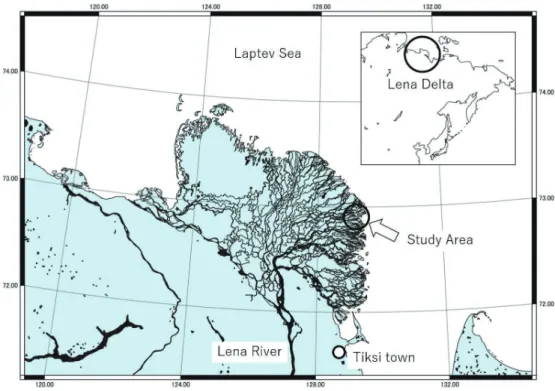
This study was conducted on a small island named Nerpalbakh, which is located in the north-eastern part of the Lena Delta (72°53′N, 129°22′E, Fig. ₁ ). Nerpalbakh Island is 14 km in
circumfer-Banding records of breeding shorebirds
in the Lena Delta, Russia
Yusuke SAWA*, Tatsuo SATO, Toshio IKEUCHI and Vladimir Pozdnyakov
A banding survey for shorebirds was conducted in the Lena Delta, Russian Federation, from June 28 to July 12, 2016. A total of 35 bird species were observed, of which 18 were determined as breeding in the area. Also, 32 shorebirds of six species were captured and banded. In this report, the characteristics of shorebird nests and the morphological measurements of banded birds are described.
キーワード:banding records, Lena Delta, nest characteristics, shorebird.
ence, and approximately 820 ha in area. The Lena Delta is classified as tundra and is characterized by a mean annual air temperature of −13°C and annual rainfall of 190 mm (Bolshiyanov 2015). The study site consists of typical ice-wedge polygonal tundra with sedge Carex sp., grass Eriophorum sp., mosses, lichen, herbs, and low shrubs (Ulrich et al. 2009).
Material and Methods
The survey was conducted for nine days in total from June 28 to July 12, 2016, and two observ-ers spent at least three hours each day. All bird species observed during the survey were recorded. Their status was determined and categorized as follows: breeder (nest or young bird observed); prob-able breeder (distraction-display or injury-feigning, agitated behavior, or anxiety calls from adults); migrant (birds observed moving in a directional manner, often in flocks); and transient (irregular visitor outside its known or suspected breeding area). All categories were adapted from Gilg et al. (2000). Nests of the shorebirds were located by tracking incubating individuals which were flushed by observers. We usually observed these individuals at a distance of 20–30 m, laying down on the ground not to make the returning birds become cautious. When the nests were found, three environmental characteristics were recorded at each nest; vegetation type, vegetation height, and vegetation cover. Vegetation type at the nests was classified as grassland, mosses and lichen, and shrubs. Vegetation height was measured by recording the maximum height of the vegetation in centimeters from the
tom of the nest bowl. Vegetation cover was assessed using a ₅ ⊗ ₅ cm checkerboard grid (₁ ⊗ ₁ cm cells) placed horizontally over the nest and the proportion of checkerboard obscured by vegetation was recorded when viewed from the height of ₁ m (Sawa et al. 2011).
Nesting shorebirds were captured by a bow-net trap at the nests (70 cm diameter; Salyer 1962) and were fitted with two red colored plastic bands on the left leg and a metal ring provided by Bird Ringing Centre of Russia on the right leg. Herring Gull Larus argentatus was captured by leg-hold nooses traps which were set up close to the bait (Schemnitz et al. 2009) and fitted with a red colored plastic band with two numeral code on the left leg and a metal ring on the right leg. Nine morphometric mea-surements were recorded following the methods of Svenson (1992) and Yamashina Institute for Orni-thology (2009). Maximum wing length (from carpal joint to tip of longest primary of flattened and extended closed wing) and tail length were measured to the nearest 0.5 mm with a metal ruler. Natural wing length, tarsus length, total head length, exposed culmen length (the upper mandible of the bill, from tip to first feathers), bill height (at the tip of nostril), and bill width (at the tip of nostril) were mea-sured with calipers to the nearest 0.1 mm. Body weight were recorded with a digital scale to the nearest 0.1 g. All measurements were taken by the same person (Tatsuo Sato) to eliminate variation among investigators.
Results
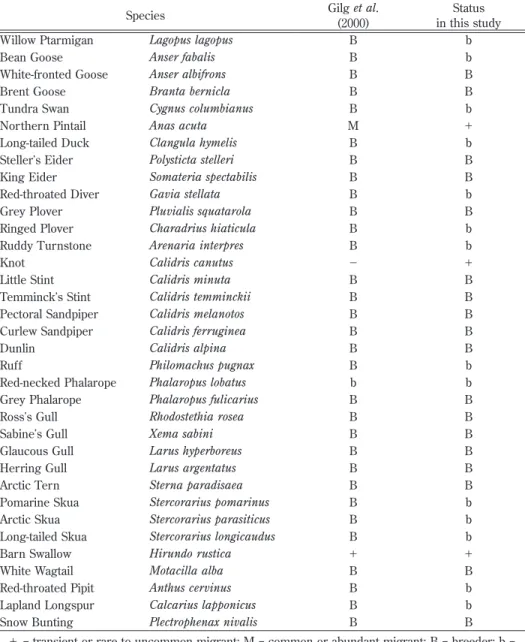
In total, 35 species were observed during survey period, of which 18 were found breeding (Table ₁), and 14 species were considered probable breeders. The species observed in the current study were consistent with those observed in the previous study (Gilg et al. 2000). The only exception is the Knot Calidris canutus recorded in this study. Because only a single Knot was observed once in the mud flat adjacent to Nerpalbakh island, it was considered a transient visitor.
A total of 34 shorebird nests of five species were found on Nerpalbakh Island (Table ₂). Little Stints Calidris minuta were the most abundant species with 17 nests found followed by Grey Phalaropes Phalaropus fulicarius with 14 nests. These numbers were similar to those recorded in a previous study in the northern part of the Lena Delta (Gilg et al. 2000).
Thirty-two shorebirds of six species and one Herring Gull were captured. The nest site charac-teristics and banding records are described in the following sections.
Grey Plover Pluvialis squatarola
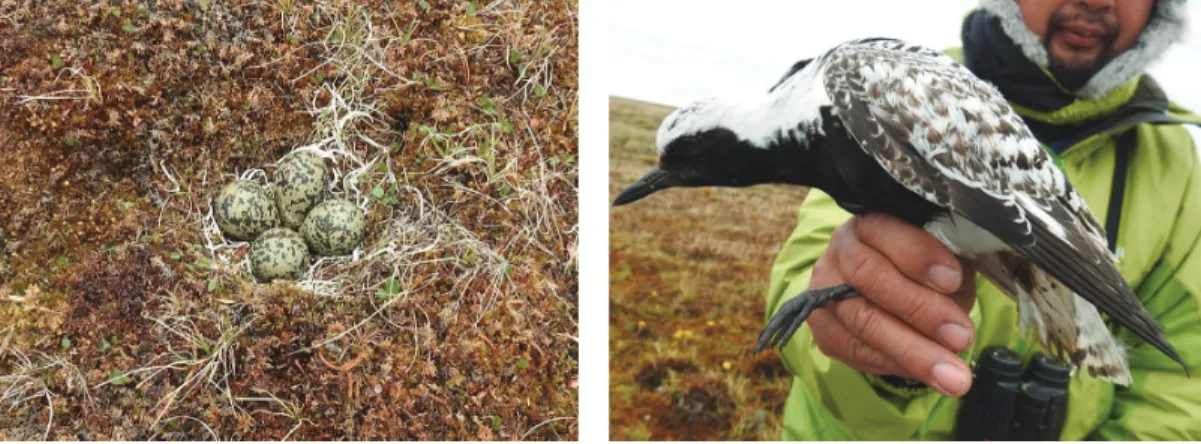
One Grey Plover nest was found on lichen and moss, with no vegetation cover (Table 2, Fig. ₂ ). One adult male was captured. The sex was determined by the shape of tertials (Prater et al. 1977).
Little Stint Calidris minuta
Fifty-three percent of the nests of this species were found in the grass, and the rest were found in dwarf shrub (Salix spp. Table 2, Fig. ₃). The vegetation height (14.3 ∓ 5.1 cm) and the vegetation
Table 1. Birds observed in the present study in the Lena Delta
Species Gilg et al.
(2000) in this studyStatus
Willow Ptarmigan Lagopus lagopus B b
Bean Goose Anser fabalis B b
White-fronted Goose Anser albifrons B B
Brent Goose Branta bernicla B B
Tundra Swan Cygnus columbianus B b
Northern Pintail Anas acuta M +
Long-tailed Duck Clangula hymelis B b
Steller's Eider Polysticta stelleri B B
King Eider Somateria spectabilis B B
Red-throated Diver Gavia stellata B b
Grey Plover Pluvialis squatarola B B
Ringed Plover Charadrius hiaticula B b
Ruddy Turnstone Arenaria interpres B b
Knot Calidris canutus - +
Little Stint Calidris minuta B B
Temminck's Stint Calidris temminckii B B
Pectoral Sandpiper Calidris melanotos B B
Curlew Sandpiper Calidris ferruginea B B
Dunlin Calidris alpina B B
Ruff Philomachus pugnax B b
Red-necked Phalarope Phalaropus lobatus b b
Grey Phalarope Phalaropus fulicarius B B
Ross's Gull Rhodostethia rosea B B
Sabine's Gull Xema sabini B B
Glaucous Gull Larus hyperboreus B B
Herring Gull Larus argentatus B B
Arctic Tern Sterna paradisaea B B
Pomarine Skua Stercorarius pomarinus B b
Arctic Skua Stercorarius parasiticus B b
Long-tailed Skua Stercorarius longicaudus B b
Barn Swallow Hirundo rustica + +
White Wagtail Motacilla alba B B
Red-throated Pipit Anthus cervinus B b
Lapland Longspur Calcarius lapponicus B b
Snow Bunting Plectrophenax nivalis B B
+ = transient or rare to uncommon migrant; M = common or abundant migrant; B = breeder; b = probable breeder.
Table 2. Nest characteristics of shorebirds found in the Lena Delta
Species n Vegetation type Vegetation height
(Mean ∓ SD) (Mean ∓ SD) Nest cover Grass Lichen & Moss Shrub
Grey Plover 1 0 100% 0 0 0
Little Stint 17 53% 0 47% 14.3 ∓ 5.1 cm 23.5 ∓ 14.6%
Pectoral Sandpiper 1 100% 0 0 19 cm 37%
Dunlin 1 100% 0 0 13 cm 45%
cover (23.5 ∓ 14.6%) was lower than that of other shorebirds nests found in this study.
A total of 13 adults and three chicks were captured. The Little Stint is a uniparental species, but males and females often incubate separate clutches (Tulp et al. 2009). Thus, the sex was identified based on morphological measurements only (Prater et al. 1977; exposed culmen ≥ 19 mm and max wing ≥ 99 mm are considered as females; Table ₃).
Pectoral Sandpiper Calidris melanotos
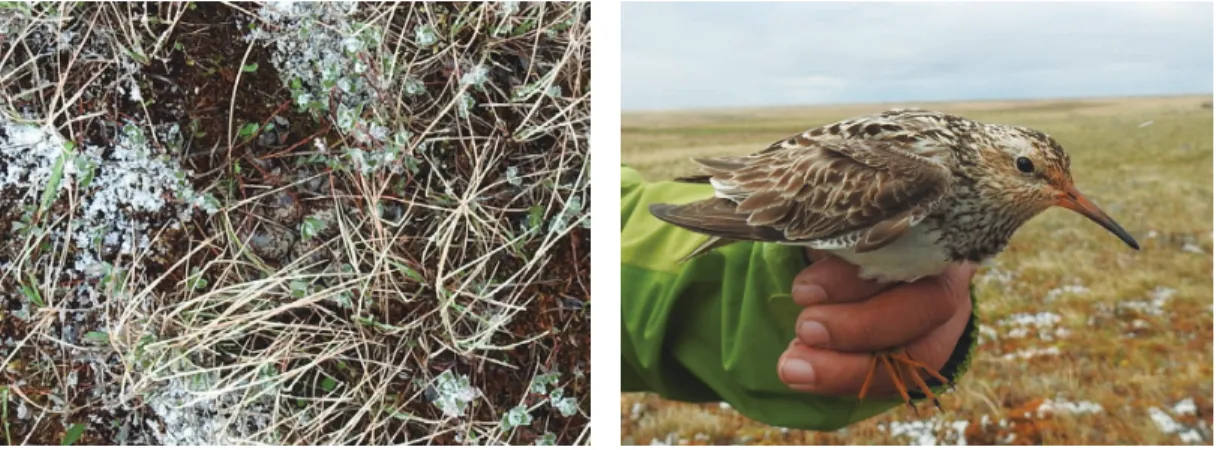
One nest was found in glass land and the nest cover (37%) was slightly higher than that of Little Stint (Table ₂). One adult female was captured (Fig. ₄). Pectoral Sandpipers are uniparental incubators, with only females incubating eggs (Norton 1972). The recorded maximum wing length was also within the size range of females ( ≤ 135 mm, Prater et al. 1977; Table ₃).
Curlew Sandpiper Calidris ferruginea
No nests of this species were found in this study, but one female with one chick was captured Fig. 2. A nest of Grey Plover (left) and a captured male (right).
(Fig. ₅). It is a uniparental species, with only females rearing chicks (Schekkerman et al. 1998), so the adult was assumed to be female. The measurements of the exposed culmen was within the size range of females (35–42 mm, Prater et al. 1977; Table ₃).
Table 3. Measurements of birds banded in the Lena Delta (part ₁).
Species Sex₁ Age₂
Max Wing (mm) Natural Wing (mm) Tarsus (mm) Tail (mm) Total Head (mm) Mean ∓ SD n Mean ∓ SD n Mean ∓ SD n Mean ∓ SD n Mean ∓ SD n
min–Max min–Max min–Max min–Max min–Max Grey Plover M A 197.5 1 185.8 1 48.3 1 75.0 1 70.2 1 Pluvialis squatarola Little Stint F A 100.3 ∓ 1.3 4 95.7 ∓ 2.5 4 22.8 ∓ 1.1 4 45.0 ∓ 3.4 4 40.9 ∓ 0.8 4 Calidris minuta 99.0–102.0 93.0–98.0 21.5–23.7 43.0–50.0 40.2–41.9 U A 97.2 ∓ 1.7 9 91.5 ∓ 2.5 6 21.8 ∓ 0.9 9 39.7 ∓ 1.3 9 39.1 ∓ 1.4 9 95.5–100.0 87.0–93.8 20.5–23.1 36.5–41.0 36.7–40.9 U P Pectoral Sandpiper F A 133.0 1 125.5 1 27.8 1 66.0 1 52.9 1 Calidris melanotos Curlew Sandpiper F A 131.0 1 124.1 1 32.2 1 45.0 1 63.9 1 Calidris ferruginea U P Dunlin U A 113.5 1 109.5 1 25.0 1 49.5 1 37.4 1 Calidris alpina Grey Pharalope M A 131.1 ∓ 3.1 11 126.4 ∓ 2.4 6 22.5 ∓ 0.8 11 62.8 ∓ 1.9 11 46.4 ∓ 1.1 11 Phalaropus fulicarius 127–137.5 123.5–130.0 21.3–23.8 60.0–66.0 44.7–48.3 Herring Gull U A 445.5 1 68.7 1 198.0 1 140.5 1 Larus argentatus
₁– F = Female; M = Male; U = Unknown. ₂– A = Adult; P = Pullus.
Table 3. Measurements of birds banded in the Lena Delta (part ₂).
Species Sex Age
Exposed Culmen (mm) Bill Height (mm) Bill Width (mm) Weight (g) Mean ∓ SD n Mean ∓ SD n Mean ∓ SD n Mean ∓ SD n
min–Max min–Max min–Max min–Max
Grey Plover M A 129.2 1 7.7 1 7.6 1 - 1 Pluvialis squatarola Little Stint F A 19.7 ∓ 0.6 4 3.8 ∓ 0.2 4 3.1 ∓ 0.3 4 30.1 ∓ 2.6 4 Calidris minuta 19.1–20.4 3.5–3.9 2.7–3.5 28.4–33.9 U A 18.3 ∓ 0.8 9 3.8 ∓ 0.2 7 3.1 ∓ 0.2 7 28.7 ∓ 0.9 9 17.2–19.4 3.5–3.9 2.8–3.3 27.3–30.1 U P 4.0 ∓ 0.2 3 3.8–4.1 Pectoral Sandpiper F A 27.2 1 4.6 1 3.9 1 56.5 1 Calidris melanotos Curlew Sandpiper F A 39.5 1 5.2 1 4.4 1 50.8 1 Calidris ferruginea U P 15.6 1 Dunlin U A 33.4 1 4.8 1 3.2 1 46.6 1 Calidris alpina Grey Pharalope M A 21.9 ∓ 1.1 11 4.2 ∓ 0.2 9 4.4 ∓ 0.2 9 49.3 ∓ 3.4 10 Phalaropus fulicarius 20.2–23.8 3.7–4.4 3.9–4.6 43.5–54.5 Herring Gull U A 58.7 1 20.6 1 10.6 1 1228.0 1 Larus argentatus
Dunlin Calidris alpina
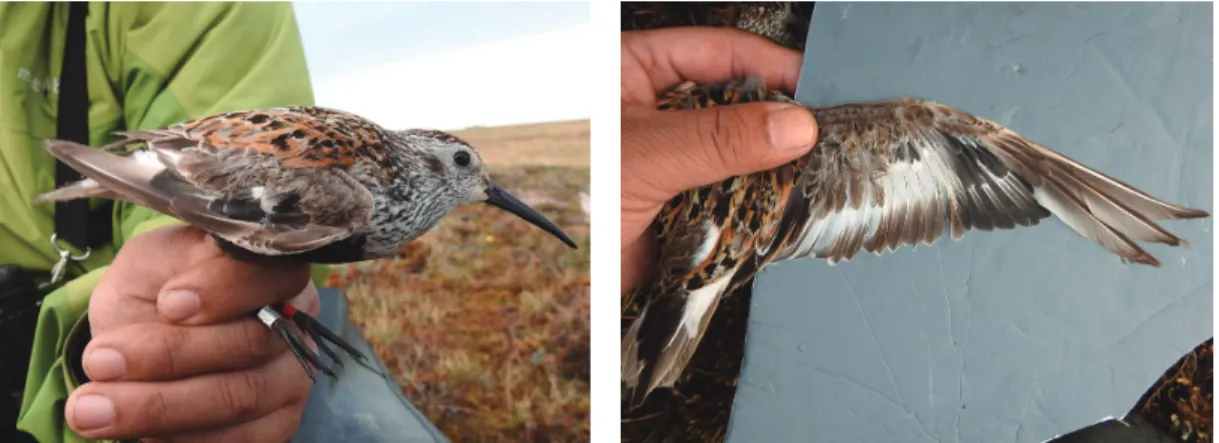
One nest was found in glass land. While the vegetation height (13 cm) was similar to that of Little Stints, the nest was well concealed by vegetation (the nest cover was 45%, Table ₂). One adult individual was captured. The inner six primaries were in the process of being replaced, and outer three primaries had not started molting (Fig. ₆).
The Lena Delta falls within the latitudinal range of the subspecies C. a. centralis, which breeds in east Siberia, extending from the Taymyr Peninsula to the Kolyma Delta (Engelmoer & Roselaar 2012). The summer plumage of this subspecies includes buff-brown fringes on the fresh inner median wing coverts (Engelmoer & Roselaar 2012). However, it was not possible to distinguish the plumage during our survey because the primary feathers of the captured bird were in molt.
Grey Phalarope Phalaropus fulicarius
A total of 14 nests of this species were found in dense grass (Table 2, Fig. ₇). Vegetation height Fig. 4. A nest of Pectoral Sandpiper (left) and a captured female (right).
around the nests (16.8 ∓ 3.6 cm) were higher than that recorded for Little Stints; thus, the nests were well hidden. Eleven adult males were captured (Table ₃). The sex was determined from the plumage. The cap and mantle of males are streaked sandy-brown and dark brown, while a small area of the cheeks is buffish-white (Prater et al. 1977).
Herring Gull Larus argentatus
One Herring Gull was captured. The breeding status of this individual was unknown because it was attracted by bait and captured far from the nest. While there were several Herring Gull's nests in the study site, some non-breeding individuals also seemed to be there.
Acknowledgements
We are grateful to the members of Foster a Goose Program for financial support. We also thank Fig. 7. A nest of Grey Phalarope (left) and a captured male (right). The nest located in the circle and was well
con-cealed by vegetation.
Inga Bysykatova from Institute for Biological Problems of Cryolithozone Siberian Branch of the Russian Academy of Science, and Vladimir Illus and Yakshina Irina from State natural reserve Ust-Lensky for all of support for field survey.
References
Bolshiyanov, D., Makarov, A. & Savelieva, L. 2015. Lena River delta formation during the Holocene. Biogeosciences 12: 579–593.
Engelmoer, M. & Roselaar, C. S. 2012. Geographical variation in waders. Springer Science & Business Media, Dordrecht.
Kamiya, K. & Pozdnyakov, V. I. 2002. International exchange between Yonago Waterbirds Sanctuary, Japan and Lena Delta, Russia and neck-banded to tundra swan (Cygnus columbianus) in Lena Delta. Nihon no Hakucho 26: 10–19 (Japanese with English abstract).
Gilg, O., Sané, R., Solovieva, D. V., Pozdnyakov, V. I., Sabard, B., Tsanos, D., ... & Eichhorn, G. 2000. Birds and mam-mals of the Lena Delta Nature Reserve, Siberia. Arctic 53: 118–133.
Minton, C. D. T., Jessop, R. E., Collins, P. C. & Wilson, J. R. 2006. The migratory movements of Curlew Sandpipers
Calidris ferruginea which visit Australia. International Wader Studies 19: 171–183.
Norton, D. W. 1972. Incubation schedules of four species of calidridine sandpipers at Barrow, Alaska. The Condor 74: 164–176.
Pozdnyakov, V. I. 2001. Lena-Delta. Anet Newsletter ₂: ₅–6.
Pozdnyakov, V. I. 2006. Migration of Curlew Sandpiper Calidris ferruginea in Sakha Republic (Yakutia), Russia. Inter-national Wader Studies 19: 36–39.
Prater, A. J., Marchant, J. H. & Vuorinen, J. 1977. Guide to the identification and ageing of Holarctic waders (BTO guide
17). British Trust for Ornithology, Norfolk.
Salyer, J. W. 1962. A bow-net trap for ducks. The Journal of Wildlife Management 26: 219–221.
Sawa, Y., Takeuchi, Y. & Nakamura, H. 2011. Nest site selection and nesting biology of Rock Ptarmigan Lagopus muta
japonicus in Japan. Bird Study 58: 200–207.
Schekkerman, H., Van Roomen, M. W. & Underhill, L. G. 1998. Growth, behaviour of broods and weather-related variation in breeding productivity of Curlew Sandpipers Calidris ferruginea. ARDEA 86: 153–168.
Schemnitz, S. D., Batcheller, G. R., Lovallo, M. J., White, H. B. & Fall, M. W. 2009. Capturing and handling wild ani-mals. In The Wildlife Techniques Manual, Vol. 1 (ed. N. J. Silvy), pp. 64–117. John's Hopkins Univ. Press, Baltimore. Si, Y., Xu, Y., Xu, F., Li, X., Zhang, W., Wielstra, B., Wei, J., Liu, G., Luo, H., Takekawa, J., Balachandran, S., Zhang,
T., Boer, W. F., Prins, H. F. T. & Gong, P. 2018. Spring migration patterns, habitat use, and stopover site protection status for two declining waterfowl species wintering in China as revealed by satellite tracking. Ecology and Evolu-tion ₈: 6280–6289.
Sugawa, H., Mihara, M. & Iso, K. 2010. Outline of measurements taken for birds in Kamchatka and discussion of data base used to make results widely available. Bulletin of Japanese Bird Banding Association 22: 87–96.
Svensson, L. 1992. Identification Guide to European Passerines. Fourth, Revised and Enlarged Edition. Published by the Author, Stockholm.
Tulp, I., Schekkerman, H., Bruinzeel, L. W., Jukema, J., Visser, G. H. & Piersma, T. 2009. Energetic demands during incubation and chick rearing in a uniparental and a biparental shorebird breeding in the high Arctic. The Auk 126: 155–164.
Ulrich, M., Grosse, G., Chabrillat, S. & Schirrmeister, L. 2009. Spectral characterization of periglacial surfaces and geomorphological units in the Arctic Lena Delta using field spectrometry and remote sensing. Remote Sensing of
Environment 113: 1220–1235.
Yamashina Institute for Ornithology. 2009. Bird Banding Manuals. 11th Edition. Published by Yamashina Institute for Ornithology, Abiko.
Yusuke Sawa₁, ₂* [email protected]
₁BirdLife International Tokyo, 1-13-1Nihonbashi Kakigara-cho, Chuo-ku, Tokyo 103-0014, Japan.
₂Head Office of the "Foster A Goose Program", 159-1 Futamata, Niinuma Aza, Sanbongi, Osaki city, Miyagi
989-6315, Japan. Tatsuo Sato₃
The Friends of the Gyotoku Wild Bird Observatory, 4-27-2 Fukuei, Ichikawa City, Chiba 272-0137, Japan. Toshio Ikeuchi₄
Head Office of the "Foster A Goose Program", 159-1 Futamata, Niinuma Aza, Sanbongi, Osaki city, Miyagi 989-6315, Japan.
Vladimir Pozdnyakov₅
State natural reserve Ust-Lensky, 28 street of Academician Fedorova, Tiksi, Republic Sakha.
要 約
ロシア・レナデルタにおけるシギ・チドリ類の標識記録
澤 祐介₁, ₂*・佐藤達夫₃・池内俊雄₄・Vladimir Pozdnyakov₅ 2016年6月下旬から7月上旬の繁殖期にかけて,ロシア・レナデルタにおいてシギ・チドリ類の標識調査を実施し た.調査期間中,合計35種の鳥類が観察され,そのうち18種が繁殖していることが確認された.そのうち6種32羽 のシギ・チドリ類を捕獲,標識した.本論文では,シギ・チドリ類の営巣環境と標識した個体の外部計測値につい て報告する. キーワード:営巣環境,シギ・チドリ類,標識記録,レナデルタ.受付日:2018年11月14日,受理日:2019年 ₇ 月20日,Received: 14 November 2018, Accepted: 20 July 2019 *Corresponding author: E-mail: [email protected]
₁BirdLife International Tokyo, 1-13-1Nihonbashi Kakigara-cho, Chuo-ku, Tokyo 103-0014,
Japan.
₂Head Office of the "Foster A Goose Program", 159-1 Futamata, Niinuma Aza, Sanbongi,
Appendix 1. Measurement data of all banded birds.
Species Metal ring Color Ring Sex₁ Age₂ Wing Max
(mm) Natural Wing (mm) Tarsus (mm) Tail (mm) Total Head (mm) Exposed Culmen (mm) Bill Height (mm) Bill Width (mm) Weight (g) Grey Plover - Red/Red M A 197.5 185.8 48.3 75.0 70.2 129.2 7.7 7.6 - Pluvialis squatarola
Little Stint XY76772 Red/Red U A 95.5 - 20.7 40.0 36.7 17.4 3.9 2.8 27.3
Calidris minuta XY76773 Red/Red U A 96.0 87.0 22.3 41.0 39.8 18.8 3.5 2.8 29.2
XY76774 Red/Red U A 96.5 93.5 23.1 39.0 40.6 18.8 3.6 3.2 29.0 XY76775 Red/Red U P - - - - - - - - 4.1 XY76776 Red/Red U P - - - - - - - - 3.8 XY76777 Red/Red U P - - - - - - - - 4.0 XY76778 Red/Red F A 99.0 93.0 23.7 50.0 41.0 19.8 3.5 3.1 28.4 XY76779 Red/Red F A 100.0 98.0 22.3 43.0 40.3 19.3 3.9 2.7 33.9 XY76780 Red/Red U A 100.0 93.0 21.5 41.0 37.9 17.4 3.8 3.3 30.1 XY76781 Red/Red F A 100.0 - 21.5 44.0 40.2 19.1 3.9 3.5 29.4 XY76782 Red/Red U A 97.5 93.8 22.1 40.0 39.6 19.0 3.9 3.1 29.3 XY76783 Red/Red U A 100.0 91.0 22.3 40.0 38.5 18.4 3.9 3.1 29.1 XY76784 Red/Red U A 95.5 90.9 20.5 40.0 38.4 17.2 3.7 3.3 28.3 XY76785 Red/Red F A 102.0 96.2 23.6 43.0 41.9 20.4 3.8 3.0 28.5 XY76786 Red/Red U A 97.5 - 21.4 40.0 39.2 18.4 - - 27.8 XY76787 Red/Red U A 96.5 - 22.4 36.5 40.9 19.4 - - 27.9 Pectoral Sandpiper
Calidris melanotos XD326248 Red/Red F A 133.0 125.5 27.8 66.0 52.9 27.2 4.6 3.9 56.5
Curlew Sandpiper XD326251 Red/Red F A 131.0 124.1 32.2 45.0 63.9 39.5 5.2 4.4 50.8
Calidris ferruginea XD326252 Red/Red U P - - - - - - - - 15.6
Dunlin
Calidris alpina XD326239 Red/Red U A 113.5 109.5 25.0 49.5 37.4 33.4 4.8 3.2 46.6
Grey Pharalope XD326238 Red/Red M A 132.5 128.0 23.1 63.0 47.6 22.5 4.4 4.3 54.5
Phalaropus fulicarius XD326240 Red/Red M A 130.0 123.5 21.3 62.5 46.0 20.4 4.2 4.3 52.5
XD326241 Red/Red M A 127.0 - 22.6 60.0 47.2 22.0 4.2 4.5 50.4 XD326242 Red/Red M A 127.5 - 22.7 60.0 45.8 21.4 4.3 4.5 47.3 XD326243 Red/Red M A 128.0 - 22.3 63.0 45.0 20.2 4.2 3.9 46.1 XD326244 Red/Red M A 130.5 125.0 21.8 62.0 45.5 22.1 4.4 4.6 46.8 XD326245 Red/Red M A 131.0 125.0 21.3 65.0 46.9 23.0 3.7 4.4 49.5 XD326246 Red/Red M A 131.0 126.6 23.2 64.0 44.7 21.5 4.1 4.6 - XD326247 Red/Red M A 137.5 130.0 22.0 66.0 46.8 22.3 4.4 4.5 53.0 XD326249 Red/Red M A 134.0 - 22.9 64.0 46.9 22.3 - - 43.5 XD326250 Red/Red M A 133.0 - 23.8 61.0 48.3 23.8 - - 49.6 Herring Gull
Larus argentatus DS004522 Red [29] U A - 445.5 68.7 198.0 140.5 58.7 20.6 10.6 1228.0
₁– F = Female; M = Male; U = Unknown. ₂– A = Adult; P = Pullus.