Corresponding author: Shinya Ito
2-1-1, Kitasato, Minami-ku, Sagamihara, Kanagawa, 252-0329, Japan. Tel: +81 42 778 9382
E-mail: [email protected]
Overview of the pregnancy and birth survey section of the
Fukushima Health Management Survey:
Focus on mothers anxieties about radioactive exposure
Shinya Ito
1), Aya Goto
2,3), Kayoko Ishii
3), Misao Ota
3,4), Seiji Yasumura
1,3), Keiya Fujimori
3,5),
for the Pregnancy and Birth Survey Group of the Fukushima Health Management Survey
1) Department of Public Health, Fukushima Medical University School of Medicine
2) Center for Integrated Science and Humanities, Fukushima Medical University
3) Radiation Medical Science Center for the Fukushima Health Management Survey
4) Department of Midwifery and Maternal Nursing, Fukushima Medical University School of Nursing
5) Department of Obstetrics and Gynecology, Fukushima Medical University School of Medicine
< Review >
Abstract
Objectives: The aims of this study are (1) to review the Pregnancy and Birth Survey section of the Fukushima Health Management Survey (FHMS); (2) to clarify the proportion of anxieties felt by mothers from Fukushima that relate to radiation exposure as a stigma in society, and also to identify associated factors; and (3) to explore the attitudes of future mothers from the region in regard to childbirth by developing a new scale, known as the “Fukushima Future Parents Attitude Measure (FPAM).
Methods: (1) We reviewed 11 studies that reported using the FHMS Pregnancy and Birth Survey to determine the health of infants and mothers. (2) To analyze levels of anxiety, we used the data from a 2011 baseline survey and its 2015 follow-up, ascertaining the mothersʼ subjective health, depressive symptoms, maternal confidence, and anxieties regarding radiation exposure. (3) Finally, to achieve our third aim, we distributed a questionnaire to all 310 students at a womenʼs college in Fukushima Prefecture.
Results: (1) Analyses of FHMS data showed that the Fukushima nuclear accident did not affect pregnancy outcomes, but did affect maternal mental health. (2) An examination of the surveys of mothersʼ mental health revealed that 974 mothers (41.2%) reported having feelings of anxiety associated with the stigma of radiation exposure. In particular, maternal age, depressive symptoms, receiving antenatal care as scheduled, and post-quake medical history were significantly associated with a higher proportion of anxieties related to this stigma. (3) Exploratory and confirmatory factor analyses were conducted, allowing us to identify two
Factors: “caring for a baby” (three items) and “giving birth to a baby” (three items). Both factors correlated with the studentsʼ quality of life, self-efficacy, and self-esteem scales, and the factor, “giving birth to a baby,” also correlated with radiation-related risk perception.
Conclusions: The FHMS highlighted the importance of providing mental health support to the mothers
of young children. It should be particularly noted that over 40 percent of mothers in the follow-up study in 2015 had anxieties about being stigmatized for their radioactive exposure. In addition, young womenʼs attitudes toward future pregnancy, as measured by the FPAM, are associated with their radiation risk perception.
keywords: Fukushima Health Management Survey, stigma, Fukushima nuclear accident, radiation, FPAM
(accepted for publication, 4th January 2018)
I
.FHMS Pregnancy and Birth Survey
The Great East Japan Earthquake occurred on March 11, 2011, causing a tsunami to hit the Tokyo Electric Power Companyʼs Fukushima Daiichi Nuclear Power Plant, which resulted in the leakage of radioactive material. Consequently, since this incident, many people in the area have lived in fear of radiation exposure. In the aftermath of this major nuclear power plant (NPP) disaster, mothers of young children were identified as one of the groups at greatest risk of experiencing negative emotional and mental health consequences [1].
1. Methods
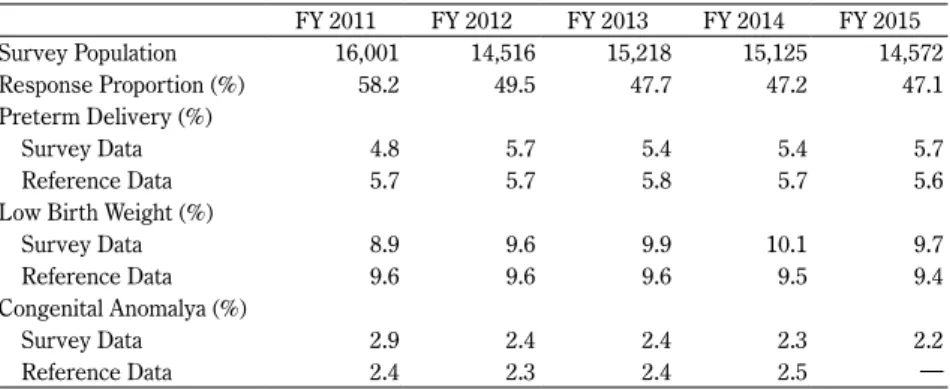
After the Fukushima nuclear accident, the Fukushima Health Management Survey (FHMS) was planned and implemented to monitor the physical and psychological health status of all prefectural residents [2]. Respondents to the FHMS Pregnancy and Birth Survey were women who registered as being pregnant at a municipal office either in Fukushima Prefecture or in another prefecture and delivered their babies in Fukushima Prefecture on or after March 11, 2011. In Japan, every pregnant woman is required to register her pregnancy; she receives a maternal and child-health handbook, as well as antenatal and postnatal checkups and other services. The total number of women meeting these criteria in 2011–2015 was 14,516–16,001; of these, 6,866–9,316 returned the FHMS questionnaire (response proportion = 47.1–58.2%: Table 1).
The questionnaire, which can be seen on our website [3], was designed to obtain general demographic and perinatal outcome data, including maternal age, pregnancy and medical history, pregnancy outcome, gestational age at delivery, mode of delivery, and infant birth weight. We also sought to ascertain mothersʼ mental health status, maternal
confidence, and the childʼs health status. The questionnaire included a blank space for respondents to freely write their own opinions.
The Ethics Committee of Fukushima Medical University approved this study (No. 1317, 2333). The survey aims were explained to all participants in a cover letter that accompanied the questionnaire. By responding to the survey, participants were considered to have consented to participate.
2. Overview of results
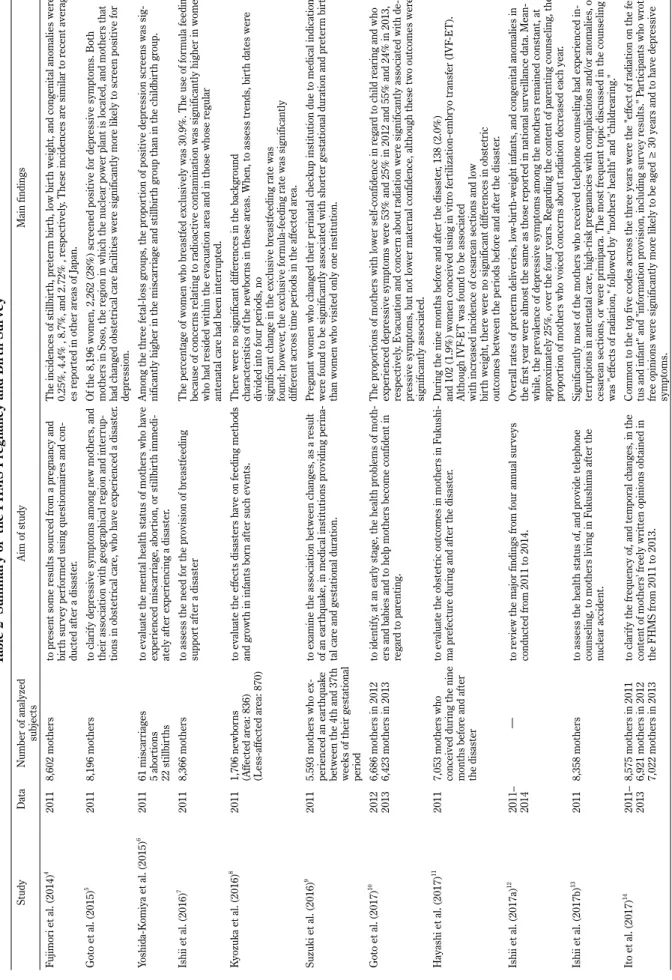
Eleven previous studies were found to have used FHMS Pregnancy and Birth Survey data [4-14] (as of November 2017; Table 2). Each of these studies focused on one of two main themes: (1) pregnancy outcomes, including stillbirth, preterm birth, low birth weight, and congenital anomalies; or (2) the mothersʼ mental health. In the 2011 data, the overall proportion of preterm (delivered at < 37 gestational weeks) and low birth weight (< 2,500 g) infants was almost the same as that reported in the national surveillance data [4,12,15] (Table 1); furthermore, the prevalence of congenital anomalies in singleton pregnancies across the five-year study period was almost the same as the 2–3% prevalence reported in the general Japanese population [12,16]. The earliest study of maternal mental health reported that, in 2011, 28% of mothers screened positive for depressive symptoms, measured using a two-item screening test [5]. Although the prevalence gradually decreased over our study period (27.1% in 2011; 25.5% in 2012; 24.5% in 2013; 23.4% in 2014; and 21.9% in 2015) [12], it remains higher than that reported, using the same questions, in other regions of Japan. For example, in Mishina et al.ʼs study, the proportion of mothers in Osaka (eastern metropolitan area) with postpartum depression was 19.8% at one month, and 1.4% at four months [17], while
Table 1 Survey population and characteristics of the infants
FY 2011 FY 2012 FY 2013 FY 2014 FY 2015 Survey Population 16,001 14,516 15,218 15,125 14,572 Response Proportion (%) 58.2 49.5 47.7 47.2 47.1 Preterm Delivery (%) Survey Data 4.8 5.7 5.4 5.4 5.7 Reference Data 5.7 5.7 5.8 5.7 5.6
Low Birth Weight (%)
Survey Data 8.9 9.6 9.9 10.1 9.7
Reference Data 9.6 9.6 9.6 9.5 9.4
Congenital Anomalya (%)
Survey Data 2.9 2.4 2.4 2.3 2.2
Reference Data 2.4 2.3 2.4 2.5 ―
a Data from singleton pregnancies.
b Reference data relating to preterm deliveries and low-birth-weight infants were sourced from vi-tal statistics recorded in Japan on an annual basis, whereas those relating to congenivi-tal anomalies were sourced from the World Health Organization and Cleaning House International Monitoring Center Japan Branch.
Table 2 Summary of the FHMS Pr
egnancy and Birth Survey
Study Data Number of analyzed subjects Aim of study Main findings Fujimori et al. (2014) 4 2011 8,602 mothers to pr esent some r esults sour ced fr om a pr egnancy and bir th sur vey per for
med using questionnair
es and con
-ducted af
ter a disaster
.
The incidences of stillbir
th, pr
eter
m bir
th, low bir
th weight, and congenital anomalies wer
e 0.25%, 4.4% , 8.7%, a nd 2.72% , r es pec tively . Th es e in ciden ces a re s imila r to r ec en t a vera g-es r epor ted in other ar eas of Japan. Goto et al. (2015) 5 2011 8,196 mothers to clarif y depr
essive symptoms among new mothers, and
their association with geographical r
egion and inter
rup
-tions in obstetrical car
e, who have experienced a disaster
.
Of the 8,196 women, 2,262 (28%) scr
eened positive for depr
essive symptoms. Both
mothers in Soso, the r
egion in which the nuclear power plant is located, and mothers that
had changed obstetrical car
e facilities wer
e significantly mor
e lik
ely to scr
een positive for
depr ession. Yoshida-K omiya et al. (2015) 6 2011 61 miscar riages 5 abor tions 22 stillbir ths
to evaluate the mental health status of mothers who have experienced miscar
riage, abor
tion, or stillbir
th immedi
-ately af
ter experiencing a disaster
.
Among the thr
ee fetal-loss gr
oups, the pr
opor
tion of positive depr
ession scr
eens was sig
-nificantly higher in the miscar
riage and stillbir
th gr
oup than in the childbir
th gr oup. Ishii et al. (2016) 7 2011 8,366 mothers
to assess the need for the pr
ovision of br eastfeeding suppor t af ter a disaster The per centage of w om en who br
eastfed exclusively was 30.9%. The use of for
m
ula feeding
because of concer
ns r
elating to radioactive contamination was significantly higher in women
who had r
esided within the evacuation ar
ea and in those whose r
egular
antenatal car
e had been inter
rupted. K yozuka et al. (2016) 8 2011 1,706 newbor ns (A ffected ar ea: 836) (L ess-affected ar ea: 870)
to evaluate the effects disasters have on feeding methods and gr
owth in infants bor
n af
ter such events.
Ther
e wer
e no significant differ
ences in the backgr
ound
characteristics of the newbor
ns in these ar
eas. When, to assess tr
ends, bir
th dates wer
e
divided into four periods, no significant change in the exclusive br
eastfeeding rate was
found; however
, the exclusive for
mula-feeding rate was significantly
differ
ent acr
oss time periods in the affected ar
ea. Suzuki et al. (2016) 9 2011 5.593 mothers who ex -perienced an ear thquak e
between the 4th and 37th weeks of their gestational period
to examine the association between changes, as a r
esult of an ear thquak e, i n m edi cal insti tuti ons pr ovi di ng per ina -tal car
e and gestational duration.
Pr
egnant women who changed their perinatal check
up institution due to medical indication
wer
e found to be significantly associated with shor
ter gestational duration and pr
eter
m bir
th
than women who visited only one institution.
Goto et al. (2017) 10 2012 2013 6,686 mothers in 2012 6,423 mothers in 2013 to ide nti fy , at an ear ly st ag e, the he al th pr obl em s of m ot
h-ers and babies and to help mothh-ers become confident in regar
d to par
enting.
The pr
opor
tions of mothers with lower self
-confidence in r
egar
d to child r
earing and who
experienced depr
essive symptoms wer
e 53% and 25% in 2012 and 55% and 24% in 2013,
respectively
. Evacuation and concer
n about radiation wer
e significantly associated with de
-pr
essive symptoms, but not lower mater
nal confidence, although these two outcomes wer
e
significantly associated.
Hayashi et al. (2017)
11
2011
7,053 mothers who conceived during the nine months befor
e and af ter the disaster to eva lu ate th e obs tetric ou tcomes in moth ers in F uk us hi -ma pr efectur e during and af
ter the disaster
.
During the nine months befor
e and af
ter the disaster
, 138 (2.0%)
and 102 (1.9%) women conceived using in vitr
o fer
tilization-embr
yo transfer (IVF
-ET).
Although IVF
-ET was found to be associated
with incr
eased incidence of cesar
ean sections and low
bir
th weight, ther
e wer
e no significant differ
ences in obstetric
outcomes between the periods befor
e and af
ter the disaster
.
Ishii et al. (2017a)
12 2011 – 2014 ― to r
eview the major findings fr
om four annual sur
veys conducted fr om 2011 to 2014. Overall rates of pr eter m deliveries, low-bir
th-weight infants, and congenital anomalies in
the first year wer
e almost the same as those r
epor
ted in national sur
veillance data. Mean
-while, the pr
evalence of depr
essive symptoms among the mothers r
emained constant, at
appr
oximately 25%, over the four years. R
egar
ding the content of par
enting counseling, the
pr
opor
tion of mothers who voiced concer
ns about radiation decr
eased each year
.
Ishii et al. (2017b)
13
2011
8,358 mothers
to assess the health status of, and pr
ovide telephone
counseling, to mothers living in F
uk
ushima af
ter the
nuclear accident.
Significantly most of the mothers who r
eceived telephone counseling had experienced in
-ter
ruptions in antenatal car
e, high-risk pr
egnancies with complications and/or anomalies, or
cesar
ean sections, or wer
e primipara. The most fr
equent topic discussed in the counseling
was "effects of radiation," followed by "mothers' health" and "childr
earing."
Ito et al. (2017)
14
2011– 2013 8,575 mothers in 2011 6,921 mothers in 2012 7,022 mothers in 2013
to clarif
y the fr
equency of, and temporal changes, in the
content of mothers' fr
eely written opinions obtained in
the FHMS fr
om 2011 to 2013.
Common to the top five codes acr
oss the thr
ee years wer
e the "effect of radiation on the fe
-tus and infant" and "infor
mation pr
ovision, including sur
vey r esults." P ar ticipants who wr ote fr ee opinions wer e significantly mor e lik
ely to be aged ≥ 30 years and to have depr
essive
the Hamamatsu Birth Cohort reported a depression rate of 11% within one month, and 4% at 2–3 months postpartum [18]. As for the mothers who wrote their own comments on the questionnaire, during the first two years after the nuclear accident, many mothers expressed concerns about the health effects of radiation on their children; by the third year, their concerns had shifted more toward their own health and general parenting issues [14].
II
. Follow-up Study of the FHMS Pregnancy
and Birth Survey
In Fukushima, there is a growing interest in the public stigma and self-stigmatization associated with radioactive exposure [19]. For example, many young women in Fukushima Prefecture worry that others might view them negatively, making assumptions about the effects of radiation on their future pregnancies or genetic inheritance [20]. Consequently, evacuees often try to conceal the fact that they lived in Fukushima [20]. Prior research has shown that self-stigmatization is often associated with public stigma [21], increased hopelessness [22], poorer self-esteem [22,23], reduced self-efficacy [22,23], and decreased quality of life (QOL) [22]. Despite these findings, little has been done to address the public stigmatization of pregnant women in Fukushima. In 2015, the FHMS conducted a follow-up study on the women who contributed to the baseline study in 2011, seeking to determine the ongoing state of maternal anxiety associated with radiation exposure, including perceptions of stigmatization. In this section, we examine the factors associated with the mothersʼ anxiety about stigmatization, using data from this follow-up study.
1. Methods
This study has used data from the baseline survey performed in 2011 and the follow-up conducted in 2015. The follow-up questionnaire was sent to 7,252 women who responded to the baseline survey, where both mother and
child were confirmed as still living. In this later survey, we sought to ascertain the mothersʼ subjective health status, depressive symptoms, maternal confidence, and anxieties concerning radiation exposure (water, food, playing outside, the child healthʼs, the stigma, genetic effects, and more).
To perform a statistical analysis, we first calculated the tetrachoric correlation coefficients for the mothersʼ anxiety about the effects of radiation, and we also examined the relationship between this anxiety and the other items. Next, the associations between the anxieties declared in 2015 and the mothersʼ background characteristics from 2011 were examined using univariate and multivariate logistic regression analyses. The Ethics Committee of Fukushima Medical University approved this study (No. 1317, 2333).
2. Results
Of the 7,252 women targeted, 2,554 returned the questionnaires (response proportion = 27.6%) and data from 2,365 women were analyzed; 189 participants were excluded on the following grounds: delivering their babies before March 11, 2011 (n = 96); and answers provided by another person (n = 93). Of the valid responses, 974 mothers (41.2%) reported feeling anxious about the stigma. The results of the tests for correlations between the anxieties regarding radiation and parenting concerns are shown in Table 3. In particular, water of the anxieties concerning radiation exposure showed medium and large correlations with food (φ = 0.84), playing outside (φ = 0.65), and child health (φ = 0.41). Meanwhile, food showed medium and large correlations with playing outside (φ = 0.62) and child health (φ= 0.40). Child health showed a medium correlation with genetic influence (φ = 0.41) and disease in children (φ = 0.46). Finally, maternal age, depressive symptoms, receiving antenatal care as scheduled, and post-quake medical history were found to be significantly associated with a higher level of anxiety about the stigma (Table 4).
Table 3 Correlations between anxieties concerning radiation effects (follow-up data from 2011)
n % 1 2 3 4 5 6 7 8 1 Water 969 41.0 -2 Food 1,121 47.4 0.84 -3 Playing outside 883 37.3 0.65 0.62 -4 Child health 1,772 74.9 0.41 0.40 0.37 -5 Stigma 974 41.2 0.02 -0.01 0.08 -0.02 -6 Genetic influence 773 32.7 0.31 0.28 0.29 0.41 0.25
-7 Mental and physical development of children 935 39.5 0.11 0.14 0.18 0.28 0.10 0.20 -8 Disease in children 953 40.3 0.29 0.28 0.27 0.46 0.06 0.30 0.23 -9 Children's lifestyle 637 26.9 0.13 0.14 0.19 0.20 0.13 0.18 0.29 0.17 * tetrachoric correlation
Table 4 Characteristics of the anxieties relating to stigma concerning radioactive exposure (data
from 2011)
Anxiety con-cerning stigma (n = 974) No anxiety concerning stigma (n = 1391)Univariate analysisa Multivariate analysisb
OR 95% CI valueP OR 95% CI valueP
n % n % Lower - Upper Lower - Upper
Mother's age at the time of pregnancy
(years; mean and SD)c 32.1 4.6 31.4 4.9 1.03 1.01 - 1.05 0.001 1.03 1.01 - 1.05 0.001 Region
Kenpoku (North region) 259 26.6 376 27.0 1 0.000 1 0.003
Kenchu (Middle region) 297 30.5 364 26.2 1.19 0.95 - 1.48 0.132 1.13 0.90 - 1.42 0.285 Kennan (South region) 64 6.6 89 6.4 1.04 0.73 - 1.49 0.814 1.09 0.76 - 1.57 0.629 Soso (Coastal region) 118 12.1 118 8.5 1.45 1.08 - 1.96 0.015 1.29 0.94 - 1.76 0.115 Iwaki (Coastal region) 143 14.7 262 18.8 0.79 0.61 - 1.03 0.077 0.74 0.57 - 0.97 0.027 Aizu, Minamiaizu (Mountainous region) 93 9.5 182 13.1 0.74 0.55 - 1.00 0.048 0.77 0.57 - 1.04 0.083 Birth 0 (First-time mother) 671 72.2 938 71.0 1 ≥ 1 259 27.8 384 29.0 0.94 0.78 - 1.14 0.536 Breast-feeding on March 11 No 930 97.3 1,307 95.8 1 Yes 26 2.7 57 4.2 0.64 0.40 - 1.03 0.064 Depressive symptoms Negative 821 85.4 1,222 89.4 1 1 Positive 140 14.6 145 10.6 1.44 1.12 - 1.84 0.004 1.34 1.04 - 1.73 0.024 Continuation of perinatal care and
deliv-ery
Yes 744 76.7 1,135 82.4 1
No 226 23.3 243 17.6 1.42 1.16 - 1.74 0.001
Attendance of antenatal care as scheduled
Yes 769 79.0 1,164 84.3 1 1
No 204 21.0 216 15.7 1.43 1.16 - 1.77 0.001 1.40 1.12 - 1.74 0.003
Prepregnancy disease
No 855 87.9 1,234 89.2 1
Yes 118 12.1 149 10.8 1.14 0.88 - 1.48 0.308
Disease between pregnancy and disaster
No 816 84.0 1,185 85.6 1 Yes 155 16.0 200 14.4 1.13 0.90 - 1.41 0.309 Post-quake disease No 753 78.0 1,145 83.5 1 1 Yes 212 22.0 226 16.5 1.43 1.16 - 1.76 0.001 1.36 1.10 - 1.68 0.005 Sexd Boy 493 51.2 701 51.1 1 Girl 469 48.8 672 48.9 0.99 0.84 - 1.17 0.927 Birth weight 2500 g or higher 909 94.2 1,265 92.1 1
Less than 2500 g (low birth weight) 56 5.8 108 7.9 0.72 0.52 - 1.01 0.055 Congenital anomaly
No 909 97.3 1,300 98.0 1
Yes 25 2.7 27 2.0 1.32 0.76 - 2.30 0.317
Feeding method
Breast feeding only 316 32.4 405 29.2 1 0.186
Mix method 604 62.0 911 65.7 0.85 0.71 - 1.02 0.075
Bottle feeding only 54 5.5 71 5.1 0.98 0.66 - 1.43 0.896 a Univariate logistic regression analysis by forced entry method.
b In the multiple logistic regression analysis (forward selection: likelihood ratio), the independent variables featured items that, through univariate logistic regression analysis, were found to have p values of less than 0.05: mother’s age at the time of pregnancy, region, depressive symptoms, continuation of perinatal care and delivery, attendance of obstetric exams as scheduled, and post-quake disease; Cox-Snell R2 = 0.024; Nagelkerke R2 = 0.033.
c Age on April 2, 2011.
III
. Young Women s Attitude towards Future
Childbirth in Fukushima
In addition to assessing current mothersʼ anxiety using FHMS, we further aimed to explore future mothersʼ attitude towards childbirth; to achieve this we developed a new scale, called the “Fukushima Future Parents Attitude Measure” (FPAM).
1. Methods
(1) Study design and participants
This cross-sectional survey was distributed to all 310 students at a womenʼs college in Fukushima Prefecture, Japan, in December 2015. Twenty-one participants were excluded on the following grounds: being married (n = 3); providing the same response to all of the questions (n = 1); scoring at least 9 out of 10 on the Social Desirability Scale (n = 9) [24,25]; and neglecting to report social desirability scale values (n = 8). Consequently, a total of 289 participants were included in the final analysis.
(2) Scale development procedure
The items included in the FPAM were selected from the following scales: the Perceived Devaluation and Discrimination Scale [26,27]; the Internalized Stigma of Mental Illness (ISMI) scale (Tanabe, personal communication, 2015) [28,29]; the BRCA Self-Concept Scale [30]; the Boston University Empowerment Scale [31]; and the Prenatal Self-Evaluation Questionnaire [32,33]. The selection criteria were that the scales were (1) globally used, and (2) had established reliability and validity. Four experts (one psychiatrist, one clinical psychologist, and two educational experts) participated in the item selection; an item was selected when at least three of the four experts independently estimated that it would be useful, resulting in the selection of 27 items. The experts then independently rated the usefulness of the items using a nine-point Likert scale (where 1 = extremely useful, 5 = neither useful nor useless, and 9 = extremely useless). Items that were rated between 1 and 5 on this scale were then collected, and the experts chose the 10 they considered most useful. When the experts judged that an item should be expressed differently, one psychologist, one clinical psychologist, and one public health physician revised the wording of the item.
The 10 FPAM items are rated on a four-point Likert scale ranging from 1 (agree) to 4 (disagree). Before responding to the items, participants are provided with the following instruction: “Please answer the following questions. Please assume that you will live and raise a family in Fukushima Prefecture.”
(3) Indicators of FPAM validity
To evaluate the validity of the FPAM, we used the
following measures: the World Health Organization-Five Well-Being Index (WHO-5) [34]; the Rosenberg Self-Esteem Scale (RSES) [35,36]; the General Self-Efficacy Scale (GSES) [37]; the Social Desirability Scale; and items for assessing perceptions of radiation-related health-effect risks [4,38]. In addition, perceptions of risks relating to the effects of radiation on health were evaluated using two items sourced from screening measures included in a mental health and lifestyle survey, developed as part of the Fukushima Health Management Survey [2,38]. Specifically, these two items are: “What do you think is the likelihood of damage to your health (e.g., cancer) in later life as a result of your current level of radiation exposure?” and “What do you think is the likelihood that the health of your future (i.e., as yet unborn) children and grandchildren will be affected as a result of your current level of radiation exposure?”
(4) Statistical analysis
A five-step analysis of the results was conducted. First, to identify the factor structure of the FPAM among participants, we conducted an exploratory factor analysis with promax rotation, using maximum likelihood as the estimation method. Criteria for the retention of factors were based on a scree plot and factor interpretability; for each of the identified dimensions, scale items with loadings greater than 0.40 were retained and used to construct the scale. Second, to assess the goodness-of-fit of the factor model identified through the exploratory factor analysis, a series of confirmatory factor analyses were performed; again, the maximum likelihood procedure was used to obtain estimates. Consequently, seven fit statistics were used to determine the best model fit [39]. Third, to evaluate the reliability of its internal consistency, we calculated Cronbachʼs alpha coefficients. Fourth, to verify criterion-related validity, Pearsonʼs or Spearmanʼs correlations between the FPAM and each measure were calculated, as appropriate. Finally, we conducted a multiple regression analysis or an ordered probit analysis, using the forced entry method. An ordered probit analysis is analogous to a multiple regression analysis; however, in ordered probit, the dependent variable is scored on an ordinal scale, whereas in multiple regression, the dependent variable is scored on an interval scale. The full and two-item versions of the FPAM were the dependent variables, and the WHO-5, RSES, and GSES were the independent variables; Mplus version 3.0 (Muthén and Muthén, Los Angeles, CA) was used for the confirmatory factor analysis and ordered probit analysis, while the other analyses were calculated using SPSS version 21.0 (SPSS Inc., Chicago, IL).
(5) Ethical considerations
The Ethics Committee of Fukushima Medical University approved this study (No. 2462). Prior to beginning the
study, we obtained approval from the university and held preparatory meetings with the studentsʼ teachers. The teacher of each class distributed questionnaires to the participants and collected them once they had been completed. The survey aims were explained to all participants in a cover letter that was distributed with the questionnaire; in particular, the cover letter stated that students should return a blank questionnaire if they did not wish to participate. We also indicated to students that the survey was anonymous, and that they would not suffer adverse consequences as a result of their responses or by choosing not to participate. Participants were considered to provide consent by returning a completed survey.
2. Results
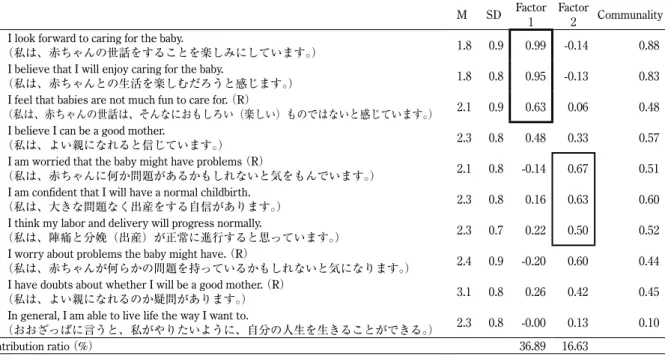
We received responses from all 310 participants (response proportion = 100%), with 289 proving to be valid; of these, 223 (77.2%) lived in Fukushima Prefecture at the time of the Great East Japan earthquake. To identify a suitable factor structure for the FPAM, we conducted an exploratory factor analysis (Table 5). The scree plot analysis indicated a two-factor solution, and the two-factor inter-correlation was 0.41; factor 1 reflected “caring for a baby” and factor 2 reflected “giving birth to a baby.” In terms of the confirmatory factor analysis, the model showed unacceptable measurement properties (χ2 = 1067.7, df = 36, CFI = 0.83, TLI = 0.77,
RMSEA = 0.152, RMSEA 90% CI = 0.132–0.177, SRMR = 0.114, AIC = 5430.3, BIC = 5500.0); consequently, we chose to exclude from the factor analysis model items
with low between-item correlation coefficients and items with reduced alpha coefficients. The “caring for a baby” factor was represented by three items (“I look forward to caring for a baby,” “I feel I will enjoy the baby,” and “I feel that babies are not much fun to care for”), and the “giving birth to a baby” factor was also represented by three items (“I am worried that the baby might have problems,” “I am confident that I will have a normal childbirth,” and “I think my labor and delivery will progress normally”). This new model demonstrated acceptable measurement properties (χ2 = 712.0, df = 15, CFI = 0.99, TLI = 0.98, RMSEA =
0.058, RMSEA 90% CI = 0.006–0.100, SRMR = 0.039, AIC = 3508.0, BIC = 3555.7).
To identify the two most important FPAM items, we calculated the alpha and correlation coefficients between the factor scores and each item score. The FPAM items, which reduced the alpha coefficients of each factor, were excluded. The “caring for a baby” score was found to have the highest correlation with “I look forward to caring for a baby” (ρ = 0.87), while the “giving birth to a baby” score was most highly correlated with “I am confident that I will have a normal childbirth” (ρ = 0.72). Therefore, these were the most important items associated with the factors of “caring for a baby” and “giving birth to a baby.”
The alpha coefficients of “caring for a baby” and “giving birth to a baby” were 0.86 and 0.65, respectively. The “caring for a baby” factor showed medium correlations with the QOL (r = -0.23), self-efficacy (r = -0.24), and self-esteem (r = -0.21) scales, while the “giving birth to a
Table 5 Exploratory factor analysis of the empowerment scale
M SD Factor 1 Factor 2 Communality 1 (私は、赤ちゃんの世話をすることを楽しみにしています。)I look forward to caring for the baby. 1.8 0.9 0.99 -0.14 0.88 2 (私は、赤ちゃんとの生活を楽しむだろうと感じます。)I believe that I will enjoy caring for the baby. 1.8 0.8 0.95 -0.13 0.83 3 (私は、赤ちゃんの世話は、そんなにおもしろい(楽しい)ものではないと感じています。)I feel that babies are not much fun to care for. (R) 2.1 0.9 0.63 0.06 0.48 4 (私は、よい親になれると信じています。)I believe I can be a good mother. 2.3 0.8 0.48 0.33 0.57 5 (私は、赤ちゃんに何か問題があるかもしれないと気をもんでいます。)I am worried that the baby might have problems (R) 2.1 0.8 -0.14 0.67 0.51 6 (私は、大きな問題なく出産をする自信があります。)I am confident that I will have a normal childbirth. 2.3 0.8 0.16 0.63 0.60 7 (私は、陣痛と分娩(出産)が正常に進行すると思っています。)I think my labor and delivery will progress normally. 2.3 0.7 0.22 0.50 0.52 8 (私は、赤ちゃんが何らかの問題を持っているかもしれないと気になります。)I worry about problems the baby might have. (R) 2.4 0.9 -0.20 0.60 0.44 9 (私は、よい親になれるのか疑問があります。)I have doubts about whether I will be a good mother. (R) 3.1 0.8 0.26 0.42 0.45 10(おおざっぱに言うと、私がやりたいように、自分の人生を生きることができる。)In general, I am able to live life the way I want to. 2.3 0.8 -0.00 0.13 0.10
Contribution ratio (%) 36.89 16.63
baby” factor showed medium correlations with the QOL (r = -0.17), self-efficacy (r = -0.18), self-esteem (r = -0.24), and radiation-related risk perception measures (r = 0.19). In relation to the “caring for a baby” factor, the standardized partial regression coefficients of the WHO-5, RSES, and GSES were -0.15, -0.07, and -0.17, respectively, and the adjusted R-squared value was 0.08. The standardized partial regression coefficients of the “giving birth to a baby” factor were -0.13, -0.18, and -.06, respectively, and the adjusted R-squared value was 0.07. In terms of the most important items reflecting these factors, the respective standardized partial regression coefficients were -0.14 and -0.14 for the WHO-5, -0.13 and -0.17 for the RSES, and -0.11 and -0.03 for the GSES. The adjusted R-squared values for the most important items were 0.085 and 0.069, respectively.
IV
.Discussion
The aims of this study were to: (1) provide an overview of the FHMS Pregnancy and Birth Survey, (2) report on the follow-up study of the FHMS Pregnancy and Birth Survey, and (3) report on a study of college womenʼs attitudes towards future childbirth in Fukushima Prefecture.
In regard to the review of the FHMS Pregnancy and Birth Survey, the nuclear accident in Fukushima was found to have not affected pregnancy outcomes, but to have affected maternal mental health, underlining the importance of providing mental health support to mothers from the area who have young children [18]. These results accord with the report of Adams et al. in 2002 and 2011 [40,41], who found that evacuee mothers in Kiev, Ukraine, who were directly affected by the Chernobyl nuclear accident, had lower levels of psychological well-being and more negative risk perception than control subjects, even at 11 [40] and 19 [41] years after the event. These results suggest that nuclear accidents cause mothers severe, long-lasting psychological problems. It is therefore essential to provide mental health support over long periods to mothers with infants; such measures should be prioritized after all such accidents.
In analyzing the follow-up to the 2011 FHMS survey, we found that over 40% of mothers were worried about experiencing a stigma as a consequence of their radiation exposure; this anxiety was associated with maternal age, depressive symptoms, receiving antenatal care as scheduled, and post-quake medical history. Our findings on mothersʼ anxieties about stigmatization are similar to those of Bromet et al.; specifically, that the Chernobyl evacuees felt that they were stigmatized when they resettled in other cities [42]. The present study shows that providing support for mothers who anxious about stigmatization continues to
be a high priority in Fukushima.
For the third part of the study, we developed a new scale to assess young womenʼs attitudes towards future childbirth and found that the scale had acceptable internal consistency reliability, content validity, construct validity, and criterion-related validity. The “caring for a baby” factor represented participantsʼ expectations of caring for a future child, while “giving birth to a baby” reflected their confidence about delivering a baby. We also extracted a two-item version of the FPAM scale for practical purposes, and confirmed its criterion-related validity.
The “giving birth to a baby” and the two-item version of the “giving birth to a baby” tools were found to be associated with “radiation-related risk perception.” This finding is consistent with Satoʼs [43] report that college students in Fukushima Prefecture worried that their children may experience hereditary effects as a result of their radiation exposure. Consequently, these results indicate that young women in Fukushima who have been evaluated as having a low risk of radiation exposure may have increased confidence in regard to giving birth; the students who received low scores on the full and two-item version of the FPAM scale demonstrated favorable results in terms of QOL, self-efficacy, and self-esteem. Our findings are supported by previous studies, which have found an association between stigma and efficacy and self-esteem [22,23]. It can consequently be suggested that the continuous provision of information on radiation-related health effects, particularly targeting younger generations, is imperative to empower them as future mothers.
However, this study also had one major methodological limitation: it did not evaluate the reliability of the FPAM scale. Consequently, to evaluate changes in the FPAM scale over time (e.g., reflecting changes in participantsʼ situations), future studies must assess this toolʼs test-retest reliability.
V
.Conclusion
The FHMS reported that radiation had no obvious effects on childrenʼs health, but had significant effects on maternal mental health, in part by generating anxieties about the stigma associated with radiation exposure. Young womenʼs attitudes toward future pregnancy were found to be associated with their radiation risk perception. Therefore, providing mental health support to mothers with infants and adequate information on radiation health effects to younger generations over long periods is important and should be prioritized, following any similar accidents, as well as the present accident.
Conflicts of interest: None.
Authors Note
Members of the Pregnancy and Birth Survey Group of the Fukushima Health Management Survey include the following: Akira Ohtsuru, Shun Yasuda, and Yasuhisa Nomura from Fukushima Medical University; Kenichi Hata from the Fukushima Society of Obstetrics and Gynecology; Kohta Suzuki from the University of Yamanashi; and Akihito Nakai from Nippon Medical School Tama Nagayama Hospital. In addition, we want to thank Mie Sasaki, Nobuhiro Konno, Osamu Sato, Yukihiko Kayama, and Kiyo Kobayashi. The findings and conclusions of this article are solely the responsibility of the authors and do not represent the official views of the government of Fukushima Prefecture.
Funding
The author(s) disclose receipt of the following financial support for the research, authorship, and/or publication of this article: this survey was supported financially by the National Health Fund for Children and Adults Affected by the Nuclear Incident, and by the Grant-in-Aid for Young Scientists (B) (Grant No.16K21256) of the Japan Ministry of Education, Culture, Sports, Science, and Technology.
References
[1] Bromet EJ. Emotional consequences of nuclear power plant disasters. Health Phys. 2014;106:206-210.
[2] Yasumura S, Hosoya M, Yamashita S, Kamiya K, Abe M, Akashi M, et al. Study protocol for the Fukushima Health Management Survey. J Epidemiol. 2012;22:375-383.
[3] Fukushima Health Management Survey Mental Health and Lifestyle Survey (For Adults) 2011. http:// fukushima-mimamori.jp/foreign-languages/media/ mental/01_3.pdf (accessed 2017-11-15)
[4] Fujimori K, Kyozuka H, Yasuda S, Goto A, Yasumura S, Ota M, et al. Pregnancy and birth survey after the Great East Japan Earthquake and Fukushima Daiichi Nuclear Power Plant accident in Fukushima prefecture. Fukushima J Med Sci. 2014;60:75-81.
[5] Goto A, Bromet EJ, Fujimori K. Immediate effects of the Fukushima nuclear power plant disaster on depressive symptoms among mothers with infants: a prefectural-wide cross-sectional study from the Fukushima Health Management Survey. BMC Psychiatry. 2015;15:59.
[6] Yoshida-Komiya H, Goto A, Yasumura S, Fujimori K, Abe M. Immediate mental consequences of the great east Japan earthquake and Fukushima nuclear power plant accident on mothers experiencing miscarriage, abortion, and stillbirth: the Fukushima health management survey. Fukushima J Med Sci. 2015;61:66-71.
[7] Ishii K, Goto A, Ota M, Yasumura S, Abe M, Fujimori K. Factors associated with infant feeding methods after the nuclear power plant accident in Fukushima: data from the Pregnancy and Birth Survey for the Fiscal Year 2011 Fukushima Health Management Survey. Matern Child Health J. 2016;20:1704-1712.
[8] Kyozuka H, Yasuda S, Kawamura M, Nomura Y, Fujimori K, Goto A, et al. Impact of the Great East Japan Earthquake on feeding methods and newborn growth at 1 month postpartum: results from the Fukushima Health Management Survey. Radiat Environ Biophys. 2016;55:139-146.
[9] Suzuki K, Goto A, Fujimori K. Effect of medical institution change on gestational duration after the Great East Japan Earthquake: The Fukushima Health Management Survey. J Obstet Gynaecol Res. 2016;42:1704-1711.
[10] Goto A, Bromet EJ, Ota M, Ohtsuru A, Yasumura S, Fujimori K. The Fukushima nuclear accident affected mothers' depression but not maternal confidence. Asia Pac J Public Health. 2017;29:139s-150s.
[11] Hayashi M, Fujimori K, Yasumura S, Nakai A. Impact of the Great East Japan Earthquake and Fukushima Nuclear Power Plant Accident accident on assisted reproductive technology in Fukushima Prefecture: The Fukushima Health Management Survey. J Clin Med Res. 2017;9:776-781.
[12] Ishii K, Goto A, Ota M, Yasumura S, Fujimori K. Pregnancy and birth survey of the Fukushima Health Management Survey. Asia Pac J Public Health. 2017;29:56s-62s.
[13] Ishii K, Goto A, Ota M, Yasumura S, Fujimori K. Content and characteristics of mothers receiving telephone counseling following the Fukushima Nuclear Power Plant accident ― Data from the pregnancy and birth survey of the Fukushima health management survey, 2011―. Japanese Journal of Maternal Health. 2017;57:652-659 (in Japanese).
[14] Ito S, Goto A, Ishii K, Ota M, Yasumura S, Fujimori K. Fukushima mothers' concerns and associated factors after the Fukushima Nuclear Power Plant disaster. Asia Pac J Public Health. 2017;29:151s-160s.
[15] Ministry of Health, Labour and Welfare. Vital Statistics. 2017. http://www.e-stat.go.jp/SG1/estat/NewListE.
do?tid=000001028897 (accessed 2017-11-19)
[16] International Clearinghouse for Birth Defects Surveillance and Research in Japan. Congenital anomalies database. https://www.icbdsrj.jp/data.html (accessed 2017-11-15) (in Japanese)
[17] Mishina A, Mishina H, Morita Y. Feasibility of two-question screening tool for maternal depressive symptoms at well-child visits. Shonika Rinsho. 2011;64:2225-2229 (in Japanese).
[18] Mori T, Tsuchiya KJ, Matsumoto K, Suzuki K, Mori N, Takei N. Psychosocial risk factors for postpartum depression and their relation to timing of onset: the Hamamatsu Birth Cohort (HBC) study. J Affect Disord. 2011;135:341-346.
[19] Maeda M, Oe M. Mental health consequences and social issues after the Fukushima disaster. Asia Pac J Public Health. 2017;29:36s-46s.
[20] Save the Children. Fukushima families: children and families affected by Fukushimaʼs nuclear crisis share their concerns one year on. 2012. http://www. savechildren.or.jp/jpnem/eng/wordpress/fukushima (accessed 2017-11-15)
[21] Corrigan PW, Watson AC. The paradox of self-stigma and mental illness. Clinical Psychology: Science and Practice. 2002;9:35-53.
[22] Livingston JD, Boyd JE. Correlates and consequences of internalized stigma for people living with mental illness: a systematic review and meta-analysis. Soc Sci Med. 2010;71:2150-2161.
[23] Corrigan PW, Watson AC, Barr L. The self-stigma of mental illness: implications for esteem and self-efficacy. J Soc Clin Psychol. 2006;25:875-884.
[24] Crowne DP, Marlowe D. A new scale of social desirability independent of psychopathology. J Consult Clin Psychol. 1960;24:349-354.
[25] Kitamura T, Suzuki T. Japanese version of social desirability scale. Japanese Journal of Social Psychiatry. 1986;9:173-180.
[26] Link BG. Understanding labeling effects in the area of mental disorders: an assessment of the effects of expectations of rejection. Am Sociol Rev. 1987;52:96-112.
[27] Shimotsu S, Sakamoto S, Horikawa N, Sakano Y. Reliability and validity of the Japanese version of the Link's devaluation-discrimination scale. Japanese Journal of Psychiatric TreatmentJpn J Psychiatr Treat. 2006;21:521-528.
[28] Tanabe Y, Hayashi K, Ideno Y. The Internalized Stigma of Mental Illness (ISMI) scale: validation of the Japanese version. BMC Psychiatry. 2016;16:116.
[29] Ritsher JB, Otilingam PG, Grajales M. Internalized
stigma of mental illness: psychometric properties of a new measure. Psychiatry Res. 2003;121:31-49.
[30] Esplen MJ, Stuckless N, Hunter J, Liede A, Metcalfe K, Glendon G, et al. The BRCA Self-Concept Scale: a new instrument to measure self-concept in BRCA1/2 mutation carriers. Psychooncology. 2009;18:1216-1229. [31] Rogers ES, Chamberlin J, Ellison ML, Crean T. A
consumer-constructed scale to measure empowerment among users of mental health services. Psychiatr Serv. 1997;48:1042-1047.
[32] Lederman R, Weis K. Psychosocial adaptation to pregnancy: seven dimensions of maternal role development. New York: Springer; 2010.
[33] Okayama H, Takahashi M. Developing the Japanese version of the Prenatal Self-Evaluation Questionnaire. Journal of Japanese Society of Psychosomatic Obstetrics and Gynecology. 2002;7:55-63.
[34] Awata S, Bech P, Yoshida S, Hirai M, Suzuki S, Yamashita M, et al. Reliability and validity of the Japanese version of the World Health Organization-Five Well-Being Index in the context of detecting depression in diabetic patients. Psychiatry Clin Neurosci. 2007;61:112-119. [35] Mimura C, Griffiths P. A Japanese version of the
Rosenberg Self-Esteem Scale: Translation and equivalence assessment. J Psychosom Res. 2007;62:589-594.
[36] Rosenberg M. Society and the adolescent self-image. Princeton (NJ): Princeton University Press; 1965. [37] Sakano Y, Tohjoh M. The General Self-Efficacy Scale
(GSES): scale development and validation. Japanese Journal of Behavior Therapy. 1986;12:73-82.
[38] Yabe H, Suzuki Y, Mashiko H, et al. Psychological distress after the Great East Japan Earthquake and Fukushima Daiichi Nuclear Power Plant accident: results of a mental health and lifestyle survey through the Fukushima Health Management Survey in FY2011 and FY2012. Fukushima J Med Sci. 2014;60:57-67. [39] Kline RB. Principles and practice of structural equation
modeling, 2nd ed. New York: Guilford Press; 2005. [40] Adams RE, Bromet EJ, Panina N, Golovakha E,
Goldgaber D, Gluzman S. Stress and well-being in mothers of young children 11 years after the Chornobyl nuclear power plant accident. Psychol Med. 2002;32:143-156.
[41] Adams RE, Guey LT, Gluzman SF, Bromet EJ. Psychological well-being and risk perceptions of mothers in Kyiv, Ukraine, 19 years after the Chornobyl disaster. Int J Soc Psychiatry. 2011;57:637-645.
[42] Bromet EJ, Havenaar JM, Guey LT. A 25 year retrospective review of the psychological consequences of the Chernobyl accident. Clin Oncol (R Coll Radiol).
2011;23:297-305.
[43] Sato O. The problems of radioactivity and the issues of the nursery teacher training education: the consideration
of the radioactivity anxiety of the students. Summary Study Reports, Fukushima College. 2015;49:7-12.
福島県県民健康調査「妊産婦に関する調査」の概説
―放射線被ばくへの不安を抱える母親に焦点をあてて―
伊藤慎也
1),後藤あや
2,3),石井佳世子
3),太田操
3,4),安村誠司
1,3),藤森敬也
3,5),
放射線医学県民健康管理センター妊産婦調査室
1) 福島県立医科大学医学部公衆衛生学講座 2) 福島県立医科大学総合科学教育研究センター 3) 福島県立医科大学放射線医学県民健康管理センター 4) 福島県立医科大学看護学部母性看護学・助産学部門 5) 福島県立医科大学医学部産科婦人科学講座 抄録 目的:本研究の目的は(1)福島県県民健康調査「妊産婦に関する調査」をレビューすること,(2) 放射線被ばくに伴うスティグマによる不安を抱える母親の割合,およびスティグマによる不安の関連 要因を明らかにすること,(3)新しく“Fukushima Future Parents Attitude Measure” (FPAM尺度)を作成 して,将来の妊娠出産に対する態度を明らかにすることの 3 点である. 方法:(1)乳児および母親の健康状態を明らかにするために,福島県県民健康調査「妊産婦に関す る調査」データを使用した11論文をレビューした.(2)放射線被ばくに伴うスティグマによる不安を 分析するために,2011年のベースライン調査および2015年のフォローアップ調査のデータを使用した. フォローアップ研究では,母親の主観的健康観,抑うつ症状,育児の自信,放射線被ばくに伴うスティ グマによる不安等を評価した.(3)福島県の女子大学の学生310名を対象に質問紙調査を行った. 結果:(1)福島県県民健康調査「妊産婦に関する調査」データの分析によると,福島原子力発電所 事故は妊娠に対して有意な影響を与えていないが,母親の精神的健康に有意な影響を与えていた.(2) 974名(41.2%)の母親がスティグマに伴う不安を感じていた.特に,母親の年齢,抑うつ症状の有 無,予定通りの妊婦健診の受診,震災後の新たな病気・状態の有無が有意にスティグマに伴う不安と 関連していた.(3)探索的および確認的因子分析を行った結果,“caring for a baby”( 3 項目)と“giving birth to a baby” (3項目)の 2 因子が抽出された.これらの 2 因子は生活の質,自己効力感,自尊感情と 相関関係を示し,“giving birth to a baby”因子は放射線のリスク認知とも相関関係を示した.結論:福島県県民健康調査「妊産婦に関する調査」の論文レビューより,小さい子供を持つ母親への 精神的健康支援が重要と考えられる.2015年のフォローアップ研究より,母親の40%以上が放射線被 ばくに伴うスティグマによる不安を示していることが示された.また,新しく作成したFPAM尺度に よると,若い女性の将来の妊娠出産に対する態度は,放射線のリスク認知と関連していることが示唆 された. キーワード:福島県県民健康調査,スティグマ,福島原子力発電所事故,放射線,FPAM尺度