
Barge-in Free Spoken Dialogue Interface Based on Response Sound Cancellation Using Sound field Control and Microphone Array
2
0
0
全文
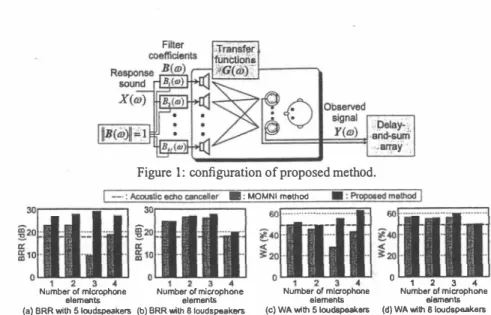
(2) Figure 1:∞nfi忽.rration of proposed method.. -. ト_.: At:.∞凶ce蜘国間ner .: MOMNI meth凶. 園内叩曲凶method I. t'ftl.__________________________.1 ζ-一...“..-一一.. , 一 …一一一.. 一 一 .引骨 t ω一占ι 一 ...・且.1 回ト "^ 一一 � 2 0咋ド-=橿圃二Lニ 宣 唱4二 :..�は霊初叫ド橿;橿園 ; 橿 -逼遍二.� 至 40岨十晴.令 令圃 -一一一-… .一.. 画十ぽ相 至 十 置園.. .置 置-置t 守1圃圃.圃圃. 忌 1.圃..圏. ... .園11 < 1 _ _圃 E圃. 11圏. 1 E匡r 圃. .園.1 匡 l圃圃.圃圃.圃圃圃 .圃圃1 < 2 1 1 置 圃 .... . 戸 1 主泊叶ト _.圃 g酌 0叶ト圃置E 圃凶E置 1惜g;; 叶叶0 ト圃置-圃. .置 '1置置 f 雲;: D叶叶1 . ..橿_ 0 1 2 3 4 0 ‘ 2 3 " 口;""2."'3."7' 0 ' 1 2 3 4". �l 一. _ .. _1. Number of mlcr甲hone elem聞ts. � Ir. 圃. l・. Number of m1cr叩hone elements. Number of micr叩h聞e. (的WAwith5刷ds同ak師. (d) WA wilh 81則自陣aka問. Number of micr叩hone elements. (a) BRR with 5刷出向ak師(b) BRR with 810uds同時間. elemer市. Figure 2: Experimental resultsおr di能rent loudspeaker and microphone conditions . 3 . EXPERIMENτ:URESULTS In由is 侃periment, we evaluate the robu成田SS of the proposed method against也e fiuc机lation of智也lSfer function, compared wi也 the acoustic echo canceller and MOMNI method. We premise that fiuctuation of仕組sfer functions is CaJぉed by changes in白e interference, i.e., a life-size m叩nequin. We measured 13 kinds of imp川lse responses: 12 pattぽns are血e states where the interference is allocated, and the 0也er pattern is 也e states where the interference dóes not exist. First,ωevaluate也.e peばormance of response sound elimination, we calculate白e barge・in reduction r蹴但RR) as B限= 10l0glO. ( L IYe町(ωWI乞|丸山W) 、 w. 弘. where 九ar(ω) is the response sound observed 鉱山e user's left ear, and. [担J.. (4). 九回(ω) is白崎町or of問sponse sound elimination.. MOMNI and the proposed method design their filters using the仕出lSfer function before出e fiuctuations. We assume that出E a∞ustic echo回nceller回n e拍nate the filter coe伍cient precisely under白巴ideal ∞ndition without eπor. We evaluate the performance of each method in位1e fiuctuated en'vironment. Secondly, the effi回cy of the el注unation ofせ1e response sound is evaluated with a加ge vocabulary continuous speech reco伊ition task. To evaluate恥speech recognition perform組問we adοpt the Word Accuracy σWA).Figure 2 illutates也e BRR and WA results with 5 or 810u必pωkers. With 5 loudspeakers, the proposed m巴thod shows higher performances in BRR and WA (s田Fig.2(a)阻d (c)). Wi也 8 loudspeakers, MOMNI method becomes ro加st, and there ar官no obvious improvement in the proposed method (see Fig. 2φ) and (d)).百1US也e propo唱ed method is highly beneficial for the appliωtion to the small number of loudspeakers. 4. CONCLUSIONS We proposed a small.size barge-in free interface using a sound cancellation. As也e results of th虐experiment, the robustness of sound elimination irnpro刊d when血巴number of loudspeakers is relatively small. From these findings, the availability of 血e proposed method is ascertained.. Acknowledgement T his work was partly suppo巾d by CREST progr沼n "Advanced Media Technology for Everyday Living" of JST in Jap田.. References [ 1] B. H. J国時間dF.K.S∞ng,官ands-仕切telecommunications," Proc. lntemational Workshop on Hands-Fl陀E争eech co明munication 2001, pp.5-lO, 2001 [2] W. Heぬordt, J. Ymg, H. Buchner, and W. Kellerman,“'A real-time acoustic human-machine合ont.end おr multimedia applications integrating robust adaptive beamforming and stereophonic acoustic echo canωllation," Proc. ICSLP 2002, vo1.2,pp.733-ー776,2002. [3 ] Y. Hin阻10ぬ, K. Mino, H. Saruwatari, 叩dK. Shikano, “h胞rf旨ce for barge-in合ee spoken dialo思le system based on , sound field control and micropno田町置が Proc. ICASSP 2003, voLV pp.50 5- 508, 2003. [4] Y. 11蹴kura, H. Saruwatari, andK. Shikano,“'An iteratÎve inverse filter design m拙od for the m出channel sound field reproduction system," IEICE Trans. Fundamentals, voLE84・A, no.4, pp.991-998,却01.. HSCMA, March 17.18, 2005, Rutgers Unive尽ity, Piscataway, New Jersey, USA. a.8. AUτ qu 円〆“.
(3)
図
関連したドキュメント
An easy-to-use procedure is presented for improving the ε-constraint method for computing the efficient frontier of the portfolio selection problem endowed with additional cardinality
Keywords: continuous time random walk, Brownian motion, collision time, skew Young tableaux, tandem queue.. AMS 2000 Subject Classification: Primary:
Kilbas; Conditions of the existence of a classical solution of a Cauchy type problem for the diffusion equation with the Riemann-Liouville partial derivative, Differential Equations,
Then it follows immediately from a suitable version of “Hensel’s Lemma” [cf., e.g., the argument of [4], Lemma 2.1] that S may be obtained, as the notation suggests, as the m A
To derive a weak formulation of (1.1)–(1.8), we first assume that the functions v, p, θ and c are a classical solution of our problem. 33]) and substitute the Neumann boundary
It is known that if the Dirichlet problem for the Laplace equation is considered in a 2D domain bounded by sufficiently smooth closed curves, and if the function specified in the
Indeed, when using the method of integral representations, the two prob- lems; exterior problem (which has a unique solution) and the interior one (which has no unique solution for
There arises a question whether the following alternative holds: Given function f from W ( R 2 ), can the differentiation properties of the integral R f after changing the sign of
