Title
[原著]Study on the Estimate of the Number of Genetic Factors
Responsible for Blood Sugar
Author(s)
Mimura, Goro; Fujioka, Setuyo
Citation
琉球大学保健学医学雑誌=Ryukyu University Journal of
Health Sciences and Medicine, 1(4): 310-314
Issue Date
1978
URL
http://hdl.handle.net/20.500.12001/2227
Study
on the
Estimate
of
the
Number of
Genetic
Factors
Responsible
for
Blood
Sugar
Goro MIMURA
Department of First Internal Medicine, College of Health Sciences, University of the Ryukyus
Setuyo
FUJIOKA
Department of physiology, Kumamoto Unitersity Medical School I ntroducti on
Heredity has been presumed as a major factor in the development of diabetes mellitus. The heredity of diabetes mellitus was certified by studies on familial incidence, and by the study of diabetes mellitus in twins. Refering to the above mentioned studies, one of the authors, Mimura has already reported in detail (Mimura et al 1970). If diabetes mellitus is heritable, it is necessary to determine the mode of inheritance, i.e., whether it has a monogenetic or polygenetic control mechanism. In 1962, Mimura concluded that it was difficult to explain the mode of inheritance of diabetes mellitus by a simple recessive gene or by a dominant gene, from the results of analyzing family data of diabetes mellitus. Since then, Mimura has advocated that polygenetic inheritance was the most suitable explanation for the development of the disease (Mimura et al 1964 a. , b. , 1970). Namely, Mimura pointed out that the genetic analysis of blood sugar which has been regarded and used as one of the most important and indispensable factors in the diagnosis of diabetes mellitus was one of the means to make clear the hereditary mechanism of diabetes mellitus. And Mimura presumed that diabetes mellitus develops due to an abnormality in the blood sugar control mechanism. If this is true, there is no theoretical contradiction, in the cases where application of the mode of blood sugar inheritance to the hereditary mechanism of diabetes mellitus is concerned. Mimura has made clear that blood sugar is a continuous character and is controlled polygenetically because of the frequency distribution of blood sugar. If the blood sugar is controlled by a polygene, it is necessary to calculate the number of gene loci. Mimura and Kodera (1973) already calculated the number of gene loci in essential hypertension by using the methods of Davenport (1910,1913) , Castle (1921) and Wright (1934). In this paper the number of gene loci in diabetes mellitus was calculated by using the methods of Castle, Wright and Furusho (1973).
Materials and methods
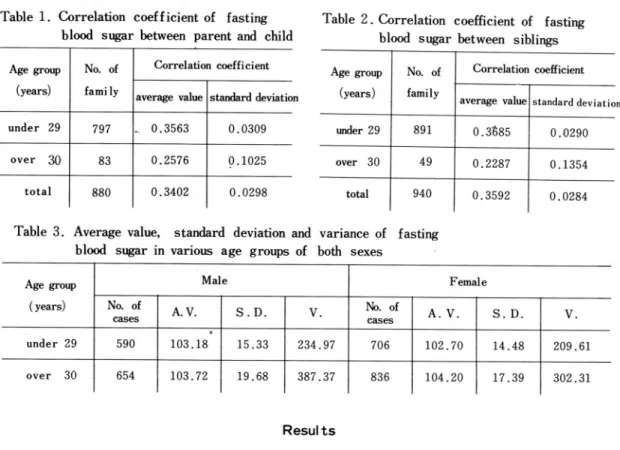
The correlation coefficient of fasting blood sugar between parent and child ( rpo) was calculated by the combination of 880 pairs of parent- child as shown in Table 1, and the' correlation coeffi-cient of fasting blood sugar between siblings (roo) was also calculated by the combination of 940 pairs of siblings as shown in Table 2. The number of gene loci of fasting blood sugar was obtained from the methods of Castle , Wright and Furusho. Average value, standard deviation, and variance of fasting blood sugar in various age groups of both sexes, which was used in the calculation of
311 Goro MIMURA
the number of loci of genes, is shown in Table 3.
Table 1. Correlation coefficient of fasting blood sugar between parent and child
Table 2. Correlation coefficient of fasting blood sugar between siblings
Table 3. Average value, standard deviation and variance of fasting blood sugar in various age groups of both sexes
Results
The number of fasting blood sugar gene loci was calculated by the formula of Castle, Wright and Furusho, as shown in Table 4. The Maximun and minimum values of fasting blood sit伊r were 60 and 144mg/100ml in the male group under 29 years old. In the female group under 29 years of age, the maximu m and minimum values of fasting blood sugar were 70 and 156mg/100ml, respecti-vely. The maximum and minimum values of fasting blood sugar in the male group over 30 years, of age were 60 and 204mg/ml respectively, and in the female group over 30 years of age the maximum and minimum values were also 60 and 226mg/100ml, respectively.
First, using the Castle-Wright formula to calculate the number of gene loci, it was determined that in the male and female groups under 29 years old the number of gene loci were 5 and 6,
res-pectively, as shown in Table 5. In the same formula, using r<サinstead of rpo, the number of gene loci were also found to be 5 and 6. But in the male and female groups over 30 years old, the number of gene loci of the fasting blood sugar were 13 and 22, respectively, and in the
Castle-Wrightformvla, using r(后instead of rpo, the number of gene loci increased, from 13 to 15 and from
22 to 25, respectively. Contrarily, when using Furusho's formula there is no great difference in the number of gene loci using both rpo and roo as shown in Table 6. That is, using rpo, the number of gene loci in the male and femele groups under 29 years old was found to be 6 and 4 respectively; and using r<サ, the number of gene loci decreased a little in number compared with the use of rpo. The number of gene loci in the male group over 30 years old was found to be 5, using both nサand r応In the female group over 30 years old, using rpo, the number of gene loci was found to be6; using r,d the number of gene loci was 7.
Table 5. Number of Locus of gene loci Table 6. Number of gene loci
Age group (years)
N o. of gene loci
male fem ale
rpo rob rpo r崩
under 29 5 5 6 6
over 30 13 15 22 25
(by method of Wright)
A g e g r ou p (y ea r s)
N o . o f ge n e lo ci m ale fe m a le
rpo r od rpo rod
u n d e r 2 9 6 5 4 3
o v e r 3 0 5 5 6 7
(by method of Furusho)
From these results, it is presumed that there is no great difference in the number of gene loci under 29 years age groups I光tween the Castle-Wright, where maximum and minimum values of distribution are used and the Furusho formula, where average value and minimum value are used.
But in the group over 30 years old, when using the maximum and minimum value approach,there is a danger that the number of gene loci are overestimated because of the e坤anse of blood sugar distribution. And in using the average value and minimum value method, the difference due to age is small and the number of gene loci using r応is a little smaller than when using rpo.
It is concluded from these results that the number of gene loci is approximately 6.
Discussion
It is already established by us that blood sugar is a continuous character and is controlled poly-genetically. Moreover, the heritability of blood sugar was also estimated by us as 0.5992 (M imura et al 1970). As stated above, if the blood sugar has a polygene control, it is necessary to calculate the number of gene loci. In the genetic studies of animals and plants, it is possible to presume the number of gene loci, using the data of F! and F2. But in human beings, it is impossible to carry out cross-breeding experiments. Therefore, the presumprion of the number of gene loci in blood sugar was arrived at by using the methods of Castle, Wright, and Furusho.
The first study of the presumption of the number of gene loci of a continuous character in human beings was performed by Davenport (1910, 1913). Li my study, the Davenport method was not emplo-yed of an insufficient number of cases in the由me age groups. Therefore, the methods of Castle,
313 Goro MIMURA
Wright, and Furusho, using the correlation coefficinnt of parent-child and inter-sibling, were used in this study. Wright presumed that if a is the effect of a single gene and there are n such genes
(with equal effect and no dominance of epistasis) the difference( A) between extreme plus and minus types is 2na, and the F2 variance due to each pair of genes is l/2a2, and hence n gene is nor2/2. The observed variance in F2 is composed of the genetic variance which may be taken as measured by the variance of Fi or the variance of the parental strains (p). Thus^F^tfP2)gives the variance of F2. Eliminating and solving for n gives
from this formula, the following formula was obtained:
Where Vg is the additive variance, Vp is the phenotypic variance, and rpo is the parent-child correlation. Max. and Min. are maximumand minimum of blood sugar in various age groups.Using the Wright formula, the number jof gene loci showed the same value in the group under 30 years both in the case of using rpo and in the case of using roo- But in the group over 30 years, the number of gene loci markedly increased in number compared with the number of gene loci in the group under 30 years. It is presumed that the difference of number of gene loci in the different age groups is due to the wide range of the distribution of blood sugar in the group over 30 years. To solve this discrepancy, Furusho used the mean value of the distribution instead of the maximum value, and moreover, he stated that the method of using roo rather than rpo was more suitable
for the calculation of the number of gene loci, because rpo included the effect of parent's age. In this study, because the difference of the value between rpo and roo was small, there was no great difference in the number of gene loci, using either the value of rpo or the value of roo in the cal-culations. From the method of Furusho, it can be concluded that the number of gene loci which regulate blood sugar in human beings is presumed to be approximately six. The number of genes whi -ch obtained from the genetic statistical method can not be regarded as ultimate, but it can be call -ed a statistical unit of inheritance or an effective factor. Therefore, in the present stage, because it is impossible to certify the correct number of genes of human chronic diseases, it will be no gross error to presume this value as the number of genes causing diabetes mellitus, on the
assumpti-on that the heredity of diabetes mellitus is regarded as that of hyperglycemic syndrome. Summary
Using the genetic statistical method, the control mechanism of blood sugar was studied and the following results were obtained.
1 ) The number of gene loci which control the blood sugar is presumed to be approximately six. 2) This value is also called a statistical unit of inheritance or an effective factor, and is not regarded as ultimate: but in the genetical study of the human being it will be no gross error to presume this value as the number of genes responsible for blood sugar.
Therefore, there is no theoretical contradiction, where application of the mode of inheritance of blood sugar to the hereditary mechanism of diabetes mellitus is concerned, if it is presumed that diabetes millitas is a hyperglycemic syndrome.
References
1 ) Mimura, G., Miyao, S., Koganemaru, K., Haraguchi, Y., Jinnouchi, T. and Hashiguchi, J.: Heredity of diabetes mellitus in Japan. Diabetes Mellitus in Asia, 1970. pp. 83-97. Excerpta Medica, Int. Cong. Series No. 221, 1971.
2 ) Mimura, G. : On the mode of inheritance of diabetes mellitus in Japan. Kumamoto Med. J. 15, 154-158, 1873.
3 ) Mimura, G., Oshiro, S., Koganemaru, K., Haraguchi, Y., Jinnouchi, T. and Hashiguchi. J. Studies on the heredity of diabetes mellitus in Japan. I. Inheritance of the fasting btood sugar value in Uto and Tomiai inhabitants. Kumamoto Med. J. 17, 45-49, 1964a.
4) Mimura, G., Oshiro, S., Koganemaru, K., Haraguchi, Y., Jinnouchi, T. and Hashiguchi, J. : Studies on the heredity of diabetes mellitus in Japan. II. Inheritance of the fasting blood sugar value and the blood sugar value two hours after meals in Uto and Tomiai inhabitants. Kumamoto Med. J. 17, 50-57, 1964b.
5 ) Mimura, G. and Kodera, M. :Genetic study on essential hypertension. Japanese Circulation J. 37, 61-67, 1973.
6) Davenport, G.C. and Davenport C. B. : Heredity of skin pigmentation in man. Amer. Nat 44, 641-672, 1910.
7 ) Davenport, C. B. : Heredity of skin color in negro-white crosses. Carnegie Inst Wash・ Publ. 188, 106-114, 1913.
8 ) Castle, W. E. : On a method of estimating the number of genetic factors concerned in cases of blending inheritance. Science 1378, 83-86, 1921a.
1 ) Castle, W. E. : An improved method of estimating the number of genetic factors concerned cases of blendi噌inheritance. Science N. S. 54, 223, 1921b.
10) Wright, S. : The results of crosses between inbred strains- of guinea pigs, differing in number of digits. Genetics 19, 537-55.1, 1934.
ll) Furusho, T. : Oh the estimate of the number of genetic factors responsible for stature. I. At age 17-21 years. Jap. Jour. Human Genet. 18, 187-215, 1973.