Title
[原著]Our experience in treating 35 proctalgia cases : To
clarify the disease etiology and the optimal therapeutic
approach
Author(s)
Tokumine, Fumio; Takano, Masahiro; Shimada, Akira; Tsuji,
Yoriyuki; Kuromizu, Joji; Muto, Yoshihiro
Citation
琉球医学会誌 = Ryukyu Medical Journal, 18(3): 69-72
Issue Date
1998
URL
http://hdl.handle.net/20.500.12001/3328
Our experience in treating 35 proctalgia cases
To clarify the disease etiology and the optimal therapeutic approach
-Fumio Tokumine , Masahiro Takano", Akira Shimadal
Yoriyuki Tsuji , Joji Kuromizu" and Yoshihiro Muto2)
''Fukuoka Takano Hospital, Shimobaru 2-24-36, Higashi-ku, Fukuoka, Japan
l First Department of Surgery, Faculty of Medicine,
University of Ryukyus, Uebaru 207, Nishiharachyo, Okinawa, Japan
(Received on November 14, 1997, accepted on September 22, 1998)
ABSTRACT
Thirty-five patients with chronic anorectal pain of obscure origin were analyzed. This syndrome has yet to be elucidated and its cause is unclear. The above 35 cases were investi-gated in order to clarify this syndrome. We treated the patients with analgesics, sedatives, and nerve block to the trigger-point of anorectal pain among others. Twenty-eight of the cases had bowel movement disorders such as IBS, constipation, diarrhea and the medications for these disorders were administered simultaneously with good results. In 2 cases, antidepres-sants were also prescribed with good results. The follow-up questionares for 26 patients with follow-up terms ranging from 6-28 months (mean 17.8 months) revealed excellent results in 17 cases, fair results in 4 cases and poor results in 5 cases. In total, 77.7% of the pa-tients showed an improvement in their symptoms. The remaining 6 papa-tients could not be fol-lowed up and 3 patients had already died. After analyzing these data, we thus concluded that the etiology of this syndrome should be divided into 3 categories consisting of:a disor-der of the central nervous system including psychological disordisor-ders, an injury or inflammation
of the nervous tract, and a mechanical overload of the pelvic floor. RyukyuMed. J., 18(3)
69-72, 1998
Key words: proctalgia, coccygodinia, chronic perianal pain, etiology, therapy
INTRODUCTION
Chronic pain of the anorectal area is usually one of the symptoms of such anal diseases as hemorrhoids, anal fistula, anal fissure, cryptitis, perianal abscess and some-times malignancy. We rarely encounter patients who pre-sent with pain of an obscure origin. Various authors have called this syndrome proctalgia , coccygodynia2 chronicperianal pain31and so on. However, itisnot
cer-tain that these terms refer the same disease, which thus makes the most the suitable treatment difficult. From 1992 to 1995, we treated 35 such cases which thus al-lowed us to better analyze this disease and its etiology.
PATIENTS AND METHODS
From June 1992 to March 1995, 35 cases of proctalgia were admitted to our hospital. All of them had been suf-fering from anorectal pain. The pain symptoms tended to worsen in most cases when standing, sitting, walk-ing or durwalk-ing evacuation and were relieved when lywalk-ing
down. The types of pain included: burning, swelling and a tightening sensation which was so severe that some cases even commited suicide. No patient demonstrated proctalgia fugax. After taking their histories and physi-cal examinations, laboratory, radiologiphysi-cal and endoscopic examinations were done to rule out any pos-sible organic causes. For the treatment of most cases ei-ther local or field nerve blocks were performed to relieve the trigger-point of the pain. In addition, analgesics and sedatives were also prescribed. If they had other symp-toms such as of IBS, constipation or diarrhea, other medi-cations were also administered simultaneously for the treatment of these complications. Constipation and diar-rhea were diagnosed based on subjective symptoms in comparison to usual bowel movements and the diagno-sis of IBS was made based on these guidelines. In some cases either biofeedback therapy or levator muscle mas-sage were added for relaxation of pelvic muscles. After finishing such treatments, the patients were discharged for the follow-up at our clinic. In this study, the his-tory, site and degree of tenderness, treatment and
70 Thirty-five cases of proctalgia
Table 1 Patient profiles (35 cases)
Case No. 1 2 3 4 5 6 7 8 9 10 ll 1213 14 15 16 17 1819 20 21 22 23 24 25 26 27 28 29 30 3132 33 34 35 Age 2732 40 43 43 59 59626567 67 677374 75 76 77 幻39 班 5762 64 64 66 6768 70 70 70 7275 7678 糾 Sex M M M M M M M M M M M M M M M M M M F F F F F F F F F F F F F F F F F AgeofonscL 2231 40 43 42 4457 65 61 5872 73 75 76 76 8338 56 57 61 61 63 65 5067 63 66 67 7170 74 77 79 Durationofsymptom(mo.) 約12 6 2 192402406】 10817 14 5 1 8 2 12 1 2 8 38 2 12捌1272誠36 2の24 12 10 T enderness ana」cana一 〇 〇 〇 〇 〇 〇 levator muscle O O O O O O O O O O O 0 0 0 0 0 0 0 0 0 0 0 0 0 0 0 0 0 0 0 0 0 sacnユm or coccyx O O O 0 0 〇 〇 〇 〇 〇 〇 〇 〇 〇 〇 〇 〇 0 0 0 0 0 0 0 Compーicalions ana】disease M M I M i l l # ・ ・ ○ ・ ・ ・ t ・ ort hopedic disease O O O O O ・ 0 0 0 0 * gynecologic disease ・ f ・ 0 0 9
(Op.サ) psychiatric disease urologic disease
柑S O O O 〇 〇 〇 〇 〇 〇 〇 〇 〇 〇 〇 〇 〇 〇 〇 〇 〇
Constipation/Diarrhea O O O O O O O 0 O O O O O 0 O O
Abnormality ofdefecography (-) (-)汁) (-)ド) (+) I-)(+) (+1 H (-] (-)ト(-) (-)トI H (+)(-)ド) (-) (-) (+) (-) (-) ト(+) (-I (+)H (-) (-) (-)
Prolongation of pudendal nerve latency (+) (+) (十) (+) (+1 (+1 H (+) (+1 (+) (+) (+) (-) (+) (+)
Treatment nerveblock(times) 3012 10 5 17 1 23 12 10 879 16 37 9 7 5 49 36 9 7 19 1045 2 35 70 15361 7 13 131 biofeed back o O 0 0 0 0 0 0
levator massage O O 0 antide pressan t O O medication forIBSorIRS O 0 O O O O O O 0 O 0 0 O 0 O O O O O O laxatives, anti-diarrheal drug O O 0 0 O 0 O 0 O O O O O O O O
Followupperiodlmo.) 1331 】5 18 17 2036202439 18 1419 ll 6 17 19 17 8 7 18 8 29 2020 2527 祖 6 13 21
Resu一t(score)
exellent(0-3) 0 0 0 0 0 00 0 0 0 0 0 0 0 0 0 0 fair(4-6) O dead 0 0 dead suicide 0
poor(7-11 0 0 0 0 0
complications were all determined based on the patient hospital records. Furthermore, the patients were also contacted by mail or telephone to complete numerical rating scale questionnaires in order to determine their subjective status. A total of 26 patients completed the questionnaires. Six of the patients were lost to the follow-up and three had already died by the time this study was written, 2 of them from other systemic dis-eases while the other had commited suicide because of
the pain.
RESULTS
Age and sex: The patient data are summarized in Table 1. Of the 35 cases,18 cases were male and 17 cases were female. Their ages ranged from 27 years to 83 years of age and the mean age was 63.5 years. The ages of onset ranged from 22 to 83 years of age. They had been suffering from pain from 1 to 240 months before admission (average: 39.1 months).
Physical findings: The sites of tenderness were di-vided into three areas. Thirty-two cases complained of tenderness in the levator muscle region. However, 24 cases also complained of tenderness in the sacrum or coccyx. It appeared that most patients tended to have tenderness of the anal canal, and also usually had or-thopedic or gynecologic illness, possibly caused by radia-tion pain due to nerve injury (Nos. 7,13,14,29,32).
Concomitant diseases: There were 26 cases who had concomitant anal diseases and almost all of the cases had undergone anal operations. Thirteen cases (Nos. 1,2, 5,7,10,12,17,23,24,26,28,31,35) had suffered from anal pain before operation and the pain did not improve after the operation. In another 13 cases (Nos. 3,4,6,8,9,18,21 (sclerotherapy), 22,25,27,32,33,34) the pain appeared after operation. However, in almost all cases (Nos. 3,4,6,8,9,18,22,25,32) pain had started at least 2 years
after the operation. We could not definitly say whether
such anal diseases were merely concomitant diseases or whether the anorectal pain was caused by these opera-tions but, in almost all cases, we considered it 0
・t
merely due to concomitant disease. There were also e 2 b
1 cases who were complicated by orthopedic diseases and sometimes accompanied with sciatica (Nos. 3,4,13,14, 17,33). Seven cases had gynecologic diseases (Nos. 20, 21,27,31,32,33,35), 2 cases had psychological problems
(Nos. 9,31) and one case had undergone a urologic op-eration (No. ll). Furthermore, many cases also suffered from bowel movement disorders of such as IBS, consti-pation or diarrhea.
Laborataory data: Manometric studies were done
in 29 cases but no remarkable co-relationship was observed between proctalgia and the manometnc study.
In some cases defecography and the pudendal nerve la-tency time were examined. Abnormal defecography was indicated in 8 cases and a prolongation of the pudenda!
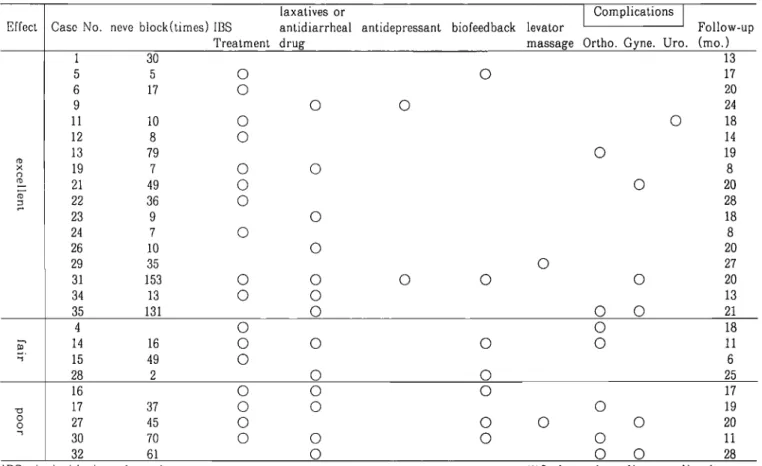
Table 2 Effect of treatment (26 cases)
E ffec t
la x a tiv es o r C o m p lic a tio n s
C a s e N o . n e ve b lo c k (tim es ) IB S a n tid ia rr h e a l a n tid e p r es sa n t b io fe e d b a c k le va to r ' ' F o llo w -u p T re a tm e n t d r u g m a ss a g e O rth o . G y n e . U ro . (m o .) の 3 0 1 3 5 5 ○ ○ 1 7 6 1 7 ○ 20 9 ○ ○ 2 4 1 1 1 0 ○ ○ 18 1 2 8 ○ 14 1 3 7 9 ○ 1 9 y. 0 19 7 ○ ○ 8 (D 2 1 4 9 ○ ○ 2 0 (ち コ 2 2 3 6 ○ 2 8 2 3 9 ○ 18 2 4 7 ○ 8 2 6 1 0 ○ 2 0 2 9 3 5 ○ 27 3 1 1 5 3 〇 〇 〇 〇 〇 20 3 4 1 3 ○ ○ 13 3 5 1 3 1 〇 〇 〇 2 1 ...、 D 4 ○ ○ 18 1 4 16 〇 〇 〇 〇 1 1 .1 15 4 9 ○ 6 2 8 2 ○ ○ 2 5 て⊃ 16 〇 〇 〇 17 17 3 7 〇 〇 〇 19 ○ ○ 2 7 4 5 〇 〇 〇 〇 2 0 「 3 0 7 0 〇 〇 〇 〇 1 1 3 2 6 1 〇 〇 〇 2 8
IDS-Irritable bowel syndrome
that these abnormalies in defecography indicated the cause of mechanical overload and a prolongation of the pudenda! nerve latency time thus seemed to indicate the presence of nerve injury.
Treatment: In 31 cases a local nerve block was ap-p】led to the trigger-point of the anorectal pain, in addi-tion to the simultaneously administraaddi-tion of analgesics and sedatives. If they were complicated with abdominal symptoms caused by IBS, constipation or diarrhea, other medications were also administered. In 12 cases either bio-feedback or levator muscle massage was performed. In two of them, psychological examination indicated the pa-tients to have psychiatric diseases that required antide-pressants.
Effect of the treatments; Excellent results were ob-tained in 17cases, fair in 4 cases and poor in 5 cases.
The symptoms improved in a total of 77.7% of the pa-tients (Table 2).
DISCUSSION
Pain inい1e anorectal area is usually caused by such anal diseases as hemorroids, anal fistula, anal fissure,
※Ortho:orthopedic complications Gyne:gynecologic complications Uro:urologic complications
cryptitis, perianal abscess and malignancy. However, on rare o∝asions, we also come across patients who have anal pain of obscure origin. Various authors have named this syndrome proctalgia , coccygodynia2'and chronic perianal pain3), among others. However, it is not certain that these names indicate the same disease which makes the treatment of such patients difficult. There have been many reports concerning such treatments, as nerve block, bio-feedback, levator massage, coccygectomy, electrogalvanic stimulation, psychotherapeutic drugs, epidural steroid block and so on. However, no sufficiently effective treat-menthas yet been found. From 1992 we treated 35 cases of proctalgia. We treated such patients with various methods because no standard therapeutic plan has yet been estab-lished. However, the follow-up questionnaires revealed unex-pectedly good results. Analysis of their data gave us some knowledge and hints concerning the etiology and treatment. As Bleijenberg and Kuijpers4'pointed out, many of the cases had underlying chronic motility disorders; 20 cases had IBS and 8 cases had either constipation or diarrhea. In these cases the use of nerve block and medication for motility disorders proved to be the most effective treat-ment modalities (Nos. 5,6,ll,12,14,15, 19, 21,22,23,24, 26,28,34,35, ). Based on these facts we hypothesized that such pain might thus be caused by mechanical
72 Thirty-five cases of proctalgia
overload against the muscles or tendons of the anorectal area and such mechanical overload might therefore be caused by motility disorders. Accordingly, we thus as-sumed mechanical overload to be the cause of the anorectal pain. In such cases we selected a local nerve block as the treatment of choice if they had a trigger-point of pain in addition to medication for motility disorders. However, in some cases the effect of these treatments were only temporary (Nos. 13, 17,27,30,31,32, 35). In addition, many of these case also had orthope-dic, gynecologic or urologic complications. As described by Neill and Swash, due to such complications'1) the intrac-table pain was thus hypothesized to be caused by either in-jury or inflammation of the nervous tract especially S2, S3 and S4. Therefore, many of these cases were also
treated by either steroids (Nos. 13,35) or epidural steroid block51 (No. 35) to improve their symptoms. On the other hand, two cases (Nos. 9,31) also improved after being treated with antidepressants. Neill and Swash also pointed out these patients to be emotionally labile with features of depression, anxiety and neuroticism . Accord-ingto the hypothesis that the IBS is one type of psy-chosomatic disease, a psychological examination is also
considered to play a significant role. We strongly believe
proctalgia to be due to various causes, i.e. 1) a disorder of central nervous system; this includes psychological dis-order, 2) an injury or inflammation of the nervous tract, 3) a mechanical overload to the supporting tissue of the pelvic floor, especialy the muscles, tendons or bones. Ac-cordingly the treatments were divided int0 3 proce-dures consisting of: psychotherapeutic drugs, epidural
nerve block, and a local or held nerve block added with medication for bowel movement disorders. To distin-guish these 3 causes, a spinal block trial is one of the methods to rule out disorders of the central nervous system. Detailed history and physical examinations also provided information about an injury of the nervous tract or mechanical overload caused by bowel movement disorders. In conclusion, the treatment of this disease is thus considered to be more effective based on our classification system.
REFER ENC ES
1 ) Granet E.:Proctalgias and allied noninflammatory perianal dyscrasias: coccygodynia, proctalgia fugax, neurogemc pruritus am. Am. J. Digest. Dis. 13:
330-333, 1946.
2 ) Simpson J.Y∴ Clinical lectures on the diseases of women. Lecture XVII. On coccygodynia and deformi-ties of coccyx. Med. Times Gaz. 4 : 1-7, 1859. 3 ) Neill M.E. and Swash M. : Chronic perianal pain:an
unsolved problem. J.R.Soc.Med. 75 : 96-101, 1982. 4 ) Bleijenberg G. and Kuijpers H.C.: Treatment of the
spastic pelvic floor syndrome with biofeedback. Dis. Colon Rectum 30 : 108-111, 1987.
5 Yoon K.S. Choi S.K. Amaranath L.A. Teo T.A. Piccirillo M.F. and Wexner S.D. : Caudal epidural
block with methylprednisolone acetate in the manage-merit of chronic ideopathic rectal pain. Coloproctology 16: 161-166,1994