On Characterizing Sanskrit Gemination
著者(英)
Yasuko Suzuki
journal or
publication title
Journal of Inquiry and Research
volume
102
page range
1-18
year
2015-09
On characterizing Sanskrit gemination
*Yasuko Suzuki
Abstract
In Sanskrit, various intervocalic biconsonantal clusters are affected by gemination, which is typically summarized by phonetic treatises as follows. First, postvocalic consonants followed by another consonant is geminated as in sapta- ‘seven’ > sappta- and cakra- ‘wheel’ > cakkra-. Second, consonants that follow r or h is geminated, as in artha- ‘purpose’ > arttha- and jihma-
‘oblique’ > jihmma- . In addition to these two major rules, there are subsidiary processes and different dialects show different variations. Given that Sanskrit gemination affects consonant clusters, earlier studies have analyzed the process in terms of syllable structure, but there are counterexamples that indicate that the syllable-only approaches are inadequate.
This paper reexamines the conditioning factors and restrictions of Sanskrit gemination and concludes that the following three tendencies, which are independent and partly overlap or contradict, interact to produce the observed extensiveness and variations. First, as some of the earlier syllable-based approaches claim, syllable-initial and especially word-initial consonant is geminated. Second, consonants with an oral gesture, especially an oral closure, are preferred targets over those without one, which is in accordance with the cross-linguistic tendency of gemination. Third, the first consonant of the cluster tends to be geminated, which is attributed to the articulatory and perceptual problems associated with preconsonantal consonants.
Keywords: Sanskrit, gemination, consonant clusters, phonotactics, syllable
1. Introduction
Gemination in Sanskrit is prescribed by contemporaneous grammarians and is supported by manuscript and inscriptional evidence, but is also known for dialectal variations, which might cast doubt on its reality (Varma 1929: 63–78, 107–125; Cardona 2013: 51–64). While earlier studies on Sanskrit gemination have presented a uniform syllable-based approach, in this paper I propose that gemination is motivated by phonetic, i.e. articulatory and perceptual, in addition to prosodic factors and suggest the possibility that the phenomenon is a merger of several processes.
gemination and discusses its characteristics and problems, §4 critically examines earlier syllable-based approaches and presents the proposed interpretation of the phenomenon, and §5 supplies conclusions. Instead of presenting variations in individual dialects, I have chosen to discuss the phenomenon as a whole and distinguish the contexts where gemination applies most frequently, where there are variations, and where gemination rarely or never applies. That way, I believe, one can get an entire picture of the phenomenon. Sanskrit examples for gemination are cited mainly from Varma (1929: 63–78, 107–25) and Cardona (2013: 51–64).
2. Consonants in Sanskrit
In (1) is a list of consonants in Sanskrit in the conventional transliteration (Whitney 1889: §75; Macdonell 1910: §4; Cardona 2003: 110; Kobayashi 2004: §11). Consonants in (1a) have a phonemic status and occur in lexical items. Oral stops have five places and four series. Fricatives are asymmetrical in voice contrast: there are three voiceless coronal fricatives and the voiced glottal fricative that historically derived from voiced aspirate stops. Note that the letter h represents the voiced glottal fricative while the voiceless glottal fricative in (1b) is represented by an h. with a dot underneath. Both liquids and glides have syllabic counterparts and thus are categorized as semivowels. A dot under a consonant symbol represents retroflex place in the case of stops and syllabicity in the case of liquids.
(1) a. Primary consonants
velar palatal retroflex dental labial no oral place Stops/T voiceless plain k c t. t p aspirate kh ch t.h th ph voiced plain g j d. d b aspirate gh jh d.h dh bh Nasals/N n. ñ n. n m Sibilants/S ś s. s Semivowels/R y r l v (V that alternate with R i r. l. u)
Voiced fricative h
b. Secondary consonants
Voiceless fricatives (x) ( ) h. (visarga)
Consonants in (1b) arise secondarily from phonological processes and occur only in the coda. The velar and labial fricatives in parentheses are optional allophones of the voiceless glottal fricative called visarga before voiceless velar and labial stops, respectively. Anusvāra, which derives from labial and dental nasals in the coda, lacks a specific place. While it is normally classified as a consonant by modern scholars such as Whitney (1889: §§70, 75), Wackernagel (1896: §223), Macdonell (1910: §4), and Cardona (2003: 109–110), it is realized either as a vowel or as a consonant depending on phonetic treatises (Varma 1929: chapter 9; Cardona 2003: 110, 2013; Suzuki 2013).
Among the consonants in (1), r, the voiced glottal fricative in (1a), and those in (1b) do not occur in geminates. These consonants are generally exempt from gemination as will be shown below although there are some exceptions. In addition, a few others in (1a), the retroflex sibilant, the palatal and retroflex nasals, which historically derived from the dental counterpart, do not occur in geminates but can be the target of gemination.
3. Sanskrit gemination
Various phonetic treatises give two rules of gemination (Whitney 1889: §§228–229; Wackernagel 1896: §96–98; Varma 1929: 63–78, 99–125; Hock 1991b: 128–132; Vaux 1992; Kobayashi 2001, 2004: §23; Cardona 2003: 120, 2013: 51–64). According to one of these two, the first consonant of the post-vocalic clusters is geminated with the exception of those that cannot be geminated. The actual application of the rule, however, is more restricted. More specifically, the commonest targets are apparently postvocalic stops preceding another stop, nasal, sibilant or semivowel, in the medial position and in word-initial position preceded by another word as in (2a). Also, a postvocalic sibilant followed by a semivowel is geminated as in (2b). Further, in some cases a semivowel before another is geminated as in (2c).
(2) a. TC > TTC
mukta- > mukkta- ‘set free’ sapta- > sappta- ‘seven’
pāpmanā > pāppmanā ‘with sin’ agni- > aggni- ‘fire’
adya > addya ‘today’ cakra- > cakkra- ‘wheel’
putrādinī > puttrādinī ‘one who eats her child’ akhyat > akkhyat ‘looked’
ā tvā > āttvā ‘hither you’
manasā dhyāyati > manasāddhyāyati ‘considers with the mind’
dadhi atra > daddhyatra ‘there is yogurt here’ cf. dadhyyatra
madhu atra > maddhvatra ‘there is honey here’
is.e tvā > is.ettvā ‘you for nourishment’ uru prathasva > urupprathassva ‘spread wide’
raks.ah. > rakks.ah. ‘guarding’ cf. ks.īra- > ks.s.īra- ‘milk’ caks.uh. > cakks.uh. ‘eye’
b. SR > SSR
viśvatah. > viśśvatah. ‘everywhere’ amus.ya > amus.s.ya ‘of that one’
uru prathasva > urupprathassva ‘spread wide’
c. R1R2 > R1R1R2
daivyā > daivvyā ‘divine’ pr.thivyām > pr.thivvyām ‘earth’
According to the second rule, the consonant that follows a postvocalic r or a voiced glottal fricative is geminated. After r, any consonant is geminated as in (3a). However, due to phonotactic constraints, only nasals and semivowels may occur after h as in (3b).
(3) a. rC > rCC
arka- > arkka- ‘ray, sun’ artha- > arttha- ‘purpose’
ūrdh
vah. > ūrddh
vah. ‘erect’
darśapūrn.amāsa > darśapūrn.n.amāsa ‘new and full moon rites’ ūrmin.īh. madh
umattamāh. > ūrmmin.īrmmadh
umattamāh. ‘full of flow, most sweet’ vars.ya- > vars.s.ya- ‘of rain’
sūryasya > sūryyasya ‘of the sun’
b. hC > hCC
jihma- > jihmma- ‘oblique’ brahmā > brahmmā ‘Brahman’ apahnute > apahnnute ‘hides, denies’ bahvīh. > bahvvīh. ‘many’
Other cases of gemination of the second consonant are supplied by some phonetic treatises, namely, oral and nasal stops after a fricative as in (4a) and a stop preceded by l and a nasal preceded by v as in (4b): in both cases the first consonant may geminate instead (Cardona 2013: 53, 57–58).
(4) a. ST/SN (also h.T) > STT/SNN (~ SST/SSN) haste > hastte ‘in the hand’
as.t.ābih. > as.t.t.ābih. ‘with eight’ cf. as.s.t.ābih. sparśa- > spparśa- ‘touch’
asmin > asmmin ‘in that one’ suks.mā > suks.mmā ‘fine’
yah. kāmayeta > yah.kkāmayeta ‘who is to be loved/may be loved’ manah. ks.eme > manah.kks.eme ‘mind on maintenance’
vis.n.oh. kramah. > vis.n.n.oh.kkramah. ‘the stride of Vis.n.u’
vah. kāmadharan.am > vaxkkāmadharan.am ‘your maintaining desires’
os.adīh. pūrvāh. > os.adī ppūrvvāh. ‘plants first’ b. lT, vN > lTT, vNN (~llT, vvN)
kalpān juhoti > kalppāñjuhoti ‘offers with the kalpa mantras’ cf. kallpāñjuhoti hiran.yaśalkān > hiran.yaśalkkān ‘pieces of gold’
pragalbhah. > pragalbbhah. ‘adept, capable’
vibhudāvne > vibhudāvnne ‘who grants power’ cf. vibhudāvvne
There are also a number of restrictions on gemination supplied in phonetic treatises, which are again subject to dialectal variations (Varma 1929: 110–116; Cardona 2013: 51–64). In terms of targets, as in (5ai), r, the voiced and voiceless glottal fricatives, and anusvāra do not undergo gemination; these are the consonants that do not occur in geminates in the first
place.
(5) a. Targets: NOT
(i) r, h, visarga, and anusvāra; but see (6) below;
(ii) sibilants in any position or sibilants followed by a vowel:
ādarśa- ‘mirror’, kars.ati ‘draws’, vars.ati ‘it rains’, but ks.s.īra- ‘milk’; (iii) geminates and homorganic nasal-stop clusters;
(iv) stop clusters: but mukkta-, sappta- in (2a). b. Environments: NOT
(i) intervocalic consonants
(ii) after long vowels: dātra- ‘sickle’, sūtra- ‘thread, sūtra’, but pāppmanā,
ūrddhvah. in (2a), os.adī ppūrvvāh. in (4a);
(iii) clusters of more than two consonants: indra- ‘Indra’, rās.t.ra- ‘kingdom’, kārtsnya- ‘totality’, but ūrddhvah. in (2a), vars.s.ya- in (3a);
(iv) before syllabic liquids: vismr.ta- ‘forgotten’, anis.kr.tah. ‘not defeated, harmed’, r.ddhih.kl.ptam ‘thriving’;
(v) consonants before yama: rukk̃mam (< rukmam) ‘jewel’, but also rukkk̃mam;
(vi) after pause:
but fricatives in hvayāmi > hhvayāmi ‘I call’, ścotanti > śścotanti ‘drip’; (vii) word-final or pre-pausal position: ūrk ‘strength’ (before pause)
cf. ūrk ca > ūrkkca ‘strength and’;
(viii) a consonant that triggers gemination of another: suks.mmā in (4a).
However, there are some examples of the geminated voiced glottal fricative as shown in (6), that is, initial h before v or r in the first two examples, h after r or anusvāra in the next three (Varma 1929: 115–116; Cardona 2013: 58).
(6) Gemination of h
hvayāmi > hhvayāmi ‘I call’ hriyate > hhriyate ‘is taken away’ barha- > barhha- ‘tail-feather’ sim.ha- > sim.hha- ‘lion’
etarhi agnih. > etarhhyagnih. ‘now Agni’
Also, in (5aii), depending on the dialects, sibilants in any position or prevocalic sibilants are not geminated. In (5aiii), geminates and homorganic nasal-stop clusters are not geminated, but homorganic stop-nasal clusters are affected by gemination. This is because both geminates and homorganic nasal-stop clusters have one single oral closure of a longer duration, which is not further lengthened by gemination, in contrast to stop-nasal clusters with two discontinuous oral closures, e.g., pāpmanā > pāppmanā in (2a). In this respect homorganic nasal-stop clusters but not stop-nasal clusters are comparable to geminates, the former of which Kirchner (2001: 111) characterizes as “partial geminates”. In (5aiv), in a certain tradition, stop clusters are prohibited from undergoing gemination, but there are examples where the first stop is geminated: mukta- > mukkta- and sapta- > sappta- in (2a) above. In terms of environments, shown in (5b), gemination generally does not affect intervocalic consonants as in (5bi) and this is a curious restriction because, cross-linguistically, geminates are most common in the intervocalic position (see below this section). According to some, gemination does not occur after long vowels as given in (5bii) or, according to a certain grammarian, in consonant clusters of more than two consonants as given in (5biii), both of which are restrictions on syllable length. Exclusion of consonant clusters before syllabic liquids in (5biv) is to be attributed, as Varma (1929: 111) suggests, to the ambivalent nature of syllabic liquids; for the purpose of gemination, syllabic liquids may also function as consonants, which add an additional consonant to the preceding cluster, and that is excluded by (5biii). In (5bv), gemination does not apply to consonants before yama, literally meaning “twin”, which is a partially nasalized stop that arises between a stop and a nasal. Gemination does not apply because the stop together with the following yama is comparable to a geminate, which is exempt from gemination by (5aiii). In (5bvi, vii), consonants after or before a pause are generally not geminated, and, depending on dialects, this prohibition may extend to word-final position. In (5bviii), a consonant does not trigger gemination of two adjacent consonants; for example, in suks.mmā, the sibilant s. triggers gemination of the following m and thus not simultaneously that of the preceding k.
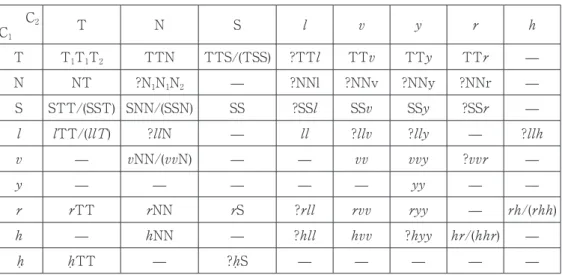
Table 1 summarizes the outcomes of biconsonantal clusters, that is, whether the cluster is affected by gemination and, if so, which consonant is geminated. T, N, and S in the table stand for oral stops, nasal stops, and sibilants, respectively, as in (1). An m-dash “—” denotes impossible consonant clusters due to phonotactic constraints (or accidental gaps); presence or
absence of consonant clusters draws on Turner and Turner (1971) except that vN is supplied based on Varma (1929) and Cardona (2013). A question mark “?” indicates that relevant examples of the predicted outcomes are not found in Varma (1929: 63–78, 107–25) and Cardona (2013: 51–64). The predicted outcomes follow from the following three rules already discussed: (i) the first consonant of the cluster is geminated except for those that cannot be geminated, cf. (2); (ii) the consonant after r or h is geminated, cf. (3a, b); (iii) prevocalic sibilants are not geminated, cf. (5aii). Anusvāra m. is not included in the table due to its ambivalent nature; there seems to be no strong evidence that anusvāra triggers gemination of the following consonant. NT-clusters are homorganic and SS-clusters are all geminates, both of which are exempt from gemination by (5aiii). Variations are indicated by a slash with the less dominant variant in parentheses.
Table 1: Gemination of biconsonantal clusters C1C2
Sanskrit gemination is, in some respects, typologically unique. As has been shown by earlier cross-linguistic studies including Thurgood (1993), Kirchner (2001: chapter 5), and Kraehenmann (2011), geminates are most common in the intervocalic position, but Sanskrit gemintation normally does not affect intervocalic single consonants (Varma 1929: 63). Other languages do have gemination that affects consonant clusters, but it is typically more restrictive. For example, in Proto- and West Germanic only the consonants preceding glides and liquids are geminated: OE biddan, OS biddian, OHG bitten as opposed to Go. bidjan, ON biþia (Prokosch 1939: §30; Hock 1974: 245–246; Vennemann 1988: 42–50; Hogg 1992: 57, 71–72).
C2 C1 T N S l v y r h T T1T1T2 TTN TTS/(TSS) ?TTl TTv TTy TTr — N NT ?N1N1N2 — ?NNl ?NNv ?NNy ?NNr — S STT/(SST) SNN/(SSN) SS ?SSl SSv SSy ?SSr — l lTT/(llT) ?llN — ll ?llv ?lly — ?llh v — vNN/(vvN) — — vv vvy ?vvr — y — — — — — yy — — r rTT rNN rS ?rll rvv ryy — rh/(rhh) h — hNN — ?hll hvv ?hyy hr/(hhr) — h. h.TT — ?h.S — — — — —
As for the motivation of gemination, of the seven “general pathways of geminate evolution” in Blevins (2004: 170–171), two concern gemination: lengthening under stress (including expressive lengthening) and boundary lengthening. While gemination is common after a stressed vowel, Sanskrit gemination is not conditioned by accent. The geminated consonant either precedes or follows an accented vowel and it occurs both in an accented and in an unacceted syllable: e.g., árttha- ‘purpose’, jihmmá- ‘oblique’, aggní- ‘fire’,
vaxkkāmadháran.am ‘your maintaining desires’ (Wackernagel 1896: §98a; Cardona 2013: 51–64).
Lengthening under stress is apparently associated with stress accent. However, Sanskrit accent is “musical” or of pitch-type (Whitney 1889: §80; Wackernagel 1896: §244a; Macdonell 1910: §83), which is not likely to lead to lengthening. Also, Sanskrit gemination is obviously not expressive gemination. The second type of gemination of Blevins is boundary lengthening in the phrase-final position, but this is an environment where Sanskrit gemination typically does not occur (cf. (5bvii)). The motivation behind Sanskrit gemination is apparently not of the common types, which would leave the question as to what motivates Sanskrit gemination. In terms of targets, consonants with an oral closure are preferred over those without one irrespective of the consonant order. In (7) is the hierarchy of consonants in terms of susceptibility to gemination.
(7) Susceptibility to Sanskrit gemination:
oral stops > nasal stops > sibilants > l, v, y > r, h, h., m.
Oral stops are the most frequent target (Varma 1929: 63–64), which geminate either as the first member of a cluster preceding any consonant or the second after any consonant. Next, nasal stops undergo gemination typically as the second member of consonant clusters after sibilants or semivowels, but not after stops. On the other hand, sibilants are geminated typically as the first member before semivowels, and optionally before oral and nasal stops. I have placed nasals between stops and sibilants because in the sequence of a sibilant and a nasal, it is primarily the nasal that gets geminated. Semivowels vary in their susceptibility to gemination (Suzuki 2014). Glides y and v geminate after r and h. The liquid l optionally geminates before stops. On the other hand, r does not geminate. Finally, glottal fricatives and anusvāra, sounds that lack a specific oral gesture, do not geminate as a rule although there are examples as in (6) where the voiced glottal fricative geminates when preceded or followed by certain semivowels.
This hierarchy of susceptibility to gemination is on the whole in accordance with the general tendency of consonant classes to occur as geminates. Thus, based on a survey of 44 languages with gemination, Maddieson (2008: 1928–1929) notes that the following are likely to occur as geminates: stops > nasals > fricatives > liquids > glides > h in descending order (also Hock 1974: 244–245; Kirchner 2001: 114–116). There are two differences between the hierarchy in (7) and the cross-linguistic tendency that Maddieson gives. First, Maddieson’s survey suggests that liquids are more likely to geminate than glides, but this is not the case in Sanskrit gemination. Further, in Sanskrit, the two liquids show distinctly different behaviors in gemination: l may geminate but not r.
The asymmetry of the two liquids is cross-linguistically observed (Proctor 2009: 38–45; Proctor and Walker 2012) and in Sanskrit is not restricted to gemination, but is also observed in external sandhi (Whitney 1889: §§202, 206, 213; Wackernagel 1896: §§276, 280, 281, 283; Allen 1962: 80–81, 84, 91–93; Macdonell 1910: §§75–77; Renou 1975: §§33–35; Cardona 2003: 116–117; Kobayashi 2004: §66; Suzuki 2014). While the two liquids generally form a natural class, in Sanskrit l and r behave in parallel with stops and sibilants, respectively, apparently due to the presence or lack of an oral contact; for discussions and examples, see Suzuki 2014. In addition, both liquids and glides alternate with a syllabic counterpart and together form a class of semivowels in traditional Sanskrit grammar: see above §2. The idiosyncracy observed in the hierarchy in (7), therefore, is not peculiar to gemination, but can be attributed to the consonant system of Sanskrit as a whole.
The next section attempts to account for the extensiveness, variations, and the obscure motivation that apparently result from these two features.
4. Analysis
In the recent literature on theoretical phonology, there are two major approaches, i.e., prosodic or syllable-based and phonetic or phonotactic, to phenomena involving consonant clusters such as assimilation, deletion, epenthesis, and well-formed consonant clusters. On the one hand, prosodic approaches attribute the phenomena observed in consonant clusters to a move towards less marked prosodic structure or improvement of the syllable structure (Parker 2011 and references therein). On the other hand, phonetic approaches find perceptual or articulatory motivations behind the same phenomena such as cue enhancement, misperception, and gesture retiming (Ohala 1981, 1997, 2005; Browman and Goldstein 1989,
1990, 1991, 1992; Côté 2000; Blevins 2004; Wright 2004 among others). For example, Jun (2011: 1103) compares “prosody-based approach” and “cue-based approach” to account for C2 dominance effect in C1C2-clusters and Seo (2011: 1259) resorts to the notion “segment
contact” as opposed to “syllable-contact”. To account for phonotactics, acoustic/perceptual and articulatory bases have been proposed as an alternative to sonority that supplies the basis of the syllable (e.g. Kawasaki-Fukumori 1992; Ohala and Kawasaki 1997; Henke, Kaisse, and Wright 2012; Proctor and Walker 2012).
While these two approaches tend to be treated as alternatives, they do not always contradict and often yield the same predictions. Moreover, particular phonological processes may operate in multiple dimensions, both prosodic and phonotactic. The approach adopted in this paper thus incorporates both aspects observed in Sanskrit gemination. The idea that a phonological phenomenon reflects different aspects is inspired by the framework of Optimality Theory, according to which the grammar consists of a set of universal constraints whose different rankings yield different outcomes (e.g. Kager 1999; McCarthy 2008b), although the paper does not resort to the apparatuses such as formulated constraints and tableaus for the comparison of different constraint rankings.
4.1. Critique on earlier approaches to gemination
Earlier studies beginning with Varma (1929: 63–64, 70) have analyzed the process in terms of syllable structure, according to which gemination attains a more preferred syllable structure or results from resyllabification (also Hock 1974, 1991a: 138, 1991b; Vennemann 1988: 33–35; Vaux 1992; Cho 1999: 153–167; Kobayashi 2001: 96–97, 2004: 31–32; Calabrese 2009). Whatever the motivation of the exact course of development, these analyses presuppose that the resultant sequence has the syllable boundary between two components of the geminate, i.e. either VC1-C1C2V or VC1C2-C2V, depending on which consonant is geminated.
In fact, some of the restrictions on gemination pertain to syllable length, namely, prohibition of gemination after a long vowel in (5bi) and gemination in clusters of more than two consonants in (5bii), which suggests that Sanskrit gemination is motivated or at least conditioned by syllable structure. In addition, in many cases, gemination appears to affect the onset-initial consonant (Cho 1999; Calabrese 2009). That is, TR > TTR such as cakra- > cakkra- and SR > SSR such as amus.ya > amus.s.ya in (2) follow from syllabification of both consonants of the input cluster into the onset. On the other hand, in rC > rCC such as artha- > arttha- and hC > hCC such as jihma- > jihmma- in (3), the two consonants in
the cluster are heterosyllabic and thus only the second is in the onset. Variations such as ST > STT ~ SST, e.g., as.t.ābih. > as.t.t.ābih. ~ as.s.t.ābih., may be attributed to two possible ways of syllabification, in which either of the two consonants may be onset-initial. Strengthening in the onset is a common phenomenon cross-linguistically (Hock 1991a: 83; Spencer 1996; Kirchner 2001; McCarthy 2008a; Jun 2011; Yu 2011) and thus is a plausible assumption for Sanskrit gemination. It is also a plausible account for the exceptional gemination of a fricative after pause in (5bvi) and of h in (6): hvayāmi > hhvayāmi, ścotanti > śścotanti, barha- > barhha-.
However, the interpretation of gemination as strengthening of the onset-initial consonant cannot be extended to all cases of gemination because coda consonants, which are typically subject to weakening, are also geminated: T1T2 > T1T1T2 as with sapta- > sappta- in (2a) and
lT > llT as with kalpān juhoti > kallpāñjuhoti in (4b). Examples such as these do not support the assumption of Cho (1999) and Calabrese (2009) that gemination affects the syllable-initial consonant. Therefore, approaches based on the position are descriptively inadequate, at least in part.
The last set of examples is also problematical for the assumption that the geminated consonants strand over two syllables, which is presupposed by all the syllable-based approaches. More specifically, the clusters of two distinct stops, as exemplified at the beginning of (2a), e.g., mukta- > mukkta- and sapta- > sappta-, cannot be analyzed straightforwardly in syllable-based approaches because gemination yields an onset of two stops, i.e., VT1-T1T2V, which is a change towards a highly marked structure that Sanskrit
originally lacked. Also problematical is the alternate development of lT > llT, kalpān juhoti > kallpāñjuhoti in (4b), which would yield the onset cluster of lT. Syllabification of geminates to two successive syllables is not necessarily supported by the phonetic treatises, either, which give variable syllabification such as ā tvā ‘hither you’ > ātt-vā ~ āt-tvā, agnim ‘fire’ > agg-nim ~ ag-gnim, pārs.n.yā ‘with the heel’ > pārs.s.-n.yā ~ pār-s.s.n.yā, pārs.s.n.-n.yā, rukmam ‘jewel’ > rukkk̃-mam ~ rukk-k̃mam (Varma 1929: chapter 2; Cardona 2013: 51–64). While these examples may be extreme cases, syllabification sapp-ta and mukk-ta, kall-pān with no aberrant onset clusters appear more reasonable than that where geminates are separated into two syllables such as sap-pta, which requires justification.
I have discussed here some problematical issues of the syllable-based approaches rather than examining individual analyses in detail; see Suzuki 2012: 195–196 for critical evaluation of various syllable-based approaches. While the observed facts suggest that syllable-based
factors are in fact relevant, the problems just discussed suggest that gemination as a whole resists a uniform analysis based on syllable structure, that change in syllable structure may be at least in part a result rather than the cause, and that motivation for Sanskrit gemination must be sought elsewhere.
A different type of interpretation is presented in de Saussure (1889). He assumes that single and geminate dental stops are not distinguished in the position preceding a sonorant consonant. The hypothesis is supported by Whitney’s (1889: §232) observation that preconsonantal geminate stops are written as single stops in manuscripts. However, lack of distinction between single and double consonants does not necessarily motivate gemination and much less extensive gemination beyond the contexts that de Saussure assumes (also Hock 1974: 247). Also, lack of distinction between single and double consonants in manuscripts does not necessarily imply lack of distinction in actual speech. Thus, while it may not have been de Saussure’s intention to pursue the motivations behind all cases of Sanskrit gemination, his hypothesis is untenable as a single factor to encompass various types of gemination in Sanskrit.
4.2. Phonotactic factors in gemination and gemination as a composite phenomenon To recapitulate the discussions in §3, there are three features observed in Sanskrit gemination: (i) gemination affects various types of consonant clusters and not intervocalic single consonants; (ii) the preferred targets are stops rather than consonants without an oral closure or, more broadly, an oral gesture; (iii) with the exceptions of r, h, visarga, and anusvāra, the target tends to be the first or postvocalic consonant of the clusters.
The first feature has led to the interpretation that gemination is conditioned by the syllable structure, but §4.1 has shown that the syllable-only approach cannot be supported. Another possible interpretation of this feature is that gemination results from phonetic effects of consonant sequences. That is, in articulation, gemination resolves the difficulty of articulating consonant sequences (Fourqué 1927; Suzuki 2012). In perception, preconsonantal consonants are more difficult to perceive than prevocalic consonants and may require remedy in some way. The phonetic interpretation predicts that the first consonant is more liable to be affected, which is the third feature discussed below. On the other hand, intervocalic single consonants pose no comparable difficulties.
The second feature concerning the preferred targets is in accordance with the cross-linguistic tendency and thus requires no further explanation. As already discussed,
consonants with an oral closure are more easily lengthened than those with a stricture (Kirchner 2001; Maddieson 2008). The susceptibility hierarchy in (7) above is independent from the order of the affected consonants in the consonant clusters and this is one aspect of Sanskrit gemination that partly contradicts with the third feature concerning the order of the target consonants. In this respect the process is characterized as a lengthening of the oral gesture, especially closure (Suzuki 2012).
As the third feature, the first consonant of the cluster has a prominent tendency to become the target of gemination with the exceptions of those that cannot be geminated: here the second feature overrides the third. However, the order determines the affected consonant when the two consonants that form a cluster are equally susceptible to gemination. This applies to the clusters of two distinct stops, where both consonants have an oral closure, e.g., mukta- > mukkta- and sapta- > sappta-. There are also variable outcomes where the second and the third features interact such as alternates of sibilant-stop clusters, the l-stop clusters, and the v-nasal clusters, e.g., as.t.ābih. > as.t.t.ābih. ~ as.s.t.ābih., kalpān juhoti > kalppāñjuhoti ~ kallpāñjuhoti, vibhudāvne > vibhudāvnne ~ vibhudāvvne in (4), where the first and the second
variants follow from the second condition on consonant classes and the third condition on the order, respectively. The third feature may also be responsible for the exceptional gemination of the voiced glottal fricative such as hvayāmi > hhvayāmi.
I have already stated in §3 and §4.1 above that there are apparently length restrictions that constrain gemination. In addition, part of the environments where gemination occurs is the strong positions such as syllable-initial and word-initial positions, where fortition typically occurs cross-linguistically. Thus, as shown above, word-initial consonants can be the targets for gemination while word-final consonants typically do not undergo gemination; in fact, the word-final position is normally affected by lenition, in Sanskrit by external sandhis or assimilation to the following consonant. I propose, therefore, that Sanskrit gemination is a composite phenomenon that results from articulatory, perceptual, and syllabic factors.
Finally, given the fact that a single factor cannot encompass the entire phenomenon, Sanskrit gemination is likely to have resulted from several processes with restricted targets and contexts such as lengthening of fricatives in phrase-initial position in addition to the two major rules by Indian grammarians. Or, due to the amount of variations, these two rules might in turn consist of several processes, for example, lengthening of stops before r, fortition of glides after r and h, and lengthening of stops before stops. This seems to be the only reasonable way to account for the variation, extensiveness, and heterogeneity of the
phenomenon.
5. Conclusions
I have attempted to show that, in identifying tendencies observed in numerous variations, Sanskrit gemination is phonotactically motivated and not just prosodically as earlier analyses suggest. The lengthening of the oral gesture, especially closure, the lengthening of the first consonant, fortition in syllable-initial position, and restriction on syllable length, interact to produce the observed outcomes. These independent but interacting factors partly overlap but may contradict, in which case there arise variaions.
Sanskrit gemination is prescribed by Pānini and various Prātiśākhyas, and these treatises are dated to the late Old Indo-Aryan and early Middle Indo-Aryan stages. It is apparently a change in progress, which has been considered to have led to Middle Indo-Aryan assimilation by a number of scholars beginning with Jacobi (1881) (Varma 1929; Murray 1982; Vaux 1992; Cho 1999; Suzuki 2012). It is likely to be a testimony of the beginning stages of vast assimilation and cluster reduction that affected most of the consonant clusters in later stages. While my interpretation of the phenomenon still requires further elaboration and justification, based on the observed facts, I believe it is in the right direction. Variations and extensiveness observed in Sanskrit gemination arise from the interaction of more than one factor and the merger of more than one process. While we typically know only the inputs and outputs of historical changes, without evidence of how the changes proceeded, variations of Sanskrit gemination suggest that they resulted from interactions of different aspects that form phonetic realization.
* I would like to thank two anonymous reviewers for comments on an earlier version of this paper. Much earlier versions were presented at the International Conference on Phonetics and Phonology 2013, January 26, 2013, at the National Institute for Japanese Language and Linguistics and at the Fourth Meeting of the Japan Society for Historical Linguistics, November 30, 2014, at the National Museum of Ethnology. I am grateful to the participants of both meetings for comments and criticisms. I also acknowledge proofreading by SCRIBENDI. This work was in part supported by JSPS KAKENHI Grant Number 25370450.
References
Allen, W. Sidney. 1962. Sandhi: The theoretical, phonetic and historical bases of word-junction in Sanskrit. Second printing. The Hague: Mouton.
Blevins, Juliette. 2004. Evolutionary phonology: The emergence of sound patterns. Cambridge: Cambridge University Press.
Browman, Catherine, and Louis Goldstein. 1989. Articulatory gestures as phonological units. Phonology 6: 201–251.
______. 1990. Gestural specification using dynamically-defined articulatory structures. Journal of Phonetics 18: 299–320.
______. 1991. Gestural structures: Distinctiveness, phonological processes, and historical change. In Ignatius G. Mattingly and Michael Studdert-Kennedy (eds.), Modularity and the motor theory of speech perception, 313–338. Hillsdale, NJ: Lawrence Erlbaum.
______. 1992. Articulatory Phonology: An Overview. Phonetica 49: 155–180.
Calabrese, Andrea. 2009. Cluster syllabification, gemination and syllabic repairs in Sanskrit. In Rajat Mohanty and Mythill Menon (eds.), Universals and variation. Hyderabad.
Cardona, George 2003. Sanskrit. In George Cardona and Dhanesh Jain (eds.), The Indo-Aryan languages, 104–160. London: Routledge.
______. 2013. Developments of nasals in early Indo-Aryan: Anunāsika and anusvāra. Tokyo University Linguistics Papers 33: 3–81.
Cho, Young-mee Yu. 1999. Parameters of consonantal assimilation. München: Lincom Europa.
Côté, Marie-Hélène. 2000. Consonant cluster phonotactics: A perceptual approach. Ph.D. dissertation, Massachusetts Institute of Technology.
Fouché, Pierre. 1927. Études de phonétique générale. Paris: Les Belles Letters.
Henke, Eric, Ellen M. Kaisse, and Richard Wright. 2012. Is the sonority sequencing principle an epiphenomenon? In Parker (ed.), 65–100.
Hock, Hans Henrich. 1974. Final weakening and related phenomena. In F. Ingemann (ed.), 1975 Mid-America Linguistics Conference Papers, 215–259. Lawrence: University of Kansas, Department of Linguistics.
______. 1991a. Principles of historical linguistics. 2nd edn. Berlin: Mouton de Gruyter.
______. 1991b. Dialects, diglossia, and diachronic phonology in early Indo-Aryan. In William G. Boltz and Michael C. Shapiro (eds.), Studies in the historical phonology of Asian languages, 119–159. Amsterdam: Benjamins.
Hogg, Richard. 1992. A grammar of Old English. Volume 1: Phonology. Chichester: Wiley-Blackwell. Jacobi, Hermann. 1881. Zur Genesis der Prâkritsprachen. Zeitschrift für vergleichende Sprachwissenschaft
25: 603–609.
Jun, Jongho. 2011. Positional effects in consonant clusters. Chapter 46 in Oostendorp et al. (eds.), 2: 1103– 1123.
Kager, René. 1999. Optimality Theory. Cambridge: Cambridge University Press.
Kawasaki-Fukumori, Haruko. 1992. An acoustical basis for universal phonotactic constraints. Language and Speech 35: 73–86.
Kirchner, Robert. 2001. An effort based approach to consonant lenition. New York: Routledge.
Kobayashi, Masato. 2001. Syllable rimes in Old Indo-Aryan and Dravidian. Journal of Asian and African Studies 62: 91–106.
______. 2004. Historical phonology of Old Indo-Aryan consonants. Tokyo: Tokyo University of Foreign Studies.
Kraehenmann, Astrid. 2011. Initial geminates. Chapter 47 in Oostendorp et al. (eds.), 2: 1124–1146. McCarthy, John J. 2008a. The gradual path to cluster simplification. Phonology 25: 271–319. ______. 2008b. Doing Optimality Theory: Applying theory to data. Malden, MA: Blackwell. Macdonell, A. A. 1910. Vedic grammar. Strassburg: Trübner.
Maddieson, Ian. 2008. Glides and gemination. Lingua 118: 1926–1936.
Murray, Robert W. 1982. Consonant cluster developments in Pāli. Folia Linguistica Historica 3: 163–184. Ohala, John J. 1981. The listener as a source of sound change. In Carrie S. Masek, Roberta A. Hendrick,
and Mary Frances Miller (eds.), Papers from the parasession on language and behavior, 178–203. Chicago: Chicago Linguistic Society.
______. 1997. Emergent stops. In Proceedings of the 4th Seoul International Conference on Linguistics 11–15 Aug 1997, 84–91.
______. 2005. Phonetic explanations for sound patterns: Implications for grammars of competence. In William J. Hardcastle and Janet Mackenzie Beck (eds.), A figure of speech: A festschrift for John Laver, 23–38. London: Erlbaum.
______ and Haruko Kawasaki-Fukumori. 1997. Alternatives to the sonority hierarchy for explaining segmental sequential constraints. In Stig Eliasson and Ernst Håkon Jahr (eds.), Language and its ecology: Essays in memory of Einar Haugen, 343–365. Berlin: Mouton de Gruyter.
Oostendorp, Marc, Colin J. Ewen, Elizabeth V. Hume, and Keren Rice (eds.). 2011. The Blackwell companion to phonology. Five volumes. Chichester: Wiley-Blackwell.
Parker, Steve. 2011. Sonority. Chapter 49 in Oostendorp et al. (eds.), 2: 1160–84. ______ (ed.). 2012. The sonority controversy. Berlin: Walter de Gruyter.
Proctor, Michael. 2009. Gestural characterization of a phonological class: The liquids. Ph.D. dissertation, Yale University.
______ and Rachel Walker. 2012. Articulatory bases of sonority in English liquids. In Parker (ed.), 289–316. Prokosch, E. 1939. A comparative Germanic grammar. Linguistic Society of America.
Renou, Louis. 1975. Grammaire sanscrite. 2nd edn. Paris: Librairie d’Amérique et d’Orient.
de Saussure, Ferdinand. 1889. Sur un point de la phonétique des consonnes en indo-européen. Mémoires de la Société de Linguistique 4: 246–257. [Reprinted 1922 in Charles Bally and Léopold Gautier (eds.), Recueil des publications scientifiques de Ferdinand de Saussure, 420–432. Payot.]
Seo, Misun. 2011. Syllable contact. Chapter 53 in Oostendorp et al. (eds.), 2: 1245–1262. Spencer, Andrew. 1996. Phonology. Oxford: Blackwell.
Suzuki, Yasuko. 2012. Sanskrit gemination as lengthening. In Jared Klein and Kazuhiko Yoshida (eds.), Indic across the millennia: From the Rigveda to Modern Indo-Aryan, 193–208. Bremen: Hempen Verlag.
______. 2013. On characterizing Sanskrit anusvāra. In Shu-Fen Chen and Benjamin Slade (eds.), Grammatica et verba: Glamor and verve, 282–297. Ann Arbor, MI: Beech Stave Press.
______. 2014. The class of semivowels in Sanskrit. Journal of Inquiry and Research (Kansai Gaidai University) 100: 1–19.
Thurgood, Graham. 1993. Geminates: A cross-linguistic examination. In Joel Ashmore Nevis, Gerald McMenamin, and Graham Thurgood (eds.), Papers in honor of Frederick H. Brengelman on the occasion of the twenty-fifth anniversary of the Department of Linguistics, CSU Fresno, 129–139. Fresno: Department of Linguistics, California State University, Fresno.
Turner, R. L., and D. R. Turner 1971. A comparative dictionary of the Indo-Aryan languages, Volume 3: Phonetic analysis. London: Oxford University Press.
Varma, Siddheshwar. 1929. Critical studies in the phonetic observations of Indian grammarians. London: Royal Asiatic Society.
Vaux, Bert. 1992. Gemination and syllabic integrity in Sanskrit. Journal of Indo-European Studies 20: 283–303.
Vennemann, Theo. 1988. Preference laws for syllable structure and the explanation of sound change. Berlin: Mouton de Gruyter.
Wackernagel, Jakob. 1896. Altindische Grammatik, Band I: Lautlehre. Göttingen: Vandenhoeck & Ruprecht.
Whitney, William Dwight. 1889. A Sanskrit grammar. 2nd edn. Cambridge, MA: Harvard University Press.
Wright, Richard. 2004. A review of perceptual cues and cue robustness. In Bruce Hayes, Robert Kirchner, and Donca Steriade (eds.), Phonetically based phonology, 34–57. Cambridge: Cambridge University Press.
Yu, Alan C. L. 2011. Mergers and neutralization. Chapter 80 in Oostendorp et al. (eds.), 3: 1892–1918. (すずき・やすこ 外国語学部准教授)