第 54 卷 第 3 期
2019 六 3 月
JOURNAL OF SOUTHWEST JIAOTONG UNIVERSITY
Vol.54 No.3
June 2019
ISSN - 0258-2724 DOI
:10.35741/issn.0258-2724.54.3.16Research article
S
OLVING
M
ULTIPLE
T
RAVELING
S
ALESMAN
P
ROBLEM BY
M
EERKAT
S
WARM
O
PTIMIZATION
A
LGORITHM
Belal Al-Khateeb a, Mohammed Yousif a a
Department of Computer Science, University of Anbar, Ramadi, Anbar, Iraq, [email protected],
Abstract
Multiple Traveling Salesman Problem (MTSP) is one of various real-life applications, MTSP is the extension of the Traveling Salesman Problem (TSP). TSP focuses on searching of minimum or shortest path (traveling distance) to visit all cities by salesman, while the primary goal of MTSP is to find shortest path for m paths by n salesmen with minimized total cost. Wherever, total cost means the sum of distances of all salesmen. In this work, we proposed metaheuristic algorithm is called Meerkat Swarm Optimization (MSO) algorithm for solving MTSP and guarantee good quality solution in reasonable time for real-life problems. MSO is a metaheuristic optimization algorithm that is derived from the behavior of Meerkat in finding the shortest path. The implementation is done using many dataset from TSPLIB95. The results demonstrate that MSO in most results is better than another results that compared in average cost that means the MSO superior to other results of MTSP.
Keywords: Optimization, Multiple Traveling Salesman Problem, Meerkat Swarm Optimization Algorithm, NP-Hard Problems, Metaheuristic Algorithms.
摘要: 多旅行商問題(MTSP)是各種實際應用之一,MTSP 是旅行商問題(TSP)的延伸。 TSP 專注於搜索銷
售人員訪問所有城市的最小或最短路徑(行進距離),而 MTSP 的主要目標是找到 n 個銷售人員以最小化的 總成本找到 m 個路徑的最短路徑。 無論何處,總成本是指所有銷售人員的距離總和。 在這項工作中,我 們提出了元啟發式算法,稱為 Meerkat Swarm Optimization(MSO)算法,用於求解 MTSP 並在合理的時間 內保證良好的質量解決現實問題。 MSO 是一種元啟發式優化算法,它源於 Meerkat 在尋找最短路徑時的行 為。 使用 TSPLIB95 中的許多數據集完成實現。 結果表明,大多數結果中的 MSO 優於平均成本比較的另一 結果,這意味著 MSO 優於 MTSP 的其他結果。
关键词: 優化,多旅行商問題,Meerkat 群優化算法,NP-Hard 問題,元啟發式算法。
I. I
NTRODUCTIONTSP is typical optimization problems, TSP is defined as path searching problem for a salesman to visit all cities just once, begin the tour and finish in same city or depot and the
main goal or primary objective of TSP is to minimize cost of salesman [1][2][3]
MTSP is improved or extension of TSP that are well-known for many real life problems. In MTSP, cities are divided into m salesmen by assigning the cities to a different salesman. In
Al-Khateeb and Yousif / Journal of Southwest Jiaotong University/ Vol.54.No.3 June 2019
this work, MTSP has been studied, metaheuristic algorithm has been proposed to solve MTSP and find the shortest path and the results of the algorithm have been checked using dataset [4]. The rest of the paper is organized as follows: The literature review of MTSP are mentioned in Section II. MTSP together with its areas and former studies are mentioned in Section III. MSO metaheuristic algorithm that is proposed for the solution of MTSP is presented in Section IV. The results of MTSP showed in Section V. Finally, conclusions future works are presented in Section VI.
II. L
ITERATURER
EVIEWXiaobin Wang et.al [5], proposed a method brand new that relies on the knowledge of Graph Theory to resolve a heterogeneity of multiple depots MTSP and open ways. An easy model (SModel) is introduced to implement the multiple depots MTSP and open paths by remodeling a complicate graph into a simplified graph with a tiny number of edges. Throughout the operation of generating easy model (SModel), high weighted edges are removed preferentially as possible. Since mdop is enforced supported on the SModel, it is secure that the ultimate result is superior. By the experimental results, it’s shown that the new solution is efficient.
L. Kota et.al [6], proposed the general model of the technical inspection and maintenance systems are shown in the first part, wherever the solution to this problem is a crucial question. A mathematical model of the system’s object skilled assignment is projected with the constraints typical of the system, like experts’
capacity minimum and maximum and
constraints on maximum and daily tours of the experts. In the second part, the improved
evolutionary programming algorithm is
described that solves the assignment, regarding the constraints introducing penalty functions in the algorithm. In the last part, the convergence of the algorithm and therefore the run times and few examination of the parallelization is presented.
T. Ramadhani et.al [7], solved MTSP using the Ant Colony Optimization (ACO) algorithm. In solving the MTSP, Ant Colony Optimization (ACO) is implemented with respect to completely different chosen cities as depots. There are three parameters of MTSP that are considered in the implementation, those are the number of salesmen, the fewest cities that must be visited by a salesman and the most variety of cities which will be visited by a salesman
frequently. The implementation is done using four datasets from TSPLIB. The results show that the various chosen cities are as depots and it was found that the number of salesmen is the most important parameter, which have an effect on the solution.
A. Steven et.al [8], performed cluster of any nodes traversed, permitting MTSP to be simplified to an MTSP (multiple traveling salesman problem) or a TSP for every cluster. The clustering algorithms that may be used are
agglomerative clustering and K-means
clustering, whereas ant colony optimization is used when determining the shortest route for every cluster. The solution to MTSP is calculated from the total of the shortest routes for these clusters. They used data samples from TSPLIB for our implementation. The results of
the simulation show that agglomerative
clustering ACO algorithms take longer to reason than K-means clustering ACO and standalone ACO algorithms; on the other hand, they yield superior results than the other two. These results also are compared with results obtained from previous researches.
Al-Khateeb [9], solved the Multiple
Traveling Salesman Problem (MTSP) by Particle Swarm Optimization (PSO). The work focused on finding the best acceleration factor at which many selected values are tested for these factors. The obtained results demonstrated that the factors are problem dependent.
Kin-Ming Lo et.al [3], proposed a novel
effective Genetic Algorithm with Local
Operators (GAL) to solved Multiple Traveling Salesman Problem (MTSP) and generate higher quality solution in reasonable time. Wherever, used two local operators, Branch and Bound (BaB) and Cross Elimination (CE), according to the results the GAL have been successfully deployed to generate higher quality results. They algorithm had made improvement in the search ability and speed.
III.
T
HEM
ULTIPLET
RAVELINGS
ALESMANP
ROBLEMMTSP is grown or developed from TSP. MTSP is completely different from TSP, as in MTSP there are m salesmen, each depot during a given cluster or group of n cities is divided or split into m tours by distribution each one of these depots to a distinct salesman. The target is to seek out the minimum value of cost of the tours in total. The value will be referred as time or distance [3].
The MTSP is outlined on a graph G = (V, A), where A represents the set of edges and V referred the set of vertices. Let C = (Cij) be the cost matrix defined on the group of A. If Cij = Cji then the cost matrix is symmetric, otherwise it is asymmetric. If the cost matrix satisfies Cij ≤ Cik + Ckj for Ɐi, j, k, then the matrix C satisfies the triangle inequality [10][11].
Assignment based mathematical model is one of the most proposed models for MTSP, therefore tree based mathematical model and a
three-index row-based model have been
common used [12].
The three-index row-based model for the MTSP is as follows: Let n be the number of cities to be visited, and m be the number of salesmen (we assume n ≥ 3m+1). Then the variable xij is defined as follows [1][12]:
Goal function: minimize (1) Constraints: =m (2) = m (3) =1,j=2,…,n (4) = 1, i = 2, …, n (5) ≤│S│-1, ⱯS V – 1, S≠0 (6) = 0 v 1, (i,j) ⋴ A (7) In this model, constraints (4), (5) and (7) satisfy the assignment problem constraints. Constraints (2) and (3) ensure the comeback of each salesman to his starting point. Constraint (6) is used to prevent sub-tours [13]. The models and solutions that are used for multi depot are also can be used for MTSP [12] [14].
IV. M
EERKATS
WARMO
PTIMIZATION FORMTSP
A. Meerkat Swarm OptimizationMeerkat also called (Suricata suricata) are social animals. Meerkats live a life, which is 80%, based on teamwork. Meerkats live in community groups called mobs. Every mob has its own leaders (named alpha) and its own territory. The Meerkat mob leaves their burrows searching for food every morning, the mob is
divided into two sub-groups, one for foraging while other stays as a babysitter for pups in burrows. The MSO algorithm simulates the cooperative behavior of meerkats during the search for food as shown in algorithm 1.
Algorithm1:Meerkat Swarm Optimization. Initialize Mob of Meerkats n members. Calculate the fitness of each search agent. Alpha=the best search agent.
t=1.
While (t < Max number of iterations)
Divide Mob into two subgroups, Foraging group and Babysitter group.
Update Hungry rate and Position of Foraging group. Update Hungry rate and Position of Babysitter group. Decrease Hungry rate for Foraging group with rate. Merge the two groups into Mob and decrease Hungry rate for all with rate. Calculate the fitness of each search agent.
Select best one in Mob as Alpha. t=t+1.
End while
Return Alpha.
B. Initialization
The important stage in the operations of solution is the initialization process which provides the algorithm needs as well as the data of the problem and submit it. The preparedness phase consists of number of stages.
The first phase is the process of reading the problem database information. The form of problem information is graphic points. Each city has two points one of them on the x-axis and the other on the y-axis. After reading dataset, the cities are distributed to groups, each salesperson in the same group selects cities called depot to start and finish, the groups don’t have the same number of crows. By these points (x-axis and y-axis), distances between each city and other cities can be calculated. This is done through the following equation:
distance (i, j) =
(1)
Where x_i and y_i represent a point on the x-axis and y-axis, respectively, for the city i. In addition, x_j and y_j represent a point on the x-axis and y-x-axis, respectively, for the city j. Equation (1) is repeatedly used until the distances between all cities are calculated. The output of this stage is two-dimensional array that contains values, which represent the distances between cities. In this stage, the number of cities that salesmen have visited is known, as well.
After knowing the number of cities of the problem and number of cities of all groups, as well as the distances between each city, it becomes possible to calculate the value of the initial Hr and Rate for all meerkat. It should be noted that in this step Hr value is between (0, 1) and Rate value is between (0, last calculated
Al-Khateeb and Yousif / Journal of Southwest Jiaotong University/ Vol.54.No.3 June 2019
rate). This procedure mimics the situation in real meerkat. This case represents the first movements of meerkat to search for the source of the food.
When selecting any path, meerkats can receive quantities of food. These routes do not necessarily lead to the feed source. Therefore, the food during this case is a guide that works on the ways that are taken by crows and not necessarily the food path.
C. MSO Solution Construction
A solution can be constructed using hungry rate, fitness and position. After the initialization step, Meerkats divided into two mob, after that, MSO algorithm starts to work. Meerkats start to move from the beginning node that had chosen in the initialization stage. Mrows move from one node (start depot) to another until reaching to the target node (finish depot).
After determining the destination depot or node (city) and salesman traveling there to, the position value is updated according to hungry rate and current position. After that, the hungry rate is updated. When the Meerkat in all mobs complete all their roads, the cost (fitness) is calculated. This helps the Meerkats attempt to get away from the roads.
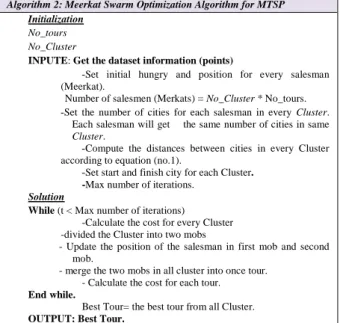
The following algorithm represents the MSO algorithm for MTSP.
Algorithm 2: Meerkat Swarm Optimization Algorithm for MTSP Initialization
No_tours No_Cluster
INPUTE: Get the dataset information (points)
-Set initial hungry and position for every salesman (Meerkat).
Number of salesmen (Merkats) = No_Cluster * No_tours. -Set the number of cities for each salesman in every Cluster.
Each salesman will get the same number of cities in same Cluster.
-Compute the distances between cities in every Cluster according to equation (no.1).
-Set start and finish city for each Cluster.
-Max number of iterations. Solution
While (t < Max number of iterations)
-Calculate the cost for every Cluster -divided the Cluster into two mobs
- Update the position of the salesman in first mob and second mob.
- merge the two mobs in all cluster into once tour. - Calculate the cost for each tour.
End while.
Best Tour= the best tour from all Cluster.
OUTPUT: Best Tour.
V. R
ESULTS ANDD
ISCUSSIONIn this paper, we used data from the dataset called “TSPLIB” in order to solve MTSP, the data is specifically selected from the categories of Pr dataset (Pr76, Pr152, Pr299, Pr439 and Pr1002), where the depots are selected randomly. Table 1, shows the results of Pr76, Pr152, Pr299
and Pr439, the following settings are used: 10 runs each run is with 1000 iterations, the depot for Pr76 are 8, 21 and 34, while the depot for dataset Pr152 are 16, 42 and 69, the dataset Pr299 have 30,83 and 135 as a depot, lastly, the dataset Pr439 selects 44, 121 and 198 as a depot. The reason behind choosing more than one depot for each dataset is to know the best number of depots to be suitable for the dataset.
In order to measure the efficiency and strength of the MSO algorithm, it will be compared with ACO algorithm, Round Robin (RR) algorithm [7] and K-Means Clustering algorithm [2]. The experimental results are shown in tables 1 and 2, respectively. Four dataset and different number of depots are used to evaluate the performance. Since the problem is not the optimal solution was obtained at a specific time and depending on the sources the comparative results were determined number of iterations, number of populations and number of depot.
Table 1.
Results of Pr76, Pr152, Pr299 and Pr439 by ACO and MSO Algorithm.
Name Iteration Depot ACO [7] RR [7] MSO Ave Ave Ave Pr76 1000 8 150660 162761 133436 21 216050 278538.8 119927 34 275450 402620.7 91122 Pr152 16 180995 220938.7 126147.6 42 400250 458573.7 107693 69 533550 748451.2 57100 Pr299 30 98432 109876.3 68414.8 83 139420 277650.3 56972 135 280650 525837.5 40573 Pr439 44 255580 231556.9 236327 121 366000 537433 223759 198 723209 1279863.4 177594
Figure 1: Results of Pr76, Pr152, Pr299 and Pr439 by ACO and MSO Algorithm.
Table 1, shows the best cost, the worst cost and the average cost for MSO and ACO. The obtained results show the superiority of MSO algorithm as MSO gives better results than ACO. This gives a good indication that MSO is better than ACO, which reflects a great success for
MSO in solving the MTSP problem. While, the results of the comparison between RR algorithm and MSO algorithm. The proposed algorithm is very much superior to the RR algorithm, where the comparison is based on 10 runs. The performance of the dataset Pr76, Pr152 and Pr299 was superior in all the results and cases. In Pr439, the algorithm excels in all the results except in the case of 44 depots. This gives indication that MSO is better than RR, which reflects an excellent success for MSO to solving the MTSP problem.
Also, we compared the results of this
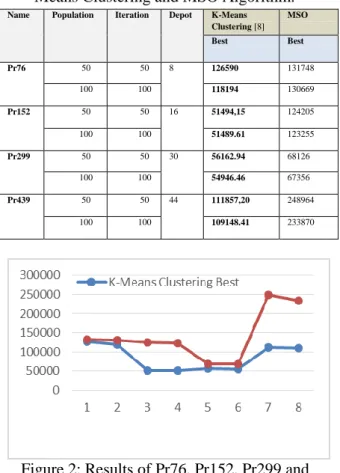
algorithm with K-Means Clustering algorithm in [8]. The experimental results are shown in table 2. Four dataset and different number of depot are designed to measure evaluate this algorithm.
Table 2.
Results of Pr76, Pr152, Pr299 and Pr439 by K-Means Clustering and MSO Algorithm.
Name Population Iteration Depot K-Means Clustering [8] MSO Best Best Pr76 50 50 8 126590 131748 100 100 118194 130669 Pr152 50 50 16 51494,15 124205 100 100 51489.61 123255 Pr299 50 50 30 56162.94 68126 100 100 54946.46 67356 Pr439 50 50 44 111857,20 248964 100 100 109148.41 233870
Figure 2: Results of Pr76, Pr152, Pr299 and Pr439 by K-Means Clustering and MSO
Algorithm.
The results in table 2 show that the results of MSO algorithm are worse than the K-Means
Clustering algorithm. This is because the
clustering concept in MTSP is very useful and improves the quality of the results.
As well, MSO algorithm is compared with
ACO algorithm [5]. The experimental results are shown in table 3. Five datasets and five depots are designed to evaluate the performance. Table 3.
Results of Pr76, Pr152, Pr226, Pr439 and Pr1002 by ACO and MSO Algorithm.
Name ACO [5] MSO
Depot Population Ave Time(s) Ave Time(s)
Pr76 5 20 180690 51 138192 23 Pr152 5 40 136341 128 136151.3 47 Pr226 5 50 170877 143 88646 60 Pr439 5 100 165035 563 256015 180 Pr1002 5 220 387205 2620 328702 500 Figure 3: Results of Pr76, Pr152, Pr226, Pr439 and Pr1002 by ACO and MSO Algorithm. The results in table 3 show that MSO is better than ACO in Pr76, Pr226 and Pr1002 with less execution time. However, in Pr152 and Pr439 by ACO is better than MSO, but MSO still managed to have a less execution time.
Also, MSO algorithm is compared with PSO algorithm [9]. The experimental results are shown in table 4. Five datasets and five depots are selected to evaluate the performance.
Table 4.
Results of Pr76, Pr152, Pr299, Pr439 by PSO and MSO Algorithm.
Problem Iterations Depot PSO [9] MSO
Pr76 1000 5 291493.6 138192 Pr152 440458.4 137851.3 Pr299 288484 75824.5
Al-Khateeb and Yousif / Journal of Southwest Jiaotong University/ Vol.54.No.3 June 2019
Pr439 727180.8 256015.3
The results in table 4 show that MSO algorithm is superior to the PSO algorithm, where the comparison is based on 10 runs. This gives indication that MSO is better than PSO, which reflects an excellent success for MSO in solving the MTSP problem.
Finally, results of MSO algorithm is compared with None, BaB, EC and CE+BaB [3]. This experimental results are shown in table 5. Six datasets and different depots (5, 10 and 15) are selected to evaluate the performance.
Table 5.
Results of Pr76, Pr152, Pr226, Pr299, Pr439, Pr1002 by None, BaB, EC, CE+BaB and MSO Algorithm. Number of Salesmen 5 10 15 Nam e
Operator Ave Time Ave Time Ave Time
Pr76 None[3] 16884 0 4.20 22025 9 5.02 27273 6 5.30 BaB[3] 16769 7 6.60 22502 3 7.66 27214 5 7.80 CE[3] 16466 1 4.90 18631 7 6.65 22622 4 6.54 CE+BaB[ 3] 16613 8 6.80 18238 1 8.29 22392 7 8.77 MSO 13819 2 5.70 13003 5 7.00 11912 0 8.25 Pr15 2 None 13808 8 16.70 22873 6 19.10 28974 4 19.13 BaB 13110 9 27.00 23494 4 27.80 30491 5 28.11 CE 13239 5 19.40 13622 8 22.09 16474 1 21.27 CE+BaB 13167 4 28.00 14199 3 32.14 16432 1 29.49 MSO 13785 1 22.45 13300 5 29.00 12485 7 30.10 Pr22 6 None 16589 3 46.70 24769 9 51.95 32426 8 51.12 BaB 15557 4 77.00 25115 5 81.43 34013 9 81.81 CE 15712 0 52.60 17219 3 58.84 18881 3 58.74 CE+BaB 15662 9 75.60 17133 8 85.43 18848 9 82.13 MSO 88646 60.25 87982 77.48 84069 84.40 Pr29 9 None 78872 78.00 12142 9 82.01 16314 4 83.17 BaB 77676 120.90 12198 3 117.67 16075 5 123.88 CE 78217 86.90 81323 95.71 87490 101.94 CE+BaB 77413 123.10 78999 132.31 88526 134.14 MSO 75824 115.48 73449 100.67 72166 109.84 Pr43 9 None 15222 4 184.70 20937 6 185.17 27018 5 209.93 BaB 14643 6 300.00 20709 5 283.39 16712 2 279.41 CE 14841 215.20 15163 211.26 15960 211.58 6 6 9 CE+BaB 14738 9 295.70 15139 2 301.25 15551 2 315.70 MSO 25601 5 255.47 25447 1 280.16 24475 9 300.00 Pr 1002 None 37588 2 793.70 44985 5 800.00 55060 5 812.93 BaB 34871 2 1154.8 0 43510 9 1182.2 4 53503 5 1149.5 5 CE 34925 8 864.30 37164 9 894.75 39328 3 888.89 CE+BaB 33858 0 1224.5 0 36028 4 1298.2 8 38336 0 1240.6 2 MSO 32870 2 900.43 32728 8 1005.4 8 32550 5 1107.8 4
The results in table 5 show that MSO algorithm is superior in performance with None, BaB, EC and CE+BaB, where the comparison is based on 10 runs. This gives indication that MSO is better than None, BaB, EC and CE+BaB, which reflects an excellent success for MSO in solving the MTSP problem.
The obtained results in tables 1 thru 5 give a good indication that MSO is a very good algorithm in solving TSP like problems, as it was very good in solving MTSP.
VI. C
ONCLUSIONS ANDF
UTUREW
ORKThe MSO is used to solve MTSP; according to the results in table 1 thru 5, the obtained results demonstrate that MSO is a good algorithm in solving MTSP. In MTSP the obtained solution can be enhanced when the number of salesmen is increased this is due to the increase of the solutions in the search space. Choosing different cities as a depot also affects the MTSP solution quality, as it leads to a better cost. Future work, the success of MSO algorithm to solve the MTSP can be enhanced by using clustering in MTSP, applied it on another problem [15][16][17].
R
EFERENCES[1] M. Yousif and B. Al-Khateeb, “A
Novel Metaheuristic Algorithm for
Multiple Traveling Salesman Problem,”
Adv. Res. Dyn. Control Syst., vol. 10,
no. 13, pp. 2113–2122, 2018.
[2] D. Lawler, E., Lenstra, J., Kan, A., and
Shmoys,
THE
TRAVELING
SALESMAN PROBLEM : A GUIDED
TOUR
OF
COMBINATORIAL
OPTIMIZATION. 1985.
[3] K. Lo, W. Y. P. Wong, K. L. Yee, and
L. S. Mak, “A Genetic Algorithm with
New Local Operators for Multiple
Traveling Salesman Problems,” Int. J.
Comput. Intell. Syst., vol. 11, pp. 692–
705, 2018.
[4] T. B. Imdat Kara, “Integer linear
programming formulations of multiple
salesman problems and its variations,”
Eur. J. Oper. Res., vol. 174, no. 3, pp.
1449–1459, 2006.
[5] X. Wang, D. Liu, and M. Hou, “A
Novel Method for Multiple Depot and
Open Paths , Multiple Traveling
Salesmen Problem,” IEEE 11th Int.
Symp. Appl. Mach. Intell. Informatics,
pp. 187–192, 2013.
[6]
Benjamin Durakovic, Muris Torlak,
"Simulation and experimental validation
of phase change material and water
used as heat storage medium in window
applications", J. of Mater. and Environ.
Sci., Vol. 8, No. 5, (2017), ISSN:
2028-2508, pp 1837-1846
.[7] T. Ramadhani, G. F. Hertono, and B. D.
Handari, “An Ant Colony Optimization
Algorithm for Solving the Fixed
Destination
Multi-depot
Multiple
Traveling Salesman Problem with
Non-random Parameters,” Int. Symp. Curr.
Prog. Math. Sci. 2016 (ISCPMS 2016),
vol. 030123, 2017.
[8] Osamah
Ibrahim
Khalaf,
Ghaida
Muttashar Abdulsahib and Muayed
Sadik, 2018. A Modified Algorithm for
Improving Lifetime WSN. Journal of
Engineering and Applied Sciences, 13:
9277-9282.
[9] B. Al-Khateeb, “The Selection of
Particle Swarm Optimization Learning
Factors Values in Solving the Multiple
Travelling Salesman Problem,” Adv.
Res. Dyn. Control Syst., vol. 10, no. 7,
pp. 439–445, 2018.
[10] Abd Ghani, M.K, Mohammed, M.A.,
Arunkumar, N. Mostafa SA, Ibrahim
DA, Abdullah MK, Jaber, M.M., Enas
Abdulhay,
Gustavo
Ramirez-Gonzalez, Burhanuddin, M.A.2018.
Decision-level fusion scheme for
nasopharyngeal
carcinoma
identification using machine learning
techniques. Neural Computing and
Applications.
https://doi:
10.1007/s00521-018-3882-6.
[11] E. Kivelevitch, K. Cohen, and M.
Kumar, “A Market-Based Solution to
the Multiple Traveling Salesmen
Problem A Market-based Solution to
the Multiple Traveling Salesmen
Problem,” J. Intell. Robot. Syst.
Manuscr. No., vol. 72, no. 1, pp. 21–
40, 2013.
[12] Mostafa,
S.A.,
Mustapha,
A.,
Mohammed, M.A., Hamed, R.I.,
Arunkumar, N., Ghani, M.K.A., Jaber,
M.M. and Khaleefah, S.H., 2019.
Examining multiple feature evaluation
and
classification
methods
for
improving
the
diagnosis
of
Parkinson’s
disease.
Cognitive
Systems Research, 54, pp.90-99.
[13] G. Dantzig, R. Fulkerson, and S.
Johnson, “Journal of the Operations
Research Society of America Solution
of a Large-Scale Traveling-Salesman
Problem,” J. Oper. Res. Soc. Am., vol.
2, no. 4, pp. 393–410, 1954.
[14] F. Nuriyeva and G. Kizilates, “A
NEW HEURISTIC ALGORITHM
FOR
MULTIPLE
TRAVELING
SALESMAN PROBLEM,” TWMS J.
Appl. Eng. Math., vol. 7, no. 1, pp.
101–109, 2017.
[15] Y. Mishenin, I. Koblianska, V. Medvid,
and Y. Maistrenko, “Sustainable
Regional
Development
Policy Formation: Role of Industrial
Ecology
and
Logistics,”
Enterpreneurship and Sustainability
Issues, vol. 6, no. 1, pp. 329–341,
2018.
[16] O. Chkalova, M. Efremova, V. Lezhnin,
A. Polukhina, and M. Sheresheva,
“Innovative Mechanism for Local
Tourism System Management: A Case
Study,”
Entrepreneurship
and
Sustainability Issues, vol. 6, no. 4, pp.
2052–2067, 2019.
[17] A. Shevyakova, E. Munsh, and M.
Arystan, “Information Support for the
Development of Tourism for the
Diversification of the Economy of
Kazakhstan,” Insights into Regional
Development, vol. 1, no. 2, pp.
西 南 交 通 大 学 学 报
第 54 卷 第 3 期
2019 六 3 月
JOURNAL OF SOUTHWEST JIAOTONG UNIVERSITY
Vol.54 No.3
June 2019
参考文:
[1] M. Yousif 和 B. Al-Khateeb,“一種用於多 旅行商問題的新型元啟發式算法”,Adv。 RES。達因。 Control Syst。,vol。 10, 不。 13,pp. 2113-2122, 2018。
[2] D. Lawler,E.,Lenstra,J.,Kan,A。和 Shmoys,“旅行銷售員問題:組合優化的 指導之旅”。 1985 年。
[3] K. Lo,W。Y. P. Wong,K。L. Yee 和 L. S. Mak,“A Genetic Algorithm with New Local Operators for Multiple Travel Salesman Problems,”Int。 J. Comput。 INTELL。 Syst。,vol。 11,pp.692-705, 2018。 [4] T. B. Imdat Kara,“多個推銷員問題及其 變 化 的 整 數 線性 規 劃 公式”,Eur。 J. Oper。 Res。,vol。 174,沒有。 3, pp.1449-1459, 2006。 [5] X. Wang,D。Liu 和 M. Hou,“一種新的 多倉庫和開放路徑的方法,多個旅行推 銷員問題”,IEEE 11th Int。 SYMP。申 請馬赫。 INTELL。信息學,第 187-192 頁,2013 年。
[6] Benjamin Durakovic,Muris Torlak,“相變 材料和水在窗戶應用中用作蓄熱介質的 模擬和實驗驗證”,J.of Mater。和環境。 Sci。,Vol。 8,No。5,(2017), ISSN:2028-2508,pp 1837-1846。 [7] T. Ramadhani,G。F. Hertono 和 B. D. Handari,“用於解決具有非隨機參數的固 定目標多車場多旅行商問題的蟻群優化 算法”,Int。 SYMP。 CURR。 PROG。 數學。科學。 2016 年(ISCPMS 2016), 第一卷。 030123, 2017。
[8] Osamah Ibrahim Khalaf,Ghaida Muttashar Abdulsahib 和 Muayed Sadik,2018。改
進的生命週期 WSN 算法。 Journal of
Engineering and Applied Sciences,13: 9277-9282。
[9] B. Al-Khateeb,“解決多旅行商問題中粒 子群優化學習因素值的選擇”,Adv。 RES。達因。 Control Syst。,vol。 10, 不。 7,pp. 439-445, 2018。
[10] Abd Ghani,M.K,Mohammed,M.A., Arunkumar , N 。 Mostafa SA , Ibrahim DA,Abdullah MK,Jaber,M.M.,Enas
Abdulhay , Gustavo Ramirez-Gonzalez , Burhanuddin,M.A.2018。利用機器學習 技術識別鼻咽癌的決策級融合方案。神 經計算與應用。 https:// doi:10.1007 / s00521-018-3882-6。 [11] E. Kivelevitch,K。Cohen 和 M. Kumar, “基於市場的解決多個旅行推銷員問題的 問題基於市場的解決多個旅行商問題的 問 題” , J 。 Intell 。 機 器 人 。 SYST 。 Manuscr。不,第一卷 72,不。 1,pp. 21-40, 2013。
[12] Mostafa , S.A. , Mustapha , A. , Mohammed , M.A. , Hamed , R.I. , Arunkumar,N.,Ghani,M.K.A.,Jaber, M.M。和 Khaleefah,S.H.,2019。檢查 多功能評估和分類方法,以改善帕金森 病的診斷。 Cognitive Systems Research, 54,pp.90-99。
[13] G. Dantzig,R。Fulkerson 和 S. Johnson, “美國運作研究學會期刊解決大規模旅行 - 推銷員問題”,J。Oper。 RES。 SOC。 Am。,vol。 2,沒有。 4,pp. 393-410, 1954。 [14] F. Nuriyeva 和 G. Kizilates,“用於多種旅 行銷售員問題的新啟發式算法”,TWMS J. Appl。工程。數學,第一卷。 7,不。 1,pp. 101-109, 2017。 [15] Y. Mishenin , I 。 Koblianska , V 。 Medvid 和 Y. Maistrenko,“可持續區域 發展政策的形成:工業生態和物流的作 用”,企業家精神和可持續性問題,第一 卷。 6,不。 1,pp. 329-341, 2018。 [16] O. Chkalova , M 。 Efremova , V 。 Lezhnin,A。Polukhina 和 M. Sheresheva, “地方旅遊系統管理的創新機制:案例研 究”,“企業家精神和可持續性問題”,第 一卷。 6,不。 4,pp. 2052-2067, 2019。 [17] A. Shevyakova,E。Munsh 和 M. Arystan, “為哈薩克斯坦經濟多樣化發展旅遊業提 供信息支持”,“區域發展見解”,第一卷。 1 , 不 。 2 , pp. 138-154, 2019 。