西 南 交 通 大 学 学 报
第 55 卷 第 4 期
2020 年 8 月
JOURNAL OF SOUTHWEST JIAOTONG UNIVERSITY
Vol. 55 No. 4
Aug. 2020
ISSN: 0258-2724 DOI:10.35741/issn.0258-2724.55.4.54
Research articleSocial Sciences
T
HE
N
EW
E
RA OF
F
INANCIAL
T
ECHNOLOGY IN
B
ANKING
I
NDUSTRY
银行业金融技术的新时代
Sharif Abu Karsha, Yusuf AbufaraaaArab American University- Palestine, Al-Quds Open University- Palestine Received: April 03, 2020 ▪ Review: June, 24 2020 ▪ Accepted: July 26, 2020
This article is an open access article distributed under the terms and conditions of the Creative Commons Attribution License (http://creativecommons.org/licenses/by/4.0)
Abstract
The purpose of this research paper is to examine the impact of FinTech companies compared to the traditional banking industry. FinTech is a digitalized financial solution that is offered to small businesses and individuals to fulfill their banking needs. It is expected that FinTech companies will be able to offer the same banking products as existing banks, but the FinTech companies are predicted to grow at a faster pace in countries where digital technology is available. There has been mention that FinTech companies have already had a financial impact on the performance of traditional banks. This research paper undertakes to determine if there is enough empirical evidence to support these hypotheses. A study model has been designed that identifies the dependent and independent variables for each hypothesis. The research undertaken to validate this theory will be drawn from the previous literature by academic authors. The findings from the research indicate that FinTech company formations will grow faster in an environment where digital technology is available and mobile phone penetration is widespread. Results show that profitability does change for the traditional banks when there are FinTech companies present in a country and when the banks adopt their own financial technology into their business model. The results from statistical analysis show that the impact of financial technology on the banking sector’s profitability is statistically insignificant.
Keywords: FinTech, RegTech, Digital, Technology, Banks, Banking Industry, Startups, Entrepreneurs, Finance, Financial Institutions
摘要 本研究报告的目的是检验金融科技公司与传统银行业相比的影响。 Fintech 是一种数字化金 融解决方案,可提供给小型企业和个人,以满足他们的银行需求。预计金融科技公司将能够提供 与现有银行相同的银行产品,但建议在有数字技术的国家中金融科技公司的增长将以更快的速度 增长。有人提到,金融科技公司已经对传统银行的业绩产生了财务影响。本研究论文旨在确定是
否有足够的经验证据来支持这些假设。设计了一个研究模型,用于识别每个假设的因变量和自变 量。为验证该理论而进行的研究将由学术作者从先前的文献中得出。我的研究结果表明,在可获 得数字技术且手机普及率很高的环境中,FinTech 公司的业务将增长更快。结果表明,当一个国 家存在金融科技公司并且银行采用自己的金融技术作为其业务模型时,传统银行的获利能力确实 发生了变化。统计分析的结果表明,金融技术对银行业盈利能力的影响在统计上微不足道 关键词:
金融科技,数字,技术,银行,银行业,初创企业,企业家,金融,金融机构
I. INTRODUCTION
This paper examines the status of the new era of financial technology within the banking industry from an international perspective.
The global financial crisis in 2008 was a pivotal moment separating the earlier stages of the development of financial technology "FinTech" and regulatory technology "RegTech” of the current model [1]. The global situation today presents a new world of developing financial technology institutions illustrated by the growing number of startups. These new startups are predominantly IT and e-commerce companies that have entered the financial services market. Regulators are faced with new challenges due to the growing FinTech industry. We are seeing a similar parallel with growth in technology regulatory firms.
II. RESEARCH
A. Research ProblemThe new era of financial technology in the banking sector introduces many new challenges, opportunities, and risks. The introduction of financial technology within the banking sector has seen the birth of new digital technology platforms across the globe that offer new services, new products and a new way of delivery to the customer. These financial technology platforms (FinTechs) have come in many forms - crowdfunding, payments, wealth management, lending, capital markets and insurance services. Traditional banks have not been able to keep pace with the new technology to be able to deliver better products and services to their customers.
This paper explores two hypotheses that look at the impact of disruption that the newly formed platforms have had on the banking sector. It is noted that the fintech platforms are still at the infancy stage and have not yet truly realized their potential. The two hypotheses that are explored will help the reader and future academics to gain
a better understanding of the disruption that has occurred to date.
B. Hypotheses
This paper looks at two hypotheses to try to measure the impact of disruption that Fintech companies have had on the banking sector.
Hypothesis 1 – Do FinTech company
formations (independent) increase in an environment where digital technology (independent) is readily available? The objective of this hypothesis is to test to see if the number of FinTech company formations increase where the environment in a country supports a strong digital presence compared to those countries with minor digital presence. If the hypothesis is correct, this will put more pressure upon the banking sector to be more competitive and offer similar delivery methods to their customers.
Hypothesis 2 – As a consequence of the rise
of FinTech companies and/or financial technology on a global perspective, have these FinTech companies (independent) and/or financial technology disrupted the banking sector’s profitability (dependent)? If the hypothesis is correct, then, it is relevant to understand how much disruption has occurred and the financial impact that the disruption has had on the banking sector.
There is a linkage between these two hypotheses. The key linkage point is that in a country that has a high level of financial technology, it is expected that the growth in the number of FinTech companies will have a greater impact on the financial performance of banks. It is expected that in countries that have lower penetration of digital technology, the number of FinTechs will be low so there will be a lesser impact of financial performance on banks. It is expected that when banks use financial technology for their own benefit, the financial performance of the banks would improve. Key performance indicators are used to examine this impact.
3
C. Research Objective
The objective of this study to examine whether FinTech companies are disrupting the banking industry through the delivery of digital technology solutions. The model that is proposed is to determine how much disruption has occurred within the banking sector as a consequence of the increase in FinTech company formations.
In order to accomplish the main objective, the study has answered the following questions by undertaking secondary research conducted by previous authors.
III. METHODS/MATERIALS
A. Procedure
The procedure that will be used during this research methodology is to examine previous academic authors’ works and professional publications that have identified if FinTech companies are growing as a consequence of available digital technology plus to see if there has been a negative impact on financial performance of traditional banks. The research into any potential negative financial performance will be undertaken by review of previous authors’ papers for Kenya and Lithuania.
B. Study Population and Sample
A population is defined as a group of individuals, events or other factors such as weight or height [2]. The population must be clearly defined as to the inclusion and exclusion criteria.
There are two population groups that have previously been studied and it is these two groups that are used for the purpose of this research report. The first population group is the Kenyan banking industry by [3]. The second population group is the Lithuanian banking sector, a study conducted by authors [4].
C. Study Model
The study model that is suggested for this paper is based upon examining the dependent and independent variables that apply to the research problem. The study model comprises of two elements which have a link between the two hypotheses.
Element 1 – Digital Technology:
Dependent Variable: Size of country’s
digital technology availability and mobile phone penetration.
Independent Variables: The amount of
newly formed FinTech companies. If availability
and penetration is high, then, it is expected that the number of FinTechs will be high.
The control variables that affect the dependent variable is the amount of digital technology present in a country plus the penetration rate of mobile phones.
Element 2 – Financial Performance of Banks
Dependent Variable: Banks’ Financial
Performance measured by (a) net interest margin, (b) return on equity and (c) return on assets.
Independent Variables: Variables include
the different services and products, technology, platform delivery, convenience to customer and lower operating costs.
There are control variables that exist that can impact upon the dependent variable including the size of the bank and its equity. Other control variables include if the banks take advantage of the financial technology and if there is competition or cooperation between the FinTech companies and traditional banks.
IV. LITERATURE REVIEW
It is important to understand the two terms – FinTech and RegTech before we go further in this research paper.
A. Definition of FinTech
Let’s take a look at the meaning of FinTech. FinTech is abbreviated for the word’s financial technology. FinTech offers a digital system and process for traditional banking requirements.
Prior to the introduction of FinTech, business entrepreneurs and people were going to the bank to apply for small business credit lines, finance leases, mortgages, loans, credit cards and general banking. The introduction of FinTech companies have changed the lives of people. People do not have to go the bank to organize mortgages or loans. Applications for these products can be done online through the financial technology companies [5]. The FinTech companies offer the platform that connects business or personal borrowers with financial institutions so as to engage in business transactions [6].
In [7] states that Fintech is the new era of financial services. Fintech is the new buzzword that describes the disruptive challenges to the financial sectors with new startup companies introducing new innovative solutions for faster and cheaper financial services.
Authors Arner, Berberis and Buckley have identified three stages of FinTech (Arner, et al., 2017). The first stage of FinTech began at the time when the first transatlantic telegraph cable was laid through to the start of the global telex network. The second stage followed with the
introduction of ATM and e-banking. The third stage of FinTech occurred after the global financial crisis with the introduction of new IT startup companies that focused upon the delivery of financial services.
There are various business models that have been established under the banner of FinTech. The business models include Crowd funding, payments, wealth management, lending, capital markets and insurance services. Each business model is unique but is dependent upon the digital platform in order to reduce operating costs [8].
B. Definition of RegTech
RegTech is abbreviated for Regulatory Technology. RegTech has rapidly risen to prominence in 2015 as the result of the rise and growth of the Financial Technology companies [9]. The growth in FinTech companies has caught the attention of the banking industry, regulators and consumers. The purpose of regulatory technology companies are to provide secure, cost-effective and reliable regulatory solutions through using the latest digital technology.
Comply Advantage illustrate the market map for Regulatory Technology companies as per Figure 1.
Figure 1. RegTech Market Map C.Impact of FinTech Companies on the
Banking Industry
The growth in FinTech companies since the global financial crisis and is present in all areas
of the international financial system. Estimates put forth by Finances Online indicate that there are over 12,000 FinTech companies globally (refer Figure 2) [10].
Figure 2. FinTech Startups by Region
FinTech companies are now categorized into five key areas covering all finance and financial services. The five key sectors include finance and investment services, security and monetization of data, payments, risk management and customer interfaces [11].
Varga identifies that there are three layers of FinTechs [12]. The three layers of FinTechs
comprise of those companies that are (i) human centered design, (ii) offering of pioneering services and (iii) ecosystem development. Each layer has its own key value drivers that determines the growth and scalability of the FinTech companies as shown in Figure 2 opposite.
5
China has experienced the most significant impact from the rise of FinTech companies. Authors Arner, Berberis and Buckley state that the Chinese banking structure is inefficient, but technology penetration is high. Consequently, China has seen the rise of Alibaba, Baidu, and Tencent, These three companies are technology companies that have impacted upon the delivery of financial services [13]. This is evident with China’s Alibaba Group Holding Ltd. China’s Alibaba Group Holding Ltd. Is bypassing the traditional banking system through the development of large payment businesses [14].
The traditional bank used to have complete control over cash management and wholesale payments. They are starting to lose market share through FinTech companies such as Transfer Wise Ltd. and Revolut Ltd.
Ernst & Young’s 2019 Global FinTech Adoption Index report, it was noted that
traditional banks are starting to take on the FinTech companies with diversification into delivering digital financial products [15] If traditional banks are offering a similar business model in addition to their core businesses, this raises the issue of FinTech companies holding a competitive advantage.
According to Ernst & Young’s Global FinTech Adoption Index 2019, 64% of consumers worldwide have used one or more FinTech platforms. This represents an increase from 33% in 2017. 25% of global SMEs have used some form of financial services from a FinTech company such as banking or financial management [16]. The country with the lowest FinTech adoption is Japan with 34% whilst China enjoys the highest FinTech consumer adoption at 87% [17].
Figure 3. Major Areas of disruption within the Finance Sector
PwC’s 2016 Global FinTech Report named “Blurred lines: How FinTech is shaping Financial Services”, the survey respondents indicated that the two sectors that are going to be disrupted are the consumer banking plus funds and payments sectors [18] as illustrated in Figure 4. PwC states that the emergence of online platforms has created a digital environment whereby transactions between financial institutions and businesses plus individuals can occur. The FinTech companies have developed their own credit business models utilizing artificial intelligence and data analytics to manage risks. Their credit business model lowers operating costs and improves the customer-centric lending processes.
Similarly, there has been an increase in FinTech companies in recent years that solely focus on the payment industry. The new companies offer faster payment solutions through their digital applications which can easily be managed through Smartphones and the company’s website.
D. Key Differences between FinTech Companies and the Traditional Bank
In this section of the report, the focus is upon the three key major differences between the FinTech companies and traditional banks. There are many differences that would take a long time to list in this research report.
FinTech companies can utilize a range of lending institutions to offer the borrower the best lending solution that meets their needs whereas
the traditional banks can only offer their financial products including acquired financial institutions. It is s recognized that FinTech companies develop their own financial products based upon a gap in the marketplace. The new financial products are predominantly aimed at a smaller market. Banks will focus on financial products to a larger audience [19].
The FinTech companies are focusing upon making the customer experience more enjoyable and personable compared to the traditional banks who focus on risk management.
E. Industry Size
By 2022, MarketScreener expects the global financial services market to have a value of nearly $26.5 trillion [20] inclusive of traditional banks and FinTech companies. This projected valuation means that the industry is growing at nearly 6% per annum. The drivers of growth are due to increasing demand for end user investments plus loan and insurance products. Risks that will hinder the valuation include government regulations and safety concerns.
PwC are projecting that a large majority of global banks and financial institutions (82%) will partner with existing FinTech companies within the next five years. This same report states that banks who participate in this partnership arrangement are expecting a 20% return on their investment. The survey conducted by PwC showed that 88% of all bank and financial institution respondents fear that they will lose revenue to the FinTech companies. The respondents saw the loss of revenue to FinTech companies occurring mainly with personal loans (64%) and personal finance (50%).
IndustryArc are projecting that FinTech companies will enjoy a 25% to 30% CAGR from 2015 to 2025. The key value driver impacting on the CAGR is the boom in e-commerce. Other growth segments in this market are payments and wealth management.
F. Key FinTech Industry Players
The key players in this industry include: Most of these players listed below are associated with online payments.
Ant Financial; Transferwise; Paypal; Alibaba; Venmo; Stripe;Alibaba; Alipay; ChinapayTenpay
V. RESULTS AND DISCUSSION
A. Hypothesis 1 – Availability of Digital Technology
Research 1 – Element 1 of the study model states that the dependent variable will be the availability of digital technology and mobile phone penetration in a country. The independent variable of the number of FinTech companies will be subject to the high or low presence of the dependent variable.
The first research undertaken was conducted by [21] on the emergence of the global FinTech market to understand the technical and economic determinants. The focus on their research was at the top-end level looking at the FinTech companies as an entirety rather than by segments within FinTech. The authors examined the determinants that made business entrepreneurs decide to set up a FinTech. Two determinants were used in their study – (i) technology and (ii) economic.
The study undertaken comprised of examining many hypotheses across 69 countries from a general perspective rather than identifying by the five different business models.
A strong capital market that has been fully developed will encourage new FinTech company formations due to the financial market being large in size and gives these new companies the opportunity to disrupt the financial industry through innovation. A small financial market in a country does not allow this opportunity of introducing new innovative solutions.
The data that was collected for the purpose of their research was based upon 2,849 FinTechs that were sourced from Crunch base for the period from 2005 to 2014. The authors took a sample of 690 observations. Working on 5 dependent variables, they estimated the random effects negative binomial (RENB) model which allowed them to remove certain elements from the observations.
The authors findings from their research found that countries that had the latest and greatest capacity of digital technology available showed an increase in FinTech company formations. Similarly, the penetration of mobile phone availability in countries was an important determinant to the increase in FinTech company formations. The null hypothesis can be accepted
Research 2 – To demonstrate the results of increased number of FinTech company formation, Russia has been chosen as the selected country for this research. Russia has been one of the countries that has seen significant growth in internet penetration and digital technology.
西 南 交 通 大 学 学 报
第 55 卷 第 4 期
2020 年 8 月
JOURNAL OF SOUTHWEST JIAOTONG UNIVERSITY
Vol. 55 No. 4
Aug. 2020
Table 1 –
Statistics from Research
Dependent variable
No. of starts up founded by
year
Financing Assets
management Payment Other
Ln (number of startups founded by year and
country) I. Ln (GDP per capita) 1.89 2.142 3.124 1.769 3.156 0.303 L. Commercial bank 0.995 0..995 0.991 0.993 0.995 -0.009 L. VC financing 1.400 1.491 1.624 2.434 1.748 -0.055 L. Latest technology 2.214 2.106 1.268 2.215 2.108 0.191 L. internet penetration 1.002 1.001 0.998 1.006 0.987 0.008 L. Government tech 0.943 0.917 0.835 0.756 1.111 0.079 L. soundness of bank 0.836 0.795 0.927 0.901 0.935 -0.156 L. Investment profile 1.017 1.041 0.872 0.961 0.933 0.090 L. Mobile subscription 1.010 1.009 1.010 1.007 1.010 0.001 L. labor force 2.108 2.191 2.532 1.732 2182 0.138 L. Unemployment rate 1.008 1.004 1.012 0.995 1.013 -.013
L. New startup formation 1.233 1.179 1.376 1.606 1.274 0.032
L. Law and order 0893 0.840 0.980 0.794 0.918 0.251
L. Strength of legal rights 1.092 1.136 1.188 1.140 0.945 0.009
L. Cluster development 0.924 0.995 1.104 0.945 0.693 0.079 L. Adjusted R2 -- - - 0.21 L. Wald X2 413.95 324.57 182.31 309.57 157.92 - L. Log likehood -670.35 -549.87 -233.11 -406.40 -325.35 - L. Observation 399 399 399 399 399 399 . .
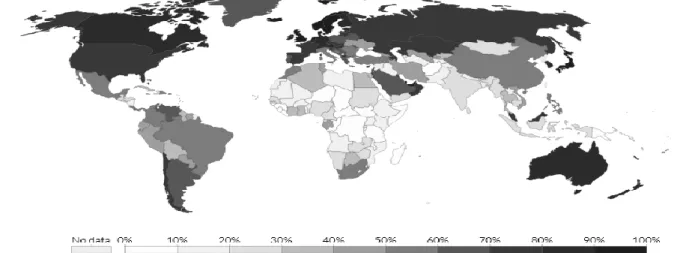
Figure 4 - Russia with 70% penetration
Figure 4 illustrates the global internet penetration rate by country with Russia showing 70.1% internet penetration. Research conducted by Kolesova and Girzheva focused on the number of FinTech companies that were formed in Russia [21]. Their research paper was not directly linked to the two hypotheses, but it does highlight the answers to the hypotheses. The authors state that Russia has seen a large increase
in FinTech companies mainly as financial and technological innovations have significantly improved in the country. The FinTech companies formed are predominantly crowd funding sites, online banking, lending sites, mobile wallets and digital data exchange platforms.
The authors mention that there were 250 registered FinTech companies as at September 2017 with investment totaling 2.3 billion rubles.
The financial services penetration rate in the megacities was reported to be 43%, compared to the average for the world which was recorded at 33%.
There will be more Fintech entrants to the market if banks do not take advantage of the latest technology. If banks are to maintain their competitive advantage, their existing business models will need to change which will be time consuming and could lead to an expensive process.
The authors’ research article is supported by a 2017 report by Ernst & Young (EY). The report by EY mentions that technology is one of the important factors for the growth in FinTech companies through developing innovative solutions plus boosting Russia as a competitive advantage on a global scale.
B. Hypothesis 2 – Financial Performance of Banks
The second hypothesis examines the financial performance of traditional banks since the formation of FinTech companies. There are three dependent variables that can impact upon the financial performance of banks as shown in the study model - (a) net profit, (b) return on equity and (c) return on assets. The dependent variables can be impacted by the different independent variables such as the different services and products, technology, platform delivery,
convenience to customer and lower operating costs. The dependent variable can be shaped by the size of the bank and its capital structure (controlling variables).
Research 3 – There are 189 FinTech startups in Kenya according to Tracxn.
Author Kemboi examined the disruption of financial technology on commercial banks in Kenya. The focus of the research paper was to determine if a relationship existed between financial technology and financial performance. The study was based upon 43 commercial banks in Kenya using descriptive statistics and multiple regression analysis to arrive at her conclusion.
The author focused on looking at one key performance indicator – return on assets. This key performance indicator was used due to the bank’s investments into digital technology. Her results that are based upon the analysis of the mean and standard deviation for the population size of 39 banks is shown in Table 2.
Table 2 –
Financial Performance
Year N Mean % Std Dev
2013 39 3.1179 1.8948
2014 39 3.2480 1.8922
2015 39 3.0380 2.0558
2016 39 3.2574 1.8462
2017 39 3.9080 2.0206
Regression analysis using the normality test shows that the variables are normal as the results fell within -3 to +3. The normality test was applied to the entire financial performance of the bank. The coefficient of determination was used to predict changes that can occur to the
dependent variable as illustrated in table 3 below. The concluding result shows that the model can predict 51.9% of the dependent variable (R Square).
Table 3 – Normality Test
Model R R square Adjusted R square Std. Error of the estimate
Durbin Watson
l 0.72 0.517 0.504 1.9248 1.662
The findings from her research paper identified that the independent variables (mobile banking, online banking and other variables) had a favourable impact on the financial performance of banks. The author recommended that banks should continue to invest into more technology.
Research 4 – A paper [9] examines the effect of financial technology (FinTech) in terms of profitability on the banking sector in Lithuania. By 2017, the number of FinTech companies had grown to 117.
Figure 5 - Number of FinTech companies
The purpose of their paper was to examine financial technology development opportunities that are available in Lithuania plus to examine the impact on the banking sector profitability. The growth of FinTech companies was seen as a boost to the economy as it is creating new jobs plus attracting foreign investment whilst existing banks feared for loss of market share. The research was conducted through the use of statistical data, expert evaluation questionnaire and the analysis of academic literature.
Lithuania is showing a different perspective on FinTech companies in respect that these companies are more aligned with working with traditional banks rather than competing with the banks. However, challenges arise when FinTech companies are cooperating with traditional banks because of different models.
The findings from their report based upon correlation-regression analysis states that financial technology does affect the profitability of the banking sector, but the profitability changes is not significant.
Statistical analysis was conducted based upon the linkage between the indicators of FinTech and the key performance indicators for the banking
Figure 6. Cooperation level between FinTech companies and traditional banks
sector profitability (net interest margin, return on equity and return on assets). The results are shown in Figure 6.
Table 4.
Statistical Analysis
P=0.05 ROA ROE NIM P=0.1 ROA ROE NIM
Fintech sn sn sn Fintech sn sn sn TUI sn sn sn TUI sn sn rn INNOV sn sn sn INNOV sn sn sn NONPMNT rn sn sn NONPMNT rn rn sn INTBANK sn sn rt INTBANK sn sn rt MOBBANK sn sn rt MOBBANK rt sn rt CARD sn sn sn CARD sn rn rn POST sn sn rt POST sn sn rt
Upon review of the ROA ratio, all results except NONPMNT (non-cash money) showed that the results were statistically insignificant. When the probability is set to less than 0.05. The NONPMNT identified a negative significance. The same statistically insignificance results appeared for the ROE ratio. The results for NIM varied across the different indicators.
But a statistically significant correlation between NIM and internet banking, mobile banking and the number of bank card readers was observed. It can be seen from table 5 below that the ratios are more significant across the three profitability indicators.
Table 5 - Regression Analysis Results
ROA Model ROE Model NIM Model
Determination coefficient 0.896 0.843 0.775
Adj. determination coefficient 0.803 0.711 0.600
Durbin-Watson- coefficient 2.430 2.415 2.194
Sig. 0.068 0.141 0.256
The authors believe that the Lithuanian finance market is enjoying favorable conditions for new FinTech companies to enter and this sector will continue to grow mostly in the changes in the business models of bank and mostly in the payment segment.
V. RESULTS AND DISCUSSION
The empirical evidence that has been researched does provide sufficient evidence to show that FinTech company formations will grow faster in an environment where mobile phone availability is high and digital technology is available. The research states that lower operating costs can occur from using digitalization for delivering financial services within these countries rather than non-technological financial services as offered by the traditional banks.
The impact of the increasing number of FinTech startups in countries where digital technology and mobile phone subscription is high allows for greater competition amongst FinTechs and traditional banks. Competition within these countries will thrive. The customer would be the winner with improved financial products, faster delivery methods and lower pricing.
Results show that profitability does change for the traditional banks when there are FinTech companies present in a country and when the banks adopt their own financial technology into their business model. The results from statistical analysis show that the impact of financial technology on the banking sector’s profitability is statistically insignificant.
VI. RECOMMENDATIONS
Based upon the international empirical evidence that has been presented in this research paper, recommendations are put forth for future academic authors. This research paper has been dedicated to proving the validity of the two hypotheses that FinTechs have been successful with increased number of formations in countries that have the latest digital technology and the presence of mobile phones is high plus the financial performance of banks have seen an insignificant change in financial performance.
The first recommendation would be for future academics to deliver a more sophisticated
framework for FinTechs in emerging markets through various scenarios. The first scenario recommended is to study the success of FinTech companies with company and personal borrowers in developed countries and how this success can be applied in emerging markets. The research question can ask if company borrowers and personal borrowers are achieving the full benefits of the ideal theory of FinTechs? If they are not realizing the full benefits, what needs to be done to improve in this area so that the improvements can be implemented into emerging markets at an early stage? The second scenario would be to see if FinTech companies are displaying the same pattern across each continent of the globe. Are there different trends that appear in emerging markets as compared to established markets?
The second recommendation is to further study the FinTech industry across the globe by delving into the question of determining if FinTechs have been disruptive to the traditional banking industry across all continents and whether there has been similarity with the results achieved across continents.
The third recommendation is for future academics to study the future of FinTech companies to understudy their viability and scalability of their business model. The study will need to determine the future competitiveness of FinTech with the traditional banking industry. How will FinTech companies be shaped in five to ten years’ time compared to their existence today?
CONCLUSION
FinTech companies around the world are disrupting the banking industry through the offering of digital financial products and services on platforms that are easily accessible for the consumer and financial institutions. FinTech companies are grouped into many segments such as crowdfunding, insurance, payments, data exchange and digital wallets. Even though the disruption is minor, the banking industry is taking note of the changes and disruptions. The banking industry will need to change their business models to incorporate the digital technology or they may lose their competitive advantage.
11
REFERENCES
[1]
ARNER, D., BARBERIS, J. and BUCKLEY, R. (2017) FinTech and RegTech in a Nutshell, and the Future in a Sandbox [Online]Research Foundation Briefs, 3(4). Available
from: https://www.cfainstitute.org/research/
foundation/2017/fintech-and-regtech-in-a-nutshell-and-the-future-in-a-sandbox [Accessed 07/09/2020].
[2]
ARNER, D., BARBERIS, J. and BUCKLEY, R. (2017) FinTech, RegTech, and the Reconceptualization of Financial Regulation.Northwestern Journal of International Law & Business, 37(3), pp. 371-413.
[3]
BANERJEE, A. and CHAUDHURY, S., (2010) Statistics without tears: Populations and samples. International Psychiatry Journal, 19(1), pp. 60-65.[4]
Earthport Case study -ComplyAdvantage (2017) [Online] Available
from: https://complyadvantage.com/wp-content/uploads/2017/10/CA_Case_Study_Earth port_US.pdf [Accessed 03/12/2019].
[5]
Focus on Fintech: Russian MarketGrowth Prospects (2017) ) [Online] Available
from: https://investinrussia.com/data/ files/sectors/0_EY-focus-on-fintech-russian-market.pdf [Accessed 07/09/2020].
[6]
EY Global FinTech Adoption Index(2019) [Online] Available from: https://assets.ey.com/content/dam/ey-sites/ey- com/en_gl/topics/financial-services/ey-global-fintech-adoption-index-2019.pdf?download [Accessed 03/09/2020].
[7]
79 Key Fintech Statistics 2019: Market Share & Data Analysis. (2019) [Online]Available from: https://financesonline.com/fintech-statistics [Accessed 03/12/2019].
[8]
HORNUF, L. and HADDAD, C. (2019) The emergence of the global fintech market: Economic and technological determinants. SmallBusiness Economics, 53(1) pp. 81-105. doi:
10.1007/s11187-018-9991-x
[9]
FinTech Market - Forecast (2020 -2025). (2019) [Online] Available at:
https://www.industryarc.com/Report/18381/finte ch-market.html [Accessed 08/12/2019].
[10]
KELIUOTYTE, G. and SMOLSKYTE, G. (2019) Possibilities for financial technology sector development and its impact on banking sector profitability in Lithuania. Economics andCulture, 16(1), pp. 12-23.
[11]
KEMBOI, B. (2018) Effect of financialtechnology on the financial performance of
commercial banks in Kenya. Nairobi: University
of Nairobi.
[12]
KOLESOVA, I. and GIRZHEVA, Y. (2018) Impact of Financial Technologies on the Banking Sector.In: III Network AML/CFTInstitute International Scientific and Research Conference "FinTech and RegTech", Moscow, 21–23 November 2017. Moscow: AML/CFT
Institute, pp. 215-220.
[13]
LEE, I. and SHIN, Y. (2018) Fintech: Ecosystem, businessmodels, investment decisions, and challenges. Business Horizons, 61(1), pp.35-46[14]
Global financial services market research reports and industry analysis (2019,July 29) [Online] Available from: https://www.abnewswire.com/pressreleases/2019 -global-financial-services-market-research-reports-industry-analysis_414724.html [Accessed 03/12/2019].
[15]
MARSH, A. (2018, October 19) Fintechfirms capturing market share from banks; $250-bn revenue at stake. [Online] Available from:
https://www.business- standard.com/article/finance/fintech-firms- capturing-market-share-from-banks-250-bn-revenue-at-stake-118101900969_1.html. [Accessed 08/12/2019].
[16]
MARTIN, F.R. (2018, December 9)FinTech vs banking: decoding the difference between banks & new market entrants. [Online]
Available from:
https://analyticsindiamag.com/fintech-vs- banking-the-difference-between-banks-new-entrants/[Accessed 07/09/2020].
[17]
Blurred lines:How FinTech is shaping financial services – Singapore (2016, October16) [Online] Available from:
https://www.digitalfrontiersinstitute.org/
2017/04/25/blurred-lines-how-fintech-is-shaping-financial-services//[Accessed 07/09/2020].
[18]
82% of banks, insurers, investment managers plan to increase FinTech partnerships; 88% concerned they’ll lose revenue to innovators - East Carribean (2017, April 21) [Online]Available from: https://www.pwc.com/bb/en/ press-releases/fintech-partnerships.html
[Accessed 09/09/2020].
[19]
ROBINSON, E. and VERHAGE, J., (2018, November 26) QuickTake Fintech[Online] Available from: https://www.bloomberg.com/quicktake/financial- technology-companies-disrupt-comfy-banks-quicktake [Accessed 03/12/2019].
[20]
ROSER, M., RITCHIE, H. and ORTIZ-OSPINA, E. (2015) Internet. [Online] Availablefrom: https://ourworldindata.org/internet [Accessed 04/12/2019].
[21]
FinTech Startups in Kenya (2019, July 24) [Online] Available from:https://tracxn.com/explore/FinTech-Startups-in-Kenya/ [Accessed 07/09/2020].
参考文:
[1] ARNER
, D. , BARBERIS , J. 和
BUCKLEY
, R. ( 2017 ) 《 金 融 科 技 和
RegTech
簡而言之,以及沙盒中的未來》
[在線]研究基金會簡介,3(4)。可從以
下
網
址
獲
得
:
https
:
//www.cfainstitute.org/research/foundation/2
017/fintech-and-regtech-in-a-nutshell-and-the-future-in-a-sandbox [訪問時間 2020 年 7
月 9 日] 。
[2] ARNER
, D. , BARBERIS , J. 和
BUCKLEY
, R. ( 2017 ) 金 融 科 技 ,
RegTech,以及金融監管的重新概念化。
西北國際法律和商業雜誌,37(3),第
371-413
頁。
[3] BANERJEE,A. 和 CHAUDHURY,S
。,(2010 年),無淚統計:人口和样
本。國際精神病學雜誌,19(1),第
60-65
頁。
[4]
地港 案例研究 -遵守優勢(2017)[在
線 ] 可 從 以 下 網 站 獲 得 :
https://complyadvantage.com/wp-content/uploads/2017/10/CA_Case_Study_E
arthport_US.pdf [已訪問 03/12/2019]。
[5]關注金融科技:俄羅斯市場增長前景(
2017
年))[在線]可從以下網站獲得:
https
:
//investinrussia.com/data/files/sectors/0_EY-focus-on-fintech-russian-market.pdf [已訪問
07/09/2020]。
[6]安永全球金融科技採用指數(2019 年
) [ 在 線 ] 可 從 以 下 網 站 獲 得 : https :
//assets.ey.com/content/dam/ey-sites/ey-com/zh_gl/topics/financial-services/ey-global
-fintech-adoption-index-2019.pdf?下載
[訪問日期:03/09/2020]。
[7] 79 2019
年關鍵金融科技統計:市場份
額和數據分析。 (2019)[在線]可從以下
網
站
獲
得
:
https://financesonline.com/fintech-statistics [
訪問時間 03/12/2019]。
[8] HORNUF,L. 和 HADDAD, C.(2019
)全球金融科技市場的出現:經濟和技術
決定因素。小型企業經濟學,53(1),
第 81-105 頁。 doi:10.1007 /
s11187-018-9991-x
[9]金融科技市場-預測(2020 年-2025 年)
。 ( 2019 ) [ 在 線 ] 可 用 :
https://www.industryarc.com/Report/18381/f
intech-market.html [
訪問時間 08/12/2019]
。
[10] KELIUOTYTE,G. 和 SMOLSKYTE
,G.(2019)在立陶宛,金融技術行業發
展的可能性及其對銀行業盈利能力的影響
。 《經濟與文化》,第 16 卷第 1 期,第
12-23
頁。
[11] KEMBOI,B.(2018)金融技術對肯
尼亞商業銀行財務業績的影響。內羅畢:
內羅畢大學。
[12] KOLESOVA, I.
和 GIRZHEVA, Y.
(2018
)金融技術對銀行業的影響。在:
第三網絡反洗錢/打擊資助恐怖主義機構國
際科學和研究會議“金融科技和 RegTech
”,莫斯科,2017 年 11 月 21-23 日莫斯科
:反洗錢/打擊資助恐怖主義研究所,第
215-220
頁。
[13] LEE, I. 和 SHIN, Y.(2018),金融科
技:生態系統,商業模式,投資決策和挑
戰。商業視野,61(1),第 35-46 頁
13