Effects of Various Daylength-Treatments on the
Growth of Shoots and the Dormancy of Lateral
Buds in Mulberry
著者
YAHIRO Masaki, YASUHIRO Norihiko, HIRA Shigeru
journal or
publication title
南海研紀要
volume
6
number
2
page range
248-255
URL
http://hdl.handle.net/10232/15673
248 Mem. Kagoshima Univ. Res. Center S. Pac, Vol. 6, No. 2, 1985
Effects of Various Daylength-Treatments
on the Growth of Shoots and the Dormancy
of Lateral Buds in Mulberry
Masaki YAHIRO*, Norihiko YASUHIRO* and Shigeru Hira*
Abstract
In the day length-treatment of 12 hours, the growth of shoots in the treatment-plot was superior to that in the control-treatment-plot (natural daylength-treatment-plot; and about 14 hours). In the daylength-treatment of 10 hours, the shoot-growth between the treatment-plot and the control-plot was nearly the same. In the daylength-treat ment of 8 hours, the growth of the shoots in the treatment-plot was worse than that in the control-plot. Also, no dormancy of the buds was observed in the
day-length-treatments of 8, 10 and 12 hours.
Introduction
It was observed by Shikata (1980)1' that in Sumatra under the equator, the mulberry varieties of Roso and Ichinose introduced from Japan, grew excellently, having no dormancy of the buds throughout the year. Accordingly, the authors carried out some experiments in Kagoshima, Japan, recreating as nearly as possible the same conditions as those under the equator to investigate this phenomenon.
Additionally, various daylength-treatments were carried out to ascertain the relationship between daylength and the growth of shoots and the dormancy of the lateral buds in the mulberry.
The following three experiments were performed : Exp. 1, daylength-treatment of 12 hours; Exp. 2, daylength-treatment of 10 hours; and Exp. 3,
daylength-treatment of 8 hours.
Materials and Methods
Exp. 1 Case of daylength-treatment of 12 hours
Of the mulberry variety, two saplings of Ichinose were planted in several
* AniEst • £j£ig$ • ¥3£, miA&±^m^&mwfm^m^M
Laboratory of Tropical Crop, Faculty of Agriculture, Kagoshima University, 21-24 Korimoto 1-Chome,
Mem. Kagoshima Univ. Res. Center S. Pac, Vol.6, No. 2, 1985 249
plastic pots (diameter: 30 cm, height: 32 cm) in May of 1983. Nine pots were used in the daylength-treatment-plot, and 10 in the control-plot. In some pots both saplings took root and in others only one sapling took root. The total number of mulberries was 13 in the daylength-treatment-plot and 17 in the control-plot (in the three saplings among 17, the investigation was made impossible on the way of experiment). One bud from each sapling was elongated. On June 3, 7 and 20 the pots were fertilized with a small amount of ammonium nitrate, potassium chloride and superphosphate of lime. The 12 hour daylength treatment which was similar to the daylength under the equator was carried out for a period of 30 days, from June 20 to July 20. The light-period was from 7 a. m. to 7 p. m... The control daylength was the natural daylength; being 14 hours 30 minutes on June 20, and 13 hours 56 minutes on July 20. The shootlength and the number of unfolded leaves were observed at intervals of 10 days in both plots. Additionally, the highest
and the lowest temperatures outdoors and in the dark-room were measured. At
the end of the experiment the shoots were cut at the shoot-bases, and the dormancy of the lateral buds was investigated by the usual method3'. In the cases where the shoots was cut into shootlets (about 15 cm) having three buds, the upper green part of the shoot was removed, and the brown part of which was used. Further, the sprouting of the buds on the stumps was observed after a few days.
Exp. 2 Case of daylength-treatment of 10 hours
In this experiment the mulberries used in the daylength-treatment in the last
year (1983), were used at random. Eight pots were used for both the
daylength-treatment-plot and the control-plot with a total number of 12 plants in each plot. One bud from each mulberry stump was elongated. A small volume of mixed chemical fertilizer was put in the pots at proper periods. The daylength-treatment
of 10 hours was carried out for 30 days, from June 20 to July 20 in 1984. The
light-period was from 8 a. m. to 6 p. m.. The parameters were the same as in experiment 1 except that the dormancy of the lateral buds in the cut-shoots was
not investigated.
Exp. 3 Case of daylength-treatment of 8 hours
The mulberries used in the daylength-treatments in the year before the last (1983) and in the last year (1984), were used at random in this experiment. The total number of pots used was 8 in each the daylength-treatment-plot and the cont rol-plot with 12 mulberry plants in each plot. One bud from each mulberry stump was elongated. A small volume of mixed chemical fertilizer was given to the pots at proper periods. The daylength-treatment of 8 hours was carried out for a period of 30 days, from June 20 to July 20 in 1985. The light-period was from 9 a.m. to 5 p. m.. The parameters for this experiment were the same as in experiment 1.
250 Yahiro et al. : Effects of Daylength-Treatments on Growth and Dormancy
Results
Exp. 1 Twelve hour daylength
The changes of shoot-length and of the number of unfolded leaves after the initiation of the daylength-treatment for experiment 1 are shown in Table 1. The mean shoot-length and the mean number of unfolded leaves on the day of the initiation of the daylength-treatment were 38.5 cm and 16.2 leaves in the treatment-plot and 35.6 cm and 15.4 leaves in the control-treatment-plot, respectively ; and the length of the shoots of the treatment-plot was slightly longer than that in the control-plot. At the end of the daylength-treatment, the shoot-length and the number of
leaves were 57.9 cm and 23.0 leaves in the treatment-plot and 45.5 cm and 18.9
leaves in the control-plot, respectively. From the above mentioned results, it was ascertained that the increase of the mean shoot-length in the treatment-plot was 19.4 cm in the daylength-treatment for 30 days, and it was 9.9 cm in the control-plot ; the shoot-length of the treatment-control-plot was 9.5 cm longer than that of the control-plot. On the other hand, the increase of the mean number of unfolded leaves was 6.8 in the treatment-plot and 3.5 in the control-plot; the increase of the mean number of leaves in the treatment-plot was 3.3 leaves more than that in the control-plot. From the above mentioned results, it was ascertained that the growth of the daylength-treatment-plot of 12 hours was superior to that in the control-plot. The highest and the lowest temperatures outdoors and in the dark room during the daylength-treatment were 41-20°C and 32-26°C, respectively.
Table 1. Changes of the shoot-length and the number of the unfolded leaves
in daylength-treatment of 12 hours
Date of observation June 20(A) June 30 July 10 July 20(B)
Growth-length (B-A) Mean Shoot-length (treatment) 38.5 cm 45.8 54.5 57.9 19.4 Mean shoot-length (control) 35.6 41.8 43.6 45.5 9.9 Mean number of unfolded leaves (treatment) 16.2 19.4 21.7 23.0 6.8 Mean number of unfolded leaves (control) 15.4 16.6 18.1 18.9 3.5
Mem. Kagoshima Univ. Res. Center S. Pac, Vol. 6, No. 2, 1985 251
Concerning the shoots cut the day after the daylength-treatment, the sprouting of buds were scarcely observed in either the treatment-plot or the control-plot 10 days after the initiation of incubation at 30°C; the sprouting of the lateral buds was little. On the other hand, the sprouting of the latent buds on the mulberry stumps which were left outdoors after the shoot-cutting was good, that is, on the 6th day after shoot-cutting, after the dappo-period (a stage of sprouting at which the leaves emerged clearly out of the scale) 62 % in the treatment-plot and 64 % in the control-plot sprouted; and on the 10th day after shoot-cutting 100% in both plots sprouted.
Exp. 2 Ten hour daylength
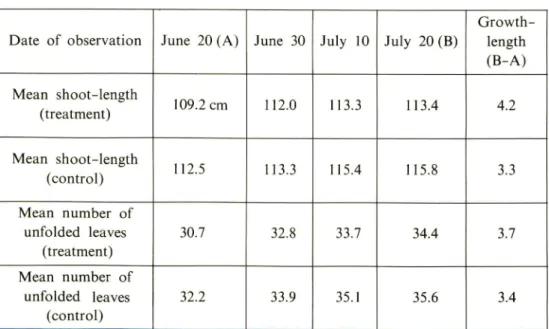
The changes of the shoot-length and the number of unfolded leaves after the initiation of the daylength-treatment are shown in Table 2. The mean shoot-length and the mean number of the unfolded leaves on the first day of the dayshoot-length- daylength-treatment were 109.2 cm and 30.7 leaves in the daylength-treatment-plot, and 112.5 cm and 32.2 leaves in the control-plot, respectively; and the length of the shoots in the control-plot were slightly longer than those in the treatment-plot. At the end of the daylength-treatment, the shoot-length and number of leaves were 113.4cm and 34.4 leaves in the treatment-plot, and 115.8cm and 35.6 leaves in the control-plot, respectively. From the above mentioned results it was assumed that the differences in the length and the number of unfolded leaves between the daylength-treatment-plot and the control-daylength-treatment-plot were not significant. Additionally, although the
investiga-Table 2. Changes of the shoot-length and the number of the unfolded leaves in daylength-treatment of 10 hours
Date of observation June 20(A) June 30 July 10 July 20 (B)
Growth-length (B-A) Mean shoot-length (treatment) 109.2 cm 112.0 113.3 113.4 4.2 Mean shoot-length (control) 112.5 113.3 115.4 115.8 3.3 Mean number of unfolded leaves (treatment) 30.7 32.8 33.7 34.4 3.7 Mean number of unfolded leaves (control) 32.2 33.9 35.1 35.6 3.4
252 YAHIRO et al. : Effects of Daylength-Treatments on Growth and Dormancy
tion of dormancy in the lateral buds on the day of the end of the daylength-treatment was not carried out by the usual method, the sprouting of the latent buds on the mulberry stumps was observed after a few days in both the treatment-plot and the control-plot, and the growth of the sprouted buds continued. The heighest and lowest temperatures outdoors and in the dark-room during the treatment were
40-21°C and 36-23°C, respectively.
Exp. 3 Eight hour daylength
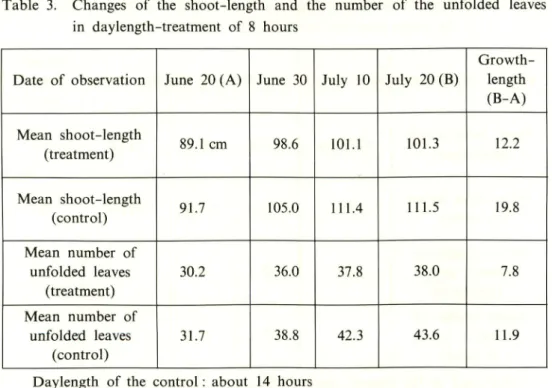
The changes of the shoot-length and the number of the unfolded leaves after the initiation of the daylength-treatment are shown in Table 3. The mean shoot-length and the mean number of unfolded leaves on the first day of the treatment were 89.1cm and 30.2 leaves in the treatment-plot; and 91.7cm and 31.7 leaves in the control-plot, respectively; and the length of the shoots in the control-plot were slightly longer than those in the treatment-plot. At the end of the daylength-treatment, shoot length and number of leaves were 101.3 cm and 38.0 leaves in the treatment-plot and 111.5cm and 43.6 leaves in the control-plot, respectively. From the beginning to the end of the experiment, the increase of the shoot-length and
of the unfolded leaves was 12.2 cm and 7.8 leaves in the treatment-plot, and 19.8 cm
and 11.9 leaves in the control-plot, respectively. The increase of the shoot-length and the number of unfolded leaves in the control-plot were 7.6 cm and 4.1 leaves greater than those in the treatment-plot. The highest and the lowest temperatures outdoors and in the dark-room during the experiment were 42-19°C and 34-24°C,
Table 3. Changes of the shoot-length and the number of the unfolded leaves
in daylength-treatment of 8 hours
Date of observation June 20 (A) June 30 July 10 July 20(B)
Growth-length (B-A) Mean shoot-length (treatment) 89.1 cm 98.6 101.1 101.3 12.2 Mean shoot-length (control) 91.7 105.0 111.4 111.5 19.8 Mean number of unfolded leaves (treatment) 30.2 36.0 37.8 38.0 7.8 Mean number of unfolded leaves (control) 31.7 38.8 42.3 43.6 11.9
Mem. Kagoshima Univ. Res. Center S. Pac, Vol.6, No. 2, 1985 253
respectively.
Discussion
Using the Ichinose variety of mulberry, in the daylength-treatment of 12 hours for 30 days from June 20 to July 20, the growth in the treatment-plot was superior to that in the control-plot in natural daylength. Apart from the difference in the temperatures between the dark-room and outdoors, the growth of mulberries in a comparatively short daylength (12 hours) is superior to that in a long daylength (about 14 hours) under natural conditions. It is thought that the very good growth observed by Shikata was caused by the 12 hour days of the equatorial region.
Concerning the dormancy of the lateral buds in experiment 1, it was noted that when shootlets having three buds were inserted into the sand of the pots and the
pots were put into an incubator at 30°C, the sprouting of buds was bad in both the treatment-plot and the control-plot. If the buds were not dormant, the sprouting percentage of the one top bud of the shootlets having the three buds, should be
over 80 % on the 10th day after the initiation of the incubation at 30°C. But, the
sprouting percentage was considerably lower in both the plots. It is assumed that the low sprouting rate occurred because the shoots were elongating, and the reserved substances were insufficient to make the buds sprout in both the shoots and lateral buds, and therefore sprouting was impossible. Also some withered shootlets were observed. On the other hand, the sprouting of the latent buds on the mulberry stumps which were left outdoors after shoot-cutting was 100 % in both-plots. This
shows that these buds were not dormant. From the above mentioned two results,
it was decided that the daylength-treatment of 12 hours carried out in summer brought forth the excellent growth and did not cause dormancy in the lateral buds. In experiment 2, no difference of growth was recognized between the treatment and the control plots. Additionally, the increase of growth in the treatment-plot was not higher than that in the control-plot observed in experiment 1 (daylength-treatment of 12 hours). The sprouting of the buds latent on the mulberry stump after shoot-cutting in the end of the daylength-treatment was observed in both the treatment-plot and the control-plot after a few days, and the growth of the sprouted buds continued. From this result, it was assumed that the dormancy of buds was not brought forth in the daylength-treatment of 10 hours.
In experiment 3, the growth of the control-plot (natural daylength plot) was superior to that of the daylength-treatment-plot of 8 hours. On the first day of the experiment, the shoot-length of the control-plot was slightly longer than that of the treatment-plot. Although the influence may be kept up to the later period,
in case of the short-daylength-treatment of 8 hours in summer, the growth of
mulberry of Ichinose variety ceased soon, the inhibition of growth was observed
254 Yahiro et al. : Effects of Daylength-Treatments on Growth and Dormancy
mulberry stump was several. In case of several shoots on the mulberry stump, the sufficient inhibition of the shoots by the short daylength-treatment of 8 hours was observed and on the other hand, in case of one shoot on each mulberry stump in this experiment the degree of the inhibition was slight. Age after the planted-period may be related to the degree of the inhibition of the growth by short daylen gth-treatment, that is, the degree of the growth-inhibition may be slight in the young plant and it may be large in the old plant. Additionally, from the previous report2' made using Ichinose variety, the growth of short daylength-treatment-plot of 8 hours (in the period from July 25 to Aug. 30) was worse than that of the natural daylength-plot. In this case, the number of shoot on a mulberry stump was four. It was assumed that in the mulberry variety of Ichinose the daylength of 12 hours is best for the growth, and the short daylength of 8 hours is bad for the growth. The dormancy in lateral buds was investigated by the usual method in Exp. 1 and Exp. 3. But, the sprouting rate of buds was lower and the cause was described in the discussion of Exp. 1. On the other hand, the sprouting of the latent buds on the mulberry stumps after the shoot-cutting was good in all the experiments and the growth of the sprouted-buds continued. Therefore, it was assumed that the buds were not dormant in the daylength-treatments of 12, 10 and 8 hours in the summer and since in the natural state, if the mulberry shoots are cut in October, none of the buds left sprout. Therefore, it was confirmed that Ichinose variety of mulberry did not go dormant just because of the short daylength-treatment. It is thought that to cause dormancy in mulberry buds, both a decrease in daylength "and" in temperature are necessary. And it was assumed that in the natural condition in Japan, the introduction to the dormancy of mulberry buds is brought forth by the declining of temperature and the shortening of daylength from summer to autumn.
Summary
It was observed by Shikata (1980) that in Sumatra under the equator, (daylength of 12 hours), the mulberry variety of Ichinose introduced from Japan grew excellent ly, not having a dormancy of the buds throughout the year.
The authors carried out some experiments to ascertain whether such was to be recognized in the summer of Japan, making the same condition as found under the equator. In the case of daylength treatment of 12 hours the growth in the treat ment-plot was superior to that of the control-plot (natural daylength: about 14 hours). It was assumed that the very good growth observed by Shikata in Sumatra under the equator was the result of the 12 hour days. Also, the buds of Ichinose
were not dormant in the daylength treatment of 12 hours.
Additionally, daylength treatments of 10 hours and 8 hours were investigated and the growth of 10 hour plot was about the same as that in the control-plot
Mem. Kagoshima Univ. Res. Center S. Pac, Vol. 6, No. 2, 1985 255
(natural daylength plot); and in the case of the 8 hour plot, the growth of the treatment-plot was worse than that of the control-plot. In the cases of daylength-treatment-plot of 10 hours and 8 hours, no dormancy was observed in the buds in the summer temperatures. It was assumed by the authors that both the decreasing of temperature and the shortening of daylength, are necessary for the introduction to the dormancy in mulberry buds.
References
1) Shikata, M. 1980: In the observation of sericulture just under the equator. University news, Kyoto University of Industrial Arts and Textile Fibres, 33,
6-7.
2) Yahiro, M. and Saeki, Y. 1956 : Studies on the reproductive growth of the mulberry. 1. On the period of the floral formation and photoperiodism. Mem. Fac. Agr. Kagoshima Univ., 2(2), 128-144.
3) Yahiro, M. and Higashi, H. 1981 : Chilling requirements in the termination of dormancy in mulberry winter buds, (in Japanese with English summary),
Japan. J. Trop. Agr., 25(2), 59-61.