72
A Stefan type
problem
arising in
modeling
ice
crystals
growing
from
vapor
Yoshikazu
Giga
1,2,Piotr Rybka
31 Department
of
Mathematics,Hokkaido University
Sapporo
060-0810,Japan
2
Present Address:
GraduateSchool
of
Mathematical
Sciences
University
ofTokyo
Komaba
3-8-1,Tokyo
153-8914
Japan
3
Institute
ofApplied
Mathematics andMechanics,Warsaw
Universiry
u1.
Banacha 2,07-097
Warsaw,Poland October 26,2004
Abstract. This paperis concerned with a quasi-steady Stefan problem with theGibbs-Thomson
relation andakinetic term appliedtomodelicecrystalsgrowingfromvapor. Our goal istoexposea
$\mathrm{n}\mathrm{u}$mberofpropertiesof solutions to the system.Herewesurvey ourearlier work$[\mathrm{G}\mathrm{R}1]-\zeta \mathrm{G}\mathrm{R}4]$and
announce newresults, [GR5].
1 Presentation
of the problem
Our goal istostudy geometricproperties ofsimple surfaces $S(t)$ evolved according to the driven
mean
weightedcurvature flow
$\beta V=\kappa_{\gamma}+\sigma$. (1.1)
Wewould immediately liketoexposethemain features of theproblem. Namely, they
are:
(a)the lack of smoothness of$S(t)$, i.e. $S(0)$ isastraight, circular cylinder;
(b) $\mathrm{h}_{\gamma}$isthe crystalline curvature of$S(t)$ (see (1.4)and Proposition 2.1 below);
(c)thedriving force$\sigma$isthecouplingtoanotherequation.
Themotivationtostudy such problems
comes
fromphysics. Moreprecisely,we are
interested in growthof ice crystals in the air. Depending
on
the controlling temperatureone can
observea
varietyofshapesfrom hexagonal; prismtoneedles,andtosnowflakes(see [Ne]). Inparticular,large columnaricecrystals
can
benotonly collectedinnaturebuttheyhave also beengrown ina
laboratory(seee.g. $[\mathrm{G}\mathrm{o}\mathrm{G}]$).The mathematical model whose part is (1.1), is supposedto handlenaturally non-smooth $S(t)$
.
Atthe
same
timewe
are
convinced that theGibbs-Thomson relation isimportant and should be included,see
[G]. Finally, the modelwe
come up
with should allowus
tostudy stability of facets. Wewillsaythata
facet
is stableattime$t$ifitneither bendsnor
breaksatthattimeinstant.
Wehaveinmind
an
evolutionsystemstemmingfrom the work by Seeger(see [Se])on
planarpolyg-onal crystals, which
was
furtherdeveloped to deal with three-dimensional crystal by Kuroda et$\mathrm{a}1$,see
73
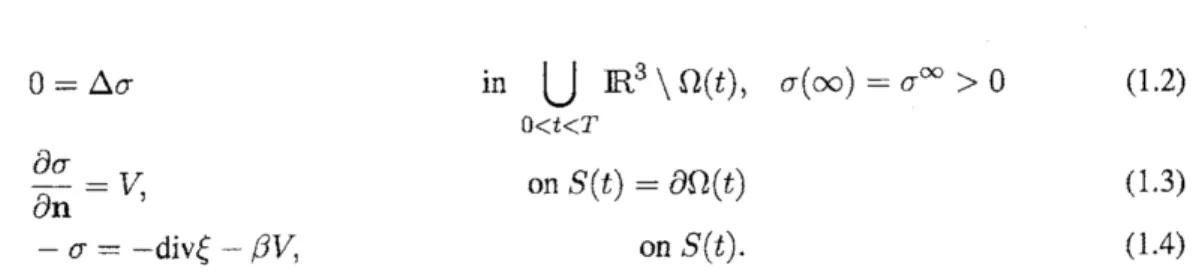
$0=\triangle\sigma$ in
$0<t<T\cup \mathrm{R}^{3}\backslash \Omega(t)$,
$\sigma(\infty)=\sigma^{\infty}>0$ (1.2)
$\frac{\partial\sigma}{\partial \mathrm{n}}=V$,
on
$S(t)$ $=\partial\Omega(t)$ (1.3)$-\sigma=-\mathrm{d}\mathrm{i}\mathrm{v}\xi-\beta V$,
on
$S(t)$. (1.4)In this system $\sigma(t, x)$ is the supersaturation outside of crystal $\Omega(t)$. The
mass
is transported bydiffusion, which is much faster than the interface $S(t)=\partial\Omega(t)$ whose speed is denoted by $V$
.
Hencethe form of equation(1.2) follows. The second equation of the abovesystemis
a
properly rescaledmass
conservationlaw, where $V$is the speed of$S(t)$, (see [GR3]). Here,the outernormal to$\Omega(t)$ is denoted
by $\mathrm{n}$
.
The lastequation is in fact the Gibbs-Thomson relation, where
4
is the Cahn-Hofmann vector and$\mathrm{d}\mathrm{i}\mathrm{v}_{6^{\mathrm{Y}}}\xi$is its surface divergence. However,intheearlierpapers [Se], [KIO]the
$\mathrm{c}$urvature term
was
omitted.Weshall recall the definition of$\mathrm{d}\mathrm{i}\mathrm{v}g\xi$,namely supposethat$\xi$defined in$U$
a
neighborhood of$S_{\dot{2}}$ $\mathrm{d}\mathrm{i}\mathrm{v}_{S}\xi=\mathrm{t}\mathrm{r}\mathrm{a}\mathrm{c}\mathrm{e}$$(\mathrm{I}\mathrm{d}-\mathrm{n}\otimes \mathrm{n})\nabla\xi.$, for$x\in S$,
where $\mathrm{n}$is
an
outernormaltothe surface. This definition isindependent of theextension of$\xi$to$U$ (see
[Si]$)$
.
Crucial for the definition of$\xi$is the surfaceenergydensity $\gamma$. If$\gamma$
were
smooth, thenwewould take$\xi=\nabla\gamma(\mathrm{n}(x))$,but$\gamma$is only Lipschitz continuous. This definition of
$\xi$doesnotmake
sense
because thenormalsto $\Omega$belong tothesetofpoints where$\gamma$isnotdifferentiate. Wewill define
$\xi$in a proper way
in
\S 2
below.As
we
mentionedearlier, the hexagonalprismsare
quitecommon ice
shapes butwe
will makesim-plifications frequentlyapplied in thephysics literature (e.g. see[Ne], [YSF]) . Namely,weshall assume
that 0(t) is
a
straight circular cylinder, i.e. $\Omega(t)=\{(x_{1},x_{2}, x3) : x_{1}^{2}+x_{2}^{2}\leq R^{2}(t), |x_{3}|\leq L(t)\}$.Fig. 1. Evolving crystal
We distinguish three parts of$S(t)$
:
top $S_{T}$, bottom $S_{B}$, and the lateral part $S_{\mathrm{A}}$. The normal to $S_{r}$ isdenoted by$\mathrm{n}_{i}$,$\mathrm{i}=\Lambda$,$B$,$T$
.
Weassume
that thesuper-saturation a shares thesymmetriesof$\Omega$
.
i.e. it isaxially symmetricand it enjoys symmetry with respecttothe plane$x_{3}=0$,i.e.
$\sigma(x_{1\dot{\mathit{1}}}x_{2}, x_{3})=$ $\sigma(\sqrt{x_{1}^{2}+x_{2}^{2}}. |x_{3}|)$. (1.5)
We
may now
spell outthe mainquestion:Supposethat$\gamma$issochosen that straight circular cylinders
are
admissible. Whatare
thecon-ditionswhichwill guarantee that$\Omega(t)$ evolving according to$(1.2\mathrm{M}1.4)$ willretainstability
offacets
on
time interval $[0, T_{0})$. Inotherwords,whatare
the conditionson
$\Omega(0)$, $\sigma^{\varpi}$whichprohibitbendingandbraking of facets of$\Omega(t)$
.
2
On
Cahn-Hoffmann
vector
4.
We heresummarizethe
common
propertiesof thesurfaceenergydensity function$\gamma$.
Namely,we assume
that function$\gamma$is:
(1)Lipschitzcontinuous;
(2) convex;
(3) l-homogeneous.
Thus, $\gamma$ is differentiable
$\mathrm{a}.\mathrm{e}.$, but this
is
not enough, because the normals to$\partial\Omega(t)$ fall into the set of
points where 7 is not differentiable. For this
reason
we
mustturn outattention
to objects whichare
defined for all $\mathrm{n}\in 1\mathrm{R}^{3}$. Namely, its subdifferential $\partial\gamma(\mathrm{n})$ is defined everywhere. We recall that if 7 : $1\mathrm{R}^{n}arrow$ IR isconvex,then
we
set$\gamma(v)=$
{
$w\in \mathrm{f}\mathrm{f}1^{7\prime}$ : $\gamma(v+h)-7(\mathrm{v})\geq w\cdot h$for all$h\in 1\mathrm{R}^{n}$}.
Subsequently, weshallrequire
$\xi(x)\in$ $\partial\gamma(\mathrm{n}(x))$
.
(2.1)This condition amends the evolutionequations (1.2)-(1.4).
Weshall consider
a
specific form of$\gamma$,consistent withour
problem$\gamma(x_{1}, x_{2}, x_{3})=r\gamma_{\mathrm{A}}+|x_{3}|\gamma_{TB}$, $\gamma_{\Lambda_{\dot{\mathit{1}}}}\gamma_{TB}>0$, (2.2)
where$r^{2}=x_{\mathrm{J}}^{2}+x_{2}^{2}$and$\gamma\Lambda$,$\gamma TB$ a\"iepositiveconstants.
Hence, the Frankdiagram, F7,and Wulff shape of$\gamma$,$W_{\gamma}$ are
$F_{\gamma}=\{p\in \mathrm{I}\mathrm{R}^{3} : \gamma(p)\leq 1\}$
$W_{\gamma}=$
{
$x\in \mathrm{I}\mathrm{R}^{3}$ : Vn$\in \mathrm{I}\mathrm{R}^{3}$,
$|\mathrm{n}|=1$, $x$ .$\mathrm{n}\leq\gamma(\mathrm{n})$
}
$=\{x\in]\mathrm{R}^{3} :x_{1}^{2}+x_{2}^{2}\leq\gamma(\mathrm{n}_{\Lambda}), |x_{3}|\leq\gamma(\mathrm{n}_{T})\}$,$\cdot$ $\mathrm{W}_{\gamma}$$\mathrm{F}_{\gamma}$
Fig.
2.
Frank diagram $F_{\gamma}$ andWulffshape $W_{\tau_{l}!}$Thus, all straight, circular cylinders will becalledadmissible. However,
we
shallnotgomore
deeplyintotonotionof admissibility ofsets.
Sinceatnormals to $W_{\gamma}$theset$\partial\gamma$is notasingleton
we
havesome
freedomofchoosing4.
Thus,we
can
rephraseour
goal: Tofind conditionsguaranteeing existence ofa
section4
such that$\sigma-\mathrm{d}\mathrm{i}\mathrm{v}_{S}\xi\equiv co^{l}r_{r}’ st_{i}$$=\beta_{\dot{\mathrm{z}}}V_{i}$
on
$S_{i}$, $\prime j,$ $=\Lambda$,$B$,T. (2.3)However, atthe moment
we
donotknow how to solve $(1.2\mathrm{M}1.4)$, (2.1). Suchatask at the momentispossiblytoo broad. For this
reason we
will make anothersimplification.Wenotice that after averaging(1.4) (or (2.3))
we
can see
75
Thisformulaiswell-defined if
$\mathrm{d}\mathrm{i}\mathrm{v}_{S}\xi|s_{i}\in L^{2}(S_{i})$ and$\xi$ $\in L^{\infty}(S_{i})$, $\mathrm{i}\in\{\Lambda, T, B\}$
.
(2.4)Conditions (2.4) imply that the $\mathrm{t}\mathrm{r}\mathrm{a}\mathrm{c}\mathrm{e}\xi\cdot\nu$
on
$S_{i}$ is well-defined ($\nu$ $\in TS_{i}$ and $\iota/$ is the normal to $\partial S_{i}$). Combining this with$\partial\gamma(\mathrm{n}_{\mathrm{A}})\cap\partial\gamma(\mathrm{n}_{T})=\{\gamma_{TB}\mathrm{n}_{T}+\gamma_{\Lambda}\mathrm{n}_{\mathrm{A}}\}$
implies
$\xi|s_{\dot{\mathrm{t}}}\mathrm{n}s_{g}\in\partial\gamma(\mathrm{n}_{i})\cap\partial\gamma(\mathrm{n}_{j})$
.
(2.5)Itturns outthat theaveragesof$\mathrm{d}\mathrm{i}\mathrm{v}s\xi$
over
facetsare
independent of the choice of4.
Proposition 2.1. (Proposition2.1. in[GR4])Letus
suppose
that$\gamma$is definedby(2.2), and0
isa
straightcircular cylinder. If
divs
$\xi|s_{i}\in L^{2}(S_{i})$, $\xi\in L"(S_{i})$as
wellas
(2.1), $\mathrm{i}.e$.$\xi(x)\in$ $\partial\gamma(\mathrm{n}(x))$, and(2.5)
hold, then
$\oint_{S_{\iota}}d\mathrm{i}\tau^{\gamma}s\xi=-\kappa_{i}|S_{i}|$ ,
$wh$
eve
$\kappa_{\Lambda}=-2\frac{\gamma(\mathrm{n}_{\Lambda})}{R}$, $\kappa_{T}=-\frac{\gamma(\mathrm{n}_{L})}{R}-\frac{\gamma(\mathrm{n}_{T})}{L}$
.
(2.6)Weshall call the numbers$\kappa_{T}=\kappa_{B}$,$\kappa_{\Lambda}$crystallinecurvaturesof thetop, bottom,and the lateralsurfaces,
respectively.
Theproofof this factdepends just
on
integration by parts. This becomesmore
tricky on $S_{\mathrm{A}}$whosemean
Euclidean curvatureisnon-zero,(see [Si]).ThisProposition willhelp ustosimplify theproblemby replacing (1.4)withits averaged form
$- \oint_{S_{i}}$a $dS=\kappa_{i}|S_{i}|-\beta_{i}V_{i}$, $\mathrm{i}=L$,$T$,B. (2.7)
Let us note that$V_{\Lambda}$, $V_{B}=V_{T}$ areeasily expressed in terms oftime derivatives of$R$, $L$, i.e.
$V_{\mathrm{A}}=\dot{R}$,
$V_{T}=\dot{L}$,then (2.7)tumsinto
an
ODE,$A(L, R)$ $\{\begin{array}{l}i\dot{R}\end{array}\}=\mathrm{B}(L, R)$, $\mathrm{L}(\mathrm{t})$,$R$(0) aregiven. (2.8)
Here$A(L, R)$ is a symmetric, positive definite matrix, it is Lipschitz continuous in $L$, $R$, (see [GR1])
and
$\mathrm{B}=(B_{\Lambda}, B_{T})$, $B_{i}=(\sigma^{\infty}+r_{1Ji})|S_{i}|$, $\mathrm{i}=\Lambda$,$T$
.
In the
process
ofreducing (2.7) to (2.8)we
obtaina representation formula for$\sigma$:a $(t, x)=\sigma^{\infty}-[(f_{T}(t, x)+f_{B}(t, x))V_{T}(t)+f_{\mathrm{A}}(t)V_{\Lambda}(t)]$, (2.9)
where the functions $f_{T}.$,$f_{B}$ and$f_{\Lambda}$
are
solutionstoa
Neumannproblemfor Laplaceequation intheouterdomain$\mathrm{I}\mathrm{R}^{3}\backslash$ $\mathrm{L}(\mathrm{t})$,(see
\S 3
in [GR1]). Wecan
summarize itas
follows.Proposition 2.2. (Theorem
1
in [GR1]) Thereexists
$(R(t), L(t)$,a $(t, x))$ a uniqueweak solution to$\triangle\sigma=0$ in $1\mathrm{R}^{3}\backslash \Omega(t)$, $\lim$ $\sigma(x)=\sigma^{\infty})$
.
$|x|arrow+\infty$$\frac{\partial\sigma}{\partial \mathrm{n}}=V$
on
$\partial\Omega(t)$ $- \int_{S_{t}}\sigma=\kappa_{r}|S_{i}|-\beta_{\tau}V_{i}|S_{i}|$augmentedwith
an
initialcondition $\Omega(\mathrm{O})=\Omega_{0}$, whichisan
admissible cylinder. Moreover,$R$,$L\in C^{1,1}([0, T))$, Va $\in C^{0,1}([0, T);L^{2}(\mathfrak{R}^{3}\backslash \Omega(t)))$
.
Thenotionof weak solutionshereis fairlynatural,forarigorous definition
see
[GR1]. In ordertomakethe notation
more
concisewe
shall write $(\Omega, \sigma)$ in placeof$(R(t), L(t),$$\sigma(t, x))$.We maywonder whatistherelation of solution of theoriginal system and the averaged
one.
Fortu-nately wehave
an easy answ
er.Theorem
2.3.
(Theorem2.3
in [GR4]) The original system(1.2)-(1.4), (2.1)and theaveragedone
(i.e.,(2.$l\mathrm{O}))$
are
equivalent intheclass of solutions satisfying$\sigma-\mathrm{d}\mathrm{i}\mathrm{v}s\xi=$const
on
each$S_{i}$.
Thenouroriginalquestion takesthe following form:
Can weconstruct solutions to (1.2)-(L4), (2.1) such thata$-\mathrm{d}\mathrm{i}\mathrm{v}s\xi$isconstant
on
each facet?Alter-natively,can wesolve(2.10) andthenfind$\xi$satisfying all theconstraints7
3
A
variational
principle
for
selecting
4
The
proper
choice of4
is crucial forour
tasks. We willpostulatea
variationalprinciple forits selection.Namely,
we
can
claim thata $-\mathrm{d}\mathrm{i}\mathrm{v}_{S}\xi=const$
on
each$S_{i}.\cdot$ $i=\mathrm{A}$,$T$,$B$ (3.1)are
$\mathrm{t}\mathrm{h}\mathrm{r}\mathrm{e}\mathrm{e}\ell$Euler-Lagrange equations of energy functional$\mathrm{s}$ $\mathcal{E}_{i}$, $\mathrm{i}=\Lambda.T$,$B$. Thus, selecting the right
Ca $\mathrm{n}$-Hoffman vectoramountsto choosing $\xi$with minimal energy. This idea
was
justified by [FG] forthegraphevolutionandit
was
further developed in [GG]. Similarideaswere
usedbyBellettini,NovagaandPaolini, (see [BNPI]-[BNP3])
as
wellas
in[GPR]. Wedefine these three functional$\mathrm{s}$$\mathcal{E}_{i}(\xi)=\frac{1}{2}I_{S_{i}}|\mathrm{d}\mathrm{i}\mathrm{v}_{S}\xi-\sigma|^{2}d\mathcal{H}^{2}$, $\mathrm{i}=\Lambda$, $T$, $B$
on
$D_{i}$ $=$ $\{\xi\in L^{\infty}(S_{\mathrm{i}}) : \mathrm{d}\mathrm{i}\mathrm{v}_{S}\xi\subset L^{2}\ulcorner(S_{1}), \xi(x)\in\partial\gamma(\mathrm{n}(x)), \xi|s_{i}\mathrm{n}s_{j}\in\partial\gamma(\mathrm{n}\Lambda)\cap\partial\gamma(\mathrm{n}_{T})\}$ .
Thus,
we
postulate: the right motion is such thatateach time instance $\xi$isasolutionto$\mathcal{E}_{i}(\xi)=\min\{\mathcal{E}_{i}(\zeta) :(\in\prime D_{i}\},$ $\prime \mathrm{i}$ $=\Lambda$,$T$
,B. (3.2)
Itis obvious from the definition that these functionate
are
strictlyconvex,hence$\mathrm{d}\acute{\iota}\mathrm{v}s\xi$is uniquely defined.Itis alsofairlyeasyto
see
thatindeedthe Euler-Lagrangeequationof$\mathcal{E}_{i}$ is(3.1). Moreover, all solutionsto(3.2)inherit thesymmetryof$\Omega$, namely,
we
can show:Proposition
3.1.
(Proposition 3.1 in [GR4].) Let us assume that $\sigma\in L^{2}(S_{i})$ and thatit ‘satisfie.s thesymmetry relations (1.5);$\xi\in D_{i}$, $\mathrm{i}\in I$,is
a
solution totheminimization problem (3.2). Then:(a) Thereexists a rotationallyinvariantvector
field
$\xi$ $\in D_{i}\mathrm{i}.e$. foranyrotation $Q_{\alpha}$, around the$x_{3}$ axisbythe angle$\alpha\in$ $(0, 2\pi)$,
$Q_{-\alpha}\overline{\xi}(Q_{\alpha}x)=\overline{\xi}(x)$, (3.3)
$\overline{\xi}$is
a
minimizerof$\mathcal{E}_{i}$,$\mathrm{i}=T$,$\Lambda_{j}B$, and77
(b)Thereexists$\tilde{\xi}\in D_{i}$
a
minimizer
of$\mathcal{E}_{i}.,$$\mathrm{i}=T$,$\Lambda$,$B$, which satisfies$\tilde{\xi}(x_{1}, x_{2_{\dot{/}}}-x_{3})=\tilde{\xi}(x_{1}, x_{2}, x_{3})$
and
$\mathrm{d}\mathrm{i}\mathrm{v}_{S}\tilde{\xi}=\mathrm{d}\mathrm{i}\mathrm{v}s\xi$.
Sketchofproof: We
can
simplywrite
formulas for$\overline{\xi}$and4,namely$\overline{\xi}(x)=\frac{1}{2\pi}\int_{0}^{2\pi}Q_{-\alpha}\xi(Q_{\alpha}x)d\mathrm{e}y$, $\tilde{\xi}(x)=\frac{1}{2}(\xi(x_{1}, x_{2}, -x_{3})+\xi(x_{1}, x_{2}, x_{3}))$
.
It is
easy
tocheckthat they have thedesired propelties. $\square$Simply by dropping the divergence free part of
4
a
further simplification ofthe structure of4
ispossible. Namely,
we
deduce thefollowing result.Proposition
3.2.
(Proposition3.3
in [GR4]) Letus
suppose
that$\xi\in D_{i}$ is aminimizer
of$\mathcal{E}_{i}$, $\mathrm{i}\in I$.
Then, thereexist$\varphi$, $\psi$ :
$\mathrm{I}\mathrm{R}arrow 1\mathrm{R}$,
$\varphi$,$\psi\in H_{loc}^{2}(1\mathrm{R})$: such that
$\tilde{\xi}=\nabla(\varphi(r)+\psi(|x_{3}|\grave{)})\in D_{i},$ $\mathrm{i}=T$,$B$,$\mathrm{A}$, (3.4)
where$r^{2}=x_{1}^{2}+x_{2}^{2}\partial lld$
$\mathrm{d}\mathrm{i}\mathrm{v}_{S}\tilde{\xi}=\mathrm{d}\mathrm{i}\mathrm{v}_{S}\xi$
on
$S_{\Lambda}$,$S_{T}$,$S_{B}$. $\square$4
Necessary
and
sufficient conditions
for the stability
of
facets
If
we
interpret (3.1)as
Euler-Lagrange equation, thenit should satisfya
number ofconstraints
andwe
face thequestion: whetherwe
can
solve thefollowing problema
$-\mathrm{d}\mathrm{i}\mathrm{v}_{S}\xi=c.onst$on
$S_{\dot{\mathrm{z}}}$,$\xi\in\partial\gamma_{\backslash }^{(}\mathrm{n}\rangle$, $x\not\in S_{i}\cap S_{j}$, (4.1)
16
$\partial\gamma(\mathrm{n}_{\mathrm{i}})$ri$\partial\gamma(\mathrm{n}_{j})$, $\prime x$ $\in S_{i}\cap S_{j}$ ?Once
we
solve itwe
wish to know what is the relation of solutions to Euler-Lagrange equations to$\mathrm{m}\mathrm{i}\mathrm{n}\mathrm{i}\mathrm{m}\mathrm{i}\mathrm{z}\mathrm{e}\mathrm{r}\mathrm{s}^{\gamma}$ We
can
givetheanswer
tothisquestion whichcorrespondstoour expectations.
Proposition
4.1.
(Proposition4,5in [GR4]) Letus
suppose
that$4\in D_{i}$is asolutionto (4.1). Then,$\xi$is
a minimizer
of$\mathcal{E}_{i}$.
Proof. Let
us
take any$\xi$ $\in D_{\mathrm{i}}$. Then, $\overline{\xi}=\xi+h$,where$h$satisfies$fi$,$\cdot\nu_{i}=0$on$S_{i}\cap S_{j}$in
an
appropriatesense
(thisisexplained in detail in Q2of[GR4]). We willsee
that$\mathcal{E}_{i}(\overline{\xi})\geq \mathcal{E}_{i}(\xi)$. Indeed,$\mathcal{E}_{i}(\xi+f\iota)$ $= \mathcal{E}_{i}(\xi)-\int_{S_{i}}(\sigma-\mathrm{d}\mathrm{i}\mathrm{v}_{S}\xi)\mathrm{d}\mathrm{i}\mathrm{v}_{S}hdH^{2}+\frac{1}{2}\int_{6_{i}^{\mathrm{v}}}(\mathrm{d}\mathrm{i}\mathrm{v}_{S}h)^{2}d\mathcal{H}^{2}$.
Now,
we
recall a$-\mathrm{d}\mathrm{i}\mathrm{v}\xi=V_{i}\beta_{i}$.Wewillconsideronly$\mathrm{i}=T$,$B$. Theintegrationbyparts yields
$\int_{S_{i}}(\sigma-\mathrm{d}\mathrm{i}\mathrm{v}_{S}\xi\}\mathrm{d}\mathrm{i}\mathrm{v}_{S}hd?\{^{2}=V_{i}\beta_{\mathrm{t}}\int_{\partial S_{i}}h$
.
$\nu$$d\mathcal{H}^{1}=0$.
TheProposition follows for$\mathrm{i}=T$.$B$. A slightly
more
involved argument is valid for$S_{\Lambda}$,thedetails $\mathrm{a}.\mathrm{e}\square$
Indeed,
we
can
solve (4.1). Weconsider only $S_{T}$, because the analysisinthe othercase
is similar.We take$\xi(x_{1}, x_{2}, ir_{I3})=\nabla(\varphi(r)+\psi(x_{3}))$. Thus,
we
look only for$\varphi(r)$on $S_{T}$, since$\psi_{x3}(L)=\gamma(\mathrm{n}_{T})$there. Finally, (4.1)takes theform,
$\sigma-\beta_{T}V_{T}=\frac{1}{r}(_{?}*\varphi_{r})_{r}$
.
Thisequationisaugmentedwith boundary data
$\varphi_{r}(R)=\gamma(\mathrm{n}_{\Lambda})$, $\varphi_{r}(0)=0$
.
This problemmay beeasily solved. Finally,
$\varphi_{r}(r\cdot)=\frac{1}{r}\int_{0}^{r}s\sigma(s, L)ds+\frac{r}{R}(\gamma(\mathrm{n}_{\Lambda})-\frac{1}{R}\int_{0}^{R}s\sigma(s, L)ds)$ . (4.2)
Asimilar reasoning leadstoaformula for$\psi_{z}$ on $S_{\Lambda}$,
$\psi_{z}(z)$ $= \int_{0}^{z}\sigma(R, s)ds-\frac{z}{L}\int_{0}^{L}\sigma(R, s)ds+\frac{\gamma(\mathrm{n}_{T})}{L}\nearrow\vee\cdot$ (4.3)
$\square$
Wemay
summarize
whatweknow.Theorem4.2. (Theorem
4.6
in[GR4]) (Necessary andsufficient conditionsfor facetstability)Letussuppose
that ais given byProposition 2.2, thus inparticular$\sigma|s_{i}\in L^{2}(S_{i})$. If$\xi\in D_{i}$ isa
solution to(4.1), then there exists $\overline{\xi}\in D_{i}$ another
minimizer
of$\mathcal{E}_{i}$, which is of the form (3.4), i.e. $\xi(x1, x2_{\dot{J}}x3)$ $=$$\nabla(\varphi(r)+\psi(|x_{3}|))\in D_{i\tau}\mathrm{i}\in I$, where$\varphi_{r}$isgiven by(4.2)and
$\psi_{z}$ by(4.3), and $d\mathrm{i}\mathrm{v}_{S}\xi=d\mathrm{i}\mathrm{v}_{\mathrm{b}}’\xi$.
Moreover,
(i) Facet$S_{T}$(and$S_{B}$)isstableifand only if
$\varphi_{\tau}(r)\in[-\gamma(\mathrm{n}_{\mathrm{A}}),$$\gamma(\mathrm{n}_{\Lambda})\rfloor$, Vr $\in[0, R]$, $\varphi_{r}(0)=0$, $\varphi_{r}(R)=\gamma(\mathrm{n}_{\Lambda})$
.
(ii) Facet$S_{\Lambda}$ isstable if and only if
$\psi_{x_{3}}(x_{3})\in$ [$-\gamma(\mathrm{n}_{T}),$$7(\mathrm{n}\mathrm{T})$ forall$x_{3}\in$ $[-L, L]$, $\psi_{x\mathrm{s}}(0)=0$, $\psi_{J_{x_{3}}}(L)=\gamma(\mathrm{n}_{T})$.
Proof, (i)Necessity, The stability implies that $\mathrm{d}\mathrm{i}\mathrm{v}_{S}\overline{\xi}-\sigma=\beta_{T}V_{T}$ and
we
can
solve (4.1). Its onlysolution is given by formula (4.2), Since $\overline{\xi}\in D_{i}$,
we
obviously have that $\varphi_{r}(r)\in[-\gamma(\mathrm{n}\Lambda), \gamma(\mathrm{n}\mathrm{A})]$.
$\varphi_{r}lR)=\gamma,$$(\mathrm{n}_{\Lambda})$,while$\varphi_{r}(0)=0$ isa consequence
of smoothness of$\varphi$.(ii)Sufficiency Thisisthe content ofProposition
4.1.
$\square$Sofar
our
resultsare
general,we
wish toseemore
specificones.
Forthispurpose we
rewrite $\varphi_{r}$,$\psi_{z}$in
a
cleanerway,andwe
introduce$\overline{\sigma}_{7}:=\frac{1}{|S_{T}\cap\{_{X_{1}^{2}+}\prime c_{2}^{2}\leq 7^{2}\}|}.\cdot.\int_{\mathrm{s}_{\tau\cap\{x_{1}^{2}+x_{2}^{2}\leq r^{2}\}}}\sigma_{\backslash }^{(}.x)$ $dH^{2}(x)$,
$\overline{\sigma}_{z}:=\frac{1}{|S_{\Lambda}\cap\{|x_{3}|\leq z\}|}\int_{S_{\mathrm{A}}\cap\{|x_{3}|\leq z\}}\sigma(x)d\mathcal{H}^{2}(x)$.
Asabove,
we
willpresentthemain
pointsfor$S_{T}$because thecase
$S_{\Lambda}$can
behandled in asimilarmanner.
Thus, (4.2)takes the form
7S
and
we
havetomakesure
that$\varphi_{r}(r)\in[-\gamma(\mathrm{n}\Lambda)., \gamma(\mathrm{n}\Lambda)]$.
The analysis of behavior of$\overline{\sigma}_{T}-\mathrm{a}\mathrm{R}$relies
on
the knowledge of the signs of$V_{i}’ \mathrm{s}$,namelywe
have:Lemma
4.3.
(a)If$V_{\Lambda}>0$, then$\mathrm{a}\mathrm{R}-\sigma_{r}>0$forall$r\in(\mathrm{O}, R]$.
(b)If$V_{\Lambda}<0$, then$\mathrm{a}\mathrm{R}-\sigma_{\tau}<0$for all$r\in(0, R]$.
(c)If$V_{\Lambda}=0$, then$\overline{\sigma}_{R}\equiv\overline{\sigma}_{r}$ for all$r\in(0, R]$
.
We shall see that the proof of this result depends on so-called Berg’s effect. Namely, Berg has
observed(see [Be])thatsupersaturation enjoys
some
monotonicityon
the crystal surface. Weshallstatethisbelow in
a
rigorous form.Theorem
4.4.
(Berg’s effect, Theorem1
in[GR2])Letus
suppose thatais aunique solution to$0=\triangle\sigma$ in$\mathrm{I}\mathrm{R}^{3}\backslash \Omega$, a(oo) $=\sigma^{\infty}>0$, $\frac{\partial\sigma}{\partial \mathrm{n}}=V_{i}$
on
$S=\partial\Omega$,where$V_{i}>0$
are
constants, and$\sigma=$a$(\sqrt{x_{1}^{2}+x_{2}^{2}}, |x_{3}|)$.
Then, (a)$\frac{\partial\sigma}{\partial x_{3}}>0$ (resp. $<0$)on
$S_{\Lambda}\cap${r3
$>0$},
(resp. $<0$);(b) $\frac{\partial\sigma}{\partial r}>0$
on
$S_{T}$, $S_{B}$; (c)$\sigma<\sigma^{\infty}$.An analogous statementis valid if
we reverse
thesigns of$V_{i}$’s. $\square$Proof of Lemma
4.3.
(a)By Berg’s effectwe
deduc$\mathrm{e}$ $\frac{\partial\sigma}{\partial r}/\backslash 0$, hence $\sigma R>\sigma_{r}$ for all$r<R$.
Similarlywe
deduce (b). Basically,(c)isa
directconsequenceof(a)and(b).Infact,Lemma4.3implies that
some
of theinequalitiesin Theorem4.2,i.e. $\varphi_{r}(r)\in$ $[-\gamma(\mathrm{n}\Lambda), \gamma(\mathrm{n}\mathrm{A})]$,are
satisfied automatically, e.g. for$V_{\Lambda}>0$we
have the following picture.$\gamma(\mathrm{n}_{T}l$
$r$
Fig.
3.
Asketch of$\varphi_{r}$Lemma
4.5.
We assume that$\xi=\nabla(\varphi(r)+\psi(z))$, where $\varphi_{r}$ and $\psi_{z}$are
given by (4.2) and (43),respectively. Then,
($aj$if$V_{\Lambda}<0$, then$\varphi_{r}(r)>-\gamma(\mathrm{n}_{\Lambda})$, forall$r\in[0,$$R$);
(b)if$V_{\mathrm{A}}>0$, then$\varphi_{r}(r)<\gamma(\mathrm{n}\Lambda)$, forall$r\in[0, R)$;
(c)if$V_{T}<0$, then$\psi_{z}(z)>-\gamma(_{\backslash }\mathrm{n}_{T})$, forall$z\in[0, L)$;
(d)if$V_{T}>0$, then$\psi_{z}(z)<\gamma(\mathrm{n}\tau)$, forall$z\in[0, L)$.
But
we
do notknow ifalltheconstraints are
fulfilled. Ifwe
keepour
focuson
$S\tau$ then,forinstance,if$V_{\Lambda}>0$thequestion is: whenitistrue that
$\varphi_{r}(r)>-\gamma(\mathrm{n}_{\Lambda})$, forall$r\in(0, R)$?
The above inequality isequivalentto
By therepresentation formulafor$\sigma$, (2.9),
we can see
a$R-\overline{\sigma}_{r}=aV_{T}\mathcal{F}_{1}(\rho, \theta, \tau)$, (4.4)
where
$\rho=\frac{L}{R}$, $\theta=\frac{T}{R}$, $\tau=\frac{V_{\Lambda}}{V_{T}}$, $a(t)$is the scale attime$t$
$\mathcal{F}_{1}(\rho, \theta, \tau)=$acomplicatedexpression.
This looks bad. It gets simpler if $\frac{V_{\Lambda}}{V_{T}}=const$ and $\frac{L}{R}=$ const, because $F_{1}$ is then
a
function ofone
variable. Indeed,
we
canhave it forself-similar
motion, i.e. if$\Omega(?)$ $=a(t)\Omega \mathrm{c}$.
Self-similar motion isaspecial, important kind of solutions. But
more
basicones
are
steadystates.Let us notice that $V\equiv 0$is equivalentto $\Omega=\frac{2}{\sigma^{\infty}}W_{\gamma}$, where $W_{\gamma}$ is the Wulffshape, i.e. $\frac{2}{\sigma^{\infty}}W_{\gamma}$ is the
onlysteady state.
We haveseenin Lemmas
43.
and4.5
thatalotdependsonsigns of velocities. Deciding thlesign of$V_{T}$, $V_{\Lambda}$ is another story. At the moment it is enough to say that for
a
self-similarmotionthey have the sign of$\sigma^{\infty}+\kappa(t)$, where$\kappa(t)$ isthe constant curvature of$a(t)W_{\gamma}$.
Letusfinally statethe resultguaranteeing existence of$\mathrm{s}\mathrm{e}\mathrm{l}\mathrm{f}\sim \mathrm{s}\mathrm{i}\mathrm{m}\mathrm{i}\mathrm{l}\mathrm{a}\mathrm{r}$solutions.
Theorem
4.6.
(Theorem4.8in[GR3]) Thereexistsa
choice of$\beta$and$\gamma$satisfying$\beta\cdot\gamma=$ const,
forwhich$\Omega(t,)=a(t)W_{\gamma}$, $a(0)=1$ is
a
solution to (2.10).We
are now
inapositionto state ourfirst specific stabilty result:Theorem 4.7. (Theorem 4.8 in [GR4]) Let
us
suppose that $\gamma$, $\beta$are
as above and$\Omega(t)=a(t)W_{\gamma}$is
a
self-similar solution. To hx attention,we assume
that$\sigma^{\infty}+\kappa>0$, where $h’$ is the curvature of$\Omega(0)=W_{\gamma}$
.
(i) Thestability of$S_{T}$attime$\gamma_{\mathit{4}}$isequivalentto
$\frac{a(t)(\sigma^{\infty}a(t)-2)c_{T}}{\beta_{T}+a(t)c_{T}}\leq\overline{d_{T},}$, (4.5)
where$c_{T}$and$\overline{d}_{T}$ areconstantsdepending only
on
$W_{\gamma}$.(ii)Asimilarstatementholds for$S_{\Lambda}$
.
Itisapparentfrom (4.4),i.e. $\overline{\sigma}_{R}-\overline{\sigma}_{r}=aV_{T}\mathcal{F}_{1}(\rho, \theta, \tau)$, that the proof of Theorem
4.6
dependson
estimates of$V_{T}$. Indeed,
we
have.Lemma
4.8.
Letus
assume
that$\gamma$and$\beta$are
such that they admit self-similarevolution. Moreover, $\Omega(t)$ isa
self-similarsolution, and$\Omega(0)=W_{\gamma}$. Then,$V_{T}(t)= \frac{\sigma^{\infty}-2/a(t)}{\beta_{T}+a(t)c_{T}}$, $V_{\Lambda}(t)= \frac{\sigma^{\infty}-2/a(t)}{\beta_{\mathrm{A}}+a(t)c_{\mathrm{A}}}$
.
(4.6)Here, $c_{T}.$,$c\mathrm{A}$
are
constants.Ideaofthe proof ofLemma
4.8:
Weuse
theaveraged Gibbs-Thomson and therepresentation formulafor$\sigma$,
$V_{T}(t)(\beta_{T}+f_{S_{T}}((f_{T}^{a}+f_{B}^{a})\alpha_{T}+f_{\Lambda}^{a}\alpha_{\Lambda})d?t^{2})=\sigma^{\infty}+\kappa(t)$ ,
81
Theproof of the facet stability result, Theorem4.7 amounts tochecking if theinequality
$\theta a(t)V_{T}(t)F_{1}(\rho_{0}\dot, \theta, p_{0})\leq 1+\theta$
holds. The calculations
are
basedon
the fact that $V_{\Lambda}/V_{T}$isconstant and theyuse
explicit formulas for$V_{T}$ and $V_{\Lambda}$.
$\square$
Remark. We will succeed in general, if
we can
bound $\frac{V_{\Lambda}(t)}{V_{T}(t)}$. For thispurpose we
drawa
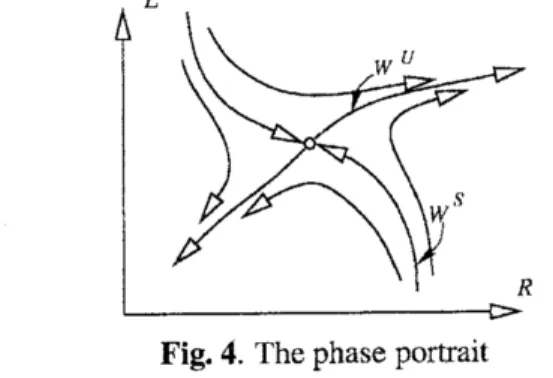
general pictureof the phaseportraitof the ODEsystem(2.10).
5 Phase portrait
Let
us
denote the unique equilibrium of(2.10)by $z_{0}= \frac{2}{\sigma^{\infty}}(R_{0}, L_{0})$, where$R_{0}$ isthe radius and $L_{0}$ishalf-height of$W_{\gamma}$
.
Fig.
4.
ThephaseportraitOnce
we
know the phase portraitwe
can draw other conclusions related to behavior of the systemnear$z_{0}$.The first observationis,
Corollary5.2. Thereexists an
open
set$\mathcal{W}$in$B(z_{0}, r_{0})\subset 1\mathrm{R}^{2}$ forsome
$r_{0}>0$, such that$0 \leq\frac{|V_{\Lambda}|}{|V_{T}|}<\overline{\rho}<$ oo in $\mathcal{W}$
.
Thepoint isthatthe manifolds $W^{U}(z_{0})\cap B(z_{0}, r_{0})$ and$W^{S}(z_{0})\cap B(z_{0}, r_{0})$
are
containedin$\mathcal{W}$which generalizes the situations described earlier.Finally,
our
preliminary, facet stability resultishere.Theorem
5.3.
Letus
assume
that$(R, L)$ isinthe subset$\mathcal{W}$of the phase plane. Then,(a) there exists $U_{T}$,
a
neighborhood of$z_{0}$, such that for allpoints $(R, L)\in \mathcal{W}\cap U_{T}$ the facets$S_{T}$,$S_{B}$
are
stable.(b)thereexists$U_{\Lambda}$,
a
neighborhoodof$z_{0}$, such that for allpoints $(R_{\}L)\in \mathcal{W}\cap U\mathrm{A}$the facet$S_{\Lambda}$ is stable.
The proof isbasedonthe
same
ideasas
in theproofof Theorem4.7. Thatis,we
have tocheck(for$V_{T}>0)$if the inequality
holds. However,thecalculations
are more
involved,they dependuponthebound stated inCorollary5.2.
andthe factthatin$\mathcal{W}$theaspectration of cylinder with radius $R$ and half-heigh $L$, where
$(R, L)\in w_{\square }$
is bounded. The details ofa
more
preciseresult will be presentedelsewhere,see
[GR5].Remark. Lemma4.3 suggests that the set of facet stability is large, because if$V_{\mathrm{A}}=0$, then $\varphi_{r}(r)=$
$\frac{T}{R}\gamma(\mathrm{n}_{\mathrm{A}})$
.
References
[BNPI] G.Belletini, M.Novaga,M.Paolini,Characterization of facet breaking for nonsmooth
mean
cur-vatureflow in the
convex
case,Interfaces
andFreeBoundaries, 3, (2001),415-446.
[BNP2] G.Belletini, M.Novaga, M.Paolini, Onacrystalline variational problem, part I: First variation
and global$L^{\infty}$regularity, Arch. Rational MeekAnal, 157, (2001),
165-191.
[BNP3] G.Belletini, M.Novaga, M.Paolini,Onacrystalline variational problem, part Il: BVregularity
andstructureofminimizers
on
facets,Arch. Rational Meek Anal, 157,(2001),193-217.
[Be] W.RBerg, Crystal growth fromsolutions, Proc. Roy. Soc. LondonA, 164, (1938),
79-95.
[FG] T. Fukui, Y.Giga, Motion ofagraph by nonsmooth weighted curvature, in: Worldcongress of
nonlinear analysts ’92,vol I,ed.V.Lakshmikantham, WalterdeGruyter, Berlin, 1996,pp.
47-56.
[GG] M.-H.Giga, Y.Giga,Asubdifferentialinterpretationof crystallinemotionunder nonuniform
driv-ingforce.Dynamicalsystemsand differentialequations, vol. I(Springfield, MO, 1996). Discrete
Contin. Dynam. Systems, 1998,Added VolumeI,276-287.
[GPR] Y.Giga,M.Paolini, P.Rybka, On themotion by singular interfacialenergy,JapanJ.Indust Appl.
Math., 18,(2001), 231-248.
[GR1] Y.Giga, RRybka, Quasi-static evolution of3-D crystals grown from supersaturated vapor,
Diff.
Integral Eqs., 15, (2001), 1-15.
[GR2\rfloor Y.Giga, P.Rybka, Berg’sEffect,Adv. Math. Sci,Appl, 13, (2003),
625-637.
[GR3] Y.Giga,P.Rybka, Existence ofself-similar evolution of crystalsgrownfromsupersaturated vapor,
to
appear
inInterfaces
andFree Boundaries,6,(2004).[GR4] Y.Giga, P.Rybka, Stability of facetsofself-similarmotion of
a
crystal,submitted.[GR5] Y.Giga, RRybka, Stability of facets of crystals growingfromvapor,inpreparation.
$[\mathrm{G}\mathrm{o}\mathrm{G}]$ T. Gonda, H.Gomi, Morphological instability of polyhedral ice crystals growing in air at low
temperature, Ann. Glaciology 6, (1985),
222-224.
[G] M.Gurtin,Thermomechanics ofEvolving Phase Boundaries in thePlane, ClarendonPress,
Ox-ford,
1993.
[Ha] J.K.Hale, Asymptotic behavior ofdissipative systems, Mathematical Surveys and Monographs
no.
25,AMS, Providence, $\mathrm{R}\mathrm{I}$,1988.
[KIO] T.Kuroda, T.Irisawa, A. Ookawa, Growth of
a
polyhedral crystalfrom solution andits
83
[Ne] J.Nelson, Growth mechanisms to explain the primary and secondary habits ofsnow
crystals,Philos. $Mag$.$A$,81, (2001),
2337-2373.
[Se] A.Seeger, Diffusionproblems associatedwith thegrowthofcrystalsfromdilute solution. Philos.
Mag.,
ser.
7, 44, no348,(1953),1-13.
[Si] L.Simon,Lectures
on
GeometricMeasure Theory,Proc.Centre for Mattt Anal.,AustralianNat,Univ.
3
(1983).[YSF] E.Yokoyama, R.F.Sekerka, Y.Furukawa,Growth trajectoriesof diskcrystalsoficegrowingfrom