ノンパラメトリック項目反応理論のための数理最適化モデル
東京工業大学大学院社会理工学研究科 高野祐一
Yuichi Takano
Graduate School of Decision Scienceand Technology,
Tokyo Institute of Technology
東京工業大学大学院社会理工学研究科 角田信太郎
Shintaro Tsunoda
Graduate School of Decision
Science
andTechnology,Tokyo Institute ofTechnology
東京工業大学大学院社会理工学研究科 村木正昭
Masaaki Muraki
Graduate School ofDecision Science and Technology,
Tokyo Institute ofTechnology
Abstract 項目反応理論とは,テストの回答結果から「被験者の能力」と「設問の正答確率を表す項 目特性曲線」を推定するテスト理論であり,TOEFLや$IT$ パスポート試験などで実際に利用 されている.項目特性曲線の形状をロジスティック曲線に限定したパラメトリック項目反応理 論が広く使われているが,ロジステイック曲線では当てはまりの悪い設問が数多く存在するこ とがしばしば問題になる.本論文では,項目特性曲線の形状に強い仮定を置かないノンパラメ トリック項目反応理論に着目し,被験者の能力と項目特性曲線を同時に推定するための定式化 と発見的解法を提案する. Keywords: 項目反応理論,混合整数非線形計画,ノンパラメトリック推定,発見的解法
1
Introduction
Itemresponsetheory (IRT) [1, 17] is a modern test theory for thedesign, analysis, and scoring of tests. The key component of IRT is the item characteristic
curve
(ICC), which shows therelationship betweenthe examinee’s latentability and the probability of correct
answer.
On thebasis of the item response data ofexaminees, IRT models estimate the ICCs ofquestion items and the latent abilities of examinees. IRT methodologies enable one to closely examine item
characteristics, such
as
difficulty and discrimination, and to investigate not the testscore
butthe latent (i.e., not directly observable) ability of each examinee. IRT models
can
be divided intotwo categories according to approaches toICCestimation. Parametricitemresponsetheory (PIRT) models typically force ICCs to be parametric functions (e.g., logisticcurves or
normalogives). On the other hand, this paper focuseson nonparametric item response theory (NIRT)
NIRT has its origin in Meredith’s work [10] and Mokken scale analysis [11], and it has achieved steady development in both the theory and applications (see, e.g., [15, 18, 19, 20, 22, 23]$)$. The greatest benefit
of
NIRT models is being able to estimate various forms of ICCs onmildassumptions. Indeed, ithas beendemonstrated, e.g., in [3, 4, 16], that PIRT models do not
always fit the data well. In this case, NIRTmodels,whichprovidea moreflexible framework, are particularly useful. NIRTmodelsarealsouseful toexamine whether model assumptions of PIRT
are
validor
not (see, e.g., [6]). However, greater flexibility in nonparametric ICCs sometimes makes a model overly fit to the data. As pointed out by [15], consequently, estimation results obtained byNIRT modelscan
beunstableespecially when usingsmall-sized itemresponsedata. There are several estimation methods for nonparametric ICCs. The most commonly-usedapproach is kernel smoothing, which was first applied by Ramsay [16] to nonparametric ICC
estimation. Althoughtheusefulnessof kernel smoothing methods has been shown,e.g., in [4], it may be that
some
estimatedICCs are
decreasing with respect to the latent ability. Meanwhile, isotonic regression methods can always provide nondecreasing ICCs. Lee [7] compared the performance of three estimation procedures: isotonic regression, smoothed isotonic regression and kernel smoothing, and demonstrated that the smoothed isotonic regression yielded better results than the kernel smoothing did. $A$ number of studies have assessed the goodness of fit ofPIRT models bymeans
ofthese estimation procedures for nonparametric ICCs (see, e.g., [4, 8, 9, 24, 25]$)$.
These procedures,however, estimatenonparametricICCsunder theassumptionthat latent abilities of examinees are predetermined.
Thepurpose ofthe presentpaper is to build anewcomputationalframework for estimating the nonparametric ICCs and the latent abilities of examinees simultaneously. To accomplish
this, we formulate mathematical optimization models for NIRT as mixed integer nonlinear
programming (MINLP) problems. Mathematical optimization methodology makes it possible
toplacevarious restrictions onexcessively flexible ICCs. In addition to the existingconstraints,
i.e., monotone homogeneity and double monotonicity, we propose slope smoothing constraints
toprevent ICCsfrom overfitting the data. Although it is very hard to obtainan exact solution
to the resultingoptimization problems, wedevelop a heuristic optimization algorithm to find
a
good-quality solution in a reasonable amount of time.
2
Nonparametric
Item
Response
Theory
Let
us
suppose that examinees $i=1,2,$$\ldots,$$I$ took a test consisting of dichotomously scoredquestion items $j=1,2,$$\ldots,$$J$. More specffically,
we
are giventhe binary item response data, $U=(u_{i,j};i=1,2, \ldots, I, j=1,2, \ldots, J)\in\{0,1\}^{I\cross J},$where $u_{i,j}=1$ if examinee $i$ gave a correct
answer
to question item $j$, otherwise $u_{i,j}=0$.
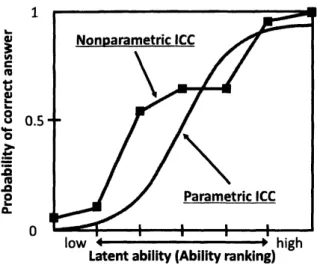
Themain objective of the item response theory (IRT) is to estimate the item characteristic
curves
low
–
highLatentability(Ability ranking)
Figure 1: Parametric/Nonparametric item characteristic
curves
In particular, this paper explores the nonparametric item response theory (NIRT) that
employs nonparametric ICCs. In a conventional way, we
assume
throughout the present paper thatUnidimensionality: latent abilities of all examinees canbe evaluated unidimensionally.
Local Independence: item responses
are
conditionally independent ofeach other given an indi-vidual latent ability.In what follows,
we
shall consider ability rankings; that is,we
evaluate the latent abilities of examinees ona
discrete scale of$t=1,2,$$\ldots,$$T$.
To estimatenonparametric ICCs, we introducethe decision variables:
$X=$ $(x_{j,t};j=1,2, \ldots, J, t=1,2, \ldots;T)\in \mathbb{R}^{JxT},$
where$x_{j,t}$ is theprobabilityof question item$j$answeredcorrectlyby examinees of abilityranking $t$
.
Figure 1 illustrates a nonparametricICC which is represented as apiecewise linear function.Thefundamental property required for ICCs is monotone homogeneity ($MH$) [10, 11]. This
requiresthat all ICCs are nondecreasing with a latent ability. This means that the probability
of correct
answer
does not decrease with the ability ranking ofexaminee. Thus, the following constraints must be imposed on $X$:Monotone Homogeneity : $0\leq x_{j,1}\leq x_{j,2}\leq\cdots\leq x_{j,T}\leq 1$ $(\forall j=1,2, \ldots, J)$
.
(1)An additional assumption of nonparametricICCisdouble monotonicity ($DM$) [11, 13]. This
of examinees, the difficulties of two question items are never reversed. To formulate a clear definition, we suppose that there is apermutation:
$\sigma:\{1,2, \ldots, J\}arrow\{1,2, \ldots, J\},$
where $\sigma(k)=j$ means that the k-th most difficult item is question item$j$. We refer to $\sigma$ as a
difficulty ranking function. Then, the$DM$ constraints are written as follows:
Double Monotonicity: $x_{\sigma(1),t}\leq x_{\sigma(2),t}\leq\cdots\leq x_{\sigma(J),t}$ $(\forall t=1,2, \ldots, T)$. (2)
This
means
that, for all examinees, the probability of answering a high-ranking item correctly is lower than that of a low-rankingone.
To estimate ability rankings ofexaminees, we further introducethe decision variables,
$Y=(y_{i,t};i=1,2, \ldots, I, t=1,2, \ldots, T)\in\{0,1\}^{I\cross T},$
where $y_{i,t}=1$ ifthe ability ranking of examinee $i$ is estimated to $t$, otherwise $y_{i,t}=0$
.
Sinceonly
one
ability ranking should be assigned to each examinee, $Y$ must satisfy the followingconstraints:
$\sum_{t=1}^{T}y_{i,t}=1$ $(\forall i=1,2, \ldots, I)$, (3)
$y_{i,t}\in\{0,1\}$ $(\forall i=1,2, \ldots, I, \forall t=1,2, \ldots, T)$. (4)
Inwhatfollows,wedefine alog likelihood function to be maximized. Given$x_{j}$ $:=(x_{j,1}, x_{j,2}, \ldots, x_{j,T})$
and $y_{i}$ $:=(y_{i,1}, y_{i,2}, \ldots, y_{i,T})$, the probability of havingthe response $u_{i,j}$ can be written
as
fol-lows:
$Pr(u_{i,j}|x_{j}, y_{i})=\sum_{t=1}^{T}y_{i,t}(x_{j,t})^{u_{i,j}}(1-x_{j,t})^{1-u_{i,j}}.$
Underthelocal independence assumption, the probabilityofhaving the response$u_{i}$ $:=(u_{i,1}, u_{i,2}, \ldots, u_{i,J})$
ofexaminee $i$ becomes
$Pr(u_{i}|X, y_{i})=\prod_{j=1}^{J}Pr(u_{i,j}|x_{j}, y_{i})$
.
Considering that the responses of different examinees are independent, we can see that the overallitem response $U$
occurs
with the probability:$Pr(U|X, Y)=\prod_{i=1}^{I}Pr(u_{i}|X, y_{i})=\prod_{i=1j}^{I}\prod_{=1}^{J}(\sum_{t=1}^{T}y_{i,t}(x_{j,t})^{u_{i,j}}(1-x_{j,t})^{1-u_{i,j}})$
.
Finally, by treating $X$ and $Y$ as decision variables, the $\log$ likelihood function is defined
as
follows:3
Mathematical optimization Models
This section presents several mathematical optimization models for NIRT.
3. 1
Monotone homogeneity
model
In viewofthe constraints (3) and (4), the $\log$likelihood function can berewritten as follows:
$\ell(X, Y|U)(=\sum_{i=1}^{I}\sum_{j=1}^{J}\sum_{t=1}^{T}y_{i,t}\log((x_{j,t})^{u_{i,j}}(1-x_{j,t})^{1-ui,j})$
$= \sum_{i=1}^{I}\sum_{j=1}^{J}\sum_{t=1}^{T}y_{i,t}(u_{i,j}\log(x_{j,t})+(1-u_{i,j})\log(1-x_{j,t}))$
.
(5)The monotone homogeneity ($MH$) model estimates $X$ and $Y$
so
that the $\log$ likelihoodfunction, $\ell(X, Y|U)$, is
maximized
under the conditions (1), (3)and
(4). Consequently, the$MH$ model
can
be framedas
the following mixed integer nonlinear programming (MINLP)problem:
(MHM)
maximize $\sum_{i=1}^{I}\sum_{j=1}^{J}\sum_{t=1}^{T}y_{i,t}(u_{i,j}\log(x_{j,t})+(1-u_{i,j})\log(1-x_{j,t}))$
subject to $0\leq x_{j,1}\leq x_{j,2}\leq\cdots\leq x_{j,T}\leq 1$ $(\forall j=1,2, \ldots, J)$,
$\sum_{t=1}^{T}y_{i,t}=1 (\forall i=1,2, \ldots, I)$,
$y_{i,t}\in\{0,1\} (\forall i=1,2, \ldots, I, \forall t=1,2, \ldots,T)$
.
3.2
Double monotonicity model
Next,
we
pondera
mathematical optimization problem with the double monotonicity ($DM$)constraints (2).
Let
us
recall that $\sigma(k)=j$means
that the k-th most difficult item is question item $j$.
Inthe sequel, we shall representa difficultyrankingfunction $\sigma$by usingthe following permutation
matrix:
$Z=(z_{j,k};j=1,2, \ldots, J, k=1,2, \ldots, J)\in\{0,1\}^{JxJ}$, (6)
$z_{j,k}=1\Leftrightarrow\sigma(k)=j$
.
(7)The optimization model presented below finds an appropriate difficulty ranking by treating
conditions:
$\sum_{k=1}^{J}z_{j,k}=1 (\forall j=1,2, \ldots, J)$, (8)
$\sum_{j=1}^{J}z_{j,k}=1 (\forall k=1,2, \ldots, J)$, (9)
$z_{j,k}\in\{0,1\} (\forall j=1,2, \ldots, J, \forall k=1,2, \ldots, J)$. (10)
To estimate ICCsunder the$DM$ constraints,
we use new
decision variables:$W=(w_{k,t};k=1,2, \ldots, J, t=1,2, \ldots, T)\in \mathbb{R}^{J\cross T},$
which represents the probabilityofthe k-thmost difficult itemanswered correctly by examinees
of ability ranking$t$
.
In this case, the monotone homogeneityanddouble monotonicityconstraintson $W$
can
beexpressedas
follows:Monotone Homogeneity : $0\leq w_{k,1}\leq w_{k,2}\leq\cdots\leq w_{k,T}\leq 1$ $(\forall k=1,2, \ldots, J)$, (11)
Double Monotonicity: $w_{1,t}\leq w2,t\leq\cdots\leq w_{J,t}$ $(\forall t=1,2, \ldots, T)$
.
(12)The associated $\log$ likelihood function becomes
$I$ $J$ ア
$\ell(W, Y, Z|U)=(5)\sum\sum\sum yi,t(u_{i,\sigma(k)}\log(w_{k,t})+(1-u_{i,\sigma(k)})\log(1-w_{k,t}))$
$i=1k=1t=1$ (6)$,$(7) $= \sum\sum^{I}\sum^{J}yi,tT(\sum_{j=1}^{J}z_{j,k}(u_{i,j}\log(w_{k,t})+(1-u_{i,j})\log(1-w_{k,t})))$ $i=1k=1t=1$ I $J$ $J$ $T$ $= \sum\sum\sum\sum yi,t^{Z}j,k(u_{i,j}\log(w_{k,t})+(1-u_{i,j})\log(1-w_{k,t}))$
.
$i=1j=1$ん$=$1オ$=$1We
are
now in a position to formulate a $DM$ model, i.e., the problem of maximizing theas
thefollowing MIMLP problem:(DMM)
$maximizeW,Y,Z$ $\sum_{i=1}^{I}\sum_{j=1}^{J}\sum_{k=1}^{J}\sum_{t=1}^{T}y_{i,t^{Z}j,k}(u_{i,j}\log(wk,t)+(1-u_{i,j})\log(1-w_{k,t}))$
subject to $0\leq wk,1\leq wk,2\leq\cdots\leq wk,T\leq 1$ $(\forall k=1,2, \ldots, J)$, $w_{1,t}\leq w_{2,t}\leq\cdots\leq wj,t (\forall t=1,2, \ldots, T)$,
$\sum_{k=1}^{J}z_{j,k}=1 (\forall j=1,2, \ldots, J)$,
$\sum_{j=1}^{J}z_{j,k}=1 (\forall k=1,2, \ldots, J)$,
$z_{j,k\in}\{0,1\} (\forall j=1,2, \ldots, J, \forall k=1,2, \ldots, J)$,
$\sum_{t=1}^{T}y_{i,t}=1 (\forall i=1,2, \ldots, I)$,
$y_{i,t}\in\{0,1\} (\forall i=1,2, \ldots, I, \forall t=1,2, \ldots, T)$
.
3.3
Slope smoothingmodel
Ithas been pointed out, e.g., in [15], that estimated results
can
beunstableespecially for small-sized itemresponsedata. Thisinstabilityiscausedby theenhanced flexibility of nonparametric ICCs. Toovercome
this drawback, it is effective to decrease flexibility of nonparametric ICCsmoderately. Thissort of approach is frequently utilized to enhance the generalization capability
in statisticallearningmethods (see, e.g., [5]). For this reason,
we
propose additional constraints to force the slope of eachICC
to vary smoothly. We shall call them “slope smoothing (SS)constraints”, which are expressed
as
follows:SIope Smoothing : $\sum_{t=2}^{T-1}|(x_{j,t+1}-x_{j,t})-(x_{j,t}-x_{j,t-1})|\leq\gamma$ $(\forall j=1,2, \ldots, J)$, (13)
where $\gamma\geq 0$ is
an
user-defined parameter. If$\gamma$is sufficiently large, the SS constraints (13)are
invalidated. By contrast, $\gamma=0$ forcesall ICCsto be straight lines.
By placing the SS constraints (13)
on
ICCs ofproblem (MHM), we can pose the SS modelas
follows:(SSM)
$\max_{X,Y}$imize $\sum_{i=1}^{I}\sum_{j=1}^{J}\sum_{t=1}^{T}y_{i,t}(u_{i,j}\log(x_{j,t})+(1-u_{i,j})\log(1-x$あ
$t))$
subject to $0\leq x_{j,1}\leq x_{j,2}\leq\cdots\leq x_{j,T}\leq 1$ $(\forall j=1,2, \ldots, J)$,
$\sum_{t=2}^{T-1}|x_{j,t+1}-2x_{j,t}+x_{j,t-1}|\leq\gamma (\forall j=1,2, \ldots, J)$,
$\sum_{t=1}^{T}y_{i,t}=1 (\forall i=1,2, \ldots, I)$,
4
Heuristic optimization
Algorithm
The optimization models presented in the previous section are mixed integer nonlinear pro-gramming (MINLP) problems, which
are
very hard to solve exactly. To efficiently computea
good-quality solution, we develop a heuristic optimization algorithm to the problems. In this section,
we
describean
algorithm for solving the slope smoothing model (SSM). We should notice that this algorithmcan be readily applied to the monotone homogeneity model (MHM) becauseproblem (MHM) isequivalent toproblem (SSM) with $\gamma=\infty.$We begin by giving
an
ability ranking to each examineeas
an initial solution. To set an examinee’s ability,one
may use the number of question items that $s/$he answered correctly.Then, we denote by
$\overline{Y}=(\overline{y}_{i,t};i=1,2, \ldots, I, t=1,2, \ldots, T)$
the determined ability rankings.
Next, wesolve problem (SSM) in which the decision variable $Y$ isfixed to $\overline{Y}$. This problem
can
be decomposed intoones of eachICC $(j=1,2, \ldots, J)$:$(SSM(j|\overline{Y}))$
$maxi_{j}mizex$ $\sum_{i=1}^{I}\sum_{t=1}^{T}\overline{y}_{i,t}(u_{i,j}\log(x_{j,t})+(1-u_{i,j})\log(1-x_{j,t}))$
subject to $0\leq x_{j,1}\leq x_{j,2}\leq\cdots\leq x_{j,T}\leq 1,$
$\sum_{t=2}^{T-1}|x_{j,t+1}-2x_{j,t}+x_{j,t-1}|\leq\gamma.$
Although the SS constraints (13)
are
nonlinear and nondifferentiable, it is well known that this sort of constraints can be converted into linear ones. Specifically, we can reformulate problem $($SSM$(j|\overline{Y}))$ as follows:$(SSM(j|\overline{Y}))$
$\max_{s_{j}}imizev_{j},x_{j}$ $\sum_{i=1}^{I}\sum_{t=1}^{T}\overline{y}_{i,t}(u_{i,j}\log(x_{j,t})+(1-u_{i,j})\log(1-x_{j,t}))$
subject to $0\leq x_{j,1}\leq x_{j,2}\leq\cdots\leq x_{j,T}\leq 1,$
$\sum_{t=2}^{T-1}(s_{j,t}+v_{j,t})\leq\gamma,$
$s_{j,t}-v_{j,t}=x_{j,t+1}-2x_{j,t}+x_{j,t-1} (\forall t=2,3, \ldots, T-1)$,
$s_{j,t}\geq 0, v_{j,t}\geq 0 (\forall t=2,3, \ldots, T-1)$,
where $s_{j}=$ $(s_{j,2}, s_{j,3}, \ldots , s_{j,T-1})$ and$v_{j}=(v_{j,2}, v_{j,3}, \ldots, v_{j,T-1})$ for $j=1,2,$$\ldots,$
$J$
are
auxiliarydecision variables. When the SS constraint (13) of ICC $j$ is tight, $s_{j,t}$ and $v_{j,t}$ correspond to
positive and negative parts of$x_{j,t+1}-2x_{j,t}+x_{j,t-1}$, respectively; therefore, $s_{j,t}+v_{j,t}$ coincides
with $|x_{j,t+1}-2x_{j,t}+x_{j,t-1}|$
.
Sinceproblem $($SSM$(j|\overline{Y}))$ is concave functionmaximization withLet
$\overline{X}=(\overline{x}_{j,t;}j=1,2, \ldots, J, t=1,2, \ldots, T)$
be optimal solutions to problems $($SSM$(j|\overline{Y}))$ for$j=1,2,$
$\ldots,$$J$
.
Now,we
solve problem (SSM)in which the decision variable $X$ is fixed to $\overline{X}$
.
This problem can be decomposed into
ones
of each examinee $(i=1,2, \ldots, I)$:$(SSM(i|\overline{X}))$
$maximizey$ $\sum_{j=1}^{J}\sum_{t=1}^{T}y_{i,t}(ui,j\log(\overline{x}_{j,t})+(1-u_{i,j})\log(1-\overline{x}_{j,t}))$
subject to $\sum_{t=1}^{T}y_{i,t}=1,$
$y_{i,t}\in\{0,1\} (\forall t=1,2, \ldots, T)$
.
Here, the objective function
can
be rewrittenas
follows:$\sum_{t=1}^{T}y_{i,t}\underline{\underline{\sum_{j=1c}^{J}(u_{i,j}\log(\overline{x}_{j,t})+(}1-u_{i,j})log(1}-\overline{x}_{j,t}))\ell(i,t)--\cdot$
Therefore,todetermine
an
ability rankingof examinee$i$, itisonlynecessary
to select$t$such that $\ell(i, t)$ is maximized. It follows that problem $($SSM
$(i|\overline{X}))$can
be easilysolved by sorting $\ell(i, t)$.
In this manner, we update $\overline{Y}$ and return to the first step to find better $X$. By repeating this
procedure, the objective, $\ell(\overline{X},\overline{Y}|U)$, monotonically increases. We terminate this algorithm
when the solutions
are
unchanged. Our heuristic optimization algorithm is summarized in Algorithm 1.A searchstrategy of Algorithm 1issimilartothat ofthe well-known expectation-maximization ($EM$) algorithm [2]. In contrast to the standard$EM$ algorithm, however, Algorithm 1 estimates
5
Conclusion
We dealt with mathematical optimization models and a heuristic optimization algorithm for nonparametric item response theory (NIRT). $A$ future direction of study will be to extend our
formulation to polytomous NIRT models [14, 20, 21].
References
[1] A. Birnbaum, “SomeLatent Trait Models and Their Use in Inferringan Examinee’s
Abil-ity,” In F. Lord
&
M. Novick (eds.), Statistical Theoriesof
Mental Test Scores (Addison-Wesley, 1968), pp.397-492.[2] A.P. Dempster, N.M.Laird, andD.B.Rubin, “Maximum Likelihood from Incomplete Data
via the $EM$ Algorithm,” Journal
of
the Royal Statistical Society, Vol.39, No.1, pp.1-38(1977).
[3] J. Douglas, “Joint Consistency of Nonparametric Item Characteristic Curve and Ability
Estimation,” Psychometrika, Vol.62, No.1, pp.7-28 (1997).
[4] J. Douglas and A. Cohen, “NonparametricItemResponseFunction Estimation for
Assess-ing Parametric Model Fit,” Applied Psychological Measurement, Vol.25, No.3, pp.234-243
(2001).
[5] T. Hastie, R. Tibshirani, and J. EYiedman, The Elements
of
Statistical Learning, 2ndEdi-tion (Springer, 2009).
[6] B. Junkerand K. Sijtsma, “NonparametricItemResponseTheory inAction: An Overview
of the Special Issue,” Applied Psychological Measurement, Vol.25, No.3, pp.211-220 (2001). [7] $Y$.-S. Lee, “A Comparison of Methods for Nonparametric Estimation of ItemCharacteristic Curves for Binary Items,” Applied Psychological Measurement, Vol.31, No.2, pp.121-134 (2007).
[8] $Y$.-S. Lee, J.A. Wollack, and J. Douglas, “On the Use of Nonparametric Item Character-istic Curve Estimation Techniques for Checking Parametric Model Fit,” Educational and Psychological Measurement, Vol.69, No.2, pp.181-197 (2009).
[9] T. Liang and C.S. Wells, “A Model Fit Statistic for Generalized Partial Credit Model,”
Educational and Psychological Measurement, Vol.69, No.6, pp.913-928 (2009).
[10] W. Meredith, “Some Results based on a General Stochastic Model for Mental Tests,”
[11] R.J. Mokken, A
Theow
and Procedureof
Scale Analysis with Applications in Political Research (Walter de Gruyter, 1971).[12] R.J.Mokken, “NonparametricModels for Dichotomous Responses,” InW.J.
van
derLindenand R.K. Hambleton (eds.), Handbook
of
Modern Item Response Theory (Springer, 1997),pp.351-367.
[13] R.J. Mokken and C. Lewis, “A Nonparametric Approach to the Analysis of Dichotomous
Item Responses,” Applied Psychological Measurement, Vol.6, No.4, pp.417-430 (1982). [14] I.W. Molenaar, “NonparametricModels for Polytomous Responses,” In W.J.
van
derLin-den and R.K. Hambleton (eds.), Handbook
of
Modern Item Response Theory (Springer, 1997), pp.369-380.[15] I.W. Molenaar, “ThirtyYears ofNonparametricItem Response Theory,” Applied
Psycho-logical Measurement, Vol.25, No.3, pp.295-299 (2001).
[16] J.O.Ramsay, “Kernel Smoothing ApproachestoNonparametric ItemCharacteristic Curve
Estimation,” Psychometrika,Vol.56, No.4, pp.611-630 (1991).
[17] G. Rasch, Probabilistic Models
for
Some Intelligence and Attainment Tests (Danish In-stitute for Educational Research, 1960). Expanded Edition (University of Chicago Press, 1980).[18] K. Sijtsma, “MethodologyReview: NonparametricIRT Approachestothe Analysis of
Di-chotomous ItemScores,” Applied Psychological Measurement, Vol.22, No.1, pp.3-31 (1998). [19] K. Sijtsma, “Developments in Measurement of Persons and
Items by Means of Item Re-sponse Models,” Behaviormetrika, Vol.28, No.1, pp.65-94 (2001).
[20] K. Sijtsma and I.W. Molenaar(eds.), Introduction to Nonparametric Item Response Theory (Saga, 2002).
[21] K. Sijtsma and L.A. van der Ark, “NIRT Analysis of Polytomous Item Scores: Dilemmas
and Practical Solutions,” In A.J. van Duijn and T.A.B. Snijders (eds.), Essays on Item
Response Theory (Springer, 2001), pp.297-318.
[22] W.F. Stout, “A Nonparametric Approach for Assessing Latent ’bait Unidimensionality,”
Psychometrika, Vol.52, No.4, pp.589-617 (1987).
[23] W.F. Stout, “NonparametricItemResponse Theory: AMaturing and Applicable
Measure-ment Modeling Approach,” Applied Psychological MeasureMeasure-ment, Vol.25, No.3, pp.300-306 (2001).
[24] M.J. SueiroandF.J. Abad, Assessing Goodness ofFitinItem Response TheoryWith Non-parametric Models: A Comparison of Posterior Probabilities and Kernel-Smoothing Ap-proaches,” Educational and PsychologicalMeasurement, Vol.71, No.5, pp.834-848 (2011). [25] C.S. Wells and D.M. Bolt, “Investigation of a Nonparametric Procedure for Assessing
Goodness-of-Fit in Item Response Theory,” Applied Measurement in Education, Vol.21,