Modelling
for
Convective
Heat
Transport
Based
on
Mixing Length Theory
混合距離理論を用いた対流のモデル化
Yasuko
Yamagishi and
Takatoshi
Yanagisawa
山岸保子・柳沢孝寿
Institute for
Frontier
Research
on
Earth Evolution
固体地球統合フロンテイア研究システム
Japan
Marine
and
Science
Technology
Center
海洋科学技術センター
$lnloal\iota t\dot{w}n$
Convectionis the mostimportantmechanismfor the Earth’sinternaldynamics, andplays asubstantial role in
its evolution. Wheninvestigatingthe thermalhistoryof theEarth,convectiveheattransportshould be taken into account. However, it isdifficult to treatprecisely full
convective
flow throughout theEarth’sentire
history. Asaresult, parameterized convection
was
developed and has beenwidelyused [Schubertet$\mathrm{a}/.$, 1979; SharpeandPeltier, 1979].
Convection occurringin the Earth’s
interior
hassome
complicatedaspects, including alargevariation invis-cosity,internal heating, and phaseboundaries. Inparticular,the viscosity contrast has asignificant effect
on
theefficiencyofconvectiveheat transport. Parameterized
convection
treatsviscosity variation artificially, andthere-forehasmanylimitations. We developed
an
alternative method basedonthe conceptof“mixing length theory”.The basic concept of this theory is thatheatis transported by verticalmotionofafluidparcel,and aftermigrating
for mixing length, the parcel loses it’s individuality. We
can
relate the local thermal gradient to the localconvective velocity of the fluidparcelanddefinetheeffective thermaldiffusivity
as
theeffectofconvective heat transport.Then,
we can
calculateahorizontaly averaged temperature profile and heat flux inaconvective fluid by solvingamere
thermal conductionproblem. Whenestimating the parcel’s velocity,we
can
include effects suchas
that causedby variable viscosity.In this study, through comparisonwith experimental results,
we
confirmthat the temperatureprofilecan
be calculated correctlybythismethod. Wefurther determine the effectoftheviscosity contraston
the temperature structure oftheconvectivefluid,and calculate the relationship between the NusseltnumberandarepresentativeRayleigh number for thelayer.
Fomuktion
As describedabove, here
we
simply treattheconvective
heat flowusing mixing length theory, ofwhichthebasicpremiseis that the velocity ofthefluid parcel is related to the local thermal gradient.
Mixing length theory
was
firstly developedin the field ofastrophysical studies in order toestimateheat fluxforconvective fluid with low Prandtl number andhigh Rayleighnumber [Vitense, 1953]. Thisformulation
was
derived by neglecting viscous drag, and the vertical velocity of the
convective
fluid parcelwas
estimated from freefall velocitybyconsideringthatallgravitational
energy
was
changed intokinematicenergy.
The viscosity, then,does not
appear
intheformula. Sasaki andNakazawa
[1986]and$Abe$[1993]extended thetheoryand formulatedforhighlyviscous fluids. Thisfomlulatim
was
basedon
theestimationof the verticalvelocity of aparcelfromStokesvelocity, namely
on
theconceptthat the buoyancyforce is balancedwithviscousdrag. Theseformulationswere
derivdfrom theperturbation equationsofenergy
andmomentum数理解析研究所講究録 1339 巻 2003 年 139-144
Inthis study,
we
$\mathrm{r}\mathrm{e}$-formulate this theorymore
simply and intuitively, especially for highly viscous flfluids.Be-cause
theidea of this theory is that the flfluid parcel migrates foramixing lengthand loses it’s individuality, themixinglength
can
be regardedas a
typeofmean
free path. Therefore,the effectivethermal diffusivity, $\kappa_{c\circ nv\prime}$can
bedeflflned
as
(2)
$\kappa_{\mathrm{c}onv}=v\mathrm{x}$$l$ (1)
where$v$is the velocity of theflfluidparcel, and$l$isthemixinglength. The temperaturedifference between theparcel
and thesurrounding$\mathrm{t}\mathrm{e}\mathrm{m}\mu \mathrm{r}\mathrm{a}\mathrm{t}\mathrm{u}\mathrm{r}\mathrm{e}$ oftheflfluid,generated becausethe parcel
moves
for$l$vertically, is estimated
as
$\triangle T=[(\frac{dT}{dz})_{ad}-(\frac{dT}{dz})]l$
(4)
where $( \frac{dT}{dz})_{ad}$isthe adiabatic temperaturegradient.Inthisstudy, thesize of theparcelisassumed to$\mathrm{k}$identified
with the mixing length. $\Pi \mathrm{e}$ flfluidparcel
moves
against Stoke’s resistance. The velocity of the parcel, then, isdefind
as
$v$ $=$ $\frac{4\alpha gl^{2}}{15\nu}\triangle T$ (3)
$=$ $\frac{4\alpha g}{15\nu}[(\frac{dT}{dz})_{ad}-(\frac{dT}{dz})]l^{3}$
(5)
where$\alpha$isthethemalexpansivity,$g$is the gravitationalaccerelation,and$\nu$is the$\mathrm{k}\mathrm{i}\mathrm{n}\mathrm{e}\mathrm{m}\mathrm{a}\dot{\mathrm{u}}\mathrm{c}$ viscosity. Theeffective
thermal diffisivityandconvective heat flflux
are
calculatedas
follows;$\kappa_{conv}$ $=$ $v \mathrm{x}l=\frac{4\alpha g}{15\nu}[(\frac{dT}{dz})_{ad}-(\frac{dT}{dz})]l^{4}$
(6)
$J_{eonv}$ $=$ $\rho C_{P}\kappa_{conv}\frac{\triangle T}{l}=\rho C_{P}\kappa_{conv}[(\frac{dT}{dz})_{ad}-(\frac{dT}{dz})]$
where$\rho$isthe densityand$C_{P}$is the heatcapacity. Therefore, the temporal change of the horizontally averagd
$\mathrm{t}\mathrm{e}\mathrm{m}\mu \mathrm{r}\mathrm{a}\mathrm{t}\mathrm{u}\mathrm{l}\mathrm{e}$profileinthe
$\mathrm{c}\mathrm{o}\mathrm{n}\mathrm{v}\mathrm{e}\mathrm{c}\dot{0}\mathrm{v}\mathrm{e}$flfluid
can
beestimatedby solving theconduction equation,$\rho C_{P}\frac{\partial T}{\partial t}=\mathrm{d}\mathrm{i}\mathrm{v}(k\frac{\partial T}{\partial z}-J_{conv})+H$ (7)
where$\mathrm{H}$is the
heatgeneration. Theseformulae
are
thesame
as
thosederivedbySasakiandNakazawa
[1986],except forthecoefficient,althoughthe
process
offormulationisdifferenceconvective
heatflux
In thismethd, the mixing length $\prime l’$ isthe most important parameter. We
assume
thatthemixinglengthisqual to the distancefromthe boundary,
as
adoptedbySasakiandNakazawa
[1986]and$Abe$$[1993]$.
$\mathrm{T}\mathrm{i}\mathrm{s}$means
that the flfluid parcel has
a
sizethat is thesame as
the distance from the boundarytoits generating point, and itmoves
for the distanceof its size. This concept isillustratedinFigure 1. Tocompare
with$\mathrm{e}\mathrm{x}\mu \mathrm{r}\mathrm{i}\mathrm{m}\mathrm{e}\mathrm{n}\mathrm{t}\mathrm{a}\mathrm{l}$ results,we
setthe adiabatic temperature gradient tozero
andcalculatedthe heatflflux basedon
equation (6). We assumed that theviscosity
in the flfluid layerwas
constant.Figure 2shows theNusseltnumberderived by thecalculated heatflflux
as a
function of Rayleighnumber. TheNusselt numberincreasesinproportiontotheRayleighnumber to the$\mu \mathrm{w}\mathrm{e}\mathrm{r}$of$\frac{1}{3}$
:
$Nu$ $\propto$
$Ra^{\beta}$ (8)
$\beta$ $=$ $\frac{1}{3}$ (9)
$\mathrm{H}1:$ The concept of themixinglength andtheparcelsize,whentheparcel size is regarded
as
same
as
the mixing lengthandthemixing length is assumedto$\mathrm{k}$the distancefrom theboundaryoftheconvective
flluid.10 $\mathrm{z}\ovalbox{\tt\small REJECT}-$ $10$
:
$\underline{\vee}$ 10 $\not\leqq$101
1 1$\mathrm{R}\bullet \mathrm{y}\mathrm{l}\mathrm{e}\mathrm{t}\iota \mathrm{h}\mathrm{N}\mathrm{n}\mathrm{m}\mathrm{b}\mathrm{e}\mathrm{r}$
$\mathrm{H}$ $2$
:
Nusselt number-Rayleigh numberrelationobtainedbythe mixing lengththeory.and
agrees
well with theexperimentally
measured value. Therefore, themethd for treatingconvective
heat flflow&velopedhere
can
calculate the temperaturesructulein theconvectivelayer accurately and easily. However,theNusselt number is slightlyoverestimatedbythis calculationat lowRayleigh numbers. If the.Rayleigh number is
belowthecriticalRayleigh number, whichisthe value for the onset ofconvection,theNusselt numkr should$\mathrm{k}$
aunity. Here, thecalculatdNusseltnumber islarger than
1
underthecriticalRayleighnumber. This is becausein thismethM, the critical Rayleighnumberis 1, which is much smallerthan theexperimental
or
linear stable analytic $\mathrm{c}\mathrm{r}\mathrm{i}\dot{\mathrm{u}}\mathrm{c}\mathrm{a}\mathrm{l}$Rayleigh number $(\sim 10^{3})$.
But the surplus heat flflux is relatively small and cannot affect thesystem significantly.
$\hslash m\mu mture\ \mu n\ neeofv\dot{u}$
eosl.y
$\ln$consideringmantleconvection,$\mathrm{v}\dot{\iota}\mathrm{s}\mathrm{c}\mathrm{o}\mathrm{s}\mathrm{i}\mathrm{t}\mathrm{y}$ is strongly variable duetoitstemperaturedependence. In
previous
parameterized convection$\mathrm{m}\iota\lambda \mathrm{e}\mathrm{l}\mathrm{s}$
.
it is implicitly assumedthat theNusselt-Rayleigh
numkr relationship is notaffected byspatial$\mathrm{v}\mathrm{a}\dot{\mathrm{n}}\mathrm{a}\dot{\mathrm{u}}\mathrm{o}\mathrm{n}$inviscosity.Whenusing viscosity calculated fromthe
mean
$\mathrm{t}\mathrm{e}\mathrm{m}\mu \mathrm{r}\mathrm{a}\mathrm{t}\mathrm{u}\mathrm{r}\mathrm{e}$$\mathrm{k}\mathrm{t}\mathrm{w}\infty \mathrm{n}$the
top and the bottom boundary, it is experimentally found that although the viscosity$\mathrm{d}\mathrm{e}\mu \mathrm{n}\mathrm{d}\mathrm{s}$
on
$\mathrm{t}\mathrm{e}\mathrm{m}\mu \mathrm{r}\mathrm{a}\mathrm{t}\mathrm{u}\iota \mathrm{e}$, theNusselt-Rayleighnumberrelationship
is
thesame
as
forconstant viscosityconvaetion
[Booker, 1976;Richteret$al.$,
1983},
Some experimentaland computational studies indicate that when the viscosity hasan
eXtlet1rly high$\mathrm{N}$
$\mathrm{T}\mathrm{e}\mathrm{m}\mu \mathrm{r}\cdot \mathrm{t}\mathrm{u}\mathrm{r}\mathrm{e}$
$\mathbb{H}$$3$
:
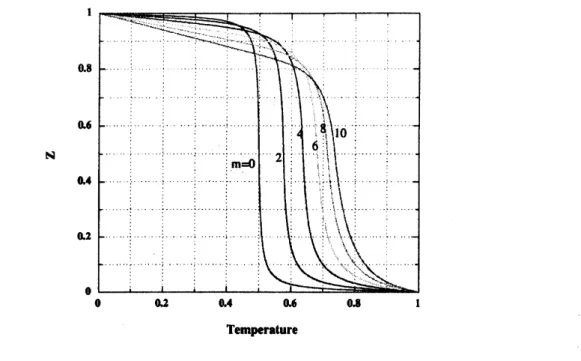
Horizontalmean
temperatureprofileinconvective layerwithstronglytemperaturedependentviscosity. $\mathrm{m}$isindicatorof temperature$\mathrm{d}\mathrm{e}\mu \mathrm{n}\mathrm{d}\mathrm{e}\mathrm{n}\mathrm{c}\mathrm{y}$ ofviscosity
contrast between the top and the bottomboundaries, the$\mathrm{d}\mathrm{e}\mu \mathrm{n}\mathrm{d}\mathrm{e}\mathrm{n}\mathrm{c}\mathrm{e}$ of Nusselt number
on
theRayleigh numberdecreases [Christensen, 1984]. Namely, inequation(8),$\beta$drops klow $\frac{1}{3}$
.
In the method
we
propose
here, only the local value of viscosity is needed. It isunnecessary
to calculatetheRayleigh number ofthe convective layer before gettingthe Nusselt number. Therefore, the variation of the
viscosity due to its temperature dependence
can
$\mathrm{k}$ taken into account directly, withoutan
artificial treatment like parameterized
convection.
Inaddition,as we
only solvea
simpleconductionequation, lesscomputationaleffort is needed,
even
though the $\mathrm{t}\mathrm{e}\mathrm{m}\mu \mathrm{r}\mathrm{a}\mathrm{t}\mathrm{u}\mathrm{r}\mathrm{e}$ dependence of viscosityis
strong andconvection
isvery
active.When the viscosity strongly depends
on
temperature, the2or
3
dimensional calculations requireextremely large computational efforts, and thereforeare
difficult tocarry
out. Experimentsare
alsomore
difficult under suchsituations. Consequently,the value of$\beta$hasnotkenclarified forconvectionwithhighly variable viscosity, and it
has not been determined whichviscosity is adequatefordefiningthe system’sRayleighnumber.
Figure3shows the temperatureprofiles in
a
convectivelayer with strongly temperature dependentviscosity. Theviscosityisgivenby
$\nu=\nu_{\mathrm{O}}\exp(-A(T-T_{\mathrm{O}}))$ (10)
where $T_{0}$ is the criterion $\mathrm{t}\mathrm{e}\mathrm{m}\mu \mathrm{r}\mathrm{a}\mathrm{t}\mathrm{u}\mathrm{r}\mathrm{e}$, which is usually assumed to be the temperature at the cold
or
the hotboundary, and$\nu_{0}$is the viscosityat$T_{0}$
.
The indicator of the temperature dependence ofviscosity,$m$,isdefined by$\frac{\nu(T_{t})}{\nu(T_{b})}=10^{m}$ (11)
where$T_{t}$ and$T_{b}$
are
the temperaturesatthetopand the bottomboundaries, $\mathrm{r}\mathrm{e}\mathrm{s}\mu \mathrm{c}\mathrm{t}\mathrm{i}\mathrm{v}\mathrm{e}\mathrm{l}\mathrm{y}$.
Figure3
indicates thata
greater$m$ corresponds toa
thicker surface conductive layer anda
highercore
temperature,as
shown in 2-Dcomputationalcalculations[MoresiandSolomatov, 1995].
Next
we
used the methoddevelopdhere toestimate $\beta$ in equation(8), when the viscosity dependsstronglyon
$\mathrm{t}\mathrm{e}\mathrm{m}\mu \mathrm{r}\mathrm{a}\mathrm{t}\mathrm{u}\mathrm{o}\mathrm{e}$.
Wecan
conffim that when the temperature $\mathrm{d}\mathrm{e}\mu \mathrm{n}\mathrm{d}\mathrm{e}\mathrm{n}\mathrm{c}\mathrm{e}$ of the viscosity baeomes strong, thedependenceof the Nusselt numberonthe Rayleigh number decreases, namely $\beta$becomes smaller,
as
previou$\mathrm{Z}^{\Xi}$
$\mathrm{R}\mathrm{a}$
$\overline{\cup\aleph}4$
:
Nusselt number-Rayleigh number relation with strongly temperature dependentviscosity. HereRayleighnumberiscalculated by the
core
temperatureintheconvectivelayerstudiesindicated. Whenusingthe viscosityatthe bottom temperature to calculate the Rayleighnumber,the value of$\beta$decreases slightly from0.33to$\mathrm{a}\mathrm{r}\mathrm{o}\mathrm{u}\mathrm{n}\mathrm{d}0.3$
as
increasing$m$.
Bycontrast,inthecase
of using theviscosityatthetop boundary, thevalue of$\beta$gets muchsmaller below0.1. If the viscosity is estimatedatthe
core
temperature,$\beta$changes from
0.330.24.
Figure 4showsthat relationship between the Nusselt number and theRayleighnumber,for
a range
in thetemperaturedependence oftheviscosity,when theRayleigh number is estimated bytheviscosity at thecore
temperature.lt isfound thatthevalue of$\beta$differs significantly between variousdefinitionsof the Rayleighnumber. If
we
wanttoinvestigatethe themal evolution of planetarybodies,the surface isthe only place where the viscosity
can
$\mathrm{k}$
put tobe constant throughout history. Thereforeit might be better to choose theviscosity at thesurface of
the bodies to calculate the Rayleighnumber, Inthis
case.
the value of$\beta$touse
would be much smaller than thevalueadopted by manyprevious studies. If the value of the
4
is assumedto be $\frac{1}{3}$ and the Rayleigh number isestimatedfrom the viscosityatthe
mean
temperaturebetween the top and the bottomboundaries,theEarth wouldhavecooledveryrapidly. In the method developed in this study,
we
do not needa
Rayleigh numbertocalculate the heat flux, andthereforewe
arefree from thedefinition ofa
representative Rayleigh number and the value of$\beta$
.
Appk.$M\dot{w}n$
for
the
themal history
of
the
$EMh$In thisstudy,
we
developeda
simple method fortreatingtheconvective heatflflux basedon
theconcept ofmixinglength theory, and showed that thismethod
can
calculate the temperature structureintheconvective
layer conectly,and
can
take intoaccount stronglytemperaturedependent viscosityvery
easily. Ofcourse, intemal heatingcan
also be taken into account very easily by only adding
a
heatgeneration term to the $\mathrm{c}\mathrm{o}\mathrm{n}\mathrm{d}\mathrm{u}\mathrm{c}\dot{\mathrm{u}}\mathrm{o}\mathrm{n}$equation. Asdescribed above,themixinglengthis the mostimportant parameterin thismethod, and byassumingthe mixing
length adequately, it is possible to extend this method to layeredconvection. In addition, it
can
be applied toporous
media byan
alterationtothe velocity of the fluid parcel. The mushy region ktween solidus and liquiduscan
be regardedas a
$\mathrm{t}\mathrm{y}\mathrm{n}$ofporous
media, therefore, thisextended methodcan
ueat the phase change regime intheplanets. Thephase change also
can
be considered easily,throughthe simpleconductionproblemwe
solveinthis method. $\mathrm{T}\mathrm{e}\mathrm{m}\mu \mathrm{r}\mathrm{a}\mathrm{t}\mathrm{u}\mathrm{r}\mathrm{e}$
dependence
of the viscosity,porous
media, phasechange, andlayeredconvection: a1
of the obstaclestocalculating the thermal histories of the planetary bodies
can
be avoided by using this method.Therefore,
we
argue
that thismethodisan
adequate and powerful tool forinvestigatingtheone
dimensional thermalstructuralevolution ofthe Earth.
$R_{6}ferences$
$\mathrm{A}\mathrm{k}$,Y.,Themal evolutionandchemical
differentiationofthe terrestrial
magma
ocean, in Evolution$cfth\ell$EanhandPlanets,E.Takahashi, R.Jeanloz, and D. Rubie,$\mathrm{e}\mathrm{d}\mathrm{s}.$,41-54,Geophysical Monograph.
$\mathrm{I}\mathrm{U}\mathrm{G}\mathrm{G}/\mathrm{A}\mathrm{G}\mathrm{U}$,
Washington D.C., 1$\mathfrak{B}3$
.
Booker, J.R.,?bemlalconvection with strongly temperature$\mathrm{d}\mathrm{e}\mu \mathrm{n}\mathrm{d}\mathrm{e}\mathrm{n}\mathrm{t}$ viscosity, J. FluidMech., 76, 741-754, 1976.
Christensen,U.R.,Heattransportby variable viscosity
convection
andimplications for the$\mathrm{e}\mathrm{a}[\mathrm{t}\mathrm{h}’\mathrm{s}$ thermalevolu-tion, Phys. Earth Planet. Inter.,35,264-282,
1986.
Moresi, L.-N., and V. S. Solomatov, Numerical investigation of$2\mathrm{D}$convection with extremely $1_{\mathfrak{B}}\mathrm{e}$ viscosity
variations,Phys. Fluids, 7, 2, 154-2, 162,
1995.
Richter,F.M.,H.-C.Nataf,andS.F.Daly, Heat transferand horizontallyaveragedtemperature ofconvection with
large viscosityvariations,J. FluidMech., $l2\mathit{9}$, 173-192,
1993.
Sasaki, S.,and K.Nakazawa, Metal-silicate fractionation inthegrowingearth:
energy
source
for the terrestrialmagma
ocean, J. Geophys. ${\rm Res}.,$$\mathit{9}l$,9,231-9,238,1986.
Schubert,G.,P.Cassen,andR. E. Young, Subsolidusconvectivecmlinghistories of tenesaial planets, ICARUS,
$f\mathit{8}$, 192-211,
1979.
Sharpe,H.N.,and W.R.Peltier,A thermal history modelforthe Earth with pmmeteriaedconvoetion,Geophys. J. R.astr.
Soc.f
59, 171-203, 1976.Vitense, E.,Die
Wasserstoff
konvektionzone derSonne,$\mathrm{Z}$Astrophys.,$f2$, 135-1U, 1993.