Efficient Enumeration Algorithm for Dominating Sets in
Bounded Degenerate Graphs
Kazuhiro Kurital, Kunihiro Wasa2, Hiroki Arimura1, and Takeaki Uno2
1 IST, Hokkaido University, Sapporo, Japan
2 National Institute of Informatics, Tokyo, Japan
Abstract
Dominating sets are fundamental graph structures. However, enumeration of dominating sets has not received much attention. This study aims to propose an efficient enumeration algorithms for bounded degenerate graphs. The algorithm enumerates all the dominating sets fork‐degenerate
graphs in O(k) time per solution using O(n+m) space. Since planar graphs have a constant degen‐
eracy, this algorithm can enumerate all such sets for planar graphs in constant time per solution.
1 Introduction
Dominating sets is one of the fundamental graph structure and finding the minimum dominating set problem is NP‐hard. Moreover, it is still open that the minimal dominating set enumeration problem can be solved in output‐polynomial time or not. Moreover, Kanté et al. have been proved if there is an output‐polynomial time algorithm for the minimal dominating set enumeration problem, then we can enumerate the hypergraph
transversals in output‐polynomial time in [8]. Enumeration of hypergrpah transversal is
also an interesting open problem. Several algorithms have been developed that can be
enumerate the minimal dominating sets with polynomial delays for some graph cıasses [7−
9], and incremental polynomial‐time algorithms have also been found [6, 10]. In addition,
Kanté et al. have proposed a polynomial‐delay algorithm for the minimal edge dominating
set enumeration problem [10].
In this paper, we consider the relax version problem, i.e. enumeration all dominating sets in an input graph. For this relaxation, the number of solution increase exponentially. Hence, the proposed algorithm may be not fast in practically in spite of the proposed algorithm is amortized polynomial time. When we use this algorithm in the real‐world problem, we should use some pruning techniques. Recently, there is some variations of domination problem in vertex‐colored graph, tropical and rainbow dominating set prob‐
lem [2, 4]. Especially, the minimum tropical dominating set is not a minimal dominating
set in a graph G=(V, E) . Thus, it is important to study non‐minimal case problem. Our
fixed H. The proposed algorithm enumerates all the dominating sets for such graphs in
constant amortized time. Moreover, enumeration of minimal dominating sets in bounded
degenerate graphs is studied. It can be enumerated in polynomial delay [7].
This study focuses on graph sparsity as being a good structural property and, in par‐ ticular, on degeneracy, which are the measures of sparseness. While it is straightforward to enumerate dominating sets with a running time of O(n) time per solution. we aim
to develop an algorithm that is strictly faster than this trivial approach. A k‐degenerate
graph has a good vertex ordering called a degeneracy ordering [12], as shown in Section 4,
and this has been used to develop some efficient enumeration algorithms [3, 5, 13].
2 Preliminaries
Let
G=(V(G), E(G))
be a simple undirected graph, that is, G has no self loops andmultiple edges, with vertex set V(G) and edge set E(G)\subseteq V(G)\cross V(G). If G is clear
from the context, we suppose that
V=V(G)
andE=E(G)
. Let u and v be verticesin G. An edge e with u and v is denoted by
e=\{u, v\}
. Two vertices u, v\in V areadjacent if
\{u, v\}\in E
. We denote byN_{G}(u)
the set of vertices that are adjacent to uon G and by
N_{G}[u]=N_{G}(u)\cup\{u\}
. We say v is a neighbor of u ifv\in N_{G}(u)
. Theset of neighbors of U is defined as
N(U)= \bigcup_{u\in U}N_{G}(u)\backslash U
. Similarly, letN[U]
be\bigcup_{u\in U}N_{G}(u)\cup U
. Letd_{G}(v)=|N_{G}(v)|
be the degree of u in G. We call the vertex vpendant if
d_{G}(v)=1. \triangle(G)=\max_{v\in V}d(v)
denotes the maximum degree of G. A set Xof vertices is a dominating set if X satisfies
N[X]=V.
For any vertex subset V'\subseteq V , we call
G[V']=(V', E[V'])
an induced subgraph of G, whereE[V']=\{\{u, v\}\in E(G)|u, v\in V'\}
. Since G[V']is uniquely determined by V', weidentify
G[V']
with V'. We denote byG\backslash \{e\}=(V, E\backslash \{e\})
andG\backslash \{v\}=G[V\backslash \{v\}]
. For simplicity, we will use v\in Gand e\in Gto refer tov\in V(G)
and e\in E(G), respectively. An alternating sequence\pi=(v_{1}, e_{1}, \ldots, e_{k}, v_{k})
of vertices and edges is a path if each edge and vertex in \pi appears at most once. An alternating sequenceC=(v_{1}, e_{1}, \ldots, e_{k}, v_{k})
ofvertices and edges is a cycle if
(v_{1}, e_{1}, \ldots, v_{k-1})
is a path and v_{k}=v_{1}. The length of apath and a cycle is defined by the number of its edges.
Let n and N be the size of the input and number of outputs, respectively. We call
enumeration algorithm as an amortized polynomial‐time algorithm if its time complexity is
O(poly(n)N)
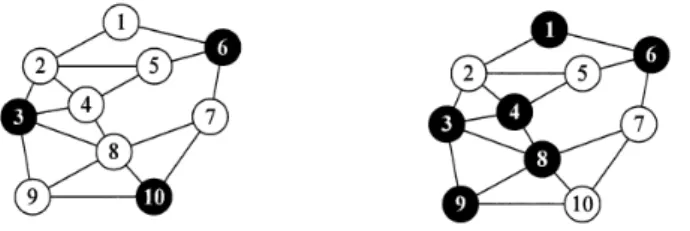
. In addition, we call it a polynomial‐delay algorithm if the following areFigure 1: Examples for a dominating set of a graph. Black vertices indicate vertices in dominating sets.
bounded by
O(poly(n))
: the time taken by the algorithm to output the first solution, the interval between outputting two consecutive solutions, and the time taken for the algo‐ rithm to terminate after outputting the last solution. Finally, we call it as an incremental polynomial‐time algorithm if these delays are bounded by poly (n, N'), where N' is thenumber of solutions that have already been generated by the algorithm. We now define the dominating set enumeration problem as follows:
Problem 1. Given a graph G, then output all dominating sets in G without duplication.
3
A Basic Algorithm Based on Reverse Search
In this paper, we propose an algorithm EDS‐D. Before we enter into details of EDS‐D, we first show the basic idea for them, called reverse search method that is proposed by Avis
and Fukuda [1] and is one of the framework for constructing enumeration algorithms.
An algorithm based on reverse search method enumerates solutions by traversing on an implicit tree structure on the set of solution, called a family tree. For building the family tree, we first define the parent‐child relationship between solutions as follows: Let
G=(V, E) be an input graph with
V={vı, . . . ,
v_{n}} and
Xand
Ybe dominating sets on
G. We arbitrarily number the vertices in G from 1 to n and call the number of a vertex
the index of the vertex. If no confusion occurs, we identify a vertex with its index. We
assume that there is a total ordering <onV according to the indices. pv (X), called the
parent vertex, is the vertex in V\backslash X with the minimum index. For any dominating set X
such that X\neq V, Y is the parent of X if Y=X\geq\{pv(X)\}. We denote by
\mathcal{P}(X)
theparent of X. Note that since any superset of a dominating set also dominates G, thus,
\mathcal{P}(X) is also a dominating set of G. We call X is a child of Y if
\mathcal{P}(X)=Y
. We denoteby
\mathcal{F}(G)
a digraph on the set of solutionsS(G)
. Here, the vertex set of \mathcal{F}(G) is S(G)and the edge set
\mathcal{E}(G)
of\mathcal{F}(G)
is defined according to the parent‐child relationship. Wecall \mathcal{F}(G) the family tree for G and call V the root of
\mathcal{F}(G)
. Next, we show that\mathcal{F}(G)
4 5 6 7 8 9 4 5 6 7 8 9 4 5 6 7 8 9 4 5 6 7 8 9 4 5 6 7 8 9 Output X; for v\in C(X) do
A1{\imath} Chi{\imath} dren(Y,C(Y), G);C(Y)arrow\{u\in C(X)|N[Y\backslash Yarrow X\backslash \{v\};\{u\}]=V\wedge \mathcal{P}(Y\backslash \{u\})=Y\}
; return;Lemma 1. For any dominating set X, by recursively applying the parent function
\mathcal{P}(\cdot)
to X at most n times, we obtain V.
Proof. For any dominating set
X, since pv (v) always exists, there always exists the parent
vertex for X. In addition,
|\mathcal{P}(X)\backslash X|=1
. Hence, the statement holds. \squareLemma 2. \mathcal{F}(G) forms a tree.
Proof. Let X be any solution in S(G)\backslash \{V\}. Since X has exactly one parent and Vhas
no parent, \mathcal{F}(G) has
|V(\mathcal{F}(G))|-1
edges. In addition, since there is a path between Xand V by Lemma 1, \mathcal{F}(G) is connected. Hence, the statement holds. \square
Our basic algorithm EDS is shown in Algorithm 1. We say C(X)the candidate set of X
and define
C(X)=\{v\in V|N[X\backslash \{v\}]=V\wedge \mathcal{P}(X\backslash \{v\})=X\}
. Intuitively, the candi‐ date set of Xis the set of vertices such that any vertex vin the set, removing vfrom Xgen‐erates another dominating set. we show a recursive procedure AllChildren (X, C(X), G)
actually generates all children of X on \mathcal{F}(G) . We denote by ch(X) the set of children of
X, and by gch(X) the set of grandchildren of X.
Lemma 3. Let X and Y be distinct dominating sets in a graph G.
Y\in ch(X)
if andonly if there is a vertex v\in C(X) such that
X=Y\cup\{v\}.
Proof. The if part is immediately shown from the definition of a candidate set. We
show the only if part by contradiction. Let Z be a dominating set in ch(X) such that
Z=X\backslash \{v'\}
, where v'\in Z. We assume that v'\not\in C(X). Fromv'\not\in C(X), N[\mathcal{P}(Z)]\neq V
or \mathcal{P}(Z)\neq X. Since Z is a child of X, \mathcal{P}(Z)=X, and thus,
N[\mathcal{P}(Z)]=V
. Thiscontradicts
v'\not\in C(X)
. Hence, the statement holds. \squareFrom Lemma 2 and Lemma 3, we can obtain the following theorem.
Theorem 4. By a DFS traversal of
\mathcal{F}(G),
EDS outputs all dominating sets in G onceAlgorithm 2: The algorithm enumerates all dominating sets in O(k) time per solution.
1 Procedure EDS‐D (G=(V, E)) //G: an input graph
2 3 2 3 2 3 2 3 2 3 2 3
foreach v\in Vdo D_{v}arrow\emptyset;
AllChildren
(V, V, D(V) :=\{D_{1}, \ldots, D_{|V|}\})
; 4 Procedure AllChildren (X, C, D) 5 6 7 8 9 10 11 12 13 14 5 6 7 8 9 10 11 12 13 14 5 6 7 8 9 10 11 12 13 14 5 6 7 8 9 10 11 12 13 14 5 6 7 8 9 10 11 12 13 14 5 6 7 8 9 10 11 12 13 14 5 6 7 8 9 10 11 12 13 14 Output X; C'arrow\emptyset;D'arrow D;//\mathcal{D}':=\{D\'{i}, D_{|V|}'\}
for v\in Cdo //v has the largest index in C
|
foru\in N(v)^{v<}doD_{u}arrow D_{u}\cup\{v\}A11Chi1dren(Y,C(Y),D(Y));D(Y)arrow
v' Y,,X,C(Y),C' \bigoplus_{;}C(Y), D')C'arrow C(Y);D'arrow D(Y);Yarrow X\backslash \{v\};Carrow C\backslash \{v\};,
DomList(
; // Remove vertices in
Del_{3}(X, v)
.
C(Y)arrow Cand-D(X, v, C); // Vertices larger than v are not in C.
15 Procedure Cand‐D (X, v, C) 16 17 18 19 20 21 22 16 17 18 19 20 21 22 16 17 18 19 20 21 22 16 17 18 19 20 21 22 16 17 18 19 20 21 22 16 17 18 19 20 21 22
Yarrow X\backslash \{v\};Del_{1}arrow\emptyset;Del_{2}arrow\emptyset; for u\in N(v)^{v<}\cup(N(v)\cap C)do
e1
seifu
<vthen|
el_{2}arrow Del_{2}(N[u]\cap C)|<u
ifN
[u]\cap(X\backslash C)\emptyset\wedge|N[u]\cap C|=2then D
;
return C\backslash (Del_{1}UDel ); //C is C(X\backslash \{v\})
23 Procedure DomList (v, Y, X, C'\oplus C(Y), D')
24 25 26 27 28 24 25 26 27 28 24 25 26 27 28 24 25 26 27 28 24 25 26 27 28 24 25 26 27 28
for u\in C'\oplus C(Y) do
forw\in N'(u)^{u<}do|^{ifu\not\in D_{w}(X)then}
if u\not\in C' then D_{w}'arrow D_{w}'\cup\{u\} ; else D_{w}'arrow D_{w}'\backslash \{u\} ;29 30 31 29 30 31 29 30 31 29 30 31 29 30 31 29 30 31 for u\in N(v)^{v<} do
|
if u\in Xthen D_{v}'arrow D_{v}'\cup\{u\};return D'; //D' is \mathcal{D}(Y)
4
The proposed algorithm
The bottle‐neck of EDS is the maintenance of candidate sets. Let X be a dominating
set and Y be a child of X. We can easily see that the time complexity of EDS is
O(\triangle^{2})
time per solution since a removed vertex u\in C(Y)\backslash C(X) has the distance at most two from v. In this section, we improve EDS by focusing on the degeneracy of an input graph
at most k. Matuıa and Beck show that the degeneracy and a degeneracy ordering of G
can be obtained in
O(n+m)time [12]. Our proposed algorithm EDS‐D, shown in
Algorithm 2, achieves amortized O(k) time enumeration by using this good ordering. In what follows, we fix some degeneracy ordering of G and number the indices of vertices
from 1 to n according to the degeneracy ordering. We assume that for each vertex v and
each dominating set X,
N[v]
and C(X) are stored in a doubly ıinked list and sorted by the ordering. Note that the larger neighbors of v can be listed inO(k)
time. Let usdenote by
V^{<v}=\{1,2, . . . , v-1\}
andV^{v<}=\{v+1, . . . n\}
. Moreover, A^{<v} :=A\cap V^{v<}and A^{v<}:=A\cap V^{<v} for a subset A of V . We first show the relation between
C(X)
andC(Y). Due to limitations of space, we omit the proofs of them.
Lemma 5. Let X be a dominating set of G and Y be a child of X. Then, C(Y)\subset C(X).
From the Lemma 5, for any v\in C(X), what we need to obtain the candidate set
of
Yis to compute Del (X, pv (Y)) :=C(X)\backslash C(Y) , where
Y=X\backslash \{v\}. In addi‐
tion, we can easily sort C(Y) by the degeneracy ordering if
C(X)
is sorted. In what follows, we denote byDel_{1}(X, v)=\{u\in C(X)|N[u]\cap X=\{u, v\}\}, Del_{2}(X, v)=
\{u\in C(X)|\exists w\in V\backslash X(N[w]\cap X=\{u, v\})\}
, andDel_{3}(X, v)=C(X)^{v\leq}
. By the fol‐lowing lemmas, we show the time complexity for obtaining Del (X, pv (Y)).
Lemma 6. Suppose that v\in C(X). Then, Del
(X, v)=Del_{1}(X, v)\cup Del_{2}(X, v)\cup
Del_{3}(X, v).
We show an example of dominated list and a maintenance of C(X) in Fig. 2. To compute a candidate set efficiently, for each vertex u in V, we maintain the vertex lists
D_{u}(X) for X . We call D_{u}(X) the dominated list of u for X . The definition of D_{u}(X)
is as follows: If u\in V\backslash X, then
D_{u}(X)=N(u)\cap(X\backslash C(X))
. If u\in X, thenD_{u}(X)=N(u)^{<u}\cap(X\backslash C(X))
. For brevity, we write D_{u} as D_{u}(X) if no confusion arises. We denote by\mathcal{D}(X)=\bigcup_{u\in V}\{D_{u}\}
. By using\mathcal{D}(X)
, we can efficiently findDel_{1}(X, v)
and
Del_{2}(X, v)
. Before showing the efficient dominated lists maintenance, we consider the sets of neighbors N(u)\cap C(X) andN(u)^{u<}\cap X
for each vertexu\in C(X)
We use these sets for computing dominated lists.Lemma 7. For each vertex v\in C(X), we can compute
N(v)\cap C(X)
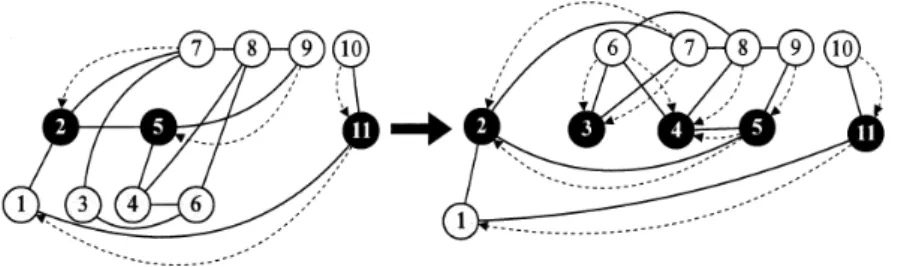
and N(v)^{v<}\cap XFigure 2: Let Xbe a dominating set {1, 2, 3, 4, 5, 6}. An example of the maintenance of C(X) and D(X) .
Each dashed directed edge is stored in D(X), and each solid edge is an edge in G. A directed edge (u, v)
implies v\in D_{u}(X). The index of each vertex is according to a degeneracy ordering. White, black, and gray vertices belong to V\backslash X, X\backslash C(X), and C(X), respectively. When the algorithm removes vertex
6, C(X\backslash \{6\})=\{1\}.
Lemma 8. Let X be a dominating set of G. Suppose that for each vertex u in G, we can
obtain the size of D_{u} in constant time. Then, for each vertex
v\in C(X)
, we can computeDel_{1}(X, v)
inO(k)
time on average over all children of X.Lemma 9. Suppose that for each vertex w in G, we can obtain the size of D_{w} in constant
time. For each vertex v\in C(X), we can compute Del_{2}(X, v) in
O(k)
time on average over all children of X.In Lemma 8 and Lemma 9, we assume that the dominated lists were computed when
we compute Del (X, v) for each vertex v in C(X) . We next consider how we maintain \mathcal{D}.
Next lemmas show the transformation from
D_{u}(X)
to D_{u}(Y) for each vertex uin G.Lemma 10. Let X be a dominating set, v be a vertex in
C(X)
, andY=X\backslash \{v\}.
For each vertex u\in G such that u\neq v,
D_{u}(Y)=D_{u}(X)\cup(N(u)^{<u}\cap(Del_{1}(X, v)\cup
Del_{2}(X, v)))\cup(N(u)^{<u}\cap(Del_{3}(X, v)\backslash \{v\}))
.Lemma 11. Let X be a dominating set, v be a vertex in
C(X)
, andY=X\backslash \{v\}.
D_{v}(Y)=D_{v}(X)\cup(N(v)<v\cap(Del_{1}(X, v)\cup Del_{2}(X, v)))\cup(N(v)^{v<}\cap X)
.We next consider the time complexity for obtaining the dominated lists for children of X. From Lemma 10 and Lemma 11, a naive method for the computation needs
O(k|Del(X, v)|+k)
time for each vertex v of X since we can list all larger neighborsof any vertex in
O(k)
time. However, if we already knowC(W)
and \mathcal{D}(W) for a childW of X, then we can easily obtain \mathcal{D}(Y), where Y is the child of X immediately after W. The next lemma plays a key role in EDS‐D. Here, for any two sets A, B, we denote by
A\oplus B=(A\backslash B)\cup(B\backslash A)
.Note that we can compute
C(Y)\oplus C(W)
when we compute C(Y) and C(W). From the above discussion, we can obtain the time complexity of AllChildren in EDS‐D. Lemma 13. Let X be a dominating set. Then, AllChildren(X, C(X), \mathcal{D}(X)) of EDS-Dother than recursive calls can be done in
O(k|ch(X)|+k|gch(X)|)
time.Theorem 14. EDS‐D enumerates all dominating sets in
O(k)
time per solution in ak‐degenerate graph by using
O(n+m)
space.5 Conclusion
In this paper, we proposed two enumeration algorithms. EDS‐D solves the dominating set enumeration problem in
O(k)
time per solution by usingO(n+m)
space, where k isa degeneracy of an input graph G.
Our future work includes to develop efficient dominating set enumeration algorithms for dense graphs. If a graph is dense, then k is large and G has many dominating sets. For
example, in the case of complete graphs, k is equal to n-1 and every nonempty subset
of V is a dominating set. That is, the number of solutions for a dense graph is much
larger than that for a sparse graph. This allows us to spend more time in each recursive call. However, EDS‐D is not efficient for dense graphs although the number of solutions is large.
References
[1] D. Avis and K. Fukuda. Reverse search for enumeration. Discrete Appl. Math.,
65(1):21-46, 1996.
[2] B. Brešar, M. A. Henning, D. F. Rall, et al. Rainbow domination in graphs. Taiwanese
Journal of Mathematics, 12(1):213-225, 2008.
[3] A. Conte, R. Grossi, A. Marino, and L. Versari. Sublinear‐Space Bounded‐Delay
Enumeration for Massive Network Analytics: Maximal Cliques. In ICALP 2016, volume 55 of LIPIcs, pages 148:1−148:15. Schloss Dagstuhl−Leibniz‐Zentrum fuer Informatik, 2016.
[4] J.‐A. A. d’Auriac, C. Bujtás, H. El Maftouhi, M. Karpinski, Y. Manoussakis, L. Mon‐
tero, N. Narayanan, L. Rosaz, J. Thapper, and Z. Tuza. Tropical dominating sets in vertex‐coloured graphs. In WALCOM 2016, pages 17‐27. Springer, 2016.
[5] D. Eppstein, M. Löfller, and D. Strash. Listing all maximal cliques in ıarge sparse
real‐world graphs. J. Exp. Algorithmics, 18:3.1:3.1−3.1:3.21, Nov. 2013.
[6] P. A. Golovach, P. Heggernes, M. M. Kanté, D. Kratsch, and Y. Villanger. Enu‐
merating minimal dominating sets in chordal bipartite graphs. Discrete Appl. Math.,
199(30):30-36, 2016.
[7] M. M. Kanté, V. Limouzy, A. Mary, and L. Nourine. Enumeration of minimal dom‐
inating sets and variants. LNCS, 6914 LNCS:298−309, 2011.
[8] M. M. Kanté, V. Limouzy, A. Mary, and L. Nourine. On the enumeration of minimal
dominating sets and related notions. SIAM J. Discrete Math., 28(4):1916-1929, 2014.
[9] M. M. Kanté, V. Limouzy, A. Mary, L. Nourine, and T. Uno. On the enumeration and
counting of minimal dominating sets in interval and permutation graphs. In ISAAC 2013, volume 8283 of LNCS, pages 339‐349. Springer Berlin Heidelberg, 2013.
[10] M. M. Kanté, V. Limouzy, A. Mary, L. Nourine, and T. Uno. Polynomial delay
algorithm for listing minimal edge dominating sets in graphs. In WADS 2015, volume 9214 of LNCS, pages 446‐457. Springer Berlin Heidelberg, 2015.
[11] D. R. Lick and A. T. White.
k‐degenerate graphs. Canadian J. Math., 22:1082−1096,
1970.[12] D. W. Matula and L. L. Beck. Smallest‐last ordering and clustering and graph
coloring algorithms. J. ACM,
30(3):417-427
, 1983.[13] K. Wasa, H. Arimura, and T. Uno. Efficient enumeration of induced subtrees in a
k‐degenerate graph. In ISAAC 2014, volume 8889 of LNCS, pages 94‐102. SpringerInternational Publishing, 2014.
Graduate School of Information Science and Technology Hokkaido University
Hokkaido 060‐0814
JAPAN