Reconstruction
of
Connected
Interval Graphs
Masashi
Kiyomi, Toshiki Saitoh, and
Ryuhei
Uehara
School of InformationScience, JAIST,
Asahidai 1-1, Nomi, Ishikawa 923-1292, Japan.
{mkiyomi,toshikis,uehara}@jaist.ac.jp Abstract
The graph reconstruction $coi$}$|ecture$ is a long-standing open problem in graph theory. There
are many algorithxnic studies related it besidesmathematical studies, such asDECK CHECKING,
LEGITIMATEDECK, PREIMAGE CONSTRUCTION, and PREIMAGE COUNTING. Westudy
these algorithmic problems limiting the graph class to interval graphs. Since wecansolve GRAPH
ISOMORPHISM for interval graphs in polynomial time, DECK CHECKING for interval graphs is
easily done in polynomial time. Wepresent in this paper that the other three problems above are
solvable in polynomial time on connected intervalgraphs.
Keywords: thegraph reconstmction conjecture, interval graphs, polynomial timealgorithm
1
Introduction
Given asimple graph$G=(V, E)$, we call the multi-set $\{G-v|v\in V\}$ the deck of$G$ where$G-v$ is a
graph obtained from $G$ by removing vertex $v$ and incident edges. The graph reconstruction conjecture
by Uram and
Kellyl
is that for any multi-set $D$ of graphs with at least two vertices there is at mostone
graph whose deck is $D$.
We call a graph whose dcck is $D$ a preimage of $D$.
No counter example isknown for this conjecture, and there
are
manymathematical results about this conjecture. For cxampletrecs, rcgular graphs, and disconnected graphs
are
reconstructible (i.e. the $coi$}$|ecture$ is true for theseclasses) [5]. About interval graphs, Rimscha showed that interval graphs are recognizable in the
sense
that looking at the deck of$G$ one
can
decide whether or not $G$ belongs to interval graphs [10]. Rimschaalso showed in the
same
paperthatmany subclassesof perfect graphsincludingperfect graphsthemselvesare
recognizable, andsomc
of subclasses including unit interval graphs are reconstructible. Thereare
manygood surveys about this conjecture. See forexample [1, 4].
Besides these mathematicalresults,there
are
some
algorithmic results. We enumeratethe algorithmicproblems that
we
addressin this paper..
Givenagraph$G$andamulti-setofgraphs$D$, check whether$D$isadeck of$G$(DECK CHECKING)..
Given a multi-setofgraphs$D$, determinewhether there is agraphwhose deck is$D$ (LEGITIMATEDECK).
.
Givena
multi-set of graphs $D$, constructa
graph whose deck is $D$ (PREIMAGECONSTRUC-TION).
.
Givena
multi-set of graphs $D$, compute the number of (pairwise nonisomorphic) graphs whosedecksare $D$ (PREIMAGE COUNTING).
lDetermining the first person who proposed the graph reconstruction conjecture is difficult, actually. See [4] for the
Graph class specified versioiis ofLEGITIMATE DECK and PREIMAGE
CONSTRUCTION assume
that preimagesarein thespecificdgraphclass. Kratsch and Hemaspaandra showed that theseproblems
arcsolvable inpolynomialtime for graphs ofbounded degree, partial k-trees for anyfixed $k_{I}$ andgraphs
ofbounded genus, inparticular forplannergraphs [7]. In thesamc paper they proved many GI related
complcxityresults.
There is alinear timcalgorithm for determiningifgiventwo interval graphsare isomorphic [9]. Thus
dcveloping a polynomial time algorithm for DECK
CHECKING
for interval graphs is easy.Theorem 1 There is an $0(n(n+m))$ time algorithm
of
DECKCHECKINGfor
n-vertexm-edge graphand its deck (or
a
deck candidate) that consistsof
interval graphs.We will givethe proof in
Section
3.LEGITIMATE
DECK,PREIMAGE
CONSTRUCTION, andPREIMAGE COUNTING
forcon-nected interval graphs
are
solvable by almost thesame
algorithm. In order to develop suchan
algo-rithm
wc
show thatgivena
set of$n$ interval graphs$D$ there is at most $O(n^{2})$ connected interval graphs(preimages)whose deck is$D$
.
Ifurtherwecan
construct such$O(n^{2})$ preimage candidates. Ouralgorithmchecks these $O(n^{2})$ candidates
one
byone
whether its deck is $D$ with DECK CHECKING algorithm.Our algorithm constructs $n$ preimage candidates from $O(n)$ different interval representations of each
intervalgraph in$D$ byinserting an intervalto them. The keyisthat the numberofpreimage candidates
is $O(n^{2})$ while anaive algorithmwhichinserts
an
intervaltoan
interval representation constructs$\Omega(2^{n})$candidatcs (Consider the case that $O(n)$ intervals terminate at some point $t$, and we insert a
new
leftend-point to$t$
.
Thenumberof the ways ofinsertionsis $\Omega(2^{n})$ since thereare $O(n)$times choices whctherthe
new
interval intersects the oldones.
Further, there may be many, say $O(2^{n})$, different compactintervalrepresentationsforan interval graph. Therefore the number of preimage candidates will be very
huge ifwe construct the candidatcs from all ofthem).
The followingis our main theorem.
Theorem 2 There
are
$O(n^{3}(n+m))$ time algorithmsfor
LEGITIMATE DECKandPREIMAGECON-$STR$UCTION, andthere is
an
$O(n^{4}(n+m))$ time algorithmfor
PREIMAGE COUNTING,for
connectedinterval graphs.
Notethat $n$ is the number of vertices and $m$ is thenumber ofedges in the preimage. Kelly’s lemma [5]
shows that we can compute $n$ and $m$ fromthe deck.
We state terminologies in Section 2, then explain about interval graphs in Section 3. In Scction 3
we introduce many small lemmas for those who unfamiliar to interval graphs. Most of these lemmas
may be well-knownand$/or$ basic for those who familiar to interval graphs and the theoryof PQ-tree [2]
and MPQ-tree [6]. However these lcmmas play important roles in this paper. Then
we
show that thenumber ofpreimagc candidates is $O(n^{2})$, and we present our algorithm in Section 4. Finally we makc
some remarks in Section 5.
2
Terminology
Graphs in this parer
are
all simple and undirccted, unless explicitly stated. We denote by $N_{G}[v]$ theclosed neighbor set ofvertex$v$ in graph G. “Closed”
means
that $N_{G}[v]$ contains $v$ itself. We dcnote by$\deg_{G}(v)$ the degree ofvertex$v$ ingraph $G$
.
We omit the subscript $G$ when there isno confusion aboutthe base graph. The
sum
of degrees of all vertices in graph $G$ is denoted by degsum(G). Notice thatdcgsum(G) is equalto twice the number of edges in $G$
.
We denote by $\tilde{G}$the graphobtained by
adding
one
universal vcrtex tothe graph $G$ such that thevertex connects to everyvertex in $G$.
Notice that $G$is always connected. Given twographs $G_{1}$ and $G_{2}$,
we
define the disjoint union $Gi\cup G_{2}$ of $G_{1}$ and $G_{2}$as $(V_{1}\cup V_{2}, E_{1}\cup E_{2})$ such that $(V_{1}, E_{1})$ is isomorphic to $G_{1}$, and $(V_{2}, E_{2})$ is isomorphicto $G_{2}$, where $\cup$
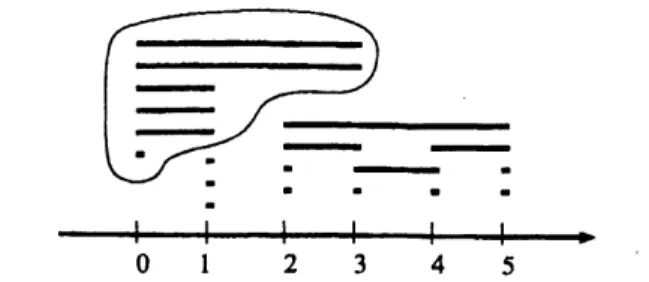
$\frac{Il1I1}{012345\prime-}!.$,
Figure 1: The figure shows a compact interval representation ofan interval graph. Every interval graph
has at least one compact interval representation. Vertices corresponding to the encloscd intervals
are
end-vertcx set.
3
Interval
Graphs
A graph $G=$ $(V, E)$ with $V=\{v_{1}, v_{2}, \ldots, v_{n}\}$ is
an
interval graph iff there is a multi-set $\mathcal{I}=$$\{I_{v_{1}}, I_{v_{2}}, \ldots, I_{v_{n}}\}$ ofclosed intervals on the real line such that $\{v_{i}, v_{j}\}\in E$ ifand only if
$I_{v_{t}}\cap I_{v_{j}}\neq\emptyset$
for cach $i$ and $j$ with $1\leq i,j\leq n$
.
We call the multi-set $\mathcal{I}$an
intervalrepresentation of$G$
.
An intervalgraph may have infinitely many interval representation. We
use
tractableone
called compact intervalrcpresentation amongthem.
3.1
compact
representation
and
basic lemmas
Definition 1 An interval representation $\mathcal{I}$
of
an
$inten!al$graph $G=(V, E)$ is compactiff
.
coordinatesof
end-pointsof
interwals in $\mathcal{I}$ arefinite
non-negative integers (We denote by $K$ the$la\tau gest$ coordinates
of
end-pointsfor
convenience. We sometimes call$K$ the lengthof
$\mathcal{I}$),.
there $e$ ists at leastone
end-point whose coordinate is $k$for
every integer$k\in[0, K]$, and.
$inten!al$ multi-set$\mathcal{I}_{k}=\{I\in \mathcal{I}|k\in I\}$differs from
$\mathcal{I}_{l}=\{I\in \mathcal{I}|l\in I\}$, and they do not includeeach other,
for
eve Zt distinctintegers $k,$$l\in[0, K]$.
Weshow
an
example ofacompact intervalrepresentationofan
interval graph in Fig. 1. Note that thercmay be still multiple compact interval representationsofan interval graph. However compact interval
represcntations have
some
good properties.Lemma 1 Let$\mathcal{I}$ and$\mathcal{J}$ be compact $inten!al$representations
of
an
interval graph $G=(V, E)$, and let$K_{1}$
be the length
of
$\mathcal{I}$, and let $K_{2}$ be the lengthof
$\mathcal{J}$.
Then the following holds.$\{\{I\in \mathcal{I}|0\in I\}, \{I\in \mathcal{I}|1\in I\}, \ldots, \{I\in \mathcal{I}|K_{1}\in I\}\}=$ $\{\{I\in \mathcal{J}|0\in I\}, \{I\in \mathcal{J}|1\in I\}, \ldots, \{I\in \mathcal{J}|K_{2}\in I\}\}$
Proof: Wc denote by $\tilde{\mathcal{I}}$
the set of multi-set of intervals $\{\{I\in \mathcal{I}|0\in I\},$ $\{I\in \mathcal{I}|1\in I\},$$\ldots,$ $\{I\in$
$\mathcal{I}|K_{1}\in I\}\}$, and
we
denote by $\vec{\mathcal{J}}$the set of multi-set $oi$ intervals $\{\{I\in \mathcal{J}|0\in I\},$ $\{I\in \mathcal{J}|1\in$
$I\},$ $\ldots,$$\{I\in \mathcal{J}|K_{2}\in I\}\}$
.
The vertices represented by the multi-set of intervals $\mathcal{I}_{i}=\{I\in \mathcal{I}|i\in I\}$correspond toa clique in$G$
.
Assume that $\mathcal{I}_{l}$never
appears in $\overline{\mathcal{J}}$ forsome
$i$
.
Since$\mathcal{I}_{*}$. represents a clique$C$, there must be aset ofintervals representing a clique C’ containing $C$ in $\overline{\mathcal{J}}$ (otherwise, clique $C$
can
not be represented in $\mathcal{J}$). Then for the
same
reason, $\tilde{\mathcal{I}}$must contain a set of intervals representing
a
cliquc containing $C$‘. This contradicts the compactness of$\mathcal{I}$
.
$\square$From the proof ofLemma 1, the followinglemmas
are
straight-forward.Lemma 2 Let$\mathcal{I}$ be a compact interval representation
of
an interval graph$G=(V, E)$, and let$K$ be thelength
of
$\mathcal{I}$.
Then $\{I\in \mathcal{I}|i\in I\}$boolean function deck-checking(graph $G=(V,$$E)$)
{
Let $G’$ bean cmpty graph.
for each vertcx $v\in V$ $\{ G’ :=G’\cup(G-v). \}$
if$G’$ is isomorphic to $G_{1}\cup G_{2}\cup\ldots\cup G_{n}$
return True else retum False.
$\}$
Figure 2: The deck checking algorithm.
Lemma 3 The length
of
a compact interwal representationof
an n-vertex$intert$)$al$graph is at most$n$.
Note that the number ofmaximalcliques in ann-vertex interval graph is at most $n$ (see [3]).
Lemma 4 All the compact interval representations
of
an
interval graph have thesame
length.Lemma 5 Intervals in
different
$C0tnpact$ interval representations corresponding to an identical vertexhave the
same
length.FromLemma 5, lengths ofintervals corresponding to a vertex that corresponds to
an
interval of lengthzero in
some
intervalrepresentationarealways (i.e. in anyintervalrepresentations) zero. Such vertexiscalled simplicial.
Noticc that allthemembers inadeck of
an
interval graphareinterval graphs sinceremovinga vcrtexfrom an interval graphresults in another interval graph.
3.2
deck
checking
Now
we
prove Theorem 1. Our main algorithm enumerates the preimagecandidates, andchccks whethereach candidate is really
a
preimage of the input deck. Thus the theorem isone
ofthe basic part ofouralgorithm.
Proof: [Proof ofThcorem1] We
can
determine whetheror
notthe given multi-set$D=\{G_{1}, G_{2}, \ldots, G_{n}\}$is a deck ofthe input graph $G$ by checking whether or not $G_{1}\cup G_{2}\cup\ldots\cup G_{n}$ is isomorphic to the deck
of$G$
.
Since the disjoint umion of two interval graphs isan
intervalgraph, we can usewcll-known linear
time isomorphismalgorithm[9] for this checking. Wedescribethe algorithminFig. 2. Since the number
of vertices of$G_{1}\cup\ldots\cup G_{n}$ is $O(n^{2})$, and since the number ofedges of $G_{1}\cup\ldots\cup G_{n}$ is $O(mn)$, the time
complexity of this algorithm is $O(n(n+m))$
.
$\square$4
Main Algorithm
First we define end-vertex set. The end-vertex set is intuitively a set ofvertices whose corresponding
intervals are at the left cnd. Our algorithm adds a vertex adjacent to all the vertices in
an
end-vcrtexset of an interval graphin the input deck. This enables
us
to avoid exponential timcs’ constructions ofpreimage candidates.
Deflnition 2 For
an
interval graph $G=(V, E)$ ,we
call a vertex subset $S\subset V$ an end-vertes setiff
in some compact intervd representation $0\int G$ all the coordinatesof
theleft
end-pointsof
intervalscorresponding to vertices in $S$
are
$0$, and$S$ isma
rimal among such vertex subsets.See Fig. 1 for example. It is well-knownthat an end-vertex set has at least onesimplicial vertex.
Weshow
some
simplelemmasaboutend-vertex sets. Wecan
estimate that thenumbcr ofessentiallyLemma 6 Let $S$ be end-vertex set
of
an interval graph $G=(V, E)$.
If
two vertices $v$ and$w$ in $S$ havethe
same
degree, then $N[v]$ and$N[w]$are
thesame
vertex subsetof
$G$.
Proof: The statement is clearfrom the definitionofcompactinterval representation (see Fig. 1 for the
better understanding). $\square$
Lemma 7 A connected interwal graph has at most $O(n)$ end-vertex sets.
Proof: An end-vertcx set of an interval graph $G$ is in the form $\{I \in \mathcal{I}|0\in I\}$ for
some
intervalrepresentation$\mathcal{I}$ of$G$
.
Thus, ffom Lemma 1 and 3, thereare
atmost $O(n)$ end-vertex sets for G. $\square$
Nowwe refer thewell-known lemma about the degree sequence.
Lemma 8 (Kelly’s Lemma [5]) We
can
calculate the degree sequenceof
a preimageof
the input $n$graphs in $0(n)$ time,
if
we
know the numberof
edges in each input graph.Proof: Lct $G_{1},$ $G_{2},$
$\ldots,$$G_{n}$ be the input graphs. Assume that graph $G$ has a deck $\{G_{1}, G_{2}, \ldots , G_{n}\}$
.
Then there
are
vertices $v_{1},$ $v_{2},$$\ldots,$$v_{n}$ such thatG.
is obtained by removing $v_{i}homG$ for each $i$ in$\{$1,2,
$\ldots,$$n\}$. Thus
degsum$(G_{i})=$ degsum$(G)-2\deg_{G}(v_{t})$
holds forcach$i\in\{1,2_{1}\ldots, n\}$
.
Hencewe
havedegsum(G) $= \frac{\sum_{i=1}^{n}\deg\S um(G_{i})}{n-2}$
.
Therefore
we
can
easilycalculate the degreesequenceof$G$,i.e., (degsum$(G)-$degsum$(G_{1})$)$/2,$$(degsum(G)-$degsum$(G_{2}))/2,$$\ldots$ ,(degsum$(G)$ –degsum$(G_{n})$)$/2$
.
Wc
can
calculate degsum$(G_{i})$ in constant time, providedwe
know the number $m_{i}$ of edges in $G_{i}$, fordegsum$(G_{i})$ is equal to $2m_{i}$
.
Thus the time complexity to calculate degsum(G) is $O(n)$, and the totaltime complexity toobtain the degree sequence of$G$ is also $O(n)$
.
$\square$Now
we
prescntan
algorithm for reconstructingaconnected interval graph. Suppose thatann-vcrtexconnccted interval graph $G$ has a deckof interval graphs $\{G_{1}, G_{2}, \ldots , G_{n}\}$
.
Let $\mathcal{I}$be acompactintervalrepresentation of $G$
.
There must be an index $i\in\{1, \ldots, n\}$ such that $G_{i}$ is obtained by removinga
simplicial vertcx $s$ in the end-vcrtcx set $S$ corresponding to $\mathcal{I}$.
We want to reconstruct $G$ from$G_{1},$
$\ldots,$$G_{n}$. To do so, we first show that we can reconstruct $G$ if we know the index
$i$
.
Once we provethis,
we can
reconstruct $G$ by checking if$G_{j}$ is the desired $G_{i}$ for every$j\in\{1, \ldots, n\}$.
It is clear that $S\backslash \{s\}$ is contained in
some
end-vertex set $S’$ of $G_{i}$.
Ofcourse
we
do notknow
$S’$if we do not know $S\backslash \{s\}$
.
However the number ofthe candidates of $S$‘ is $O(n)$ by Lemma 7. Thuschccking if each candidate is $S’$ can be done by $O(n)$ times tryingofthe algorithmbelow. Lct $\mathcal{I}_{i}$ be an
interval rcpresentation of$G_{i}$ whose correspondingend-vertex set is $S’$
.
Notice that $\mathcal{I}_{i}$ is easily obtainedin $O(n+m)$ time by usingthe data structure called MPQ-tree [6] ifwe know $S’$
.
Nowwetry to know$S\backslash \{s\}$
.
Ifweknow$S\backslash \{s\}$,we canobtain$G$,since$G$has the intervalrepresentationobtained $h:om\mathcal{I}_{i}$ byextendingintervalscorresponding to vertices in$S\backslash \{s\}$tothe left byoneand adding
an interval $[-1, -1]$
.
Thereforeweneed to know $S\backslash \{s\}$.
Sincewe knowthe degree sequence of$G_{i}$, andwe can know the dcgree sequence of $G$ by Lemma 8, we
can
know the degree sequence of$S\backslash \{s\}$.
Wedenote the degree sequence by $(d_{1}, d_{2}, \ldots, d_{t})$
.
Nowwe
can
obtain $S\backslash \{s\};S\backslash \{s\}$ is the subset of $S’$such that whosc degree sequence in $G_{i}$ is $(d_{1}-1, d_{2}-1, \ldots, d_{l}-1)$
.
Notice that there may be manysubsets of$S$‘ whosedegreesequences in $G_{i}$
arc
$(d_{1}-1, d_{2}-1, \ldots, d_{l}-1)$.
However Lemma 6 guaranteesthat any of such subsets can be $S\backslash \{s\}$, i.e. all the graphs reconstructed in the assumption that some
subset of$S$‘ whose degreescquenceis $(d_{1}-1\rangle d_{2}-1, \ldots, d_{l}-1)$
are
$S\backslash \{s\}$are
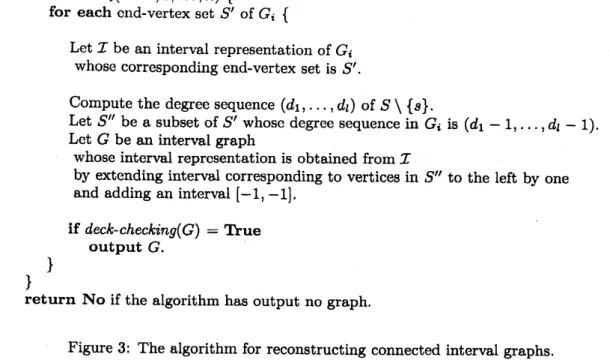
isomorphicto eachother.for each $G_{i}(i=1,2, \ldots, n)$
{
for each end-vertex set $S’$ of$G_{i}$
{
Let $\mathcal{I}$be
an
intervalrepresentation of$G_{i}$
whose corresponding end-vertexset is $S’$
.
Computethe degreesequence $(d_{1}, \ldots, d_{l})$ of$S\backslash \{s\}$
.
Let $S”$ be
a
subset of$S’$ whosc dcgreesequence in $G_{i}$ is $(d_{1}-1, \ldots, d_{l}-1)$.
Let $G$ be
an
interval graphwhose intervalreprcsentation is obtained from$\mathcal{I}$
by extending interval corresponding to verticesin $S”$ to the left by
one
and adding an interval $[-1, -1]$
.
ifdeck-checking$(G)=$ True
output $G$
.
$\}$ $\}$
return No ifthe algorithm has output no graph.
Figure 3: The algorithmfor reconstructing connected interval graphs.
Now
we
consider thetimecomplexity ofthis algorithm. Because of the space limitationwe
omit thcdetail of the basic algorithms about MPQ-tree. For each$G_{l}$, calculatingan MPQ-tree of$G_{i}$ in$o(n+m)$
time helps
us
to list each $S$‘ and $I$ in $0(n)$ time. Computing the degrce sequence $(d_{1}, d_{2}, \ldots, d_{l})$ takcs$O(n)$ timefromLemma8. Sinceobtaining$S”$needs sorting ofthedegreesequence, it requires$o(n\log n)$
time. It is clear thatreconstructinganintervalgraph$hom$itsintervalrepresentation takes$O(n+m)$ time,
ifthe end-points of intervals
are
sorted. DECKCHECKING algorithmcosts $O(n(n+m))$.
Thereforethctotal time complexity of this algorithm is $O(n((m+n)+n(n+m+n\log n+n(n+m))))=O(n^{3}(m+n))$
.
Note that we have to check every output preimage is not isomorphic to each other for PREIMAGE
COUNTING. Since the number of output preimagemay be $O(n^{2})$, wenecd $O(n^{4}(n+m))$ time for this
checking. If the graph reconstruction conjecture is true, the time complexity of this checking
can
beomitted.
Theorem 3 There isapolynomial time algorithm thatlists up connectedinterval graphs that
are
preim-ages
of
the input $n$ interval graphs. The time complexityfor
outputtingone
connected interval graph is$O(n^{3}(n+m))f$ and that
for
outputting all is $O(n^{4}(m+n))$.
Thcreforc
we
have the main theorem (Theorem 2).5
Concluding Remarks
The algorithms
we
described does not help directly theproofofthe graph rcconstruction conjecture oninterval graphs. The conjecture on intervalgraphs remains to beopen.
Thccomplexitiesofgraphreconstruction problemsarestronglyrelated$tQ$that of graphisomorphism
problcms, To develop
a
polynomial time algorithmfora
graphreconstruction
problem restricting inputsto be in GI-hard graph class
seems
very hard. Since graph isomorphisms of circular-arc graphsare
References
[1] J. A. Bondy: A graph reconstructor’s manual. Surveys in Combinatorics, London Mathematical
Society Lecture Note Series, vol. 166 (1991) 221-252.
[2] K. S. Booth andG. S. Lueker: Testingfor theconsecutive
ones
property, interval graphs, and graphplanarityusing PQ-troe algorithms. Joumal
of
Computer and SystemSciences, vol. 13 (1976)335-379.
[3] D. R. lfulkersonand O. A. Gross: Incidence matrices and interval graphs.
Pacific
Joumalof
Math-ematics, vol. 15 (1965) 835-855.
[4] F. Harary: A survey of the reconstructionconjecture. Graphs and Combinatorics, Lecture Notes in
Mathematics, vol. 406 (1974) 18-28.
[5] P. J. Kelly: A congruencetheorem for trees.
Pacific
Joumalof
Mathematics, vol. 7 (1957) 961-968.[6] N. Korteand R. H. Mohring: An incremental linear-timcalgorithmfor recognizing intervalgraphs.
SIAM Journal on Computing, vol. 18 (1989) 68-81.
[7] D. Kratsch and L. A. Hemaspaandra: On the complexity of graph reconstruction, Mathematical
Systems Theory, vol. 27 (1994) 257-273.
[8] C. G. Leckerkerker and J. Ch. Boland: Representation ofafinite graphby a set of intervalson the
real line. hndamenta Mathematicae, vol. 51 (1962) 45-64.
[9] G. S. Lueker and K. S. Booth: A linear time algorithm for deciding interval graph isomorphism.
Journal
of
the ACM, vol. 26 (1979) 183-195.[10] M. von Rimscha: Reconstructibility andperfect graphs. Discrete Mathematics, vol. 47 (1983)