Distinguishing
Discretization
and Discrete Dynamics, with Application to Machine Learning, Ecology, and Atomic PhysicsKarl
Gustafson
*Abstract. The distinction between the discretizingof acontinuous dynamicalsystem, and
an
anal-ogous
discretedynamical system, is examined. Anumber of critical conceptual misunderstandingsare
identified, in historical context. Implications for the internal structures in machine learning,ecological dynamics, and atomic
wave
systems,are
discussed.51.
Introduction. In arecent paper [GusOO] Ipromised “to analyze from ahistorical perspective how this rather fundamental findingwas
previously missed.” Thefundamental findingreferred towas
abasicconnection Idiscovered (adozenyears
ago) between widelyusedrecently developed ma-chine learningalgorithms and the recently developingtheoryof chaotic discretedynamical
systems.My discovery
moreover
impliedsome
critical conceptual misunderstandings within both thema-chine learning community and the dynamical system community. The first
purpose
ofthe present paper is to keep my promise of [GusOO]. In doing this Iwill go beyond [Gus 00, Gus90, Gus97,$\mathrm{G}\mathrm{u}\mathrm{s}98\mathrm{a}$, $\mathrm{G}\mathrm{u}\mathrm{s}98\mathrm{b},\mathrm{G}\mathrm{u}\mathrm{s}98\mathrm{c}$, GS99], referring to those
papers
forconvenience. Asecond purpose is togo beyondmy previous work by discussinghere also certainimplications for the internalstructures
of population dynamics and quantum
wave
system dynamics.52.
Machine Learning. In1988 as
aresult of asuccessfulinterdisciplinary proposal foran
NSF EngineeringResearch Center
for Optoelectronic Computing Systemsat the UniversityofColoradoand Colorado State University, Ifound myself responsible for the mathematics and algorithm de-velopment to accompany
an
optical neural network being constructed in hardware. The originalPerceptronmachine learningalgorithm, which was linear, had beenby then superseded by the
im-portant Backpropagation algorithm. Backpropagation
overcame
many learning limitations of thelinear Perceptron. Thiswas accomplished in Backpropagation by introducingnonlinearthresholds,
typically implemented by sigmoids$f(x)=(1+e^{-\beta x})^{-1}$
.
Irefer the reader to the bibliography andin particular to [RM86] for agood discussion of Badcpropagation (also called other
names
suchas
the $\delta$-rule, multilayer perceptron, etc.). For thepurposesof this paPer,
we
maydescribeBackprop-’DepartmentofMathematics, UniversityofColorado, Boulder,Colorado 80309-0395,USA
数理解析研究所講究録 1271 巻 2002 年 100-111
agation learning as the building of alearning surface (sometimes called the learning landscape)
in multidimensional space on the basis ofanumber of repetitive training examples (input-0utput pairs).
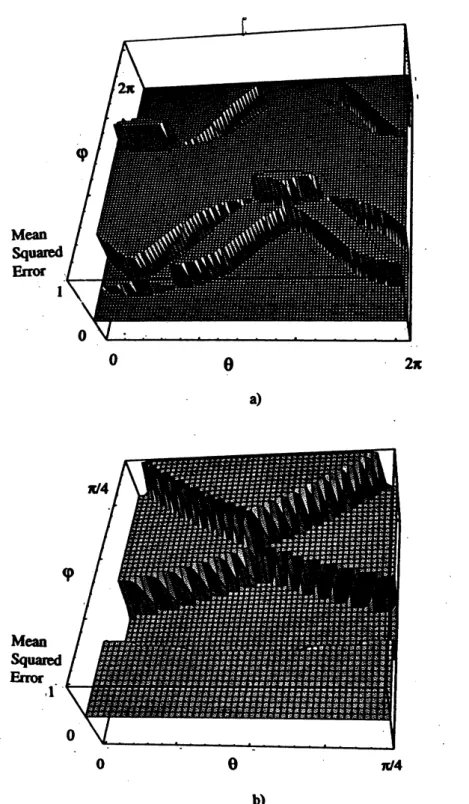
Tofix this idea, Ishow in Figure 1such alearning surface from [GG92]. In that (unpublished) paper,
we
modified Backpropagation to an algorithm we called Anglelearning Backpropagation,or
Angleprop for short. You may view Figure 1asdepicting
conceptually thesame
type of landscapes the standard Backpropagation algorithm generatesas
aresult of alarge number of training pairs repetitively fed to it. Because Backpropagation learns this surface by arepetitive steepest descentprocedure,
convergence
to the valleys (which carry smaller least squareserror
than mountainsor
plateaus) is often very slow, especially if the previous training iteration put you on
one
of theplateaus. Our idea in Angleprop
was
to just learn the angles between weights, rather than the weightsthemselves.
Iinclude Angleprop here to show you typical Backpropagationerror
surfaces, and because [GG92] wasnever
published elsewhere and contains an interesting original idea. See also [WUG94] forsome
recent nice pictures ofsuchlearning surfaces from the Japaneseengineering community.When we went to implement Backpropagation on the hardware optical neural network, I
learned that theoptical devices
were
not available to usto implement the thresholdings. Therefore wejust took this optical data out to adigital computer to do all thresholdingand then went backinto the optics for the next training epoch. At that point Ilearned that
one
reason
the sigmoid thresholdingwas so
popular in the machine learningcommunitywas
that it had the niceproperty that itsderivativeis convenientlyexpressed in termsof itself: $\mathrm{f}’\{\mathrm{x}$)$=\beta f(x)(1-f(x))$
.
Inparticular, in theBackpropagation algorithm, thispermits the weight changes $\triangle\omega_{ij}$ tobecalculatedintermsofcurrently known network values. AlthoughtheBackpropagationupdateformulas becomesomewhat
complicateddue to lots ofneural networkinterconnectivityandfeedback,
one
can
see
that they take the form (at an output node, for simplicity) $\triangle\omega_{ij}=\eta f’(\mathrm{n}\mathrm{e}\mathrm{t})(t_{\ell}-\mathit{0}_{\ell})\mathit{0}_{j}=\eta(t_{\ell}-\mathit{0}\ell)\beta o_{\ell}(1-\mathit{0}_{\ell})\mathit{0}_{j}$
where $t\ell$ is alearning target value,
$\mathit{0}_{\ell}$ is the net output at the current $k\mathrm{t}\mathrm{h}$ iteration,
$\mathit{0}_{j}$ is the
transmitting node value, $\eta$ is apreassigned learning parameter, net is alinear combination of
weighted inputs being fed to the nodes, and $\beta$ is the s0-called gain. If
we
lumpfactors
inwe
maysee
that the digitally implemented Backpropagation weight updatesare
each of the form$x_{n+1}=\mu x_{n}(1-x_{n})$, which is the discrete iterated quadratic map of dynamical
systems theory
0
9
$2\pi$ a)b)
Figure 1: Aplot of theerrorfor theXORproblemversustheangles of the weights
relative to the bias axis andoneoftheweight axes, a) Aglobal view of theerror
surface, b)An enlargedviewof solutioninlower lefthandcorner. Noteconstrained
location of solution
Ilearned in the period 1988-1990that virtually everyone in the machine learning community
was implementing Backpropagation, or similar thresholding multilayer perceptron algorithms, dig-itally. Yet they all
were
also viewing the thresholdingas
it appears in Figure 1, they spoke of itthat way, they viewed it that way, in terms of acontinuous steepest descent minimizing path down
to aleast squares cost function surface. Ihinted at my discovery oflocal discrete quadratic map
dynamics due to digital implementation in [Gus90] but it was only
some
years later after Ihad ascertained to the best ofmy ability thatno one
else shared my discovery, that Ipresented this finding rather completely in $[\mathrm{G}\mathrm{U}\mathrm{S}98\mathrm{c}]$.Recall that the quadratic mapis well-known to map the interval$0\leqq x\leqq 1$ tozero independent
of initial
guess
$x_{0}$, when $\mu<1$.
For $1<\mu<3$one
converges toanonzero
stationary point. For$\mu>3$ the quadraticmap may exhibit periodic orbits, aperiodic orbits,
or
chaos. As the simulationsof [$\mathrm{G}\mathrm{u}\mathrm{s}98\mathrm{c}$, GusOO] show, neural networks implementing Backpropagation do exhibit the
same
three qualitative behaviors. Although network connectivity, input and target values; initial weight
choices, learning parameter, etc., all the complexity ofthe learning network architecture and data,
may affect which of these basic behaviors you see, amain point is that this quadraticmap behavior
within aneural network is completely local, i.e., it applies to each individual node in the network.
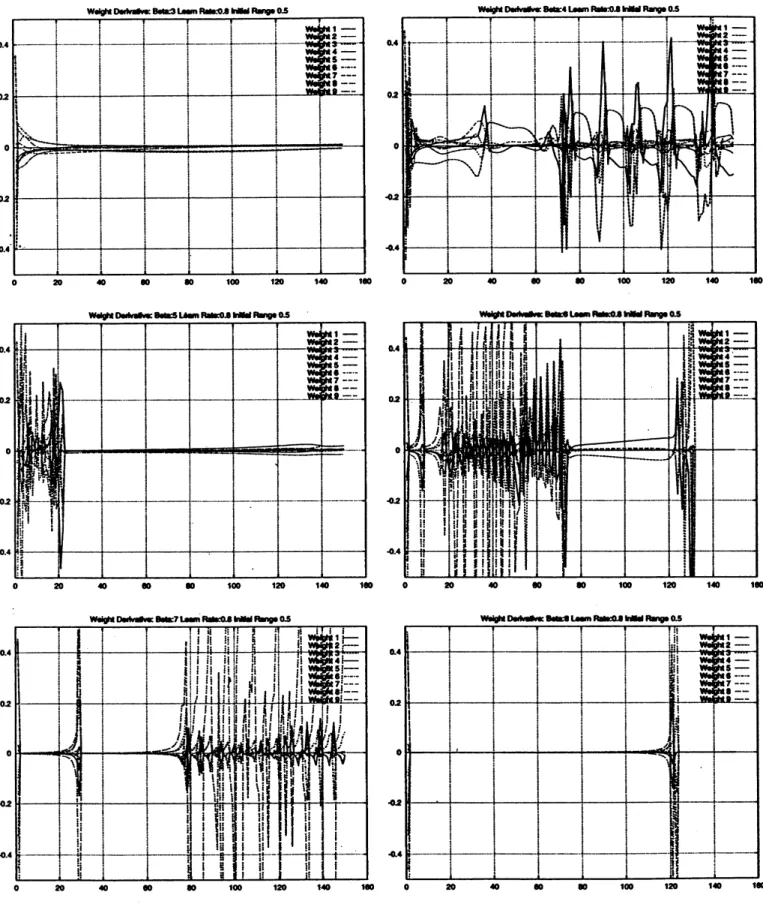
Iillustratethis here in Figure 2. This Figure is the detail of the fourth column of [$\mathrm{G}\mathrm{u}\mathrm{s}98\mathrm{c}$, Figure
2]. As gain $\beta$ increases through values $\beta=3,4,5,6,7,8$, one
sees
weight change behavior varyingfrom rapid
convergence
tozero
to intermittent oscillations to oscillatorynonconvergence.
\S 3.
Historical Comment. Above Ihave pointedouthow the machine learning community missed the fact thateven
the local node-specific learning dynamicswas
that (when implemented digitally)of the quadratic map of discrete dynamical systems theory. This fact was obscurred by thestrong historical and cultural dogma influenced by the conceptual transition from the linear Perceptron to the nonlinear, smoothly thresholded multilayer perceptron, with its smooth slopes and ravines, upon which you can do gradient descent. That is not to say that others in the machine learning community had not happened onto notions
or
experience of chaos within neural network theory or practice. But (to my knowledge), allwere
confused by failing to distinguish the fundamental differences between continuous and discrete dynamical systems,or
theywere
influenced too much by analogy,or
therewas
confusion about onset of chaos being caused by high connectivityor
large scale. Rather thanrepeatmydiscussions of these things already in [GusOO] and$[\mathrm{G}\mathrm{u}\mathrm{s}98\mathrm{c}]$,letme
justFigure 2: Discretequadraticmap irregularitiesin weight changedynamics. Learningparameter$\eta=0.8$
and the initial weights chosen randomly in (-0.5, 0.5), the same initial weights then used for each gain
parameter$\beta$$=3,4,5,6,7,8$. Notethe network internal nonlinear waves, whichoften appeartobe coupled
refer the reader to those papers, with the accompanying summarizingremark here that in [GusOO]
and $[\mathrm{G}\mathrm{u}\mathrm{s}98\mathrm{c}]$ you will find specific reference to, citation to, quotes from, the books of
Devaney, Strogatz, Ott from discrete dynamical systems community, the books of $\mathrm{R}\mathrm{u}\mathrm{m}\mathrm{e}\mathrm{l}\mathrm{h}\mathrm{a}\mathrm{r}\mathrm{t}-\mathrm{M}\mathrm{c}\mathrm{C}\mathrm{l}\mathrm{e}\mathrm{l}\mathrm{l}\mathrm{a}\mathrm{n}\mathrm{d}$ ,
Hertz, Levine, Wiegand-Gershenfeld, Kosko from the machine learning community, all excellent books and outstandingscientists. Ialsocite in [GusOO] and $[\mathrm{G}\mathrm{u}\mathrm{s}98\mathrm{c}]$asignificantnumberofpapers
dealing with chaos in machine learning. Let me add afew more here which have become known to
me and which may be helpful from the historical or conceptual perspectives to anyone who wishes to further pursue this work.
In [SF87]
an
early attempt is made to bridge the recently developed“corinectionist”
models(e.g., machine learning algorithms and neural network architectures) to actual brain function.
To quote from the abstract: “Special emphasis is placed in our model on chaotic activity. We hypothesize that chaotic behavior
serves
as
the essential ground state for the neural peceptualapparatus.” However, the point of view of [SF87] is that the role of chaos in the brain is that of
a
source ofbackground white noise as observed in EEG studies. Then they adopt the Grassberger-Procaccia et al. model oflow-dimensional deterministic (continuous) dynamical system “strange
attractor” chaos. Also they [SF87, p. 190] “we insist repeatedly that behaviorally relevant neural
information is to be found in the
average
activity of ensembles (as manifested in the EEG) and not in the activity of single neurons.” And [SF87, p. 171] “Connectionist models can certainly be modified to produce chaotic and oscillatory behavior, but current theorists have not includedthese behaviors in their models,.
. . .
Another [reason] is that engineers have traditionally viewedoscillatory and chaotic behavior
as
undesirable and something to be eliminated.” [SF87] also contains an interestingadjoined Open Peer Commentaryby manyof theeminent researchersof thetime, so the whole paper is interesting reading. My final point about it is the following. [SF87], representing the brain-science community, wants to get rid ofthe digital computer metaphor that
the rival connectionist community employs. In doing so, [SF87] goes to the continuous dynamical
system chaos models. Thus they have missed my finding that in the digital connectionist models, single
neuron
chaoswas
already present. The connectionist community missed this fact too.Another interesting earlierpaper is [Ha83]. The emphasis there is on “higher” neural
process-ing accomplished by incorporating not only current information but also time-delayed connected
information. However there is also
some
discussionof individual “trajectories for the netlet,” whicin turn leads to discussion ofattractors and the low dimensional (continuous) dynamical system theoryofchaos
so
popular inthe $1980\mathrm{s}$.
What interestsme
about thisearlypaper is that it actuallypresents [Ha83, p. 786] “the parabola $F(x)=4bx(1-x)$, $0<b\leq 1$”as an example of amap which “willbe chaotic forcertain
ranges
of values of$b$and for certain ‘seed’ values of$x.$” Howeveragain (in my opinion) abetter understanding
was
obscured by not distinguishing andeven more
delineatingthe continuous chaos paradigm ffom the discrete chaos paradigm.\S 4.
Ecological Dynamics. In [GusOO] Istate: “To May through his influential 1976 paper[Ma76] belongs much credit for the
resurgence
of recent interest in simple discrete maps, includingthe quadraticmap. However, in
our
opinion, theuse
of the words ‘analogous, corresponding’in the transition from population dynamics $P’(t)=aP(t)-bP^{2}(t)$ tomap
equations $y_{n+1}=ay_{n}-by_{n}^{2}$is misleading. There is
no
way that youcan
discretize the former to obtain the latter in thesense
of differential equations going to consistent difference equations, e.g.see
[Gus99]. Succeeding treatises of discrete dynamical systems continue to fall into this (inour
opinion) trap.77 Iwould like to elaborate this statement here, beyond what Isaid in [GusOO] and $[\mathrm{G}\mathrm{u}\mathrm{s}98\mathrm{c}]$.
The ordinary differential equation initial value problem $\frac{d}{}dRt=ap-\psi^{2}$,$p(t_{0})=p_{0}$
occurs
widelyin science. In mathematics it falls within the category of Riccati equations. Its solution is easily found to be $p(t)= \frac{ap_{\mathrm{O}}}{b\mathrm{p}\mathrm{o}+(a-b\mathrm{p}\mathrm{o})e^{-a(l-\iota_{0\mathfrak{l}}}}=\frac{1}{1+e^{-\beta l}}$ where in the last equality Itook $a=b=\beta$,
$p_{0}=1/2$, $t=0$
.
Discretization of adifferential equation, e.g., to render adiscrete version of it for numerical solution methods, usually carries the desired requirement of consistency: the true solution, when substituted into the discrete version, has truncation
error
which goes tozero as
the discretization size becomes arbitrarily small. The obvious finite difference discretization of the initial valueproblemis theforward difference $\frac{\mathrm{p}(t+\Delta t)-\mathrm{p}(t)}{\Delta t}=\beta p(t)(1-p(t))$ which is justthedifference quotient
approximation to the first derivative. In this simple instance, consistency just reduces to the fact
that thedifference quotient rule of elementary calculus is aconsistent oneand the sigmoid function
is differentiate.
However,
now
note that discrete quadratic map has virtuallyno
connection to the continuousparameter differential equation from the point of view of discretizing the former to get the latter.
Nor can you work back ffom the latter,
as
if itwere
adiscretization, to get theformer. Ifyou trya
few obvious discretization schemes, you willsee no
naturalconnections between the two equations.Therefore Ithink agood word is incommensurate: the population dynamics equation and the
quadratic map equation, although analogous, are incommensurate.
\S 5.
Historical Comment. May [Ma76] popularized the mathematics of iterated maps and imagined them to be apossible explanation of the oscillations he had observed in populationdynamics. Gleick [G187] gives agood account of this story. Then [G187, p. 80]: “May realized
that the astonishing structures he had barely begun to explore had no intrinsic connection to biology.” But [G187] does not develop this latter statement. Let
me
doso
here. If you look at [Ma81] you will find alowered emphasison
the potentialuse
of iteratedmaps
for such ecological population modelling. May clearly [Ma81, Chapter 2] now restricts the conceptual use of one-dimensional quadratic maps to models for single populations. The assumption has to be [Ma81, p. 6] that “generationsare
nonoverlapping and growth is adiscrete process (first order differenceequations).” Then for continuous growth, differential equations
are
proposed [Ma81, section 2.2].However, to fit population data, time delays
are
also allowed into these equations. This is okay, these continuous population models have served ecological dynamics well, but it should be noted at this point that mathematicians’ know well that differential-delay equations can model awidevariety of dynamics. When we get to the main section 2.3 of [Ma81], Discrete growth (difference
equations),
some
actual ecological examplesare
claimed. However, the discussion quickly slides away from the biology and into the iterated map mathematical lore. Without asingle specific ecological data set yet, wecome
to the statement [Ma81, p. 17]: “To see mathematical ecology informing theoretical physics is apleasing inversion of the usual order of things.” Without any ecology yet, this would appear tome
to be inverted logic. Whenwe
do get to population data,one
resorts to time delayor
thecontinuous dynamics models. In Fig. 2.6 [Ma81, p. 21], Fig. 6[Ma76],we find only
one
data point in the “chaos” region, and that not for aquadratic equation, ratherfor afit by $y_{t+1}\cong 60\mathrm{y}\mathrm{t}(1+y_{t})^{-10}$.
To this day, confusion persists about the appropriate roles ofdiscrete and continuous chaos. By this Imean, respectively: chaoticiterative dynamicsproducedby
an
iterateddiscretedynamical system, and chaotic dynamics produced by the continuous time evolution of anonlinear system ofordinary differentialequations. For example, beyond the popular quadratic map, another popular
discretedynamical system is thequadraticHenon-Heilesmap,
see
[Ta89]. Perhaps the mostpopularexampleofacontinuous chaoticdynamical systemisthefamousquadraticLorenzsystemwhich
was
an
extreme simplificationof
the partialdifferential
equationsof
meteorology.See
the discussions in [G187], [Ta89], and elsewhere. Both the Lorenz continuous dynamical system and the Henondiscrete dynamical systempossess strange attractors. What Iam asserting above in Section 4and
throughout this paper is that the algebraic similarities in $fom$ between the discrete dynamical
systems and the continuous dynamical systems equations
can
be critically misleading, andone
cannot assert apriori any ‘corresponding’ behavior in their dynamics without afurther analysis
which would (unlikely in most instances) prove such.
How this confusion happens? Iwould like to identify two key factors, although there
are
certainly others. Letme
briefly present these two factors: analogy and vocabulary. The point I would like to make here is that Analogy although apowerful mental function, should be regarded as asubjective reasoning. Always it should then be placed into an objective analysis. Subjective reasoningrelieson
experience-based intuition andcan
be very powerful butcan
also lead to seriouserrors
unless checked by deductive systematic testing. Right brain and leftbrain cannot trusteachother and theircoexistence may beviewed as avaluable systemof checksandbalances. Thesecond
factor Iwish to identify is vocabulary. For example,
one
finds the term logistic used in the literature for both the continuous population equation and discrete quadratic map. Also thesame
function is called both the logistic function and the sigmoid function. Such vocabulary failures of precisioncan translate into conceptual confusions.
56.
Atomic Physics. Next Iwould like to turn to athird field ofscientific endeavor, Atomic Physics, where Ibelieve caution should be exercised to avoid critical misunderstandings due to insufficientcare
in distinguishingcontinuous and discrete dynamical systems. Ihaven’t discussedthissituation previously. Theproblems arise in attempts to model quantum dynamics by classical
Hamiltonians
so
thatone can
actually calculate approximate bound states and their energiesas
periodic orbitals
as
if theywere
in the old Bohr “solar system” quantum mechanics. Withinthe mathematics of quantum mechanics these theories and techniques go under the names
Born-Oppenheimer approximation, WKB method, Bohr-Sommerfeld quantization. In our conference volume [GR81] youwillfind several articles
on
thistopic. Ialso recommend theconferencevolume [Hi83] for asimilar perspective. Alsosee
[Ta89], to which Iwill refer below. Iwill also refer to [BR97], with all due respect and apologies to my colleague William P. Reinhardt with whom Iput out the book [GR81] about twenty years agoWithout getting into the details, given aquantum mechanical Hamiltonian $H$ viewed
semi-classically, the density of states per unit energy $\rho(E)$ is given by $\rho(E)=Tr[\delta(E-H)]=\sum_{n}\delta(E-$
$E_{n})$ where C5 is the delta function and the $E_{n}$
are
the distinct eigenvalues of the Hamilton-ian. By Fourier Transform $\delta(E-H)=\frac{1}{2\pi\hslash}\int_{-\infty}^{\infty}e^{iEt/\hslash}e^{-iHt/\hslash}dt$, the density becomes $\rho(E)=$ $\int_{-\infty}^{\infty}e^{iEt/\hslash}Tr(e^{-iHt/\hslash})dt=\frac{1}{2\pi\hslash}\int_{-\infty}^{\infty}e^{iHt/\hslash}\int\langle q, e^{-iHt/\hslash}q\rangle dqdt$ where the last integral representsintegrationof the expectation values
over
all configuration states $q$ at time $t$ in the evolution. Thesemiclassical approximation then is achieved by approximating this expectation value integrand by $\langle q_{1}, e^{-iHt/\hslash}q_{2}\rangle\sim e^{i\phi(q_{1\prime}q_{2})/\hslash}$ where $\phi(q_{1}, q_{2})$ is the action integral along the classical trajectory connecting $q_{1}$ and $q_{2}$ in time interval $[0, t]$. In other words, the quantum
averagirig
is replaced byasingle frequency oscillation. This leads via the
now
classical Hamiltonian dynamics to arequire-ment that the values of$q$ which actually contribute in this stationary phasesense
to the integralmust lie
on
aperiodic trajectory. See [BR97] and [Ta89] for more details.It is well-known that classical Hamiltonian systems may exhibit chaos. For example [Ta89] the Henon-Heiles Hamiltonian $H= \frac{1}{2}(p_{x}^{2}+p_{y}^{2}+x^{2}+y^{2})+x^{2}y-\frac{1}{3}y^{3}$ exhibits chaotic Poincare
cross
sections. Thereare
many other examples and it can be said that the thrust of quantumchaos studies are motivated by these classical Hamiltonian chaotic dynamical systems. [BR97, $\mathrm{p}$. 83] are careful to point out that true quantum systems do not typically display chaos in the
sense
ofexponential sensitivity to initial state. They
are
careful to distinguish (I) quantized chaos, (II)semi-quantum chaos, (III) quantum chaos. It is really (I) whichdominates most current modelling.
Thus
one
mayconsidernotonly periodicorbits from the stationaryphase approximationIdescribedabove, but also aperiodicorbits and
more
irregular orbits in thesame setting. [Ta89, p. 229] is also very careful to point out that the steps in the semiclassical approximation from the Schr\"odingerpartial differential equation to aclassical Hamilton-Jacobi equation, “is very subtle.” As Planck’s
constant Ais taken to zero, one is neglecting the $i\hslash\nabla^{2}S/2m$ term in the limit. Moreover $\hslasharrow 0$
corresponds to “ever
more
rapid oscillations in thewave
function.” Here $S=S(q, t)$ representsa
single phase evolution in the
wave
function $\psi(q, t)=e^{iS/\hslash}$ resultingfrom aseparation of variables.They go
on
to make clear that “It is completely wrong to think thatsomeone can
somehow writequantum mechanical quantities as classical quantities plus an expansion of corrections in power of
$\hslash$
.
”\S 7.
Historical Comment. Myconcern
about the models presented above inSection 6is the mixof discrete and continuous dynamical systems employed in this current research in atomic physics. This mix is found throughout [BR97] and [Ta89] and elsewhere. It is too easy to imagine that the
discrete model’swave systemdynamics somehowreally depict what is happening in the continuous
model’s
wave
system,even
when staying completely within the frame of classical Hamiltonian systems. Although [BR97] and [Ta89]are
careful to put in qualifying provisos, there still is the inference thatone
really is modelling quantumchaos, i.e. statedmore
carefully, quantum evolutions which depend on an underlying chaos. The fact that underlying discrete nonlinear chaotic phase-space dynamicscan
be treated in terms ofstate space (e.g., probability distributions) functionsover
the phase space is demonstrably true in statistical mechanics,see e.g.
[Gus97]or
[GR81] and citations therein. But it onlyholdstrue in that situation for rather special ’Kolmogorov’ dynamical systems andon
compact phasespaces. Thus the “manifestations of chaos in atomic and molecular physics” [BR97] must be takenas
experimentallyor
conceptually inspired rather than theoretically proven. Finally, is there really any need for such chaos models in atomic physics? The physical evidence presented in [BR97] and [Ta89] ismeager
at best. And amanifestation ofchaos is not proofof true underlying physical chaos.58.
Conclusions. The three ‘stories’ Ihave given here illustrate the force of fashion within the scientific enterprise. The machine learning community followed afashion ofsmooth learning surfaces and did notsee
and did not want the chaos which Iidentifiedas
inadvertently introduced through digital, i.e., discrete, implementation of nonlinear thresholdings. The ecological dynamics community became entranced with afashion of chaoseven
though chaoswas
not in their population dynamics. The atomic physics community created afashion of quantum chaos which n0-0ne hasyet
seen.
References[BR97] Bliimel, R. and Reinhardt, W. P., Chaos in AtomicPhysics, Cambridge University Press,
Cambridge, 1997.
[G187] Gleick, J., Chaos: Making a Neeu Science, Viking, New York, 1987.
[GusOO] Gustafson, K., Chaos in discrete learningsystems, Chaos, Solitons and Fractals 11 (2000),
321-327
[Gus90] –, Reversibility in neural processing systems, in: Statistical Mechanics
of
Neural Networks, (L. Garido, ed.), Lecture Notes in Physics 368, Springer, Berlin, 1990,
269-285.
[Gus97] –, Lectures on Computational Fluid Dynamics, Mathematical Physics, and
Linear Algebra, World Scientific, Singapore, 1997.
[Gus98a] –. Internal dynamics of Backpropagation learning, in: Proc. Ninth Aus-tralian
Conference
on Neural Networks, (T. Downs, M. Prean, M. Gallagher, eds.), Uni-versity of Queensland, Brisbane, 1998, 179-182.[Gus98b] –, Ergodic learning algorithms, in: Unconventional Models
of
Computa-tion, (C. Calude, J. Casti, M. Dinneen, eds.), Springer, Singapore, 1998, 228-242.
[Gus98c] –, Internal sigmoid dynamics in feedforward neural networks,
Connection
Science 10
(1998),43-73.
[Gus99], –, Partial
Differential
Equations and Hilbert Space Methods, DoverPub-lications, New York, 1999.
[GG92] , Gustafson, K. and Goggin, S., Anglelearning Backpropagation, (1992, unpublished).
[GR81] Gustafson, K. and Reinhardt, W. P., Quantum Mechanics in Mathematics, Chemistry, and Physics, PlenumPress, NewYork, 1981.
[GS99] Gustafson, K. and Sartoris, G., Assigning initial weights in feedforard neural networks, in: Proc. 8th IFAC Symposium on Large Scale Systems, (N. Koussoulas, P. Groumpos,
eds.), Patras, Greece, July 1998, Pergamon Press, N.Y. 1999, 1108-1113.
[Ha83] Harth, E., Orderand chaos in neural systems: anapproachto the dynamics of higher brain functions, IEEE Trans, on Systems, Man, and Cybernetics, $\mathrm{S}\mathrm{e}\mathrm{p}\mathrm{t}./\mathrm{O}\mathrm{c}\mathrm{t}$. 1983, 782-789.
[Hi83] Hinze, J. (ed.), Energy Storage and Redistribution in Molecules, Plenum Press, New York,
1983.
[Ma76] May, R., Simplemathematicalmodelswithverycomplicateddynamics, Nature261 (1976), 459-467.
[Ma81] –(ed.), Theoretical Ecology: Principles and Applications, 2nd Ed., Black-wellScientific Publications, Oxford, 1981.
[RM86] Rumelhart, D. and McClelland, J. et al, Parallel Distributed Processing, Vols. I, II, MIT Press, Cambridge, MA, 1986.
[SF87] Skarda, C. and Freeman, W., How brains make chaos in order to make
sense
of the world,Behavioral and Brain Science 10 (1987), 161-195.
[Ta89] Tabor, M., Chaos and Integrability in Nonlinear Dynamics, Wiley, New York, 1989.
[WUG94] Watanabe, T., Uchikawa. Y., and Gouhara, K., Experimental studies ofmemorysurfaces
and learning surfaces in recurrent neural networks, Systems and Computers in Japan 25,
No. 8 (1994), 27-39, (Denshi Joho Gakkai Ronbunshi J76-D-II, No. 5, 1993,