Some
inverse
problems
and
fractional
calculus
Yutaka Kamimura *
Department of Ocean Sciences, Tokyo University ofMarine Science and Technology,
4-5-7 Konan, Minato-ku, Tokyo 108-8477, email: [email protected]
Several inverseproblemsinphysics
are
modeled intermsofnonlinearintegralequationsofthe Abel type. The main aim of this survey article isto show amethod withfractional
calculus iscommonly effective for proving the global existence ofsolutions to the integral
equations.
A typical inverse problem reduced to
a
nonlinear integral equation of the Abel typeis the problem to determine
a
restoring force of the Newtonian equation such that theequation hasaprescribedhalf-period as afunction of thehalf-amplitudeof of the solution:
Problem 1 Determine a nonlinearity $g$ of
an
equation $=d^{2}udt+g(u)=0$so
that, for each$x\in(0, r]$, a solution $u(t)$ of the equation with the stationary (maximal) value $x$ has a
half-period $T(x)$ that is
a
prescribed function of$x$.
Figure 1: Problem 1.
As is easily verified by a standard discussion (see, e.g., [16]), Problem 1 is reduced to
the integral equation:
$\sqrt{2}\int_{0}^{x}\frac{dy}{\sqrt{\int_{y}^{x}g(u)du}}=T(x)$, $0\leq x\leq r$
.
(1)Here $r>0,$ $T(x)$ is a prescribed, positive function, and we seek a solution $g$ that is
continuous on the interval $[0, r]$, positive on the interval $(0, r]$. The uniqueness of
a
continuous solution$g$of(1)
was
establishedby Opial [10]. The existence resultfor Problem1 was firstly obtained by Urabe [15, 16], which showed that (1) admits a solution $g$ if $r$
is small, under the assumption that $T$ has a Lipschitz continuous derivative. This local
existence result
was
improved by Alfawicka [1], which showed that (1) admits a solution$g$ if $r$ is small, under the assumption that $T$ itself is Lipschitz continuous. However
whether the solution exists globally (in the
sense
that $r$ is arbitrary) had beena
well-known open problem in the field ofinverse problems, until the author [9] has closed this
open problem recently by proving the following global versionofthelocalexistence result
due to Alfawicka.
Theorem 2 ([9]) Given a Lipschitz continuous, positive
function
$T$on
the interval $[0,r]$,there exists
a
(unique) solution $g$of
(1) that is continuouson
$[0, r]$ andpositiveon
$(0,r]$.
We give
an
example indicating the meaning ofTheorem 2:Example 3 Let $-$
oo
$<\alpha<1$, let $G(x)$ be the inverse function of the incomplete betafunction
$x(t):= \int_{0^{s^{-f}(1-s)^{-\alpha}ds}}^{t_{1}}$,
and let $T(x)$ be afunction defined by
$T(x)=\sqrt{2}\pi F(\alpha,$$\frac{1}{2},1;G(x))$
with the Gauss hypergeometric function $F(\alpha, \beta, \gamma;t)$
.
Then the solution $g$ of (1) is givenby
$g(x)=G(x)^{\pi}1(1-G(x))^{\alpha}$ , $0\leq x<x_{0}$ $:=B( \frac{1}{2},1-\alpha)$
.
One
can
verify (see [9]) that $g$ satisfies (2) with the function $T(x)$ for $0\leq x<x_{0}$.
Figure 2: $g(x)$ and$T(x)$ for $\alpha\in(0,1)$
In the
case
$-\leq\alpha<1$ (see the upper part in Fig 2), the prescribed function $T(x)$ isincreasing monotonically from $\sqrt{2}\pi(=T(O))$ to $+\infty$
as
$x$moves
from$0$to $x_{0}$. ThenTheorem 2 when
we
take $r$ in $(0, x_{0})$.
The lower bound$\alpha=\frac{1}{2}$ inthiscase
is correspondingto the simple pendulumsince$g(x)= \frac{1}{2}\sin x$ and$T(x)= \sqrt{2}\pi F(\frac{1}{2},$$\frac{1}{2},1;s^{2}\frac{x}{2})$ for $\alpha=\frac{1}{2}$
.
In the
case
$0< \alpha<\frac{1}{2}$ (see the lower part in Fig 2), the prescribed function $T(x)$ isincreasing monotonically from $\sqrt{2}\pi(=T(0))$ to $T(x_{0})=\sqrt{2\pi}\Gamma(1/2-\alpha)/\Gamma(1-\alpha)$
as
$x$moves
from $0$ to $x_{0}$. However, in this case, $T(x)$ is not Lipschitz continuous at$x_{0}$
.
Hence,as
wellas
in thecase
$-\leq\alpha<1$, Theorem 2 is applicable by taking $r$ in $(0, x_{0})$.
Noticethat we
are
not able to take $r$as
$x_{0}$ because $g(x)=0$ at $x=x_{0}$.
The lower bound $\alpha=0$in this
case
is corresponding toa
spring witha
homogeneous elasticity, since $g(x)= \frac{1}{2}x$and $T(x)\equiv\sqrt{2}\pi$ for $\alpha=0$. In the
case
$0\alpha<0$the prescribedfunction $T(x)$ is decreasingmonotonically from $\sqrt{2}\pi(=T(0))$ to $T(x_{0})=\sqrt{2\pi}\Gamma(1/2-\alpha)/\Gamma(1-\alpha)$
as
$x$moves
from$0$ to $x_{0}$. However, either in this case, $T(x)$ is not Lipschitz continuousat
$x_{0};g(x)$ is going
to $+\infty$
as
$xarrow x_{0}$.
Theorem 2 is also applicable by taking$r$ in $(0, x_{0})$
.
The proof of Theorem 2 is crafted by an appropriate combination of of fractional
calculus and successive approximations in [9]. Here we explain only a core of it. By
letting $x(t)$ be the inverse function of$t= \int_{0}^{x}g(u)du$, equation (1) is rewritten
as
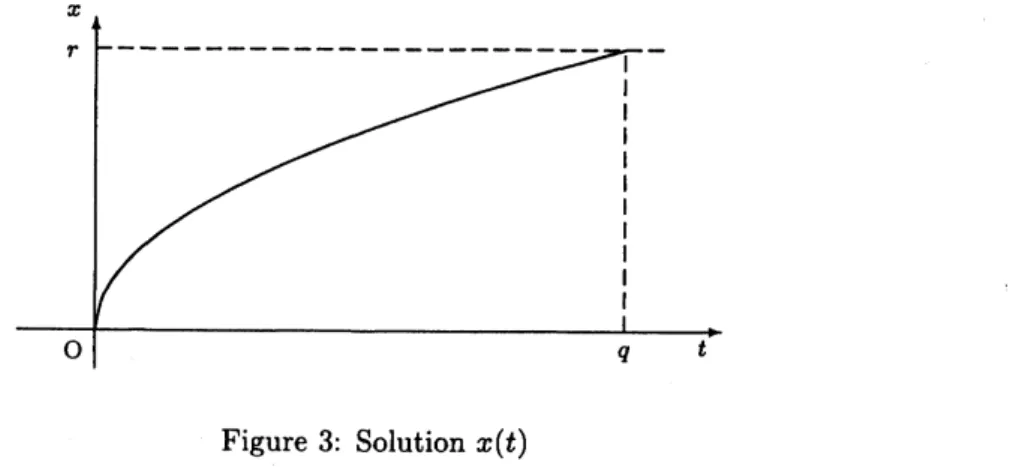
$\frac{\sqrt{2}}{2\pi}\int_{0}^{t}\frac{T(x(s))}{\sqrt{t-s}}ds=x(t)$
.
(2)Applying a method of successiveapproximationswe
can
geta
solution$x(t)$ of thisequationreaching $r$ (see Figure 3). So our task is to show that $x(t)$ is monotonically increasing,
because $g$ is the derivative of the inverse function of $x(t)$.
Figure3: Solution $x(t)$
Proposition 4 Let$T$ be a Lipschitz continuous
function
on an interval containing$0$ andassume
that $T(O)>0$.If
a continuousfunction
$x(t)$defined
onsome
bounded, closedinterval $[0, q]$
satisfies
(2) then$x(t)$ isdifferentiable
and the derivative $x’(t)$ is positiveon
$(0, q]$.
The proof of this proposition is based upon the fractional calculus associated with a
Riemann-Liouville integral operator $I^{\delta}$ defined by
($\Gamma$ is the Gamma function) and and a corresponding differential operator $D^{\delta}$ defined by
$D^{\delta}=DI^{1-\delta}$, where $D$ is
a
standard differential operator $D=d/dt$.
Generally speaking,the $Remam-Li_{ouV}m_{e}$ integral operators improve the H\"older continuity of
functions
bytheir order $\delta$, while the $Riemam-Li_{ouV}m_{e}$ differential operators $D^{\delta}$ have the
converse
character (see Samko, Kilbas and Marichev [12]). We
use
this mapping property of theRiemann-Liouvilleoperatorswithin theframework of
a
H\"olderspace, whichisa a
modifiedversion of the result dueto Hardy and Littlewood [2].
First
we
note that equation (2) is writtenas
$I^{1} z\frac{Tox}{\sqrt{2\pi}}=x$.Applying the operator $D^{1}\pi$
to this equality
we
get$\frac{Tox}{\sqrt{2\pi}}=I^{1}zx’$,
and, in tum, letting $\epsilon$ be asmall, positive number and applying the operator
$D^{1}z$
to this
resulting equation, we arrive at
$D^{1-\epsilon} \frac{Tox}{\sqrt{2\pi}}=D^{\frac{1}{2}-\epsilon}x’$
.
If the set $\{t\in(0, q]|x’(t)=0\}$
were
not empty thenwecan
show that $(D^{1}\Sigma^{-\prime})(a)\leq-\rho<0$at the smaUest point in the set, where $\rho$ is a positive number independent of$\epsilon$. On the
otherhand we
can
get$\lim_{\epsilonarrow 0}(D^{1-\epsilon}\frac{Tox}{\sqrt{2\pi}})(a)=0$
The assumption that $T$ is Lipschitz continuous is used essentially at this stage. In this
waywehavegotacontradiction. Thisisan outlineof the proofofProposition Proposition
4. We wish to point out that this proposition is of independent interest in the field of
integral equations, apart ffom Problem 1.
Problem 1 is interpreted
as a
part ofan
inverse bifurcationproblem (for several inversebifurcation problems,
see
Iwasaki and Kamimura [3, 4], Kamimura [7], Shibata [13]$)$. Asis well-known in ageneral bifurcation (see, e.g., Rabinowitz [11]), if $f$ is continuous with
$f(0)>0$ then the first bifurcating branch of the nonlinear eigenvalue problem
$\{\begin{array}{l}u’’+\lambda uf(u)=0 on (0,1),u(0)=u(1)=0,u\neq 0 on (0,1).\end{array}$ (3)
bifurcates at the point $( \frac{\pi^{2}}{f(0)},$$0)$ from the trivial solution. By the condition that $u\neq 0$ on
the interval $(0,1)$, each solution $u$ of (4) is positive or negative in the interval. Hence the
solution has its maximum value or minimum value at the middle point $\frac{1}{2}$ in the interval
(see Figure 4). By
means
of the value $h$,as a
projection into $(0, \infty)\cross I$ of the firstFigure 4: Solution of equation (3).
$\Gamma(f)$ $:=$
{
$(\lambda,$$h)\in(0,$ $\infty)\cross I|$ョ$u\in C^{2}[0,1]$ satisfying (3) and $u( \frac{1}{2})=h$},
(4)where $I$ is a bounded, closed interval containing $0$. Let us confine ourselves in the case
where $f(u)>0$ on $I$ in what follows. It is easy $0$ see that the set $\Gamma(f)$ is represented
as
$\Gamma(f)=\{(\lambda(h), h) : h\in I\backslash \{0\}\}$ via apositive function $\lambda(h)$ defined by
$\lambda(h)=2(\int_{0}^{1}\frac{dt}{\sqrt{\int_{t}^{1}sf(hs)ds}}I^{2}$ (5)
In this way we may define a correspondence
$\mathcal{B}:f(u)\mapsto\lambda(h)$,
which
we
refer toas
the bifurcationtransform. It should be noted that the trivial function$f\equiv f(O)$ is mapped by the bifurcation transform $\mathcal{B}$ to the trivial bifurcation
$\lambda(h)\equiv\frac{\pi^{2}}{f(0)}$,
which is corresponding to the linear case.
Figure 5: Bifurcation Transform.
Our inverse bifurcation problem is to ask whether $f$
can
be recovered from $\lambda(h)$, whichProblem
5
1. (Existence)
Given a
positive function $\lambda$on
$I$, does there exista
positive function $f$on
$I$ such that $Bf=\lambda$ ?2. (Uniqueness) Is $f$ unique for each $\lambda$ ?
3. (Stability) Does $f$ depend
on
$\lambda$ continuously ?4. (Reconstruction) Can
one reconstruct
$f$ from $\lambda$ ?An
answer
to questions 1 and 2 of Problem 5 is obtainedas an
immediate rewriting ofTheorem 2:
Theorem 6 Given
a
Lipschitz continuous, positivefunction
$\lambda$on
$I$, there existsa
uniquecontinuous
function
$f$on
I such that$\mathcal{B}f=\lambda$. The
function
$f$ is obtainedina constructive
way.
Notice that Theorem6 is aglobalresult in the fieldofinversebifurcation problems. In
addition, since
a
method ofproofto Theorem 2 is constructive (recall that thesolution of$x=x(t)$ to equation (2) is obtained bysuccessive approximations),
we
can
geta
generalstrategy for question 4, namely, for reconstruction of the nonlinearity $f$
.
When
one
considers the bifurcation transform $\mathcal{B}$as a
map, the space of Lipschitz continuous functions is notso
suitable, because the inverse image of the space via the transform is not well-characterized. So, instead of the space of Lipschitz continuousfunctions,
we
introduce the following H\"older-like spaces with $\alpha\in(0,1]$:$C^{0,\alpha}(I)_{1};= \{\phi\in C(I):||\phi||_{0,\alpha,1}:=\sup_{h\in I\backslash \{0\}}\frac{|\phi(h)|}{|h|}$
$+ \sup_{h,k\in I\backslash \{0\},h\neq k}\frac{||h|^{\alpha-1}\phi(h)-|k|^{\alpha-1}\phi(k)|}{|h-k|^{\alpha}}<\infty\}$ ,
$C^{1,\alpha}(I)_{1}:=\{\psi\in C(I)\cap C^{1}(I\backslash \{0\}):\psi(0)=0,$ $h\psi^{f}(h)\in C^{0,\alpha}(I)_{1}\}$
.
Equipped with the
norms
$||\phi||$ $:=||\phi||_{0,\alpha,1}$ and $||\psi||;=||h\psi’(h)||_{0,\alpha,1}$ respectively, thespaces$C^{0,\alpha}(I)_{1}$ and $C^{1,\alpha}(I)_{1}$
are
Banach spaces. A suitable choice ofmetric spacessettingfor the transform $\mathcal{B}$ is the combination of
$\mathcal{M}^{0,\alpha}(I)_{1}:=\{f\in C_{+}(I):f(h)-f(0)\in C^{0,\alpha}(I)_{1}\}$
and
$\mathcal{M}^{1,\alpha-z}(I)_{1}:=1\{\lambda\in C_{+}(I):\lambda(h)-\lambda(0)\in C^{1,\alpha-\frac{1}{2}}(I)_{1}\}$ ,
with $\alpha\in(\frac{1}{2},1)$, where $C_{+}(I)$ denotes the set of continuous, positive functions and the
metrics of $\mathcal{M}^{0,\alpha}(I)_{1}$ and $\mathcal{M}^{1,\alpha-\frac{1}{2}}(I)_{1}$ are defined by
$d(f_{1}, f_{2}):=|f_{1}(0)-f_{2}(0)|+||(f_{1}(h)-f_{1}(0))-(f_{2}(h)-f_{2}(0))||_{0,\alpha,1}$
and
$d(\lambda_{1}, \lambda_{2}):=|\lambda_{1}(0)-\lambda_{2}(0)|+||(\lambda_{1}(h)-\lambda_{1}(0))-(\lambda_{2}(h)-\lambda_{2}(0))||_{1,\alpha-\frac{1}{2},1}$
respectively. With the aid of these metric spaces, we have
an answer
to questions 1-3 ofTheorem 7 Let $\frac{1}{2}<\alpha<1$
.
Then $\mathcal{B}$ isa
homeomorphismof
$\mathcal{M}^{0,\alpha}(I)_{1}$ onto $\mathcal{M}^{1,\alpha-}\pi(I)_{1}1$.
Theorem 7implies that, for each first bifurcating branch $\lambda\in \mathcal{M}^{1,\alpha-\frac{1}{2}}(I)_{1}$, there exists
a
unique nonlinearity $f$ in $\mathcal{M}^{0,\alpha}(I)_{1}$ realizing the first bifurcating branch (theanswer
to
question 1-2), and in addition, that the correspondence $\lambda\mapsto f$ is continuous with respect
to the topology of $\mathcal{M}^{0,\alpha}(I)_{1}$ and $\mathcal{M}^{1,\alpha-\frac{1}{2}}(I)_{1}$ induced from the
metrics of these spaces
(the
answer
to quention 3), providedthat $\alpha\in(\frac{1}{2},1)$.
Since the space$\mathcal{M}^{0,1}(I)_{1}$ isno
otherthan that ofLipschitz continuous functions, Theorem 6 can be regarded
as
the limitcase
of Theorem 7
as
$\alphaarrow\frac{1}{2}+0$, though the conclusion in Theorem 7seems
to break downwhen $\alpha=\frac{1}{2}$
.
We omit the proof of Theorem 7, which is rather long and technical, deviating from the aim of this article.
In this article we have discussed a method with fractional calculus that is applicable
in proving the global existence of solutions to integral equations related with inverse
problems. The method is also available for
a
heat conductivity determinationproblem:Problem 8 Given
functions
$f(t),g(t)$, detemine $a(t)$ so that the pambolic system$\{\begin{array}{l}u_{t}=a(t)u_{xx},u(x, 0)=0,u(0, t)=f(t),-a(t)u_{x}(0, t)=g(t),\end{array}$
admits a bounded, solution $u(x, t)$.
$0<x<\infty,$
$0<t<T$
;$0\leq x<\infty$;
(6)
$0\leq t<T$;
$0<t<T$
This inverse problem was studied by Jones [5, 6], Suzuki [14], Kamimura [8]. The
original idea offractional calculus applicable to inverse problems can be found in [8],
References
[1] B. Alfawicka, Inverseproblems connected with periods ofoscillations describedby$\ddot{x}+g(x)=0$, Ann.
Polon. Math. 44 (1984), 297-308.
[2] G.H. Hardy and J.E. Littlewood, Some properties of fractional integrals. I, Math. Zeitschrift, 27
(1928), 564-606.
[3] K. Iwasaki and Y. Kamimura, An inverse bifurcationproblem and an integral equation of the Abel
type,Inverse Problems 13 (1997), 1015-1031.
[4] K. Iwasaki and Y. Kamimura, Inverse bifurcation problem, singular Wiener-Hopf equations, and
mathematicalmodels in ecology, J. Math. Biol. 43 (2001), 101-143.
[5] B. F. Jones Jr. , The detemination of a coefficient in a parabolic differential equation, Part I,
existence and uniqueness, J. Math. Mech. 11 (1962), 907-918
[6] B. F. Jones Jr. , Various methodsforfinding unknown coefficients in parabolicdifferential equations,
Comm. Pure. Appl. Math. 16 (1963), 33-44.
[8] Y. Kamimura, Conductivity
identification
inthe heat equation by the heat flux,J.Math. Anal. Appl.235 (1999), 192-216.
[9] Y. Kamimura, Global $e\dot{m}$tence ofa restoring
force
realizing aprescrived half-period, J. DifferentialEquations, in press.
[10] Z. Opial, Surles peiiodes des solutions de l’\’equation
differentielle
$x”+g(x)=0$. Ann. Polon. Math.10 (1961), 49-72.
[11] P.H.Rabinowitz,NonlinearSturm-Liouvilleproblemforsecond order ordinarydifferentialequations,
Comm. Pure Appl. Math. 23 (1970), 939-961.
[12] S.G. Samko, A.A. Kilbas, O.I. Marichev, Fractional integrals and derivatives, Gordon and Breach,
Switzerland, 1993.
[13] T. Shibata,$L^{q}$-inverse spectral problems
for
semilinearSturm-Liouvilleproblems, Nonlinear Analysis69 (2008), 3601-3609.
[14] T. Suzuki, MathematicalTheory of Applied Inverse Problems: Sophia Kokyuroku in Math. Vol. 33,
Sophia University, Tokyo, 1991.
[15] M. Urabe, The potentid