Memory Congestion on NUMA Systems
著者
Agung Mulya
学位授与機関
Tohoku University
学位授与番号
11301甲第19336号
TOHOKU UNIVERSITY
Graduate School of Information Sciences
Task Mapping for Coordinating Locality and Memory
Congestion on NUMA Systems
(
NUMA システムにおける局所性とメモリ負荷集中を考慮した
タスクマッピングに関する研究)
A dissertation submitted for the degree of Doctor of Philosophy
(Information Sciences)
Department of Computer and Mathematical Sciences
by
Mulya Agung
January 14, 2020
Task Mapping for Coordinating Locality and Memory
Congestion on NUMA Systems
Mulya Agung
Abstract
Recent multicore systems have complex memory hierarchy with multiple cache levels and memory controllers, which leads to Non-Uniform Memory Access (NUMA) charac-teristics. In such systems, the mapping of parallel tasks to processor cores, called task mapping, has a significant impact on performance and energy efficiency because it affects the cost of communication among tasks. Most of existing approaches in efficient task mapping has focused only on improving the locality of memory accesses. Improving the locality is important because it will reduce the remote access penalty and congestion on interconnects. However, in recent NUMA systems, the high number of cores can cause the memory congestion problem, which could degrade performance more severely than the locality problem. As the number of cores increases, the number of concurrent commu-nications will also increase. Maximizing the locality will increase the memory congestion because it will concentrate the concurrent communications on particular NUMA nodes. Therefore, considering only the locality is not sufficient to achieve a scalable performance on NUMA systems, and it is necessary to consider both the locality and the memory congestion to increase performance and energy efficiency of NUMA systems.
To optimize the task mapping, it is mandatory to analyze the communication behaviors of the parallel applications. Different applications may have different communication behaviors, which determine the impacts of task mapping on the performance and energy consumption of the applications. Most of the existing methods rely on offline profiling and analysis to trace the communications and analyze the communication behaviors prior to the execution of the application. On the other hand, some existing online methods analyze the communication behaviors and perform the task mapping during the execution of the application. Unlike offline methods, these methods can dynamically change the task mapping to adapt to changes in the communication behaviors of the application. However, the main drawback of the online methods is that they introduce overhead to the execution time of the application. In contrast, offline methods obtain the task mapping prior to the execution, and thus they do not impose overhead to the execution time of the application. This dissertation aims to establish task mapping methods that consider both
local-ity and memory congestion at the same time to achieve high performance and energy efficiency of NUMA systems. This dissertation contributes to task mapping from the following three aspects. First, this dissertation introduces a method to analyze and char-acterize the spatial and temporal communication behaviors of parallel applications. The method consists of two techniques to obtain the communication events among tasks, a data clustering method to identify the concurrent communications that cause the mem-ory congestion, and a set of metrics to characterize the communication behaviors. The proposed metrics are important because of three reasons. First, they are necessary to evaluate the impacts of a task mapping method on the performance of a particular ap-plication. Second, the metrics can be used to evaluate the suitability of task mapping methods to a particular application. Third, by using the metrics, a parallel application is classified into one of three categories based on which of offline and online methods can increase the performance of an application.
The second contribution of this dissertation is to propose an offline task mapping method to address the locality and memory congestion problems. The proposed method works offline prior to the execution of a parallel application. The proposed method con-sists of three steps. First, it gathers the NUMA node topology of the target system. Then, it analyzes the spatial and temporal communication behaviors of the target application. Finally, it computes a task mapping that can coordinate the locality and the memory congestion. A mapping algorithm is proposed to calculate the mapping by using informa-tion about the NUMA node topology and the communicainforma-tion behaviors. The mapping result is then used for the execution of the target application. An extensive evaluation with parallel applications from three benchmark suites has been conducted to show that the proposed method can achieve substantial performance improvements in comparison with a dynamic mapping method and five static mapping methods, including the current state-of-the-art locality-based method.
The third contribution of this dissertation is to present an online task mapping method for coordinating locality and memory congestion. Unlike the proposed offline method, this method works online during the execution of the application. It does not require any infor-mation about the communication behaviors prior to the execution. During the execution, it dynamically analyzes the communication behavior and performs task mapping to adapt to changes in the communication behavior. Since the proposed method works at runtime, it introduces overhead to the execution of the application. The overhead is caused by repeatedly updating the mapping and thereby migrating tasks among cores. In this dis-sertation, the online method employs two mechanisms to reduce the overhead. The first mechanism is to dynamically adjust the mapping interval. The mapping interval is ad-justed to limit the frequency of updating the mapping and to adapt the changes in the communication behavior. The second mechanism is a mapping algorithm that considers
the current mapping to calculate the next mapping. The mapping algorithm prevents un-necessary task migrations by giving a higher priority to tasks that have a higher amount of communication to be mapped to the same NUMA node of the current mapping. An extensive evaluation has been conducted with a set of parallel benchmarks on two NUMA systems, and two biomolecular applications on a larger NUMA system. The evaluation results show that the proposed method can achieve performance and energy consumption close to the best static method with a low overhead.
The conclusions of this dissertation are as follows: task mapping coordinating the lo-cality and memory congestion is crucial to achieving the scalable performance and energy efficiency in NUMA systems, analyzing the communication behaviors of parallel applica-tions is a mandatory step for task mapping, and both offline and online task mapping are necessary to improve the performance and energy efficiency on NUMA systems.
Abstract
1 Introduction 1
1.1 Background . . . 1 1.2 Research Problem and Objective . . . 6 1.3 Organization of the Dissertation . . . 7
2 Analyzing the Communication Behaviors of Parallel Applications 8 2.1 Introduction . . . 8 2.2 Related Work . . . 10 2.2.1 Communication Behaviour Analysis in MPI . . . 10 2.2.2 Communication Behavior Analysis in Multithreaded Applications . 10 2.2.3 Memory Access Analysis in NUMA Systems . . . 11 2.3 A Method to Analyze and Characterize the Spatial and Temporal
Com-munication Behaviors . . . 12 2.3.1 Gathering Communication Events of Applications Based on
Distributed-memory Parallel Processing . . . 12 2.3.2 Gathering Communication Events of Applications Based on
Shared-memory Parallel Processing . . . 14 2.3.3 Analyzing Spatial and Temporal Communication Behaviors from
Communication Events . . . 15 2.3.4 Communication Behaviors that Affect the Locality and the Memory
2.3.5 Static and Dynamic Communication Behaviors . . . 23
2.4 Evaluation . . . 25
2.4.1 Evaluation Methodology . . . 25
2.4.2 Communication Behaviors of the Benchmarks . . . 27
2.4.3 Classification of the Applications . . . 31
2.4.4 Performance Results . . . 34
2.5 Conclusions . . . 37
3 Offline Task Mapping for Coordinating Locality and Memory Conges-tion 38 3.1 Introduction . . . 38
3.2 Related Work . . . 41
3.2.1 MPI Process Mapping . . . 41
3.2.2 Thread Mapping . . . 41
3.2.3 Thread and Data Mapping . . . 42
3.3 DeLoc: A Task Mapping Method for Coordinating Locality and Memory Congestion . . . 44
3.3.1 Gathering the NUMA Node Topology Information of the Target System . . . 44
3.3.2 Analyzing the Communication Behaviors of the Application . . . . 45
3.3.3 Computing the Task Mapping . . . 46
3.3.4 Scalability of DeLoc . . . 48
3.4 Evaluation . . . 49
3.4.1 Performance Evaluation on a Real System . . . 49
3.4.1.1 Analyzing the Communication Behaviors of the Benchmarks 51 3.4.1.2 Performance Results . . . 52
3.4.1.3 Performance Analysis . . . 57
3.4.2 Performance Evaluation with a Simulator . . . 60
4 Online Task Mapping for Coordinating Locality and Memory
Conges-tion 65
4.1 Introduction . . . 65
4.2 Related Work . . . 68
4.2.1 MPI Process Mapping . . . 68
4.2.2 Online Thread and Process Mapping . . . 68
4.2.3 Online Thread and Data Mapping . . . 69
4.3 OnDeLoc-MPI: An Online Process Mapping Method for Coordinating Lo-cality and Memory Congestion . . . 69
4.3.1 Procedure of OnDeLoc-MPI . . . 70
4.3.2 Implementation of OnDeLoc-MPI . . . 73
4.3.2.1 Modification of the Runtime System . . . 73
4.3.2.2 Data Consolidation . . . 74 4.3.2.3 OnDeLocMap+ Algorithm . . . 75 4.3.2.4 Data Structures . . . 77 4.4 Evaluation . . . 79 4.4.1 Experimental Setup . . . 79 4.4.2 Performance Evaluation . . . 82
4.4.3 Energy Consumption Evaluation . . . 87
4.4.4 Overhead of OnDeLoc-MPI . . . 89
4.4.5 Evaluation on a Larger System . . . 91
4.5 Conclusions . . . 94
5 Conclusions 96
Bibliography 111
1.1 Number of logical cores per processor. . . 2
1.2 Performance gap between processor and memory. . . 2
1.3 Ratio of CPU performance to memory bandwidth. . . 3
2.1 The procedure of DeLocProf. . . 12
2.2 Explicit communication in MPI. . . 13
2.3 Memory accesses of different threads can be seen as their communications. 14 2.4 The representations of undirected communication graph for a parallel ap-plication that consists of eight tasks. . . 15
2.5 Examples of a NUMA system and the outputs of Packed, Scatter, Balance, and Locality mappings. . . 16
2.6 Temporal communication behaviors of four NPB-MPI applications. . . 18
2.7 Communication behaviors of NPB-MPI described with the metrics. . . 27
2.8 Communication behaviors of NPB-OMP described with the metrics. . . 29
2.9 Communication behaviors of PARSEC described with the metrics. . . 30
2.10 The decision tree for classifying a parallel application. . . 32
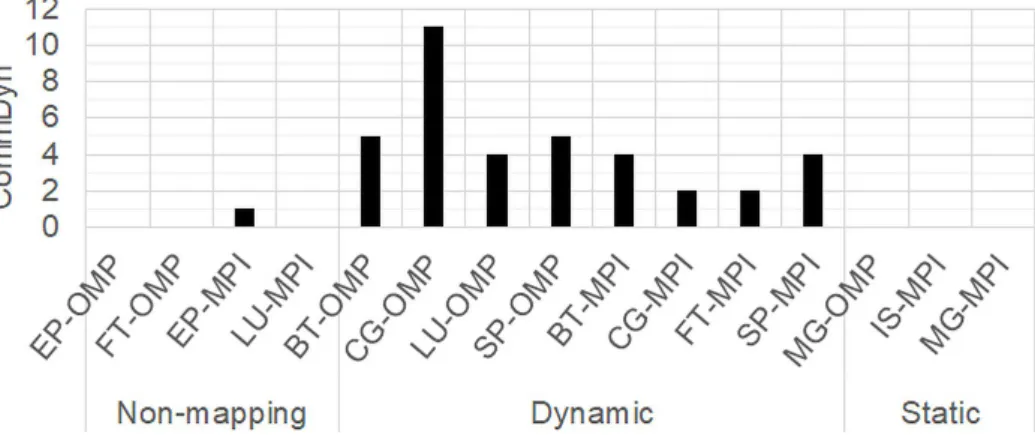
2.11 Classification results of the NPB. . . 32
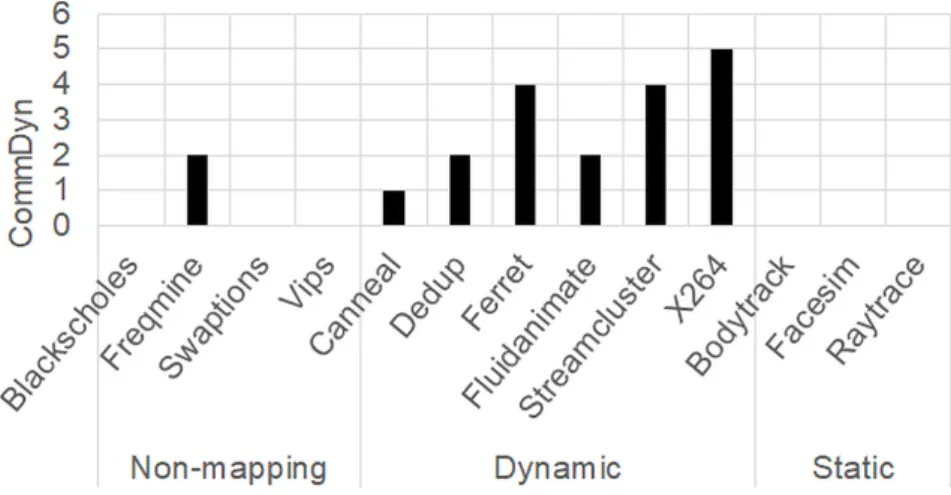
2.12 Classification results of the PARSEC. . . 33
2.13 Performance results of NPB-MPI with the four mapping methods. . . 34
2.14 Performance results of NPB-OMP with the four mapping methods. . . 35
2.15 Performance results of PARSEC with four mapping methods. . . 36
3.1 An example of the NUMA node topology with eight cores. . . 44
3.3 Performance results of NPB-OMP on Xeon56 . . . 53
3.4 Performance results of PARSEC on Xeon56. . . 54
3.5 Communication behaviors of the applications that benefit from Packed and Scatter mappings. . . 56
3.6 Performance monitoring results of the NPB and PARSEC applications. . . 58
3.7 Performance results in the simulator. . . 61
4.1 The procedure of OnDeLoc-MPI. . . 70
4.2 Examples of the NUMA node topology and the communication matrix. . . 70
4.3 The mechanism of mapping interval adjustment. . . 72
4.4 The consolidation mechanism with four MPI processes. . . 74
4.5 Evaluation results with CDSM. . . 80
4.6 Performance results on Xeon56. . . 82
4.7 Performance results on Xeon2. . . 83
4.8 Performance monitoring results on Xeon2. . . 84
4.9 Communication behaviors of CG-MPI, BT-MPI and SP-MPI. . . 85
4.10 Energy consumption results on Xeon2. . . 87
4.11 Core and Uncore energy consumptions on Xeon2. . . 88
4.12 Overhead of OnDeLoc-MPI. . . 89
4.13 Communication behaviors of the GROMACS applications. . . 92
AMD Advanced Micro Devices
DDR Double Data Rate
DRAM Dynamic Random-Access Memory
IMC Integrated Memory Controller
KNL Knights Landing
MCDRAM Multi-Channel Dynamic Random-Access Memory
MPI Message Passing Interface
NUMA Non-Uniform Memory Access
NPB NAS Parallel Benchmarks
PARSEC The Princeton Application Repository for Shared-Memory Computers
Introduction
1.1
Background
Since the early 2000s, the number of cores in a processor has been increasing. Increases in the number of cores are accompanied by more complex memory hierarchies, consisting of several private and shared cache levels, and multiple memory controllers that form the base for Non-Uniform Memory Access (NUMA) architectures. Each processor consists of one or several sets of processor cores that are physically associated with one or more memory controllers and memory devices. Such a set of processor cores is referred to as a NUMA node [1, 2]. The main advantage of this architecture is that it provides a higher memory bandwidth and less latency because multiple nodes can be assembled into a single NUMA system [3, 4]. However, the main drawback is that the performance of memory accesses depends on the location of the data [5–7]. The NUMA nodes are generally connected by high-speed interconnect links such as Intel QuickPath Interconnect (QPI) [8] and AMD HyperTransport [9]. However, accessing the data that is located on the memory devices of remote NUMA nodes causes a performance penalty because it still needs a longer latency than accessing the data of the local memory devices [10]. Thus, the cost of remote memory access is higher than that of the local memory access.
The most important performance optimization for NUMA systems considered until now is to increase the locality of memory accesses. Various studies have focused on
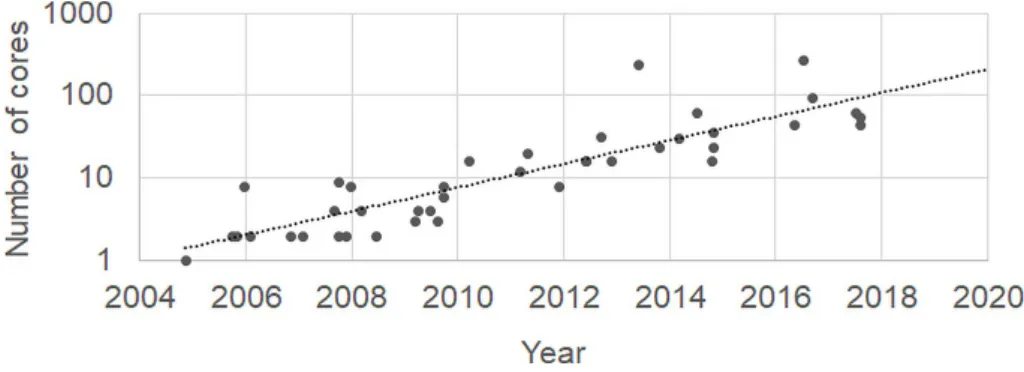
Figure 1.1: Number of logical cores per processor.
Figure 1.2: Performance gap between processor and memory.
increasing the locality in NUMA systems to improve the performance of parallel appli-cations on the systems [3, 11, 12]. Improving the locality is important because it will reduce the remote access penalty. However, when the number of processor cores in a sys-tem increases, the impact of the locality on the performance becomes lower. The higher number of processor cores in the recent systems can induce a larger number of accesses to memory devices, causing congestion on the shared cache memories and memory con-trollers. This congestion is referred to as the memory congestion [1,13,14]. Recent studies on NUMA systems have shown that the memory congestion problem could degrade per-formance more severely than the locality problem because heavy congestion on memory controllers could cause long latencies [4, 13]. Furthermore, maximizing the locality can degrade performance because it potentially increases the memory congestion [1, 15].
As shown in Figure 1.1, every two years, the number of cores in a processor has been doubling [16]. The number of parallel tasks that can be executed by a processor at the
Figure 1.3: Ratio of CPU performance to memory bandwidth.
same time increases with the number of cores. However, as shown in Figure 1.2, the performance of a processor increased more rapidly than the performance of memory [17]. Over the last 20 years, the performance gap between processor and memory has been steadily increasing. The dashed curve shows the extrapolated values of the performance. The differences between the number of cores and memory bandwidth of the system is one main factor that contributes to the performance gap. As the number of cores increases, the risk of memory congestion also becomes higher. One way to alleviate the memory congestion is by increasing the memory bandwidth of the system. However, due to the physical limits, the memory bandwidth of a system cannot be increased beyond a certain point [18]. As an example of the memory bandwidth limitation, Figure 1.3 shows the ratio of the performance of processor to memory bandwidth in AMD and Intel-based NUMA systems [16]. The dashed curve shows the extrapolated values of the ratio. Every three to four years, the ratio has been doubling. As the memory bandwidth becomes the limiting factor for the performance, it is important to manage the memory congestion in NUMA systems efficiently.
A parallel application consists of multiple tasks, each of which is executed on a pro-cessor core as a thread or a process. On NUMA systems, the performance of applica-tions can be improved by placing tasks to processor cores according to a policy that can consider various objectives. The task placement is achieved by mapping the tasks to processor cores, which is called task mapping [19]. On NUMA systems, task mapping can have a significant impact on the performance and energy consumption of the systems because the mapping affects the cost of the communications among tasks. As the cost
of communication significantly affects the performance on NUMA systems, exploiting the communication behavior to map tasks to processor cores is important to increase per-formance and save energy. Such task mapping methods are called communication-aware task mapping [2, 20, 21].
To optimize the task mapping of a parallel application, analyzing the communication behavior of the application is necessary because different applications can have different communication behaviors. Moreover, on a NUMA system, the impacts of task mapping on performance and energy consumption of an application may vary depending on the communication behavior the application. In an application, a task does not necessarily need to communicate with all the other tasks, and the time and amount of data exchanged among tasks may vary. The diversity of the number of communications and amount of data exchanged among tasks is referred to as spatial communication behavior, while the changes of the spatial behavior over time is referred to as temporal communication behavior [22, 23].
Considering the spatial communication behavior of an application is necessary to re-duce the total cost of communication or load imbalance among the NUMA nodes. How-ever, to effectively reduce the memory congestion, it is also necessary to consider the temporal communication behavior of the application because memory congestion only oc-curs when multiple tasks are running on different processor cores access a particular node at the same time. Therefore, analyzing both the spatial and temporal communication behaviors is a mandatory step to optimize the task mapping on NUMA systems.
Conventional approaches to efficient task mapping have focused only on improving the locality by mapping tasks, which frequently communicate with each other, to processor cores that are closer to each other in the memory hierarchy [2, 11, 12, 24]. However, maxi-mizing the locality does not always improve performance due to the memory congestion. Moreover, some approaches rely on offline profiling to analyze the communication behav-ior [11, 12, 25, 26], which cause a high overhead and may result in incorrect analysis if the communication behavior of the application changes during the execution. Therefore, all of these approaches are not sufficient to improve the performance and energy efficiency of
NUMA systems.
Some approaches use online mechanisms to overcome the limitations of offline profiling and analysis [2, 13, 14]. However, the offline and online approaches have advantages and disadvantages. The offline approach obtains task mapping prior to the execution, and the mapping is applied when the application is launched. Thus, it does not incur any overhead to the execution of the application. However, the overhead of this method is incurred by the offline profiling and analysis. In contrast, the online approach analyzes the commu-nication behaviors and calculates the mapping during the execution of the application, and thus it introduces overhead to the execution time of the application. Moreover, the online approach will migrate tasks if the mapping changes during the execution, and the task migration can significantly affect performance and energy consumption [2, 27].
The goal of this dissertation is to improve the performance and energy efficiency of parallel applications on NUMA systems by using task mapping to address the locality and the memory congestion problems. Because of the advantages and disadvantages of offline and online approaches, this dissertation discusses offline and online task mapping to co-ordinate locality and memory congestion. To obtain the information of communication behaviors, this dissertation first proposes a method to analyze spatial and temporal com-munication behaviors of parallel applications, which includes a set of metrics to describe the communication behaviors that affect the locality and memory congestion. Then, the task mapping methods use the proposed analysis method to determine task mapping that can coordinate locality and memory congestion. The first mapping method analyzes the communication behaviors and computes the task mapping offline prior to the execution of the application. On the other hand, the second mapping method does not need offline profiling and analysis, and it analyzes the communication behaviors and performs the task mapping online during the execution of the application. Comparisons between the two methods are also discussed in this dissertation.
1.2
Research Problem and Objective
This dissertation focuses on task mapping to address the locality and memory congestion problems in NUMA systems that stem from the spatial and temporal communication behaviors of a parallel application. To coordinate locality and memory congestion, ana-lyzing both spatial and temporal communication behaviors of the application is necessary because the timing of the communication affects the memory congestion. Thus, this dis-sertation proposes a method to analyze and characterize the spatial and temporal commu-nication behaviors of parallel applications. This method consists of a toolchain to analyze the communication behaviors of the application, and a set of metrics to characterize the communication behaviors that affect the locality and the memory congestion.
After the communication behaviors of an application are obtained, a task mapping method can exploit the communication behaviors to optimize the task mapping for the application. Most of the related studies in task mapping focus only on improving the locality to reduce the overall communication cost. However, considering only the locality is not sufficient due to the memory congestion problem. Thus, this dissertation discusses task mapping to tackle the locality and memory congestion problems on NUMA systems. For the discussion, it first proposes an offline method that uses the information about the NUMA node topology and the communication behaviors to optimize the task mapping.
To analyze the communication behaviors of an application, most of the existing task mapping methods rely on offline profiling and analysis, which traces the communication events and analyzes the communication behaviors prior to the execution of the appli-cation. However, the offline profiling and analysis are potentially time-consuming and are not applicable if the application changes its behavior between executions. Thus, this dissertation also discusses online task mapping to address the locality and memory con-gestion problems. An online mapping method is proposed to coordinate both problems without requiring offline profiling and analysis.
1.3
Organization of the Dissertation
The rest of the dissertation is organized as follows. Chapter 2 discusses a method for ana-lyzing and characterizing the communication behaviors of parallel applications. Chapter 3 discusses offline task mapping for coordinating locality and memory congestion. Chap-ter 4 discusses online task mapping for coordinating locality and memory congestion. Chapter 5 summarizes the conclusions of this dissertation.
Analyzing the Communication
Behaviors of Parallel Applications
2.1
Introduction
In a parallel application, the application workload is partitioned into tasks. During the ex-ecution of the application, tasks may communicate with each other to share data among them. As discussed in Chapter 1, analyzing the spatial and temporal communication behaviors of parallel applications is a necessary step in task mapping for coordinating locality and memory congestion. Analyzing the communication behaviors is necessary because different applications may have different communication behaviors, and the im-pacts of task mapping on a particular application depend on the communication behaviors of the application [21, 28].
During the execution of a parallel application, a task does not necessarily need to communicate with all the other tasks, and the time and amount of communication events among tasks may vary. The event that each time two tasks communicate with each other is called a communication event. The spatial communication behavior is determined by the diversity of the amount of communication, which can be represented by the number or volume of communication events. By exploiting this communication behavior, a task mapping method that aims to improve locality can reduce the overall communication cost
by mapping tasks that have larger amounts of communication to processor cores within the same NUMA node. In contrast, a method that focuses on improving the balance of communication will map such tasks to cores of different NUMA nodes [29].
The temporal communication behavior is determined by the times that communica-tion events occur during the execucommunica-tion [23, 30]. When multiple communicacommunica-tion events among different tasks are in progress, they are referred to as concurrent communications. In conjunction with spatial communication behavior, temporal communication behavior can affect the memory congestion because the risk of memory congestion increases with a larger amount of concurrent communications. As spatial and temporal communication behaviors affect the locality and memory congestion, the impacts of task mapping on per-formance and energy consumption of an application are determined by the communication behaviors of the application.
In order to analyze the spatial and temporal communication behaviors of an applica-tion, there are two challenges that need to be addressed. The first is how to obtain the communication events, including information about the amount and the timing of com-munication. The other challenge is how to analyze and characterize the communication behaviors from the obtained communication events. The characterization is required for describing the communication behaviors that affect the locality and memory congestion. To address these two challenges, this chapter proposes a method, called decongested local-ity profiler (DeLocProf ), to analyze and characterize the spatial and temporal communi-cation behaviors of parallel applicommuni-cations. The method consists of two techniques to obtain communication events from parallel applications, a data clustering method to analyze the spatial and temporal communication behaviors, and a set of metrics to characterize the communication behaviors.
This chapter is organized as follows. First, Section 2.2 briefly reviews related work that has focused on analyzing the communication behaviors of parallel applications. Then, DeLocProf is described in Section 2.3. Section 2.4 presents the experimental evaluation, and discusses the evaluation results with the proposed metrics. Finally, the conclusions
2.2
Related Work
This section reviews the related studies that have focused on analyzing the communication behaviors of parallel applications. It first reviews existing methods for analyzing the communication behaviors of MPI applications, and then reviews existing methods for analyzing the communication behaviors of multithreaded applications. Finally, it reviews existing tools for analyzing parallel applications on NUMA systems.
2.2.1
Communication Behaviour Analysis in MPI
Most of the related studies in analyzing communication behaviors focused on applications that use message passing frameworks, such as Message Passing Interface (MPI) [31]. Com-munication behaviors of different MPI applications and benchmarks have been analyzed by [32–34] A methodology to analyze communication behavior is presented in [22, 35], where communication is described with spatial and temporal components. The proposed method of this chapter uses similar components to analyze the communication behaviors. However, in this chapter, the spatial and temporal components are applied to optimize the task mapping that can improve locality and reduce memory congestion. Moreover, the proposed method focuses on analyzing communication not only in MPI applications but also in multithreaded applications. The difference between communication in MPI and multithreaded applications is discussed in Section 2.3.2.
2.2.2
Communication Behavior Analysis in Multithreaded
Ap-plications
Some related studies have focused on characterizing the communication behaviors of mul-tithreaded applications. In the related work [21,26], communication is analyzed by tracing memory accesses among threads, and the related work [21] had shown that the page usage behavior could be analyzed from the memory accesses. However, all the related studies consider only the spatial communication behavior to improve the locality, and do not
account the memory congestion issue caused by spatial and temporal communication be-haviors of the applications. A related work [23] has focused on analyzing spatial and temporal communication behaviors of PARSEC benchmarks. However, this related work is limited to a set of benchmark applications and does not consider the impacts of the communication behaviors on task mapping.
2.2.3
Memory Access Analysis in NUMA Systems
So far, several tools had been proposed to analyze parallel applications on NUMA sys-tems, such as Memphis [36], Memprof [37] and MemAxes [38]. These methods analyze the memory access behavior by tracing the memory accesses among threads in parallel applications. However, these tools focus on memory access analysis, and do not take into account the communication among tasks of the applications.
Figure 2.1: The procedure of DeLocProf.
2.3
A Method to Analyze and Characterize the
Spa-tial and Temporal Communication Behaviors
This section presents DeLocProf, which can analyze and characterize the spatial and tem-poral communication behaviors of parallel applications. Figure 2.1 shows the procedure of DeLocProf, which consists of three steps:
Step 1 Gather the communication events of the target application.
Step 2 Analyze the spatial and temporal communication behaviors.
Step 3 Calculate the metrics for characterizing the communication behaviors.
For Step 1, two techniques are proposed to obtain the communication events of a parallel application based on distributed-memory parallel processing and shared-memory parallel processing methods. Two different techniques are proposed because communica-tion in a parallel processing method can be explicit or implicit, and a deteccommunica-tion mechanism is required to detect implicit communication from memory accesses among tasks. For Step 2, this section proposes a data clustering method to detect concurrent communica-tions from communication events. For Step 3, a set of metrics is introduced to characterize the communication behaviors that affect locality and memory congestion, and a metric to describe static and dynamic communication behaviors.
2.3.1
Gathering Communication Events of Applications Based
on Distributed-memory Parallel Processing
In parallel applications based on distributed-memory parallel processing, such as MPI, a task is instantiated by a process, and each process has a unique identifier called a process ID. Thus, in MPI, process mapping is also referred to as task mapping [39]. In
Figure 2.2: Explicit communication in MPI.
MPI, communication is explicit, and is performed by sending and receiving messages. Figure 2.2 shows an explicit communication between two MPI processes. The process that sends the message is called a sender, and the process that receives the message is called a receiver. For each communication, there is a pair of sender and receiver processes. Thus, a communication event can be defined as one message with its corresponding pair of sender and receiver. This pair is also referred to as a task pair.
In MPI, a process can communicate with other processes by using point-to-point (P2P) operations and collective operations. In P2P operations, a process sends messages to an-other process by explicitly specifying the ID of the receiver. On the an-other hand, rather than explicitly sending and receiving such messages, a collective operation involves com-munications among all processes in a communicator. In internal MPI implementation, a collective operation is typically implemented using multiple P2P operations [40,41]. Thus, in that case, each collective operation can be decomposed into P2P operations.
To trace the communication events, the target application is preliminarily run while monitoring the MPI communication events. For the monitoring purpose, a monitoring tool is implemented as a component of the monitoring framework that has been proposed in [42]. This framework is built on the top of the P2P management layer (PML) of the Open MPI stack [43]. Since the PML can monitor P2P operations organizing a collective communication, the communication events can be traced in both cases of P2P and collective communications. Furthermore, PML monitors not only MPI SendMPI -Recv but also MPI Isend-MPI Irecv operations. Thus, the monitoring tool also traces both blocking and non-blocking communications. The tool generates a time-series dataset of communication events by recording the IDs of the sender and receiver, the data size,
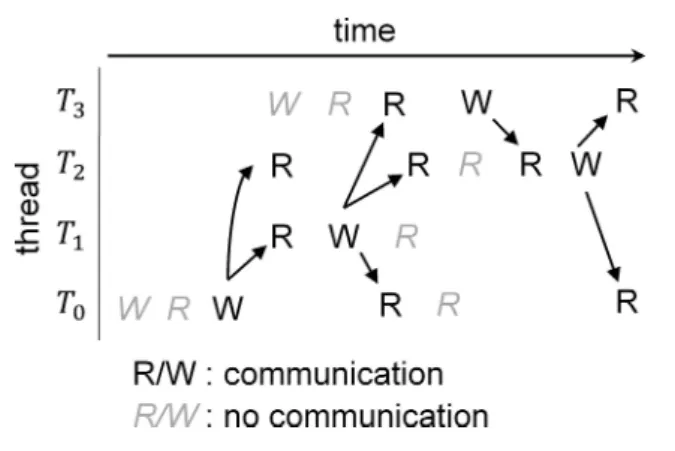
Figure 2.3: Memory accesses of different threads can be seen as their communications.
about the timing of the communication.
2.3.2
Gathering Communication Events of Applications Based
on Shared-memory Parallel Processing
In parallel applications based on shared-memory parallel processing, such as OpenMP [44] and Pthreads [45], a task is instantiated by a thread of execution, and each thread has a unique identifier called thread ID. Thus, in shared-memory parallel processing, thread mapping is also referred to as task mapping [29]. The communication among threads is performed implicitly by accessing the shared memory space. By tracing accesses to memory addresses at the cache line granularity, a communication event can be defined as two consecutive write and read memory accesses from different threads to the same cache line. These two memory accesses are referred to as communicating memory accesses [23]. Figure 2.3 shows communicating and non-communicating memory accesses for one cache line. The communicating memory accesses are shown in black, while non-communicating memory accesses are shown in gray. Two different threads that perform the communicat-ing memory accesses are called a pair of threads, and this pair is also referred to as a task pair.
To obtain the communication events, the target application is preliminarily run while monitoring the memory accesses performed by the threads of the application and de-tecting the communication events from the memory accesses. For the monitoring and
(a) An example of communication matrix. (b) Visualization of the commu-nication matrix.
Figure 2.4: The representations of undirected communication graph for a parallel appli-cation that consists of eight tasks.
detection purpose, a tracing tool is implemented based on a dynamic binary instrumenta-tion framework, called pin [46]. This tool detects communicainstrumenta-tion from memory accesses of the threads at a granularity of cache line, which is a 64 byte-wide memory block. It generates a time-series dataset of communication events by recording the IDs of the pair of threads, the timestamp, and the data size of memory access of each event.
2.3.3
Analyzing Spatial and Temporal Communication
Behav-iors from Communication Events
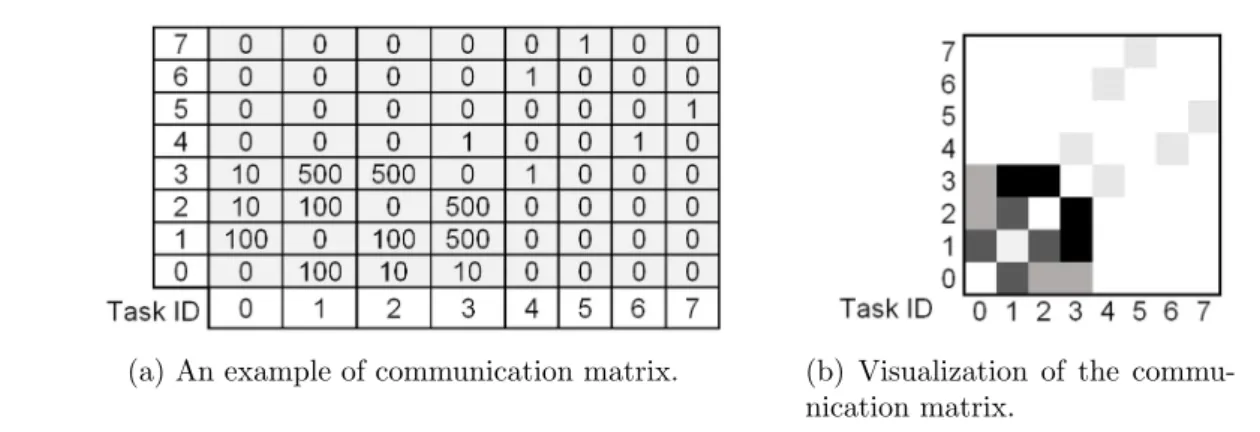
As discussed previously in Section 2.1, the spatial communication behavior is determined from the diversity of the amount of communication among tasks of the parallel application. To analyze this behavior, an undirected communication graph is built from the dataset of communication events, where nodes represent tasks and edges represent the amount of communication between each pair of tasks. The communication graph is represented as a matrix, which is called a communication matrix [2,23,26]. An example of the communica-tion matrix is shown in Figure 2.4(a). Each cell (x, y) of the matrix contains the data size of communication events between a pair of tasks x and y, which represents the amount of communication between the pair. Since the communication graph is undirected, the com-munication matrix is symmetric. In the comcom-munication behavior shown by the matrix, most communication events are performed by the neighboring tasks, which are tasks that have IDs close to each other, and tasks 0 to 3 have a larger amount of communication
(a) An example of the system with eight cores. (b) The Packed mapping. (c) The Scatter mapping. (d) The Balance mapping.
(e) The Locality mapping.
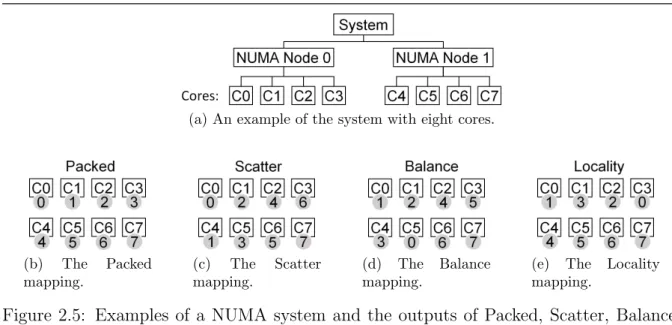
Figure 2.5: Examples of a NUMA system and the outputs of Packed, Scatter, Balance, and Locality mappings.
than the other processes.
To analyze the spatial communication behavior, the communication matrix is normal-ized to its maximum value to limit the range of values, such as between 0 and 1. By normalizing the matrix, two communication matrices from different applications can be compared to each other. Then, to visualize the communication behavior, the normal-ized matrix is represented as a heat map. Figure 2.4(b) shows the visualization of the previous communication matrix shown in Figure 2.4(a). In the visualization, the darker cells indicate larger amounts of communication. With the spatial communication behav-ior represented by the communication matrix, a locality-based task mapping method can improve the locality by mapping tasks that have larger amounts of communication to processor cores of the same NUMA node, while a balance-based mapping method can im-prove the balance of communication by distributing tasks that have substantial amounts of communication to different NUMA nodes.
To illustrate how a task mapping method uses the communication behavior to de-termine the mapping, Figure 2.5 depicts examples of a system with eight cores and the outputs of four mapping methods: Packed, Scatter, Balance and Locality. In the figure, the white boxes represent the processor cores, while the gray circles represent the tasks. Packed and Scatter do not consider the communication behavior, while Balance and
Lo-cality take into account the communication behavior represented by the communication matrix shown in Figure 2.4. Packed maps the neighboring tasks to the same NUMA node, while Scatter maps the neighboring tasks to different NUMA nodes. These two methods are available in some MPI runtime environments [43, 47] and OpenMP libraries [48]. In the related work [49], Scatter corresponded to the Socket-span mapping. In the case where neighboring tasks have a larger amount of communication than the other tasks, Packed will increase the locality of communication, while Scatter will reduce the communication load imbalance among the NUMA nodes. In contrast to these methods, Balance and Lo-cality use the communication matrix to determine the mapping. Balance maps the tasks that have the largest amount of communication to different NUMA nodes, while Locality maps the tasks that have the largest amount of communication to the same NUMA node. Among the communication events of a parallel application, only the concurrent com-munications will affect memory congestion. Thus, in this dissertation, the analysis of temporal communication behavior focuses on identifying the concurrent communications from the communication events. For the analysis purpose, a data clustering method is proposed to identify concurrent communications from a time series dataset of communi-cation events. The method is based on a weighted k-means clustering method [50] and uses the numbers of communication events as the weights for the clustering. The numbers of communication events are used as the weights because the concurrent communications are determined by the number of communication events that occur at times close to each other.
Given a set of timestamps of communication events {t1, t2, ..., tn} and a set of clusters
{C1, C2, ..., Ck}, the clustering method aims to minimize the objective function j defined
by Equation (2.1), where k is the number of clusters, µi is the mean of timestamps in a
cluster, and Ncommt is the number of communication events at timestamp t.
j = k X i=1 X t∈Ci Ncommtkt − µik2. (2.1)
(a) IS-MPI. (b) MG-MPI.
(c) EP-MPI. (d) LU-MPI.
Figure 2.6: Temporal communication behaviors of four NPB-MPI applications.
clusters. However, the actual number of clusters is generally unknown in advance, even though the parameter certainly affects the clustering results. This parameter affects the accuracy of detecting the concurrent communications. If the value of k is too small, two communication events may be falsely identified as concurrent communications. Thus, it is necessary to estimate an optimal number of clusters for the clustering. Moreover, the execution time of k-means increases with the number of communication events. Since the number of communication events in long-running parallel applications can be very large, reducing the execution time of the clustering process also becomes necessary. For these two reasons, the proposed method selects k by using the Bayesian information criterion (BIC) [51]. This criterion is used because it has been empirically used not only to find an optimal value of k but also to accelerate the clustering process for large datasets [52]. The method iteratively tests the k parameters, and the acceleration is achieved by reducing the search space of k and reusing statistics of previous iterations.
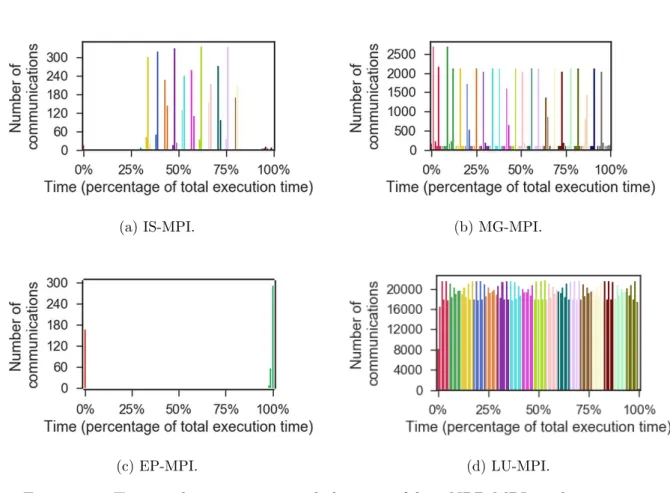
IS-MPI, MG-IS-MPI, EP-IS-MPI, and LU-MPI applications of the NAS Parallel Benchmarks (NPB-MPI) [53], with the class C input size. The x-axis and y-axis show the time elapsed during the execution, and the number of communication events, respectively. The figure shows that the number of communication events changes during the execution of each application. In IS-MPI, the communication events mostly occur in between 30% and 81% of the total execution time, while the communication events of MG-MPI and LU-MPI are distributed over the the execution time. In EP-MPI, the communications happen only at the beginning and the end of the execution. It is because EP-MPI is an embarrassingly parallel application, and the communications are only required for bcast and allreduce operations, which are executed at the beginning and the end of the execution.
The colors in Figure 2.6 show the clustering results of the four NPB applications, in which different colors represent different clusters. The figure shows that time periods are likely to be grouped in the same cluster when they are close to each other and have a large number of communication events. In IS-MPI, the clusters with the highest number of communication events are shown in the middle of the execution, while in MG-MPI, the clusters with the highest number of communication events are shown at the beginning of the execution. In EP-MPI, there are only two clusters, and the cluster shown at the end of the execution has the highest number of communication events. On the other hand, in LU-MPI, the number of communication events is distributed over all of the clusters. As also shown in the figure, a cluster can have a high number of communication events. If all the communication events of this cluster occur in the same NUMA node, the memory congestion will likely happen because all concurrent communications will access data from the same node. By using the information about concurrent communications, task mapping can reduce memory congestion by distributing different tasks that perform concurrent communications to processor cores of different NUMA nodes.
2.3.4
Communication Behaviors that Affect the Locality and
the Memory Congestion
As discussed in Section 2.1, performance and energy consumption improvements accord-ing to a specific task mappaccord-ing method depend on the communication behaviors of the target application. In this section, five metrics are proposed to describe the communica-tion behaviors that affect the locality of communicacommunica-tion and the memory congescommunica-tion. The first two metrics are communication load and communication-to-memory ratio. These two metrics are used to describe the communication behaviors that can benefit from communication-aware task mapping. Two other metrics are called communication concur-rency and DRAM-to-memory ratio. In conjunction with the previous metrics, these two metrics are proposed to describe the communication behaviors that can benefit from task mapping to reduce memory congestion. The last metric, called communication locality, is proposed to describe the communication behavior that can benefit from locality-based task mapping.
An improvement according to a specific communication-aware task mapping method depends on how much tasks are communicating. The improvement is expected to be higher for parallel applications, in which the total amount of transferred data is larger. The load of communication is described by using the Lcomm metric, which is defined as the total amount of communication by all tasks. Lcomm is calculated by
Lcomm = T X i=1 T X j=1 Scomm[i][j], (2.2)
where T is the total number of tasks and Scomm[i][j] is the amount of communication be-tween a pair of tasks i and j. The load of communication itself is not sufficient to evaluate if an application will gain performance benefit from communication-aware task mapping. If the number of non-communicating accesses is much higher than the number of commu-nicating accesses, a communication-aware task mapping method might not significantly affect the overall memory access behavior. For this reason, the communication-to-memory
ratio metric CommR is defined as the ratio of load of communication to the total size of memory accesses of the tasks. CommR is calculated by
CommR = Lcomm PT
i=1M emV [i]
, (2.3)
where M emV [i] is the size of data accessed by task i during the whole execution. The expected performance gains are higher for parallel applications that have higher values of Lcomm and CommR.
For communication-aware task mapping methods that aim to reduce the memory con-gestion, it is necessary to evaluate how the communication among tasks affects the memory congestion. Even if the load of communication is high, the task mapping method might not give a performance benefit if most of the communication events do not happen simul-taneously. In addition, the communication events may not access the memory controllers. If tasks access cache memory much more frequently than DRAM, a communication-aware task mapping method might not affect the congestion on memory controllers. In that case, the task mapping can affect the congestion on the shared caches. The communica-tion concurrency and DRAM-to-memory ratio metrics are defined to evaluate the impacts of communication behaviors on the shared caches and memory controllers.
Communication concurrency (CommC) is defined as the average number of tasks per cluster. It is calculated by CommC = PNc i=1T askN [Ci] T · Nc , (2.4)
where Nc is the total number of clusters, and T askN [Ci] is the number of tasks of the
communication events that belong to cluster Ci. These clusters are obtained from the
method described in Section 2.3.3.
accesses to the total number of memory accesses. DramR is calculated by
DramR = PT
i=1DramV [i]
PT
i=1M emV [i]
, (2.5)
where DramV [i] is the size of data in DRAM potentially accessed by task i. A communication-aware mapping method will have higher impacts on the memory congestion of parallel applications that have higher values of CommR, CommC and DramR.
For communication-aware task mapping methods that aim to improve the locality of communication, it is necessary to have a high variance in the amount of communication per task pair. It is necessary because the locality-based mapping focuses on mapping the tasks that have a larger amount of communication than the other tasks. The communication locality metric CommLoc is defined to describe the variance. A related work [21] is adopted to formulate this metric. First, the amount of communication of each task pair is normalized to the largest amount of communication among all task pairs. This normalization is shown by
Scommnorm[i][j] =
Scomm[i][j]
max(Scomm). (2.6)
Then, CommLoc is calculated by
CommLoc = PT
i=1var(Scommnorm[i][1..T ])
T , (2.7)
where max and var are the functions that calculate the maximum and variance, respec-tively. A locality-based task mapping method will gain higher performance improvements for parallel applications that have higher values of CommLoc.
In a parallel application that has a low or zero communication-to-memory ratio, task mapping can still affect the memory access behavior if the application performs a sub-stantial number of memory accesses. In this case, distributing the non-communicating memory accesses can reduce the memory congestion because it will improve the balance of memory accesses among the NUMA nodes. However, analyzing the communicating
memory accesses is necessary to reduce the amount of remote memory accesses and the memory congestion because of two reasons. First, as shown in related work [2, 13], the cost of communication remains a performance-limiting factor in modern NUMA systems. Second, in many parallel applications, improving the communication locality also signif-icantly affects the balance of memory accesses [26, 27], indicating that tasks with larger amounts of communication also perform substantial amount of memory accesses. In computation-intensive applications [54], where the ratio of memory accesses to computa-tion is low, task mapping cannot significantly affect performance because the impact of memory access latency on the execution time is negligible.
All the proposed metrics, except DramR and CommC, are application-dependent, which means that the value of each metric is affected by the communication behaviors of the application. For DramR and CommC, the value of the metric also depends on the system used for obtaining the metrics. The sizes of the processor caches will affect the number of DRAM accesses of an application. A smaller last-level cache may increase the number of DRAM accesses because the application needs to fetch more data from DRAM. As previously discussed in Chapter 1, a high number of processor cores can induce a large number of concurrent communications. Thus, the value of CommC will increase with the number of parallel tasks and the number of processor cores.
2.3.5
Static and Dynamic Communication Behaviors
For offline and online task mapping methods, it is necessary to evaluate if an application changes its communication behavior during the execution. The communication behavior is static if it does not change during the execution, while it is dynamic if it changes during the execution. If an application has a static communication behavior, offline mapping is sufficient to improve the performance of the application. Moreover, for a target NUMA system, an offline mapping method only needs to run profiling and analysis once, and the mapping result can be reused for different executions. Unlike offline mapping, online mapping incurs an overhead to every execution of the application from continuous
monitoring and repeated calculations of the mapping.
In the case of dynamic communication behavior, offline mapping can still give a perfor-mance benefit if the number of changes in the communication behavior is low. However, if an application frequently changes its communication behavior during the execution, offline mapping will not significantly impact the performance of the application because the static mapping is not sufficient to take into account the temporal changes of the com-munication behavior. Moreover, for different executions, an offline method may need to rerun the profiling and analysis steps to update the mapping. In contrast, online map-ping can give a higher performance benefit to the application by dynamically changing the mapping to adapt to changes in the communication behavior.
To describe the static and dynamic communication behaviors of an application, the communication dynamic metric CommDyn is defined as the number of changes of the communication behavior during the execution of the application. Given a set of time intervals {it1, it2, ..., itn}, CommDyn is calculated by
CommDyn =
Nit
X
i=1
compare(Mi, Mi+1), (2.8)
where Mi is the communication matrix of interval iti, Nit is the number of intervals,
and compare is the function that calculates the difference between two communication matrices of different intervals. The output of the function is 0 or 1. To calculate the difference, the function first generates a task sequence for each matrix by sorting the tasks of the matrix by their amount of communication. Then, it compares the two sequences of the two matrices. The function will return 1 if the two sequences are different. Otherwise, it will return 0. Parallel applications that have higher values of CommDyn are expected to gain a higher performance improvement from online mapping.
2.4
Evaluation
This section presents the experimental evaluation of DeLocProf. First, it presents the methodology of the evaluation. Then, it presents the communication behaviors of a set of parallel applications and characterizes the communication behaviors using the proposed metrics. The results of the metrics are also used to classify the applications based on the suitability of offline and online task mapping methods to improve the performance of the applications. Finally, the effectiveness of the proposed metrics is discussed by examining the performance results of the applications.
2.4.1
Evaluation Methodology
The experiments have been conducted on an Intel-based NUMA system, named Xeon56, that has two Intel Xeon E5-2680v4 processors. The system consists of two NUMA nodes, and is operated with Linux OS kernel v4.4. The NUMA nodes are connected with Quick-path Interconnect (QPI), and each node has 28 logical cores, 64 GB main memory, and an Integrated Memory Controller (IMC) [34]. Each NUMA node or processor has private L1 and L2 caches, and an L3 cache as last-level cache that is shared among all cores of the node. Thus, the system has 56 logical cores in total. The sizes of L1, L2, and L3 caches are 64 KB, 256 KB, and 35 MB, respectively.
The evaluation uses three sets of parallel benchmarks as workloads: the MPI and OpenMP implementations of the NPB [53] v3.3.1, and the PARSEC benchmark suite [55] v2.1. The PARSEC benchmarks consist of parallel applications based on OpenMP and Pthreads implementations. All the NPB applications are executed with the class C input size, while PARSEC applications are executed with the native input size, which is the largest size available. The applications of PARSEC and the OpenMP implementation of NPB OMP) are executed with 56 threads. For the MPI implementation (NPB-MPI), the number of processes executing the CG-MPI, FT-MPI, IS-MPI, and MG-MPI must be the power of two. Thus, 32 processes are launched for executing these four applications. The number of processes of BT-MPI and SP-MPI is required to be a square,
and thus 49 processes are launched for executing BT-MPI and SP-MPI. EP-MPI and LU-MPI are executed with 56 processes using all the cores. For the NPB-LU-MPI applications, Open MPI v3.1.4 [43] is used as the MPI implementation.
To analyze the communication behaviors, each application is preliminarily executed using the Scatter mapping, which is also the default mapping of the runtime system. This mapping is used because it does not consider the communication behaviors of the appli-cation, and thus, it does not require any information about the communication behaviors prior to the execution. This mapping is also used as the baseline for the performance eval-uation. To detect the communications in the multithreaded applications, the timestamp of a communication event is traced in ns and µs time resolutions. The µs time resolution is only used for the NPB-OMP due to the tracing time constraints. However, the results of analysis of the communication behaviors of the NPB-OMP applications show that the method can still effectively analyze the communication behaviors of the NPB-OMP applications using µs time resolution. These results are presented in Section 2.4.2.
To discuss the effectiveness of the proposed metrics, this evaluation compares the per-formance results of four mapping methods and discusses the results with the metrics. The mapping methods used for the evaluation are Random, Scatter, Balance and Lo-cality. Both Scatter and Random do not consider the communication behaviors of the application. In Random, the task mapping is randomly generated for each execution, and this mapping is used to evaluate the importance of task mapping. In contrast to Scatter and Random, both Balance and Locality consider the spatial communication behavior of the application. The differences among Scatter, Balance and Locality are shown in Fig-ure 2.5. An existing method, called TreeMatch [12], is used to calculate the mapping for Locality. Balance and Locality use the communication matrix to calculate the mapping, and the matrix is obtained by using the method described in Section 2.3.3.
(a) Lcomm. (b) CommC. (c) CommR.
(d) DramR. (e) CommLoc. (f) CommDyn.
Figure 2.7: Communication behaviors of NPB-MPI described with the metrics.
2.4.2
Communication Behaviors of the Benchmarks
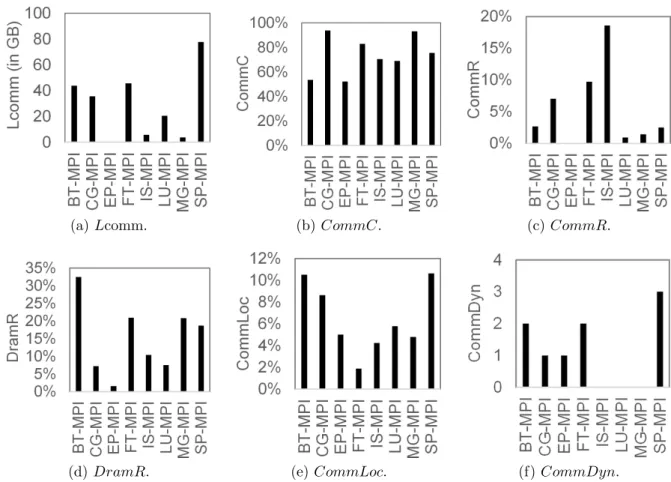
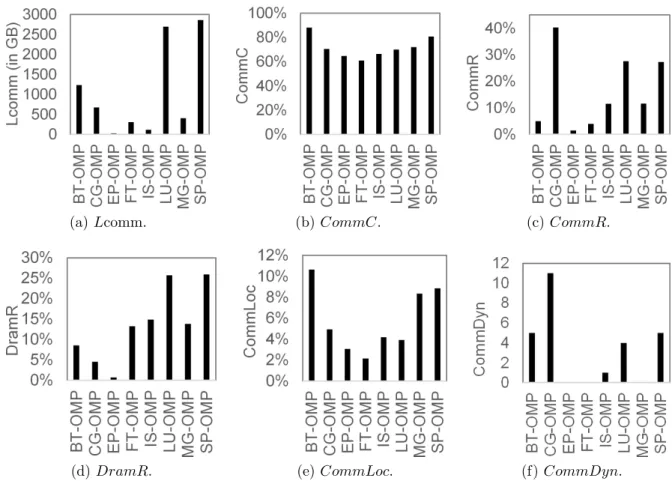
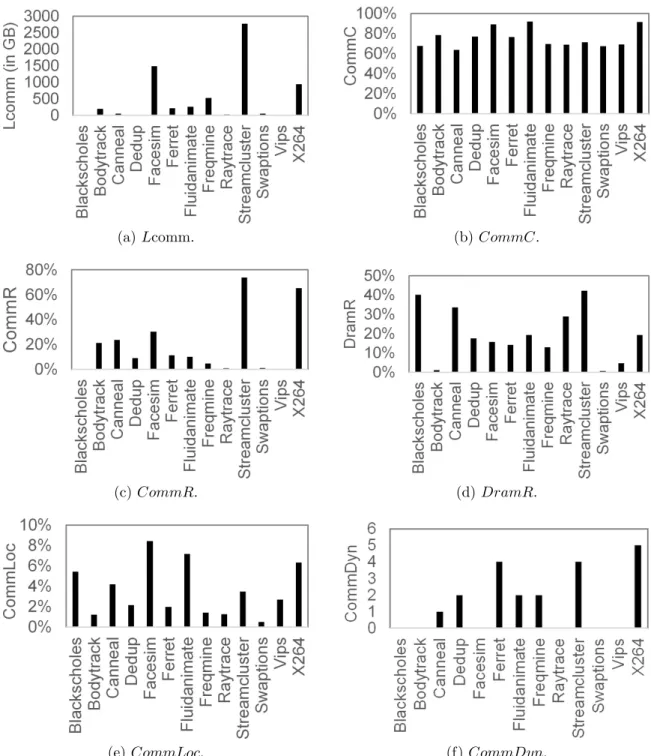
In this subsection, the communication behaviors of the benchmarks are analyzed using the metrics introduced in Section 2.3.4. All the metrics, except DRAM-to-memory ratio, are obtained using techniques described in Section 2.3.3. The DRAM-to-memory ratio is obtained by measuring performance counters with Linux perf tool [56]. To obtain the communication dynamic metric, the communication matrix is obtained for every 1-second interval. Figures 2.7, 2.8, and 2.9 show the values of the metrics for the MPI, NPB-OMP, and PARSEC applications, respectively. The vertical axis of each figure represents the values of the metric shown by the figure. The values of CommC, CommR, DramR and CommLoc are shown in percentages, and the values Lcomm are shown in gigabyte.
EP-MPI has a low communication load (Figure 2.7(a)) and communication-to-memory ratio (Figure 2.7(c)), indicating that it cannot gain improvement from communication-aware task mapping. CG-MPI, FT-MPI, IS-MPI, MG-MPI, and SP-MPI have higher
communication concurrency (Figure 2.7(b)) and DRAM-to-memory ratio (Figure 2.7(d)) compared with the other applications. These results indicate that they can gain a higher performance improvement from a task mapping method that reduces memory congestion than that from the other applications. In BT-MPI, CG-MPI, LU-MPI, and SP-MPI, the communication locality is higher than that of the other applications (Figure 2.7(e)). However, LU-MPI has low communication-to-memory ratio and DRAM-to-memory ratio, indicating that it cannot gain significant performance improvement from communication-aware task mapping. On the other hand, BT-MPI, CG-MPI, and SP-MPI can gain a higher performance improvement from locality-based mapping compared with the other applications. Most of the NPB-MPI applications have dynamic communication behaviors (Figure 2.7(f)), indicating that most of the applications can gain a higher performance improvement from online task mapping. The results in Figure 2.7 indicate that all NPB-MPI applications, except EP-NPB-MPI and LU-NPB-MPI, are expected to benefit from the task mapping method that focuses on reducing memory congestion.
For NPB-OMP applications, the results of communication-to-memory (Figure 2.8(c)) and communication locality (Figure 2.8(e)) indicate that all the applications, except EP-OMP and EP-OMP, can benefit from locality-based mapping. In EP-EP-OMP and FT-OMP, the load of communication (Figure 2.8(a)) and communication-to-memory ratio are low, indicating that these two applications cannot gain performance improvement from communication-aware task mapping. The results of communication concurrency (Figure 2.8(b)), communication-to-memory ratio and DRAM-to-memory ratio (Figure 2.8(d)) show that all NPB-OMP applications, except EP-OMP and FT-OMP, have a high risk of memory congestion. In CG-OMP, although the DRAM-to-memory ratio is low, the communication-to-memory ratio is the highest among the NPB-OMP applications. It means that CG-OMP has much more memory accesses to cache memory than that to DRAM, and it can benefit from task mapping to reduce the congestion of memory access to the shared caches. The results of communication dynamic (Figure 2.8(f)) show that most of the applications can benefit from online task mapping. The results in Figure 2.8 suggest that all NPB-OMP applications, except EP-OMP and FT-OMP, are expected
(a) Lcomm. (b) CommC. (c) CommR.
(d) DramR. (e) CommLoc. (f) CommDyn.
Figure 2.8: Communication behaviors of NPB-OMP described with the metrics.
to benefit from task mapping that reduces the number of remote accesses and memory congestion.
Although most PARSEC applications have a high communication concurrency (Fig-ure 2.9(b)), some applications have a low communication-to-memory ratio (Fig(Fig-ure 2.9(c)). It means that not all PARSEC applications will benefit from communication-aware task mapping. Most of the applications have dynamic communication behaviors (Figure 2.9(f)), indicating that these applications will also benefit from online task mapping. In Blacksc-holes, Swaptions and Vips, the load of communication (Figure 2.9(a)) and communica-tion-to-memory ratio are negligible, indicating that these three applications cannot gain performance improvement from communication-aware task mapping. In Freqmine, al-though the communication load is higher than those of other PARSEC applications, the communication-to-memory ratio is low. It means that Freqmine cannot gain significant improvement from communication-aware task mapping. Although Canneal, Dedup,
Fer-(a) Lcomm. (b) CommC.
(c) CommR. (d) DramR.
(e) CommLoc. (f) CommDyn.
ret and Fluidanimate have a lower communication load compared with Freqmine, these four applications have higher communication-to-memory ratio and DRAM-to-memory ratio (Figure 2.9(d)). Thus, Canneal, Dedup, Ferret and Fluidanimate can still gain performance improvements from memory-congestion aware task mapping.
In Bodytrack, the DRAM-to-memory ratio is low. However, it has a higher com-munication-to-memory ratio compared with most of the other applications. It means that Bodytrack has much more memory accesses to cache memory than those to DRAM, and thus it can benefit from the proposed method to reduce the congestion of memory access to the shared caches. In contrast to Bodytrack, Raytrace has a higher DRAM-to-memory ratio than most of the PARSEC applications, which means that it can benefit from the proposed method to reduce the congestion on memory controllers. On the other hand, Facesim, Streamcluster and X264 have higher loads of communication, communica-tion concurrency, communicacommunica-tion-to-memory ratio and DRAM-to-memory ratio compared with most of the other applications, indicating that these three applications will gain sig-nificant performance improvements from a task mapping method that reduces memory congestion. In Facesim, the communication locality (Figure 2.9(e)) is the highest among the PARSEC applications, indicating that it will gain a higher performance improvement from locality-based mapping compared with the other applications. The results in Figure 2.9 indicate that all PARSEC applications, except Blackscholes, Freqmine, Swaptions, and Vips, are expected to benefit from the proposed method.
2.4.3
Classification of the Applications
In this subsection, the benchmarks are classified using the benchmarking results presented in Section 2.4.2, which are measured on the Xeon56 system. Three classes are used for the classification: Non-mapping, Static, and Dynamic. Non-mapping is a class for applications that cannot benefit from task mapping to improve performance, while Static and Dynamic are classes for applications that have static and dynamic communication behaviors, respectively. Figure 2.10 shows the decision tree that is used to classify a
Figure 2.10: The decision tree for classifying a parallel application.
Figure 2.11: Classification results of the NPB.
parallel application. The decision tree uses CommR, DramR, and CommDyn metrics to classify the application.
First, the decision tree determines whether the application belongs to the Non-mapping class by evaluating the values of CommR and DramR metrics. As discussed in Sec-tion 2.3.4, a parallel applicaSec-tion that has a low communicaSec-tion-to-memory ratio cannot gain a significant performance improvement from communication-aware task mapping. However, if the application has a high DRAM-to-memory ratio, task mapping can still give a performance benefit by reducing the congestion on the memory controllers. Since the DramR metric is system-dependent, the results of Non-mapping class may be different for different target systems. Then, if the application can benefit from task mapping, the decision tree determines if the application has static or dynamic communication behaviors by evaluating the value of CommDyn. As previously described in Section 2.3.5, offline
Figure 2.12: Classification results of the PARSEC.
and online task mappings are suitable for improving the performance of applications that belong to Static and Dynamic classes, respectively.
Figures 2.11 and 2.12 show the classification results for the NPB and PARSEC appli-cations. The y-axis represents the value of the CommDyn metric for each application, which also represents the number of changes in the communication behavior during the ex-ecution of the application. Most of the NPB applications are classified as Dynamic, which means that most of the applications will gain a higher performance improvement from online task mapping than that from offline mapping. MG-OMP, IS-MPI, and MG-MPI belong to the Static class, suggesting that offline task mapping is suitable for improving the performance of these particular applications. The other NPB applications are classi-fied as Non-mapping, indicating task mapping cannot improve the performance of these applications.
Most of the PARSEC applications are classified as Non-mapping and Static. As also described in Section 2.4.2, Blackscholes, Freqmines, Swaptions, and Vips cannot gain a performance improvement from task mapping. Thus, these four applications are classified as Non-mapping. Bodytrack, Facesim, and Raytrace are classified as Static, indicating that these three applications will gain a higher performance improvement from offline mapping than that from online mapping. The other six applications are classified as Dynamic, suggesting that online task mapping will give a higher performance benefit to these applications. The classification results show that both offline and online methods are
Figure 2.13: Performance results of NPB-MPI with the four mapping methods.
important in increasing performance, and the proposed metrics can be used to evaluate if a particular application can gain a performance benefit from these mapping methods.
2.4.4
Performance Results
Figures 2.13 and 2.14 show the performance results on the Xeon56 system. The per-formance results are obtained by measuring the execution time of the applications with each mapping method. The results are the averages obtained from 10 sample executions, which are normalized to the results of Scatter mapping. The figure also shows the 95% confidence interval calculated with Student’s t-distribution [57]. The error line of the bar represents the confidence intervals of the samples.
Figure 2.13 depicts the execution time of the NPB-MPI applications. The results of Random mapping show higher margin of errors in most of the applications, indicating that most of the applications are affected by the task mapping. As predicted by the anal-ysis of the communication behaviors of the NPB-MPI applications, Scatter and Balance can achieve a higher improvement than Locality for all NPB-MPI applications, except EP-MPI and LU-MPI. Compared with Locality, Balance gains the highest performance improvements for FT-MPI and MG-MPI by 33% and 57%, respectively.
In BT-MPI, CG-MPI and SP-MPI, the difference in execution times between Locality and Balance is smaller than that among FT-MPI, IS-MPI and FT-MPI because BT-MPI, CG-MPI and SP-MPI have the highest communication locality among the NPB-MPI applications (Figure 2.7(e)). However, in most of the NPB-MPI applications, Balance
Figure 2.14: Performance results of NPB-OMP with the four mapping methods.
and Scatter outperform Locality, indicating that locality-based mapping cannot achieve the best performance of the applications. These results suggest that in the Xeon56 system, the impact of the memory congestion on the performance of the NPB-MPI applications is higher than that of the locality. Moreover, in the case when the number of tasks is less than the number of processor cores available, Locality can map more tasks to one NUMA node to reduce the number of remote accesses. Since the number of concurrent communications on one NUMA node becomes higher, the memory congestion increases on that particular node.
For NPB-OMP applications, task mapping also affects most of the applications. How-ever, as shown in Figure 2.14, Scatter shows the lowest performance among the methods in most of the NPB-OMP applications, which is contrast to the results of NPB-MPI applications. As expected by previous analysis, Locality can achieve a higher average im-provement than Balance and Scatter. These results indicate that most of the NPB-OMP applications gain more benefit from locality-based mapping. As also predicted by the pre-vious analysis of the communication behaviors of NPB-OMP applications, Balance can improve the performance of BT-MP, LU-MP, MG-OMP and SP-OMP. As shown in the results of communication concurrency, communication-to-memory ratio and DRAM-to-memory ratio, these four applications have the highest risk of DRAM-to-memory congestion among the NPB-OMP applications. By reducing the communication load imbalance, Balance also reduces memory congestion in these four applications.